

Secrets of the Biblical Creation Story
GA 122
18 August 1910, Munich
Translate the original German text into any language:
Versions Available:
Secrets of the Biblical Creation Story, tr. SOL
Dritter Vortrag
Third Lecture
[ 1 ] Bei mancherlei von dem, was in diesem Vortragszyklus gesagt werden muß und was überhaupt im Verlaufe unserer anthroposophischen Unterredungen zur Sprache kommt, könnte es scheinen, namentlich der Außenwelt, die noch wenig bekannt ist mit den Empfindungen, die in unseren Kreisen herrschen, als ob es mir eine gewisse Befriedigung und Freude machte, wenn ich gedrängt bin, dieses oder jenes scheinbar im Gegensatz zu der modernen Wissenschaft zu sagen. Ich möchte wirklich gerade in diesem Punkt nicht gern mißverstanden sein. Sie dürfen alle überzeugt davon sein, daß es mich stets eine harte Überwindung kostet, mich in Gegensatz zu stellen zu dem, was man heute wissenschaftliche Behauptung nennt, und daß ich es an keinem anderen Punkte jemals tun würde als da, wo es mir genau möglich ist, selbst das wirklich zu entwickeln, was Wissenschaft heute zu sagen hat in bezug auf das jeweilig in Rede Stehende. Ich fühle das Verantwortlichkeitsgefühl, nichts vorzubringen im Gegensatz zur modernen Wissenschaft, wo es mir nicht auch möglich wäre, überall anzuführen, was diese moderne Wissenschaft in dem betreffenden Punkte zu sagen hat. Und man kann sich, wenn man von diesem Gesichtspunkte ausgeht, solch wichtigen Kapiteln wie das, was wir in diesen Tagen zu besprechen haben, nur nähern, wenn man es tut mit einer gewissen heiligen Scheu und eben mit einem entsprechenden Verantwortlichkeitsgefühl.
[ 1 ] In regard to some of what must be said in this series of lectures and what comes up in the course of our anthroposophical discussions, it might seem especially to the outside world, which is still largely unfamiliar with the sentiments prevailing in our circles, as though I derive a certain satisfaction and pleasure from being compelled to say this or that which appears to be in contrast to modern science. I really do not wish to be misunderstood on this very point. You may all be convinced that it always takes a great effort on my part to take a stand in opposition to what is today called a scientific assertion, and that I would never do so on any other point than where it is precisely possible for me to develop for myself what science has to say today regarding the matter at hand. I feel a sense of responsibility not to put forward anything in opposition to modern science unless I am also able to cite, in every instance, what modern science has to say on the matter in question. And if one proceeds from this point of view, one can approach such important chapters as the one we are discussing these days only with a certain sacred reverence and precisely with a corresponding sense of responsibility.
[ 2 ] Es muß ja leider gesagt werden, daß in bezug auf Fragen, die dabei berücksichtigt werden müssen, moderne Wissenschaft ganz und gar versagen muß, daß moderne Wissenschafter nicht einmal in der Lage sind, zu wissen, warum ihre Ausgangspunkte versagen müssen, daß sie nicht in der Lage sind einzusehen, warum den wirklichen, großen Fragen des Lebens und des Daseins gegenüber gerade moderne Wissenschaft so intensiv dilettantisch sein muß, wie nur irgend möglich ist. Also ich bitte Sie recht sehr, das, was gesagt wird, immer so aufzunehmen, daß im Hintergrunde ein volles Bewußtsein von alledem steht, was in dem betreffenden Punkte moderne Wissenschaft zu sagen hätte. Nur kann natürlich in einer kurzen Vortragsreihe nicht verlangt werden, daß etwa polemisch in den Einzelheiten alles berücksichtigt werde, was zur Widerlegung dieser oder jener modernen Anschauung über den betreffenden Punkt zu sagen wäre. Ich muß mich so viel als irgend möglich auf das Positive beschränken und darauf vertrauen, daß in einem Kreise von Anthroposophen die Voraussetzung, die ich eben gemacht habe, wirklich auch in allen Einzelheiten gemacht wird.
[ 2 ] It must unfortunately be said that, with regard to the questions that must be taken into account here, modern science is bound to fail completely; that modern scientists are not even capable of knowing why their starting points are bound to fail; that they are unable to see why, when faced with the real, great questions of life and existence, modern science in particular must be as intensely amateurish as is humanly possible. So I ask you very much to always take what is said with a full awareness in the background of everything modern science would have to say on the point in question. Of course, in a short series of lectures, one cannot expect that every detail—especially in a polemical sense—be taken into account regarding what might be said to refute this or that modern view on the matter. I must limit myself as much as possible to the positive and trust that, within a circle of anthroposophists, the assumption I have just made is indeed also made in every detail.
[ 3 ] Ich versuchte Ihnen gestern zu zeigen, wie jene urgewaltigen Worte, die am Ausgangspunkte der Bibel stehen und die uns in einer Sprache vorliegen, die ganz anderer Natur ist als die modernen Sprachen, wie diese urgewaltigen Worte nur dann richtig gedeutet werden können, wenn wir versuchen, alles das zu vergessen, was in unseren Empfindungen, in unseren Gefühlen auflebt bei den gebräuchlichen Übersetzungen und Übertragungen dieser Worte in moderne Sprache. Denn die Sprache, in der ursprünglich diese urgewaltigen Schöpfungsworte uns gegeben sind, hat wirklich die Eigentümlichkeit, daß sie durch den Charakter ihrer Laute Herz und Sinn hinlenkt zu den Bildern, die vor dem Seherauge auftauchen, wenn es sich hinrichtet auf den Punkt, wo aus dem Übersinnlichen das Sinnliche unserer Welt hervorquillt. Und es liegt eine Gewalt und eine Kraft in allen einzelnen Lauten, in denen, wenn wir so sagen dürfen, der Urbeginn unseres Erdendaseins vor uns hingestellt wird. Wir werden noch öfter im Verlaufe dieser Vorträge gerade auf den Charakter dieser Sprache hinzuweisen haben. Heute aber möchte ich auf einiges für uns zunächst notwendige Sachliche eingehen.
[ 3 ] Yesterday I tried to show you how those primal, powerful words that stand at the very beginning of the Bible—and which are presented to us in a language of a completely different nature than modern languages—how these primal, powerful words can only be properly interpreted if we try to to forget everything that stirs in our sensibilities and emotions when we encounter the common translations and renderings of these words into modern language. For the language in which these primal words of creation were originally given to us truly has the peculiarity that, through the character of its sounds, it directs the heart and mind toward the images that arise before the seer’s eye when it is directed toward the point where the sensible world springs forth from the supersensible. And there is a power and a force in every single sound, in which, if we may say so, the very beginning of our earthly existence is set before us. We will have to refer specifically to the character of this language more often in the course of these lectures. Today, however, I would like to address some practical matters that are necessary for us at this stage.
[ 4 ] Sie wissen ja, daß in der Bibel nach den Worten, die ich gestern versuchte ein wenig im Bilde vor Ihre Seele hinzumalen, Eigenschaften von dem einen Komplex stehen, der da auftauchte aus dem göttlichen Sinnen, aus dem produktiven Sinnen heraus. Ich sagte Ihnen, daß wir uns vorzustellen haben, daß wie aus einer kosmischen Erinnerung heraus zwei Komplexe auftauchten. Der eine war ein Komplex, der sich etwa vergleichen läßt mit dem Vorstellungscharakter, der in uns auftauchen kann, der andere war ein Komplex, der mit einem Begierden- oder Willenscharakter verglichen werden kann. Der eine enthält alles das, was sich nach außen offenbaren, ankündigen will, gleichsam nach außen hin kraften will, haschamajim. Der andere Komplex, ha’arez, enthält das innerlich Regsame, das innerlich von Begehren Durchdrungene, das innerlich Belebende, sich Regende. Von diesem innerlich Belebenden, sich Regenden werden uns dann Eigenschaften angeführt, und diese Eigenschaften werden in der Bibel angedeutet mit charakteristischen Lautcharakteren. Es wird uns gesagt, daß dieses sich innerlich Regende in einem Zustand war, der bezeichnet wird als tohu wabohu, was in der deutschen Sprache gewöhnlich ja wiedergegeben wird mit «wüste und wirr». Verstehen aber können wir es nur dann, wenn wir uns wiederum genau den bildhaften Charakter dessen vor Augen malen, was eigentlich mit dem tohu wabohu gemeint ist. Und wir kommen nur darauf, was gemeint ist, wenn wir aus unserer geisteswissenschaftlichen Erkenntnis heraus uns vergegenwärtigen, was da eigentlich, sagen wir, im Raume durcheinanderwogte, als alles das, was früher durchschritten. hatte das Saturn-, Sonnen- und Mondendasein, als das Erdendasein, als planetarischer Erdenzustand wieder auftauchte.
[ 4 ] As you know, in the Bible—following the words I tried to sketch out for you yesterday—there are descriptions of the characteristics of the one complex that emerged from divine thought, from creative thought. I told you that we must imagine that two complexes emerged, as it were, from a cosmic memory. One was a complex that can be roughly compared to the imaginative character that can arise within us; the other was a complex that can be compared to a character of desire or will. One contains everything that seeks to reveal itself outwardly, to make itself known, to exert itself outwardly, so to speak, hashamayim. The other complex, ha’arez, contains that which is inwardly active, that which is inwardly permeated by desire, that which is inwardly enlivening and stirring. From this inner animating, stirring force, certain qualities are then described to us, and these qualities are indicated in the Bible by characteristic phonetic symbols. We are told that this inner stirring force was in a state described as tohu wabohu, which in English is usually rendered as “formless and void.” But we can only understand it if we, in turn, vividly picture the pictorial character of what is actually meant by tohu wabohu. And we can only grasp what is meant if, drawing on our spiritual scientific insight, we visualize what was actually, so to speak, surging chaotically through space when everything that had previously passed through the Saturn, Sun, and Moon stages of existence reemerged as the Earth stage, as the planetary Earth state.
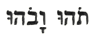
[ 5 ] Ich machte Sie gestern darauf aufmerksam, daß das, was wir den festen Zustand nennen, also was einen Widerstand auf unsere Sinne ausübt, während des Saturn-, Sonnen- und Mondenzustandes noch nicht vorhanden war, daß da nur das Element des Feurigen oder der Wärme, das Element des Gasigen oder Luftförmigen und das Element des Wässerigen vorhanden war. Und im Grunde genommen fügt sich erst mit dem Aufgehen des planetarischen Erdenzustandes das Feste zu den früheren elementarischen Zuständen hinzu. Also in jenem Moment, wo das ins Dasein trat, was wir gestern charakterisiert haben, wo auch sozusagen die Tendenz auftritt, daß sich das Sonnenhafte von dem Erdhaften abspaltet, da haben wir, wenn wir das elementarische Weben ins Auge fassen, es mit einem sich gegenseitig Durchdringen der Elemente Wärme, Luft und Wasser zu tun. Das wogte und webte durcheinander. Wie das zunächst durcheinanderwogte und -webte, wie wir es uns vorzustellen haben, wenn wir es uns vor den geistigen Sinn hinmalen, das deuten uns diese Worte an, die im Deutschen etwa wiedergegeben werden mit «wüste und wirt», aber natürlich nur in ganz ungenauer Weise, und die prägnant bezeichnet werden durch das, was die Lautzusammenfügung ist tohu wabohu. Denn was bedeutet dieses tohu wabohu? Wenn wir uns bildhaft vor die Seele führen, was in der Seele angeregt werden kann durch diese Laute, dann ist es etwa das Folgende.
[ 5 ] Yesterday I pointed out to you that what we call the solid state—that is, what exerts resistance upon our senses—did not yet exist during the Saturn, Sun, and Moon states, but that only the element of fire or heat, the element of gas or air, and the element of water were present. And, essentially, it is only with the dawn of the planetary Earth state that the solid is added to the earlier elemental states. So at that moment when what we characterized yesterday came into being, when, so to speak, the tendency arises for the solar to separate from the earthly, then, if we consider the elemental interweaving, we are dealing with a mutual interpenetration of the elements of heat, air, and water. This undulated and interwove in confusion. How this initially surged and wove together in confusion—how we must imagine it when we picture it in our spiritual mind—is indicated to us by these words, which in German are roughly rendered as “wüste und wirt,” though of course only in a very imprecise way, and which are succinctly designated by the sound combination tohu wabohu. For what does this tohu wabohu mean? If we vividly bring before our soul what these sounds can stir within the soul, then it is something like the following.
[ 6 ] Der Laut, der da unserem T sich vergleichen läßt, der regt an ein Bild des Auseinanderkraftens von einem Mittelpunkt nach allen Seiten des Raumes, nach allen Richtungen des Raumes. Also in dem Augenblick, wo man den T-Laut anschlägt, wird angeregt das Bild von einem aus dem Mittelpunkt nach allen Richtungen des Raumes Auseinanderkraften, ins Unbegrenzte hin Auseinanderkraften. So daß wir uns also vorzustellen haben das Ineinandergewobensein der Elemente Wärme, Luft und Wasser und da drinnen ein Auseinanderkraften wie von einem Mittelpunkt aus nach allen Seiten, und wir würden dieses Auseinanderkraften haben, wenn nur der erste Teil des Lautgefüges da wäre, tohu. Der zweite Teil, was soll er ergeben? Er ergibt nun genau das Entgegengesetzte von dem, was ich eben gesagt habe. Der regt an durch seinen Lautcharakter — durch alles das, was wach wird in der Seele bei dem Buchstaben, der sich mit unserem B vergleichen läßt, Bet —, der regt an alles das, was Sie im Bilde bekommen, wenn Sie sich eine mächtig große Kugel, eine Hohlkugel denken, sich selbst im Inneren vorstellen und nun von allen Punkten, von allen inneren Punkten dieser Hohlkugel wiederum Strahlen nach innen sich denken, nach dem Mittelpunkt hereinstrahlend. Also Sie denken sich dieses Bild, einen Punkt inmitten des Raumes, von da aus Kräfte nach allen Richtungen des Raumes ausstrahlend, tohu; diese Strahlen sich gleichsam an einem äußeren Kugelgehäuse verfangend, zurückstrahlend in sich selber, von allen Richtungen des Raumes wieder zurück, dann haben Sie das bohu. Dann, wenn Sie sich diese Vorstellung machen und sich all die Kraftstrahlen erfüllt denken von dem, was gegeben ist in den drei elementarischen "Wesenheiten Wärme, Luft und Wasser, wenn Sie sich diese Kraftstrahlen denken, wie sie sich gleichsam in diesen drei durcheinanderwogenden Elementen bilden, dann haben Sie die Charakteristik dessen, was das innerlich Regsame ist. So also wird uns durch diese Lautzusammenstellung die Art angedeutet, wie das elementarische Dasein dirigiert wird durch die Elohim.
[ 6 ] The sound that can be compared to our “T” evokes an image of a force radiating outward from a central point in all directions of space, in every direction of space. Thus, the moment the T sound is uttered, the image of a force radiating outward from a central point in all directions of space—radiating outward into the infinite—is evoked. So that we must imagine the interweaving of the elements heat, air, and water, and within that a radiating force as if from a center to all sides, and we would have this radiating force if only the first part of the sound structure were present, tohu. The second part—what is it to yield? It yields precisely the opposite of what I have just said. It stimulates, through its sound character—through everything that awakens in the soul at the letter that can be compared to our B— Bet—it stimulates everything you picture when you imagine a mighty great sphere, a hollow sphere, picture yourself inside it, and now imagine rays radiating inward from all points, from all inner points of this hollow sphere, radiating toward the center. So you imagine this picture: a point in the midst of space, from which forces radiate in all directions of space—tohu; these rays, as it were, catching on an outer spherical shell, reflecting back into themselves, returning from all directions of space—then you have the bohu. Then, when you form this image and imagine all the rays of force filled with what is given in the three elemental “beings”—heat, air, and water—when you imagine these rays of force as they form, as it were, within these three intermingling elements, then you have the characteristic of what is the inner movement. Thus, through this combination of sounds, the manner in which elemental existence is directed by the Elohim is indicated to us.
[ 7 ] Was ist denn aber mit dem Ganzen jetzt überhaupt gesagt? Wir werden nicht den ganzen großartigen dramatischen Vorgang der sieben Schöpfungstage verstehen, wenn wir uns diese Einzelheiten nicht vor die Seele führen. Führen wir sie uns vor die Seele, dann wird uns das Ganze als ein wunderbares, gewaltiges kosmisches Drama erscheinen. Was soll eigentlich gesagt werden? Da erinnern wir uns noch einmal daran, daß wir es in all dem, was zum Beispiel durch das Zeitwort bara gemeint ist — in den Urbeginnen «schufen» die Götter —, mit einer seelisch-geistigen Tätigkeit zu tun haben. Ich verglich das gestern damit, daß innerhalb der Seele Vorstellungskomplexe heraufgerufen werden. So denken wir uns in den Raum hineingelagert die Elohim, und wir denken uns das, was angedeutet ist mit «schuf», bara, als eine kosmisch-seelische Tätigkeit eines Ersinnens. Was sie ersinnen, das ist dann angegeben mit haschamajim und ha’arez, das nach außen Strahlende und das innerlich Regsame. Aber jetzt wird auf etwas anderes Bedeutsames hingewiesen. Versetzen Sie sich, damit Sie einen möglichst guten Vergleich haben, in den Zustand des Aufwachens. Es dringen in Ihre Seele herauf Vorstellungskomplexe. So dringen in der Seele der Elohim herauf haschamajim und ha’arez.
[ 7 ] But what has actually been said about all this so far? We will not understand the entire magnificent, dramatic process of the seven days of creation unless we bring these details to mind. If we do so, the whole thing will appear to us as a wondrous, mighty cosmic drama. What is actually being said? Let us recall once more that in all that is meant, for example, by the verb *bara*—in the very beginnings the gods “created”—we are dealing with a soul-spiritual activity. Yesterday I compared this to the evocation of complexes of ideas within the soul. So we imagine the Elohim embedded within space, and we conceive of what is indicated by “created,” bara, as a cosmic-soul activity of conception. What they conceive is then indicated by haschamajim and ha’arez, that which radiates outward and that which is inwardly active. But now something else significant is pointed out. To have the best possible comparison, imagine yourself in the state of waking up. Complexes of imagination rise up into your soul. In the same way, haschamajim and ha’arez rise up in the soul of the Elohim.
[ 8 ] Nun wissen wir aber, das haben wir ja schon gestern hervorgehoben, daß diese Elohim herüberkamen in ihrer eigenen Entwickelung von dem Saturn-, Sonnen- und Mondenzustand. So war das, was sie ersannen, wirklich in einer ähnlichen Lage wie Ihre Vorstellungskomplexe, wenn Sie aufwachen und sie in Ihre Seele heraufrufen. Dann können Sie sie gleichsam seelisch-geistig anschauen, Sie können sagen, wie sie sind. Sie können sagen: Wenn ich am Morgen aufwache und wiederfinde, was früher in meiner Seele sich gelagert hat und was ich mir heraufrufe, dann kann ich beschreiben, wie es ist. — So konnte für die Elohim beschrieben werden, was sich jetzt ergab, nachdem sie etwa, wenn ich es sehr grob ausdrücken würde, sich sagten: Wir wollen jetzt einmal ersinnen, was in unsere Seele tritt, wenn wir uns alles das zurückrufen, was während des alten Saturn-, Sonnen- und Mondenzustandes sich zugetragen hat. Wir wollen sehen, wie das in der Erinnerung sich ausnimmt. — Und es nahm sich so aus, daß es bezeichnet wird mit den Worten tohu wabohu, daß es bezeichnet werden konnte durch ein Bild, wie ich es eben jetzt schilderte mit den Strahlen, die von einem Mittelpunkt ausgehen in den Raum hinaus und wieder zurück, so daß die Elemente in diesen Kraftstrahlen ineinanderwogen. Also konnten die Elohim etwa sagen: So also nimmt es sich aus, nachdem wir es bis zu diesem Punkt geführt haben. So hat es sich wieder hergestellt.
[ 8 ] But as we already pointed out yesterday, we know that these Elohim came over in the course of their own evolution from the Saturn, Sun, and Moon states. Thus, what they conceived was truly in a similar situation to the complexes of your imagination when you wake up and summon them into your soul. Then you can, as it were, view them soul-spiritually; you can describe what they are like. You can say: When I wake up in the morning and rediscover what has previously settled in my soul and what I call up, then I can describe what it is like. — Thus could be described to the Elohim what now arose, after they had, so to speak—if I were to put it very roughly—said to themselves: Let us now conceive what enters our soul when we recall all that took place during the old Saturn, Sun, and Moon states. Let us see how this appears in memory. — And it appeared in such a way that it is described by the words tohu wabohu, that it could be described by an image, as I just described it with the rays emanating from a central point out into space and back again, so that the elements swayed within one another in these rays of force. Thus the Elohim could say, as it were: This is how it appears now that we have brought it to this point. This is how it has been restored.
[ 9 ] Nun aber, um das Folgende zu verstehen, was in den modernen Sprachen gewöhnlich so ausgedrückt wird: «Finsternis war über den flutenden Stoffen» oder «über den Wassern», um das zu verstehen, müssen wir uns noch ein anderes vor Augen führen. Wir müssen den Blick wiederum zurückwenden auf den Hergang der Entwickelung, bevor das Erdendasein gekommen war.
[ 9 ] Now, however, in order to understand what follows—which in modern languages is usually expressed as: “Darkness was over the flowing elements” or “over the waters”—we must consider something else. We must turn our gaze back once more to the course of development before earthly existence had come into being.
[ 10 ] Da haben wir zuerst das Saturndasein hereinwebend im feurigen Element. Dann kommt dazu das Sonnendasein mit dem luftartigen Element. Sie können es aber in meiner «Geheimwissenschaft» nachlesen, daß mit diesem Hinzukommen der Luft noch ein anderes verknüpft ist. Es kommt ja nicht nur zu dem Wärmeelement das gasige oder luftförmige Element hinzu. Das ist sozusagen die Vergröberung des Wärmeelementes. Das feine Wärmeelement des alten Saturn vergröbert sich zu dem gasigen Elemente. Aber ein jedes solches Vergröbern ist verbunden mit dem Hervorgehen eines Feineren. Wenn das Vergröbern zu dem gasigen Element gleichsam ein Heruntersteigen ist, so ist auf der anderen Seite das Hinaufsteigen zu dem Lichtelement gegeben. So daß, wenn wir von dem alten Saturn zur alten Sonne herüberkommen, wir sagen müssen: Der alte Saturn ist noch ganz im Wärmeelement webend; während des Sonnenzustandes kommt dazu etwas Verdichtetes, das Gasige, dann aber auch das Lichtelement, das da macht, daß sich die Wärme und das Gasige nach außen hin erstrahlend offenbaren kann.
[ 10 ] First, we have the Saturnic presence woven into the fiery element. Then comes the Solar presence with the airy element. However, as you can read in my *Secret Science*, the addition of air is linked to something else. It is not merely the gaseous or airy element that is added to the element of warmth. This is, so to speak, the coarsening of the element of warmth. The fine element of warmth of the ancient Saturn coarsens into the gaseous element. But every such coarsening is connected with the emergence of something finer. If the coarsening into the gaseous element is, as it were, a descent, then on the other hand there is an ascent to the light element. So that, when we move from the old Saturn to the old Sun, we must say: The old Saturn is still entirely woven into the element of warmth; during the solar state, something condensed is added—the gaseous element—and then also the element of light, which enables the warmth and the gaseous element to reveal themselves outwardly in a radiant manner.
[ 11 ] Wenn wir nun den einen der Komplexe nehmen, die da auftreten, denjenigen, der angedeutet wird mit ha'arez, das, was gewöhnlich übersetzt wird mit «Erde», und beachten, daß die Elohim, nachdem sie sich erinnert hatten, ihn ins Seelenauge faßten, dann müssen wir uns fragen: Wie mußten sie ihn bezeichnen? —- Sie konnten ihn nicht so bezeichnen, daß in ihm jetzt wieder aufgelebt hat, was schon in der alten Sonne war. Es fehlte das Lichtelement. Das hatte sich abgesondert. Dadurch war ha’arez einseitig geworden. Es hatte das Licht nicht mitgenommen, sondern nur die dichteren Elemente, das wäßrige, das luftförmige und das Wärmeelement. Es fehlte das Licht allerdings nicht in dem, was mit haschamajim angedeutet wird, aber haschamajim ist das Sonnenhafte, das sich herausbewegt aus dem anderen Komplex. In diesem anderen Komplex fehltcii die Verfeinerungen der Elemente, fehlte das Licht. So daß wir sagen können: In dem einen der Komplexe wogten so, wie wir es eben mit dem tohu wabohu bezeichnet haben, durcheinander die Wärme-, Luft- und Wasserelemente. Und sie waren entblößt; ihnen fehlte, was im alten Sonnendasein in die Entwickelung eingetreten ist, das Lichtelement. Sie waren also dunkel geblieben, sie hatten nichts Sonnenhaftes. Das war mit dem haschamajim herausgezogen aus ihnen. So bedeutet also der Fortschritt zur Erdenentwickelung nichts anderes als: Dasjenige, was als Licht in dem alten Sonnenhaften enthalten war, solange dieses noch mit dem verbunden war, was wir Erde nennen, das war herausgezogen, und ein dunkles Gewebe der Elemente Wärme, Luft und Wasser war als das ha’arez zurückgeblieben.
[ 11 ] If we now take one of the complexes that appear there—the one indicated by ha'arez, which is usually translated as “earth”—and note that the Elohim, after having remembered it, took it into the eye of the soul, then we must ask ourselves: How were they to designate it? —- They could not designate it in such a way that what had already been in the old sun was now revived within it. The light element was missing. It had separated itself. As a result, ha’arez had become one-sided. It had not taken the light with it, but only the denser elements: the watery, the airy, and the warmth element. The light was certainly not missing in what is indicated by haschamajim, but haschamajim is the solar aspect that moves out of the other complex. In this other complex, the refinements of the elements were missing; the light was missing. So that we can say: In one of the complexes, the heat, air, and water elements swirled together in confusion, just as we have just described with tohu wabohu. And they were stripped bare; they lacked what had entered into development in the old solar existence, the light element. They had thus remained dark; they had nothing solar about them. That had been drawn out of them with the haschamajim. Thus, the progression toward Earth’s development means nothing other than this: that which was contained as light in the old solar existence, as long as this was still connected to what we call Earth, was drawn out, and a dark fabric of the elements of heat, air, and water remained behind as the ha’arez.
[ 12 ] Damit haben wir also das, was die Elohim ersannen, noch genauer vor unsere Seele hingestellt. Wir werden es uns aber niemals in der tichtigen Weise vorstellen können, wenn wir uns nicht immer bewußt bleiben, daß alles das, was wir als elementarisches Dasein bezeichnen, Luft, Wasser und auch Wärme, im Grunde genommen auch die äußere Ausdrucksform von geistigen Wesenheiten ist. Es ist nicht ganz richtig, zu sagen das Kleid, man muß es vielmehr als eine äußere Kundgebung auffassen. Also alles, was man so bezeichnet als Luft, Wasser, Wärme, ist im Grunde genommen Maja, Illusion, ist zunächst nur für den äußeren Anblick, auch des Seelenauges, vorhanden. In Wahrheit, wenn man auf seine eigentliche Wesenheit eingeht, ist es Seelisch-Geistiges, ist es äußere Ankündigung des Seelisch-Geistigen der Elohim. Wenn wir aber diese Elohim betrachten, dann dürfen wir sie uns noch nicht irgend menschenähnlich vorstellen, denn das war ja gerade ihr Ziel, den Menschen zu gestalten, den Menschen ins Dasein zu rufen in seiner eigenartigen Organisation, die eben jetzt von ihnen ersonnen ist. Menschlich also dürfen wir sie uns nicht denken. Wohl aber müssen wir in gewisser Beziehung bei diesen Elohim schon eine Art von Scheidung in ihrer Wesenheit ins Auge fassen. Wenn wir heute vom Menschen sprechen, so können wir ihn ja gar nicht verstehen, wenn wir seine Wesenheit nicht scheiden in ein Leibliches, ein Seelisches und ein Geistiges. Und Sie wissen ja, wie sehr es uns gerade auf dem anthroposophischen Felde beschäftigt, die Wirksamkeit und Wesenheit dieser Trinitätt des Menschen, dieses Leiblichen, Seelischen und Geistigen, genauer kennen zu lernen. So zu unterscheiden, in dieser Dreiheit eine Wesenheit zu erkennen, dazu sind wir allerdings erst beim Menschen genötigt, und wir würden natürlich den größten Fehler machen, wenn wir die Wesenheit der Vormenschheit, die also in der Bibel als die Elohim bezeichnet wird, in ähnlicher Weise uns denken würden wie den Menschen. Aber wir müssen bei ihnen doch schon unterscheiden eine Art Leibliches und eine Art Geistiges.
[ 12 ] Thus, we have presented what the Elohim conceived even more clearly before our souls. However, we will never be able to imagine it in the proper way unless we remain constantly aware that everything we call elemental existence—air, water, and even heat—is, in essence, also the outer expression of spiritual beings. It is not entirely correct to speak of a “garment”; rather, it must be understood as an outer manifestation. So everything that is referred to as air, water, and heat is, in essence, Maya, illusion; it exists initially only for external perception, including that of the soul’s eye. In truth, when one considers its true nature, it is soul-spiritual; it is the outward manifestation of the soul-spiritual nature of the Elohim. But when we consider these Elohim, we must not yet imagine them as human-like, for that was precisely their goal: to shape humanity, to call humanity into existence in its unique organization, which has just now been conceived by them. We must not, therefore, conceive of them as human. However, in a certain sense, we must already take into account a kind of division in the nature of these Elohim. When we speak of human beings today, we cannot truly understand them unless we distinguish their being into a physical, a soul, and a spiritual aspect. And you know how deeply we are concerned, especially in the field of anthroposophy, with gaining a more precise understanding of the activity and nature of this trinity of the human being—the physical, the soul, and the spiritual. To make such a distinction, to recognize an essence within this triad—we are, however, compelled to do so only in the case of human beings; and we would, of course, be making the greatest mistake if we were to conceive of the essence of pre-human beings—those referred to in the Bible as the Elohim—in a manner similar to that of human beings. Yet we must already distinguish in them a kind of physical and a kind of spiritual aspect.
[ 13 ] Nun werden Sie, wenn Sie beim Menschen den Unterschied machen zwischen seinem Leiblichen und seinem Geistigen, sich ja durchaus bewußt sein, daß auch in der äußeren Gestalt, als die sich Ihnen der Mensch darbietet, seine Wesenheit in verschiedener Weise wohnt. Wir werden zum Beispiel nicht versucht sein, in der Hand oder in den Beinen das eigentlich Geistige des Menschen zu lokalisieren, sondern wir sagen: Im wesentlichen ist das Leibliche zum Beispiel im Rumpfe, in den Beinen, in den Händen. Das Geistige hat seine Organe im Kopf, im Gehirn; da hat es seine Werkzeuge. — Wir unterscheiden also innerhalb der äußeren Gestalt des Menschen so, daß wir gewisse Teile mehr als den Ausdruck des Leiblichen, gewisse Teile mehr als den des Geistigen begreifen.
[ 13 ] Now, when you distinguish between a person’s physical and spiritual aspects, you will certainly be aware that their essence is also present in various ways within their outward form, as it appears to you. For example, we will not be tempted to locate the truly spiritual aspect of a human being in the hands or legs, but rather we say: Essentially, the physical is found, for example, in the torso, in the legs, in the hands. The spiritual has its organs in the head, in the brain; that is where its instruments are. — We thus distinguish within the human being’s outward form in such a way that we understand certain parts more as the expression of the physical, and certain parts more as that of the spiritual.
[ 14 ] Ein solches müssen wir nun auch in bezug auf die Elohim, wenn auch nicht in gleicher, doch in ähnlicher Weise tun. Im Grunde genommen ist das ganze Gewebe und Gewoge, von dem ich gesprochen habe, nur dann richtig verstanden, wenn wir es auffassen als die Leiblichkeit des Geistig-Seelischen der Elohim. Also alles das, was sich als elementarisches Weben des Luftigen, des Wärmehaften, des Wäßrigen dargestellt hat, ist die äußere Leiblichkeit der Elohim. Aber wir müssen die Teile der Elohim wieder in verschiedener Weise an diese elementarischen Glieder verteilen, wir müssen an das Wäßrige und an das Luftförmige mehr das Leibliche, das Gröbere der Elohim geknüpft denken. Und in alledem, was als Wärmeelement das Gasige und das Wäßrige durchsetzte, was dieses tohu wabohu als das Wärmeelement durchdrang, was es durchwogte als wogende Wärme, in dem wirkte das, was wir nennen können das Geistige der Elohim. Ebenso wie wir sagen, im Menschen wirkt das mehr Leibliche in seinem Rumpf, in den Beinen und den Händen, das mehr Geistige in seinem Kopfe, so können wir sagen, wenn wir den ganzen Kosmos auffassen als eine Leiblichkeit der Elohim: In dem Luft- und in dem Wasserelemente lebte das mehr Leibliche der Elohim, und in dem Wärmeelemente webte das Geistige. — Damit haben Sie dann den Kosmos selbst aufgefaßt als eine Leiblichkeit der Elohim. Und nachdem das äußerlich Leibliche charakterisiert ist als etwas, was ein tohu wabohu der elementarischen Wesenheiten war, haben Sie in dem, was als Wärme diese elementarischen Wesenheiten durchdrang, den webenden Geist der Elohim lokalisiert.
[ 14 ] We must now do the same with regard to the Elohim, if not in exactly the same way, then in a similar manner. Essentially, the entire fabric and interplay of which I have spoken can only be properly understood if we conceive of it as the physical embodiment of the spiritual-soul aspect of the Elohim. Thus, everything that has presented itself as the elemental weaving of the airy, the warm, and the watery is the outer physicality of the Elohim. But we must distribute the parts of the Elohim in various ways among these elemental members; we must think of the physical, the coarser aspect of the Elohim as more closely linked to the watery and the airy. And in all that which, as the element of warmth, permeated the gaseous and the aqueous, which penetrated this tohu wabohu as the element of warmth, which surged through it as undulating warmth—in that was at work what we may call the spiritual aspect of the Elohim. Just as we say that in human beings the more physical aspect works in the torso, legs, and hands, and the more spiritual aspect in the head, so we can say, when we conceive of the entire cosmos as a physicality of the Elohim: In the air and water elements lived the more physical aspect of the Elohim, and in the heat element the spiritual aspect wove. — With this, you have then conceived of the cosmos itself as a physical manifestation of the Elohim. And since the outwardly physical is characterized as something that was a tohu wabohu of the elemental beings, you have located the weaving Spirit of the Elohim in that which, as warmth, permeated these elemental beings.
[ 15 ] Nun gebraucht die Bibel ein merkwürdiges Wort, um das Verhältnis dieses Geistigen der Elohim zu den Elementen auszudrücken: «Ruach Elohim m'rachephet.» Ein merkwürdiges Wort, auf das wir näher eingehen müssen, wenn wir verstehen wollen, wie der Geist der Elohim die anderen Elemente durchwebte. Dieses Wort, racheph, wir können es nur verstehen, wenn wir sozusagen alles zu Hilfe nehmen, was in der damaligen Zeit durch die Seele zog, wenn dieses Wort ausgesprochen wurde. Wenn man sagt: «Und der Geist der Götter webte auf sich ausbreitenden Stoffmassen» oder «auf den Wassern», so ist damit gar nichts gesagt. Denn zu der richtigen Deutung dieses Zeitwortes, racheph, kommen wir nur, wenn Sie sich denken — ich muß es durch einen etwas, ich möchte sagen groben, anschaulichen Vergleich charakterisieren —, ein Huhn sitzt auf den Eiern, und die Brutwärme von dem Huhn strahlt aus über die Eier, die darunter sind. Und wenn Sie sich nun denken die Tätigkeit dieser Brutwärme, die von dem Huhn in die Eier strahlt, um da die Eier zum Ausreifen zu bringen, diese Tätigkeit der Wärme, dieses Strahlen der Wärme von dem Huhn in die Eier hinein, dann haben Sie einen Begriff von dem Zeitwort, das da steht und uns sagt, was der Geist im Wärmeelemente tut. Es wäre natürlich durchaus ungenau ausgedrückt, wenn man sagen würde, der Geist der Elohim «brütet», weil nicht das gemeint ist, was man sich heute unter der sinnlichen Tätigkeit des Brütens vorstellt; es ist vielmehr die Aktivität der ausstrahlenden Wärme damit gemeint. So wie die Wärme vom Huhn strahlt, so strahlte in die anderen elementarischen Zustände, in den luftförmigen und den wäßrigen, durch das Wärmeelement der Geist der Elohim hinein. Wenn Sie sich das denken, dann haben Sie das Bild dessen, was gemeint ist, wenn gesagt wird: «Und der Geist der Elohim brütete über den Stoffmassen, über den Wassern.»
[ 15 ] Now the Bible uses a curious word to express the relationship between this Spirit of the Elohim and the elements: “Ruach Elohim m’rachephet.” A strange word that we must examine more closely if we are to understand how the Spirit of the Elohim interwove the other elements. We can only understand this word, racheph, if we draw upon, so to speak, everything that moved the soul at that time when this word was spoken. When one says, “And the Spirit of the Gods wove over spreading masses of matter” or “over the waters,” that says absolutely nothing. For we can only arrive at the correct interpretation of this verb, racheph, if you imagine—I must characterize it through a somewhat, I would say, crude, vivid comparison—a hen sitting on her eggs, and the brooding heat from the hen radiating over the eggs beneath her. And if you now imagine the activity of this brooding heat, which radiates from the hen into the eggs to bring them to maturity—this activity of the heat, this radiation of heat from the hen into the eggs—then you have a concept of the verb that stands there and tells us what the Spirit does in the element of heat. It would, of course, be quite inaccurate to say that the Spirit of the Elohim “broods,” because this does not mean what we today understand by the sensory activity of brooding; rather, it refers to the activity of the radiating warmth. Just as the heat radiates from the hen, so the Spirit of the Elohim radiated into the other elemental states—the airy and the watery—through the element of warmth. If you picture this, you will have an image of what is meant when it is said: “And the Spirit of the Elohim hovered over the masses of matter, over the waters.”

[ 16 ] Nun haben wir aber auch bis zu einem gewissen Grade uns das Bild konstruiert, das vor der Seele des althebräischen Weisen schwebte, wenn er an diesen Urzustand dachte. Wir haben uns konstruiert einen Komplex, der in der Art, wie ich Ihnen das tohu wabohu charakterisiert habe, sozusagen kugelig ineinanderwogende Wärme, Luft und Wasser hatte, von dem sich abgesondert hatte alles lichtartige Element in dem haschamajim, und wir haben dieses Ineinanderwogen der elementarischen drei Zustände von Finsternis innerlich durchsetzt. Wir haben in dem einen Element, in dem Wärmehaften, wogend und webend das Geisthafte der Elohim, das nach allen Seiten mit der sich verbreitenden Wärme wie wogend sich selber verbreitet und zur Reifung bringt, was zunächst unreif ist in dem finsteren Elemente.
[ 16 ] Now, however, we have also, to a certain extent, reconstructed the image that floated before the mind of the ancient Hebrew sage when he thought of this primal state. We have constructed a complex that, in the way I have characterized the tohu wabohu to you, had, so to speak, a spherical interplay of heat, air, and water, from which all light-like elements had separated into the hashamayim, and we have internally interwoven this interplay of the three elemental states of darkness. In the one element, the warm one, we have the spiritual essence of the Elohim, undulating and weaving, which, spreading in all directions with the expanding warmth, spreads itself as if undulating and brings to maturity what is initially immature in the dark element.
[ 17 ] So stehen wir, wenn wir bis zum Ende dieses Satzes kommen, der gewöhnlich angedeutet wird mit den Worten: «Und der Geist der Elohim brütete über den Wassern», sozusagen innerhalb einer Charakteristik dessen, was im ersten Vers der Bibel in dem ha’arez angedeutet wird mit dem Worte «Erde». Wir haben charakterisiert, was da sozusagen zurückgeblieben ist, nachdem das haschamajim abgezogen war.
[ 17 ] Thus, when we reach the end of this sentence—which is usually indicated by the words, “And the Spirit of Elohim hovered over the waters”—we find ourselves, so to speak, within a description of what is indicated in the first verse of the Bible by the word “earth” in ha’arez. We have characterized what, so to speak, remained after the haschamajim had withdrawn.
[ 18 ] Fassen wir jetzt noch einmal die früheren Zustände ins Auge. Wir können zurückgehen von der Erde zum Mondenzustand, zum Sonnen- und zum Saturnzustand. Gehen wir einmal zum alten Sonnenzustand zurück. Wir wissen, daß damals von einer Trennung des heute Erdenhaften von dem Sonnenhaften noch nicht die Rede sein konnte, also auch nicht davon, daß das Erdenhafte von außen vom Lichte bestrahlt wird. Das ist ja das Wesentliche unseres Erdenlebens, daß das Licht von außen kommt, daß die Erde von außen bestrahlt wird. Sie müssen sich die Erdkugel eingeschlossen in die Sonne denken, einen Teil der Sonne selber bildend und also nicht Licht empfangend, sondern selber zu demjenigen Wesen gehörend, das Licht in den Raum hineinstrahlt, dann haben Sie den alten Sonnenzustand. Dieser alte Sonnenzustand ist nur dadurch zu charakterisieren, daß man sagt: alles Erdenhafte ist nicht ein Lichtempfangendes, es gehört zu dem Lichtverbreitenden, es ist selber eine Lichtquelle.
[ 18 ] Let us now take another look at the earlier states. We can go back from the Earth to the Moon state, to the Sun state, and to the Saturn state. Let us go back to the ancient Sun state. We know that at that time there could be no question of a separation between what is now Earthly and what is Solar, nor, therefore, of the Earthly being irradiated from the outside by light. That is, after all, the essence of our earthly life: that light comes from the outside, that the Earth is illuminated from the outside. You must imagine the globe of the Earth enclosed within the Sun, forming a part of the Sun itself and thus not receiving light, but rather belonging to that being which radiates light into space; then you have the ancient solar state. This ancient solar state can only be characterized by saying: everything earthly is not a receiver of light; it belongs to that which radiates light; it is itself a source of light.
[ 19 ] Fassen Sie jetzt den Unterschied ins Auge! Der alte Sonnenzustand: die Erde beteiligt sich an der Ausstrahlung des Lichtes; der neue Zustand, der Erdenzustand: die Erde beteiligt sich nicht mehr daran. Die Erde hat aus sich herausgehen lassen alles das, was lichtverbreitend ist. Sie ist darauf angewiesen, von außen das Licht zu empfangen. Das Licht muß in sie einstrahlen. Das ist der charakteristische Unterschied des neuen Erdenzustandes im Laufe der Entwickelung von dem alten Sonnenzustand. Mit der Abtrennung des Sonnenhaften, des haschamajim, ist mitgegangen das Lichthafte. Das ist jetzt außerhalb der Erde. Und das elementarische Dasein, das im ha’arez durcheinanderwogt als tohu wabohu, das hat keinen eigenen Lichtzustand, das hat nur etwas, was man nennen kann «durchbrüter sein von dem Geist der Elohim». Aber das machte es nicht in sich selber hell, das ließ es in sich dunkel.
[ 19 ] Now take a good look at the difference! The old solar state: the Earth participates in the radiation of light; the new state, the Earth state: the Earth no longer participates in it. The Earth has allowed everything that radiates light to depart from itself. It is now dependent on receiving light from outside. The light must shine into it. This is the characteristic difference between the new Earth state and the old Solar state in the course of evolution. With the separation of the Solar, the hashamayim, the luminous aspect has also departed. That is now outside the Earth. And the elemental existence that surges chaotically within the ha’arez as tohu wabohu has no light state of its own; it has only what one might call “being permeated by the Spirit of the Elohim.” But that did not make it bright within itself; it left it dark within.
[ 20 ] Fassen wir jetzt das Ganze des elementarischen Daseins noch einmal ins Auge. Sie wissen ja aus früheren Vorträgen: Wenn wir das, was wir die elementarischen Zustände nennen, innerhalb unseres Erdendaseins aufzählen, so fangen wir mit dem Festen an, gehen dann nach dem Wäßrigen, nach dem Gas- oder Luftförmigen und nach dem Wärmeelemente. Damit haben wir sozusagen die dichtesten Stoffzustände angegeben. Aber damit sind diese Zustände noch nicht erschöpft. Wenn wir weiter hinaufgehen, so finden wir feinere Zustände, die nicht viel charakterisiert sind, wenn man sie als «feinere Stofflichkeit» bezeichnet. Es kommt darauf an, daß wir sie als feinere Zustände gegenüber den gröberen des Gasigen, Wärmehaften und so weiter erkennen. Man nennt sie gewöhnlich ätherische Zustände. Und wir haben ja immer unterschieden in diesen feineren Zuständen als erstes das Lichthafte. Wenn wir also von der Wärme hinuntergehen ins Dichtere, kommen wir zum Gasigen, wenn wir weiter hinaufgehen, zum Lichthaften. Wenn wir noch weiter hinaufgehen von dem Lichthaften, so kommen wir zu einem noch feineren Ätherzustand; dann kommen wir schon zu etwas, was eigentlich in der gewöhnlichen Sinneswelt nicht unmittelbar gegeben ist. Es ist uns in der Sinneswelt nur ein äußerer Abglanz gegeben von dem, was wir bezeichnen können als einen feineren Ätherzustand gegenüber dem Lichtäther. Okkultistisch kann man davon sprechen, daß die Kräfte in diesem feineren Äther dieselben sind, welche das chemische Anordnen, das Ineinanderfügen der Stoffe dirigieren, das Organisieren des Stoffes in der Art, wie man es etwa ausdrücken kann, wenn man auf eine Platte feinen Staub legt, die Platte dann mit einem Violinbogen streicht und so die sogenannten Chladnischen Klangfiiguren bekommt. Was der grobe sinnliche Ton da bewirkt in dem Staub, das geschieht überhaupt im Raum. Der Raum ist in sich differenziert, wird durchwogt von solchen Kräften, die feiner sind als die Lichtkräfte und die im Geistigen das darstellen, was im Sinnlichen der Ton ist. So daß wir von einem chemischen oder Klangäther als einem feineren Elemente sprechen können, wenn wir aufwärtsgehen von der Wärme zum Licht, von da zu diesem feineren Äther, der die Kräfte enthält, die den Stoff differenzieren, trennen und zusammenfügen, der aber in Wirklichkeit tonartige, klangartige Wesenheit hat, von dem der sinnliche Klang, den das sinnliche Ohr hört, nur ein äußerer Ausdruck, nämlich ein durch die Luft hindurchgegangener Ausdruck ist. Das bringt uns nahe diesem feineren Elemente, das oberhalb des Lichtes liegt. Wenn wir also davon sprechen, daß mit dem haschamajim das sich äußerlich Offenbarende herausgetreten ist aus dem ha’arez, dann müssen wir uns nicht nur das durch das Lichthafte sich Offenbarende denken, sondern auch das, was sich offenbart durch das feinere Ätherhafte des Klanghaften, des Tonhaften, das dieses Licht wiederum durchsetzt.
[ 20 ] Let us now take another look at the whole of elemental existence. As you know from previous lectures: When we list what we call the elemental states within our earthly existence, we begin with the solid, then move on to the liquid, to the gaseous or airy, and to the heat element. With this, we have, so to speak, indicated the densest states of matter. But these states are not yet exhausted. If we go further up, we find finer states that are not very well characterized when described as “finer matter.” What matters is that we recognize them as finer states in contrast to the coarser ones of the gaseous, the heat-bearing, and so on. They are usually called ethereal states. And we have always distinguished, within these finer states, the light-bearing as the first. So when we move down from heat into the denser, we come to the gaseous; when we move further up, to the light-bearing. If we ascend even further from the luminous, we arrive at an even finer etheric state; then we are already approaching something that is not immediately present in the ordinary sensory world. In the sensory world, we are given only an external reflection of what we can describe as a finer etheric state in contrast to the light ether. From an occult perspective, one can say that the forces in this finer ether are the same ones that direct the chemical arrangement, the interlocking of substances, the organization of matter in the way one might describe it, for example, when one places fine dust on a plate, then strokes the plate with a violin bow, and thus obtains the so-called Chladni sound figures. What the coarse, sensory sound effects in the dust there occurs throughout space. Space is differentiated within itself, is permeated by forces that are finer than the forces of light and that represent in the spiritual realm what sound is in the sensory realm. So that we can speak of a chemical or sound ether as a finer element when we ascend from warmth to light, and from there to this finer ether, which contains the forces that differentiate, separate, and unite matter, but which in reality has a tone-like, sound-like essence, of which the sensory sound heard by the sensory ear is only an outer expression, namely an expression that has passed through the air. This brings us close to this finer element that lies above the light. So when we speak of the hashamayim as that which manifests outwardly having emerged from the ha’arez, we must conceive not only of that which manifests through the luminous, but also of that which manifests through the finer ethereal aspect of the sonorous, the tonal, which in turn permeates this light.
[ 21 ] Ebenso wie wir von der Wärme abwärtsgehen zu dem Gasigen und von da zum Wässerigen, so können wir nach aufwärts von der Wärme zum Licht, vom Licht zum Tonhaften, zum chemisch Ordnenden gehen. Und vom Wässerigen können wir nach abwärts schreiten zum Erdigen. Wohin kommen wir nun, wenn wir von dem Klanghaften zu noch feinerem, höherem Ätherischen steigen, das also wiederum mit dem haschamajim hinausgegangen ist? Da kommen wir zu etwas, was sozusagen als der feinste ätherische Zustand wiederum webt in dem eben beschriebenen Ton- oder Klanghaften, in dem chemisch Ordnenden. Wenn Sie das geistige Ohr richten nach diesem Ätherzustand, den ich eben beschrieben habe, dann hören Sie natürlich nicht einen äußeren Luftklang, aber Sie hören den Ton, der den Raum differenziert, der ihn durchsetzt und die Materien ordnet, wie der 'Ton, der durch den Bogen an der Platte hervorgerufen wird, die Chladnischen Klangfiguren ordnet. Aber in dieses Dasein hinein, das durch den Klangäther geordnet ist, ergießt sich eben der höhere Ätcherzustand. Der durchdringt, durchsetzt das Klangätherische so, wie in uns den Klang, den unser Mund ausspricht, der Sinn des Gedankens durchdringt, das was den Klang zum Worte macht. Das fassen Sie ins Auge, was den Klang zum sinnvollen Worte macht, dann bekommen Sie eine Vorstellung von dem, was den Klangäther durchwebt als das feinere ätherische Element, was kosmisch durchwebt und Sinn gibt dem ordnenden Weltenklang: das den Raum durchwogende Wort. Und dieses den Raum durchwogende Wort, das sich hineinergießt in den Klangesäther, das ist zu gleicher Zeit der Ursprung des Lebens, das ist wirklich webendes, wogendes Leben. Das also, was mit dem haschamajim herausgezogen ist aus dem ha’arez, was in das Sonnenhafte gegangen ist gegenüber dem anderen, Niederen, dem Erdenhaften, gegenüber dem tohu wabohu, das ist etwas, was sich äußerlich ankündigen kann als Lichthaftes. Hinter diesem steht aber ein geistig Klanghaftes, hinter diesem das kosmische Sprechen. Deshalb dürfen wir sagen: In der brütenden Wärme lebt sich zunächst aus das niedrige Geistige der Elohim, so wie etwa unsere Begierden sich in unserem niederen Seelenhaften ausleben. Das höhere Geistige der Elohim, das ist hinausgegangen mit dem haschamajim, das lebt im Lichthaften, geistig Klanghaften, geistig Worthaften, in dem kosmischen Worte. Alles das, was in dieses Sonnenhafte hinausgegangen ist, das kann allein von außen wieder hereinstrahlen in das tohu wabohu.
[ 21 ] Just as we descend from warmth to the gaseous and from there to the aqueous, so can we ascend from warmth to light, from light to the sound-bearing, to the chemically ordering. And from the aqueous we can proceed downward to the earthy. Where do we arrive, then, when we ascend from the sound-bearing to an even finer, higher ethereal state, which has thus again gone out with the haschamajim? There we arrive at something that, so to speak, as the finest ethereal state, weaves once more within the sound-bearing or tonal realm just described, within the chemically ordering. If you turn your spiritual ear toward this etheric state I have just described, you will of course not hear an external sound in the air, but you will hear the tone that differentiates space, that permeates it and orders the materials, just as the tone produced by the bow on the plate orders Chladni’s sound figures. But into this existence, which is ordered by the sound ether, the higher etheric state pours forth. It permeates and interweaves the sound ether just as, within us, the meaning of the thought permeates the sound our mouth utters—that which makes the sound into a word. If you take to heart what makes sound a meaningful word, then you will gain an idea of what weaves through the sound ether as the finer etheric element, which weaves through the cosmos and gives meaning to the ordering sound of the world: the word that surges through space. And this Word that surges through space, pouring itself into the sound-ether, is at the same time the origin of life; it is truly weaving, surging life. So that which was drawn out of the ha’arez with the hashamayim, that which went into the solar realm as opposed to the other, the lower, the earthly, as opposed to the tohu va-bohu—that is something that can manifest outwardly as light. Behind this, however, lies a spiritual, sound-filled reality; behind this, the cosmic speech. Therefore we may say: In the brooding warmth, the lower spiritual aspect of the Elohim first lives itself out, just as our desires live themselves out in our lower soul. The higher spiritual aspect of the Elohim, which has gone forth with the haschamajim, lives in the luminous, spiritually resonant, spiritually word-like, in the cosmic Word. All that has gone out into this solar realm can only shine back in from the outside into the tohu wabohu.
[ 22 ] Versuchen wir jetzt, uns das Ganze bildhaft vor Augen zu führen, was vor der Seele des althebräischen Weisen schwebte als das ha’arez, das haschamajim. Was da als geistig Lichthaftes, Klanghaftes, Sprechendes, Wortbildendes hinausgezogen ist, wenn das wiederum hereinstrahlt, wie wirkt es dann? Es wirkt wie ein aus dem Sonnenhaften heraus sich sprechendes Licht, als ein Licht, hinter dem das kosmische Sprechen steht. Also denken wir uns alles das, was wir im tohu wabohu gegeben haben in seiner Finsternis, in seinem Durcheinanderwogen des Wärmehaften, des Gasigen, des Wässerigen, denken wir es in seiner sozusagen lichtverlorenen Finsternis. Und nun denken wir uns aus der Tätigkeit der Elohim heraus von außen einstrahlen durch das schöpferische Wort, das als die höchste Äther-Entität zugrunde liegt, von außen hereinstrahlen mit dem Licht das, was aus dem Wort herausströmt. Wie soll man das bezeichnen, was da vorgeht? Man kann es nicht treffender bezeichnen, als wenn man das monumentale Wort hinstellt, das besagt: Die Wesenheiten, die mit dem haschamajim ihr Höchstes in das Ätherische hinausgetrieben hatten, erstrahlten zurücksprechendes Licht aus dem Weltenraum in das tohu wabohu hinein! — Damit haben Sie den Tatbestand dessen gegeben, was in den monumentalen Worten liegt: Und die Götter sprachen: Es werde Licht! und es ward Licht in dem, was Finsternis war, in tohu wabohu. — Da haben Sie das Bild, das dem althebräischen Weisen vorschwebte.
[ 22 ] Let us now try to visualize the whole picture that hovered before the soul of the ancient Hebrew sage as the ha’arez, the haschamajim. What emerged from there as something spiritually luminous, resonant, speaking, and word-forming—when that in turn shines back in, how does it then affect us? It acts like a light speaking from the solar realm, as a light behind which cosmic speech stands. So let us imagine all that we have described in the tohu wabohu in its darkness, in its chaotic surging of the warm, the gaseous, the watery—let us imagine it in its darkness, so to speak, devoid of light. And now let us imagine, from the activity of the Elohim, radiating in from the outside through the creative Word, which underlies as the highest etheric entity, radiating in from the outside with the light that flows out of the Word. How should one describe what is happening there? One cannot describe it more aptly than by setting forth the monumental word that states: The beings who, with the hashamayim, had driven their highest essence out into the etheric, beamed back-speaking light from the world-space into the tohu wabohu! — With that, you have described the essence of what lies in the monumental words: “And God said, ‘Let there be light!’ and there was light in what was darkness, in tohu wabohu.” — There you have the image that the ancient Hebrew sage had in mind.
[ 23 ] So müssen wir uns die Wesenheit der Elohim über den ganzen Kosmos ausgedehnt denken, diesen ganzen Kosmos uns wie den Leib denken; das, was das elementarische Dasein ist in dem tohu wabohu als die niedrigste Gestalt des Leiblichen, das Wärmehafte als etwas höhere Gestalt, als die Gestalt des höchsten Geistigen das haschamajim, das hinausgegangen ist und jetzt von außen herein schaffend wirkt in die ganze Gestaltung des tohu wabohu.
[ 23 ] Thus we must conceive of the essence of the Elohim as extending throughout the entire cosmos, and of this entire cosmos as a body; that which is the elemental existence in the tohu wabohu as the lowest form of the physical, the warm as a somewhat higher form, and as the form of the highest spiritual, the haschamajim, which has gone forth and now works creatively from the outside into the entire structure of the tohu wabohu.
[ 24 ] Nun können Sie sagen: Damit führst du uns eigentlich vor, daß durch das kosmisch gesprochene lichtstrahlende Wort das tohu wabohu, das Durcheinanderwogen des Elementarischen, geordnet wurde, zu dem gemacht wurde, was es später wurde. Von wo aus wird nun aber die menschliche Gestalt organisiert? — Es kann keine solche menschliche Gestalt geben, wie wir sie haben, die auf zwei Beinen aufrecht geht, die die Hände gebraucht, wie wir sie gebrauchen, ohne daß sie von den im Gehirn veranlagten und von dort ausstrahlenden Kräften organisiert wird. Von den höchsten geistigen Kräften, die da ausstrahlen von unserem Geistigen, wird unsere Gestalt organisiert. Immer wird das Niedrige von dem Höheren organisiert. So wurde das ha’arez gleichsam als der Leib der Elohim, als das Niedrige, von dem höheren Leiblichen, von dem haschamajim und dem darin wirkenden Geistigen der Elohim organisiert. Also von dem, was hinausgegangen ist, nimmt das höchste Geistige der Elohim Besitz und organisiert es, wie es sich ausdrückt in den Worten: «Das durch das kosmische Sprechen sich offenbarende Licht strömt ein in die Finsternis.» Dadurch wird das tohu wabohu organisiert, aus der Unordnung der Elemente herausgehoben. Wenn Sie sich also denken in dem haschamajim gleichsam den Kopf der Elohim und in dem Elementarischen, das zurückgeblieben ist, den Rumpf und die Gliedmaßen, und durch die Macht des Kopfes nunmehr organisiert Rumpf und Gliedmaßen, das Elementarische, dann haben Sie den tatsächlichen Vorgang, dann haben Sie gleichsam den Menschen vergrößert zum Kosmos; und in diesem Kosmos wirkt er organisierend von den Organen des Geistes aus, die im haschamajim liegen. Einen sich organisierenden makrokosmischen Menschen, das dürfen wir uns als ein Bild vor die Seele malen, wenn wir uns all die Kräftestrahlungen denken, die von dem haschamajim nach dem ha’arez herunterströmen.
[ 24 ] Now you might say: With this, you are actually showing us that through the light-radiating Word spoken on a cosmic scale, the tohu wabohu—the chaotic surging of the elemental forces—was brought into order and transformed into what it later became. But from where is the human form organized? — There can be no such human form as we have, walking upright on two legs, using its hands as we do, without being organized by the forces rooted in the brain and radiating from there. Our form is organized by the highest spiritual forces that radiate from our spiritual being. The lower is always organized by the higher. Thus, the ha’arez was, as it were, organized as the body of the Elohim—as the lower—by the higher physical, by the haschamajim and the spiritual of the Elohim active within it. Thus, the highest spiritual of the Elohim takes possession of that which has gone forth and organizes it, as expressed in the words: “The light revealed through cosmic speech flows into the darkness.” Through this, the tohu wabohu is organized, lifted out of the disorder of the elements. So if you imagine in the haschamajim, as it were, the head of the Elohim, and in the elemental realm that has remained behind, the torso and the limbs, and the head now organizing the torso and the limbs—the elemental realm—through its power, then you have the actual process; then you have, as it were, the human being magnified into the cosmos; and within this cosmos he acts as an organizing force emanating from the organs of the spirit that lie within the haschamajim. A self-organizing macrocosmic human being—this is the image we may paint before our soul when we conceive of all the radiations of power flowing down from the haschamajim to the ha’arez.
[ 25 ] Und jetzt fassen wir einmal unseren heutigen Menschen auf, um uns das Bild noch genauer vor die Seele malen zu können. Fragen wir uns einmal: Ja, wodurch ist denn der Mensch für die Geisteswissenschaft — nicht für die dilettantische Wissenschaft von heute — so geworden, wie er heute ist? Wodurch hat er denn die bestimmte Gestalt, die ihn ja doch unterscheidet von allen übrigen Lebewesen in seiner Umgebung; was macht ihn denn eigentlich zum Menschen? Was webt denn da durch diese menschliche Gestalt hindurch? — Es ist ungeheuer leicht, wenn man sich keine Binde vor die Augen legt, zu sagen, was den Menschen zum Menschen macht. Dasjenige, was er hat und alle übrigen Wesen um ihn herum im irdischen Dasein nicht haben, die Sprache, die in Lauten zum Vorschein kommt, das macht ihn zum Menschen. Denken Sie sich die tierische Gestalt. Wodurch kann sie zur Menschengestalt herauforganisiert werden? Was muß hineinschlagen in sie, damit sie zur menschlichen Gestalt wird? Stellen wir die Frage so: Denken wir uns eine tierische Gestalt, und wir müßten sie mit etwas durchströmen, mit einem Hauch durchströmen — was müßte dieser Hauch enthalten, daß dadurch diese Gestalt anfangen würde zu sprechen? — Sie müßte innerlich sich so organisiert fühlen, daß sie Lauthaftes von sich ausstrahlte! Das Lauthafte schafft aus der tierischen Gestalt die menschliche Gestalt.
[ 25 ] And now let us take a closer look at modern humanity so that we can paint an even clearer picture in our minds. Let us ask ourselves: How, from the perspective of spiritual science—not today’s amateurish science—has humanity come to be what it is today? What gives them that specific form that distinguishes them from all other living beings in their environment; what actually makes them human? What is it that weaves through this human form? — It is incredibly easy, if one does not blindfold oneself, to say what makes a human being a human being. That which he possesses and all other beings around him in earthly existence do not possess—language, which manifests itself in sounds—that is what makes him human. Imagine an animal form. By what means can it be organized into a human form? What must enter into it so that it becomes a human form? Let us put the question this way: Let us imagine an animal form, and we would have to let something flow through it, let a breath flow through it—what would this breath have to contain so that this form would begin to speak?—It would have to feel internally organized in such a way that it radiated sound! It is sound that transforms the animal form into the human form.
[ 26 ] Wie kann man daher den Kosmos sich bildhaft vorstellen, innerlich erfühlen? Wie kann man alles das, was ich Ihnen in Bildern vor die Seele geschrieben habe, in umständlicher Weise Bild für Bild aus dem Elementarischen herauskonstruiert habe, wie kann man das erfühlen, wie kann man die Gestalt des makrokosmischen Menschen gleichsam innerlich erfühlen? Wenn man anfängt zu fühlen, wie der Laut in die Gestalt schießt! Man lerne fühlen am Laut A, wenn er dahinsaust durch die Luft, nicht bloß den Ton, man lerne fühlen, wie sich dieser Laut gestaltet, so wie sich der Staub gestaltet durch den Ton des Fiedelbogens, der die Platte streicht. Man lerne fühlen das A und lerne fühlen das B, wie sie durch den Raum hinweben! Man lerne sie nicht bloß als Lautstrahl fühlen, sondern als sich Gestaltendes, dann fühlt man so, wie der althebräische Weise fühlte, wenn er sich in Lauten anregen ließ zu den Gestalten der Bilder, die ich Ihnen hingestellt habe vor das geistige Auge. So wirkte der Laut. Deshalb mußte ich sagen: Das Bet regte an etwas sich Umschließendes, etwas wie ein Gehäushaftes, etwas sich Abschließendes und im Inneren einen Inhalt Einschließendes. Dasjenige, was mit dem Resch angedeutet wurde, das regte an etwas, was man fühlte, wie man sich fühlt, wenn man sein Haupt fühlt. Und das Schin regte etwas an, was ich bezeichnete mit dem Aufstacheln. — Dos ist eine durchaus objektive Sprache, eine Sprache, die in ihrer Lauthervorbringung sich zum Bilde kristallisiert, wenn die Seele sich von ihr anregen läßt. Daher liegt auch in diesen Lauten selber die hohe Schule, die den Weisen hinführte zu den Bildern, die sich vor die Seele des Sehers drängen, wenn er ins Übersinnliche hineintritt. So setzt sich Laut in Geistgestalt um und zaubert vor die Seele Bilder, welche sich so zusammenfügen, wie ich es Ihnen beschrieben habe. Das ist das ungeheuer Bedeutsame an dieser alten Urkunde, daß sie in einer Sprache erhalten ist, welche in ihren Lauten gestaltenschaffend ist, deren Laute sich in der Seele kristallisieren zu Gestalten. Und diese Gestalten sind die Bilder, die man gewinnt, wenn man zum Übersinnlichen vordringt, aus dem sich das Sinnliche unseres physischen Erdenplanes herausentwickelt hat. Wenn man das ins Auge faßt, dann gelangt man dazu, jene tiefe, ungeheure Scheu und Ehrfurcht zu empfinden vor dem, wie die Welt sich entwickelt, und man lernt empfinden, wie es wahrhaft kein Zufall ist, daß dieses große, dieses urgewaltige Dokument des Menschendaseins gerade in dieser Schrift uns übermittelt ist, in einer Schrift, die in ihren Charakteren selber imstande ist, den Geist in der Seele bildhaft zu erwecken und uns hinzuführen zu dem, was der Seher in unserer Zeit wiederum herausholen soll. Das ist die Empfindung, die der Anthroposoph sich aneignen sollte, wenn er sich dieser alten Urkunde nähert, die am Ausgangspunkte des Alten Testamentes steht.
[ 26 ] How, then, can one visualize the cosmos, feel it inwardly? How can one feel all that which I have written before your soul in images, which I have laboriously constructed image by image from the elemental, how can one feel this, how can one, as it were, inwardly feel the form of the macrocosmic human being? When one begins to feel how the sound shoots into form! Let us learn to feel the A as it rushes through the air—not merely the sound—but let us learn to feel how this sound takes shape, just as dust takes shape through the sound of the violin bow as it strokes the string. Let us learn to feel the A and learn to feel the B as they weave through space! Let us learn to feel them not merely as a sound beam, but as something taking shape; then we will feel as the ancient Hebrew sage felt when he was inspired by sounds to the forms of the images I have set before your mind’s eye. Thus did the sound work. That is why I had to say: The Bet suggested something enclosing, something like a casing, something closing in on itself and enclosing a content within. That which was indicated by the Resch suggested something one felt, just as one feels when one feels one’s head. And the Schin suggested something I described as stirring. — This is a thoroughly objective language, a language that, in the production of its sounds, crystallizes into an image when the soul allows itself to be inspired by it. Hence, the high art that led the sages to the images that press themselves upon the seer’s soul when he enters the supersensible realm lies within these sounds themselves. Thus sound is transformed into spiritual form and conjures up images before the soul that come together as I have described to you. This is what is immensely significant about this ancient document: that it has been preserved in a language whose sounds are form-creating, whose sounds crystallize into forms within the soul. And these forms are the images one gains when one penetrates into the supersensible, from which the sensible world of our physical earthly plane has developed. When one takes this to heart, one comes to feel that deep, immense awe and reverence for the way the world develops, and one learns to feel how it is truly no coincidence that this great, this elemental document of human existence has been transmitted to us precisely in this scripture, in a scripture whose very characters are capable of vividly awakening the spirit within the soul and leading us to what the seer of our time is to bring forth once more. This is the feeling the anthroposophist should cultivate when approaching this ancient document, which stands at the starting point of the Old Testament.