

Secrets of the Biblical Creation Story
GA 122
18 August 1910, Munich
Translated by Steiner Online Library
Third Lecture
[ 1 ] In regard to some of what must be said in this series of lectures and what comes up in the course of our anthroposophical discussions, it might seem especially to the outside world, which is still largely unfamiliar with the sentiments prevailing in our circles, as though I derive a certain satisfaction and pleasure from being compelled to say this or that which appears to be in contrast to modern science. I really do not wish to be misunderstood on this very point. You may all be convinced that it always takes a great effort on my part to take a stand in opposition to what is today called a scientific assertion, and that I would never do so on any other point than where it is precisely possible for me to develop for myself what science has to say today regarding the matter at hand. I feel a sense of responsibility not to put forward anything in opposition to modern science unless I am also able to cite, in every instance, what modern science has to say on the matter in question. And if one proceeds from this point of view, one can approach such important chapters as the one we are discussing these days only with a certain sacred reverence and precisely with a corresponding sense of responsibility.
[ 2 ] It must unfortunately be said that, with regard to the questions that must be taken into account here, modern science is bound to fail completely; that modern scientists are not even capable of knowing why their starting points are bound to fail; that they are unable to see why, when faced with the real, great questions of life and existence, modern science in particular must be as intensely amateurish as is humanly possible. So I ask you very much to always take what is said with a full awareness in the background of everything modern science would have to say on the point in question. Of course, in a short series of lectures, one cannot expect that every detail—especially in a polemical sense—be taken into account regarding what might be said to refute this or that modern view on the matter. I must limit myself as much as possible to the positive and trust that, within a circle of anthroposophists, the assumption I have just made is indeed also made in every detail.
[ 3 ] Yesterday I tried to show you how those primal, powerful words that stand at the very beginning of the Bible—and which are presented to us in a language of a completely different nature than modern languages—how these primal, powerful words can only be properly interpreted if we try to to forget everything that stirs in our sensibilities and emotions when we encounter the common translations and renderings of these words into modern language. For the language in which these primal words of creation were originally given to us truly has the peculiarity that, through the character of its sounds, it directs the heart and mind toward the images that arise before the seer’s eye when it is directed toward the point where the sensible world springs forth from the supersensible. And there is a power and a force in every single sound, in which, if we may say so, the very beginning of our earthly existence is set before us. We will have to refer specifically to the character of this language more often in the course of these lectures. Today, however, I would like to address some practical matters that are necessary for us at this stage.
[ 4 ] As you know, in the Bible—following the words I tried to sketch out for you yesterday—there are descriptions of the characteristics of the one complex that emerged from divine thought, from creative thought. I told you that we must imagine that two complexes emerged, as it were, from a cosmic memory. One was a complex that can be roughly compared to the imaginative character that can arise within us; the other was a complex that can be compared to a character of desire or will. One contains everything that seeks to reveal itself outwardly, to make itself known, to exert itself outwardly, so to speak, hashamayim. The other complex, ha’arez, contains that which is inwardly active, that which is inwardly permeated by desire, that which is inwardly enlivening and stirring. From this inner animating, stirring force, certain qualities are then described to us, and these qualities are indicated in the Bible by characteristic phonetic symbols. We are told that this inner stirring force was in a state described as tohu wabohu, which in English is usually rendered as “formless and void.” But we can only understand it if we, in turn, vividly picture the pictorial character of what is actually meant by tohu wabohu. And we can only grasp what is meant if, drawing on our spiritual scientific insight, we visualize what was actually, so to speak, surging chaotically through space when everything that had previously passed through the Saturn, Sun, and Moon stages of existence reemerged as the Earth stage, as the planetary Earth state.
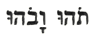
[ 5 ] Yesterday I pointed out to you that what we call the solid state—that is, what exerts resistance upon our senses—did not yet exist during the Saturn, Sun, and Moon states, but that only the element of fire or heat, the element of gas or air, and the element of water were present. And, essentially, it is only with the dawn of the planetary Earth state that the solid is added to the earlier elemental states. So at that moment when what we characterized yesterday came into being, when, so to speak, the tendency arises for the solar to separate from the earthly, then, if we consider the elemental interweaving, we are dealing with a mutual interpenetration of the elements of heat, air, and water. This undulated and interwove in confusion. How this initially surged and wove together in confusion—how we must imagine it when we picture it in our spiritual mind—is indicated to us by these words, which in German are roughly rendered as “wüste und wirt,” though of course only in a very imprecise way, and which are succinctly designated by the sound combination tohu wabohu. For what does this tohu wabohu mean? If we vividly bring before our soul what these sounds can stir within the soul, then it is something like the following.
[ 6 ] The sound that can be compared to our “T” evokes an image of a force radiating outward from a central point in all directions of space, in every direction of space. Thus, the moment the T sound is uttered, the image of a force radiating outward from a central point in all directions of space—radiating outward into the infinite—is evoked. So that we must imagine the interweaving of the elements heat, air, and water, and within that a radiating force as if from a center to all sides, and we would have this radiating force if only the first part of the sound structure were present, tohu. The second part—what is it to yield? It yields precisely the opposite of what I have just said. It stimulates, through its sound character—through everything that awakens in the soul at the letter that can be compared to our B— Bet—it stimulates everything you picture when you imagine a mighty great sphere, a hollow sphere, picture yourself inside it, and now imagine rays radiating inward from all points, from all inner points of this hollow sphere, radiating toward the center. So you imagine this picture: a point in the midst of space, from which forces radiate in all directions of space—tohu; these rays, as it were, catching on an outer spherical shell, reflecting back into themselves, returning from all directions of space—then you have the bohu. Then, when you form this image and imagine all the rays of force filled with what is given in the three elemental “beings”—heat, air, and water—when you imagine these rays of force as they form, as it were, within these three intermingling elements, then you have the characteristic of what is the inner movement. Thus, through this combination of sounds, the manner in which elemental existence is directed by the Elohim is indicated to us.
[ 7 ] But what has actually been said about all this so far? We will not understand the entire magnificent, dramatic process of the seven days of creation unless we bring these details to mind. If we do so, the whole thing will appear to us as a wondrous, mighty cosmic drama. What is actually being said? Let us recall once more that in all that is meant, for example, by the verb *bara*—in the very beginnings the gods “created”—we are dealing with a soul-spiritual activity. Yesterday I compared this to the evocation of complexes of ideas within the soul. So we imagine the Elohim embedded within space, and we conceive of what is indicated by “created,” bara, as a cosmic-soul activity of conception. What they conceive is then indicated by haschamajim and ha’arez, that which radiates outward and that which is inwardly active. But now something else significant is pointed out. To have the best possible comparison, imagine yourself in the state of waking up. Complexes of imagination rise up into your soul. In the same way, haschamajim and ha’arez rise up in the soul of the Elohim.
[ 8 ] But as we already pointed out yesterday, we know that these Elohim came over in the course of their own evolution from the Saturn, Sun, and Moon states. Thus, what they conceived was truly in a similar situation to the complexes of your imagination when you wake up and summon them into your soul. Then you can, as it were, view them soul-spiritually; you can describe what they are like. You can say: When I wake up in the morning and rediscover what has previously settled in my soul and what I call up, then I can describe what it is like. — Thus could be described to the Elohim what now arose, after they had, so to speak—if I were to put it very roughly—said to themselves: Let us now conceive what enters our soul when we recall all that took place during the old Saturn, Sun, and Moon states. Let us see how this appears in memory. — And it appeared in such a way that it is described by the words tohu wabohu, that it could be described by an image, as I just described it with the rays emanating from a central point out into space and back again, so that the elements swayed within one another in these rays of force. Thus the Elohim could say, as it were: This is how it appears now that we have brought it to this point. This is how it has been restored.
[ 9 ] Now, however, in order to understand what follows—which in modern languages is usually expressed as: “Darkness was over the flowing elements” or “over the waters”—we must consider something else. We must turn our gaze back once more to the course of development before earthly existence had come into being.
[ 10 ] First, we have the Saturnic presence woven into the fiery element. Then comes the Solar presence with the airy element. However, as you can read in my *Secret Science*, the addition of air is linked to something else. It is not merely the gaseous or airy element that is added to the element of warmth. This is, so to speak, the coarsening of the element of warmth. The fine element of warmth of the ancient Saturn coarsens into the gaseous element. But every such coarsening is connected with the emergence of something finer. If the coarsening into the gaseous element is, as it were, a descent, then on the other hand there is an ascent to the light element. So that, when we move from the old Saturn to the old Sun, we must say: The old Saturn is still entirely woven into the element of warmth; during the solar state, something condensed is added—the gaseous element—and then also the element of light, which enables the warmth and the gaseous element to reveal themselves outwardly in a radiant manner.
[ 11 ] If we now take one of the complexes that appear there—the one indicated by ha'arez, which is usually translated as “earth”—and note that the Elohim, after having remembered it, took it into the eye of the soul, then we must ask ourselves: How were they to designate it? —- They could not designate it in such a way that what had already been in the old sun was now revived within it. The light element was missing. It had separated itself. As a result, ha’arez had become one-sided. It had not taken the light with it, but only the denser elements: the watery, the airy, and the warmth element. The light was certainly not missing in what is indicated by haschamajim, but haschamajim is the solar aspect that moves out of the other complex. In this other complex, the refinements of the elements were missing; the light was missing. So that we can say: In one of the complexes, the heat, air, and water elements swirled together in confusion, just as we have just described with tohu wabohu. And they were stripped bare; they lacked what had entered into development in the old solar existence, the light element. They had thus remained dark; they had nothing solar about them. That had been drawn out of them with the haschamajim. Thus, the progression toward Earth’s development means nothing other than this: that which was contained as light in the old solar existence, as long as this was still connected to what we call Earth, was drawn out, and a dark fabric of the elements of heat, air, and water remained behind as the ha’arez.
[ 12 ] Thus, we have presented what the Elohim conceived even more clearly before our souls. However, we will never be able to imagine it in the proper way unless we remain constantly aware that everything we call elemental existence—air, water, and even heat—is, in essence, also the outer expression of spiritual beings. It is not entirely correct to speak of a “garment”; rather, it must be understood as an outer manifestation. So everything that is referred to as air, water, and heat is, in essence, Maya, illusion; it exists initially only for external perception, including that of the soul’s eye. In truth, when one considers its true nature, it is soul-spiritual; it is the outward manifestation of the soul-spiritual nature of the Elohim. But when we consider these Elohim, we must not yet imagine them as human-like, for that was precisely their goal: to shape humanity, to call humanity into existence in its unique organization, which has just now been conceived by them. We must not, therefore, conceive of them as human. However, in a certain sense, we must already take into account a kind of division in the nature of these Elohim. When we speak of human beings today, we cannot truly understand them unless we distinguish their being into a physical, a soul, and a spiritual aspect. And you know how deeply we are concerned, especially in the field of anthroposophy, with gaining a more precise understanding of the activity and nature of this trinity of the human being—the physical, the soul, and the spiritual. To make such a distinction, to recognize an essence within this triad—we are, however, compelled to do so only in the case of human beings; and we would, of course, be making the greatest mistake if we were to conceive of the essence of pre-human beings—those referred to in the Bible as the Elohim—in a manner similar to that of human beings. Yet we must already distinguish in them a kind of physical and a kind of spiritual aspect.
[ 13 ] Now, when you distinguish between a person’s physical and spiritual aspects, you will certainly be aware that their essence is also present in various ways within their outward form, as it appears to you. For example, we will not be tempted to locate the truly spiritual aspect of a human being in the hands or legs, but rather we say: Essentially, the physical is found, for example, in the torso, in the legs, in the hands. The spiritual has its organs in the head, in the brain; that is where its instruments are. — We thus distinguish within the human being’s outward form in such a way that we understand certain parts more as the expression of the physical, and certain parts more as that of the spiritual.
[ 14 ] We must now do the same with regard to the Elohim, if not in exactly the same way, then in a similar manner. Essentially, the entire fabric and interplay of which I have spoken can only be properly understood if we conceive of it as the physical embodiment of the spiritual-soul aspect of the Elohim. Thus, everything that has presented itself as the elemental weaving of the airy, the warm, and the watery is the outer physicality of the Elohim. But we must distribute the parts of the Elohim in various ways among these elemental members; we must think of the physical, the coarser aspect of the Elohim as more closely linked to the watery and the airy. And in all that which, as the element of warmth, permeated the gaseous and the aqueous, which penetrated this tohu wabohu as the element of warmth, which surged through it as undulating warmth—in that was at work what we may call the spiritual aspect of the Elohim. Just as we say that in human beings the more physical aspect works in the torso, legs, and hands, and the more spiritual aspect in the head, so we can say, when we conceive of the entire cosmos as a physicality of the Elohim: In the air and water elements lived the more physical aspect of the Elohim, and in the heat element the spiritual aspect wove. — With this, you have then conceived of the cosmos itself as a physical manifestation of the Elohim. And since the outwardly physical is characterized as something that was a tohu wabohu of the elemental beings, you have located the weaving Spirit of the Elohim in that which, as warmth, permeated these elemental beings.
[ 15 ] Now the Bible uses a curious word to express the relationship between this Spirit of the Elohim and the elements: “Ruach Elohim m’rachephet.” A strange word that we must examine more closely if we are to understand how the Spirit of the Elohim interwove the other elements. We can only understand this word, racheph, if we draw upon, so to speak, everything that moved the soul at that time when this word was spoken. When one says, “And the Spirit of the Gods wove over spreading masses of matter” or “over the waters,” that says absolutely nothing. For we can only arrive at the correct interpretation of this verb, racheph, if you imagine—I must characterize it through a somewhat, I would say, crude, vivid comparison—a hen sitting on her eggs, and the brooding heat from the hen radiating over the eggs beneath her. And if you now imagine the activity of this brooding heat, which radiates from the hen into the eggs to bring them to maturity—this activity of the heat, this radiation of heat from the hen into the eggs—then you have a concept of the verb that stands there and tells us what the Spirit does in the element of heat. It would, of course, be quite inaccurate to say that the Spirit of the Elohim “broods,” because this does not mean what we today understand by the sensory activity of brooding; rather, it refers to the activity of the radiating warmth. Just as the heat radiates from the hen, so the Spirit of the Elohim radiated into the other elemental states—the airy and the watery—through the element of warmth. If you picture this, you will have an image of what is meant when it is said: “And the Spirit of the Elohim hovered over the masses of matter, over the waters.”

[ 16 ] Now, however, we have also, to a certain extent, reconstructed the image that floated before the mind of the ancient Hebrew sage when he thought of this primal state. We have constructed a complex that, in the way I have characterized the tohu wabohu to you, had, so to speak, a spherical interplay of heat, air, and water, from which all light-like elements had separated into the hashamayim, and we have internally interwoven this interplay of the three elemental states of darkness. In the one element, the warm one, we have the spiritual essence of the Elohim, undulating and weaving, which, spreading in all directions with the expanding warmth, spreads itself as if undulating and brings to maturity what is initially immature in the dark element.
[ 17 ] Thus, when we reach the end of this sentence—which is usually indicated by the words, “And the Spirit of Elohim hovered over the waters”—we find ourselves, so to speak, within a description of what is indicated in the first verse of the Bible by the word “earth” in ha’arez. We have characterized what, so to speak, remained after the haschamajim had withdrawn.
[ 18 ] Let us now take another look at the earlier states. We can go back from the Earth to the Moon state, to the Sun state, and to the Saturn state. Let us go back to the ancient Sun state. We know that at that time there could be no question of a separation between what is now Earthly and what is Solar, nor, therefore, of the Earthly being irradiated from the outside by light. That is, after all, the essence of our earthly life: that light comes from the outside, that the Earth is illuminated from the outside. You must imagine the globe of the Earth enclosed within the Sun, forming a part of the Sun itself and thus not receiving light, but rather belonging to that being which radiates light into space; then you have the ancient solar state. This ancient solar state can only be characterized by saying: everything earthly is not a receiver of light; it belongs to that which radiates light; it is itself a source of light.
[ 19 ] Now take a good look at the difference! The old solar state: the Earth participates in the radiation of light; the new state, the Earth state: the Earth no longer participates in it. The Earth has allowed everything that radiates light to depart from itself. It is now dependent on receiving light from outside. The light must shine into it. This is the characteristic difference between the new Earth state and the old Solar state in the course of evolution. With the separation of the Solar, the hashamayim, the luminous aspect has also departed. That is now outside the Earth. And the elemental existence that surges chaotically within the ha’arez as tohu wabohu has no light state of its own; it has only what one might call “being permeated by the Spirit of the Elohim.” But that did not make it bright within itself; it left it dark within.
[ 20 ] Let us now take another look at the whole of elemental existence. As you know from previous lectures: When we list what we call the elemental states within our earthly existence, we begin with the solid, then move on to the liquid, to the gaseous or airy, and to the heat element. With this, we have, so to speak, indicated the densest states of matter. But these states are not yet exhausted. If we go further up, we find finer states that are not very well characterized when described as “finer matter.” What matters is that we recognize them as finer states in contrast to the coarser ones of the gaseous, the heat-bearing, and so on. They are usually called ethereal states. And we have always distinguished, within these finer states, the light-bearing as the first. So when we move down from heat into the denser, we come to the gaseous; when we move further up, to the light-bearing. If we ascend even further from the luminous, we arrive at an even finer etheric state; then we are already approaching something that is not immediately present in the ordinary sensory world. In the sensory world, we are given only an external reflection of what we can describe as a finer etheric state in contrast to the light ether. From an occult perspective, one can say that the forces in this finer ether are the same ones that direct the chemical arrangement, the interlocking of substances, the organization of matter in the way one might describe it, for example, when one places fine dust on a plate, then strokes the plate with a violin bow, and thus obtains the so-called Chladni sound figures. What the coarse, sensory sound effects in the dust there occurs throughout space. Space is differentiated within itself, is permeated by forces that are finer than the forces of light and that represent in the spiritual realm what sound is in the sensory realm. So that we can speak of a chemical or sound ether as a finer element when we ascend from warmth to light, and from there to this finer ether, which contains the forces that differentiate, separate, and unite matter, but which in reality has a tone-like, sound-like essence, of which the sensory sound heard by the sensory ear is only an outer expression, namely an expression that has passed through the air. This brings us close to this finer element that lies above the light. So when we speak of the hashamayim as that which manifests outwardly having emerged from the ha’arez, we must conceive not only of that which manifests through the luminous, but also of that which manifests through the finer ethereal aspect of the sonorous, the tonal, which in turn permeates this light.
[ 21 ] Just as we descend from warmth to the gaseous and from there to the aqueous, so can we ascend from warmth to light, from light to the sound-bearing, to the chemically ordering. And from the aqueous we can proceed downward to the earthy. Where do we arrive, then, when we ascend from the sound-bearing to an even finer, higher ethereal state, which has thus again gone out with the haschamajim? There we arrive at something that, so to speak, as the finest ethereal state, weaves once more within the sound-bearing or tonal realm just described, within the chemically ordering. If you turn your spiritual ear toward this etheric state I have just described, you will of course not hear an external sound in the air, but you will hear the tone that differentiates space, that permeates it and orders the materials, just as the tone produced by the bow on the plate orders Chladni’s sound figures. But into this existence, which is ordered by the sound ether, the higher etheric state pours forth. It permeates and interweaves the sound ether just as, within us, the meaning of the thought permeates the sound our mouth utters—that which makes the sound into a word. If you take to heart what makes sound a meaningful word, then you will gain an idea of what weaves through the sound ether as the finer etheric element, which weaves through the cosmos and gives meaning to the ordering sound of the world: the word that surges through space. And this Word that surges through space, pouring itself into the sound-ether, is at the same time the origin of life; it is truly weaving, surging life. So that which was drawn out of the ha’arez with the hashamayim, that which went into the solar realm as opposed to the other, the lower, the earthly, as opposed to the tohu va-bohu—that is something that can manifest outwardly as light. Behind this, however, lies a spiritual, sound-filled reality; behind this, the cosmic speech. Therefore we may say: In the brooding warmth, the lower spiritual aspect of the Elohim first lives itself out, just as our desires live themselves out in our lower soul. The higher spiritual aspect of the Elohim, which has gone forth with the haschamajim, lives in the luminous, spiritually resonant, spiritually word-like, in the cosmic Word. All that has gone out into this solar realm can only shine back in from the outside into the tohu wabohu.
[ 22 ] Let us now try to visualize the whole picture that hovered before the soul of the ancient Hebrew sage as the ha’arez, the haschamajim. What emerged from there as something spiritually luminous, resonant, speaking, and word-forming—when that in turn shines back in, how does it then affect us? It acts like a light speaking from the solar realm, as a light behind which cosmic speech stands. So let us imagine all that we have described in the tohu wabohu in its darkness, in its chaotic surging of the warm, the gaseous, the watery—let us imagine it in its darkness, so to speak, devoid of light. And now let us imagine, from the activity of the Elohim, radiating in from the outside through the creative Word, which underlies as the highest etheric entity, radiating in from the outside with the light that flows out of the Word. How should one describe what is happening there? One cannot describe it more aptly than by setting forth the monumental word that states: The beings who, with the hashamayim, had driven their highest essence out into the etheric, beamed back-speaking light from the world-space into the tohu wabohu! — With that, you have described the essence of what lies in the monumental words: “And God said, ‘Let there be light!’ and there was light in what was darkness, in tohu wabohu.” — There you have the image that the ancient Hebrew sage had in mind.
[ 23 ] Thus we must conceive of the essence of the Elohim as extending throughout the entire cosmos, and of this entire cosmos as a body; that which is the elemental existence in the tohu wabohu as the lowest form of the physical, the warm as a somewhat higher form, and as the form of the highest spiritual, the haschamajim, which has gone forth and now works creatively from the outside into the entire structure of the tohu wabohu.
[ 24 ] Now you might say: With this, you are actually showing us that through the light-radiating Word spoken on a cosmic scale, the tohu wabohu—the chaotic surging of the elemental forces—was brought into order and transformed into what it later became. But from where is the human form organized? — There can be no such human form as we have, walking upright on two legs, using its hands as we do, without being organized by the forces rooted in the brain and radiating from there. Our form is organized by the highest spiritual forces that radiate from our spiritual being. The lower is always organized by the higher. Thus, the ha’arez was, as it were, organized as the body of the Elohim—as the lower—by the higher physical, by the haschamajim and the spiritual of the Elohim active within it. Thus, the highest spiritual of the Elohim takes possession of that which has gone forth and organizes it, as expressed in the words: “The light revealed through cosmic speech flows into the darkness.” Through this, the tohu wabohu is organized, lifted out of the disorder of the elements. So if you imagine in the haschamajim, as it were, the head of the Elohim, and in the elemental realm that has remained behind, the torso and the limbs, and the head now organizing the torso and the limbs—the elemental realm—through its power, then you have the actual process; then you have, as it were, the human being magnified into the cosmos; and within this cosmos he acts as an organizing force emanating from the organs of the spirit that lie within the haschamajim. A self-organizing macrocosmic human being—this is the image we may paint before our soul when we conceive of all the radiations of power flowing down from the haschamajim to the ha’arez.
[ 25 ] And now let us take a closer look at modern humanity so that we can paint an even clearer picture in our minds. Let us ask ourselves: How, from the perspective of spiritual science—not today’s amateurish science—has humanity come to be what it is today? What gives them that specific form that distinguishes them from all other living beings in their environment; what actually makes them human? What is it that weaves through this human form? — It is incredibly easy, if one does not blindfold oneself, to say what makes a human being a human being. That which he possesses and all other beings around him in earthly existence do not possess—language, which manifests itself in sounds—that is what makes him human. Imagine an animal form. By what means can it be organized into a human form? What must enter into it so that it becomes a human form? Let us put the question this way: Let us imagine an animal form, and we would have to let something flow through it, let a breath flow through it—what would this breath have to contain so that this form would begin to speak?—It would have to feel internally organized in such a way that it radiated sound! It is sound that transforms the animal form into the human form.
[ 26 ] How, then, can one visualize the cosmos, feel it inwardly? How can one feel all that which I have written before your soul in images, which I have laboriously constructed image by image from the elemental, how can one feel this, how can one, as it were, inwardly feel the form of the macrocosmic human being? When one begins to feel how the sound shoots into form! Let us learn to feel the A as it rushes through the air—not merely the sound—but let us learn to feel how this sound takes shape, just as dust takes shape through the sound of the violin bow as it strokes the string. Let us learn to feel the A and learn to feel the B as they weave through space! Let us learn to feel them not merely as a sound beam, but as something taking shape; then we will feel as the ancient Hebrew sage felt when he was inspired by sounds to the forms of the images I have set before your mind’s eye. Thus did the sound work. That is why I had to say: The Bet suggested something enclosing, something like a casing, something closing in on itself and enclosing a content within. That which was indicated by the Resch suggested something one felt, just as one feels when one feels one’s head. And the Schin suggested something I described as stirring. — This is a thoroughly objective language, a language that, in the production of its sounds, crystallizes into an image when the soul allows itself to be inspired by it. Hence, the high art that led the sages to the images that press themselves upon the seer’s soul when he enters the supersensible realm lies within these sounds themselves. Thus sound is transformed into spiritual form and conjures up images before the soul that come together as I have described to you. This is what is immensely significant about this ancient document: that it has been preserved in a language whose sounds are form-creating, whose sounds crystallize into forms within the soul. And these forms are the images one gains when one penetrates into the supersensible, from which the sensible world of our physical earthly plane has developed. When one takes this to heart, one comes to feel that deep, immense awe and reverence for the way the world develops, and one learns to feel how it is truly no coincidence that this great, this elemental document of human existence has been transmitted to us precisely in this scripture, in a scripture whose very characters are capable of vividly awakening the spirit within the soul and leading us to what the seer of our time is to bring forth once more. This is the feeling the anthroposophist should cultivate when approaching this ancient document, which stands at the starting point of the Old Testament.