Secrets of the Biblical Creation Story
GA 122
20 August 1910, Munich
Translated by Steiner Online Library
Fifth Lecture
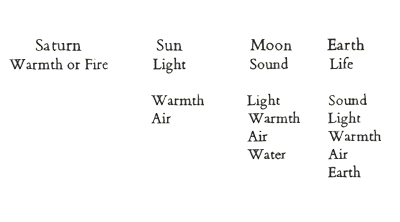
[ 1 ] We have pointed out how the account of the Earth’s formation in the so-called Genesis initially presents a repetition of those earlier stages of development that can be accessed today only through clairvoyant research—that is, what we refer to as the source of the anthroposophical “worldview.” If we once again bring to mind what we have learned about the stages of development during periods when nothing of our earthly existence yet existed, then we point out that what later became our solar system was at that time contained within a planetary existence that we call the ancient Saturn. And we must keep firmly in mind that this ancient Saturn was an interweaving of mere thermal states, an interweaving of thermal conditions. To anyone who, according to our current physical concepts, might take offense at the notion of a ‘world entity’ that exists solely as heat, I refer to what I said the day before yesterday: namely, that all objections raised by so-called modern scientific rigor against what is said here today—and elsewhere—could just as well be raised by me. It is simply not the time, in these lectures, to actually address everything that modern science, in good faith, might say. Compared to the sources of spiritual scientific research, what could be said from the entire scope of modern science appears quite amateurish. Indeed, in order to take into account various things that arise from this perspective, I will begin and indeed, starting with my Prague lecture series, which is to be held next spring, I will speak not only of all that can be used to justify anthroposophy, but also—so that modern minds may then be reassured—of all that can be used to refute it. For this reason, my Prague lecture series will be preceded by two public lectures, the first of which is titled “How Does One Refute Anthroposophy?” and the second “How Does One Justify Anthroposophy?” And I will then give these lectures in other places, and people will see that we ourselves can say all of this, that we are fully aware of what might be objected to from this or that side against what is taught on anthroposophical grounds. Anthroposophy is firmly grounded in itself, and those who believe they can refute it simply do not yet know it. This will be amply demonstrated in the course of time. With regard to that state of heat of the ancient Saturn, I may also refer to a few remarks I made in my Occult Science, through which even those who feel compelled, based on their scientific training, to raise objections against it may find some reassurance.
[ 2 ] With that said, I would like to speak once again quite frankly and freely from an anthroposophical perspective, without regard for any well-intentioned objections that might be raised against these ideas.
[ 3 ] An interweaving of states of warmth, then, was present in the ancient Saturn existence. Let us take a close look at this. In the context of the Genesis, this ancient Saturn state—which, as I said, is an interweaving of conditions of warmth or fire—is repeated within the process of Earth’s formation. This is the first thing we wish to note regarding the elemental existence. And I ask you to bear in mind, in this context, the specific sense in which we speak of heat or fire when referring to such a high state of existence as that of the ancient Saturn. We cannot come close to what we call heat or fire there by, for example, lighting a match or a candle and studying the heat or fire in physical existence. Rather, we must conceive of what we call heat here, what we call fire here, in a much more spiritual or, better said, soulful way. If you feel yourself to be a being that carries warmth within, if you feel, so to speak, your own warmth, experience your own warmth in a soulful way, then it will be good if you regard this personal experience, this emotional experience, as something that can give you a rough idea of the interweaving of the warmth conditions in ancient Saturn.
[ 4 ] We then proceed to the ancient solar state, the second of our planet’s stages of development, and speak, within the context of elemental existence, of heat having condensed into what we might call a gaseous or air-like state. Thus, in the elemental existence of the ancient Sun, we must distinguish between heat and the gaseous or air-like state. But we have already pointed out that the condensation of heat into the airy state—that is, a descent of the elemental states toward the denser—is linked to an ascent, if we may call it that, toward the thinner, toward the more ethereal, so that while we describe the next elemental state below heat as airy, we must designate the next state above heat as light-like, as light-like ether. So when we consider the entire range of elemental conditions during the old solar state, we might say: There existed in the old Sun an interwoven interplay of heat, light, and air, and everything that lived there during this old solar state manifested itself within these states of heat, light, and air. Now we must once again realize that if we direct our gaze merely at these elemental manifestations of heat, light, and air, we then have, so to speak, only the outer side, the Maya, the illusion of what actually exists. In truth, it is spiritual beings who reveal themselves outwardly through heat, light, and air. It would be something like if we were to reach our hand into a heated room and say to ourselves: the reason there is heat in this room is that there is a being there who radiates heat and finds in the radiation of heat a means of revelation.
[ 5 ] When we now move on to the old moon, we again have the middle state as warmth, below that the condensation of warmth into air or gas, and still further down the condensation into water. The light is again carried over. We then have, lying as it were above the light as a finer, more ethereal state, that which I have already characterized by saying: What acts within our materials as that organizing principle that brings about chemical compounds and chemical decompositions—that which human beings can perceive with their external senses only when it is transmitted through the medium of air—but which, in a . spiritual nature underlies all existence—we can call this a sound or tone ether, or, since this spiritual sound orders material existence according to measure and number, the number ether. —- So we say: We ascend from light to sound, but we do not confuse this sound with the external sound conveyed through the air; rather, we see in it something that is perceptible only when the human clairvoyant sense is awakened in a certain way. — Within this old moon, then, in everything that is within the old moon itself and in what acts upon it from the outside, in all of this we must regard heat, air, water, light, and sound as elemental states.
[ 6 ] As we then ascend to the fourth state—the actual becoming of the Earth—the Earthly or Solid, along with what we call the actual life-ether (an ether even finer than the tone-ether), are added as new condensations and rarefactions of these elemental states, extending downward and upward. Thus we can describe the elemental existence of the earthly as follows: Heat is again present as the middle state; as states of condensation we have the airy, the watery, and the solid; and as states of rarefaction we have the light, sound, and life ethers. — I wish to make it explicitly clear once more, so that nothing remains unclear in this discussion, that what is designated as the Earthy or the Solid must not be confused with what modern science designates as the Earthy. What is designated as such in our discussions here is something that is not immediately visible in our surroundings. In the sense of occultism, however, what we tread upon when we step beyond the surface of our Earth is Earth, insofar as it is solid; but gold, silver, copper, and tin are also Earth. Everything that is solid and material is Earth in the sense of occultism. The modern physicist will, of course, say from his own standpoint: This entire distinction is meaningless; we distinguish our various elements, but of what is supposed to underlie these elements, as it were, like a primordial substance, like an earthiness, of that we know nothing. — Only when the seer’s gaze penetrates what is given in the outer elements of science, in the seventy-odd elements, and seeks the basis of the solid elements, the forces that bring matter into the solid state, only when one thus penetrates beyond sensory existence does one find those forces that construct, form, and compose the solid, the liquid, and the gaseous in the sense of occultism. And that is what is being discussed here. And that is also what is discussed in Genesis, if one understands it correctly. Regarding these four states, we must therefore say, for the sake of understanding Genesis, that the first three must in some way be repeated in our earthly existence, while the fourth appears as a new one within our earthly existence.
[ 7 ] Let us try to examine our Genesis in light of this. Let us examine it using the tools we have already acquired over the past few days. We should therefore find in our becoming as an Earth a kind of repetition of the ancient Saturn state. In other words, we must rediscover the ancient Saturn warmth as it acts as an expression of the spiritual-soul aspect. And we find it when we understand Genesis correctly. I have told you that the words usually translated as “The Spirit of Elohim hovered over the waters” actually mean that the spiritual-soul aspect of the Elohim is spreading out, and that the warm element—which we must imagine radiating down from the hen into the eggs—permeates what existed at that time of elemental existence. In the words “The Spirit of Elohim radiated warmth-incubatingly through the elemental existence, or the waters,” you have indicated the recurrence of the ancient Saturn warmth.
[ 8 ] Let us continue. The next state must be the one that represents a repetition of the old solar existence. Let us not, for the moment, consider what we have in the elemental solar existence as a state of condensation—that which became air from heat—but rather what appeared as a state of rarefaction: the element of light. So if we take the fact that during the solar phase light strikes our cosmic space, then the repetition of this ancient solar state in the becoming of the Earth will be the striking of the light. This is expressed in the powerful words: “And the Elohim said, ‘Let there be light!’ And there was light.”
[ 9 ] The third repetition will have to be brought about by the fact that, with regard to the finer elemental states, what we call the organizing sound or tone ether permeates our earthly becoming. Let us therefore ask ourselves whether this lunar state is also indicated in any way in its repetition. How might it be indicated in Genesis? Perhaps in such a way that sound intervenes in an ordering manner in the elemental material conditions of the Earth’s formation, just as we see when we stroke a plate sprinkled with fine dust with a violin bow, and the so-called Chladni figures emerge. Something like this would have to occur in the state of repetition to tell us: The tone or sound ether intervened and ordered the matter in a certain way. — But what is told to us about that moment of our Earth’s formation that follows the emergence of light? There we are told that something was stirred up by the Elohim amidst the material elemental masses, whereby these elemental masses, as I characterized them for you yesterday, organized themselves by flowing upward and gathering downward. An organizing force penetrates and arranges the elemental masses, just as sound penetrates the dust masses and produces Chladni figures. Just as the dust arranges itself there, so do the elemental masses arrange themselves by radiating upward and gathering downward. The word rakia, which is used there to denote what the Elohim inserted into the elemental masses of matter, is a word that is difficult to translate, and the common translations do not suffice to render it correctly. If one takes everything together, even purely philologically, that can be gathered today to explain this word, one must say: The translations “firmament” or “tent” or “expansion” do not do much justice to it, for in this word lies something active, something stirring. And a more precise philological analysis would reveal that this word contains precisely what has been indicated here: The Elohim stirred something within the elemental masses of matter that can be compared to what is stirred within the dust masses of Chladni’s sound figures when sound intervenes to bring order. Just as the dust arranges itself there, so the elemental mass of matter is arranged upward and downward on the so-called second day of creation. — Thus we see the intervention of the sound ether following the light ether within Genesis, and with the so-called second day of creation we have before us, quite appropriately, that which we must regard in a certain sense as a repetition of the lunar existence.
[ 10 ] You will see that these repetitions cannot occur in a completely unambiguous way, but rather that they overlap, as it were. And what might appear to be a contradiction between today’s debates and those of yesterday will eventually become clear. The repetitions occur in such a way that first there is a repetition as I am describing it now, and then a more comprehensive one, as I characterized it yesterday.
[ 11 ] We must now expect that, following the moment of the Earth’s formation—when the sound ether had arranged the materials so that some radiated upward and others gathered downward—something would intervene that we have described as a finer state than the actual earthly one, that which we have called life, the life ether. So the so-called second day of creation ought to be followed by something that would indicate to us that life-ether flowed into the elemental masses of our Earth, just as light and the ordering sound-ether had flowed in first. We ought to have something in Genesis that suggests to us: there life-ether surged in and stirred life into activity, into unfolding. — Look at the third moment in the becoming of the Earth in Genesis. There you are told how the Earth brings forth the green, the living, the herb- and tree-like—as I said yesterday: according to their kind. There you have vividly depicted the inflow of the life-ether, which brings about everything that is said about the third day.
[ 12 ] Thus, in Genesis you have everything that occultism can bring to light through clairvoyant powers, and everything we must expect if Genesis truly originates from such occult knowledge. We see this confirmed if we are only willing to understand it correctly. It is wonderful how what we first explore independently of any written record is then confirmed by Genesis. I can assure you that in the way the formation of the Earth is presented in my Occult Science—as a repetition of the ancient Saturn, the ancient Sun, and the ancient Moon—everything that could have been derived from Genesis has been deliberately and conscientiously excluded. Only those findings are recorded that can be discovered independently of any external document. But if you then compare these findings, discovered so independently of the texts, with Genesis, you will find that Genesis presents itself to us as a document that tells us the very same thing that we have been able to deduce from our own research. This is that wonderful harmony to which I alluded yesterday, where, as it were, what we ourselves can say resounds to us from the seers who spoke to us millennia ago.
[ 13 ] When we consider the more subtle elements of our earthly existence, we see in what is called the first three days of creation a successive unfolding of heat, light, sound ether, and life ether, and in what is stirred and enlivened within, we simultaneously see the states of condensation unfolding: from warmth comes air, then water, and finally the solid, the earthly, in the manner I have described to you. Thus the states of condensation and rarefaction interweave, and in this way we attain a unified worldview of our becoming as an Earth. And when we speak in this way of the denser states—of warmth, air, water, earth—or of the more subtle states—of light, sound, and life ethers—we are dealing with modes of manifestation, with the outer garments of soul-spiritual beings. Of these soul-spiritual beings, the Elohim first appear before our inner eye in the sense of Genesis, and here the question must arise for us in the light of our anthroposophical wisdom: What kind of beings were the Elohim, actually? What were they? — In order to fully orient ourselves, we must be able to place these beings, so to speak, within our hierarchical order. You all likely recall from what has been presented to you over the years or what you can read in my Occult Science that, in the hierarchical order, starting from the top, we first distinguish a triad that we designate as Seraphim, Cherubim, and Thrones. You know that we then recognize a subsequent triad, which we designate as Kyriotetes or Dominions, Dynamis or Powers, and Exusiai or Manifestations, Authorities. If we then take the lowest triad and use the Christian terms, we speak of Archai or primal forces, primal beginnings or spirits of personality, of Archangeloi or archangels, of Angeloi or angels—that is, of those spiritual beings who are closest to human beings. Only then do we come, in the order of the hierarchies, to human beings themselves as the tenth link within our hierarchical order. And we must ask ourselves: Where in this order do the Elohim belong?
[ 14 ] Here we must turn our attention to the second of the triads, to those beings we call Exusiai or Powers, Spirits of Form. Then we have the hierarchy of the Elohim. We know from what we have presented over the years that during the ancient Saturn existence, the Archai, the spirits of personality, stood at the stage of humanity where we stand today. During the ancient Sun existence, the Archangels or Archangeloi stood at the stage of humanity; during the ancient Moon existence, the Angels or Angeloi; and during the Earth existence, humanity stands at the stage of humanity. One degree above the spirits of personality we have the spirits of form, the Exusiai, the very ones we call the Elohim. These are thus spiritual beings who, when our planetary existence began with ancient Saturn, had already advanced beyond human existence; high, exalted spiritual beings who had already passed through their human stage before the ancient Saturn era. By bringing this to mind before our soul, we gain a sense of the sublimity of these Elohim and know that they stand, so to speak, four degrees higher in the hierarchical order than the human stage. What was thus at work there—what, if I may use the word again, thought cosmically and brought about our earthly existence through that thinking—stands four degrees higher in the hierarchical order than the human being; it can work creatively with its thinking, just as the human being can work creatively only in relation to his thought-forms. Because it stands four degrees higher than the human, this thinking of the Elohim is not merely an ordering, forming, and creating within a world of thought, but this thinking of the Elohim is a shaping of beings and a creation of beings.
[ 15 ] Now that we have made this preliminary remark, the question must arise within us: What of the other ‘beings of the hierarchies’? First of all, we will be interested in what happened, in the sense of Genesis, to those we have just referred to as Archai or Spirits of Personality. They are, after all, the next beings descending in our hierarchical order. Let us therefore remind ourselves once more that in the Elohim we have before us exalted ‘beings’ who had already advanced beyond the human stage at the time of the ancient Saturn existence. These beings of the Elohim accompanied the ancient Saturn, Sun, and Moon existences, creating and ordering them, and also intervened in the Earth existence. What, then, can we expect from that hierarchy immediately below the hierarchy of the Elohim—from the Spirits of Personality? Does Genesis tell us nothing at all about them? If we regard the Elohim as the high, exalted beings recognizable to us in the sense of Genesis, we should actually expect these primal forces, primal beginnings, or Spirits of Personality to act, as it were, as serving beings. Does Genesis tell us anything about the fact that, after the Elohim had unfolded the great creative activities, they now made use of the lower activities as their servants, the Archai or Primordial Beginnings? The Elohim carried out the most principal, the most comprehensive activities. But if the Elohim thus laid out the broad outlines and unleashed the great creative forces, did they then properly place, for example, the Archai or spirits of personality in their proper places?
[ 16 ] If we wish to answer the question of whether Genesis says anything about the Elohim making use of such subordinate beings and placing them in their stead, then we must first understand Genesis correctly. There is now a point in the understanding of Genesis that is a true crux, a true cross, for all external exegesis, and this is because for centuries these external commentators on the Bible have taken absolutely no account of what occult research has to say about the actual meaning of the words at the beginning of our Bible. It is a cross in the interpretation of Genesis. You need only go through the literature, as it has developed over a long period of time, and you will find this confirmed. There it stands in Genesis, as rendered in modern languages, so that in our German it reads: “And the Elohim separated the light from the darkness,” and it is then depicted as if light and darkness were alternating. I will return to the words in more detail later. For now, I will use the words of modern language as a representative example; they are not accurate and are only to be used provisionally. It says at a certain point: “And there was evening, and there was morning—one day,” and further on: “And the Elohim called the light ‘day.’” Scholarship has really had its hands full with this. What, then, is a day of creation? The naive mind sees in a day something that lasts twenty-four hours, something that alternates between light and darkness just as our days do, during which we are awake and asleep. Now you all surely know how much ridicule has been heaped upon this naive conception of the creation of the world in seven such days. You may also know what effort—and one might say amateurish effort—has been expended to interpret the days of creation in some way as longer or shorter periods, as geological periods and so on, so that such a day of creation would signify some longer period of time.
[ 17 ] The first difficulty naturally arises when one turns one’s attention to the so-called fourth day of creation, where, according to Genesis itself, it is first mentioned that the sun and moon are established as the agents that order time. Yet every child today knows that the order of our twenty-four-hour day depends on the relationship between the Earth and the Sun. But if this was not established until the fourth day, then there can be no question of such days prior to that. Anyone who therefore wished to cling to the naive belief that Genesis deals with twenty-four-hour days would be sinning against Genesis itself. There may well be such minds, but one must counter them by saying that they certainly do not base themselves on revelation when they claim that we are dealing with days in our sense. — To go into all the arbitrariness that has arisen among those who seek a means of interpretation to explain these days of Genesis geologically is really not even worth the effort. For nowhere in the vast expanse of literature is there even the slightest thing that could serve as evidence that, where the word yom appears in the Bible, we are dealing with anything like a geological period. On the other hand, the question now arises for us: What does this word yom mean, which is usually translated as “day”?

[ 18 ] Only those who are capable of immersing themselves, with all their sensibilities, in old ways of naming things—in old nomenclatures—can truly grasp what this means. One must have a completely different way of feeling and sensing than we do today if one wishes to transport oneself back to old nomenclatures. But so as not to surprise you too much, I would like to guide you back, step by step, so to speak. I would first like to direct you to an ancient teaching that exists in the tradition of the Gnostics. There, one spoke of powers that participate in the development of our existence, that intervene successively in this development of our existence, and these powers, these beings, were called Aeons. One spoke of the Aeons in the Gnostic sense. These Aeons do not refer to periods of time, but to beings. This means that a first Aeon acts and brings about what it is capable of bringing about, is then replaced by a second, and this, after having acted with its powers, is in turn replaced by a third, and so on. It was such successive, one another replacing entities guiding evolution that the Gnostics meant when they spoke of Aeons, and it was only very late that the purely abstract concept of time became associated with what the word Aeon originally meant. An eon is something “essential,” something “living and essential.” And in the same sense that an eon is living and essential, so too is that which is designated by the Hebrew word yom. Here we are not dealing with a mere abstract determination of time, but with something essential. Yom is an entity. And when one is dealing with seven successive such yomim, then one is dealing with seven successive entities or, if you will, groups of entities.
[ 19 ] Here we have the same thing hidden behind another similarity in words. In the more Aryan languages, there is a linguistic connection between deus and dies, “God” and “day.” These are intrinsically related in essence, and in earlier times people certainly sensed the connection between “day” and a spiritual being; and when they spoke of days of the week—as we speak of Sunday, Monday, Tuesday, and so on—they did not merely mean periods of time, but the “dies” also referred to the groups of beings active in the Sun, Moon, and Mars. If you consider the word yom, which appears in Genesis and is usually rendered as “day,” as a spiritual entity, then you have those entities that stand one level below the Elohim in the hierarchy, whom the Elohim employ as subordinate spirits. Where the Elohim, through their higher, ordering powers, had brought about that there be light, there they placed in its stead “yom,” the first being, the first of the spirits of time or Archai in the sense of these primordial words. Thus these spiritual beings, whom we call spirits of personality or primordial beginnings, are the very same as what is there called periods of time, “day,” or “yom.” They are the serving spirits of the Elohim, those who, as it were, carry out what the Elohim command from a higher perspective. Those of you who have heard the lectures I recently gave in Christiania will recall that I there also referred to the Archai as the spirits of time, and that I characterized how these spiritual entities still act as the spirits of time today. These were the serving beings of the Elohim; the Elohim appointed them, as it were, so that they might carry out what the Elohim themselves had arranged in broad strokes, according to the plan. But in the same way, everything also fits together into a great system for our wisdom. However, only if you follow what is said for years will you gain a proper overview of the way in which everything truly fits together without exception.
[ 20 ] We can therefore say: As exalted ‘beings,’ the Elohim intervened in this interweaving of the various ethers—of air, water, and earth. They acted as servants, if we may use this trivial expression, to the beings among them. They issued commands to them, as it were. At the moment when they had poured the light into existence, they entrusted the further elaboration of what they had ordained to these beings. — Thus we may say: After the Elohim had created the light, they placed in its stead the first spirit of the age serving them. This is hidden behind the common phrase “the first day.” — We will, however, only understand what is meant by this “first day” in an even deeper sense once we understand the other elements surrounding this sentence: “And there was evening, and there was morning—the first day.” Thus the first of the spirits of time came into effect, and associated with this was what can be described as a transitional state between ereb and boker. Ereb is not the same as what is rendered as “evening,” and boker is not the same as what is rendered as “morning.” If we wish to find words that are reasonably appropriate for this, we must say: “And it became ereb, the disordered, and it was followed by boker, the ordered.” We would have to say: “And there arose confusion, and it was followed by order, by harmony, and in this the first of the spirits of time was at work.”