

Secrets of the Biblical Creation Story
GA 122
22 August 1910, Munich
Translated by Steiner Online Library
Seventh Lecture
[ 1 ] My task in these lectures will be to provide an overview, from a wide variety of perspectives, of everything that can lead to an understanding of Genesis. I would ask you, however, never to lose sight of the actual anthroposophical perspective in all such discussions. This anthroposophical perspective is, first and foremost, to approach the facts of spiritual life themselves. So, in everything we discuss, we are primarily interested in the question: How do things relate to one another in spiritual life, in spiritual evolution? — Thus, even for what corresponds to the accounts in Genesis, the main point is what supersensible events and facts preceded the visible course of our Earth’s evolution. And only then is it of particular importance for us to find, in the records of various times and various peoples, that which we have first established independently of all records through spiritual research itself. Through this we gain the possibility of placing ourselves in the right emotional relationship, in the right attitude of respect, toward what resounds into our hearts from distant times and peoples. In this way, we gain the opportunity, as it were, to communicate with those times that we ourselves have lived through in other incarnations, the opportunity to reconnect with what must have touched us in past eras. This is how we are to understand the perspective underlying this series of lectures.
[ 2 ] Over the past few days, we have been trying to form a picture of how we can find those spiritual beings, whom we know from the field of spiritual science, in the Book of Genesis. We have already succeeded to some extent. In doing so, we have always kept in mind the point of view that what first presents itself to us externally—indeed, even what presents itself to us on the lower levels of clairvoyant consciousness—and in Genesis we are, after all, always dealing with facts of clairvoyant consciousness—that this is Māyā, illusion; that our ordinary conception of the sensory world, as this sensory world initially presents itself to our cognitive faculties, is Maya or illusion. This is a statement familiar to anyone who has engaged to any extent with the field of spiritual science. Also, that the lower realms of clairvoyance, so to speak—that everything we call the etheric and astral worlds—in a higher sense belongs to this realm of illusion; this, too, is something that cannot remain hidden from anyone who has engaged with spiritual scientific views for any length of time. We come upon the true foundation of existence, so to speak, insofar as it is accessible to us, only when we go beyond these aforementioned realms to the deeper sources of existence. We must keep this constantly in mind. And we must not stop at merely stating this theoretically; rather, the feeling must, so to speak, become second nature to us that we are succumbing to illusions when we remain attached to external existence. To overlook external existence, for example, or to underestimate it, would of course also be one of the great illusions to which people can succumb.
[ 3 ] Let us consider what has so often occupied our thoughts these days: the elemental realm, which is the closest to us beyond our physical existence, beyond what we perceive with our senses. Let us take that elemental existence which spiritual science characterizes as underlying the elements of earth, water, air, fire or warmth, light, sound-ether, and life-ether; let us take this elemental existence. We try to form ideas about the Earthy, the Watery, the Airy, and so on. We seek to hold fast to these ideas. It is of no avail for us to say, with a certain intellectual arrogance—which can all too easily be widespread among theosophical believers—“Well, yes, that is all Maya, illusion!” It is precisely through this Maya that the true ‘beings’ reveal themselves. And if we refuse to take these revelations into account, to bring to our attention the tools and means through which they reveal themselves, then we lose all content through which we might make existence comprehensible to ourselves. We must be clear that when we say “water,” “air,” and so on, we are considering expressions, manifestations of the actual true spiritual beings; but that when we say, “We want nothing to do with this Maya,” we then arrive at no concept whatsoever of what underlies all of this. So, on the other hand, we must be clear that in the earthly, the aqueous, and so on, we have before us expressions, revelations, and manifestations of spiritual beings.
[ 4 ] Let us now consider, from our anthroposophical perspective, something like the “earthly” element! We already know quite well that there can be no question of such an “earthly” element during the old Saturn era, nor during the old Sun and Moon eras. We know that evolution had to wait until our planetary existence; only then could the earthly element be added to the warmth of the ancient Saturn, the airiness of the ancient Sun, and the watery nature of the ancient Moon. We know that every step of evolution can only take place through the work of spiritual beings. Of what we today call the physical body, the lowest member of our human being, we may say—when we place this physical body entirely within the elemental existence—that it has fought its way through from its first form, which it developed on the ancient Saturn, from the state of heat, through the sun-like state of air, through the moon-like water state, and has advanced to the present earth state. We thus have in our own outer physical body something of which we can say that it has passed through an existence in the mere heat-wave, an existence as an air-like body, an existence as a watery body, and has ascended to the earth-like existence. — We also know the beings who were involved in the work of the ancient Saturn, in the first stage of development of the physical human body. Recall what you find described in my *Esoteric Science*, and what has been said elsewhere: On ancient Saturn, certain spiritual beings were initially at work who had undergone their lower stages of development in a very distant past and who had already reached such a stage during the ancient Saturn existence that they were able, as it were, to sacrifice their own physicality, to offer it up, in order to provide the basic material, the basic substance, for ancient Saturn. In the order of the hierarchies, these spiritual beings are none other than those we designate as the spirits of the will. What existed as this basic substance—what these spirits of the will sacrificed—was then worked into by the other spiritual beings, the other hierarchies; and the spirits of personality also worked themselves into it, imprinting their own humanity, so to speak, upon this substance of will. And it was this substance of will that also functioned as the element of warmth in the ancient Saturn existence and in which the first rudiments of the physical human body were formed.
[ 5 ] But you must not think that such spiritual beings as the spirits of will, for example, complete their work at a certain stage. Even though they had, so to speak, done the main work on the ancient Saturn, they continued to work throughout the course of evolution through the Sun, Moon, and Earth. And in a certain sense, they remained within the substantial realm for which they had first sacrificed themselves. We have seen, after all, that within the old solar existence, on the side of densification—that is, as it were, downward—the warm has been transformed into the airy. Such a process, which we can observe outwardly as a condensation of the warm into the airy, is in fact only, in the illusion of Maya, a process of condensation. In this condensation itself lies a spiritual weaving and essence, lies a spiritual activity. And whoever wishes to get to the bottom of things must ask: Who, within the hierarchy, brought about the fact that the denser airy substance was consolidated from the thinner “warmth substance,” if I may put it that way? — None other than the same spirits of will who sacrificed the warmth substance from within themselves. So that we can understand this activity of the spirits of will in such a way that we say: during the old Saturn existence, they had reached the point where they allowed their own substance to flow out as heat, sacrificed it substantially, so that their fire flowed into the planetary existence of the old Saturn. Then, during the old Sun existence, they solidified this fire of theirs into a gaseous state. But it was they themselves who, during the old Moon existence, condensed their gaseous state into a watery one, and during the Earth existence, they further condensed their watery state into an earthy, solid one. — So when we look around the world today and see the solid, we must say: Within this solidity, forces are at work that alone make it possible for this solidity to exist; forces that, through their own essence, flowed out as warmth on ancient Saturn, gradually thickening this outflow until it became the solidity that they now powerfully hold together. — And if we wish to know who does this, if we direct our gaze beyond the Maya of the solid, then we must say: Behind everything that appears to us as the solid form, the spirits of will, the Thrones, are at work and weaving. — Thus, even within earthly existence, the spirits of will are present. And now what is recounted in Genesis appears to us in a new light.
[ 6 ] When we hear that what is referred to in Genesis as *bara* is a kind of contemplative activity on the part of the Elohim, we must say: Yes, the Elohim once again created, through their contemplation and as if from memory, something that I have called “complexes of existence.” — But in a certain sense, it was just as it is for us when we create something from memory; admittedly, we only engage in such activity on a much lower plane. I would like to speak in terms of a comparison. Imagine a person falling asleep in the evening. His world of feelings and imagination sinks into oblivion for his subjective consciousness; he passes into the state of sleep. Let us assume that the last thought he had that evening was, to give an example, of a rose—a rose that stood near him as he fell asleep. This thought sinks into oblivion. In the morning, the thought of the rose resurfaces. This thought alone would remain if the rose had not stayed. Now distinguish between these two facts. One is the summoning of your image of the rose into memory, which might also arise under certain circumstances even if the rose had been removed—that is, the thought, the memory of the rose. But if the rose has remained, then the substantial rose also appears to your perception. That is the other fact. I ask you now to distinguish between two similar facts in all that we have called the cosmic thinking of the Elohim. So when we are told that in the third moment of the Earth’s becoming a cosmic thinking takes place, that the Elohim separate the liquid from the solid, that they set the solid apart and designate it as Earth, we must also take into account the cosmic thinking of the Elohim, from whom this thought productively springs; but in what occurs prior to their thinking, we must effectively conceive of the spirits of will, who now bring forth the objective in their own substantial being. Thus the spirits of will have been at work from the very beginning in all earthly things that surround us.
[ 7 ] You must familiarize yourselves with the idea that, under certain circumstances, within what surrounds us most closely—what we often regard as something very lowly—we may encounter very high and sublime beings. It is easy and cheap to say, when confronted with what appears to us as solid matter: “That is merely matter!” And perhaps some are tempted to say: The spiritual researcher does not concern himself with that at all! Matter is, after all, only a subordinate form of existence! What do we care about this substance? We rise above matter into the spiritual! — The one who thinks this way fails to consider that in what he so greatly wishes to despise, high, sublime spiritual beings have worked through countless ages to bring it into this solid state. And indeed, if our feelings were normal, they would be filled with deep reverence as we move from the outer substance—as it were, from the elemental earth’s surface—to that which has solidified this earth’s surface. Our feelings should, in the deepest reverence, take on the highest respect for the sublime spiritual beings whom we call the Spirits of Will, who, through long activity in this earthly realm, have built the solid foundation upon which we walk and which we ourselves carry within us in the earthly components of our physical body. These Spirits of Will, whom we in Christian esotericism also call the Thrones, have indeed built—or rather, fashioned—the solid ground upon which we walk. Those who, as esotericists, gave names to the creations of the spirits of the will within our earthly existence called these spirits the Thrones, because they have indeed built for us the thrones upon which we always rest as upon a firm foundation, upon which all other earthly existence continues to stand as upon its own firm thrones. These ancient expressions contain something immensely worthy of respect and veneration, capable of engaging our entire sensibility.
[ 8 ] If we now ascend from the solid or earthy aspect of elemental existence back to the watery aspect, we must say: The earthy aspect required a longer period of building and shaping than the watery aspect; therefore, we must also seek the fundamental forces of the watery aspect in beings of a lower hierarchy. — Just as the aqueous realm acts as an elemental existence in our surroundings, so only the activity of the Spirits of Wisdom, the Kyriotetes or Principalities, the next level of the hierarchies, was necessary for its densification. Thus, behind the solid ground we see the Spirits of Will, and behind that which is not physical water—but rather the forces that constitute the liquid—we must see the activity of the Spirits of Wisdom or Kyriotetes. If we ascend to the airy realm, we must see at work there a hierarchy one level lower. Even in the airy realm, which weaves and reigns in our surroundings, we must see—insofar as it is brought about by forces lying behind it—the outflow of the activity of certain spirits of the hierarchical order. Just as the spirits of wisdom work in the aqueous realm, so do the spirits of movement, dynamis, and powers—as we are accustomed to saying in Christian esotericism—work in the airy realm. And when we ascend to the warm element, to the next thinner state, it is the spirits of the next lower hierarchy that live and weave within it—the spirits of form, the Exusiai—the very same ones we have been discussing for days now as the Elohim. From a completely different perspective, we have hitherto characterized the spirits of form as those that brooded within the warm element. By tracing the hierarchical order down from the spirits of will through the spirits of wisdom and motion, we come once again to our Elohim, to our spirits of form. You see how it all comes together once it has been properly woven into a thread.
[ 9 ] If you now try to bring a sense of feeling and perception into everything that has been described, you will say: Underlying what our senses perceive in the surrounding world is an elemental existence, an earthly one; but in truth, the spirits of the will dwell within this earthly realm. It is based on a fluid element, but in truth the spirits of wisdom live within it. It is based on an airy element, but in truth the spirits of movement live within it, and a warm element, in which in truth the spirits of form, the Elohim, live.
[ 10 ] However, we must not imagine that we can strictly separate these realms from one another, that we can draw firm boundaries between them. Our entire earthly existence is based on the fact that the liquid, the gaseous, and the solid interact with one another, and that heat permeates and interpenetrates everything. There is no solid substance that is not in some state of warmth. We find warmth everywhere in the other elemental stages of existence. Therefore, we may say: We also find the activity of the Elohim—the very element of warmth—everywhere. It has poured itself into everything. Even though it required as its prerequisite the activity of the spirits of will, wisdom, and movement, this element of warmth—which is the manifestation of the spirits of form—permeated all the lower levels of existence during earthly life. — Thus, in the solid, we will not only find, as it were, the substantial foundation, the body of the spirits of will, but we will see this body of the spirits of will permeated and interwoven by the Elohim themselves, by the spirits of form.
[ 11 ] And now let us try to find, in our sensory existence, the outward expression of what we have just described. We have described what exists in the supersensible realm: an interwoven tapestry of the spirits of the will, the Thrones, and the spirits of form, the Elohim. This lies in the supersensible realm. But everything supersensible casts its shadow into our sensory world. How does this manifest? That which is, so to speak, the substantial body, the essence of the spirits of will, is the expanding matter, the solid matter. What is usually regarded as matter is an illusion. The ideas one forms about matter are Maya. In truth, when the seer enters, so to speak, the realms where matter is said to haunt, he does not find the fantastical image of physical matter, for that is an empty dream. The concept of matter of which so-called natural-philosophical physics speaks is merely a notion, a fantasy, a figment of the imagination. As long as one treats it merely as a unit of calculation, it is fine. But if one believes that one is thereby grasping something essential, then one is dreaming. And so—in essence—physics today is dreaming when it speaks of matter in its theories. Where it states facts, where it describes facts, the real, the actual, there it speaks of truth when it describes what the eye can see and what can be determined by calculation. But where it begins to speculate about atoms, molecules, and so on—which are supposed to be nothing other than certain things that have a material existence—there it begins to spin a cosmic dream, in the face of which we really must say that the situation is as Felix Balde announces in the temple in our Mystery Drama when he says: If you wanted to buy something somewhere and said, ‘I won’t pay you with hard cash; I promise you that I will form ducats out of some kind of mist—it will condense into ducats!’ — In this crude comparison, one can truly capture that illusion of physical theory which willingly accepts entire world-structures emerging from primordial mists, provided that the so-called need for a worldview is to be paid for with the coins that science is eager to spend in this realm. One is dealing with fantasy when one regards atomistic existence, as it is understood today, as real. As long as one means by this shortcuts, accounting units for what the senses reveal, one stands on solid ground. If one penetrates this ground of the sensory, then one must proceed to the spiritual; then one arrives at the essence and weaving of a fundamental substance, which is, however, nothing other than the corporeality of the thrones, permeated by the activity of the spirits of form. And how does this present itself, how does it project itself into our sensory world? Well, there we have spread out the solid matter, which, however, is not amorphous at any level. The amorphous, the formless, is brought about only by the fact that, fundamentally, all existence that strives toward form is shattered, crushed. Everything we encounter, as it were, as a dust-like existence in the structure of the world does not at all have the potential to be dust-like. That is a worn-down existence. Matter as such has the urge to take shape. Everything solid has the urge to be crystalline. What is solid matter strives toward crystalline form, strives toward form. Thus we can say: What we call the substantial nature of the Thrones and the Elohim pushes its way into our sensory existence by announcing itself to us as the spreading solid. By the very fact that something like what we call material existence manifests itself at all, it announces itself as the “essential nature of the Thrones.” By the fact that it appears shaped, that forms are, as it were, constantly being formed within this fundamental substance, it announces itself as the outer revelation of the Elohim.
[ 12 ] And now let us once again look into the spiritual essence of the nomenclature of ancient times. The ancient seers said to themselves: When we look around in the material world, this reveals itself to us in the essential nature of the Thrones, but this is permeated by an element of power that seeks to give form to all things. — Hence the name “Spirits of Form”! In all these names lies a hint of the true essence they signify. So turn your gaze to the striving for crystalline form in the surrounding realm, and you will find, at a lower level, that which manifests outwardly in the crystallization the forces that weave and reign within the substance of the Thrones as the Elohim themselves, as the Spirits of Form. There they are at work, the smiths in their element of heat, forging from the formless substance of the Spirits of Will the crystalline forms of the various earths and metals. These are the spirits in their heat-active work, who are at the same time the formative element of existence.
[ 13 ] If you look at it this way, you are gazing into the living essence and interplay that underlies our existence. And so we must accustom ourselves to seeing Maya, or illusion, in everything that confronts us externally. However, we must not stop at the worthless theory that “the external world is Maya.” That accomplishes absolutely nothing. Only when one can see through the individual elements of Maya to what essentially underlies them does the statement take on true meaning; only then is it of use. So let us accustom ourselves to seeing in all that happens externally, in all that surrounds us, something that is truth as illusion, yet remains, at its core, an illusion. An appearance is just an appearance. As such, it is a fact, but one does not understand it if one stops at its illusory nature. Only then may one also respect and appreciate it as an appearance, if one does not stop at its illusory nature.
[ 14 ] According to our current abstract view, everything is thrown into confusion. The ancient seers were not capable of that. They did not have the luxury of seeing the same trivial forces everywhere, as, for example, a modern physicist does—one who wants to be not only a physicist but also, at the same time, a meteorologist. Who, after all, would doubt—according to today’s physical concepts—that the same forces that, let’s say, operate in the elemental realm, in solids, liquids, and so on, are also at work when, for example, clouds form within the atmosphere, when water gathers to form clouds? I know full well that the physicist today cannot think any other way, that as a physicist he also wants to be a meteorologist at the same time, and that it only makes sense to him if he extends the very same laws he considers for earthly existence to the formation of the water masses that surround our Earth as clouds. — The seer does not have it so easy. As soon as one goes back to the spiritual foundations, one cannot see the same thing everywhere. Other spiritual beings are at work there when, let us say, a liquid forms directly on the earth’s surface from some gaseous substance, or when, in the atmosphere of the earth, the gaseous and vaporous elements condense into liquid. So when we look at the formation of water in our atmosphere, the seer cannot say that water forms there in exactly the same way as on the ground, or that the floating form arises in the same way that water condenses in the earth itself, on the ground itself. — For in reality, different beings are involved in the formation of clouds than in the formation of water on the earth’s surface. What I have just said about the participation of the hierarchies in our elemental existence refers only to the earth, from the center upward to where we ourselves stand; but these same forces are not sufficient, for example, to form the clouds as well. There are other beings at work there. The natural philosophy that emerges from modern physics proceeds according to a very simple principle. It first seeks out a few physical laws and claims that these now govern all existence. And then it overlooks all the diversity in the various realms of existence. When one does this, one proceeds according to the principle: At night, all cows are gray, no matter how different their colors may be. — But things are not the same everywhere; rather, they present themselves very differently in the various realms.
[ 15 ] Now, the one who, through clairvoyant research, has come to realize that within our Earth the Being of the Thrones—or the Spirits of Will—reigns in the earth element, the Being of the Spirits of Wisdom in the water element, the Spirits of Movement in the air element, and the Elohim in the heat element, gradually ascends to the realization that when clouds gather, and in that peculiar process of the gaseous-watery becoming watery that takes place in our Earth’s atmosphere, those beings belonging to the hierarchy of the Cherubim are at work. Thus we look upon our solid Earth, upon what we call elemental Earth existence, and behold within it an interplay of the Elohim with the Thrones. We turn our gaze upward and see how, in the airy realm—where the spirits of movement indeed reign—the Cherubim are at work so that the watery substance rising from the realm of the spirits of wisdom may gather into clouds. Just as truly do the Cherubim reign in the atmosphere surrounding our Earth as the Thrones, the spirits of wisdom, and the spirits of movement reign within the elemental existence of our Earth. — And when we now observe the weaving and nature of these cloud formations themselves, when we see what is, as it were, hidden in their depths, what reveals itself only occasionally, it is the lightning and thunder bursting forth from the cloud. This, too, is not something that comes out of nowhere. Underlying this activity, for the seer, is the weaving and essence of those spirits of the hierarchies whom we call the Seraphim. And with this, if we remain within our earthly realm, if we go as far as the next sphere, we have found all the individual levels of the hierarchies.
[ 16 ] Thus, in what meets us through our senses, we see the outflow, the manifestations of hierarchical activity. It would be utter nonsense to see in the lightning striking from a cloud the same thing as what one sees when a match is struck. Entirely different forces are at work, if indeed the element that governs the lightning—the electrical force—emerges from matter at all. There the Seraphim are at work. Thus we have found the totality of the hierarchies in our earthly sphere as well, just as we can find them in the cosmos beyond. These very hierarchies extend their activity to what lies within our immediate surroundings.
[ 17 ] And when you go through Genesis, when you consider the entire unfolding and interweaving of world evolution as Genesis recounts it to us, you will find that, so to speak, all the preliminary stages that took shape during the ancient Saturn, Sun, and Moon epochs are repeated, and that ultimately, as the crowning achievement of this evolution, the human being appears. We must therefore understand this account in Genesis in such a way that the entire weaving and essence of the hierarchies is interwoven into what is happening there, and that all of this, as it were, condenses into the final product of Earth’s becoming, into that supersensible being—for at first it is still a supersensible being—of whom it is said that the Elohim decided upon it, saying: “Now let us make man!” — Then they wove together everything they could, in all its details, into a single work. All the activities they brought over from earlier stages, they wove together to finally bring forth man. All these hierarchies, then, that preceded that of man and which we designate as Seraphim, Cherubim, Thrones, as Spirits of Wisdom, of Movement, of Form, as Archai or Spirits of Personality, as Fire Spirits or Archangels, and as angelic beings—all these beings we have found weaving and existing within all this existence. And when we trace what Genesis tells us all the way to that crowning of the edifice that appears with humanity on the so-called sixth day of creation, when we consider the entire weaving and being, so to speak, of pre-human earthly development, we find all the various hierarchies already present therein. And all these hierarchies had to work together to prepare what ultimately came to light in human beings.
[ 18 ] We may therefore say: The seer or seers from whom Genesis sprang were aware that all the hierarchies listed had to be at work even during the preparatory stage of human development. But they must also have been aware that, for the actual creation of humanity itself—the final crowning achievement of this entire hierarchical order—help still had to come from a source that, in a certain sense, stands even higher than all these hierarchies. We thus look, as it were, beyond the Seraphim to a divine being that is at first unknown, only sensed. Let us follow, for example, the activity of some member of the hierarchical order—say, the activity of the Elohim. As long as they had not come to the decision to crown their works through the creation of the human being, it was sufficient for them to harmonize their own activity with that of the hierarchies up to the Seraphim. But then help had to come to them from that side toward which we now intuitively raise our spiritual gaze, which stands, so to speak, above the Seraphim. If the Elohim wished to direct their creative activity up to this dizzying height so that they could receive help from this side, then something had to occur that we must seek to understand in its full significance. They had to, so to speak, rise above themselves. They had to learn to do more than they had been able to do merely in the preparatory work. In order to fully crown the work, to bring it to completion, the Elohim had to become capable of developing even higher powers than they had merely unfolded in the preparatory work. The group of Elohim, so to speak, had to rise above themselves. Let us try to form an idea of how something like this can happen. Let us try to grasp this concept by starting again with something trivial. Let us take the development of the human being as our starting point.
[ 19 ] When we see a human being entering into existence as a very small child, we know that what we call a unified consciousness has not yet developed within them. It is only after some time that the child begins to utter the “I,” which holds consciousness together. What exists in the child’s inner life then coalesces into the unity of consciousness. The human being grows by synthesizing the various activities that are still decentralized in the child. Thus, this synthesis in the human being is a development toward a higher state. We can conceive of the further development of the Elohim in a similar way. They have unfolded a certain activity during the preparatory development leading to humanity. By carrying out these activities, they themselves learned something, contributed something to raise themselves to a higher level. They have now attained a certain sense of unity as a group; they have, as it were, not merely remained a group but have become a unity. The unity has, as it were, become essential. This is something extraordinarily important that we are expressing here. Up to now, I could only tell you: The individual Elohim were such that each had a special ability. Each could contribute something to the common decision, to the common image according to which they wished to shape humanity, and what humanity was was, as it were, merely a concept within which they could work together. In the work of the Elohim, this was initially not yet anything real. It only became real once they had created the common product. In this work itself, however, they developed to a higher level; they developed their unity into a reality, so that they were now not merely seven, but the Sevenfold was a whole, so that we can now speak of an Elohim-hood that reveals itself in sevenfold ways. This Elohim-hood has only just come into being. It is that which the Elohim have worked their way up to.
[ 20 ] The Bible is familiar with this concept. The Bible is familiar with the concept that the Elohim are, as it were, first the members of a group and then organize themselves into a unity, so that they first work together as the members of a group and are subsequently guided by a common organism. And this real unity of the Elohim, in which the individual Elohim act as members, as organs, the Bible calls Yahweh-Elohim. Here you have, in an even deeper way than was previously possible, the concept of Yahweh, of Jehovah. That is why the Bible initially speaks only of the Elohim in its account, and begins to speak of Yahweh-Elohim only when the Elohim themselves have advanced to a higher level, to a unity. That is the deeper reason why the name Yahweh suddenly appears at the end of the work of creation. There you see how one must delve into the occult sources if one wishes to understand such things.
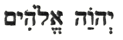
[ 21 ] What did nineteenth-century biblical exegesis make of this? Based on all the facts I have just presented from occult sources, biblical exegesis arrived at the following conclusion. It said: Well, the name Elohim appears in one place, and the name Yahweh in another. Of course, this provides proof that the two documents originate from two different religious traditions, and one must distinguish between what has been passed down from a people who worshipped Elohim, for example, and what has been passed down from a people who worshipped Yahweh. And the person who wrote what we have as the creation account combined both names, Elohim and Yahweh-Elohim, and so now we have one document that has the name Elohim and another that has the name Yahweh. These must be separated again! — Research has already progressed to the point where we now have so-called “rainbow Bibles,” in which everything said to have come from one side is printed in blue letters, and everything said to have come from the other side is printed in red letters. Such Bibles already exist. It is just a pity that one sometimes has to separate the matter in such a way that the first clause is blue and the second clause is red, because the first clause is supposed to come from one people and the second from the other! The only surprising thing is that the main clause and the subordinate clause fit together so wonderfully that some kind of combinator must have come along to bring these two traditions together.
[ 22 ] An immense amount of effort has been devoted to this exegesis of our century, and one can say, if one is familiar with the subject, that perhaps no scientific or historical research has been the object of such great diligence as this nineteenth-century theological exegesis of the Bible, which fills us with deep melancholy and a sense of profound tragedy. That which was meant to tell humanity about the most spiritual has lost its connection to the spiritual sources. It is as if someone were to say: Yes, for example, we see a completely different style in the second part of *Faust* when we compare the passage where Ariel speaks with the doggerel in the first part of *Faust*. This cannot possibly have been written by the same person, and Goethe must therefore be a mythical figure. — The fruit of the most immense labor, the most devoted diligence, tragically stands on the same ground—due to its separation from the occult sources—as someone who denies Goethe’s existence, because he cannot conceive that two things as different as the style of the first part of *Faust* and that of the second part could originate from one and the same person. Here we glimpse a profound tragedy of human life. Here we see how it gives rise to the necessity of directing the spirits back to the sources of spiritual life. Spiritual insight is possible only if people once again seek the living spirit. They will seek it again, for this is linked to an irresistible urge of the human soul. And on the trust that this urge exists in the human soul, that the heart drives people to seek the connection with the spiritual sources once more, and will drive them to an understanding of the very foundation of the religious texts—on this, fundamentally, rests all the power that can inspire us on anthroposophical ground. Let us imbue ourselves with this trust, and we shall reap the true fruits in this realm, which is meant to lead us into spiritual life.