

Excursions into the Subject of
the Gospel of Mark
GA 124
19 December 1910, Berlin
Translated by Steiner Online Library
Fifth Lecture
[ 1 ] We began here last time by offering some insights into the nature and character of the Gospel of Mark. It was already evident from this that, when considering the Gospel of Mark—almost even more so than when drawing on the other Gospels—the aim may be to shed light on the great laws governing both human development and cosmic development in general. It must be said: Building on what is hinted at in this Gospel from the depths of the Christian mysteries, there is reason to delve perhaps most deeply into certain mysteries and laws of cosmic and human evolution.
[ 2 ] Originally, however, I thought it would be possible, in the course of this winter, to offer here significant and intimate insights into matters we have not yet heard of within our spiritual scientific development—or perhaps, to put it better, into matters that lie on spiritual levels we have not yet touched upon. It will nevertheless be necessary to depart from this original plan for this winter, for the simple reason that this Berlin branch in particular has grown in such a surprising way in recent weeks that it would not be possible to convey everything that was originally intended to be said at this time. It is indeed necessary not only to assume a certain level of prior knowledge, for example in mathematics or any other science, but this must be the case to an even greater degree when one ascends to certain heights of spiritual scientific contemplation. Therefore, consideration will be given at a later time to how the sections of the Gospel of Mark that cannot yet be discussed in such a broad context might be presented.
[ 3 ] Above all, however, if we wish to understand a text such as the Gospel of Mark, it is necessary that we first clearly bring to mind the key factors that have shaped the development of humanity. This is, I would say, always emphasized as an abstract, very general truth: that at all times there have been certain leaders of humanity who, because they stood in a certain relationship to the mysteries, to the spiritual, supersensible worlds, were thereby able to impart impulses into human development that could contribute to the progress and advancement of this human development. Now there are two main, essential ways in which human beings can come into relationship with the supersensible, spiritual worlds. One way is the one we can study particularly clearly when we point out—in a few strokes, as will soon be done publicly, exoterically, in a public lecture—the image of the great leader of humanity, Zarathustra; and the other way in which such leaders of humanity can enter into relationship with the spiritual worlds can appear before our inner eye when we call to mind the unique character of the great Buddha. However, these two leaders of humanity, Buddha and Zarathustra, are very different from one another in regard to the entire nature of their work. We must be clear that in what Buddha and Buddhism call the absorption that occurred under the Bodhi tree—which is thus a symbolic expression for a certain mystical deepening of the Buddha—there lies a path that the human ego undertakes into its own being, into its own deeper nature. This path, which Buddha embarked upon in such an extraordinary way, is a descent of the human ego into the depths, into the abysses of one’s own human being.
[ 4 ] You will gain a clearer understanding of what this means when you realize that we have traced human evolution through four stages, three of which have already been completed; we are now in the fourth. We have traced human evolution through the Saturn, Sun, and Moon stages and are now within the Earth stage. We know that these three stages of human development correspond to the formation of the human physical body, the etheric body, and the astral body, and that we are now within the Earth stage, which signifies the formation of the human ego, insofar as this ego is to be developed as a member of the human being. From a wide variety of perspectives, we have characterized this human being as an “I” enclosed by three sheaths: the astral sheath, corresponding to the Lunar stage; the etheric sheath, corresponding to the Solar stage; and the physical sheath, corresponding to the Saturn stage. Schematically, we can depict this human being as follows:
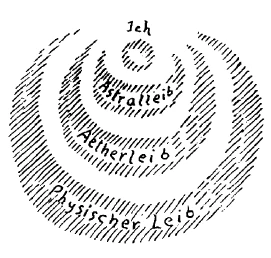
[ 5 ] Given the state of human development today and the level to which human consciousness has evolved, people essentially know nothing; they have no awareness of their astral body, their etheric body, or their physical body. Of course, you might say that people do have an awareness of their physical body. But that is not the case. For what is usually regarded as the human physical body is merely a maya, an illusion. What confronts the human being there, and what they take for the physical body, is essentially already the interplay of the four members of the human being—physical body, etheric body, astral body, and I—and the result, the entire outcome of this interplay, is what, so to speak, confronts the human being as visible to the eyes and tangible to the hands. If you truly wanted to see the physical body, you would have to—much as one might remove three of the four substances in a chemical compound and retain one—be able to remove the ego, the astral body, and the etheric body from the human being; then you would be left with the physical body. But this is not possible under the present conditions of earthly existence. You might think that this happens every time a person dies. But that is not correct. For what remains after a person’s death is not the person’s physical body, but rather the corpse. The physical body could not live by the laws that are active within it once death has occurred. These are not its own inherent laws, but rather laws that belong to the external world. So if you follow these thoughts, you will have to conclude that what is commonly called the human physical body is a Maya, an illusion, and what we in spiritual science designate as the physical body is that regularity, that organism of laws, which within our mineral world creates the human physical body just as the law of crystallization of quartz or that of the emerald creates the quartz or the emerald. This human organization active in the mineral-physical world is actually the human physical body. And this is precisely what is meant in spiritual science whenever the human physical body is discussed. For what the human being knows of the world today is nothing other than the result of sensory perception—that which the senses perceive. Yet the way the human senses perceive can only occur within an organism in which an “I” resides. Today’s superficial view naturally assumes, for example, that an animal perceives the external world in the same way that a human being perceives it through their senses. This is a completely confused view, and people would be very surprised if they were introduced—as must eventually happen—to the way in which the worldview of a horse, a dog, or another animal appears. If the dog’s environment or the horse’s environment were, so to speak, sketched or painted, it would look quite different from what the human worldview is. For in order for the senses to perceive the world as humans do, it is necessary for the “I” to pour itself out over the world and fill the sensory organs—eyes, ears, and so on. Thus, only an organism in which an “I” dwells has a worldview such as that of a human being, and the human being’s external organism stands within it, belonging solely to this worldview. Therefore, you must say: What we are accustomed to calling the physical body of a human being is merely a result of our sensory observation and not reality.
[ 6 ] When we speak of the physical human being—of everything that surrounds the human being in a physical sense—it is the “I” that perceives the world with the aid of the senses and the intellect, which is connected to the brain. Therefore, the human being knows only that which the “I” encompasses, that which belongs to the “I.” As soon as the ego cannot be present in some way with something that is part of the world picture, the world picture ceases to be a perception altogether; that is, the human being then falls asleep. But then there is no world picture around him; he then becomes unconscious. Wherever you look, at every point, your ego is connected to what you perceive; that is, it is spread out over your perception, so that you actually know only the content of your ego. As a normal human being, one knows the content of one’s ego, and what one’s own nature and being is—into which one ascends every morning upon waking—the astral body, the etheric body, the physical body—one does not know these as a human being today, for at the moment when one wakes up as a human being today, one does not see one’s astral body. Modern humans would even be horrified if they were to perceive their astral body—that is, the sum of all the drives, desires, and passions that have accumulated through repeated earthly lives. Nor do they see their etheric body; they could not bear it at all. When he delves into his own nature—into his physical body, etheric body, and astral body—his perception is immediately diverted toward the external world. There he sees what benevolent forces spread out before his gaze, so that he never finds himself in a position to descend into his own inner being, for he could not bear it.
[ 7 ] We are therefore right to say, when we speak of this process in spiritual science: The moment a person wakes up in the morning, they are actually stepping through the gate of their own being. But at this gate stands a guardian; this guardian is the little guardian of the threshold. He does not allow the human being to enter into his own being, but immediately diverts him toward the outer world. Every morning, the human being encounters this little guardian of the threshold. Whoever consciously enters into his outer nature upon waking comes to know this little guardian of the threshold. And fundamentally, the mystical life is concerned only with whether this little guardian of the threshold does us the favor of numbing us to our own inner being—so that we cannot descend into it—and directing our ego toward our surroundings, or whether he lets us pass through the gate and allows us to enter our own being.
[ 8 ] Thus, the mystical life is the act of passing through the gate just described, past the little guardian of the threshold, into one’s own human being. And what is symbolically described for the great Buddha as sitting under the Bodhi tree is nothing other than descending into one’s own inner being through the gate that otherwise closes off this very being to us. What the Buddha had to experience in order to descend into this inner being of his own is depicted within Buddhism. These things are not mere legends, but rather renderings of profound, inwardly experienced truths, of spiritual realities.
[ 9 ] What the Buddha experienced as he descended into his own being is described in Buddhism as the so-called Temptation of the Buddha. In this story of temptation, the Buddha describes how even those beings he loves approach him at the very moment when he seeks to descend mystically into his own inner being. He describes how they seem to draw near to him, urging him to do this or that—for example, to perform false practices in order to enter his own inner being in a false way. We are even shown the figure of the Buddha’s mother—in his spiritual vision he sees her—who urges him to begin a false asceticism. This is, of course, not the Buddha’s real mother. But the temptation lies precisely in the fact that, for his still-developing vision, it is not the real mother but a mask, a Maya, an illusion that confronts him. But he resists. Then a number of demonic figures confront him, which he describes as greed—corresponding to the feeling of hunger and thirst—or as passions, drives, pride, arrogance, vanity, and avarice. They all approach him—how? Well, insofar as they are still within his own veiled nature, within his astral being, insofar as he has already conquered them in his moments of strength, while sitting beneath the Bodhi tree. And in a wondrous way, this temptation of the Buddha shows us how all the forces and powers of our astral body—which exist because we have made ourselves worse and worse through the downward development of humanity in the course of successive incarnations—make themselves felt. Even though he has already risen so high, he can still perceive them and must now, through the final ascent, overcome the last of what remains as tempting demons for his astral body.
[ 10 ] What will a human personality discover when it descends through the region of the astral body—through temptation—into the physical body and the etheric body; that is, when it truly comes to know these two aspects of the human being? If we wish to understand this, we must draw attention to what a human being can experience by descending into their own being. We must point out that, in the course of their incarnations within the course of Earth’s evolution, human beings have indeed been able to corrupt their astral body to a great extent, but have been less able to truly corrupt what lies within them as the etheric body and the physical body. One corrupts the astral body through everything that can be called the egoisms in human nature: envy, hatred, selfishness in general, arrogance, pride, and so on. Through all these things one corrupts the astral body, as well as through all the lower instincts and so on. As a human being, one can essentially corrupt the etheric body only—for a normal person today has no greater power than that—through lying, and at most unconsciously through error. But even then, only a part of the etheric body can ever be corrupted. A certain part of the etheric body is so strong that no matter how hard a person might try to corrupt it, they could not do so, for the etheric body would resist. A person cannot descend so far into their own nature with their own individual powers that they could corrupt the etheric body or the physical body. Only in the course of incarnations can the faults that a person directly kindles continue to affect the physical body and the etheric body; and they then appear as illnesses, as injuries, and as predispositions to illness, even in the physical body. But a person cannot act directly, not immediately from their individuality, upon their physical body. If he cuts his finger, this is not an effect of the soul on the physical body; nor is it the case when the physical body becomes infected. In the course of his incarnations, the human being has become capable only of acting upon the astral body and upon a part of the etheric body; but he can act upon the physical body only indirectly, never directly.
[ 11 ] Therefore, we can say: When we descend into the region of the etheric body, over which we still have direct influence, everything that already belongs to the human being’s successive earthly lives—the incarnations—becomes apparent in this region; so that the moment the human being immerses themselves in their own being, they also immerse themselves in their previous, more distant incarnations. Human beings thus find the path to their earlier incarnations by immersing themselves in their own being. And when this immersion is as intense, as powerful, and as comprehensive as it was in the case of the great Buddha, this insight into the incarnations extends further and further.
[ 12 ] Now, human beings are, in their original essence, purely spiritual beings, and everything that constitutes their physical forms has developed later around their spiritual essence. Human beings have sprung from the spirit, and everything external is like a condensation arising from the spirit. Thus, through this immersion into his own being, man enters into the spirit of the world. This descent into oneself, this breaking through the shell of the physical body, is a path into the spiritual fabric of the world, to see how this physical body has been built up again and again in the course of incarnations. And when the human being goes back far enough, to the times when, through ancient primitive clairvoyance, the human being was a member of the spiritual world, then he looks right into the spiritual world.
[ 13 ] In what has been handed down from the Buddha—and this, too, is not mere legend—you will find the stages the Buddha reached as he journeyed through his own being, of which he himself says: When I had reached the point of enlightenment—that is, when I could feel myself as a member of the spiritual world—I had reached the point where I saw the spiritual world lying before me like a spreading cloud, but I could not yet distinguish anything within it, for I did not yet feel complete. Then I took another step forward. There I no longer saw only the spiritual world lying like a spreading cloud, but I could also distinguish individual forms; yet I could not yet see what they were, for I was not yet perfect. Again I ascended one step higher and now found not only distinct beings, but I could know what kind of beings they were.
[ 14 ] And this process continues until he himself saw his archetype, which has descended from incarnation to incarnation, and was able to perceive it in its proper relationship to the spiritual world. This is the one path, the mystical path: passing through one’s own being to the point where that boundary is broken through, beyond which the spiritual world can then be reached. On this path, one group of humanity’s leaders attains that which such individuals must possess in order to provide the impulses for humanity’s further development.
[ 15 ] Through a completely different path, personalities such as the original Zarathustra gain the opportunity to become leaders of humanity. If you look back once more at what I have said about Buddha, you will realize that in his earlier incarnations, where he had advanced as far as the Bodhisattva, he must already have ascended from stage to stage. Through enlightenment—sitting beneath the Bodhi tree—which must be depicted as I have just described it, a personality who has gradually ascended to great heights through the merits inherent in their individuality gains the ability to look into the spiritual worlds. If humanity had always been dependent solely on such leaders, it would not have been possible to advance humanity as far as it has. There were, however, other leaders as well. Zarathustra was of this other kind. I am not speaking now of the individuality of Zarathustra, but of the personality of the original Zarathustra, the herald of Ahura Mazdao. When we study such a personality in the place where it meets us in the world, there is initially no individuality within it that has risen particularly high through its own merits; rather, such a personality is chosen to be a vessel, a vessel for a spiritual being, for a spiritual individuality that cannot incarnate itself in the world in a physical form, but can only shine into a human vessel and work within it.
[ 16 ] In my Rosicrucian mystery work *The Gate of Initiation*, I drew attention to how a human being is inhabited at a specific point in time, when it is necessary for the development of the world, by a higher being. This is not meant merely as a poetic image, but as a poetic representation of an occult reality.
[ 17 ] The personality of the original Zarathustra was therefore not one that had risen to such heights through its own efforts as Buddha had, but was destined to be inhabited, as it were, by a higher individuality that would permeate and inspire it. Such personalities were found primarily in all those cultures of ancient times—that is, in all pre-Christian cultures—that had developed throughout Europe and across northwestern and central-western Asia, but not in those pre-Christian cultures that extended into Asia through Africa, Arabia, and the countries of the Near East. While in the latter countries the type of initiation I have just described—in its highest form as exemplified by the great Buddha—was predominant, the other type of initiation, which I now wish to illustrate with a specific example from Zarathustra, was particularly prevalent among the northern peoples. Even in our regions, as recently as three to four millennia ago, the only possibility was to confer the kind of initiation I am now about to describe.
[ 18 ] In much the same way, the personality of Zarathustra was destined to be the vessel for a higher being who was not to incarnate itself. It was, as it were, determined by the spiritual worlds: a divine-spiritual being was to be immersed into this child, a being capable of working within this human being, of making use of his brain, his faculties, and his will once this child had grown up. For this to happen, however, something quite different must occur with the human being from the very beginning than what usually happens in individual human development. Now, the processes that are to be described here do not so much take place on the physical-sensory level as they do throughout the entire life of such a growing human being, although, of course, someone else who were to observe such a child with gross senses would not be able to perceive them. But whoever can observe it sees that from the very beginning there are conflicts between the soul forces of such a child and the outer world, that this child has a will, an impulsiveness, that stands, as it were, in contradiction to what is happening all around. Such is the fate of the divine, spirit-filled personalities: that they grow up as strangers, that their surroundings lack the sense and feeling to truly understand them. Usually there are only very few, perhaps even just one person, who can have a sense of what is developing within such a human being. Conversely, conflicts with the environment easily arise, and what I have just described to you in the story of the Buddha’s temptation—what arises when a person descends into their own being—does not occur only in later years.
[ 19 ] Just as a person is in ordinary life, their individuality is born into the outer shell bestowed upon them by their parents and their people. This individuality does not always fully align with the outer shell, and that is why people always feel more or less dissatisfied with the way fate has treated them. But a conflict as bitter and as violent as that which existed, for example, in Zarathustra is not possible if a person grows up with his individuality in a way that corresponds to ordinary human life. If one now observes such a child as Zarathustra was through clairvoyance, it becomes apparent that he possesses within himself feelings, abilities, and powers of thought and will that are entirely different from what develops in the surrounding humanity in terms of feelings, impulses of will, ideas, and so on. Above all, it turns out—and indeed it always turns out this way, though it is simply not noticed because people today do not consider psychic, spiritual facts—that the environment knows nothing of the true nature of such a child, yet instinctively feels hatred toward such a person, disliking what is growing up there. This is the sharpest conflict that meets the clairvoyant eye: that such a child, who is actually born to be a savior of humanity, unleashes storms of hatred all around. This must be so. For it is precisely because the child is so different that the great impulses enter into humanity. Such things are then told to us in connection with corresponding personalities, as they are told to us in the case of Zarathustra.
[ 20 ] It is said that Zarathustra is capable of something that usually takes weeks to develop in humans: that he can perceive the harmony of the world in such a way that he develops his “Zarathustra smile.” This smile of the newborn Zarathustra is described to us as the first thing that reveals him to be something entirely different from the other people around him. The second is that an enemy, a sort of King Herod, was found in the region where Zarathustra was born. His name was Duransarun; and with his own hand—after he had learned of Zarathustra’s birth, which had been revealed to him by the Magi, the Chaldeans—he attempted to murder the child. Now the legend tells: At the very moment he raised his sword and was about to kill the child, his hand went limp, and he had to desist. — All of this is merely imagery that spiritual consciousness might have perceived, images of spiritual realities. The story continues to tell how this enemy of the child Zarathustra, since he could not kill him in this way, had a servant carry him out to the wild animals in the desert so that they might kill him. But when they went to look for him, no wild animal had touched him; instead, they found the child sleeping peacefully. When this attempt also failed, the enemy had the child of Zarathustra abandoned in such a way that a whole herd of cows and oxen would have to run over it, trampling it to death. But the first animal, so the legend tells, took the child between its legs, carried it away so that the rest of the herd had to pass by, and then set it down. Thus, no harm came to him. The same thing happened with a herd of horses. And finally, the enemy tried to have a pack of wild animals, after all their young had been snatched away, have the Zarathustra child placed in their stead. But when the parents checked, it turned out that these animals, too, had not harmed the child; rather, as the legend states, the Zarathustra child had been nourished by the “heavenly cows” for a long time.
[ 21 ] At first, we need see nothing more in such a wealth of information than that the presence of the spiritual being, the spiritual individuality, which enters into such a soul, awakens very special forces to bring such a child into disharmony with its surroundings—a disharmony that is necessary so that upward impulses can be given to the development of humanity. For disharmony is always necessary if we are truly to advance toward perfection. It should then be pointed out, however, that these forces are such that they nevertheless benefit such a being, such a child, by leading it upward toward the connections with the spiritual world into which it is to enter. But through what does the child itself experience all these conflicts?
[ 22 ] Imagine that this entry of the soul into its own being were a moment of awakening. When the soul can experience the physical body and the etheric body within itself, it undergoes the development I described in the case of Buddha. Now imagine falling asleep consciously. As it is today, when a person falls asleep, they lose consciousness—it ceases, and nothingness surrounds them as their worldview. But imagine if a person retained their consciousness while falling asleep. Then they would be surrounded by a spiritual world into which the person pours themselves during sleep. But there are certain obstacles here as well. Even in the evening, when we fall asleep, there stands a guardian of the threshold before a gate that we must pass through. This is the great guardian of the threshold, who does not let us enter the spiritual world as long as we are immature; who does not let us in for this reason: because, if we have not yet made our inner being strong and firm, we are exposed to certain dangers if we were to pour out our ego into the spiritual world into which we enter when we fall asleep.
[ 23 ] These dangers lie in the fact that, instead of seeing the objective reality of what exists in this spiritual world, we would see only what we ourselves bring into it through our fantasies, our thoughts, sensations, and feelings. And we bring in precisely what is worst in us, what does not correspond to the truth. Therefore, entering this spiritual world prematurely means that a person does not see reality, but rather figments of the imagination, fantastical constructs—constructs that are technically described in spiritual science as not being human vision. If a person were to see the objective in the spiritual world, they would ascend a step higher; they would see what is human. It is always a sign of fantastical vision when a person, upon ascending into the spiritual world, sees animal forms. For these animal forms represent their own fantasies, because they are not sufficiently grounded within themselves. What is unconscious at night must absorb a force within itself so that the outer spiritual world becomes objective. Otherwise, it becomes subjective, and we carry our own fantasies into the spiritual world. We do carry them in otherwise as well, but the Guardian of the Threshold protects us from seeing them. For this is, after all, a purely inner process: the ascent into the spiritual world and this being surrounded by animal figures that attack us because they want to lead us into error. We need only surround ourselves with ever greater strength; then we can enter the spiritual world.
[ 24 ] When a child such as the Zarathustra child is filled by a higher being, the little body is naturally immature and must first be brought to maturity. In such a case, the human constitution—the constitution of the intellect and the senses—is, as it were, inflated. Such a child exists in a world that can quite aptly be described as “being among wild animals.” We have often described how, in such depictions, the historical and the pictorial are merely two different sides of the same thing. Events unfold in such a way that what the spiritual powers are—when they assert themselves outwardly as hostile, as in the case of the Zarathustra child—manifests, for example, in the person of King Duransarun. But the whole thing also exists in its archetype in the spiritual world, so that the external actions correspond to what happens within the spiritual world. In today’s way of thinking, people are not able to grasp such a thought easily. When one says that the events surrounding Zarathustra have significance in the spiritual world, people think: Then they are not real. But if one proves that they are historical, then modern people are again inclined to view every personality as developed only to the same extent as themselves. This is, after all, the aim of today’s liberal theologians: to imagine, for example, the figure of Jesus of Nazareth as similar to—or not much beyond—what they themselves can conceive as their own ideal. It greatly disturbs people’s materialistic peace of mind today when they are asked to imagine great individualities. Nothing may exist in the world that is too exalted above the respective professor or theologian who wishes to elevate himself to such an ideal. But in the case of great events, we are dealing with something that is both historical and symbolic-spiritual, so that one does not exclude the other. Whoever does not understand that the external form signifies something else will never come to understand the real and essential.
[ 25 ] The soul of the child Zarathustra was thus indeed led into great dangers in his early youth; but at the same time, as the legend tells, the heavenly cows stood by his side to help him; they strengthened him.
[ 26 ] Among all the great founders of worldviews throughout the region stretching from the Caspian Sea through our lands to Western Europe, you can observe this phenomenon: such individuals, without having risen through their own development, are imbued by a spiritual being in order to become leaders of humanity. The Celtic people had a considerable number of such legends. The account of Habich, a Celtic religious founder, describes how he too was abandoned and nursed by heavenly cows, how enemy attacks were repelled, how animals retreated before him—in short, these descriptions of the dangers faced by the Celtic leader Habich are such that one might say: Some of the seven miracles of Zarathustra have been selected—as it were, because Zarathustra is regarded as the greatest figure of this kind. Certain features of the miracles of Zarathustra can be found throughout Greece and into the Celtic regions. One need only think of Romulus and Remus to have a well-known example.
[ 27 ] This is the other path through which leaders of humanity emerge. In this way, we have characterized in a deeper sense what we have often considered: the two great cultural currents of the post-Atlantean era. After the great Atlantean catastrophe, one cultural current developed through Africa, Arabia, and South Asia, while the other, further north, extended through Europe and North Asia toward Central Asia. There the two currents converged. And everything that emerged from this is our post-Atlantean culture. The northern current had leaders such as I have now described in Zarathustra, while the southern current had leaders such as those who appeared in their highest representation in the great Buddha.
[ 28 ] If you now recall what we already know about the Christ event, you will ask yourself: How does John’s baptism in the Jordan appear to us now?
[ 29 ] Christ descends, a spiritual-divine being, just as all the northern leaders and founders of worldviews—most notably Zarathustra—have descended into a human being. It is the same process, only transposed to the greatest scale: Christ descends into a human being, but not in childhood, rather in the thirtieth year of life, and this personality of Jesus of Nazareth is specially prepared for this. Both mysteries of human leadership are to be presented to us in synthesis, in union, in harmony with one another. And while the two evangelists, Matthew and Luke, primarily depict how the human personality into which the Christ descends was formed, the Gospel of Mark presents to us the character and nature of the Christ-being itself. The overflowing element in this great individuality is presented to us in particular through the Gospel of Mark. That is why the Gospels of Matthew and Luke describe a different account of the temptation than the Gospel of Mark, because Mark portrays the Christ who has entered into the Jesus of Nazareth. Here, the account of the temptation must appear that otherwise occurs already in childhood: being with animals and the assistance of spiritual forces. That is why you can see it as a repetition of the Zarathustra miracles when the Gospel of Mark tells us in impressively simple terms: “And the Spirit drove him into the wilderness; … and he was with the animals, and the angels”—that is, the spiritual beings—“served him.” Whereas the Gospel of Matthew describes something quite different, something that appears to be a repetition of the Buddha’s temptation—that is, what happens when one descends into one’s own being, where all the temptations and seductions approach the human soul in question.
[ 30 ] Thus we can say: Matthew and Luke describe the path that Christ took as he descended into the forms he had received through Jesus of Nazareth; and the Gospel of Mark describes what the Christ had to experience as a kind of story of temptation, as he clashed with his surroundings, just as all the founders of religions have clashed who were inspired or guided by a spiritual being from above. The Christ Jesus undergoes both, whereas the earlier leaders of humanity have always undergone only one. He unites the two kinds of paths into the spiritual world. This is precisely the essential point: that what previously unfolded in two great currents, into which various smaller ones then flowed, now converges into a single current.
[ 31 ] Only from this perspective can we understand the apparent or actual contradictions between the Gospels. The writer of the Gospel of Mark was initiated into such mysteries that enabled him to describe what the Markan temptation is: going out to the animals and receiving help from spiritual beings. Luke was initiated into the other aspect. Each of the Gospel writers described what was close to him and familiar to him. Thus, it is different aspects of the events in Palestine or the Mystery of Golgotha that are presented to us in the Gospels.
[ 32 ] With this, I wanted to illustrate to you once again, from a perspective we have not yet been able to discuss here, how one must understand the course of human development and the intervention of such individualities who thus ascend from the development of the Bodhisattva to the Buddha; and how one must understand the development of those in whom what they are as human beings does not really come into consideration, but rather what comes down from above. Only in the figure of Christ do these two aspects unite. Once one knows this, the figure of Christ can be understood all the more fully.
[ 33 ] This will also help you understand that certain inconsistencies are bound to arise in mythical figures. When it is described that certain spiritual beings have done this or that—in terms of right or wrong and the like—such as Siegfried, one might well ask: But wasn’t he an initiate, as was said? — Yet with such a personality through whom a spiritual being acts, individual evolution—for example, that of Siegfried—is not a factor. Siegfried can make mistakes. However, the point is to contribute something to the development of humanity. For this, the most suitable personality must be chosen. One cannot lump everything together; one cannot judge a Siegfried in the same way as a southern leader; for the entire nature and character is different from that of those who descend into their own being.
[ 34 ] One might therefore say: A spiritual entity permeates the northern figures and propels them out of their own being, enabling them to ascend into the macrocosm. Whereas in southern cultures the human being descends into the microcosm, in the northern cultural current he pours himself out into the macrocosm and thereby comes to recognize the entire spiritual hierarchies, just as, for example, Zarathustra recognized the spiritual nature of the sun.
[ 35 ] We can thus summarize what has been said as follows: The mystical path, the Buddha-path, leads through one’s own inner being to such an extent that, through a breakthrough of one’s inner self, one enters the spiritual world. The Zarathustra path snatches the human being from the microcosm and pours him out over the macrocosm, so that its mysteries become transparent. The world still has little understanding for the great spirits who are to unveil the mysteries of the great world. Therefore, there is truly very little understanding, for example, of the Zarathustra being. We shall see how much what we have to say about Zarathustra differs from what is commonly said about him today.
[ 36 ] This is yet another digression intended to gradually familiarize you with the nature of the Gospel of Mark.