

Excursions into the Subject of
the Gospel of Mark
GA 124
13 March 1911, Berlin
Translated by Steiner Online Library
Ninth Lecture
[ 1 ] Today we are about to bring the reflections we have made over the course of this winter—in a rather loose and unstructured way based on the Gospel of Mark—to at least a provisional conclusion. This connection to what we have been able to bring before our souls on these evenings throughout the winter is provided by the words spoken here in the previous lecture, which, in a sense, pointed out how we stand in our time within a transitional epoch. Even those who view spiritual life today—one might say—somewhat from the outside will be able to notice that, in many respects, a reordering of concepts and ideas is taking place slowly and gradually, even if the people who are right in the midst of this reordering hardly realize it themselves. We would do well now to take with us for the coming weeks a kind of material for reflection—some of what we can then use as a guide as we continue to process it within ourselves. That is why some such suggestions will be offered this evening, which can then be further processed on the basis of the spiritual scientific material already presented.
[ 2 ] When speaking of a transitional era, it is useful to recall the great transitional era we have experienced in the development of humanity—one we have spoken of time and again—and to recall the turning point of the events in Palestine. We know what this turning point signifies from much of what has already been said. If we now wish to form a conception of how this most important idea— —let us call it that—the Christ idea—grew out of the thoughts and feelings of the immediately preceding era, we would do well to remember that the idea of Yahweh or Jehovah was of the same value to the ancient Hebrew people as the Christ idea was to those who became followers of Christ. We also know from other lectures that, for those who penetrate more deeply into the essence of Christianity, Yahweh or Jehovah is, in essence, no different from Christ himself. Rather, we must realize that there is an intimate connection between the idea of Yahweh and the idea of Christ. It is difficult to explain here in a few words the entire vast connection between the idea of Christ and the idea of Yahweh, which has, to a certain extent, been developed in various lectures and lecture series over the past years. But one image can already illustrate how we are to conceive of the relationship between the idea of Christ and the idea of Yahweh. We need only recall an image that has already been pointed out on several occasions: the image of sunlight as it appears to us either directly from the sun or, especially on moonlit nights, as it is reflected back by the full moon. It is indeed sunlight that shines toward us from the full moon, but it is reflected sunlight, which is nevertheless something different from the sunlight received directly. If, to draw a comparison, we were to symbolize Christ by direct sunlight, then we would have to symbolize Yahweh or Jehovah as sunlight reflected back by the moon, and in doing so we would precisely capture the meaning intended in the development of humanity. That is why everyone who knows anything about these matters perceives this transition from a temporary reflection of Christ in Yahweh or Jehovah to Christ himself in the same way that a person would perceive moonlight and sunlight: Yahweh or Jehovah is an indirect manifestation, while Christ is a direct manifestation of the same being. When we think of evolution, we must simply conceive of what appears to us side by side in space as occurring one after the other in time. And those who speak of these things from an occult point of view say: If we call the Christ religion a sun religion—and if we recall what was said about Zarathustra, we may use this term—then we can call the Yahweh religion, the temporary reflection of the Christ religion, a moon religion. Thus, in the time preceding Christianity, we prepared the Sun religion through a Moon religion. Now, what is about to be said will be properly appreciated only by those who know that symbols are not chosen arbitrarily, but are deeply grounded in their meaning. Therefore, when any world religion or worldview presents itself with a symbol, that symbol signifies, for those who use it with knowledge, something that is essentially connected to the worldview in question. Now, although people today have largely lost the symbol of moonlight for the ancient Yahweh religion, and have also, in a certain sense, lost the designation of the Christ religion through the sun symbol, wherever worldviews appear that are completely imbued with the meaning of their essence through their symbols, we must also conceive of a conscious connection with those symbols.
[ 3 ] Now, recall how I characterized the overall course of human development. First, we have a downward development beginning at the time when human beings were, so to speak, cast out of the spiritual world and descended deeper and deeper into the material world. This is a downward path. And when we imagine the general course of human development, we can think that the lowest point to which humanity descended is the one where the Christ impulse took effect, gradually transforming the descending path into an ascending one. Thus, we have the development of humanity on a descending and an ascending path, and at the lowest point, the Christ impulse began to work there and will continue to work until the Earth has reached the end of its mission.
[ 4 ] However, evolution proceeds in a complex manner, namely in such a way that certain evolutionary processes are continuations of impulses given earlier. One such evolutionary process is that brought about by the Christ impulse. The Christ impulse arose once at the beginning of our era and will, as it were, in a straight line—becoming ever more powerful—take root in human souls until the goal of human development is reached, and from there take hold of the entire life of the Earth. This is an impulse that is given once and that we must follow in such a way that we can, as it were, draw a progressive line and say to ourselves: Everything that occurs later reveals to us the development and influence of this impulse on a higher, more perfect level. There are several such impulses in the world. But there are also impulses and factors of development that operate differently and cannot be traced in a straight line. We have already mentioned such other impulses as well. In post-Atlantean development, we have distinguished the ancient Indian cultural epoch, followed by the ancient Persian, the Egyptian-Chaldean, then the Greco-Latin, followed by our own, and, succeeding ours, two further cultural epochs, so that within these seven periods, the Greco-Latin one—in which the Christ event occurs—stands right in the middle.
[ 5 ] Now, the fact is that, for example, in our fifth post-Atlantean epoch, in which we now live, certain processes are repeating themselves in a different form than they did in the third, the Egyptian-Chaldean epoch; so that we have the Christ impulse standing at the center, and the third epoch is contained within the fifth in a certain sense. Likewise, the second, the primordial Persian epoch, will be contained within the sixth, and the first, the ancient Indian epoch, within the seventh. Here we are dealing with overarching developmental factors that will manifest in evolution in such a way that we can apply the biblical saying to them: The first shall be last. — The ancient Indian epoch will revive in the seventh in a different form, yet in a way that will be recognizable.
[ 6 ] Here we have another way in which the earlier period influences the later one. However, this other way arises from the fact that, within the development of humanity, even smaller epochs are formed. In a certain sense, therefore, what existed in the pre-Christian epoch during the ancient Hebrew culture extends once more into the post-Christian era, overlapping the Christ impulse, as it were, so that what was prepared in the Yahweh or Jehovah worldview has, in a certain sense, reappeared later and, despite the existence of other factors, it nevertheless plays a role in the later factors.
[ 7 ] If we wish to describe, through a symbol, what we cannot adequately elaborate on today due to time constraints, we can say: If we perceive the Yahweh religion through the symbol of the moon in contrast to the sun, we can expect that a similar view, encompassing the Christ impulse, will re-emerge in later times as a kind of moon religion. This is indeed the case. And anyone who does not take such things superficially will not laugh at them — for it is not a matter for laughter, but is in fact connected with the symbolism of the religion and worldview in question — that the reappearance of the ancient Yahweh-Moon religion can be seen in the religion of the crescent moon, which reemerges in the period following the Christ event and carries the preceding impulses into the post-Christian era. Thus we have the repetition of an earlier period in a later one in an overarching sequence in the last third of the Greco-Latin era, which we indeed count, in occult terms, into the 12th and 13th centuries. That is to say, after a period of six centuries has been set aside — beginning in the 6th century, extending into the next era, and powerfully influencing all factors of development—in the religion that the Arabs carried from Africa to Spain, that religion which, disregarding the actual Christ impulse, represents a kind of re-establishment of the Yahweh-Moon religion in another form. It is not possible now to analyze all the peculiarities of what was carried over there. But it is significant, if we only take to heart, that in this worldview of Mohammed the Christ impulse was initially disregarded, that this Mohammedan religion was truly a kind of revival of what could be found in the monotheism of Mosaic religion. Only this God of Unity was carried into something that was, so to speak, taken from the other side, for example from the Egyptian-Chaldean worldview, which provided precise knowledge of the connection between the events in the starry sky and world events. Hence we see that all those ideas and concepts which we find among the Egyptians as well as among the Chaldeans, Babylonians, and Assyrians reappear in the religion of Muhammad, but now, in it, strangely illuminated and permeated by what we might call the monotheistic deity of Yahweh or Jehovah. It is like a union—to speak scientifically—like a synthesis of everything that the Egyptian-Chaldean priest-sages taught, of what was taught in Chaldea, with what the ancient Hebrew religion of Yahweh taught, which we encounter there in the Arab world.
[ 8 ] However, in such a convergence, it is not merely a matter of things coming together; rather, something is always set apart and separated. Everything that had been attributed to clairvoyant observation now had to be set apart. What remained was a process of synthesis, a purely intellectual inquiry, so that the concepts of Egyptian medicine and Chaldean astronomy—which had emerged among both the Egyptians and the Chaldeans from ancient clairvoyance—present themselves to us in an intellectualized and individualized form in the Arab world of Muhammad. It is brought to us in Europe, as it were, by a roundabout route through the Arabs, in a filtered form — refined in that all the ancient concepts that prevailed among the Egyptians and Chaldeans were stripped of their clairvoyant imagery and cast into abstract forms, reappearing to us in the admirable science of the Arabs, who made their way into Europe from Africa via Spain. If Christianity provided an impulse that was essentially for the human soul, then the greatest impulse for the human mind, for the human intellect, came indirectly through the Arabs. And those who are not well acquainted with the course of human development have no idea what this worldview, which reappeared under the symbol of the moon, has actually given to all of humanity. Kepler and Copernicus would not have been possible without the impulses brought to Europe through Arab culture. For the entire manner of thinking and combining worldviews while setting aside the old clairvoyance, we see reappearing in the time when the third cultural period celebrates its resurrection in our fifth epoch—in our present-day astronomy, in our present-day science in general.
[ 9 ] Thus, on the one hand, we have the course of human development proceeding in such a way that the Christ impulse penetrates directly into the European peoples through Greece and Italy, and we have another current to the south of this, which takes a detour by passing by Greece and Italy and connecting with what has come to us via the Arab impulse.
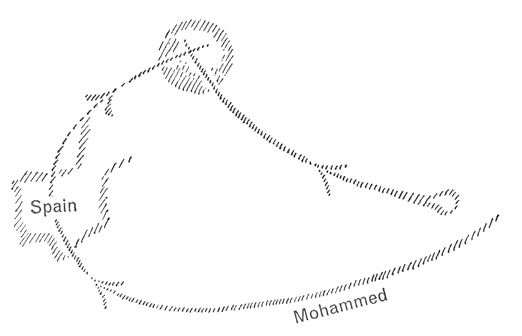
[ 10 ] It was only through the convergence of the Christian and Islamic religions during the period marked by a significant turning point that what we now recognize as our modern culture could emerge. For reasons that need not be discussed here, we must conceive of epochs lasting roughly six to six and a half centuries specifically for impulses such as those just mentioned; so that, in fact, six centuries after the Christ event, the renewed moon cult—the Arab moon cult—arises, spreads, and penetrates into Europe, fertilizing Christ culture well into the 13th century, a culture that had received its direct impulses through other channels. There was a continuous exchange. Anyone who is even vaguely familiar with the outward course of events, anyone who knows how, even in the monasteries of Western Europe—though they may have fought against Arab culture —Arabic ideas flowed into science and spread within it, knows also that up to that point in the mid-13th century, which again signifies something special, there was a convergence of the two impulses: the Arabic impulse and the direct Christ impulse.
[ 11 ] From this you will be able to see that the direct Christ impulse indeed takes a different path from the impulses that flow toward it, as it were, as side currents, in order to unite with it. Six centuries after the Christ impulse, a new cultural wave arises in the East through events that are not easy to describe, although they are well known to every occultist—a wave that then flows through Africa and Spain into European spiritual life and unites with the Christ impulse, which had to come by other paths. We can therefore say that the sun symbol fused with the moon symbol from the 6th and 7th centuries into the 12th and 13th centuries—that is, again during an epoch that lasted about six centuries.
[ 12 ] Now, after this direct inspiration had, so to speak, achieved its goal, something new began to take shape, gradually developing from the 12th and 13th centuries onward. It is interesting that even today, conventional science acknowledges that something inexplicable was at work in the souls of the European people at that time. Conventional scholarship says: something inexplicable. Occultism, however, says that during this time, as it were flowing in the wake of the direct Christ impulse, that which the fourth period of post-Atlantean culture itself offered poured into the souls in a spiritual manner; the Greek period forms a subsequent wave. This is what we call the era of Renaissance culture, which now, over the next few centuries, fertilizes everything that was already there. Thus we see once again such a transition following a six-hundred-year epoch of the influx of Arab culture, seeing how Arab culture was given time, after it had flowed in, to gradually settle in. This occurs because the Greek era, which stands neutrally in the middle of the seven post-Atlantean cultural epochs, follows on into Renaissance culture. And it signifies another period of six centuries—that is, extending into our own time—during which this Greek wave, so to speak, runs its course. Our time still lives within this today. We are living, so to speak, in a transition today, insofar as we are once again standing at the beginning of a six-hundred-year cultural wave, in which something new is pushing its way in, and the Christ impulse must be fertilized by something new. Now that the renewed moon cult, in its crescent phase, had time to run its course through the Renaissance, the time has come in which the Christ impulse—which propagates itself directly—must take up a side current. Our time has a very special character due to this secondary current. We must, however, understand precisely how this secondary current flows into our culture. All these things correspond entirely to the proper course of an occult schema—an occult system, we might also say.
[ 13 ] If we were to think of the Moon, Mercury, Venus, and the Sun in succession in the old style—not the new one—then, after the renewed influence of the Moon had been present and the lunar wave had, so to speak, run its course during the Renaissance, we would now expect an influence that we would have to designate, in a perfectly correct manner, with the symbol of Mercury. We could therefore theoretically say that, if the symbolism holds true, we are facing the prospect of a kind of Mercury influence flowing into our culture—a wave that can be symbolized as a Mercury influence, just as the Arab period could be characterized as a lunar influence.
[ 14 ] If we have an understanding of the course of history, we may describe Goethe as the last great spirit who united within his soul the richness of science, the richness of Christianity, and the richness of Renaissance culture, and we could then expect that Goethe would portray in his soul the beautiful synthesis of Renaissance culture, science—that is, intellectualism, as it was fertilized by Arab culture—and Christianity. If we now view Goethe as we have been accustomed to doing for years, it is easy to see that these elements truly converged in Goethe’s soul. However, based on the time periods of six centuries each that have just been mentioned, we might also expect that the influence of Mercury was not yet present in Goethe’s soul and that this must be something that was to emerge as something new after Goethe. It is interesting—as you know—that even Goethe’s student, Schopenhauer, already exhibits this influence of Mercury. You know from my remarks how Eastern wisdom has penetrated Schopenhauer’s philosophy, particularly in the form of Buddhism. Since Mercury is regarded as the symbol of Buddhism, you have accordingly characterized the Buddha influence—in that here Buddha is equal to Mercury and Mercury is equal to Buddha—in relation to Goethe’s time in the same way that you characterized the lunar influence in Arab culture; so that we can now also designate what this side current is, which flows into the straight path of the Christ impulse as a new current at the beginning of a new six-hundred-year epoch: We must regard Buddhism as the side current—as a renewal in a new form—with the qualifications set forth in my public lecture on Buddha.
[ 15 ] Now let us ask ourselves: What is the direct current of culture flowing into the future? It is the Christ current. It flows onward in a straight line. And what side currents can we observe? First, we have the Arab current, which flows into the main current and then takes a pause, finding clarification in Renaissance culture. Now we are witnessing a renewed influx of the Buddha current. Anyone who is able to see these facts in the right light will now say to themselves: We must therefore take up those elements from the Buddha current that have not yet been contained within our Western culture. There we can already see how certain elements of the Buddha current are also flowing in through Western spiritual development, such as the ideas of reincarnation and karma. These are flowing in. However, we must now firmly impress upon ourselves something else: All these side currents will never be able to shed light on the core of our worldview, our spiritual science. To ask Buddhism or any pre-Christian Orientalism—which extend into our time as renewing worldviews—about the nature of Christ, for example, would be just as sensible today as if Christian Europeans had asked the Arabs who had come to Spain about the nature of Christ. People in Europe knew back then that the idea of Christ could not come to them from the Arabs, that the Arabs had nothing to say to them about Christ. And if they did say something to them, it was ideas that did not correspond to the true idea of Christ. And the various prophets who appeared as false messiahs—with no understanding of the Christ impulse—emerged from the Arab world, with the exception of Sabbatai Zevi. It must therefore be clear to us that this offshoot of the Arab world was to be enriched by entirely different elements—and by no means through an insight into the central mystery of the Christ.
[ 16 ] In exactly the same way, we must approach that current which must flow toward us today as a secondary wave—an ancient wave renewed—that will bring understanding of reincarnation and karma, but which cannot possibly bring an understanding of the Christ impulse. For that would be just as absurd as if the Arabs had wanted to teach Europeans the true idea of Christ. The Arabs, however, were able to impart many ideas of false messiahs to the Europeans, right up to Sabbatai Zevi. Such things will arise again. For the development of humanity can only move forward if people have the strength to see through these things. And we must see through the circumstances with ever greater clarity and urgency.
[ 17 ] Consequently, it will become evident that the spiritual science based on the central idea of Christ—which was founded by the European Rosicrucians—will prevail against all external resistance and will find its way into the hearts and minds of people, despite all external temptations. You can learn from my *Outline of Esoteric Science* how the central idea of Christ must enter into the minds of people, and how Christ is woven into the overall evolution not only of humanity but of the entire world. From this, it becomes clear which path is currently evolving. All those who are able to understand a passage such as the one from the Gospel of Mark cited at the end of the last lecture will have the opportunity to heed this spiritual science that is currently evolving: “False Christs and false prophets will arise … If anyone says to you at that time, ‘Look, here is the Christ!’ or ‘There he is!’ do not believe them!” — Alongside this current, however, another will emerge further afield, which will believe itself to be even better informed about the nature of Christ than the Rosicrucian Western spiritual science. All manner of ideas and teachings will then be brought into the world from views that will grow quite naturally on the soil of the side current of Orientalizing Buddhism. But it would be a sign of the gravest weakness on the part of European souls if these European souls were unable to grasp the thought that, in the direct pursuit of the Christ idea, the Mercury or Buddha current has just as little light to shed as Arabism has shed in the direct pursuit of the Christ idea. This is not derived here from any belief, from any dogmas or fantasies, but from the objective course of world development. With figures or cultural currents that you can trace if you wish, it will be demonstrated to you that things must be as occult science teaches.
[ 18 ] However, what is now taking place will be linked to the necessity of distinguishing between an orthodox, ancient Eastern Buddhism—which, so to speak, seeks to transplant a static form of Buddhism into Europe and to recognize a “Christ idea” within that static Buddhism—and a Buddhism that has truly evolved. That is to say, there will be people who will speak of Buddha in this way: Look at Buddha, who lived about five to six centuries before our era! These are his teachings! — What these people will say is comparable to what spiritual science in the Rosicrucian sense must say: It is up to you, not Buddha, that you speak today as if Buddha had remained at the stage he was at five to six centuries before our era! Do you believe that Buddha has not progressed? When you speak this way, you are speaking of a teaching that was correct for that time. You are, after all, speaking of a teaching of the Buddha as he gave it, correctly calculated for the time five to six centuries before our era! But we look up to the Buddha who has advanced, and who from spiritual heights exerts his enduring influence on human culture. We look to that Buddha whom we were able to portray in our examination of the Gospel of Luke, who exerted his influence on Jesus of the Nathanic line of the House of David; we look to the Buddha as he has continued to develop in the realm of the spirit, and who today has the authoritative truths to impart to us that matter most.
[ 19 ] Something quite curious has happened to Christianity—specifically, dogmatic Christianity in the West—which could be described as follows: through a strange turn of events, a Buddha-like figure has found its way among the Christian saints. You will recall that I once spoke of a legend that was told throughout Europe during the Middle Ages: the legend of Barlaam and Josaphat. It tells us roughly this: Once upon a time there was an Indian king who had a son. He initially raised this son so that he lived far away from all human misery, from all external earthly life. He raised him in the royal palace, where he saw only that which leads to the happiness and blessing of humanity. His name was Josaphat; the name has been altered several times and has taken on various forms: Josaphat, Judasaph, Budasaph. Josaphat lived in the royal palace until a certain age without getting to know the world. Then one day it happened that he was led out of his father’s palace, and now he came to know life. There he first saw a leper, then a blind man, and then an old man. The story continues that he found a Christian hermit named Barlaam; it was through him that Josaphat came to understand Christianity and converted to it.
[ 20 ] You will not fail to recognize that the story of an Indian king whose son is born to live far from the world, is then led out, and sees a leper, a blind man, and an old man, contains echoes of the Buddha legend itself. And on the other hand, you can easily see that this legend was continued in the Middle Ages, but that something was added to it that cannot be attributed to the Buddha: that he converted to Christianity. That could not be said of the Buddha.
[ 21 ] This legend has stirred a certain awareness among Christians, at least among some Christians, but especially among those who have compiled lists of saints. It was known that the name Josaphat, Jodasaph, is connected to what we call a Bodhisattva: Jodasaph, Budasaph, leads directly to Bodhisattva. We thus see here a remarkable, quite profound connection between a Christian legend and the figure of the Buddha. We know, of course, that the Eastern legend depicts the Buddha as passing into Nirvana, and that he had handed over the crown of the Bodhisattva to his successor, the Maitreya Buddha, who is now a Bodhisattva and will later be the Buddha of the future. In the legend, the Buddha appears to us again as Josaphat. And the connection between Buddhism and Christianity is wonderfully characterized by the fact that someone has said: Josaphat is a saint; for Buddha himself was so holy that, in the spirit of the legend, he converted from the Indian prince to Christianity, so that he can be counted among the saints—even though he was persecuted from another quarter.
[ 22 ] From this you can see that people knew where to look for what would later become Buddhism, or rather the Buddha. In the hidden worlds, Buddhism has now merged with Christianity. And Barlaam, this remarkable figure, introduced the Bodhisattva to Christianity, so that even if we now trace Buddhism—in the sense of this legend—as a living world current, we can only revive it in the form in which it now exists, transformed. We must speak of the Buddha as he exists for us today, if we are to clairvoyantly understand his inspirations. Just as Arabism was not Judaism, just as the Jehovah-Moon did not reappear in Arabism in its old form and shape, so too will Buddhism, insofar as it can bear fruit in Western culture, not reappear in its old form, but will emerge in a transformed form, because what comes later does not merely reappear as a mere imitation of what came before.
[ 23 ] These are short, fragmentary sentences intended to serve as inspiration for humanity’s evolving ideas, which you can expand upon. And I can assure you that if you take all the historical insights you can find and truly follow the spiritual-scientific development of Europe, you will see that we are now at a point where Christianity and Buddhism are converging. Just as a convergence of the religion of Yahweh with Christianity took place in the period described, so today we stand at a convergence of Buddhism with Christianity. Examine this by taking everything that the historians of Europe can offer you! But do not examine it as European historians are accustomed to doing, but rather in such a way that all factors are taken into account; then you will see that everything I have said is true. We would, however, have to spend weeks discussing what can flow to us from what is given to us as the Rosicrucian spiritual tradition within Europe. But you can find evidence of this not only in history, but—if you approach the matter correctly—also in contemporary natural science and related fields. You need only search in the right way, and then you will find that, in fact, everywhere the new concepts are, as it were, forcing their way into the present, while old concepts become obsolete and disappear. In a certain sense, our researchers and thinkers are working with concepts that have become obsolete, because they are still largely unable to properly absorb and process the current of thought that is characterized primarily by the ideas of reincarnation and karma and by what spiritual science has to offer in other respects. Our researchers work with concepts that have become obsolete. You can go through the current literature in the fields of the most diverse sciences, and you will see that for the connoisseur of these matters it is sometimes downright pitiful how facts spring up one after another in scientific life and how the concepts everywhere fall short of understanding these facts. Thus we have a concept—these matters can only be hinted at here today—that still plays a major role across the broadest scope of our science: the concept of heredity. Just as this concept of heredity still figures in the various sciences today and even enters popular life, it is simply unusable. The facts will teach people that they require different concepts for their understanding than, for example, the utterly useless concept of heredity that is currently prevalent across the broadest scope of the sciences. With regard to heredity in humans and also in related beings, it will become apparent that certain facts, which are already quite well known today, can only be understood once entirely different concepts are available. When people today speak of heredity in successive generations, they hold the belief that all human abilities can be traced back through the hereditary line to immediate ancestors. But only the concepts of reincarnation and karma will make it possible for clear concepts to replace the current confusion. Thus it will become evident that a large part of what is in human nature today—I can only hint at this here—has absolutely nothing to do with what is called the mutual influence of the sexes; whereas a confused science still teaches today that everything in the human being has its origin in conception through the union of the male and the female. For it is not at all true that everything that occurs in human beings has anything to do with what, so to speak, comes together immediately in a physical sense in the union of the sexes. You will have to think more deeply about this matter; I merely wish to offer it as a suggestion.
[ 24 ] If you consider the human physical body, you know that it has a long history: it has gone through a Saturn epoch, a Sun epoch, a Moon epoch, and is now going through the Earth epoch. It is only during the Lunar epoch that the influence of the astral body appears. It was not there before. This astral body naturally also transformed the human physical body. That is why the physical body appears to us today not only as it has become through the forces of the Saturn and Sun epochs, but as it has become under these forces and under the forces of the astral body and the ego. The only aspect of the physical body that is inheritable through the interaction of the sexes is that which is connected to the influence of the astral body on the physical body; whereas everything that consists of laws which must be traced back to the Saturn and Sun epochs has absolutely nothing to do with the interaction of the sexes. A part of human nature is received directly—not from the opposite sex, but directly from the macrocosm. This means that what we carry within us does not at all originate extensively from the interaction of the sexes. Only that part comes from it which depends on us through our astral body, while we carry a large part of human nature within us in such a way that it is received—from the mother, for example—directly from the macrocosm, not at all via the detour through the opposite sex. Therefore, we must distinguish within human nature between that part which stems from the interaction of the sexes and that part which is received directly from the mother from the macrocosm. Consider that clarity regarding these matters can only prevail once we are able to make a clear distinction between the individual aspects of human nature, whereas today everything is thrown into confusion. For in the physical body, we do not have something self-contained, but rather the inworking of the forces from the etheric body, the astral body, and the I; and we must now again distinguish between those forces that are directly due to the influence of the macrocosm and those that are attributable to the interaction of the sexes.
[ 25 ] But something is also absorbed through the paternal nature that has nothing to do with the interaction of the sexes. While certain tools and laws that are not based on sexual inheritance at all are absorbed and directly implanted from the macrocosm via the maternal organism, laws from the macrocosm that take a spiritual path are also implanted via the paternal organism. In the case of what is absorbed via the maternal organism, one can still say: The maternal organism is a point of entry. But what, with regard to the mother’s organism, does not at all stem from the interaction of the sexes, this interacts with something that again does not stem from the interaction of the sexes, but from the paternal. A cosmic process, a macrocosmic process, is thus taking place, which finds expression in the physical members and forms of the body. Therefore, one is completely mistaken if one today depicts the development of the human embryo in such a way that everything is attributed to heredity, while elements are taken in directly from the macrocosm.
[ 26 ] Here you have something where the facts currently go far beyond what science has in terms of concepts; for its concepts still stem from earlier eras. Now you may ask: Is this evident in any way? — Popular books say little about it, but in the realm of occult practice it stands out clearly. I would like to draw your attention to something here. I can only hint at it, but I would like to point out that there is a very remarkable contrast between two contemporary natural scientists and thinkers, a contrast that has also had wider repercussions and affected others. And the characters of these two natural scientists speak volumes about the entire situation. There is Haeckel, who, because he processes his admirable facts using the most ancient concepts, attributes everything to heredity and presents the entire history of development as based on heredity. And standing opposite him is the researcher who actually adheres more closely to the facts and who can therefore, with some justification, be accused of thinking too little: His, the zoologist and natural scientist. His was compelled, by the peculiar way in which he pursued the facts, to oppose Haeckel’s idea of heredity and to point out that certain organs and organ forms in humans can only be explained if one disregards the fact that they owe their origin to the interaction of the sexes; to which Haeckel then retorted: So Mr. His attributes the formation of the human body to a certain virginal influence that does not rest on the interaction of the sexes! — But that is also quite correct. For scientific facts today compel us to distinguish between what can be attributed to the interaction of the sexes and what comes directly from the macrocosm—which, of course, is a completely absurd idea to many people today. From this you can see that even on the basis of science, there is already a push toward new concepts. We are in the midst of a development that says: If you wish to correctly understand the facts presented to you, you must adopt a series of entirely new concepts; for what you have inherited as concepts from ancient times is no longer sufficient.
[ 27 ] From this we see how a secondary current must flow together with our culture. This is the Mercury current, which manifests itself in the fact that those who today undergo an occult development, as described in the various lectures, grow into the spiritual world and thereby experience certain new realities. These flow toward them, pouring into their soul. We can, in a certain sense, describe or compare this immersion of the human being into another world to a fish that is taken out of the water and into the air, but which would first have prepared itself for this by transforming its swim bladder into lungs. We can compare this to a human being’s transition from sensory perception to spiritual perception, in that the soul has made itself capable of using certain powers in a different element. Then the most diverse things become apparent. Today, the air is permeated precisely by those thoughts that make it necessary for us to truly comprehend the new facts of science emerging on the physical plane. As a supersensible researcher, one immerses oneself in what is pressing in from all sides as facts. This was not the case before the side current arose, of which I spoke today. We see, then: No matter where we turn, we are living in an extraordinarily important epoch, in a time in which it will not be possible to continue living unless precisely such upheavals occur in human thinking and feeling as have been declared necessary.
[ 28 ] I said that just as a fish, which is accustomed to living in water, would have to adapt to a new environment, so too must human beings adapt to a new environment. But human beings must also adapt, in their thinking, to the realities that the physical plane will eventually bring forth. People who want to resist this new way of thinking would be in a situation like that of a fish that is simply taken out of the water. For one cannot remain in the water! And you will then see the intellectual starvation such people will later experience in relation to spiritual concepts. Oh, they will gasp for air! And those who wish to continue living within today’s monism are like fish that want to exchange their life in water for a life in air, yet wish to retain their gills. Only those human souls who transform their faculties—which have grown to accommodate a new understanding of reality through thought—will comprehend what the future holds.
[ 29 ] Thus, with full understanding, we feel as though we are standing at the confluence of two currents of thought. One is meant to bring us a deeper understanding of the Christ problem, the mystery of Golgotha, and the other is meant to bring new concepts and ideas about reality. Both are compelled to converge in our time. This will not happen without the gravest obstacles. For in such times, when currents of worldview encounter one another, they face many hindrances and obstacles. And in a certain sense, humanity devoted to spiritual science will be placed right in the midst of the situation where an understanding of such things will inevitably arise. Some of those who are, so to speak, our members might perhaps say, with reference to a discussion such as the one held today: What you are saying there is difficult to understand, and we must first work our way into it for a long time. Why don’t you give us more palatable fare that could convince us of the spirituality of the world, that might be more to our taste? Why do you make such demands on the world’s understanding? - Some might speak this way and say: How much more beautiful it would be if we were allowed to believe what a Buddhism directly transmitted from antiquity can tell us: that we need not think of the Christ event as the single point on which the scales hang, and that there can be no second such point besides this one, but rather that a being like the Christ, like other human beings as well, incarnates again and again. Why don’t you say: “One will come in the flesh here or there!”—instead of saying something like that people must make themselves capable of experiencing the renewal of the event before Damascus? For when we are told: “One will come in the flesh”—then we can say: “There, look, there he is!” We can see him with our physical eyes!—That is much easier to understand.
[ 30 ] Others will ensure that such things are said. It is the task of Western spiritual science to ensure that the truth is spoken. The truth must be spoken with full responsibility for all the preconditions inherent in the development that has led up to the present day. And whoever seeks comfort in the spiritual world may seek spirituality by other means. But whoever wishes to find the truth—the truth that our time requires, namely, by employing all the intellectual faculties we have gained in addition to the old clairvoyance until the day when the new clairvoyance dawns again— and whoever wishes to understand this intellectual capacity as it must be understood today—I am certain that such a person will follow the path outlined by the words spoken here today and on many previous occasions. For the point is not that we first say how we want the truth to be, but that we know, from the entire course of human development in a particular epoch, how this truth must necessarily be spoken at a specific moment. Oh, many other things will be said! But you should not be unprepared for the many other things that might be said. That is why, within the Rosicrucian spiritual development, we will not fail to point out, again and again, what can stand at the very height of spiritual knowledge in our time. And you have a means of not accepting what is said here or elsewhere on blind faith; for such blind faith is never called for here, in this spiritual current. You have this means in the use of your reason, your intellect, your own understanding, and you can hear the words that are repeated time and again: Take all of life, all of science, everything you can experience, and examine what is given within the Rosicrucian spiritual current! Do not fail to examine everything, and you will see that it stands up to scrutiny! Those who will live in the Rosicrucian spiritual tradition will know that it stands up to scrutiny. But do not fail to apply the test! For precisely on the ground where opposites touch most closely, where perhaps the exact opposite appears somewhere, on the ground of true spirituality, no faith whatsoever may be decisive. Everything based on blind faith will be fruitless and stillborn. It would be easy to build upon blind faith. Those who stand in the ranks of Western spiritual life renounce this. Instead, they build upon what can be tested by reason, by the mind, by human intellectuality. For those who are connected to the sources of our Rosicrucian spiritual tradition—speaking from within this tradition—say: This is how things stand after conscientious examination, and the edifice of spiritual science is to be erected upon the foundation of truth. The ground of facile faith is not our ground. Upon the foundation of carefully examined, though perhaps more difficult, truth the edifice of spiritual science will be erected, and the prophets of a blind, complacent faith will not shake the edifice of spiritual science.