

Human Soul-Life and Spiritual Striving
GA 212
26 May 1922, Dornach
Translate the original German text into any language:
Versions Available:
Sechster Vortrag
The Human Heart
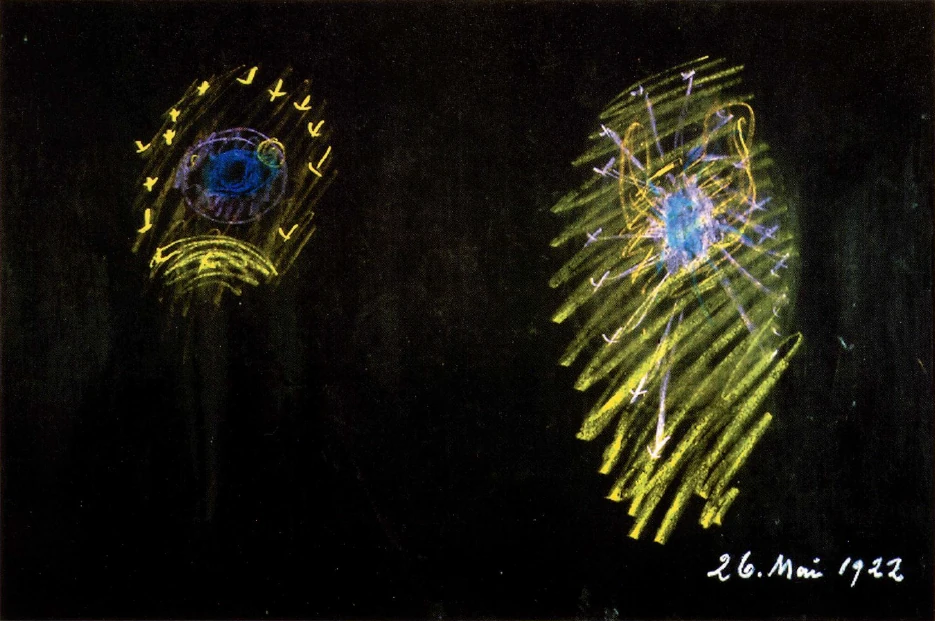
[ 1 ] Es ist auch hier des öfteren auseinandergesetzt worden, wie die ersten Lebensalter des Menschen sich in der Entwickelung verhalten. Ich habe vor vielen Jahren schon darauf aufmerksam gemacht, daß bis etwa zum kindlichen Zahnwechsel hin der Mensch sich vorzugsweise als ein nachahmendes Wesen verhält. Alles, was in seiner Umgebung geschieht, wird gewissermaßen instinktiv, stark miterlebt, so wie im späteren Lebensalter nur in den Sinnesorganen, aber ohne daß der Mensch es weiß, miterlebt wird, was in der Außenwelt geschieht.
[ 1 ] We have often explained how the development of man takes place during the first periods of life, and it is many years since I first indicated how the child behaves to a great extent as an imitative being during the period up to the change of teeth. More or less instinctively—and intensively—he experiences all that is going on in his environment. Later on it is only in the sense organs that the processes of the outer world are thus intensively experienced, although we are not conscious of this fact.
[ 2 ] Wir haben in der Tat zum Beispiel in unserem Auge einen Vorgang, der in einer gewissen Weise nachahmt, was äußerlich geschieht, so wie in einer photographischen Kamera nachgeahmt wird, was sich vor dieser Kamera befindet. Der Mensch erlebt dann das, was sich da in seinem Auge nachahmt, und bekommt dadurch seine Kenntnis von der Außenwelt. Ebenso ist es mit den anderen Sinnen. Daß dieses Nachahmungsprinzip gewissermaßen auf die Peripherie der menschlichen Wesenheit beschränkt ist, das findet erst im späteren Lebensalter statt. Im kindlichen Alter bis zum Zahnwechsel nimmt, wenn auch in einem geringeren Grade, doch der ganze Leib an dieser Nachahmung teil. Es ist der ganze Leib in einer gewissen Beziehung in einem solchen Verhältnis zur Außenwelt wie sonst die Sinne. Der Mensch ist vorzugsweise ein nachahmendes Wesen. Er richtet sich innerlich so, wie das Äußere auf ihn innerlich wirkt, wenn er es von außen nachahmt. Daher ist es so wichtig, daß wir in der Umgebung des Kindes in diesem Lebensalter bis in die Gedanken und Gefühlsformungen hinein nichts geschehen lassen, was nicht von dem Kinde aufgenommen und angeeignet werden kann.
[ 2 ] In our eyes, for example, we have a process imitating in a certain sense what is going on in the outer world—reproducing it, just as the camera reproduces whatever is there in front of the lens. The human being becomes aware of what is thus imitatively reproduced in his eyes, and thus he gains information about the external world. It is the same with the other senses. But this restriction of the imitative principle to the periphery of the human organism occurs only at a later stage in life. In early childhood, until the change of teeth, the whole body partakes in this imitative process, though to a lesser extent. At this stage the whole body is in a certain respect related to the outer world as the senses are during the rest of human life. The child is still in the main an imitative being. He follows the way in which outer things work in upon him and he imitates them internally. Hence it is very important to let nothing happen in the young child's environment, not even in the forming of our thoughts and feelings, which the child cannot rightly absorb and make his own.
[ 3 ] Mit dem Zahnwechsel beginnt dann für das Kind die Möglichkeit, sich nicht wie ein Sinnesorgan zu verhalten, sondern das Vorstellungsmäßige aufzunehmen. Das Kind beginnt — und bildet es dann immer mehr und mehr aus -, das, was man ihm sagt, zur Richtschnur zu nehmen. Vorher nimmt es alles das zur Richtschnur, was man in seiner Umgebung tut, nachher kommt es dazu, zu erfassen, was man ihm sagt. Daher wird zwischen dem Zahnwechsel und der Geschlechtsreife die Autorität für das Kind maßgebend. Das Kind muß in selbstverständlicher Weise das befolgen können, sich nach dem richten können, was man ihm sagt. Die Sprache selbst lernt das Kind noch durch Nachahmung; aber was in der Sprache ausgedrückt werden kann, was also der Erwachsene durch die Sprache dem Kinde mitteilen kann, das wird maßgebend für das Kind erst vom Zahnwechsel an. Und die eigentliche Urteilsfähigkeit, wo das Kind oder der junge Mann oder die junge Dame, wie man jetzt sagen muß, anfangen, die eigene Urteilskraft geltend zu machen, das beginnt mit der Geschlechtsreife. Da erst soll man voraussetzen, daß das Kind anfängt, Urteile zu bilden aus dem eigenen Inneren heraus.
[ 3 ] With the change of teeth it begins to be possible for the child to behave no longer like a sense organ but to assimilate something in the nature of ideas. The child begins to take as his guideline what we say to him. Previously he has taken as his guideline all that we did in his environment; now he begins to grasp what we say. Authority thus becomes the decisive factor between the change of teeth and puberty. The child will quite naturally follow and be guided by what is said to him. Language itself he will of course learn by imitation, but that which is expressed and communicated through language—this can become a determining factor for the child only after the change of teeth. And a true power of judgment, when the child or adolescent begins to make his own faculty of judgment felt, comes only at the time of puberty. Not until then can the child begin to form real judgments of his own.
[ 4 ] Nun, damit ist zunächst die Sache äußerlich charakterisiert, charakterisiert, möchte ich sagen, an der Art, wie das Kind in die Welt hineinwächst, was man durch eine unbefangene Wahrnehmung sich ja immer zum Bewußtsein bringen kann. Das alles hängt aber zusammen mit sehr bemerkenswerten inneren Vorgängen, und von diesen inneren Vorgängen möchte ich Ihnen heute sprechen. Ich habe bis jetzt immer darauf aufmerksam gemacht, wie der Ätherleib des Menschen in einer innigen Verbindung mit dem physischen Leib lebt bis zu der Zeit, wo eben der Zahnwechsel beginnt einzutreten. Deshalb sagte ich: Den Zahnwechsel können wir auch die eigentliche Geburt des Ätherleibes des Menschen nennen. In der entsprechenden Weise können wir bei der Geschlechtsreife sprechen von der eigentlichen Geburt des astralischen Leibes. Damit sind die Vorgänge aber, wie gesagt, nur äußerlich charakterisiert, und wir wollen heute zu einer etwas innerlicheren Charakteristik kommen.
[ 4 ] So far I have been describing quite simply, from an external viewpoint, how a child grows into the world. These facts can be observed by anyone with an unbiased sense of truth. But they are connected with highly significant inner processes, and it is of these that I want to speak today. I have often pointed out how the human etheric body lives in intimate union with the physical body until the change of teeth begins. Therefore, as I have also said, we can describe the change of teeth as marking the essential birth of the etheric body. Likewise we can refer the birth of the astral body to the time of puberty. However, that again is only an external account. Today we will try to arrive at a rather more inward characterization of these processes.
[ 5 ] Wenn wir den Menschen betrachten, lange bevor er die Neigung entwickelt, von der geistigen Welt herabzusteigen zu einer physischen Verkörperung, so sehen wir ihn als eine geistig-seelische Wesenheit in einer geistig-seelischen Welt. Das waren wir ja alle, bevor wir heruntergestiegen sind, um uns mit dem zu verbinden, was als physischer Leib im mütterlichen Organismus vorbereitet wurde. Mit diesem physischen Leib verbinden wir uns dann, um unsere Daseinsepoche auf der Erde zwischen Geburt und Tod durchzumachen. Längere Zeit also vorher, sage ich, waren wir geistig-seelische Wesen in einer geistig-seelischen Welt. Was wir das ind und auch das, was wir da erleben, das unterscheidet sich nun ganz erheblich von dem, was wir hier auf Erden zwischen Geburt- und Tod erleben. Daher ist es so schwierig, die Erlebnisse zwischen dem Tod und einer neuen Geburt darzustellen, weil sie schließlich doch sehr verschieden von den irdischen Verhältnissen sind und der Mensch sich seine Vorstellungen nach den irdischen Erlebnissen bildet, und man immer solche Vorstellungen zu Hilfe nehmen muß. Allein wir wollen uns zunächst weniger darin ergehen - das soll morgen und übermorgen darankommen -, wie der Mensch in der geistig-seelischen Welt selber ist, sondern wir wollen jetzt ins Auge fassen, wie er sich nähert seinem Herabstieg auf die Erde, um sich dann mit einem physischen Leib zu durchziehen.
[ 5 ] Let us consider man in the spiritual world, long before he develops the tendency to descend into physical embodiment. We see him there as a being of soul and spirit in a world of soul and spirit. So were we, all of us, before we descended to unite with what was prepared for us, as physical body, in the maternal organism. With this physical body we then united, to undergo our period of earthly existence between birth and death. Long before this, as I said, we were beings of soul and spirit. What we were, and what we experienced there, is very different from what we experience between birth and death here on earth. Hence it is hard to describe the experiences between death and a new birth; they are so utterly different from earthly conditions. Man models his ideas on his earthly experiences, and it is to these ideas that we must always have recourse for our descriptions. Today, however, we will not dwell so much on the character of man within the world of soul and spirit; we will rather envisage him, to begin with, on his descent, when he approaches the earth to imbue himself with a new physical body.
[ 6 ] Das, was zunächst geschieht, bevor der Mensch an seinen physischen Leib, an das Embryonale, an das Keimhafte seines physischen Leibes herankommit, ist, daß er die Kräfte der ätherischen Welt an sich heranzieht. Wir leben hier auf der Erde in der physischen Welt, das ist in derjenigen Welt, die durch alles das charakterisiert ist, was wir durch unsere Sinne sehen und durch unseren irdischen Verstand begreifen. Aber in dieser Welt gibt es nichts, was nicht durchsetzt ist von der ätherischen Welt. Diese physische Welt, die wir sehen, die wir hören und so weiter, ist überall von der ätherischen Welt durchsetzt. An diese ätherische Welt lebt sich der Mensch früher heran als an die physische Welt. Bevor er die Neigung erhält, sich mit der physischen Welt durch den Embryo zu verbinden, zieht er die Kräfte der ätherischen Welt heran. Und er bildet sich, indem er die Kräfte aus der ätherischen Welt heranzieht, seinen Ätherleib.
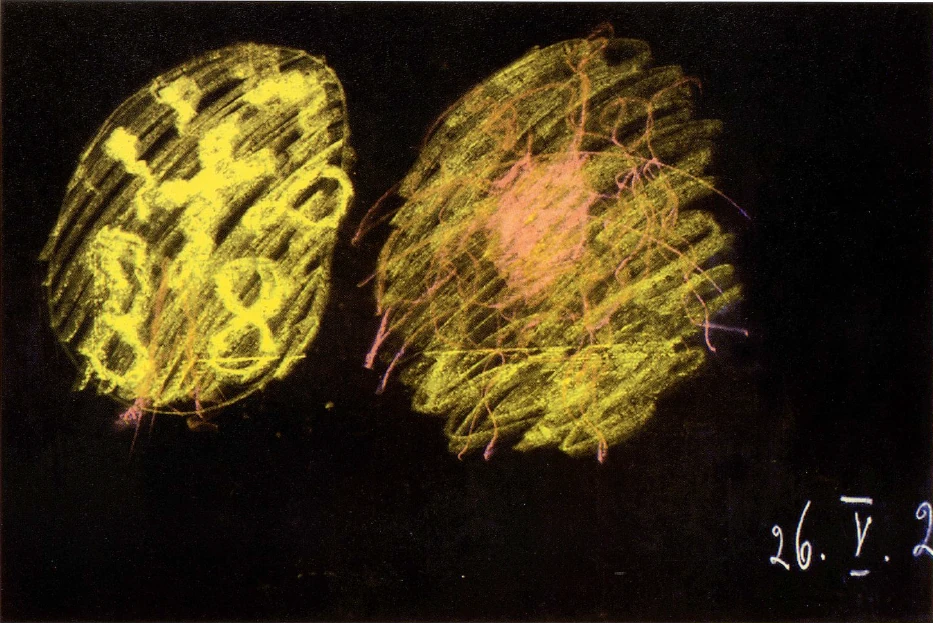
[ 6 ] Before he approaches his physical body—or rather the germ, the embryo, of it—man draws into himself the forces of the etheric universe. Here on earth we live in the physical world—in the world characterized by all that we see with the senses and understand with earthly intellect. But there is nothing in this world that is not permeated by the etheric world. And before man gets the inclination to unite—through the embryo—with the physical world, he draws to himself the forces of the etheric world, and, in so doing, he forms his own etheric body. But to say that man clothes himself with his etheric body is to say very little. We must enter a little more closely into the nature and constitution of this body.
[ 7 ] Damit wir diese Vorstellungen genauer aufnehmen können, wollen wir uns das schematisch auf die Tafel zeichnen. Nehmen wir an, ich wollte das Geistig-Seelische, was da herankommt aus der geistigen Welt, durch diese Figur charakterisieren (Zeichnung S. 114, violett. Die Zeichnung auf Tafel 10 wird während der folgenden Ausführungen nach und nach vervollständigt). Das ist natürlich nur ganz schematisch gemacht. Nur dasjenige, was der Mensch zunächst an sich heranzieht, das wird zu seinem ätherischen Leib. Also er umkleidet sich gewissermaßen, indem er heruntersteigt aus der geistigen Welt, mit seinem ätherischen Leib (orange schraffiert). Aber damit, daß man sagt, «der Mensch umkleidet sich mit seinem ätherischen Leib», ist nicht viel gesagt; man muß da schon ein wenig eingehen auf die Beschaffenheit dieses ätherischen Leibes. Dieser ätherische Leib, der sich da im Menschen heranbildet, ist gewissermaßen eine Welt für sich. Allerdings, man möchte sagen, eine Welt für sich im Bilde. Es ist so, daß dieser ätherische Leib zum Beispiel an seiner Umgebung Sternhaftes zeigt (gelbe Sterne), und daß er in seinem unteren Teile etwas zeigt, was sich mehr oder weniger wie ein Abbild der Erde selber ausnimmt. Ja, er hat sogar eine Art von Abbild des Sonnen- und Mondenhaften in sich.
[ 7 ] The etheric body, as it forms and develops itself in the human being, is a universe in itself—a universe, one might say, in picture form. At its circumference it manifests something in the nature of stars, and in its lower portion something that appears more or less as an image of the earth. It even has in it a kind of image of the sun nature and the moon nature.
[ 8 ] Das ist außerordentlich bedeutsam, daß, wenn wir so aus der allgemeinen Ätherwelt beim Herunterstieg in die irdische Welt die Ätherkräfte heranziehen, wir in unseren Ätherleib eine Art Abbild des Kosmos mitnehmen. Wenn wir den Ätherleib des Menschen in dem Momente herausnehmen könnten, wo der Mensch sich mit dem physischen Leib verbindet, so würden wir, viel schöner als das jemals mechanisch geformt worden ist, eine Sphäre haben mit den Sternen, mit dem Tierkreis, mit Sonne und Mond.
[ 8 ] This is of great significance. On our descent into the earthly world, when we draw to ourselves the forces of the universal ether, we actually take with us in our etheric body a kind of image of the cosmos. If we could extract the etheric body of a man at the moment when he is uniting with the physical, we should have a sphere—far more beautiful than has ever been wrought by mechanical means—a sphere complete with stars and zodiac and sun and moon.
[ 9 ] Diese Konfigurationen des Ätherleibes bleiben noch vorhanden, wenn der Mensch mit seinem physischen Leib während der Embryonalzeit immer mehr und mehr zusammenwächst. Sie blassen nur etwas ab, aber sie bleiben vorhanden. Und sie bleiben auch vorhanden bis in das siebente Lebensjahr hinein, bis zum Zahnwechsel. Da ist durchaus im kindlichen Ätherleib noch immer diese Weltensphäre zu erkennen. Mit dem siebenten Jahre, mit dem Zahnwechsel, beginnen die Gebilde, die man da drinnen schaut in dem Ätherleib, gewissermaßen strahlig zu werden, während sie vorher mehr sternig waren. Ich zeichne das schematisch für die Zeit von dem siebenten bis ungefähr zum vierzehnten Jahr, vom Zahnwechsel bis zur Geschlechtsreife (siehe Zeichnung, rote Strahlen). Wie gesagt, es verblaßt während der Embryonalzeit schon und dann immer mehr, aber es ist noch deutlich vorhanden. Vom Zahnwechsel ab jedoch beginnt es ganz zu verblassen, dafür aber Strahliges nach innen zu senden (rot). Ich möchte sagen: die Sterne lösen sich auf im menschlichen Ätherleib, sie werden zu Strahlen, die die Tendenz haben, da im Inneren zusammenzukommen.
[ 9 ] These configurations of the etheric body remain during the embryonic time, while the human being coalesces more and more with his physical body. They begin to fade away a little, but they remain. Indeed they remain right on into the seventh year—that is, until the change of teeth. In the etheric body of the little child, this cosmic sphere is still quite recognizable. But with the seventh year—with the change of teeth—these forms that we behold in the etheric body begin to ray out, in a manner of speaking, previously they were more star-like; now they begin to be like rays. The stars dissolve away in the human ether body; but as they do so they become rays, rays with a tendency to come together inwardly.
[ 10 ] Das alles geschieht langsam und allmählich während des ganzen Lebensabschnittes vom Zahnwechsel bis zur Geschlechtsreife. Bei der Geschlechtsreife ist es dann so weit, daß, indem diese Strahlen hier zusammengewachsen sind, sie innerlich eine Art eigenes Gebilde, ein ätherisches Gebilde formen (rot). Man möchte sagen: Dasjenige, was die Umfangssterne waren, das strahlt zuerst nach innen; dann hört es später auf, da werden diese Sterne vollständig blaß. Es bleibt natürlich immer etwas vorhanden, aber es wird ganz blaß. Es werden auch diese Strahlen blaß. Dagegen wird das, was sich in der Mitte gewissermaßen zusammengeballt hat, besonders lebendig. Und in dem, was sich da in der Mitte zusammengeballt hat, in dem hängt in der Zeit, in der auch die Geschlechtsreife eintritt, das physische Herz darinnen. Das ist also an der Stelle des menschlichen Organismus, wo das physische Herz darinnenhängt mit den Adern (blau).
[ 10 ] All this goes on gradually throughout the period of life between the change of teeth and puberty. At puberty the process is so far advanced that these rays, having grown together here in the center, form as it were a distinct structure—a distinct etheric structure of their own. The stars have faded out, while the structure which has gathered in the center becomes especially living. And in the midst of this central etheric structure, at the time of puberty, the physical heart, with its blood vessels, is suspended.
[ 11 ] Das ist also das Eigentümliche, daß sich der Stern-Ätherleib nach innen zieht. Er bleibt natürlich als Ätherleib für den ganzen Menschen vorhanden. Er ist nur da dann im Außenraum, also an der Peripherie des Menschen, da ist er später undifferenziert, man kann nicht viel darin unterscheiden. Aber während der Zeit vom Zahnwechsel bis zur Geschlechtsreife, da ist er sehr strahlend von außen nach innen.
[ 11 ] So we have this strange phenomenon of the star-ether-body drawing inwards. As etheric body it is, of course, undifferentiated at the periphery of the organism—very little can be distinguished in there. On the other hand, during the time from the change of teeth until puberty, it is intensely radiant, raying from without inwards. Then it gathers itself together, and there, clearly suspended within it, is the physical heart.
[ 12 ] Und dann ballt sich das zusammen, und da ist dann deutlich darinnenhängend das physische Herz. Sie dürfen nicht glauben, daß der Mensch etwa nicht vorher auch ein Ätherherz hätte; das hat er schon; aber das bekommt er auf eine andere Art als das, was dann Ätherherz wird. Denn in der Tat wird das, was sich da von der Geschlechtsreife an zusammengeballt hat, das Ätherherz. Bis dahin hat er, wie gesagt, auch ein Ätherherz, aber das hat er bekommen als Erbschaft, das hat er bekommen durch die Kräfte, welche im Embryo drinnen sind. Wenn der Mensch nämlich seinen Ätherleib hat, und sich mit seinem Ätherleib nach dem physischen Organismus hin begibt, so wird auch eine Art Ätherherz, ein stellvertretendes Ätherherz gewissermaßen, durch die Kräfte des physischen Leibes zusammengezogen. Dieses Ätherherz aber, das der Mensch in seinem Kindheitsalter hat, das es ist der Ausdruck etwas unschön für die Gewohnheiten, die wir haben, aber es trifft ganz genau das, um was es sich handelt -, das verfault nach und nach, und an seine Stelle setzt sich, gleichsam immerfort ersetzend das, was da ätherisch faulend herausfällt, jenes Ätherherz, welches eine Zusammenballung der ganzen Weltensphäre ist, das wirklich ein Bild des Kosmos ist, und das wir uns als ein ätherisches Gebilde mitbringen, wenn wir durch Konzeption und Geburt ins irdische Dasein schreiten.
[ 12 ] You must not suppose that until then man has no etheric heart. Certain he has one, but he obtains it differently from the way in which he acquires the etheric heart that will now be his. For the gathered radiance that arises at the time of puberty becomes the true etheric heart of man. The etheric heart he has before this time is one that he received as a heritage through the inherent forces of the embryo. When a man gets his etheric body, and with it makes his way into the physical organism, a kind of etheric heart—a substitute etheric heart, so to speak—is drawn together by the forces of the physical body. He keeps this etheric heart during his childhood years, but then it gradually decays. (This may not be a very beautiful expression, by our usual standards, but it meets the case exactly.) The first etheric heart slowly decays, and in its stead, as it were constantly replacing that which falls out in the etheric process of decay, there comes the new, the real, etheric heart. This etheric heart is a concentration of the whole cosmic sphere we brought with us as an ether form, a faithful image of the cosmos, when we proceeded through conception and birth into this earthly life.
[ 13 ] Man kann also wirklich eine deutliche Veränderung des ganzen ätherischen Leibesgebildes verfolgen, das der Mensch während der Zeit von der Geburt oder schon von der Konzeption an bis zu der Geschlechtsreife in sich trägt. Man möchte sagen: Mit der Geschlechtsreife eigentlich erst ist des Menschen eigenes, aus seinem ätherischen Leibe herausgebildetes, nicht durch äußere Kräfte provisorisch gebildetes Ätherherz vorhanden.
[ 13 ] Thus we can trace, throughout the time from birth or conception until puberty, a distinct change in the whole etheric form that the human being bears within him. One may describe it by saying: not until puberty does the human being possess his own etheric heart—that is, the etheric heart formed out of his own etheric body, and not supplied provisionally by external forces.
[ 14 ] Und alle die Ätherkräfte, die im Menschen bis zur Geschlechtsreife tätig sind, tendieren dahin, ihm ein solches frisches Ätherherz zu geben. Es ist wirklich etwas, was sich in bezug auf das Ätherische mit dem Zahnwechsel vergleichen läßt. Nicht wahr, im Zahnwechsel haben wir die vererbten Zähne; die werden ausgestoßen, und die anderen Zähne, die dann unsere eigenen sind, ersetzen sie. Und so wird das vererbte Ätherherz, das wir bis zur Geschlechtsreife haben, ausgestoßen, und wir bekommen unser eigenes Ätherherz. Das ist das Wesentliche, daß wir da unser eigenes Ätherherz bekommen.
[ 14 ] All the etheric forces that are working in man until puberty tend to endow him with this fresh etheric heart. It is, in the etheric sphere, a process comparable to the change of teeth. For, as you know, until the change of teeth we have our inherited teeth; these are cast out, and their place is taken by the second teeth—those that are truly our own. So, likewise, the etheric heart we have until puberty is cast out, and we now receive our own. That is the point—we receive our own etheric heart.
[ 15 ] Nun aber geht parallel mit diesem etwas anderes, was sich im Menschen vollzieht. Wenn wir den Menschen betrachten so, wie er hereingetreten ist in die physische Welt, also als ganz kleines Kind betrachten, dann finden wir, daß in seinem astralischen Leibe außerordentlich viel einzelne Organe zu unterscheiden sind. Der Mensch setzt sich, wie ich eben geschildert habe, einen Ätherleib zusammen, der ein Abbild der Außenwelt ist. Aber in seinem astralischen Leibe, da bringt er sich ein Abbild dessen mit, was er erlebt hat zwischen dem letzten Tode und dieser Geburt. In diesem astralischen Leibe des Kindes sieht man außerordentlich viel darinnen. Da sind große Geheimnisse eingeschrieben. Da sieht man wirklich viel von dem, was erlebt worden ist zwischen dem letzten Tode und dieser Geburt. Dieser astralische Leib ist außerordentlich differenziert und individuell. Und das Eigentümliche ist, daß in derselben Zeit, in der sich das abspielt, was ich da für den Ätherleib beschrieben habe, der stark differenzierte astralische Leib immer undifferenzierter wird. Ursprünglich ist er ein Gebilde, von dem man, wenn man es verständig anschaut, sagt: Das ist ein Gebilde aus einer anderen Welt, das ist hereingekommen aus einer Welt, die weder in der physischen Welt noch in der Welt des Äthers ist. Aber alles, was da im astralischen Leib als außerordentlich viele einzelne Gebilde lebt, das schlüpft gewissermaßen bis zu der Geschlechtsreife in die physischen Organe hinein, und zwar nur in diejenigen Organe, die, wenn ich mich annähernd ausdrücken soll - es ist nicht ganz genau -, bis zum Zwerchfell liegen. Es schlüpfen wunderbare Gebilde, die in den ersten Lebenstagen im astralischen Leibe glänzend vorhanden sind, nach und nach in die Gehirnbildung hinein, füllen auch die Sinnesorgane aus. Dann schlüpfen andere hinein in die Atmungsorgane, andere in das Herz und durch das Herz in die Arterien. In den Magen schlüpfen sie nicht direkt hinein, sondern erst durch die Arterien breiten sie sich dann aus bis in die Organe des Unterleibes hinein. Aber nach und nach sieht man gewissermaßen den ganzen astralischen Leib, den sich der Mensch durch die Geburt ins physische Dasein mit hereinbringt, untertauchen in. die Organe. Er schlüpft in die Organe hinein. So daß, wenn man das aussprechen will in einem Sinne, der ganz ein eigentlicher Sinn ist, der durchaus die Wirklichkeit mit ergibt — aber es nimmt sich natürlich paradox aus gegenüber den Vorstellungen, die man sich sonst heute in der Welt macht -, man sagen kann: Wenn wir erwachsen sind, haben unsere Organe die einzelnen Gebilde unseres astralischen Leibes in sich eingesperrt. Das ist die intimere Kenntnis der menschlichen Organe, die nur verstanden werden können, wenn man das Astralische des Menschen, das er sich mitbringt, versteht. Man muß wissen, daß jedes einzelne Organ in einer gewissen Weise ein Astralisches als Erbstück trägt, so wie das Ätherherz zunächst auch ein Erbstück ist, daß aber nach und nach dieses vererbte Astralische ganz durchsetzt wird von dem, was der Mensch sich als seinen astralischen Leib selber mitbringt und was Stück für Stück untertaucht in die physischen und ätherischen Organe. Das Herz bildet gewissermaßen eine Ausnahme. Da taucht auch ein Astralisches unter. Im Herzen konzentriert sich das Äthergeschehen ebensowohl wie das astralische Geschehen. Deshalb ist also das Herz dieses ganz besonders wichtige Organ für den Menschen.
[ 15 ] But now there is another process running parallel with this. When we observe man just after his entry into the physical world—i.e., as a very young child—we find a multitude of single organs distinguishable in his astral body. Man, as I have said, builds for himself an etheric heart, which is an image of the outer universe. In his astral body, however, he brings with him an image of the experiences he has undergone, between his last death and his present birth. Much, very much, can be seen in this astral body of a little child, great secrets are inscribed there. Much can be seen there of what the human being has experienced between his last death and his present birth. Moreover, the astral body is highly differentiated, individualized. And now, this is the peculiar thing: during the very time when the aforesaid process is taking place in the etheric body, this highly differentiated astral body becomes more and more undifferentiated. Originally it is an entity of which we can say it comes from another world, from a world which is not there in the physical, or even the etheric universe. By the time of puberty, all that is living in this astral body—as a multitude of single forms and structures—slips into the physical organs—primarily into those organs which are situated (to speak approximately) above the diaphragm. Marvelous structures, radiantly present in the astral body in the first days of life, slip by degrees into the brain formation and saturate the organs of the senses. Then, other structures slip into the breathing organism; others again into the heart, and through the heart into the arteries. They do not come directly into the stomach; it is only through the arteries that they eventually spread into the abdominal organs. Thus we see the whole astral body, which man brings with him through birth into this physical existence—we see it diving down gradually into the organs. It slides into the organs. This way of putting it is quite true to reality, though naturally it sounds strange to the habitual ideas of today. By the time we have grown to adult life, our organs have imprisoned in them the several forms and structures of our astral body. Precisely herein lies the key to a more intimate knowledge of the human organs; they cannot be truly understood unless we also understand the astral which man brings with him. We must know in the first place that every single organ bears within it, in a sense, an astral inheritance, even as the etheric heart is, to begin with, an inheritance. Moreover, we must know that this inherited astral becomes permeated gradually, through and through, with that which man brings with him as his own astral body, which dives down bit by bit into the physical and etheric organs. The heart is an exception, in a certain sense. Here, too, an astral part dives down; but in the heart not only the astral process but the etheric, too, is concentrated. Therefore the heart is the uniquely important organ which it is for man.
[ 16 ] Also der astralische Leib wird immer unbestimmter und unbestimmter, weil er seine konkreten Gebilde, die er sich aus einem anderen Leben durch die Geburt auf die Erde mitbringt, hinunterschickt in die physischen Organe, so daß sie da drinnen eben eingesperrt sind. Dadurch wird der astralische Leib mehr oder weniger immer eine bloße Nebelwolke.
[ 16 ] The astral body becomes more and more indefinite, for it sends into the physical organs the concrete forms which it brings with it from another life. It sends them down into the physical organs, so that they are imprisoned there; and thereby the astral body itself becomes more or less like a cloud of mist.
[ 17 ] Aber das Interessante ist jetzt dieses: der astralische Leib wird von dieser Seite her eine Nebelwolke, aber es treten andere Differenzierungen erst langsam und von der Geschlechtsreife an dann mit voller Regelmäßigkeit immer mehr und mehr ein.
[ 17 ] But—and this is the interesting thing—while from this side the astral body turns into a cloud of mist, new differentiations come into it from another side—first slowly, then with full regularity and increasingly from the age of puberty onwards.
[ 18 ] Wenn das Kind mit seinen Beinchen zappelt, so merkt man von diesem Zappeln außerordentlich wenig im astralischen Leib. Wirkungen davon sind in dem astralischen Leib schon vorhanden, aber das, was sich der astralische Leib an Differenzierungen mitgebracht hat, ist so stark, daß sich eigentlich die ganze Sache so verhält: Wenn ich hier den astralischen Leib zeichne, so sind da wunderbare Gebilde darinnen. Das ist nur schematisch gemeint, aber doch eben der Wirklichkeit entlehnt. Diese Gebilde verschwinden allmählich, sie schlüpfen hinunter in die physischen Organe. Der astralische Leib wird mehr und mehr eine Nebelwolke. Aber, wie gesagt, wenn das Kind nun zappelt, so ist es schon so, daß von den Zappelbewegungen auch allerlei heraufkommt in den astralischen Leib, aber es stößt an das, was schon da ist, reflektiert sich wieder zurück (rot) und verschwindet wiederum. Es ist so, wie wenn Sie in einen elastischen Ball einen Eindruck machen; er gleicht sich sofort wieder aus. Diese Zappelbewegungen des Kindes, wenn sie auch noch so kräftig sind, machen wohl einen Eindruck in den astralischen Leib, aber er bleibt nicht. Nun, in demselben Maße, in dem das Kind dann sprechen lernt und solche Vorstellungen entwickelt, die in der Erinnerung bleiben, also in demselben Maße, in dem das Kind sprechen und die Erinnerungen ausbilden lernt, in dem Maße sieht man immer mehr und mehr, wie in der Tat das nicht zurückgeworfen wird, sondern wie die Bewegungen, die das Kind, nun nicht mehr als Zappelbewegungen, sondern als verständige Bewegungen macht, als Herumgehen und so weiter, auch die Bewegungen der Arme und so weiter, im astralischen Leibe bleiben. Ja, in diesen astralischen Leib kann außerordentlich viel eingeschrieben werden.
[ 18 ] When the baby is kicking with its little legs, you notice very little of this in the astral body. True, the effects are there, but the differentiations which the astral body has brought with it are far more intense. Gradually these forms disappear, they slide into the physical organs. The astral body more and more becomes a cloud of mist. When the child kicks and fidgets, all manner of effects come up into the astral body from these childish movements, but they impinge on what they find there, they are cast back and disappear again. It is as though you made an impression on an elastic ball: the ball recovers is shape immediately. All this, however, changes proportion as the child learns to speak and develops ideas which are retained in memory. We then see how his movements—intelligent movements, now, walking about, moving the arms, and so on—are increasingly retained in the astral body.
[ 19 ] Wenn Sie fünfundvierzig Jahre alt sind, dann sind fast alle Bewegungen in Spuren im astralischen Leibe eingeschrieben und auch noch viele andere, wie wir gleich sehen werden. Der astralische Leib kann viel aufnehmen von dem, was sich da abgespielt hat seit dem Sprechen- und Denkenlernen und seitdem er seine eigene Konfiguration aufgelöst hat. So daß also das wunderbare Gebilde, das der astralische Leib des Kindes darstellt, nach und nach undifferenziert wird, weil all das allmählich in die Organe hinein verschwindet. Der astralische Leib wird ein undifferenziertes Gebilde, natürlich nicht ganz, aber verhältnismäßig undifferenziert. In dieses undifferenzierte Gebilde schreibt sich jetzt alles das ein, was wir an Bewegungen der Arme und der Beine ausführen. Aber es schreibt sich auch ein, was wir durch Arme und Beine tun: Wenn wir zum Beispiel eine Feder führen, alles, was wir da in der Außenwelt vollführt haben, schreibt sich ein. Wenn wir Holz hacken, wenn wir jemandem eine Ohrfeige geben, so schreibt sich das ein. Sogar wenn wir etwas nicht selber tun, sondern einem Diener einen Auftrag geben und der es dann ausführt, so schreibt sich durch das Verhältnis unseres Wortinhaltes zu dem, was der Diener tut, das auch ein. Kurz, es schreibt sich die gesamte Tätigkeit eines Menschen, die einen Ausdruck in der Außenwelt findet, jetzt in diesen astralischen Leib ein (Rot im Gelb). So konfiguriert sich der astralische Leib also in der mannigfaltigsten Weise durch das, was menschliches Tun ist. [Während der folgenden Ausführungen wird die Zeichnung auf Tafel 11, rechts, vervollständigt. Siehe Zeichnung S. 122.]
[ 19 ] Yes, indeed, untold things can be inscribed in this astral body. When you are forty-five years old, almost all your movements are inscribed in traces there, and many other things too, as we shall see. The astral body can absorb very much of all that has taken place since you learned to speak and think and since its own configuration was dissolved. Into this undifferentiated entity all that we do now is inscribed—the movements of our arms and leg, and not only these, but all that we accomplish through our arms and leg. For instance, when we hold a pen in writing, all that we thus accomplish in the outer world is there inscribed. When we chop wood, or if we give someone a box on the ears, all is inscribed into the astral body. Even when we do not do something ourselves but give instructions to a person and he does it, this, too, is inscribed, through the relation of the content of our words to what the person does. In short, the whole of man's activity which finds expression in the outer world is written into the astral body; thus the astral body becomes configurated in manifold ways through all our human actions.
[ 20 ] Das beginnt, wie gesagt, wenn das Kind sprechen lernt, wenn das Kind in der Sprache Gedanken verkörpern lernt. Mit Bezug auf die Vorstellungen, die das Kind aufnimmt, an die man sich aber später nicht mehr erinnern kann, findet das noch nicht statt; erst von der Zeit an, bis zu der man sich später im gewöhnlichen Bewußtsein zurückerinnert. Dann aber wird sozusagen alles, was der Mensch tut, da aufgeschrieben.
[ 20 ] This process, as I said, begins when the child learns to speak—learns to embody thoughts in speech. It does not apply to ideas which the child receives but cannot remember afterwards. It begins from the time to which he can remember back, with ordinary consciousness, in later life.
[ 21 ] Nun ist das Eigentümliche, daß alles, was da eingeschrieben wird, in einer ähnlichen Weise die Tendenz hat, sich da im Inneren zu treffen, wie auch die Strahlungen des Ätherleibes sich im Ätherherzen treffen. Auch alles, was menschliche Taten sind, trifft sich da. Und dieses Sich-Treffen hat eigentlich nun auch eine Art äußerer Veranlassung. Wir müssen einfach dadurch, daß wir Menschen sind, von Kindheit auf in eine gewisse Tätigkeit hineinkommen. Diese Tätigkeit drückt sich so aus, wie ich es eben angedeutet habe, durch den ganzen astralischen Leib hindurch. Aber auf der anderen Seite ist ein fortwährender Widerstand da. Die Wirkungen, die da auf den Organismus ausgeübt werden, können, man möchte sagen, sich nicht immer bis da hinauf (oben in der Zeichnung) entwickeln. Es ist überall Widerstand da; sie werden hinuntergestoßen. Was wir so tun, wenn wir uns an physische Organe halten, das will bis in den Kopf strömen; aber die menschliche Organisation läßt es da nicht heraufkommen, hält es auf. Und dadurch sammelt sich das auch in einer gewissen Weise hier an (rot) und bildet hier auch eine Art astralischen Mittelpunktes. So daß wir - und wiederum in der Zeit der Geschlechtsreife, da ist das sehr deutlich ausgebildet - an derselben Stelle, wo sich dieses Ätherherz, das nun unser eigenes ist, gebildet hat, auch ein astralisches Gebilde haben, das unser gesamtes Tun zentralisiert. Und dadurch, daß das von der Zeit der Geschlechtsreife an so ist, dadurch ist ein Mittelpunktsorgan geschaffen, in dem sich unser gesamtes Tun, unsere gesamte menschliche Tätigkeit zentralisiert. Es ist so, daß in derselben Gegend, wo der Mensch das Herz hat, sich nun weder physisch noch ätherisch, aber astralisch seine gesamte Tätigkeit zentralisiert. Und das Wichtige ist, daß in der Zeit, wo die Geschlechtsreife eintritt - es fallen ja die astralischen Ereignisse nicht ganz, sondern nur annähernd mit den physischen Ereignissen zusammen -, dieses Ätherherz so weit vorgebildet ist, daß es die Kräfte aufnehmen kann, die sich hier aus der Tätigkeit in der äußeren Welt entwickeln. Man kann also sagen, und man trifft damit durchaus ein wirkliches Ereignis im Inneren des Menschen: Von der Geschlechtsreife an schaltet sich auf dem Umwege durch den Astralleib die gesamte menschliche Tätigkeit in das Ätherherz ein, in dasjenige Organ, das aus den Abbildern der Sterne, aus den Abbildern des Kosmos geworden ist. Da schaltet sich das alles ein.
[ 21 ] And now the strange thing is that all that is thus inscribed in the astral body has a tendency to meet inwardly, just as the radiations of the ether body meet in the etheric heart. All that our human deeds are—this, too, comes together within. Moreover, this has a kind of outer causation. Simply as human beings on earth, we are bound to enter into many forms of activity. This activity expresses itself, as I said just now, throughout the astral body. But there is a perpetual resistance. The influences that are exerted on the human organism cannot always go right up, as it were. There is always a certain resistance; they are driven down again. All that we do, in connection with our physical organs, tends to stream upward to the head, but the human organization prevents it from reaching there. Hence these influences collect together and form a kind of astral center. This, once again, is clearly developed at the time of puberty. At the same place where the etheric heart—our own etheric heart—has formed itself, we now have an astral structure too, which gathers together all our actions. And so from puberty a central organ is created wherein all our doing, all our human activity, is centered. It is so indeed: in the very region where man has his heart, all his activity is centralized—centralized, in this case, neither physically nor etherically, but astrally. And the important thing is that in the time when puberty occurs (naturally, the astral events coincide only approximately with the physical) man's own etheric heart is so far formed that it can receive these forces that develop out of our activity in the outer world. Thus we can truly say (and in so saying we mark a real event in the human inner being): from puberty onwards man's whole activity becomes inserted, via the astral body, in his etheric heart—and in that which has grown out of the pictures of the stars, out of the images of the cosmos.
[ 22 ] Das ist eine außerordentlich bedeutsame Erscheinung, denn wenn Sie dieses alles betrachten, dann haben Sie den Zusammenschluß dessen, was der Mensch in der Welt tut, mit dem Kosmischen. Im Herzen haben Sie, insofern die ätherische Welt in Betracht kommt, einen zusammengezogenen Kosmos; aber zugleich auch, insofern die astralische Welt in Betracht kommt, eine Zusammenziehung desjenigen, was der Mensch tut. Hier schließen sich der Kosmos mit seinem Geschehen und das Karma des Menschen zusammen. Es ist eine so innige Korrespondenz des astralischen Leibes und des ätherischen Leibes mit dem ganzen menschlichen Organismus nur in der Gegend des Herzens vorhanden. Da ist es in der Tat so, daß die ganze Welt, von der sich der Mensch durch die Geburt in seinem Ätherleib ein Abbild hereingebracht hat, daß diese ganze Welt, die da wie in einer Essenz darinnen ist, alles das, was der Mensch tut, in sich aufnimmt, sich damit durchdringt. Und nun ist Gelegenheit durch diese Zusammenschlüsse, durch diese Zusammenschaltung, daß während des ganzen menschlichen Lebens fortwährend das menschliche Tun in die Essenz der Abbilder des Kosmos eingeschaltet wird.
[ 22 ] This is a phenomenon of untold importance. For, my dear friends, we have here a joining together with the cosmos of what man does in this world. In the heart, as far as the etheric universe is concerned, you have a cosmos gathered up into a center; while at the same time, as far as the astral is concerned, you have a gathering together of all that man does in the world. This is the point where the cosmos—the cosmic process—is joined to the karma of man. This intimate correspondence of the astral body with the etheric body is to be found nowhere in the human organism except in the region of the heart. But there, in truth, it is. Man has brought with him through birth an image of the universe in his etheric body, and the entire universe, which is there within him as an essence, receives all that he does and permeates itself with it. By this constant coming together—this mutual permeation—the opportunity is given throughout human life for human actions to be instilled into the essence of the images of the cosmos.
[ 23 ] Wenn dann der Mensch durch die Pforte des Todes geht, da ist nun in diesem ätherisch- astralischen Gebilde, in dem das Herz, ich möchte sagen, schwimmt, alles das, was der Mensch, wenn er den physischen Leib und jenes Äthergebilde abgelegt hat, in sein weiteres geistig-seelisches Leben mitnimmt. Und indem er jetzt geistig immer größer und größer wird, kann er- weilja die Substanz des ganzen Kosmos dadrinnen ist, es ist nur zusammengezogen im Herzen im Ätherleib - sein ganzes Karma dem Kosmos übergeben. Dasjenige, was aus dem Kosmos gekommen und zum Äthergebilde geworden ist, was im Herzen sich zusammengezogen hat und Essenz geworden ist, das will wiederum nach dem Kosmos hin. Der Mensch breitet sich im ganzen Kosmos aus und wird dann in die Seelenwelt aufgenommen und macht dasjenige durch, was ich in meiner «Theosophie» als den Durchgang durch die Seelenwelt und dann durch das Geisterland beschrieben habe. Aber es ist tatsächlich so, daß, wenn wir die menschliche Organisation in ihrem Werden betrachten, wir uns sagen können: Es findet in der Gegend des Herzens ein Zusammenschluß des Kosmischen mit dem Irdischen statt, und zwar so, daß das Kosmische in seiner kosmischen Konfiguration in das Ätherische hereingenommen wird und sich da bereitmacht, unsere Taten, alles, was wir tun, aufzunehmen. Und mit dem, was da durch eine innige Durchdringung des Ätherischen mit dem menschlichen Tun sich gebildet hat, gehen wir heraus und treten wiederum ein in ein neues kosmisches Dasein, wenn wir durch die Pforte des Todes gegangen sind.
[ 23 ] Then when man passes through the gate of death, this ethereal-astral structure—wherein the heart is floating, so to speak—contains all that man takes with him into his further life of soul and spirit, when he has laid aside the physical and the etheric forms. Now, as he expands ever more widely in the spirit, he can hand over his entire karma to the cosmos, for the substance of the whole cosmos is contained within him; it is drawn together in his heart, in the etheric body of his heart. It came from the cosmos and changed into this etheric entity, then it was gathered up as an essence in the heart, and now it tends to return into the cosmos once more. The human being expands into the cosmos. He is received into the world of souls. He undergoes what I described in my book, Theosophy, as the passage through the world of souls and then through spirit land. In truth it is so. When we consider the human organization in its becoming, we can say to ourselves: in the region of the heart there takes place a union of the cosmos with the earthly realm, and in this way the cosmos, with its cosmic configuration, is taken into our etheric body. There it makes ready to receive all our actions, all that we do in life. Then we go outward again, together with everything that has formed itself within us through this intimate permeation of the cosmic ethereal with our own human actions. So do we enter again into a new cosmic existence, having passed through the gate of death.
[ 24 ] Damit beschreibt man in der Tat in einer ganz konkreten Gestaltung die Art und Weise, wie der Mensch sich heranlebt an seinen physischen Leib und wie er wiederum sich aus diesem physischen Leib herausziehen kann, weil seine Taten ihm die Kraft geben, zusammenzuhalten, was er aus dem Kosmos nur als eine Essenz herausgebildet hat.
[ 24 ] Thus we have now described in a quite concrete form how the human being Lives his way into his physical body, and how he is able to draw himself out of it again, because his deeds have given him the force to hold together what he had first formed within him as an essence out of the cosmos.
[ 25 ] Der physische Leib wird ja innerhalb der physisch-irdischen Welt durch die Vererbungskräfte gebildet, also durch die Kräfte der Embryonalbildung, der Keimesbildung. Mit diesen verbindet sich das, was der Mensch herunterbringt aus der geistigen Welt, nachdem er zunächst seinen Ätherleib herangezogen hat. Mit diesem verbindet sich der Mensch auf der einen Seite. In dem Astralischen, das er sich als ein so wunderbares Gebilde mitgebracht hat, da lebt nun aber auch sein Ich darinnen, das durch viele Erdenleben gegangen ist und überhaupt eine Entwickelung hinter sich hat. Und dieses Ich lebt in einer gewissen Sympathieverbindung - indem ich das Wort gebrauche, bezeichne ich wiederum etwas sehr Wirkliches - mit alledem, was da als Gebilde im astralischen Leibe ist. Und indem diese Gebilde in die Organe des physischen Leibes hineinschlüpfen, so wie ich es beschrieben habe, behält das Ich die Sympathie und entwickelt diese innere Sympathie auch zu den Organen, breitet sich immer mehr und mehr auch in den Organen aus und nimmt Besitz von ihnen. Gewiß, es ist das Ich auch früher schon vom ersten Kindesalter an in einer gewissen Beziehung zu den Organen. Aber da sind eben diese Vererbungsverhältnisse da, von denen ich früher gesprochen habe, da ist die Beziehung des Ich eine äußerliche. Das Ich schlüpft aber nach und nach schon mit seinem astralischen Leibe in die Organe des physischen Leibes hinein, und indem es da hineinschlüpft, geschieht das Folgende: während vorher das Ich längs des Blutlaufes, ich möchte sagen, äußerlich beim Kinde vorhanden war, verbindet es sich jetzt intensiv innerlich immer mehr und mehr mit dem Blutkreislauf, bis es bei der Geschlechtsreife im vollen Sinne eingetreten ist. Und während Sie hier ein astralisches Gebilde um das ätherische, um das physische Herz herum haben, während Sie hier also ein astralisches Gebilde haben (Zeichnung S. 115, orange), macht das Ich den anderen Weg durch: es schlüpft, sagen wir, in die Organe der Lunge hinein; mit den Adern, die von der Lunge zum Herzen hingehen, nähert sich das Ich immer mehr dem Herzen. Das Ich folgt immer mehr und mehr, innig verbunden mit dem Blutkreislauf, dem Wege dieses Blutkreislaufes. So daß wiederum auf dem Umwege durch diese mit dem Blutkreislaufe laufenden Ich-Kräfte das Ich eingreift in dasjenige, was aus dem Zusammenschluß des ätherischen und des astralischen Herzens gebildet worden ist, wobei überhaupt ein Ätherisches aus dem Kosmos mit einem Astralischen von uns selbst zusammenwächst. Ich sagte vorhin: Dieser astralische Leib enthält nach und nach außerordentlich viel, weil sich alle die Taten in ihm einschreiben. Aber indem das Ich in einer Sympathiebeziehung zu allem steht, was der astralische Leib macht, schreiben sich auch die Absichten, die Ideen ein, aus denen der Mensch heraus seine Handlungen vollzieht. So daß tatsächlich hier ein voller Zusammenschluß des Karmas mit den Gesetzmäßigkeiten des Kosmos stattfindet.
[ 25 ] The physical body, as you know, is formed within the physical and earthly world by the forces of heredity, that is, the forces of the embryo. What man brings with him from the spiritual world, having first drawn together his etheric body, comes into union with this. But we must now go further. In the astral, that wonderful entity he has brought with him, there Lives the ego, which, having passed through many earthly lives, has a long evolution behind it. This ego lives in a certain connection of sympathy with all the complex forms that are present in the astral body. (By using the word “sympathy” in this connection, I am once more describing something absolutely real.) Then, when these astral forms slide into the organs of the physical, as explained above, the ego retains this sympathy and extends the same inner sympathy to the organs themselves. The ego spreads out increasingly into the organs and takes possession of them. From earliest childhood, indeed, the ego is in a certain relation to the organs. But at that time the inherited condition, of which I spoke, is still prevailing; therefore the relation of the organs to the ego is a more external one. When, later on, the ego slips with its astral body into the organs of the physical, this is what happens: whereas, in the little child, the ego was present only outwardly along the paths of the blood, it now unites with the blood circulation more and more inwardly, intensively, until—at puberty once more—it has entered there in the fullest sense. And while you have an astral formation around the etheric and the physical heart, the ego takes a different path. It slides into the organs of the lung, and with the blood vessels that pass from the lung to the heart approaches nearer and nearer to the heart. More and more closely united with the blood circulation, it follows the paths of the blood. By way of the forces that run along the courses of the blood, the ego enters into that which has been formed from the union of the etheric and the astral heart, wherein an etheric from the cosmos grows together with an astral from ourselves. As I said, this astral body comes by degrees to contain an immeasurable amount, for all our actions are written in it. And that is not all. Inasmuch as the ego has a relation of sympathy to all that the astral body does, our intentions, our ideas, too, are inscribed there—the intentions and ideas, I mean, out of which we perform our actions. Here, then, you have a complete linking up of karma with the laws of the whole cosmos.
[ 26 ] Man weiß von all dem, was da innerlich im Menschen vor sich geht, eigentlich heute, man möchte, da die Verhältnisse so sind, mit Emphase sagen: «herzlich wenig»; denn es bezieht sich alles das, was man nämlich nicht weiß, auf das Herz. Man weiß heute davon «herzlich wenig». Man weiß das, was hier in der physischen Welt geschieht und betrachtet es nach Naturgesetzen; und man weiß das, was der Mensch moralisch vollzieht und betrachtet es nach moralischen Gesetzen. Aber alles das, was im Menschenleben moralisch geschieht, und das, was auf der anderen Seite physisch geschieht, das schließt sich gerade im Menschenherzen zusammen; so daß man diese zwei Dinge, die heute so selbständig nebeneinanderherlaufen beim Menschen, moralisches Geschehen und physisches Geschehen, in ihrem Zusammenschluß findet, wenn man wirklich die Gesamtkonfiguration des menschlichen Herzens verstehen lernt, das heißt, wenn man verstehen lernt, was sich da in diesem Herzen in einer natürlich viel verborgeneren Weise vollzieht, als es sich offen vollzieht beim Zahnwechsel. Wir erben Zähne, und wir bilden dann aus unserem Organismus heraus Zähne. Die ersteren fallen ab, die anderen bleiben uns. Die ersteren haben eine gewisse Tendenz unterzugehen, sie würden sich in sich nicht halten können, wenn sie nicht ausfallen würden. Die bleibenden Zähne werden vorzugsweise durch die äußeren Verhältnisse zerstört, wozu natürlich auch die äußeren Verhältnisse im Organismus selbst gehören. In einer unsichtbaren Weise wird unser ätherisches Herz mit der Geschlechtsreife dem Zerfall übergeben, und eine Art bleibenden Herzens, eine Art Ätherherz, gewinnen wir. Dieses bleibende Ätherherz, das ist aber erst ganz geeignet, unsere Tätigkeit voll aufzunehmen. Deshalb ist es in der Tat etwas ganz anderes, ob der Mensch vor der Geschlechtsreife stirbt oder erst nach der Geschlechtsreife. Wenn der Mensch vor der Geschlechtsreife stirbt, dann ist in ihm nur die Tendenz vorhanden, daß sich dasjenige, was er hier auf der Erde getan hat, karmisch weitervererbt. Es kann sich einzelnes, auch wenn Kinder vor der Geschlechtsreife sterben, dem Karma einverleiben, aber es hat das immer etwas Unbestimmtes und Schillerndes. Das richtige Bilden des Karma geschieht eben erst von dem Momente an, wo das astralische Herz in das ätherische Herz voll eingreift, wo sich diese zusammenschalten. Aber es ist das auch, wenn ich so sagen darf, der Organismus der Karmabildung. Denn mit dem Tode wird das, was da im Menschen konzentriert ist, was sich da zusammengeschlossen hat, immer mehr und mehr kosmisch und wird dann aus dem Kosmos heraus später beim nächsten Erdenleben dem Menschen wiederum einverleibt, so daß alles, was wir tun, nicht uns selbst allein angeht. Sondern es ist so, daß sich uns etwas einverleibt, was aus dem Kosmos kommt und was auch die Tendenz behält, nach dem Tode unsere Taten dem Kosmos zu übergeben, aus dem heraus aber sich die karmischen Gesetze für die Gestaltung unseres Karmas wirksam erweisen, so daß wir dann dasjenige, was der Kosmos aus unseren Taten macht, in seiner Wirkung wiederum ins Erdenleben hereintragen beim Beginn eines nächsten Erdenlebens.
[ 26 ] Of all that thus goes on within the human being, people today know “heartily little” (herzlich wenig); and we can repeat the words with emphasis, for all these things, of which people today are ignorant, relate to the human heart. They know what goes on here in the physical world, and they consider it in relation to moral laws. The real fact is that all that happens in the moral life, and all that happens physically in the world, are brought together precisely in the human heart. These two—the moral and the physical—which run so independently and yet side by side for modern consciousness today, are found in their real union when we learn to understand all the configurations of the human heart Naturally, all that takes place in the heart is far more hidden than the event which happens openly with the change of teeth. We have our inherited teeth; then we form teeth again out of our own organism. The former fall away, the latter remain. The former have an inherent tendency to go under; nor could they ever keep themselves intact, even if they did not fall out. The permanent teeth, on the other hand, are destroyed chiefly by extraneous conditions—including, of course, those of the organism itself. Likewise at puberty: in an invisible way, our etheric heart is given over to disintegration, and we now acquire a kind of permanent ether heart. Only this permanent ether heart is fully adapted to receive into itself our activities. Therefore it makes a great difference whether a human being dies before puberty or after. When he dies before puberty, he has only the tendency for what he has done on earth to be karmically inherited later on. Even when children die before puberty, this or that can certainly be incorporated in their karma, but it is always rather vague and fleeting. The forming of karma, properly speaking, begins only at the moment when the astral heart takes hold of the etheric heart and they join together. This, indeed, is the real organism for the forming of karma. For, at death, what is gathered up and concentrated there in the human being becomes increasingly cosmic; and in our next earthly life it is incorporated in the human being once again out of the cosmos. Everything we do, accordingly, concerns not ourselves alone. Incorporated within us is something that comes from the cosmos and retains the tendency, after our death, to give over our deeds to the cosmos once more. For it is from the cosmos that the karmic laws work themselves out, fashioning our karma. So do we bear the effects of what the cosmos makes of our deeds back again into earthly life, at the beginning of our next life on earth.