

Basic Elements of Esotericism
GA 93a
28 September 1905, Berlin
Translated by Steiner Online Library
Lecture III
[ 1 ] There are three things in evolution that must be distinguished: form, life, and consciousness. Today we want to talk about the forms of consciousness.
[ 2 ] We can view plants and lower animals as if higher beings were extending their senses into the world through them in order to observe the world through them. Let us start with the sensory organs of plants. When we speak of the sensory organs of plants, we must be clear that we are not only dealing with the sensory organs of individual plants, but with beings in higher worlds. Plants are, as it were, only the antennae that higher beings extend. The higher being informs itself through the plants.
[ 3 ] All plants have cells containing starch grains, particularly at the tips of their roots, but also in other places. Even plants that do not otherwise contain starch have these starch grains at the tips of their roots. Lilies, for example, which do not otherwise contain starch, have these starch grains in the cells at the tips of their roots. These starch grains are loose and mobile, and it depends on whether the grains are located in one place or another.
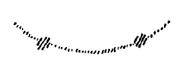
[ 4 ] As soon as the plant turns slightly, the starch granules fall to the other side. The plant cannot tolerate this. It then turns back so that the starch granules are in the right place. These starch granules are symmetrical to the Earth's gravitational line. The plant grows upright because it senses the direction of gravity. The starch grains sense gravity. By observing the starch grains at the root tips, we learn about a kind of sensory organ. For the plant, it is the sense of gravity. This sense belongs not only to the plant, but to the soul of the whole earth, which allows the whole plant to grow according to this sense.
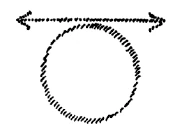
[ 5 ] This has a fundamental significance. The plant aligns itself with gravity. If we take a wheel, for example a water wheel, into which we can place plants, and turn the wheel together with the plants, another force is added to gravity: the force of rotation. This force is then present at every point of the plants, and the roots and stems of the plants grow in the direction of the tangent of the wheel, in the direction of the tangential force, and not in the direction of gravity. The starch grains then also align themselves in their position.
[ 6 ] Let us now consider the human ear. First we have the external auditory canal, then the eardrum, and in the inner ear the ossicles: the malleus, incus, and stapes—tiny little bones. Hearing is based on these small bones causing the other organs to vibrate. Inside, we find three semicircular, membranous canals arranged in the directions of the three dimensions. These are filled with fluid. Then we find the labyrinth in the ear, a snail-shaped structure filled with very fine hairs. Each one is tuned to a specific tone, like the strings of a piano. The labyrinth is connected to the auditory nerve, which goes to the brain.
[ 7 ] We are mainly interested in the three semicircular canals. They are arranged in relation to each other in the three directions of space. They are filled with substances similar to the starch grains in plants, with otoliths. If these are destroyed, a person cannot stand upright or walk upright. When a person faints, the rush of blood to the head can disrupt the organism in the three canals. The human sense of orientation is based on the three semicircular canals. This is the same sense that is located at the tip of the root in plants as the sense of balance. What is located at the tip of the root in plants is formed at the top of the head in humans.
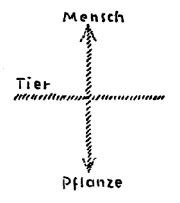
[ 8 ] If you look at the whole of evolution, plants, animals, humans, you will find certain relationships between them. The plant is the reverse of the human being. The animal stands in the middle. The plant has its roots in the ground and directs its sexual organs towards the sun. If you turn the plant halfway around, you have the animal. If you turn it completely upside down, you have the human being. This is the original meaning of the sign of the cross: the plant kingdom, the animal kingdom, the human kingdom. The plant sinks its roots into the ground. The animal is the half-reversed plant. The human being is the completely reversed plant. That is why Plato says: The world soul is stretched across the cross of the world body.
[ 9 ] In plants, the organ of direction is located in the tip of the root; in humans, it is located in the head. What is the head in humans is the root in plants. The reason why the sense of direction in humans is connected with the sense of hearing is that the sense of hearing is the sense that elevates humans to a higher realm. The last ability that humans have acquired is the ability to speak. Speaking, in turn, is connected with upright walking, which would not be possible without the sense of direction or balance. The sound that humans produce through speech is the active complement to passive hearing. What is merely a sense of orientation in plants has become a sense of hearing in humans, which carries the old sense of orientation within itself in the three semicircular canals that are oriented toward the three spatial dimensions.
[ 10 ] Every being has consciousness. Plants also have consciousness, but this consciousness lies on the devachanic plane, the mental plane. If one wanted to record the consciousness of a plant, one would have to draw it in the following way:
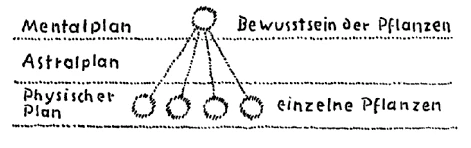
[ 11 ] Plants can also answer our questions, but we must learn to observe them on the mental plane. There, the plant tells us its own name.
[ 12 ] In humans, consciousness extends down to the physical plane. Human consciousness here is connected to the same organ that anchors the plant in the earth. We only truly get to know a person when we see how they produce speech and utter the word “I.” This “I” is rooted in the mental plane. Without the ability to speak the word “I,” we could mistake the human form for that of an animal.
[ 13 ] The plant is rooted in the mental plane, and it is through the organ of hearing that the human being becomes an inhabitant of the mental plane. That is why we associate “it thinks” with language. The ear is a higher development of the sense of direction. Because the human being has turned away from the plant and then turned toward the spirit, he has the old remnant of the sense of direction in his hearing organ. He gives himself direction. So there are two opposite types of consciousness: the consciousness of the plant on the mental plane and the consciousness of the human being here, who carries his being down from the mental world into the physical world. This earthly consciousness of the human being is called the kama-manasic consciousness.
[ 14 ] Our sense organs now also all have a consciousness of their own. These different consciousnesses: the consciousness of the visible, the audible, the olfactory, and so on, are summarized in the soul. Consciousness only becomes manasic when the individual consciousnesses are summarized in the soul center. Without this summarization, the human being would disintegrate into his organ consciousnesses. These were originally formed by the solar plexus, by the sympathetic nervous system. When humans themselves were still a kind of plant, they did not yet have consciousness on the physical plane. It was the higher consciousness that first formed the organs.
[ 15 ] In a deep trance state, the central consciousness is silent. Then the individual organs become conscious and the human being begins to see with the pit of the stomach, with the solar plexus. The seer of Prevorst had such consciousness. She describes real figures of light, but they are only observed by the organ consciousness. The lowest consciousness is that of the mineral. A somewhat more centered consciousness, somewhat more similar to the consciousness of the present human being, is the astral consciousness. The fact that consciousness has formed in the entire astral body is expressed in the spinal cord. There, the human being perceives the world analogously to dream images. Only people whose physical brain is not active have such consciousness. Idiots, for example, see the world in images; their soul life is analogous to dream life. They can only say that they know nothing of what is going on around them. Other beings in the world also have a similar consciousness.
[ 16 ] When a person develops astral consciousness so that they consciously experience dreams, they can do the following: Let us assume that we are able to develop this consciousness and then stand in front of the Venus flytrap flower. If we look at it long enough and let it work on us all by itself, then at a certain moment we get the feeling that the center of consciousness descends from the head and creeps into the plant. One is then consciously in the plant and sees the world through the plant. One must transfer one's consciousness into the plant. Then one becomes clear about what the soul of this being is like. One then experiences this soul. In a sensitive plant, consciousness is very similar to the consciousness of an idiot; it is not merely mental consciousness. It has brought consciousness down to the astral plane. There are therefore two kinds of plants: those that are conscious only on the mental plane, and those that are also conscious on the astral plane.
[ 17 ] Certain animal species also have consciousness on the astral plane, which is also the plane of idiot consciousness. Helena Petrovna Blavatsky points in particular to Indian night insects, moths. Spiders, for example, also have astral consciousness; the fine spider webs are actually spun from the astral plane. The spiders are merely the tools for astral activity. The threads are spun from the astral plane. Ants, like spiders, also have consciousness on the astral plane. That is where the anthill has its soul. That is why the actions of ants are so orderly.
[ 18 ] Minerals also have consciousness. This lies on the higher mental plane, on higher levels than that of plants. Blavatsky calls it kama-pranic consciousness. Humans can also attain this consciousness later on while maintaining their current state of consciousness. They then no longer need to enter a physical body, no longer need to be incarnated. Stones are on the lower physical plane and their consciousness is in the higher parts of the mental plane. From above, it arranges the crystals. Once humans can carry their consciousness up there, they form their own physical body from the minerals of the world.
[ 19 ] The three parts of the brain must later be completely separated (thinking, feeling, willing). Human consciousness must rule over the brain, just as higher consciousness rules over the anthill. Just as one can distinguish between workers, males, and females in the anthill, so too will a precise distinction into three parts take place later in the brain. Then the human being will be a planetary spirit, a creator who creates things himself. Just as the Earth spirit builds the Earth's crust, so too will humans build a planet. To do this, they must have kama-pranic consciousness. Today, they only have kama-manasic consciousness. This consists of the organ consciousness being saturated and permeated by the mind (manas). Consciousness becomes rationalized, as Blavatsky says. The process of rationalization takes place from animals to humans. Mere organ consciousness can recognize goals, but does not know the means to achieve them. Rationalized consciousness can direct the means. Blavatsky says quite correctly: “For example, a dog locked in a room has the instinct to get out, but it cannot because its instinct has not become rational enough to take the necessary means, while humans immediately grasp the situation and free themselves.”
[ 20 ] We therefore distinguish with Blavatsky:
1. The organ consciousness that our organs have.
2. The astral consciousness of animals and certain plants, and also of idiots.
3. The kama-pranic consciousness of stones, which humans also acquire later.
4. The kama-manasic consciousness, the intellectual.
[ 21 ] In this way, one must dissect the cross of worldly existence.
[ 22 ] The true meaning of the cross lies infinitely deep. Even the ancient legends are images drawn from such depths. The legends rendered a great service to the human soul as long as humans were able to understand the truths of the legends emotionally. Take, for example, the ancient legend of the Sphinx. The Sphinx posed the riddle: In the morning it walks on four legs, at noon on two, and in the evening on three. What is it? It is man! At first, in the morning of the earth, man walked on four legs, in his animal state. At that time, the front limbs were still organs of movement. Then he stood upright. The limbs diverged in two ways and the organs divided into the physical-sensory and the spiritual organs. He then walked on two legs. In the distant future, the lower organs will fall off, as will the right hand. Only the left hand and the two-petaled lotus flower will remain. Then he will walk on three. That is why Vulcan limps. His legs are in the process of regression; they are ceasing to be. At the end of evolution, in the Vulcan metamorphosis of the Earth, man will be the three-part being that legend suggests as the ideal.