

Basic Elements of Esotericism
GA 93a
24 October 1905, Berlin
Translated by Steiner Online Library
Lecture XXII
[ 1 ] Continuing our discussion of karma and reincarnation, we will now address the problem of death as a special question in connection with the whole.
[ 2 ] The question: Why do humans die? — has always preoccupied humanity. But it is not so easy to answer, because what we call death today is connected with the fact that we are at a very specific stage of our development. We know that we live in three worlds, the physical, astral, and mental worlds, and that our existence alternates between these three worlds. Within us, we have an inner core of being that we call the monad. We retain this core being throughout the three worlds. It lives within us in the physical world, but it also lives within us in the astral and devachanic worlds. The inner core of our being is always clothed in a different garment. In the physical, astral, and devachanic worlds, the garment of our core being is different.
[ 3 ] Let us now disregard death for the moment and imagine human beings in the physical world clothed in a certain kind of matter. Then they enter the astral and devachanic worlds, each time wearing a different garment. Let us now assume that human beings were conscious in all three worlds, so that they could perceive the things around them. Without senses and perception, humans would not live consciously even in the physical world. If humans were equally conscious in all three worlds today, there would be no death, only transformation. Humans would then consciously pass from one world to another. This passing would not be dying for them, but at most like traveling for those left behind. Now it is the case that human beings only gradually acquire the continuity of consciousness in these three worlds. At first, they experience it as a darkening of their consciousness when they enter the other worlds from the physical world. They only become clearly conscious again when they return to the physical world. The beings who retain consciousness do not know death. Let us now agree on how human beings came to have their present physical consciousness and how they will acquire a different consciousness.
[ 4 ] We must recognize human beings as a duality, composed of two beings: the monad and the envelope of the monad. We ask: How did one come into being and how did the other come into being? Where did the astral human being live before becoming what it is today, and where did the monad live? — Both have gone through different stages of development, both have gradually come to be able to unite.
[ 5 ] When we consider the physical-astral human being, we are thrown back to very distant times, when he existed only as an astral archetype, as an astral form. The astral human being that originally existed there was a form that was not like today's astral body, but a much more comprehensive entity. This former astral body can be imagined as the Earth at that time being like a large astral ball, composed of astral human beings. All the forces of nature and beings that surround us today were still within human beings at that time; human beings lived dissolved in astral existence. All plants, animals, and so on, the animal instincts and passions still lived in astral human beings at that time. What lions and all mammals have within them today was thoroughly mixed with the astral body of human beings at that time. The astral body of human beings at that time contained all the beings distributed on this earth. The astral earth was composed entirely of astral human bodies, like a large blackberry ball, and enclosed in a spiritual atmosphere in which devachanic beings lived.
[ 6 ] This atmosphere—which could be called astral air—that surrounded the astral earth at that time was made of a slightly thinner substance than the astral body of humans. Spiritual beings, both lower and higher, lived in this astral air, including human monads, completely separated from the human astral body. That was the state of the earth at that time. The monads that already existed in the astral air could not connect with the astral body, because the astral bodies of humans were still too wild at that time. The instincts and passions first had to be removed from them. Thus, through the elimination of certain substances and forces that the astral body possessed, the human astral body gradually emerged in a purer form. However, the eliminations remained separate astral formations, beings with an even denser astral body, with wilder individual instincts, drives, and passions.
[ 7 ] So now there were two astral bodies: a less wild human astral body and a very dense, wild astral body. Let us keep these two strictly separate: the human astral body and everything that lived around it. The human astral body became increasingly refined and noble, expelling more and more secretions, which became denser and denser. When these reached physical density, they gave rise to the other kingdoms: the animal, plant, and mineral kingdoms. Certain expelled instincts and forces emerged through this process of densification as the various classes of animals.
[ 8 ] Thus, a continuous purification of the astral bodies took place, and this had a necessary consequence on Earth. For as a result of the purification, human beings now had beside them what they had previously had within themselves, and they came into contact with these beings, and what they had previously had within themselves now worked into human beings from outside. This is an eternal process, also in the separation of the two sexes, which thereafter also influence each other from outside. The whole world was first interwoven with us; only then did it influence us from outside. The original symbol for this return to oneself from the other side is the snake biting its own tail.
[ 9 ] Images of the world surrounding him now arise in the purified astral body. Let us assume that the human being has perhaps separated out ten different forms that now surround him. Previously they were within him, and now they are around him. Now mirror images of the world surrounding him, of the forms outside him, arise in the purified astral body. These mirror images become a new force within him; they work within him, reshaping the nobler astral body that has been purified. For example, he has cast out the wildness from within himself; it is now outside him as an image and now acts upon him as a formative force. The astral body is built up by the images of the separated world that used to be within him. They build a new body within him. The human being had previously had the macrocosm within him, then cast it out, and this now formed the microcosm within him, an outline of himself.
[ 10 ] Thus we encounter the human being at a certain stage in a form that is bestowed upon him by his entire environment. The mirror images act on his astral body in such a way that they differentiate and divide it. Through the mirror images, his astral body split and he reassembled it from the parts, so that it then became a structured organism. The common astral mass has been differentiated into the various organs, the heart, and so on. At first, everything was astral, and then the physical human being formed around it. Human formations thus became increasingly capable of condensing and becoming a more complex and diverse organism that is a reflection of the entire environment.
[ 11 ] What has become most dense is the physical body; less dense is the etheric body, and the finest is the astral body. They are essentially mirror images of the outside world, microcosms within the macrocosm. The astral body has become finer and finer, so that at a certain point in the Earth's development, human beings have a developed astral body. As the astral body has become finer and finer, it has approached the fine astral matter around it.
[ 12 ] Meanwhile, the opposite developmental processes have taken place in the upper region. The monad has descended from above, from the highest Devachan regions to the astral region, and has become denser during this descent. Here the two parts meet. On one side, the human being ascends into the astral body; on the other side, the monad encounters him on its descent into the astral world. This was in the Lemurian epoch. There, both were able to fertilize each other. The monad clothed itself in devachanic matter, then in astral air matter. From below, we have physical matter, then etheric matter, then astral matter again. In this way, the two astral matters fertilize each other and merge together. What comes from above has the monad within it. Like a bed, it embeds itself in the astral matter.
[ 13 ] This is how the descent of the soul takes place. But for this to happen, the monad must develop a thirst for knowledge of the lower regions. This thirst must first be presupposed. As a monad, one can only get to know the lower regions by incarnating in the human body and looking out into the environment through it. Now the human being is fourfold: First, they have a physical body; second, an etheric body; third, an astral body; and fourth, within it, the I, the monad. Once the fourfold body is in place, the monad can look out into the environment through it, and communication then takes place between the monad and everything in the environment. This satisfies the monad's thirst to some extent.
[ 14 ] We have seen that the entire human body is composed of parts that came into being when the originally unstructured mass divided into organs after the original astral body had separated out various elements and, through these separations surrounding it, which were reflected in it, images arose within it. These images became forces within it and formed its etheric body; that is, its etheric body is structured by these manifold images. In this etheric body, now composed of parts, each such etheric part in turn condenses within itself and the physical limb body arises. Each such physical core, from which the organs then develop, simultaneously forms a kind of center in the ether.
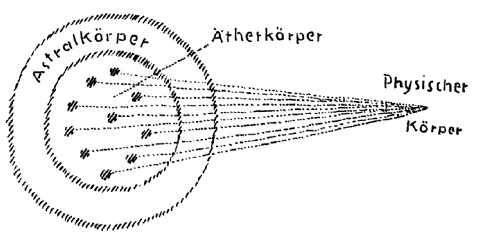
[ 15 ] The spaces between the centers are filled with the mere etheric mass. We imagine the body to be composed of ten parts. These ten parts, which we take as a model, hold the body together through their kinship; they are images of the rest of nature, and it depends on how strongly they are connected. There are degrees of kinship between them and the individual parts. As long as these hold, the body remains together; when the degrees of kinship cease, the parts fall apart and the body disintegrates. Since we have projected the most diverse forms during our earthly development, the parts of the etheric body only hold together to a certain degree. Human nature is a reflection of the projected entities. To the extent that the entities lead a separate existence, the parts of the physical body also lead a separate existence. When the kinship of forces has become so small that it ceases, we live only until then; the length of our life is determined by how well the beings around us get along.
[ 16 ] The development of the higher human being proceeds in such a way that the human being first works on his astral body. There he works in ideals, enthusiasm, and so on. He fights his instincts. The moment a person replaces drives with ideals, duties with instincts, and develops enthusiasm instead of desires, he creates harmony within the parts of his astral body. This peacemaking work begins with the entry of the monad, and the astral body begins to become more and more immortal. From then on, the astral body no longer dies, but survives to the extent that it has brought peace, that peace can withstand the destructive forces. From the moment the monad enters, it brings peace, first in the astral body. Then the instincts begin to get along. Harmony arises in the former chaos and an astral structure emerges which endures and remains alive. Peace is not initially established in the physical body and the etheric body, but only partly in the astral body. It initially lasts only a short time in other worlds, but the more peace has been established, the longer the devachan period lasts.
[ 17 ] When a person has become a chela, they also begin to establish peace in the etheric body. Then the etheric body also endures. The masters also establish peace in the physical body; therefore, the physical body also endures for them. It is a matter of bringing the various bodies, which consist of individual parts that fight each other, into harmony and transforming them into eternal bodies.
[ 18 ] Human beings have formed their physical bodies by projecting the natural kingdoms out of themselves, which were then reflected back into them. This is how the individual parts within them came into being. Now they perform actions; through these, they re-enter into communication with their surroundings. What they now project outwards are the effects of their deeds. Now they integrate their deeds into the environment, and gradually become a reflection of these deeds. The monad has entered the human body; it begins to perform deeds. It is these deeds that are integrated into the environment, and they are reflected back in it. To the same extent that it begins to make peace, it also begins to absorb the reflections of its own deeds.
[ 19 ] Now we have arrived at a point where we are constantly creating a new realm around us, the effects of our own deeds. This in turn builds something within us. Just as we previously separated the residual etheric body from the reflections, we now integrate the effects of our actions into the monadic existence. We call this the foundation of our karma. This allows us to make everything permanent in the monad. Previously, the astral body purified itself by casting off everything that was within it. Now, human beings create a new realm of action, as it were out of nothing, out of nothing according to the circumstances. That which previously had no existence, the new relationship, is reflected in the monad as something new that has a pictorial character, and a new inner core of being is formed in it, arising from the mirror image of the deeds, the mirror image of karma. As the monad continues to work, the core of its being grows larger and larger. After some time, we look at the monad: it will then have developed harmony from the conflicting forces on the one hand, and on the other hand from the effects of the deeds. Both connect with each other, and a communal structure emerges.
[ 20 ] Let us assume that the earthly garment is removed from the human being and the monad remains. It retains the effects of its deeds. The question arises as to the nature of the effects of the deeds. If they are such that they can be active in the worlds in which the monad now finds itself, then human beings will be able to remain there for a long time; if not, then only for a short time. Then they must fall back into the thirst of the monad [for the physical plane] and take on a physical body again.
[ 21 ] Human life is constantly enveloped by what surrounds us: involution – evolution. We absorb images and shape our own bodies accordingly. What the monad has wrought, man takes up again as karma. Human beings will always be the effect of their karma. Vedanta teaches that the various parts of human beings are dissolved and scattered in all directions; what remains of them is their karma. This is the eternal, what human beings have made of themselves, what they themselves have initially absorbed as images from their surroundings. Human beings are immortal; they only need to want it, they only need to shape their deeds in such a way that they have a lasting existence. What is immortal in us is what we acquire from outside. We have become through the world and are beginning to build up the mirror of a new world through the fertilization with the monad within us. The monad has enlivened the mirror images within us. Now the images can have an effect, and now the effects of these images are reflected anew. A new inner life emerges. We are constantly changing our environment with our actions. This creates new mirror images, which now become karma. This is a new life that springs from within. It follows from this that, in order to develop ourselves further, we must, from a certain point on, go out from ourselves and act selflessly in our environment. We must make this stepping out possible in order to selflessly bring our environment into harmony. This requires harmonizing the mirror images within us. Our task is to make the world around us harmonious. If we are destroyers in the world, the devastation is reflected in us; if we bring harmony to the world, the harmonies are reflected in us.
[ 22 ] We will take with us the final degree of perfection that we have set forth, that we have created around us. That is why the Rosicrucians said: Shape the world so that it contains wisdom, beauty, and strength, then wisdom, beauty, and strength will be reflected in us. If you have used your time for this, then you yourself will depart from this earth with the reflection of wisdom, beauty, and strength. Wisdom is the reflection of Manas; beauty, piety, and goodness are the reflection of Buddhi; strength is the reflection of Atma.
[ 23 ] First, we develop a realm of wisdom around us by promoting wisdom. Then we develop a realm of beauty in all areas. Then wisdom becomes visible and is reflected in us: Buddhi. Finally, we give the whole physical existence, wisdom within, beauty without.
[ 24 ] If we have the power to enforce this, then we have strength: Atma, the power to turn all this into reality. In this way we establish the three realms within ourselves: Manas, Buddhi, Atma.
[ 25 ] It is not through idle contemplation that man progresses on earth, but by incorporating wisdom, beauty, and strength into the earth. Through the work of our higher self, we transform the transitory bodies given to us by the gods and create eternal bodies for ourselves. The chela who refines his etheric body [so that it is preserved] gradually renounces the maharajas. The master, whose physical body is also preserved, can renounce the Lipikas. He stands above karma. We must describe this as the progress of the human being within. We must seek to enter what is higher, outside of ourselves. Therefore, our higher self is not to be sought within us, but in the higher individualities.