

Cosmogony
The Gospel of St. John
GA 94
5 March 1906, Berlin
Translated by Steiner Online Library
Lecture Three
[ 1 ] The reflections we have made individually on the Gospel of John have led us deeply, very deeply into the essence of the Christian worldview and have also taught us what profound mystical power lies in the true penetration of the Christian document. We have seen that the Gospel of John should not be read merely as an external story, as news or a message, but that it should be read as a biography, so that every sentence, when we take it in alive, transforms something within us.
[ 2 ] We have considered the seven stages of spiritual ascent in this life of John. Today, a small addendum may show us how deeply such things are to be taken. I would like to show you with individual examples that what I have tried to extract as such a deep meaning from the Gospel of John is really not something superficial, but that it is only with the means of so-called secret teaching, with the means of occultism, that we can learn to understand many things that would otherwise appear dark and incomprehensible. First of all, I would like to remind you of something I have mentioned many times before, namely what the seven stages of initiation were at the time when Christianity came into being.
[ 3 ] We learned about Christian initiation last time. But not only has Christianity made inner initiation possible, but at all times since human beings in our sense have existed on earth, there has been the possibility of becoming an initiate, of climbing to higher stages of human existence. Through Christianity, all these things have become even more internalized. Human beings can achieve a great deal, a very great deal, since Christianity has given us documents such as the Gospel of John, which they only need to allow to work within themselves, to bring to life within themselves, in order to ascend to certain heights. However, such documents as Christianity has given to human beings did not actually exist before the emergence of Christianity. People had to be initiated into secret temples of initiation or places of worship, and the lowest levels of initiation differed among the various peoples. But you can imagine that one then transcends all national peculiarities. The higher levels were therefore the same for all peoples, even in ancient times.
[ 4 ] I would like to mention once again the seven stages of initiation as they existed in the Persian Mithras initiation. This was a type of initiation that was practiced throughout the Near East, even beyond Greece and Rome, as far as the Danube region. It continued to be practiced long after the emergence of Christianity. For a long time, it was possible to go through these seven stages, even in the secret cults and temples of Egypt, which were often built into rocks. They were accessible only to those who, as purified disciples and initiates, had become familiar with them after rigorous testing. First there was the degree of the “raven.” As a raven, the initiate carried the knowledge that could be gained in the sensual outer world into spiritual life. The concept of the raven has been preserved in myths and legends. There are the ravens of Wotan, the ravens of Elijah, and in the German Barbarossa legend, the ravens are the mediators between the emperor enchanted in the mountain and the outside world. In the Mithras mysteries, the term raven was therefore the description for a degree of initiation.
[ 5 ] The second degree was that of the “occult.” This was the name given to those who had already been entrusted with some important, essential occult secrets.
[ 6 ] The third degree was that of the “warrior.” These were initiates in whom the higher self was already felt to such a degree that sayings of the kind you can find in the second section of “Light on the Path” – “Step aside in the coming battle, and even if you fight, do not be the warrior” – became understandable to them. Only an initiate of the third degree can understand these sayings. This is not to say that not everyone can acquire a certain understanding. Everyone has a higher self, and if a person is able to deny their lower self and place what they are as a lower self in the service of the higher self, then they can say in a certain sense: Even if you fight, you are not the fighter. But only when a person has reached a certain level of development does he know exactly what this sentence means. Then even interests that are otherwise considered higher interests fall away. They become mere lower interests and mere servants of the fighter.
[ 7 ] The fourth degree is reached when complete inner harmony and peace, balance, and strength have been attained. This stage of initiation is called the degree of the “Lion.” Such an initiate has realized the occult life within himself to such an extent that he may stand up for the occult not only with words but also with deeds.
[ 8 ] Meanwhile, the consciousness of a person who passes through these four stages goes further and further. It identifies with ever larger and larger groups of people. All these expressions have a secret meaning. Take the expression “the occult.” The person as he usually stands before us, what is he? He is what is within him. As a raven, as a first-degree initiate, he seeks to overcome what is only within him; then his interests broaden. What the people in his immediate environment are, what they feel, what they want, becomes at the same time his feeling and his will. The expressions were coined in times when there were still human communities that were regarded as clans, as extended families. What did people say, for example, about a clan, about a common family? They said that these were the members of a soul family going back to a common pair of ancestors. Thus, such a clan was regarded as the members of a hidden self, as the members of a soul family.
[ 9 ] Everyone who was initiated into the second degree, the occult, had ennobled their ego to the level of the ego of their community, so that they made its interests their own. The occult of a human community was able to live in them. Thus, such a human community, whose ego the individual initiate made their own, became their dwelling place. The warrior fought for the greater community. In ancient Palestine, those who had risen to take in an entire tribe, the consciousness of an entire tribe, the ego of an entire tribe, were called “lions.” The lion of the tribe of Judah is an expression for those who had reached such a level of initiation that they had taken in the ego of the entire tribe.
[ 10 ] The initiate of the fifth degree had overcome his personality to such an extent that he could take in the soul of the people. The spirit of the people lived in him. In Persia, such an initiate was called a “Persian”; in Greece, such an initiate would have been called a “Greek,” if that had been the custom. So what does this degree mean? Everything individual has disappeared for him, and his consciousness has become identical with the whole. This is a higher consciousness.
[ 11 ] Today it is not so. Today, through the fragmentation of all communities, we are moving toward completely different degrees of initiation. But it still had meaning when Christianity arose, where there is talk of souls initiated in the fifth degree. You can see this for yourself in the Gospel of John. I ask you to read the Gospel of John, chapter 1, verse 45:
[ 12 ] "Philip found Nathanael and said to him, ‘We have found the one Moses wrote about in the Law, and about whom the prophets also wrote—Jesus of Nazareth, the son of Joseph.’ Nathanael said to him, ‘Can anything good come out of Nazareth?’ Philip said to him, ‘Come and see.’ Jesus saw Nathanael coming toward him and said of him, ‘Here is a true Israelite, in whom there is nothing false.’"
[ 13 ] Nathanael is described here as an initiate of the fifth degree. He has thus come to know that which constitutes the power of life for us humans, the tree of life. One enjoys the fruit of the tree of knowledge at an early age. One enjoys the fruit of the tree of knowledge when one is able to say “I” to oneself at all. But when the higher, the spiritual in man awakens, it can happen that God wants to protect man. Jehovah's concern was that, after enjoying the tree of knowledge, humans would not also enjoy the tree of life, for which they were not yet ready. But the initiate of the fifth degree learns what lessens this concern and what rises above all death and transience: the spiritual element.
[ 14 ] How can this spiritual element become established in human beings? For anyone who delves deeper into theosophy, this spiritual element is something that permeates the entire world. For those who are able to see into the higher worlds, everything that is initially an inner state of development is also expressed on the higher planes, first on the astral plane, as an image. When a person has attained the fifth degree of initiation, they always see an image on the astral plane that they did not see before, namely the image of a tree, the image of a branching white tree. This image on the astral plane, which you may take as a symbol for the fifth degree of initiation, is called the tree of life. It is said of those who have attained it that they sat under the tree of life. Thus, the Buddha sat under the bodhi tree and Nathanael under the fig tree. These are expressions for the images on the astral plane. What can be seen there are reflections of inner, now also physically inner, things. This Bodhi tree is nothing other than the astral reflection of the human nervous system. The person who is able to turn their gaze inward through initiation sees their inner life reflected in the astral outer world, down to the physical level. You can see what is meant here in this chapter of the Gospel of John: Nathanael is to be addressed as an expert. It should be pointed out that we understand each other. “Jesus said to him, ‘Before Philip called you, when you were under the fig tree, I saw you.’” This means: We are brothers of the fifth degree of initiation. It is a scene of recognition between initiates. “Nathanael said to him, ‘Rabbi, you are the Son of God, you are the King of Israel.’” You see, the recognition has been accomplished. Jesus immediately replies that he will prove himself not only to be initiated in the fifth degree, but also to be something else. He says: “You believe because I told you that I saw you under the fig tree; you will see even greater things than that!”
[ 15 ] Next, I would like to draw your attention to the conversation with Nicodemus, which you can find in the third chapter. There the significant words are spoken: “Verily, verily, I say unto thee, except a man be born of water and the Spirit, he cannot enter into the kingdom of God.” What does it mean to be born again and see the kingdom of God? — It means to have awakened one's higher self, that is, to be born in such a way that the eternal core of one's being is awakened. What does it mean to enter the kingdom of heaven? It means not only seeing the reflection of Devachan here, as it appears through the physical eyes, but seeing this kingdom directly. Only those who are not merely born for this physical world, but who are born a second time, can do this.
[ 16 ] Take what I have used before as a comparison, but which is more than a comparison. Take it literally to a certain extent. To be born means to pass from the embryonic state to the state in which one perceives the outside world with the senses. Those who do not go through the embryonic state could never be ready to be born. Those who are familiar with this state also know that ordinary life is an embryonic state for higher life. This leads us deep into the meaning of ordinary life. Those who focus their attention on the spiritual world could very easily become convinced that such a spiritual world exists and that human beings are citizens of this spiritual world; they could disregard this physical world and believe that human beings could not leave this world quickly enough, kill themselves, in order to soon enter the spiritual world. That is not the correct understanding. That is just as nonsensical as not wanting to let the human embryo mature, but wanting to retrieve it after two months so that it can live here. In exactly the same way, one must mature, become ripe for the higher life. That is the one who has developed his higher self. Here in this physical world is the training ground. The one who has developed the I here is ripe to enter the realms of heaven, that is, to be reborn. Human beings must go through birth and death again and again until they have attained their full measure of maturity, in order to then gain entry into the spiritual realm itself, so that they no longer need physical organs. Therefore, we must realize that everything our eyes, ears, and other senses accomplish here are achievements for higher life.
[ 17 ] Certainly, we have spoken often and often about the fact that human beings must develop higher senses, that they must develop the chakrams or sacred wheels that enable them to enter the spiritual world and see it. But how do they attain these sacred wheels? Through their work here on the physical plane. This is the place of preparation for it. What we do here prepares our organs for a higher world. Just as the human being is prepared in the body of the mother, so in the body of the great world mother—and that is where we are when we lead our physical life—in the body of the great mother, that which must enable us to see and act in the higher worlds is prepared. It is therefore entirely justified to speak of a higher world and to value it more highly than our lower world. But we must take this expression only in a technical sense. All worlds are, in essence, equal manifestations of the highest principle. We must not look upon any world with contempt. In this way we come to behave correctly toward the lower and higher worlds. This forms the prerequisite for the third chapter of the Gospel of John.
[ 18 ] We must be clear that Jesus is speaking to Nicodemus about true rebirth, and that he wants to remind him above all that ordinary life should be born as a higher life from this point of view and must be regarded as such. Anyone who reads this chapter more closely and considers it more carefully will see that this is precisely what it is about.
[ 19 ] Certain circles object most strongly to theosophy because it teaches reincarnation, the gradual maturing of the human being toward rebirth through repeated earthly lives. It is said that Christianity knows nothing of this doctrine of rebirth. First of all, there is a clear indication in the Gospel of John that Jesus taught reincarnation when he spoke intimately with his disciples. The ninth chapter – the healing of a man born blind on the Sabbath – can only be understood if one takes the doctrine of reincarnation as a basis. One must bear in mind that he spoke in the language that was customary at that time. In Greece at that time, it was not customary to speak of anything other than the power that permeates the innermost being of human beings and advances them in their innermost being. The force that shapes and develops human beings: for the Greeks, and indeed for all peoples of that time, this was God. Such times did not yet know a merely external God, a God in the hereafter. Therefore, above all, what lives in human beings was referred to as the God in human beings. So when we speak of the God of Abraham, Isaac, and Jacob, we mean the higher self. You can only understand the Old Testament if you know that God is to be understood in this way. Jesus, too, when speaking intimately to his disciples, speaks of the God living within man: "His disciples asked him, saying, 'Master, who sinned, this man or his parents, that he was born blind? Jesus answered, ‘Neither this man nor his parents sinned, but this happened so that the works of God might be displayed in him.’"
[ 20 ] These three sentences speak clearly enough. Neither he, that is, the physical part, nor his parents sinned; therefore, the Jewish law that God punishes the sins of the fathers to the umpteenth generation does not apply. But the works of God in man are to become visible, that is, the self in man that passes through all incarnations. The words that Jesus spoke to his disciples in this way are as clear as can be. You know the orthodox interpretation. Just think, if someone wanted to presuppose what is meant here: God's glory should be revealed in a blind man. That would presuppose that someone had been made blind so that Jesus could heal him, so that God's glory could be revealed. Is that compatible with a deep Christianity? No. For that would degrade Christianity in a moral sense. Interpreted theosophically, this image has a great, beautiful, and glorious meaning.
[ 21 ] This was always the case when Jesus spoke intimately with his disciples. That this was so is revealed above all in a scene we call the Transfiguration. However, this is not found in the Gospel of John. You will find this Transfiguration scene in Matthew, chapter 17, and in Mark, chapter 9; we do not find it in John. The only thing we find in John that could refer to it is the passage in chapter 12, verse 28: "Father, glorify your name! Then a voice came from heaven: ‘I have glorified it, and I will glorify it again.’“ And further, verse 31: ”Now is the judgment of this world; now the prince of this world will be cast out. And I, when I am lifted up from the earth, will draw all people to myself. He said this to show the kind of death he was going to die. The crowd answered him, We have heard in the law that Christ remains forever; and how can you say that the Son of Man must be lifted up? Who is this Son of Man? Jesus said to them, "The light will be with you for a little while longer. Walk while you have the light, lest darkness overtake you. Whoever walks in darkness does not know where he is going. Believe in the light while you have it, that you may become children of light."
[ 22 ] All the evangelists describe the Transfiguration scene, except John. This will lead us deeper into this scene. Let us make the meaning of the Transfiguration scene very clear to ourselves. What happens there? Jesus goes with three disciples, Peter, James, and John, up the mountain, that is, into the inner sanctuary, where one is initiated into the higher worlds, where one speaks in occult language. When it is said, “The Master went with his disciples up the mountain,” it means that he went to the place where he explained the parable to them. The disciples were transported to a higher state of consciousness. They see in it what is not transitory but eternal. Moses and Elijah appear, and Jesus himself among them. What does this mean? In secret science, the word Elijah means the same as EL — the goal, the path. Moses is the occult word for truth. So when Elijah, Moses, and Jesus in the middle appear, you have the early Christian truth: I am the way, the truth, and the life. Jesus himself says — this is an early Christian mystical truth — “I am the way, the truth, and the life.”
[ 23 ] Underlying all this is the fact that the eternal is presented here in contrast to the temporal, that the disciples are looking into a world that lies beyond this world. Afterwards they said to the Master: All this should only happen when Elijah has returned. So they spoke to him as if it were self-evident that there is reincarnation, just as the doctrine of reincarnation is discussed in various places in the Gospel. John asks: Are you Elijah who has been raised from the dead? Then the Master says to him: “Elijah has come back.” John the Baptist is Elijah. —- “People just didn't recognize him.” — “But don't tell anyone until I come back.” — Here you have the general, wise, religious truth of reincarnation expressed in an intimate conversation between the Master and his disciple. At the same time, it is used as a kind of testament: Don't tell anyone until I come back. — This return points to a much later time, to the time when all people will recognize Christ through their higher understanding. When that is the case, he will reappear to them.
[ 24 ] Christ will reappear in the world. For this time, however, the teachings of reincarnation and karma should be kept as popular teachings. But now people should know nothing of the teachings of reincarnation and karma; this should cause them to regard life between birth and death as something particularly valuable and important. All stages of life experience must be gone through by human beings. Until the time of Christ, it was generally spoken of reincarnation. Life between birth and death was only a temporary episode. Now, however, human beings should learn to regard this life here on earth as something important. A radical elaboration of this teaching was the doctrine of eternal punishment and eternal reward. This is a very radical interpretation. What mattered was that every human individuality, every human god, should go through an incarnation in which he knows nothing of reincarnation and karma, through an incarnation in which he recognizes the life between birth and death as eminently important.
[ 25 ] If you go through the theosophical books, you will find that the time between two incarnations is fifteen to eighteen centuries. That is approximately the time between the birth of Jesus and our time. Those who lived at that time are now reappearing. So now they can take up the new teaching again. Therefore, the theosophical worldview was prepared on Mount Tabor by Christ Jesus. When we look at world history in the big picture, we must not believe that it is a matter of right and wrong that we can criticize. It cannot be a question of absolute truth and absolute falsehood, but of what is beneficial to human beings. If I were sitting here with a group of boys no older than ten and teaching them mathematics, what I was teaching would be true — and yet it would be foolish. I must give people what is good for them at a certain stage of development. So it is not right for us, as later generations, to apply a standard and say that Christianity taught falsehoods. No, in order to conquer the physical plane, one had to take this one life seriously. Certainly, the Chaldean priests brought great spiritual truths into existence. They brought down an enormous amount of knowledge about the spiritual world, but they lived with the most primitive tools, without knowledge of the everyday forces of nature. The physical plane had to be conquered first. To do this, the entire emotional world had to be attuned to it. Christianity had to prepare humanity to conquer the physical world. This was determined by law; it is the Testament of Mount Tabor. Thus, what underlies this Testament brings about something wonderful.
[ 26 ] Those who delve deeper will discover all kinds of things. If we want to understand religious documents that originate from times when people did not think materialistically but had real knowledge of spiritual life, we must know that the way of thinking was completely different, that when people spoke of human beings, they spoke in a completely different way.
[ 27 ] Now I must tell you something that is easy for the mind to understand, but difficult for the soul to comprehend for people today. At the time when the Gospel was written, it was the dawn of Christianity. People still used names, as I will now describe. They did not refer to the physical organism. A person of that time always saw through the physical organism to the spiritual, the higher. They did not perceive a name as we understand it today, but rather named things meaningfully. Imagine that someone was called James. James actually means water. Water is the esoteric expression for the soul, so that when I call someone James, I am saying that the soul element shines through his body. I thus meaningfully designate him as belonging to water. So when I give someone the name James as an initiate, he is for me the symbol of water (Hebrew = Yam). James is nothing other than the scientific name for an initiate who has mastered the power of occult water in particular.
[ 28 ] These were the three disciples, designated by their initiation names, who were taken to Mount Tabor: James means water, Peter means earth – the rock (Hebrew = Jabbaschah), John means air (Ruach). John therefore designates the one who has attained the higher self. This leads you deep into the secret doctrine. Transport yourself back to the time when humans only had the lower principles, that is, to the third root race, to the Lemurian period of the Earth. At that time, humans did not yet breathe air, but through gills. The lungs developed later, and with them, lung breathing. This process coincides with fertilization by the higher self. Air is nothing other than, according to the hermetic principle, the lower for the higher, for the higher self. If I call someone John, he is one who has awakened the higher self, one who masters the occult powers of air. Jesus is the one who masters the occult powers of fire (Nur). Thus, in the four names, you have the representatives of earth, water, air, and fire. These are the names of the four who ascend Mount Tabor.
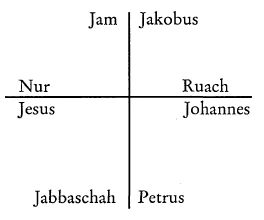
[ 29 ] Imagine these four together on the Mount of Transfiguration, and you have at the same time the initiates who master the four elements—the lords of the four elements: fire, water, air, earth. So what happens? It happened at that time that spiritual proof was provided that through the appearance of Jesus, the whole power of the elements is renewed in such a way that the life that pulsates through the elements undergoes a new, important point in its development. Occultly, this is the Transfiguration. If someone undergoes the transfiguration in this way, having within themselves the stages of water, earth, and air, and ascends to the powers of fire, then they are a resurrected one, one who has undergone crucifixion. Therefore, this scene in the other Gospels is in truth nothing more than a preparation for the actual, deeper scene of initiation, the crucifixion itself. In contrast, in John everything appears to be prepared. The preparatory scene does not appear at all, but rather the death on Mount Golgotha. Jam - Nur Ruach - Jabbaschah = INRI - that is the meaning of the words written on the cross.
[ 30 ] In this way you can go deeper and deeper, and you will never finish learning from the religious scriptures. Sometimes, when you hear something like this, it seems like a forced explanation. But every step you take deeper into it will prove to you that it is not something forced. Especially with trivial explanations, you will see that they are an attempt to forcibly dismiss the “depth.” But the depth lies in these writings. Those who know something can always say to themselves: There is probably much more to it than this, I still have a lot to learn. That is the reverence we can show for religious writings.
[ 31 ] This reverence is the best, because it then becomes the power we gain from the depths. I can only point to an important sentence. It is in the Gospel of John, chapter 19, verse 33: "But when they came to Jesus and saw that he was already dead, they did not break his legs ... For this happened,“ it says in verse 36, ”that the Scripture might be fulfilled: ‘You shall not break any bone of him.’" You know that this echoes a passage from Moses. There, too, when understood correctly, it has a deep meaning. I would like to briefly explain this passage, which is deeply symbolic.
[ 32 ] If you look at our whole world, you will say to yourself that human beings, as they are now incarnated in the flesh, have no power over life and no power over what is above life. What they control is the lifeless force, the inorganic force. Human beings cannot make a plant grow, nor can they make it grow faster. He would first have to acquire the occult powers to do so. He is certainly not able to exercise dominion over that which is even higher than the life force. What man is able to control is the inanimate world outside. He exercises his dominion in his everyday work, in the materials that nature provides him. He creates works of art, images of the Most High, but he cannot breathe life into them. He can only imitate life. He can only awaken the idea of life in the inanimate, even in the highest Christian works of art. This is indeed the case because man has surrounded his astral and etheric forces with the solid, dense physical body. This has given him a relationship to the external environment in which he is only master of the lifeless. Man must use his own physical tools, and these are only masters of the lifeless. The higher forces, which are not bound to the physical, would have to awaken, then man would again become master of life. Human beings can become masters of the physical forces, but not of life itself.
[ 33 ] This is related to the fact that the human body was once soft and flexible, but has now become firmer and firmer. If you go back in evolution, you will see that human beings have become completely different. The skeletal system did not yet exist in the Lemurian period. It only developed later. Thus, the skeletal system is the last thing to have appeared in the human organism. It will remain part of the human being until they have become spiritualized again, until they have reawakened their inner powers and learned the lesson they have to learn in their body, which has become densified to the point of having a skeletal system. Christ Jesus, in his cosmic mission, is the spirit who is embodied in such a body in order to show human beings the way out of this world and into a higher world. He is the guide, the sage into such a higher world. What is to find the way into this higher world is symbolized in the solidity, in the skeleton of the human being. When human beings were still different, not yet so far advanced as to have a solid skeletal system, they did not need a Messiah. But it is precisely for this epoch that they need the Messiah, the Redeemer.
[ 34 ] So it is clear that for the present human race, the forces in Jesus that are connected with the higher world are not relevant. The expression is now this: the skeleton is called the outer body, water is called the etheric body, blood is called the astral body, and then spirit. Therefore, you can read in John: There are three that bear witness: blood, water, and spirit. — Therefore, the blood and water can flow out of the body of Christ. These are not relevant for the present human cycle. On the other hand, that which must hold the whole together, that which must bring human beings up to the throne of the Eternal, in which the lesson must be learned, must be kept intact. This is the skeleton, the symbol of the lifeless in nature. Through the skeletal system, this has now brought Christ together with the present human cycle. It is what must be held together until the time when humanity has reached the higher stages. We could follow this up to the corresponding passage in the books of Moses. But that can be done another time.
[ 35 ] Today I wanted to add a supplement, a subsequent hint that will show you that the Gospel of John can never be fully explored; that will show you how it contains power and life. As we take it in, it gives us strength and life. This makes it the main scripture for all those who want to delve deeper and deeper into theosophical Christianity. Therefore, if theosophy is to work for Christianity, it will have to connect first and foremost with this Gospel of John. However, you must be aware that if I wanted to explain the Gospel of John in its entirety, I would have to spend an entire winter talking to you about it. I would have to go through it line by line, and only then would you see how profound are the words attributed to John, that is, to the one who already indicates by his name that he is a herald of the higher self. He is the representative of the air, who rules the higher powers and wrote his Gospel of John from the insights of the higher self.
[ 36 ] It would be vain and futile to try to fathom or criticize the Gospel of John with the powers of the lower human intellect. In our time, the intellect celebrates great triumphs, but the Gospel of John is not written for the intellect. Only those who have overcome the lower intellect and can then lead it to the heights of spiritual powers, as John did, can understand the Gospel of John. It would not be right for theosophy to decide to begin an intellectual criticism of the Gospel of John, but rather to immerse itself completely in its depths in order to understand it for itself. Then we will see that a new spirit of Christianity — not only the spirit of the past, but of a future Christianity — can emerge for us from the Gospel of John, and we will sense something of the profound truths of one of the most beautiful and significant Christian sayings, which is meant to indicate to us from the mouth of the creator of Christianity himself that Christianity is not something that lived in the past, but that the same power still lives, for what Christ said is true: “I am with you always, even unto the end of the age.”