

Anthroposophy's Response
to Universal Questions
GA 108
13 December 1908, Stuttgart
Translated by Steiner Online Library
19. From a Chapter on the Occult History the Rishis
[ 1 ] In their various incarnations, human beings always experience different circumstances. With each incarnation, they encounter different circumstances, and their own circumstances also take shape accordingly between birth and death. Now the question may arise: Are the experiences between death and rebirth always the same, since the experiences in the physical world are so different? In other words: Has life in Devachan always been the same throughout all periods of physical development? The following explanations will show that there is also a history of life in the beyond.
[ 2 ] Let us recall the state of consciousness of the ancient Atlanteans, who during the day, while still in a clairvoyant state, saw physical objects in faint, misty contours—like lanterns in the fog—and at night were companions of the gods; but day and night were not strictly separated as they are today.
[ 3 ] The most advanced part of the Atlanteans, that is, those who had already lost most of their clairvoyant consciousness and could see things around them physically in sharper contours, lived in the region of present-day Ireland under a high spiritual being: Manu. They moved in separate groups, one of them under the leadership of Manu, from west to east. Then came the Flood. After this, colonies were founded from the center in Central Asia. The first was the founding of Indian culture.
[ 4 ] For the ancient Indian, who still carried within himself the memory of the time of Atlantis, when he was still a companion of the gods, what confronted him in the earthly world was illusion, Maya, the entire environment, even the stars. The connection with the spiritual world, for which the Indian longed, was maintained by the holy Rishis. They proclaimed the existence of spiritual worlds. There were seven rishis; they were the disciples of Manu. They could only teach at certain times when they were in a special state. Then they were completely devoted to high spiritual beings. They were the whole comfort, the whole strength of the Indian world at that time; they told of the wonders and laws of the spiritual worlds. When people died, they experienced what the Rishis had described, but only up to a certain level of Devachan, for only the initiated, the Rishi, experiences Devachan in its entirety. But people at that time were skilled at working in the afterlife.
[ 5 ] The initiated lived alternately in the earthly and the spiritual worlds. He taught the eternal truth, sometimes to the living, sometimes to the dead. But people had not yet grown fond of the physical plane: they regarded the spiritual world as their true home, and the holy Rishis had little to tell them in the afterlife about life on earth. The people in the afterlife had no interest in earthly matters.
[ 6 ] In the second post-Atlantean culture, the Persian culture, where agriculture first appeared, people had already grown to love the physical plane. However, to the same extent, consciousness in the beyond became clouded. The Devachan became darker. People had to grow to love the earthly plane more and more. Therefore, the disciples of Zarathustra had to point to the spiritual world with stronger language; but in the world beyond, they could tell nothing about this world.
[ 7 ] The third culture, the Egyptian, shows even greater love for the physical plane. The laws of the spiritual were studied in the stars. People increasingly tried to imprint their spirit on things. But the more skilled people became in earthly matters, the less skilled they became in spiritual cooperation in the beyond.
[ 8 ] A high point in the mastery of the earthly plane is the Greek-Latin culture. There, the marriage of the spiritual and the physical had been consummated. The Greek temple is the expression of spiritual laws. The Greeks loved life. That is what Greek culture means, but it also means something else. When a clairvoyant looks at a Greek temple today, for example the one in Paestum, he experiences something special about this temple: one feels the wonderful harmonies in which spiritual life is expressed. If the clairvoyant now transports himself from this physical observation, at the moment of the wonderful sensation of the harmonies of this work of art, into the spiritual world, nothing remains, nothing, precisely because the Greek temple is such a perfect expression of the spiritual world. This is what the Greek soul experienced in death; it longed for the pure harmonious expressions and forms of the physical plane. The Roman, who felt strong in life at the peak of his ego-consciousness, was paralyzed when he entered the afterlife. “Better to be a beggar in this world than a king in the realm of shadows.” So shadowy was the consciousness of the world beyond at that time. If the glorious things of this world had been told in the realm of shadows, it would only have made these beings even more unhappy. In this life, people could learn more about the spiritual than in the afterlife, in the shadow realm.
[ 9 ] This fourth culture was the time when the upward impulse was given through the appearance of Christ. We described the significance of the event at Golgotha in August; today we will do the same for the beyond. For at the moment when physical death occurs on the cross, something happens in the world of shadows: Christ appeared among them. For the first time, something could be reported from the other side that was significant for the afterlife, namely that life in the spirit can conquer death. The shadow-like life of the world beyond flashed into light. The most momentous event for the afterlife had taken place: over there in this world, there is something that also has meaning for the afterlife.
[ 10 ] What human beings now experience, in contrast to the first four cultures, for example in the Gospel of John, is not erased when they enter the spiritual realm. From now on, human beings take with them everything they have spiritually felt and acquired on the physical plane. The more one delves into the deep occult truths of the Bible, the more one will take with one to the beyond. Before the fourth culture, the beyond shone slowly and increasingly less into this world. Now it is the other way around:
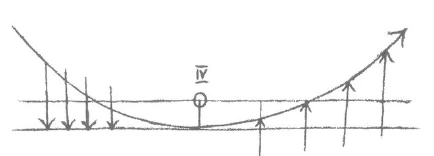
[ 11 ] In the beyond, there is now an upward development; it is becoming ever brighter.
[ 12 ] The spiritual forces that are used today for inventions and discoveries serve only to produce external cultural means. It was different in the past: then these forces served to explore the spiritual world and its laws. Today, the spirit serves as a slave to material needs. All the intelligence that has gone into steam engines and other inventions is a stumbling block for the spiritual world—a deficit! The opposite is true of anthroposophical work. What is gained in the earthly realm serves to enlighten the world beyond.
[ 13 ] Christ appeared in the fourth cultural epoch, hence the Greek name Christ. However, so that the appearance of Christ would not take people unprepared, Moses and the prophets appeared. The proclamation of the I-God, Yahweh, was necessary so that people would have something to hold on to as a goal. The event at Golgotha could only be understood through the proclamation of the imageless God. More on that tomorrow.