

Macrocosm and Microcosm
The Greater and the Lesser World Questions
of the Soul, Life, and Spirit
GA 119
28 March 1910, Vienna
Translated by Steiner Online Library
Eighth Lecture
[ 1 ] To better understand what will be discussed here, it will be helpful to begin today’s reflection by once again considering the human awakening, but this time in a way that takes into account everything from the spiritual world that contributes to the development of the human being. When a human being wakes up, this is, as we have seen in the lectures, a crossing over of our entire being from the macrocosm—into which the human being is poured out during the state of sleep—into the microcosm. Now, it is understandable that, in normal consciousness, a person is quite uninformed about the actual processes taking place in the interaction between the macrocosm and the microcosm. Thus, people usually believe that what they call their “I” is, in essence, merely situated within them. But if you consider that during sleep, the human being is outside their physical body with their astral body and their “I,” then you will realize that we must by no means seek our “I” within the confines of our skin during sleep; rather, it is as if poured out into the sphere of the worlds, it is given over to those worlds we have discussed: the elemental world, the spiritual world, the world of reason, and also the world we wish to discuss a little today—the world of the spiritual archetypes of all things, which lies even higher than the world of reason. The I is as if poured out, as if spread out into the vastness of the worlds, and therefore slipping back into it in the morning is not to be understood merely as if one could say: ‘Well, my I is there, it comes from that direction and slips into me’—but rather, this waking up is at the same time a kind of contraction of the I, so that it contracts more and more densely and then enters into the physical and the etheric or life body in such a way that it is now present within these bodily sheaths of the human being with a corresponding density. But it becomes apparent to the clairvoyant consciousness that this I is by no means entirely within the human being even during the entire waking day. For the clairvoyant consciousness, the I is something that is always present in a certain way in the human being’s surroundings as well; the human I only partially coincides with what we perceive, for example, as the physical body. And so we can say that the ego is actually always present in our surroundings in terms of its substantial essence. One can call that which the clairvoyant sees, let us say, as a kind of light aura around the human being, the ego-aura. Thus, the human being is always within a cloud of spiritual substance, and one cannot seek the ego merely in this or that place, but rather as filling this entire ego-aura of the human being. In the morning upon waking, the ego approaches from all sides; it emerges from all the entities and realities that we have described as the world of reason and as the spiritual and elemental world.
[ 2 ] Now let us take a closer look at this process of the “I” slipping into the actual human body. Let us ask ourselves: How is it that, upon waking, we suddenly have sensory perceptions around us—colors, sounds, impressions of light, and other sensory perceptions? — Let us consider this in relation to a specific color. Suppose we look at a blue surface in the morning when we wake up. Our first sensory impression is therefore the color blue. How does this come about? For the ordinary, normal human consciousness is completely in the dark about how this happens; it imagines the matter entirely wrong. This sensory impression arises because, as the “I” enters from the macrocosm into the microcosm, there is initially something like an obstacle to the inflow of all the forces that exist out there in the spiritual world; there is initially an obstacle to everything we call the elemental world. So what we characterized yesterday and the day before as the elemental world is something that is initially held back. It is not entirely held back, but it is held back in such a way that only a part of the elemental world actually flows in. If we have a surface of blue color before us, then it is the case that through this surface, which we have before us as a blue color image, all the forces from the higher worlds that we have described flow through, with the exception of a part of the elemental world. That which is held back from the elemental world comes to human consciousness as a mirror image, as a reflection, and this reflection is precisely the blue color. Everything we described yesterday regarding the elements of fire, air, water, and earth as belonging to the elemental world flows through. Everything that exists in the world in terms of elements flows in through the eye, with the exception of what we are currently seeing. Thus, sensory perception arises because our eye holds back light from the elemental world, our ear holds back sound from the elemental world, and the rest of our organism holds back, for example, a portion of heat, and so on. What is not retained flows in.
[ 3 ] Now you can add to what we have said in the previous lectures. We have said: The eye is formed by light for the sake of light. When the eye perceives light, it is naturally not formed by what is seen, but by that which it allows to enter, and that is a part of the elemental world. So we can say (a drawing is made. The drawing has not been preserved.): When all the forces from the supersensible worlds flow in here, certain forces are held back in the eye, and the same applies to the other senses. What does not flow into us, what is held back, is the sum of our sensory perceptions. We see, hear, and so on, therefore, what we do not allow into ourselves. But that which we do allow into ourselves is what the physical organization, for example of the eye, has formed. So we hold back certain forces, and we allow certain forces to pass through. The forces we let through are forces of the elemental world; they form our eye. So that when we look at our eyeball, we can say: In the elemental world, which we do not see precisely because it is being let through, we simultaneously have that which forms our sense of sight; our other senses, too, are formed in the same way from the elemental world. Thus, as sensory beings, we are formed from the elemental world. The elemental world, which we see when we make ourselves capable of looking into it, forms our senses.
[ 4 ] But where the sense is confined inwardly, at the back of the eye, there is, as it were, a second mirror; there all the other forces from a wider world flow into us, except for those that are reflected back. I say “as it were,” but this is a complete explanation. At the back of the eye, the elemental forces themselves are held back and reflected; thereby they cease to act, and behind them only the forces of the spiritual world flow through—and these are the very forces that form, for example, our optic nerve. Just as the eye has the optic nerve through the inflow from the spiritual world, so too does the ear have the auditory nerve through the inflow from the spiritual world, and so on. Our entire nervous system is thus formed from the spiritual world. From it flow to us those forces and beings that are the formers of our nervous system. And our nerves are arranged like the laws of the planetary world out there; for we have been able to perceive the planetary world, as it were, as the outer expression of a kind of clock for what acts there as spiritual facts and spiritual beings.
[ 5 ] Now it would be natural for us to ask ourselves: If that were the case—if this world were truly acting upon our nerves, a world that expresses itself through external signs in our planetary system—then our nervous system would have to be based on a certain regularity that corresponds to the external solar system. We would, as it were, have to have a kind of inner solar system within our nervous system. For, once we have passed through the elemental world, it is the forces of the spiritual world that express themselves in the planetary solar system. The forces from the heavenly world flow in and organize our nervous system. Let us try to ask ourselves whether our nervous system really does appear as a kind of mirror image of what is expressed out there in the macrocosm through the planets and the zodiac signs.
[ 6 ] Well, you all know that our time is governed by the Earth’s position relative to the Sun and by the Sun’s passage through the twelve signs of the zodiac over the course of the year. It appears as though the Sun travels through the twelve signs of the zodiac over the course of a year. This is a fundamental division of the year—the division into twelve months—brought about by the laws that govern the relationship between the planets and the signs of the zodiac within the solar system. The number twelve is a number that expresses the laws governing these positions and movements. We have twelve months in a year, and for the longest months, we have the number thirty-one—thirty-one days. This, in turn, is something derived from the positions of our celestial bodies relative to one another, and again, something connected to our calendar system. The longest months have thirty-one days, the others thirty days, and the month of February twenty-eight or twenty-nine days. There is a certain irregularity here, but this irregularity has its good reasons. We cannot go into this in detail here.
[ 7 ] Let us try to visualize this curious division of time out there in the great world clock and ask ourselves: If what underlies this vast cosmos truly also provides the formative forces for our nervous system, then the numbers must be reflected in the nervous system. — Well, we have twelve pairs of cranial nerves and thirty-one pairs of spinal nerves; that is to say, the cosmic laws governed by the numbers twelve and thirty-one are indeed reflected in our nervous system. And the fact that a certain irregularity prevails is because human beings are meant to become independent beings through their nervous system and because they are meant to become independent of what takes place externally in space. Human beings have their thirty-one pairs of spinal nerves. Just as the number twelve of the months is governed by the sun’s passage through the zodiac, so the number of days in a month should actually be governed by the moon; that would result in only twenty-eight days. And if we did not have three pairs of nerves, so to speak, in excess—through which we can make ourselves independent as free human beings—we would indeed be subject to the number twenty-eight. Thus you are looking into a profound mystery, into a wondrous connection between what is expressed out there in the great symbols of space—which are a reflection of beings and forces in the spiritual world—and what we have in our nervous system.
[ 8 ] Now we come to the third part of the reflection. Our nervous system is thus built up by the spiritual world. Where each nerve enters the brain or the spinal cord, a reflection takes place once again at this point of entry. There, the spiritual world is held back, and what we have come to know in the world of reason now penetrates through: the forces of the hierarchies; and the world of reason builds up for us that which lies behind the nerves—our brain and spinal cord—so that in the brain and spinal cord we have the result of all the activity that ultimately originates in the world of reason. Those who survey the spiritual world clairvoyantly find, even in the smallest reflections in the brain and nervous system, precise images of the great world processes.
[ 9 ] Yet what we call the world of archetypes—the world of the spiritual archetypes of things—passes right through us without our being able to hold it back. How, then, can we become aware of anything in ordinary life? By being able to hold it back. We become aware of a part of the elemental world by holding back a part of the elemental world. We ourselves are a product of this elemental world in our sense organs. We become aware of our senses by holding back a part of the elemental world. We are a product of the spiritual world in our nerves. When we become aware of our nerves, we become aware, in a certain sense, of the spiritual world—though of course only in images—by holding back a part of the spiritual world. What, then, does the human being know of the elemental world? He knows of the elemental world that which is reflected to him through the senses. And what does the human being know of the spiritual world? He knows that which his nerves reflect to him; this is what is usually called the laws of nature. The laws of nature are nothing other than a shadow image, a weakened reflection of the spiritual world. And what human beings know as their inner spiritual life, as their reason, is a weakened reflection of the outer world of reason. What we call intellect and understanding in our language is an image of the world of reason, but a weak, shadowy image.
[ 10 ] So what, we must now ask ourselves, would we need to be able to do if we wanted to be in a position to see more than what we have just described? If we wanted to see more, we would have to be able to retain more. If we wanted to be influenced by the world of archetypes, we would have to be able to retain that world in some way. We can only have physical sense organs by allowing the elemental world into ourselves and then holding it back. This is how, for example, our eye is formed. We can only have a nervous system by allowing the spiritual world into ourselves and then holding it back. We can only have a power of thought by allowing the world of reason to enter us and then holding it back. This is how our brain forms. If even higher organs are to form, then we must have the ability to hold back a further, even higher world. We must be able to send something out to meet it, just as we send out into our brain that which holds back the world of reason so that it is reflected. Human beings must therefore do something if they wish to develop further. Human beings must do something to be able to hold back a higher world, to draw from it forces that would otherwise simply pass through them. For the forces of the world of archetypes simply pass through them. They must now create a mirroring apparatus themselves. In the sense that modern human beings can and should, the spiritual scientific method creates such a mirroring apparatus, which, in its work on the soul for the purpose of perceiving the higher worlds, proceeds from what is called imaginative perception. What human beings usually perceive is the outer physical world.
[ 11 ] If a person wishes to attain higher knowledge, they must first take steps to develop higher faculties within themselves. They must bring about a state of stillness within themselves that transcends the realm of reason, and this is achieved by engaging in a new kind of activity. You can easily understand that it is impossible to attain higher knowledge through what a person does in normal consciousness, for what a person does in normal consciousness is limited to what we have described. A person must therefore do something to develop a new activity within themselves that can now oppose the world of archetypes and hold it back. This is achieved, for example, by a person learning to undergo inner experiences that do not belong to the ordinary experiences of consciousness. And such an inner experience, which is indeed a kind of archetypal experience, is described in my *Esoteric Science* in the section on the structure of the concept of the Rosicrucians.
[ 12 ] How does one go about experiencing this concept of the Rosicrucians inwardly in the right way? Although this has already been said here in Vienna, it should be repeated today because it must be integrated into our whole being. Anyone who wishes to lead a spiritual student to higher levels of knowledge and thus make a small beginning would say: Look at how a plant grows out of the ground. There you see how, leaf by leaf, it grows until it blossoms and bears fruit. It grows in such a way that you can see it is permeated by the green sap of the plant. Now let us compare this plant to a human being. We know that this human being is permeated by what we call blood, and we know that in the blood there is the outward expression of what pulsates within the human being as passions, as drives, as desires, and so on. Because the human being is an “I”-being, he appears to us as a higher being compared to the plant. Only a fantasist could believe—though there are many such people—that the plant also possesses a consciousness like that of a human being, that it could internally reflect external impressions. One does not have a consciousness simply by performing some activity—the plant does that too—but by being able to internally reflect external impressions. Humans can do this. They have thus, in a certain sense, evolved to a higher level than the plant, which cannot do so. But by evolving to a higher level, humans have had to accept, in a certain sense, a kind of humiliation; they have had to accept the possibility of error. The plant does not err by following its laws. We cannot speak of error in this context. Nor does the plant possess a higher and a lower nature within itself; it does not possess what are called the lower-directed drives, desires, passions, and so on. When we stand before a plant, we may be struck by the plant’s chastity, in contrast to the drives, desires, and passions that permeate human beings. Thus, with his red blood, the human being stands before the plant as a being who, although he has developed higher in his consciousness, has had to accept, for the sake of this higher development, a descent into a kind of humiliation.
[ 13 ] The teacher will make all this clear to the spiritual student. Then he will point out that human beings must now achieve for themselves what appears to them at a lower level in the plant. Human beings must once again become masters of their instincts, desires, and passions—of that which finds expression in their surging blood. He will do so when his higher nature has triumphed over his lower nature, when his red blood has become as chaste as the green sap of the plant that turns red in the red rose. Thus, the red rose can serve as a symbol of what a human being must become when he lives toward a real ideal, through the fulfillment of which his higher nature gains mastery over his lower nature. We look to the rose as a model; it is a symbol, an emblem of purified, refined blood. And when we unite the red rose with the black wooden cross—the dead wood that the plant leaves behind when it dies and withers—then the wreath of red roses on the black wooden cross can serve as a symbol of the victory of the higher nature, the purified nature of man, over his lower nature, which he must overcome. In the black wooden cross we have the symbol of man’s overcome lower nature, and in the red rose we have the symbol of the purified red blood. The Rose Cross is a symbol of human development as it unfolds in the world. In the Rose Cross, we are not faced with an abstract concept, but with a symbol of something felt and sensed; our souls can be warmed when we look upon human development as it is depicted in the Rose Cross.
[ 14 ] This shows you that a person can have ideas that do not correspond to anything in the external world. Anyone who wants to remain solely in normal consciousness would say: “You’re a wild fantasist! What good is this Rose Cross? Ideas are untrue if they do not reflect anything in the external world. Now you’ve conjured up a Rose Cross. Where on earth is that? Where do red roses grow on dry wood?” That is what someone might say. But that is precisely what matters: that we acquire abilities with our soul that are not already present in normal consciousness. We must ascend to a level of inner activity where we do not merely reflect something external within ourselves, but where we transform the external into living ideas that stand in a certain relationship to the external world, yet do not merely reflect the external world. The Rose Cross stands in a certain relationship to the external world, but the nature of that relationship we have built up ourselves. We have sensed the ascent from the plant to the human being and the human being’s own ascent. With living feeling we paint the Rose Cross before us in our imagination. In this way, various symbols could be set before the soul. To help us understand this more clearly, I would like to present another symbol to your soul. Let us look at the ordinary life of a human being, how a person lives through the days of their life. There we first find the alternation of day and night, of waking and sleeping. During the day we have a sum of experiences; from morning to evening we experience all manner of things. Let us now ask ourselves: What is it like at night? — we already know from the lectures that certain forces are drawn from the spiritual world without our consciousness. Just as we have experiences in our consciousness during the day, so do we have experiences in the unconscious at night. This alternation is present. Now, when we sometimes turn inward for the sake of a certain self-knowledge and ask ourselves: How are you actually progressing? Has every experience of the day truly given you a corresponding push forward? Does a person actually have reason to be satisfied with themselves if they advance only a very small bit each day through the experiences the day brings and the forces the night supplies? — A person must, so to speak, experience quite a lot during the day in order to have truly matured a little through these daily experiences. Try asking yourself how much maturity you have actually gained when, throughout a day, you have allowed the day’s experiences to take effect on you and the night’s strength to take effect on you, and you will find that the progress of our true being, our “I,” happens quite slowly, while a relatively large number of experiences pass us by. We can imagine the experiences of the day and the progress of our being in its development something like this: perhaps we have advanced a little bit with our “I” after one day, another little bit on the second day, and so on; and that is perhaps already a gross exaggeration, for many people make very little progress at all from day to day. But if we look only at the favorable period of our life, at childhood, we will see how a person as a child advances extraordinarily quickly in comparison to later life. It is not without foundation when it has been claimed that a world traveler, through everything he learns about the world on his travels, does not advance as far as through what he learned from his nurse.
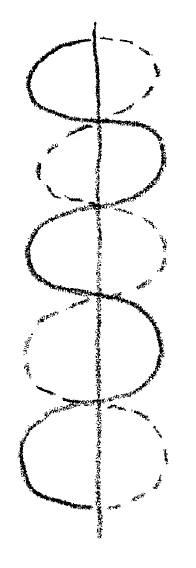
[ 15 ] We can illustrate the ego’s forward progress in stages using a diagram. The vertical line represents progress; the curved line winding around it represents the day’s experiences. We have many experiences during the day; these take us only as far as that point (the intersection). Then, the next day, we have many more experiences; these, in turn, take us another step forward. If we now consider the forces that act upon us at night, we can represent these with the dotted line. Thus, we can depict this forward progress of the human being in relation to their experiences as a rod upon which two serpents wind their way upward, one light and one dark. The light serpent would represent the experiences of the day, the dark one the forces of the night. We have before us something like a symbol of human life.
[ 16 ] We can form both complex and simple symbols. A very simple one would be to observe a sprouting plant as it grows upward until it bears fruit, and then, from a certain point onward, begins to wither until, in the end, everything external has disappeared except for the seed. In this way, we could imagine a very simple metaphor for the plant’s upward development and its descent until it withers again. In this vein, we would have a simple metaphor for what happens in the growing and withering plant.
[ 17 ] In the Rose Cross, we have a symbol of humanity’s evolution from a lower to a higher being, and in the Caduceus, we have a symbol of the ego’s progress through the experiences of day and night. In this way, we could explore symbol by symbol. None of these symbols depict anything external, but when we devote ourselves to them, when we immerse ourselves in inner contemplation of the meaning of these symbols—which reflect nothing external—then we work upon our soul in such a way that it becomes accustomed to inner activities it would not otherwise engage in. And the sum of these inner activities ultimately forms a kind of inner power through which we can hold back that which we call the world of archetypes.
[ 18 ] Symbols need not be merely images that we visualize; they can also be words in which profound truths about the world are condensed. When great, all-encompassing truths about the world are expressed in symbolic phrases, we have material with which we can shape the substance of our soul. Through such work on oneself, the human being consciously forms what the external world would otherwise have done to him without his intervention, in that his brain was formed from the world of reason, his nervous system from the spiritual world, and his sense organs from the elemental world. Human beings shape for themselves the organs that stand above their brain, but which are not visible externally because they lie outside the physical world. These organs cannot be perceived by ordinary, normal consciousness. Just as the eyes are formed from the elemental world, the nervous system from the spiritual world, and the human brain from the world of reason, so too is that which we now call the higher sense organs formed from the world of archetypes—those organs that will gradually enable us to look into the spiritual worlds. Because these sense organs appear as spiritual floral formations sprouting from the human being, they are called lotus flowers, or spiritual wheels, or chakras.
[ 19 ] Indeed, for the clairvoyant consciousness of a person who performs the exercises described here, something like new organs may become visible—organs that cannot be seen by ordinary consciousness. Something may form in the center of the forehead that unfolds like a wheel or a flower, which we call the two-petaled lotus flower. This two-petaled lotus flower is something like a spiritual sense organ. Just as the physical sense organs are there to bring the physical world around us into our consciousness, so these spiritual sense organs are there to bring into consciousness the world that cannot be seen with ordinary, normal consciousness. In fact, it is forces and systems of force springing forth from the human soul that form these organs. A second lotus flower is to be formed in the region of the larynx, a third in the region of the heart, and so on. Such spiritual sense organs—the term is, of course, a contradiction in terms, but we have no more suitable expression in today’s language, which is shaped by the physical-sensory world — are formed through inner fulfillment, through patiently and energetically filling oneself anew with such symbolic images that do not depict anything external, but rather act within our soul in a way that differs from the ordinary experience of consciousness, and through which we summon forces from the soul that now counteract the world of archetypes.
[ 20 ] But it is not enough for us to go only this far, for there is still nothing to be seen. Those who are already able to see can perceive the relevant sense organs in a person who is developing in this way; but these higher sense organs that are forming there must first develop further into clairvoyant vision. So far, they have been formed from a higher world than those worlds that otherwise shape us. Now comes the second stage, through which the actual seeing is prepared. This preparation for the actual seeing takes place in that the person who has attained imaginative knowledge—that is, the formation of the lotus flowers—now moves on to a higher stage of inner soul work. This is somewhat more difficult than the first. The first stage consists in the person developing as many symbolic images within themselves as possible—symbolic images that can be provided in every school of spiritual research in accordance with the individuality of the spiritual student—so that, little by little, with patience and perseverance, they develop their spiritual sense organs. The next stage consists in the human being, after having developed a certain skill in visualizing such images, then being able to remove these images from consciousness, to set them aside, and to take into account only that within himself which created these images. Isn’t it true that a certain activity was at work within us when we formed the image of the Rose Cross? We looked at the plant and at the human being, we looked toward a distant future, and we first constructed this symbol out of our soul’s capacity. Let us suppose we now allow this symbol to disappear completely. Let us remove it from our consciousness—the Rose Cross or the Caduceus—and ask ourselves: How did we manage to create these images? — Let us look at our own activity, without looking at the product of that activity! That is more difficult. So we turn away from the symbols and look at the activity within us that creates them. This is a turning of our attention inward. After creating a symbol, one thinks: How did you do that? — One imagines what one did to bring it about. Most people will have to make many, many attempts to move from the symbol to the activity that creates it. One must become accustomed to telling oneself: If I remove the symbol, I have nothing left. — That will take a long, long time. Again and again, one will have to create the symbols, only to let them go and then be able to experience what symbol-creating activity is.
[ 21 ] If, on the other hand, you have been practicing for a long time, so that you can feel a sort of bubbling and swirling within yourself, then you have already made some progress. You have reached the point where you can actually experience the moment when you no longer merely possess higher organs, lotus flowers, but when you see all manner of new things flashing before you—things of which you previously had no inkling—and when you gain your first glimpse into the spiritual world. You have now reached the stage where you have a new field of vision. The experience is roughly as follows: One has left everything behind, has already departed from the ordinary external sensory world; one has lived in contemplation within a world of symbols; now one dispels these symbols, and then one is surrounded by pitch-black darkness. Yet now consciousness does not cease; rather, it is now seething and swirling from one’s own activity. And through this, one is now able to perceive something further. Previously, one perceived the world of archetypes; now one perceives something further—one perceives what might be called the world of reason, and in a different way than before—from the opposite side. One perceives what otherwise flows in. Previously, one saw only the shadows of the world of reason in one’s own intellectual activity. Now one sees this world of reason from the other side; now one sees those beings we have called the hierarchies; now everything gradually comes to life.
[ 22 ] That is the next step one must take. But that is not the end of it. Another step is that one must now also refrain from this activity of one’s own. One has first suppressed the images and held back one’s own activity. Now one must also be able to refrain from this own activity; now one must also be able to suppress it. There the person will again realize how difficult this is when they actually carry out the attempts. It will take even longer until they have anything left at all. For the rule will be that—when the person also refrains from their activity—they will now truly fall asleep or enter a state resembling sleep. But if they retain a degree of consciousness, if they have reached the point where they now consciously suppress their own activity, then they have arrived at a stage where they are holding back not only the world of reason but also the spiritual world. From the other side, they thereby perceive the spiritual world. Now they see the spiritual facts and beings in the spiritual world.
[ 23 ] While the insight gained by setting aside images and retaining the activity is called inspired insight, the insight gained by setting aside one’s own activity is called intuitive insight. Through it, one gains a glimpse of the true form of the spiritual world, which one otherwise sees only in its shadows within the laws of nature. Now one receives into one’s field of consciousness the beings and activities that play out in the laws and facts of nature.
[ 24 ] You can see that this describes a process of insight that proceeds somewhat differently than when one simply makes a person aware of descending into their inner self or stepping out into the spiritual world. Here, something is accomplished through the method of spiritual development that brings the human being into the spiritual world in a completely different way. This method first creates the organs for the human being by drawing upon the world of archetypes and using it to create these organs. Then the human being is led back through the imaginative and inspired worlds into the spiritual world, into which he can now look. Once they have progressed to intuitive knowledge, and as this intuitive knowledge continues to develop, they can enter quite of their own accord into what might be called the elemental world. He then grows into this, and in such a way that he does not enter unprepared, but fully prepared, because he sees this elemental world as the final stage before him. However, this path is fundamentally a difficult one for many people, because it requires great self-denial. For at first, the human being must practice with symbols for a long time and must wait until his organs are developed. At first, they cannot yet see with these. But people today are very often eager to say: What matters to me is that I see something! — They do not want to take a sure path, but above all to see success. Success will certainly come, but it must be achieved through a certain degree of self-denial. One must first work on oneself in order to gradually, through this work on oneself—which progresses step by step in the manner described—enter the higher worlds. And what one first comes to know of the world of reason and the spiritual world is truly rather pale. Only then, when one returns from the world of reason to the elemental world, when one has advanced far in intuitive knowledge, does all this take on color and radiance, because it becomes imbued with the effects of the elemental world. Only then can one describe it vividly; the description is only possible from the standpoint of intuitive knowledge.
[ 25 ] A certain degree of self-denial is therefore required. Only by taking joy in the symbols and working with patience and perseverance to train the senses can one sense progress, even if one sees very little of the spiritual world at first. But if one takes joy in this inner work, the feeling of self-denial is thereby dispelled. One must find satisfaction in the subtle grasping of such an activity. One is rewarded relatively late on this path. But it is also a sure path, a path that protects against all fantasy, against all illusion. One is already standing in the world immediately above our own once one has worked one’s way up to imaginative knowledge, but one perceives this at most in the sense that one feels one has incorporated something from a higher world. Only gradually does one come to a true grasp of the higher worlds. You will find an outline of the path of development into the higher worlds both in my book *How Does One Attain Knowledge of the Higher Worlds?* and in the second part of my *Esoteric Science*. The same things are described there, though for a wider audience, and therefore sometimes in a more concise form. I wanted to point out a few things in greater detail today, and if you add what has been presented today to what is described there, you will be able to gain an even deeper understanding. In the path that has now been described, an attempt has been made to convey the understanding that the foundations of ordinary human perception—sensory perception within the microcosm, the nervous system, and the brain—are mirror images of the effects and beings of the macrocosm.
[ 26 ] It has been shown that even before we ourselves begin to work on ourselves to develop a higher human being within us, we have already been shaped and formed to develop the ordinary human being. We have seen that we are now, in a sense, continuing the work that has already been done on us. Just as our physical human being was built from the higher worlds, so do we build our spiritual human being from within ourselves. We transcend ourselves as we progress in this way through development. It should come as no surprise to anyone who takes the concept of development seriously and honestly that such further progress in development is possible. Anyone who believes that what exists today has risen from earlier stages of existence to the present must admit that development can also be carried further. But because modern human beings have become conscious beings, they must also consciously take their development into their own hands. We have seen that human beings can carry out what has been described as a path of development with full consciousness. If they need a teacher, they no longer need one in the way that was the case with the older methods, where the teacher or guide takes something away from or imparts something to the one being guided, so that the guided person becomes dependent. Today we have come to know a path that truly corresponds to modern human consciousness. For whoever follows this path today entrusts themselves to a spiritual teacher in no other sense than one might, say, entrust oneself to a mathematics teacher. One assumes that the teacher knows more than one does oneself. If one did not assume that the teacher knows more than one does oneself, it would be utterly superfluous to go to him. In the same sense, one entrusts oneself to a guide who gives nothing but instructions, nothing but a symbol; then one already perceives from the effect what this symbol leads one to. Step by step, one remains, so to speak, one’s own master. One follows the spiritual teacher’s instructions just as one follows the instructions of a math teacher who gives an assignment, except that one follows the spiritual teacher’s instructions with one’s whole soul, whereas one solves a math problem only with one’s intellect. This is the essence of the new method of initiation: that it takes the greatest possible account of the individual’s independence; that the guru is no longer a guru in the old sense, but only in the sense that the guide offers advice: This is how one should proceed in order to advance in the appropriate manner.
[ 27 ] Successive eras change in such a way that human beings continually pass through new stages. For this reason, the methods of initiation must also change. The methods of initiation required in earlier times were different from those needed today. For people today, the method I have described to you is the appropriate one. It is called the Rosicrucian training, after its most important symbol. There are many symbols, but the Rosicrucian symbol is the most important because it is an emblem of human development itself. This Rosicrucian method is the true modern method of initiation, capable of leading modern people into the higher worlds in an appropriate and correct manner.
[ 28 ] We have so far provided only a brief outline of this. Tomorrow we will need to describe how, as a person works on themselves step by step, they grow into the higher worlds and how these worlds gradually reveal themselves to them. Today we have described what a person must do within themselves. Tomorrow we will discuss what becomes of the person and what appears to them.