

The Gospel of St. Matthew
GA 123
11 September 1910, Bern
Translate the original German text into any language:
Versions Available:
Elfter Vortrag
Eleventh Lecture
[ 1 ] Auf die Versuchungsgeschichte, die wir darstellen konnten als Impuls für eine besondere Art der Einweihung, folgte das, was der Christus Jesus zunächst seinen Jüngern als Verbreiter der alten Lehren in einer vollständig neuen Form werden konnte, sodann, was er werden konnte nicht nur als Verbreiter von Lehren, sondern, wenn der Ausdruck gebraucht werden darf, als Kraft, als gesundende Kraft der Menschen. Das ist dargestellt in den Heilungen. Dann haben wir gestern jenen Übergang gemacht, der, wie ich sagte, einigen guten Willen zum Verständnis voraussetzt, guten Willen, der sich ergibt aus einer Verarbeitung der geisteswissenschaftlichen Erkenntnisse, wie man sie im Laufe von Jahren in sich aufgenommen haben kann. Wir haben den Übergang gemacht zu jener eigentümlichen Art von lebendiger Belehrung durch Übergabe von Kräften, die ausgingen von dem Christus Jesus und sozusagen in die Seelen seiner Jünger einstrahlten. Und wir haben versucht, so gut es ging, ein gewaltiges Mysterium mit Menschenworten auszudrücken. Wir haben versucht, darauf aufmerksam zu machen, wie diese Lehre war, die der Christus Jesus seinen Jüngern zu geben hatte. Er war eine Art Sammelpunkt, ein Sammelwesen für Kräfte, die aus dem Makrokosmos in die Verhältnisse der Erde einflossen und zu den Seelen der Jünger hinströmen sollten, und die nur durch jene Kräfte gesammelt werden konnten, die in der Wesenheit des Christus Jesus vereinigt waren. Die Kräfte, welche sonst den Menschen nur unbewußt während des Schlafzustandes zuströmen, sie strömten aus Weltenweiten durch die Wesenheit des Christus Jesus den Jüngern zu als die belehrenden und belebenden Kräfte des Kosmos selber. In den Einzelheiten kann man natürlich diese Kräfte, welche aufklärende Kräfte über das Weltendasein sind, nur charakterisieren, wenn man sich einläßt auf die verschiedenen Konstellationen im Kosmos. Und auf dieses Mysterium werden wir heute noch, insofern es das Matthäus-Evangelium darstellt, hinzuweisen haben. Vorerst aber haben wir uns klarzumachen, wie die Jünger zunehmen mußten an Weisheit gegenüber den Verhältnissen der Erde dadurch, daß die Kräfte des Christus Jesus auf sie hinüberstrahlten. Sie mußten sozusagen in sich selber, in ihrem Leben, in ihrer lebendigen Weisheit wachsen, wachsen in der verschiedensten Weise.
[ 1 ] The story of the temptation, which we could describe as the impetus for a special kind of initiation, was followed by what Christ Jesus could first become for his disciples as a transmitter of the ancient teachings in a completely new form, and then by what he could become not only as a transmitter of teachings but, if I may use the expression, as a power, as a healing power for humanity. This is depicted in the healings. Then yesterday we made that transition which, as I said, presupposes a certain willingness to understand—a willingness that arises from having processed the insights of spiritual science as they may have been absorbed over the course of years. We have made the transition to that unique form of living instruction through the transmission of forces that emanated from Christ Jesus and, so to speak, radiated into the souls of his disciples. And we have tried, as best we could, to express a mighty mystery in human words. We have tried to draw attention to what this teaching was like, which Christ Jesus had to impart to his disciples. He was a kind of focal point, a being that gathered forces flowing from the macrocosm into the conditions of the Earth and intended to stream toward the souls of the disciples—forces that could be gathered only through those powers united in the being of Christ Jesus. The forces that otherwise flow to human beings only unconsciously during sleep flowed from the vastness of the cosmos through the being of Christ Jesus to the disciples as the instructing and life-giving forces of the cosmos itself. In detail, of course, one can characterize these forces—which are enlightening forces regarding worldly existence—only by engaging with the various constellations in the cosmos. And we shall have to point out this mystery today as well, insofar as it is presented in the Gospel of Matthew. For now, however, we must make clear to ourselves how the disciples had to grow in wisdom regarding the conditions of the earth through the fact that the forces of Christ Jesus radiated upon them. They had to grow, so to speak, within themselves, in their lives, in their living wisdom—grow in the most diverse ways.
[ 2 ] Nun wird uns gerade eine eigentümliche Art in dem Wachstum eines der Jünger oder Apostel dargestellt. Aber wir werden dieses einzelne, besonders Bedeutsame in dem Leben eines Apostels nur verstehen, wenn wir es aus einem großen Zusammenhange herausholen. Da müssen wir uns klarmachen, daß der Mensch ja in der Menschheitsevolution fortschreitet. Wir machen nicht umsonst Inkarnation nach Inkarnation durch. So haben wir in der nachatlantischen Zeit nicht umsonst Inkarnationen durchgemacht innerhalb der ersten nachatlantischen Kulturperiode, der indischen, dann in der persischen Kulturperiode, in der ägyptisch-chaldäischen, in der griechisch-lateinischen und so weiter, sondern diese Inkarnationen machen wir durch als die große Lebensschule, damit wir in jeder dieser Inkarnationen aus den Verhältnissen, die in diesen Kulturperioden vorhanden sind, etwas aus der Umgebung aufnehmen. Dadurch wachsen wir allmählich. Und worin besteht dieses Wachstum des Menschen durch die einzelnen Epochen der Menschheitsevolution hindurch?
[ 2 ] Here we are presented with a peculiar aspect of the development of one of the disciples or apostles. But we will only understand this particular, especially significant aspect of an apostle’s life if we view it within a broader context. We must realize that humanity is, after all, progressing through human evolution. We do not go through incarnation after incarnation for no reason. Thus, in the post-Atlantean era, we did not go through incarnations within the first post-Atlantean cultural period—the Indian one—then in the Persian cultural period, in the Egyptian-Chaldean one, in the Greek -Latin, and so on; rather, we undergo these incarnations as a great school of life so that in each of these incarnations we may absorb something from the environment, from the conditions prevailing in these cultural periods. Through this we gradually grow. And in what does this growth of the human being consist as we pass through the individual epochs of human evolution?
[ 3 ] Der Mensch hat ja, wie wir aus den elementarischen Anschauungen der Anthroposophie wissen, verschiedene Glieder seiner Wesenheit. Wenn wir sie in unserem Sinne aufzählen wollen, haben wir physischen Leib, Ätherleib, Astralleib, mit dem Astralleib verknüpft die Empfindungsseele, dann die Verstandes- oder Gemütsseele, die Bewußtseinsseele. Dann haben wir an höheren Gliedern der menschlichen Natur, zu denen wir uns hinaufentwickeln: Geistselbst, Lebensgeist und den Geistesmenschen. Nun wurde uns in der Tat in jeder der nachatlantischen Kulturepochen etwas gegeben für diese einzelnen Glieder unserer Menschennatur. So wurde in der ersten Epoche, in der altindischen Kultur, dem Menschen etwas an Kräften eingefügt, wodurch er in seinem Ätherleibe mehr wurde, als er früher war. Was ihm in dieser Beziehung eingeprägt werden sollte in seinen physischen Leib, das wurde ihm schon in den letzten Zeiten der atlantischen Periode eingefügt. Mit dem Ätherleibe dagegen beginnen jene Gaben, die dem Menschen während der nachatlantischen Zeit zukommen sollten. So wurden ihm in der altindischen Zeit die Kräfte gegeben, die seinem Ätherleibe eingepflanzt werden sollten; dann in der urpersischen Zeit die Kräfte, die seinem astralischen Leibe, dem Empfindungsleibe, eingepflanzt werden sollten; während der ägyptisch-chaldäischen Zeit die Kräfte für die Empfindungsseele. Während der vierten Kulturperiode, der griechisch-lateinischen Zeit, wurden ihm eingeprägt die Kräfte der Verstandes- oder Gemütsseele; und jetzt leben wir in dem Zeitalter, wo die entsprechenden Kräfte, die in diese Linie gehören, nach und nach der Bewußtseinsseele eingeprägt werden sollen. In diesem Einprägen ist die Menschheit noch nicht sehr weit vorgeschritten. Dann wird ein sechster nachatlantischer Zeitraum kommen, wo in die Menschennatur eingeprägt werden die Kräfte des Geistselbst und im siebenten Kulturzustande die Kräfte des Lebensgeistes. Und dann blikken wir auf ferne Zukünfte hin, wo uns der Geistesmensch oder Atma in dem normalen Menschentum eingeprägt werden soll.
[ 3 ] As we know from the elementary concepts of anthroposophy, the human being has various aspects to their being. If we were to list them in our own terms, we have the physical body, the etheric body, the astral body, linked to the astral body is the sensory soul, then the intellectual or emotional soul, and the conscious soul. Then we have the higher aspects of human nature toward which we evolve: the spiritual self, the life spirit, and the spiritual human being. Now, in fact, in each of the post-Atlantean cultural epochs, something was given to us for these individual aspects of our human nature. Thus, in the first epoch, in ancient Indian culture, certain powers were instilled in human beings, through which they became more in their etheric body than they had been before. What was to be imprinted upon them in this regard in their physical body had already been instilled in them during the final times of the Atlantean period. With the etheric body, however, begin those gifts that were to be bestowed upon human beings during the post-Atlantean era. Thus, in the ancient Indian period, the forces were given to him that were to be implanted in his etheric body; then, in the ancient Persian period, the forces that were to be implanted in his astral body, the feeling body; and during the Egyptian-Chaldean period, the forces for the feeling soul. During the fourth cultural period, the Greco-Latin era, the powers of the intellectual or emotional soul were imprinted upon humanity; and now we live in the age when the corresponding powers belonging to this line are to be gradually imprinted upon the conscious soul. Humanity has not yet progressed very far in this process of imprinting. Then a sixth post-Atlantean epoch will come, in which the forces of the spiritual self will be imprinted upon human nature, and in the seventh cultural epoch, the forces of the life spirit. And then we look toward a distant future, when the spiritual human being, or Atma, is to be imprinted upon normal humanity.
[ 4 ] Nun betrachten wir diese menschliche Entwickelung in bezug auf den einzelnen Menschen. Wie wir jetzt den Menschen betrachten müssen, so betrachten ihn stets die, welche von den wahren Verhältnissen dieser Dinge aus den heiligen Mysterien heraus etwas wußten. So mußten ihn auch nach und nach betrachten lernen die Jünger durch die belebende, belehrende Kraft, die ausströmte von dem Christus Jesus und auf sie überging. Wir können daher sagen: Wenn wir den Menschen betrachten - jetzt oder auch zur Zeit des Christus Jesus -, so liegen in ihm Anlagen, wie zum Beispiel in einer Pflanze Anlagen liegen, die auch schon dann vorhanden sind, wenn die Pflanze nur die grünen Blätter und noch nicht Blüte und Frucht hat. Eine solche Pflanze, die nur grüne Blätter hat, schauen wir an und wissen: So wahr die Pflanze da ist, hat sie schon in sich die Anlage zur Blüte und zur Frucht, die sie entwickeln wird, wenn alles regelmäßig geht. So wahr aus der Pflanze, auch wenn sie erst die grünen Blätter hat, herauswachsen Blüte und Frucht, so gewiß ist es, daß aus dem Menschen, der, wie es zur Zeit des Christus Jesus der Fall war, nur Empfindungsseele und Verstandes- oder Gemütsseele hat, die Bewußtseinsseele herauswächst, die sich dann öffnet dem Geistselbst, damit die oberste Dreiheit als Neues wie eine göttlich-geistige Gabe dem Menschen zufließen kann. Deshalb können wir sagen: Der Mensch entfaltet sich aus dem, was seine Seeleninhalte, was seine Seeleneigenschaften sind. So, wie sich die Pflanze, die nur grüne Blätter hat, zu Blüte und Frucht entfaltet, so entfaltet sich der Mensch in der Weise, daß er aus Empfindungsseele, Verstandesseele und Bewußtseinsseele etwas wie eine Blüte seines Wesens dem entgegenhält, was ihm als ein Göttliches von oben herunterkommt, damit er durch den Empfang des Geistselbst einen weiteren Weg in die Höhen der Menschheitsentwickelung durchmachen kann.
[ 4 ] Let us now consider this human development in relation to the individual human being. Just as we must now view the human being, so too did those who knew something of the true nature of these things from the sacred Mysteries always view him. In the same way, the disciples had to learn to view him gradually through the life-giving, instructive power that radiated from Christ Jesus and passed on to them. We can therefore say: When we look at the human being—now or even in the time of Christ Jesus—there are potentials within him, just as there are potentials in a plant that are already present even when the plant has only green leaves and not yet flowers and fruit. We look at such a plant, which has only green leaves, and know: Just as surely as the plant is there, it already has within it the potential for the flower and fruit that it will develop if all goes according to plan. Just as surely as the flower and fruit grow out of the plant, even when it has only green leaves, so certain is it that from the human being who, as was the case at the time of Christ Jesus, possesses only a sentient soul and an intellectual or emotional soul, the conscious soul grows forth, which then opens itself to the spiritual self, so that the highest Trinity may flow into the human being as something new, like a divine-spiritual gift. Therefore, we can say: The human being unfolds from what constitutes the contents of his soul, from his soul qualities. Just as the plant that has only green leaves unfolds into flower and fruit, so the human being unfolds in such a way that, out of the feeling soul, intellectual soul, and conscious soul, holds forth something like a blossom of his being to that which comes down to him as the Divine from above, so that through the reception of the spiritual self he may undergo a further path into the heights of human development.
[ 5 ] In dieser Weise konnten die Menschen, die zur Zeit des Christus Jesus bloß das Äußere ganz normal entwickelt hatten, sagen: Ja, jetzt ist erst normalerweise die Verstandes- oder Gemütsseele entwickelt, die noch nicht ein Geistselbst in sich aufnehmen kann, aber es wird sich aus demselben Menschen, der jetzt die Verstandes- oder Gemütsseele als Höchstes entwickelt hat, herausentwickeln als sein Kind, als sein Ergebnis, die Bewußtseinsseele, die sich dann öffnen kann dem Geistselbst.
[ 5 ] In this way, people who, at the time of Christ Jesus, had merely developed their outer nature in a normal way, could say: Yes, at present the intellectual or emotional soul is normally developed—one that cannot yet receive a spiritual self within itself—but from the very same human being who has now developed the intellectual or emotional soul to its highest degree, the conscious soul will emerge as his child, as his result, and this conscious soul will then be able to open itself to the spiritual self.
[ 6 ] Und was der Mensch nach seiner ganzen Wesenheit sozusagen als seine Blüte entfalten mußte, was da aus ihm herauswuchs, was sich ergab aus seiner Natur, wie nannte man das in den Mysterien? Wie mußte man es daher auch in der Umgebung des Christus Jesus nennen, wenn die Jünger wirklich vorwärtskommen wollten? Man nannte es - wenn wir es in unsere Sprache übersetzen wollen - mit dem Ausdruck «Sohn des Menschen»; denn das griechische Wort υἱὸς τοῦ ἀνθρώπου hat durchaus nicht die eingeschränkte Bedeutung unseres «Sohn» als «Sohn eines Vaters», sondern dessen, was sich ergibt als Nachkomme einer Wesenheit, was herauswächst aus einer Wesenheit wie die Blüte aus einer bisher nur blättertragenden Pflanze. Daher konnte man, als die normalen Menschen noch nicht in der Bewußtseinsseele jene Blüte ihrer Wesenheit entwickelt hatten, noch nichts von dem υἱὸς τοῦ ἀνθρώπου in sich hatten, sagen: Ja, die normalen Menschen haben noch nichts von dem «Sohn des Menschen» entwickelt, aber es muß ja immer Menschen geben, die ihrem Geschlechte voranschreiten, die schon in einer früheren Zeit das Wissen und das Leben einer späteren Epoche in sich haben. Unter den Führern der Menschheit muß es solche geben, die im vierten Zeitraum, wo normalerweise nur die Verstandes- oder Gemütsseele entwickelt ist, trotzdem sie äußerlich ausschauen wie die anderen Menschen, doch innerlich schon die Möglichkeit der Bewußtseinsseele entwickelt haben, in die hineinleuchtet das Geistselbst. - Und solche «Menschensöhne» gab es. Und die Jünger des Christus Jesus sollten daher heranwachsen zum Verstehen, welches die Natur und Wesenheit dieser Führer der Menschheit ist.
[ 6 ] And what did human beings, in their very essence, have to unfold—as it were, as their full flowering? What grew out of them? What arose from their nature? What was this called in the Mysteries? How, then, did one have to refer to it in the circle of Christ Jesus if the disciples truly wished to make progress? It was called—if we are to translate it into our language—by the expression “Son of Man”; for the Greek word υἱὸς τοῦ ἀνθρώπου by no means has the limited meaning of our “son” as “son of a father,” but rather that of what arises as the offspring of a being, what grows out of a being like the flower from a plant that previously bore only leaves. Therefore, when ordinary people had not yet developed that blossom of their being within the consciousness soul, and had not yet possessed within themselves anything of the υἱὸς τοῦ ἀνθρώπου, one could say: Yes, ordinary human beings have not yet developed anything of the “Son of Man,” but there must always be people who lead their race forward, who already possess within themselves, at an earlier time, the knowledge and life of a later epoch. Among the leaders of humanity there must be such individuals who, in the fourth period—when normally only the intellectual or emotional soul is developed—though they outwardly appear like other human beings, have nevertheless already developed within themselves the potential for the consciousness soul, into which the spiritual self shines. - And such “sons of man” did exist. And the disciples of Christ Jesus were therefore to grow to an understanding of the nature and essence of these leaders of humanity.
[ 7 ] Da fragte der Christus Jesus, um sich zu überzeugen, wie sie darüber denken, zunächst seine intimen Schüler, seine Jünger: Sagt mir etwas davon, von welchen Wesen, von welchen Menschen man sagen kann, daß sie Menschensöhne sind diesem Geschlecht? - So etwa müßte man die Frage stellen, wenn man sie im Sinne der aramäischen Urschrift des Matthäus-Evangeliums stellen wollte; denn ich habe schon darauf aufmerksam gemacht, daß in der griechischen Übertragung, wenn man sie gut versteht, zwar noch alles besser ist, als es heute ausgelegt wird, daß aber trotzdem notwendigerweise manches bei der Übertragung aus der aramäischen Urschrift undeutlich geworden ist. Also müssen wir uns den Christus Jesus vor seinen Jüngern stehend denken und sie fragend: Was herrscht als Anschauung darüber, wer von jenen Menschen des vorangegangenen Geschlechts, die schon in den griechisch-lateinischen Zeitraum hineingehörten, Menschensöhne wären? Da zählten sie ihm auf: Elias, Johannes der Täufer, Jeremias und sonstige Propheten. Das wußten die Jünger durch die belehrende Kraft, die ihnen durch den Christus geworden war, daß jene Führer Kräfte in sich aufgenommen hatten, durch die sie hinaufgewachsen waren bis zum Insichtragen des Menschensohnes. Bei derselben Gelegenheit gab einer der Jünger, der Petrus gewöhnlich genannt wird, noch eine andere Antwort (Matth. 16,13-16).
[ 7 ] Then Christ Jesus, wishing to ascertain their views on the matter, first asked his closest disciples: Tell me, of what kind of beings, of what kind of people, can one say that they are sons of man of this generation? - This is roughly how one would have to phrase the question if one wanted to ask it in the spirit of the Aramaic original of the Gospel of Matthew; for I have already pointed out that in the Greek translation, if one understands it correctly, everything is indeed better than it is interpreted today, but that nevertheless, some things have necessarily become unclear in the translation from the Aramaic original. So we must imagine Christ Jesus standing before his disciples and asking them: What is the prevailing view regarding which of those people of the preceding generation, who already belonged to the Greek-Latin period, were sons of man? They listed for him: Elijah, John the Baptist, Jeremiah, and other prophets. The disciples knew, through the teaching power that had come to them through Christ, that those leaders had absorbed powers within themselves through which they had grown to the point of bearing the Son of Man within themselves. On the same occasion, one of the disciples, usually called Peter, gave yet another answer (Matt. 16:13–16).
[ 8 ] Um diese andere Antwort zu verstehen, müssen wir uns ganz fest in die Seele geschrieben sein lassen, was wir gerade in den verflossenen Tagen als die Mission des Christus Jesus im Sinne des Matthäus-Evangeliums gezeigt haben: daß durch den Christus-Impuls für die Menschen die Möglichkeit gegeben war, das volle Ich-Bewußtsein auszubilden, das, was in dem «Ich bin» liegt, zur höchsten Blüte zu bringen. Mit anderen Worten: Auch in der Initiation sollten die Menschen gegen die Zukunft hin so in die höheren Welten hineinwachsen, daß das Ich-Bewußtsein, das wir als normale Menschen heute nur für die physische Welt haben, voll erhalten bleibt bei allen Wegen in die höheren Welten hinauf. Daß dies sein kann, wurde ermöglicht durch das Dasein des Christus Jesus in der physischen Welt. So dürfen wir sagen: Es ist der Christus Jesus der Repräsentant derjenigen Kraft, welche der Menschheit das volle Bewußtsein des «Ich bin» gegeben hat.
[ 8 ] To understand this other answer, we must deeply engrave upon our souls what we have just demonstrated in the past few days as the mission of Christ Jesus in the sense of the Gospel of Matthew: that through the Christ impulse, humanity was given the opportunity to develop full ego-consciousness and to bring to its highest flowering that which lies in the “I am.” In other words: Even in initiation, human beings should grow into the higher worlds in such a way that the sense of self—which we as ordinary people today possess only for the physical world—is fully preserved throughout all paths leading upward into the higher worlds. That this is possible was made possible by the existence of Christ Jesus in the physical world. Thus we may say: It is Christ Jesus who is the representative of that power which has given humanity the full consciousness of the “I Am.”
[ 9 ] Ich habe schon besonders darauf hingewiesen, wie die Evangelieninterpretationen der freisinnigen oder gar evangeliengegnerischen Richtungen gerade das Wichtige gewöhnlich nicht betonen. Sie weisen immer darauf hin, daß einzelne Wortfolgen der Evangelien und so weiter schon früher irgendwo vorgekommen sind. So zum Beispiel könnten sie darauf hinweisen, daß selbst der Inhalt der Seligpreisungen schon früher da war. Aber, was nicht da war - darauf müssen wir immer wieder hinweisen -, was früher nicht unter Aufrechterhaltung des Ich-Bewußtseins der Menschen erreicht werden konnte, das wird durch den Christus-Impuls für die menschliche Eigenheit erreicht werden können! Das ist außerordentlich bedeutsam. Ich habe die einzelnen Glieder der Seligpreisungen auseinandergelegt und habe gezeigt, daß es im ersten Satze heißen muß: «Selig sind die Bettler um Geist», weil nach der Menschheitsevolution derjenige Mensch arm an Geist ist, der nicht mehr hineinschauen kann in die geistige Welt im Sinne des alten Hellsehens. Aber den Trost und die Aufklärung gibt ihnen der Christus: Wenn sie auch nicht mehr durch die alten Hellseherorgane hineinschauen können in die geistige Welt, so werden sie jetzt durch sich selbst, durch ihr Ich hineinschauen können, denn: «Durch sich selber werden sie finden die Reiche der Himmel!» (Matth. 5,3). Ebenso der zweite Satz: «Selig sind, die da Leid tragen» (Matth. 5,4). Sie brauchen nicht mehr hineinzuwachsen durch das alte Hellseher vermögen in die Sphären der geistigen Welt; sie werden ihr Ich so entwickeln, daß sie hinaufwachsen können in die geistige Welt. Aber dazu muß das Ich immer mehr und mehr die Kraft aufnehmen, die in dem Christus als in einer einzigartigen Wesenheit einmal auf der Erde verankert war.
[ 9 ] I have already specifically pointed out how interpretations of the Gospels by liberal or even anti-Gospel factions typically fail to emphasize what is most important. They always point out that individual phrases in the Gospels and so on have appeared elsewhere before. For example, they might point out that even the content of the Beatitudes existed earlier. But what did not exist—and we must keep pointing this out—what could not be achieved in the past while maintaining human self-consciousness, will be achievable through the Christ impulse for human individuality! This is extraordinarily significant. I have analyzed the individual clauses of the Beatitudes and have shown that the first sentence must read: “Blessed are those who are poor in spirit,” because, in the course of human evolution, the person who is poor in spirit is one who can no longer look into the spiritual world in the sense of the old clairvoyance. But Christ gives them comfort and enlightenment: even if they can no longer look into the spiritual world through the old clairvoyant organs, they will now be able to look into it through themselves, through their ego, for: “Through themselves they will find the kingdoms of heaven!” (Matt. 5:3). Likewise the second sentence: “ Blessed are those who mourn” (Matt. 5:4). They no longer need to grow into the spheres of the spiritual world through the old clairvoyant powers; they will develop their ego in such a way that they can grow upward into the spiritual world. But for this, the ego must increasingly absorb the power that was once anchored on Earth in Christ as a unique being.
[ 10 ] Es sollten die gegenwärtigen Menschen ein klein wenig gerade bei solchen Sachen wirklich überlegen: Nicht umsonst steht in diesen Seligkeiten der Bergpredigt überall in jedem einzelnen Satze ein griechisches Wort, das sehr wichtig ist: Ὅτι αὐτῶν ἐστιν ἡ βασιλεία τῶν οὐρανῶν. Wenn wir also den ersten Satz nehmen: «Selig sind die Bettler um Geist», so würde es dann weiter heißen: «In ihnen selbst» — oder «durch sich selbst werden sie haben die Reiche der Himmel.» Auf dieses «in ihnen selbst» wird immer hingedeutet; im zweiten Satz, im dritten Satz und so weiter, immer wird darauf hingewiesen. - Verzeihen Sie, wenn ich Sie jetzt auf etwas Großes in bezug auf unsere Zeit in einer sehr trivialen Weise hinweise. Unsere Zeit wird sich entschließen müssen, das Wort αὐτῶν «auton» — was in unserem «Automobil» liegt - nicht bloß auf Maschinen anzuwenden, nicht immer nur in der äußerlichsten Weise zu verstehen, sondern sie wird sich entschließen müssen, auch auf dem geistigen Gebiete die Eigenheit des ὅτι αὐτῶν, der Inbetriebsetzung zu verstehen. Das ist etwas, was unsere Zeit wohl als eine Mahnung aufnehmen darf: In bezug auf Maschinen liebt sie das Durch-Eigenheit-in-Betrieb-Setzen; aber in bezug auf das, was früher außerhalb des Ich-Bewußtseins war, und was in allen alten Mysterien bis zum Christus-Ereignis hin außerhalb des Ich-Bewußtseins erlebt wurde, sollte die Menschheit auch lernen das Durch-Eigenheit-in-Betrieb-Setzen, so daß der Mensch nach und nach der selbst-schöpferische Urheber von alledem werden kann. Und das wird gerade die heutige Menschheit verstehen lernen, wenn sie sich mit dem Christus-Impuls durchdringen wird.
[ 10 ] People today should really give a little thought to matters like this: It is no coincidence that in each and every sentence of the Beatitudes in the Sermon on the Mount there is a Greek word that is very important: Ὅτι αὐτῶν ἐστιν ἡ βασιλεία τῶν οὐρανῶν. So if we take the first sentence: “Blessed are those who hunger and thirst for righteousness,” it would then continue: “In themselves”—or “through themselves they will have the kingdom of heaven.” This “in themselves” is always being pointed to; in the second sentence, in the third sentence, and so on, it is always being referred to. — Please forgive me if I now point out something significant regarding our time in a very trivial way. Our time will have to resolve not merely to apply the word αὐτῶν “auton”—which lies in our “automobile”—to machines, not always to understand it in the most external sense, but it will have to resolve to understand the peculiarity of ὅτι αὐτῶν, the bringing into operation, in the spiritual realm as well. This is something our time may well take to heart as a warning: With regard to machines, it loves the act of putting them into operation through their own nature; but with regard to what was formerly outside of ego-consciousness, and what was experienced outside of ego-consciousness in all the ancient mysteries up to the Christ event, humanity should also learn to set things in motion through individuality, so that the human being can gradually become the self-creative originator of all this. And this is precisely what humanity today will learn to understand when it becomes imbued with the Christ impulse.
[ 11 ] Wenn wir dies ins Auge fassen, werden wir sagen: Es bedeutet die Frage, welche der Christus Jesus nach der anderen Seite an die Jünger stellte, noch etwas ganz Besonderes. Erst fragte er: Wer könnte von denen, welche die Führer waren dieses Geschlechtes, als ein Menschensohn bezeichnet werden? Und die Jünger wiesen hin auf einzelne der Führer. Dann fragte er noch etwas anderes. Er wollte es allmählich dahin bringen, daß sie seine eigene Natur verstehen, daß sie verstehen, was er repräsentiert für die Ichheit. Das liegt in der anderen Frage: «Und was denkt ihr, daß ich bin?» Und das «Ich bin» muß in jedem einzelnen Falle gerade in dem Matthäus-Evangelium besonders betont werden. Da gab Petrus eine Antwort, die dahin ging, daß er jetzt den Christus nicht bloß bezeichnete als Menschensohn, sondern daß er ihn bezeichnete - und wir können das Wort immer so übersetzen, wie es gebräuchlich ist — als den «Sohn des lebendigen Gottes». Was ist im Gegensatz zum «Menschensohn» der «Sohn des lebendigen Gottes»? Um diesen Begriff zu verstehen, müssen wir die Tatsachen ergänzen, die wir vorhin ausgesprochen haben.
[ 11 ] When we consider this, we will say: The question that Christ Jesus asked his disciples about the other side has a very special significance. First he asked: Who among those who were the leaders of this generation could be called the Son of Man? And the disciples pointed to individual leaders. Then he asked something else. He wanted to gradually lead them to understand his own nature, to understand what he represents for the I-ness. This is contained in the other question: “And who do you say that I am?” And the “I am” must be particularly emphasized in every single instance, especially in the Gospel of Matthew. Then Peter gave an answer to the effect that he now did not merely designate the Christ as the Son of Man, but that he designated him—and we can always translate the word as is customary—as the “Son of the living God.” What is the “Son of the living God” in contrast to the “Son of Man”? To understand this concept, we must supplement the facts we mentioned earlier.
[ 12 ] Der Mensch, haben wir gesagt, entwickelt sich so hinauf, daß er in seiner Wesenheit die Bewußtseinsseele entfaltet, in der das Geistselbst erscheinen kann. Wenn er aber die Bewußtseinsseele entwickelt hat, müssen ihm Geistselbst, Lebensgeist und Geistesmensch gleichsam entgegensteigen, damit seine sich öffnende Blüte diese obere Dreiheit aufnehmen kann. Diese Hinaufentwickelung des Menschen können wir auch graphisch darstellen gleichsam wie eine Hinaufentwickelung von einer Art Pflanze:
[ 12 ] As we have said, the human being develops in such a way that, in his very being, he unfolds the soul of consciousness, within which the spiritual self can appear. But once the human being has developed the soul of consciousness, the spiritual self, the life spirit, and the spiritual human being must, as it were, rise to meet him, so that his blossoming being may receive this higher triad. We can also illustrate this upward development of the human being graphically, as it were, like the upward growth of a kind of plant:
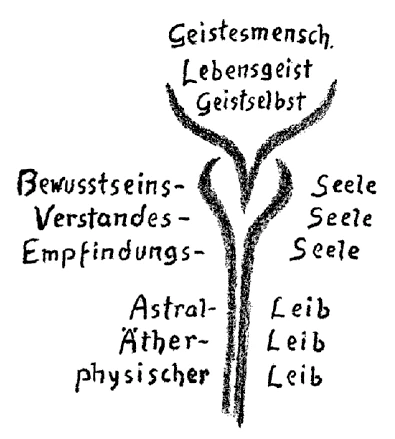

[ 13 ] In der Bewußtseinsseele öffnet sich der Mensch, und es kommt ihm entgegen das Geistselbst oder Manas, der Lebensgeist oder die Budhi und der Geistesmensch oder Atma. Das ist also etwas, was gleichsam dem Menschen als das Geistbefruchtende von oben entgegenkommt. Während der Mensch mit den anderen Gliedern von unten heraufwächst und sich öffnet zur Blüte des Menschensohnes, muß ihm, wenn er weiterschreitet und das vollständige Ich-Bewußtsein aufnehmen will, von oben entgegenkommen, was ihm entgegenbringt Geistselbst, Lebensgeist und Geistesmensch. Und der Repräsentant dessen, was ihm von oben heruntergebracht wird, was in die fernste Menschenzukunft hindeutet, wer ist das? Die erste Gabe empfangen wir als das Geistselbst. Wessen Repräsentant ist der, der die Gabe bringen wird des herunterkommenden Geistselbst ? Das ist der Sohn des Gottes, der lebt, der Lebensgeist, der «Sohn des lebendigen Gottes»!
[ 13 ] In the soul of consciousness, the human being opens up, and the spiritual self or Manas, the life spirit or Budhi, and the spiritual human being or Atma come to meet him. This is, so to speak, something that comes to meet the human being from above as a source of spiritual inspiration. While the human being grows upward from below through the other members and opens to the flowering of the Son of Man, if they are to proceed further and take in complete ego-consciousness, what must come to meet them from above is the spiritual self, the life spirit, and the spiritual human being. And who is the representative of that which is brought down to him from above, that which points to the farthest future of humanity? We receive the first gift as the Spirit-Self. Whose representative is the one who will bring the gift of the descending Spirit-Self? That is the Son of the living God, the Spirit of Life, the “Son of the living God”!
[ 14 ] Also es fragt der Christus Jesus in diesem Augenblick: Was muß durch meinen Impuls an den Menschen herankommen? Dasjenige, was das belebende Geistprinzip von oben ist, muß an den Menschen herankommen! So stehen sich gegenüber der «Menschensohn», der von unten nach oben wächst, und der Gottessohn, der «Sohn des lebendigen Gottes», der von oben nach unten wächst. Die müssen wir unterscheiden. Aber wir müssen es begreiflich finden, daß diese Frage für die Jünger eine schwierigere war. Diese Frage wird Ihnen in ihrer ganzen Schwierigkeit für die Jünger besonders dann vor die Seele treten, wenn Sie bedenken, daß die Jünger ja alles das erst empfingen, was die einfachsten Menschen nach der Zeit des Christus Jesus schon eingepflanzt erhalten haben durch die Evangelien. Die Jünger mußten es alles erst durch die lebendigen Lehrkräfte des Christus Jesus in sich aufnehmen. Es war in den Kräften, die sie bereits entwickelt hatten, keine Verständnisfähigkeit für das, was Antwort geben konnte auf die Frage: Wessen Repräsentant bin ich selber? Da wird darauf hingewiesen, daß einer der Jünger, der Petrus hieß, die Antwort gab: «Du bist der Christus, der Sohn des lebendigen Gottes» (Matth. 16,16). Das war in diesem Augenblicke eine Antwort, die, wenn wir so sagen dürfen, nicht aus den normalen Geisteskräften des Petrus heraus war. Und der Christus Jesus - versuchen wir die Sache dadurch lebendig darzustellen, daß wir etwa in gewissem Sinne an die Anschaulichkeit appellieren -, er mußte sich sagen, indem er den Petrus ansah: Es ist viel, daß aus diesem Munde diese Antwort gekommen ist, die sozusagen auf eine fernste Zukunftszeit hindeutet. - Und wenn er dann auf das blickte, was in dem Bewußtsein des Petrus war, was in ihm bereits so war, daß er mit dem Intellekt oder mit den Kräften, zu denen er es durch die Einweihung gebracht hatte, eine solche Antwort geben konnte, dann mußte der Christus sich sagen: Aus dem, was der Petrus bewußt weiß, ist es nicht heraus; da reden jene tieferen Kräfte, die im Menschen sind und die der Mensch erst nach und nach zu bewußten Kräften macht.
[ 14 ] So at this moment, Christ Jesus asks: What must reach humanity through my impulse? That which is the life-giving spiritual principle from above must reach humanity! Thus, the “Son of Man,” who grows from below to above, stands opposite the Son of God, the “Son of the living God,” who grows from above to below. We must distinguish between them. But we must understand that this question was a more difficult one for the disciples. This question will come before your soul in all its difficulty for the disciples, especially when you consider that the disciples first received everything that even the simplest people after the time of Christ Jesus had already been imbued with through the Gospels. The disciples first had to take it all in through the living teachings of Christ Jesus. There was no capacity for understanding within the powers they had already developed that could provide an answer to the question: Whose representative am I myself? It is pointed out here that one of the disciples, named Peter, gave the answer: “You are the Christ, the Son of the living God” (Matt. 16:16). At that moment, this was an answer that, if we may put it that way, did not come from Peter’s normal mental faculties. And Christ Jesus—let us try to bring this to life by appealing, so to speak, to the power of imagery—must have said to himself as he looked at Peter: It is significant that this answer came from this mouth, pointing, so to speak, to a time far in the future. — And when he then looked at what was in Peter’s consciousness, at what was already present in him such that he could give such an answer with his intellect or with the powers he had attained through initiation, then the Christ must have said to himself: It does not come from what Peter consciously knows; it is those deeper powers within the human being that are speaking, powers that the human being only gradually transforms into conscious powers.
[ 15 ] Wir tragen in uns physischen Leib, Ätherleib, Astralleib und Ich. Wir kommen hinauf zum Geistselbst, Lebensgeist und Geistesmenschen durch Umwandlung der Kräfte des astralischen Leibes, des Ätherleibes und des physischen Leibes. Das ist in der elementaren Geisteswissenschaft oft dargestellt worden. Aber die Kräfte, die wir einmal in unserem Astralleibe als Geistselbst entwickeln werden, sind in unserem Astralleibe schon darinnen; nur sind sie von göttlich-geistigen Mächten darinnen und nicht von uns entwickelt. Und ebenso ist in unserem Ätherleib schon ein göttlich-geistiger Lebensgeist darinnen. Daher sagt der Christus, indem er auf Petrus sieht: Was da gegenwärtig ist in deinem Bewußtsein, das hat nicht aus dir gesprochen; sondern es hat etwas gesprochen, was du erst in der Zukunft entwickeln wirst, was zwar in dir ist, aber wovon du noch nichts weißt. Was schon in deinem Fleisch und Blut ist, kann noch nicht so sprechen, daß das Wort zutage tritt: «Du bist Christus, der Sohn des lebendigen Gottes», sondern da reden die tief unter der Schwelle des Bewußtseins liegenden göttlich-geistigen Kräfte, die tiefsten sogar, die in dem Menschen drinnenstecken. - Das geheimnisvolle Höhere im Petrus, was der Christus den «Vater im Himmel» nennt, die Kräfte, aus denen Petrus zwar geboren ist, deren er sich aber noch nicht bewußt ist, die haben in diesem Augenblick aus ihm gesprochen. Daher das Wort: «Was du als Mensch aus Fleisch und Blut gegenwärtig bist, hat dir das nicht eingegeben, sondern der Vater in den Himmeln» (Matth. 16,17).
[ 15 ] We carry within us the physical body, the etheric body, the astral body, and the I. We ascend to the spiritual self, the life spirit, and the spiritual human being through the transformation of the forces of the astral body, the etheric body, and the physical body. This has often been described in elementary spiritual science. But the forces that we will one day develop in our astral body as the spiritual self are already present within our astral body; they have simply been developed there by divine-spiritual powers, not by us. And in the same way, a divine-spiritual life spirit is already present within our etheric body. That is why Christ says, looking at Peter: What is present in your consciousness now did not speak from you; rather, it was something speaking that you will only develop in the future—something that is indeed within you, but of which you know nothing yet. What is already in your flesh and blood cannot yet speak in such a way that the words “You are the Christ, the Son of the living God” come to light; rather, it is the divine-spiritual forces lying deep beneath the threshold of consciousness that speak—the deepest ones, in fact, that dwell within the human being. - The mysterious Higher Self within Peter, which Christ calls the “Father in Heaven”—the powers from which Peter was indeed born, but of which he is not yet conscious—spoke through him at that moment. Hence the words: “It was not flesh and blood that revealed this to you, but the Father in heaven” (Matt. 16:17).
[ 16 ] Dabei mußte aber der Christus noch etwas anderes sagen. Er mußte sich sagen: In dem Petrus habe ich eine Natur vor mir, einen Jünger, dessen ganze menschliche Konstitution so ist, daß durch die Kräfte, die schon das Bewußtsein entwickelt hat, daß durch die ganze Art und Weise, wie die Geistestätigkeit wirkt, nicht gestört wird die Vaterkraft in ihm; sie ist so stark, diese unterbewußte Menschenkraft, daß er auf sie bauen kann, wenn er sich dieser unterbewußten Menschenkraft überläßt. Das ist das Wichtige in ihm, konnte sich der Christus sagen. Was so in ihm ist, das ist aber auch in jedem Menschen. Nur bewußt ist es noch nicht weit genug, das wird sich erst in der Zukunft entwickeln. Soll sich das, was ich der Menschheit zu geben habe, und wofür ich der Impuls bin, weiter entwickeln und die Menschen ergreifen, so muß es sich auf das begründen, was da in dem Petrus eben gesprochen hat: «Du bist Christus, der Sohn des lebendigen Gottes!» Auf diesen Felsen im Menschen, den noch nicht zerstört haben die brandenden Wogen des schon entwickelten Bewußtseins, was da als die Vaterkraft spricht, darauf will ich das bauen, was immer mehr und mehr hervorsprießen soll aus meinem Impuls. - Und wenn die Menschen diese Grundlage entwickeln, wird sich das ergeben, was die Menschheit des ChristusImpulses sein wird. - Das liegt in den Worten: «Du bist der Petrus, und auf diesen Felsen will ich bauen, was eine Menschengemeinde ergeben kann, was eine Summe von Menschen ergeben kann, die sich zum Christus-Impuls bekennen!» (Matth. 16,18).
[ 16 ] But the Christ had to say something else as well. He had to say to himself: In Peter I see a nature before me, a disciple whose entire human constitution is such that the Father-force within him is not disturbed by the powers that consciousness has already developed, nor by the entire manner in which spiritual activity works; this subconscious human force is so strong that he can rely on it when he surrenders to this subconscious human force. That is what is important in him, Christ could say to himself. But what is in him in this way is also in every human being. It is just not yet sufficiently conscious; that will only develop in the future. If what I have to give to humanity—and for which I am the impulse—is to develop further and take hold of people, it must be grounded in what Peter has just spoken: “You are the Christ, the Son of the living God!” Upon this rock within the human being—which has not yet been destroyed by the crashing waves of the already developed consciousness—that which speaks as the Father’s power, upon this I will build what is to spring forth more and more from my impulse. - And when people develop this foundation, what will emerge is the humanity of the Christ impulse. - This is expressed in the words: “You are Peter, and on this rock I will build what a community of people can become, what a gathering of people who profess the Christ impulse can become!” (Matt. 16:18).
[ 17 ] So leicht, wie die Diskussionen heute fließen - denn ein besonderer Streit herrscht fast in der ganzen Welt über diese Worte -, so leicht sind diese Worte, die im Matthäus-Evangelium stehen, wahrhaftig nicht zu nehmen. Sie sind nur zu verstehen, wenn man sie aus der Tiefe jener Weisheit, die zugleich die Mysterienweisheit ist, herausschöpft.
[ 17 ] As easily as the discussions flow today—for there is a particular controversy raging almost throughout the world over these words—these words found in the Gospel of Matthew are truly not to be taken lightly. They can only be understood if one draws them from the depths of that wisdom which is at the same time the wisdom of the mysteries.
[ 18 ] Und jetzt soll klar und deutlich noch etwas anderes gezeigt werden: daß nämlich wirklich auf die tiefere, unterbewußte Kraft in Petrus von dem Christus Jesus gebaut wird. Denn im nächsten Augenblick redet der Christus von den nächsten Ereignissen, die sich abspielen sollen. Von dem, was als das Mysterium auf Golgatha geschehen soll, beginnt er zu reden. Und jetzt ist der Augenblick schon vorbei, wo das tiefer in Petrus Liegende spricht; jetzt spricht das in Petrus, was in ihm schon bewußt ist. Jetzt kann er nicht verstehen, was der Christus damit meint, kann nicht glauben, daß Leiden und Sterben eintreten sollen. Und wo der bewußte Petrus spricht, der schon die bewußten eigenen Kräfte in sich entwickelt hat, da muß ihn der Christus zurechtweisen, indem er sagt: Jetzt redet nicht irgendein Gott, sondern jetzt spricht das, was du schon als Mensch entwickelt hast; das ist unwert, daß es emporwächst; das ist aus einer Lehre der Täuschung; das ist aus Ahriman, das ist des Satans! - Das liegt in dem Wort: «Hebe dich, Satan, von mir! Du bist mir ärgerlich; denn du meinest nicht, was göttlich, sondern was menschlich ist» (Matth. 16,23). Der Christus nennt ihn gleich den Satan; er wendet gerade das Wort Satan an für Ahriman, während sonst in der Bibel Diabolus steht für alles Luziferische. Da gebraucht der Christus in der Tat für die Täuschung, der sich Petrus noch hingeben muß, das richtige Wort.
[ 18 ] And now something else must be made clear: namely, that Christ Jesus is truly building upon the deeper, subconscious power within Peter. For in the very next moment, Christ speaks of the events that are about to unfold. He begins to speak of what is to take place as the Mystery on Golgotha. And now the moment has already passed when what lies deeper within Peter speaks; now what speaks in Peter is what is already conscious within him. Now he cannot understand what the Christ means by this, cannot believe that suffering and death are to come. And where the conscious Peter speaks—who has already developed his own conscious powers within himself—there Christ must rebuke him by saying: Now it is not some God speaking, but rather that which you have already developed as a human being; that is unworthy of rising up; that comes from a teaching of deception; that comes from Ahriman, that is of Satan! - This is contained in the words: “Get behind me, Satan! You are a stumbling block to me; for you are not setting your mind on the things of God, but on the things of man” (Matt. 16:23). Christ calls him Satan outright; he uses the very word Satan for Ahriman, whereas elsewhere in the Bible Diabolus stands for all that is Luciferic. Here, in fact, Christ uses the right word for the deception to which Peter must still yield.
[ 19 ] So verhalten sich die Dinge wirklich. Was hat nun die moderne, populäre Bibelkritik daraus gemacht? Sie hat gefunden: Es ist doch ganz unmöglich, daß der Christus Jesus gegenübersteht dem Petrus und von ihm das eine Mal sagt: Du hast allein begriffen, daß ein Gott dir gegenübersteht! — während er gleich darauf ihn das andere Mal einen Satan nennt. Und die Bibelkritiker sagen nun: Also muß man daraus schließen, daß das Wort Satan, das Christus zu Petrus gesprochen haben soll, von einem anderen später eingeschoben worden ist, daß es also eine Fälschung ist. - Richtig ist dabei nur, daß die Meinung, die man in der Gegenwart über den tieferen Sinn dieser Worte aus der philologischen Forschung hat, gar nichts wert ist, wenn nicht vorangeht das sachliche Verständnis der biblischen Urkunden. Erst auf Grundlage des sachlichen Verständnisses der Bibel ist es möglich, daß der Mensch wirklich auch etwas sagen kann über die geschichtliche Entstehung der entsprechenden Urkunden.
[ 19 ] This is how things really stand. What, then, has modern, popular biblical criticism made of this? It has concluded: It is simply impossible that Christ should stand before Peter and say to him on one occasion, “You alone have understood that a God stands before you!”—while immediately afterward, on another occasion, he calls him a Satan. And the biblical critics now say: We must therefore conclude that the word “Satan,” which Christ is said to have spoken to Peter, was inserted by someone else later, and is thus a forgery. - The only truth here is that the current opinion regarding the deeper meaning of these words, derived from philological research, is worth nothing unless it is preceded by a factual understanding of the biblical documents. Only on the basis of a factual understanding of the Bible is it possible for a person to truly say anything about the historical origins of the relevant documents.
[ 20 ] Aber zwischen diesen beiden Worten, die ich angeführt habe, liegt noch ein anderes. Und das werden wir nur verstehen können, wenn wir ins Auge fassen eine uralte und doch immer neue Mysterienlehre, die Lehre, daß der Mensch, so wie er auf der Erde ist, und nicht nur der Mensch selbst, sondern eine jede Menschengemeinde, eine Art Abbild ist für dasjenige, was im großen Kosmos, im Makrokosmos vor sich geht. Wir haben das insbesondere schildern können bei der Besprechung der Abstammung des Jesus von Nazareth. Wir haben gesehen, wie jenes Wort, das zu Abraham gesprochen ist, eigentlich bedeutet: «Deine Nachkommenschaft soll sein ein Abbild der Ordnung der Sterne am Himmel» (1.Mose 22,17). Was am Himmel ist als die Ordnung der zwölf Sternbilder und als der Gang der Planeten durch den Tierkreis, das soll sich wiederholen in den zwölf Stämmen und in dem, was das hebräische Volk durchmacht durch drei mal vierzehn Generationen hindurch. Also in der Aufeinanderfolge der Generationen mit der eigentümlichen Vererbung durch die Blutsverbände in den zwölf Stämmen soll ein Abbild der makrokosmischen Verhältnisse gegeben werden. Das ist dem Abraham gesagt worden.
[ 20 ] But between these two words I have mentioned lies yet another. And we will only be able to understand this if we consider an ancient yet ever-new mystery teaching—the teaching that human beings, as they are on Earth, and not only human beings themselves but every human community, are a kind of reflection of what takes place in the great cosmos, in the macrocosm. We were able to describe this in particular when discussing the lineage of Jesus of Nazareth. We have seen how that word spoken to Abraham actually means: “Your descendants shall be a reflection of the order of the stars in the heavens” (Genesis 22:17). What is in the heavens—the order of the twelve constellations and the course of the planets through the zodiac—is to be repeated in the twelve tribes and in what the Hebrew people undergo over the course of three times fourteen generations. Thus, in the succession of generations with the unique inheritance through the blood ties in the twelve tribes, a reflection of the macrocosmic conditions is to be given. This is what was said to Abraham.
[ 21 ] In dem Augenblick, da der Christus Jesus den Petrus gegenüber hat, der in seiner tieferen Natur begreifen kann, was eigentlich mit dem Christus-Impuls gegeben ist — die hinunterfließende geistige Kraft durch den Sohn des lebendigen Gottes -, da weiß der Christus, daß er die Umstehenden darauf hinweisen kann, daß jetzt auf der Erde etwas Neues beginnt, ein neues Abbild gegeben werden kann. Während für Abraham in der Blutsverwandtschaft das Abbild der kosmischen Verhältnisse gegeben war, soll jetzt in den ethisch-moralisch-geistigen Verhältnissen ein Abbild dessen geformt werden, was der Mensch durch sein Ich werden kann. Wenn die Menschen verstehen werden in demselben Sinne, wie es die bessere Natur in Petrus versteht, was der Christus ist, dann werden sie nicht nur solche Gemeinschaften, solche Ordnungen einführen, die auf Blutsverwandtschaft beruhen, sondern solche, welche bewußt von Seele zu Seele das Band der Liebe spinnen. Das heißt: Wie in dem jüdischen Blute, in den Fäden, die durch die Generationen hindurchgingen, zusammengefügt war, was im Menschengeschlecht zusammengefügt werden sollte nach dem Vorbild des Maktokosmos, und wie das, was auseinandergelöst war im Menschengeschlecht, eben auch auseinandergelöst war nach den Ordnungen am Himmel, so sollte jetzt aus dem bewußten Ich heraus in den ethisch-moralisch-geistigen Verhältnissen dasjenige entstehen, was die Menschen trennt oder in Liebe zusammenhält. Die Ordnungen der Menschen sollten geformt werden oder harmonisiert werden aus dem bewußten Ich heraus. Das liegt in den Worten, die der Christus Jesus spricht als Fortsetzung der Antwort, die er dem Petrus gegeben hat: «Was du auf Erden binden wirst - was die tiefere Natur in dir bindet -, das ist dasselbe, was im Himmel gebunden ist, und was dieselbe Natur hier unten löst, das ist etwas, was auch im Himmel gelöst wird» (Matth. 16,19).
[ 21 ] At the moment when Christ Jesus stands before Peter, who in his deeper nature can comprehend what the Christ impulse actually entails—the spiritual power flowing down through the Son of the living God—Christ knows that he can point out to those around him that something new is now beginning on Earth, that a new image can be given. While for Abraham the image of cosmic relationships was given through blood kinship, now an image of what the human being can become through his or her ego is to be formed within ethical, moral, and spiritual relationships. When people come to understand, in the same sense that the better nature in Peter understands it, what the Christ is, then they will not only establish communities and orders based on blood kinship, but also those that consciously weave the bond of love from soul to soul. That is to say: Just as in the Jewish bloodline, in the threads that ran through the generations, was woven together what was to be woven together in the human race after the model of the macrocosm, and just as what was separated in the human race was likewise separated according to the orders in heaven, so now, out of the conscious self, in ethical, moral, and spiritual relationships, that which separates people or holds them together in love should arise. The orders of humanity should be formed or harmonized out of the conscious self. This is contained in the words spoken by Christ Jesus as a continuation of the answer he gave to Peter: “Whatever you bind on earth—whatever the deeper nature within you binds—is the same as what is bound in heaven, and whatever that same nature here below loosens is something that is also loosened in heaven” (Matt. 16:19).
[ 22 ] In den alten Zeiten lag alle Bedeutung des Menschenzusammenhanges in der Blutsverwandtschaft. Immer mehr und mehr aber soll der Mensch hineinwachsen in die geistigen, moralischen, spirituellen Verbände. Wenn wir das ins Auge fassen, müssen wir sagen: Es muß dem Menschen dasjenige, was er als Gemeinde gründet, etwas werden. Wenn wir anthroposophisch sprechen, können wir sagen: Das Einzelkarma des Menschen muß sich verbinden mit dem Karma von Gemeinschaften. Sie können es schon durchaus wissen aus dem, wasinden verflossenen Jahren ausgeführt worden ist. Wie es nicht der Karmaidee widerspricht, wenn ich einem Armen etwas schenke, ebensowenig widerspricht es der Karmaidee, wenn einem Menschen dasjenige, was er als sein Einzelkarma hat, von einer Gemeinde abgenommen wird. Die Gemeinde kann mittragen das Los des einzelnen. Das Karma kann so verbunden werden, daß die Gemeinde mitträgt an dem Karma des einzelnen. Es kann mit anderen Worten folgendes im moralischen Zusammenhange eintreten: Das einzelne Glied innerhalb dieser Gemeinde begeht etwas Unrechtes. Das wird ganz gewiß in das Karma der einzelnen Persönlichkeit eingeschrieben sein, und es muß im großen Weltzusammenhange ausgetragen werden. Aber es kann sich ein anderer Mensch finden, der sagt: Ich helfe dir das Karma austragen! - Erfüllt muß das Karma werden, aber der andere kann ihm helfen. So können ganze Gemeinden dem helfen, der ein Unrecht begangen hat. Es kann der einzelne sein Karma so mit der Gemeinde verflochten haben, daß er, weil die Gemeinde ihn als eines ihrer Glieder betrachtet, etwas, was ihn betrifft, bewußt abgenommen erhält, daß die ganze Gemeinde mitfühlt und mit will den einzelnen bessern; so daß die Gemeinde sprechen kann: Du einzelner hast unrecht getan, aber wir treten für dich ein! Wir übernehmen das, was zur Ausbesserung des Karma führt. - Will man die Gemeinde «Kirche» nennen, so legt sich die Kirche damit die Verpflichtung auf, die Sünden des einzelnen auf sich zu nehmen, sein Karma mitzutragen. Es handelt sich nicht um das, was man heute Sündenvergebung nennt, sondern um ein reales Band, um ein Aufsichnehmen von Sünden. Und darum handelt es sich, daß die Gemeinde dies bewußt auf sich nimmt.
[ 22 ] In ancient times, the entire significance of human relationships lay in blood ties. But more and more, human beings are meant to grow into intellectual, moral, and spiritual communities. When we consider this, we must say: What a person establishes as a community must become something meaningful to them. Speaking in anthroposophical terms, we can say: The individual karma of a person must connect with the karma of communities. You can certainly know this from what has been explained in past years. Just as it does not contradict the idea of karma when I give something to a poor person, neither does it contradict the idea of karma when a community takes upon itself what a person has as their individual karma. The community can share in the individual’s fate. Karma can be connected in such a way that the community shares in the individual’s karma. In other words, the following can occur in a moral context: An individual member within this community commits an injustice. This will certainly be inscribed in the karma of the individual personality, and it must be worked out within the greater context of the world. But another person may come forward and say: “I will help you work through this karma!”—The karma must be fulfilled, but the other person can assist him. In this way, entire communities can help the one who has committed a wrongdoing. The individual may have so interwoven his karma with the community that, because the community regards him as one of its members, he consciously receives relief from something that concerns him; the entire community sympathizes and shares the will to improve the individual; so that the community can say: “You, as an individual, have done wrong, but we stand up for you! We take upon ourselves what leads to the rectification of the karma.” - If one wishes to call the community “Church,” the Church thereby takes upon itself the obligation to bear the sins of the individual, to share in his karma. This is not what is today called the forgiveness of sins, but a real bond, a taking upon oneself of sins. And this is what it is all about: that the community consciously takes this upon itself.
[ 23 ] Wenn man in dieser Art und Weise das «Binden» und «Lösen» versteht, dann müßte man bei jeder Sündenvergebung, wenn man sie richtig versteht, an die Verpflichtung denken, die der Gemeinde da heraus erwächst. So spinnt sich dadurch, daß die Fäden der einzelnen verwoben werden in das Karma der ganzen Gesellschaft, ein Netz. Und dieses Netz soll durch das, was der Christus heruntergebracht hat aus geistigen Höhen, in seiner Charakteristik ein Abbild sein der Ordnung am Himmel, das heißt, nach der Ordnung der geistigen Welt soll das Karma des einzelnen mit dem Gesamtkarma verbunden sein, nicht in beliebiger Weise, sondern so, daß der Gemeindeorganismus ein Abbild der Ordnung im Himmel werde. Damit beginnt diese Szene des sogenannten Petrus-Bekenntnisses für die, welche anfangen sie zu verstehen, einen unendlichen tiefen Sinn zu haben. Es ist sozusagen die Stiftung der auf die Ich-Natur gebauten Menschheit der Zukunft. Das ist es, was in diesem vertraulichen Gespräch zwischen dem Christus und seinen nächsten Schülern sich abspielt, daß der Christus überträgt die Kraft, die er aus dem Makrokosmos herunterbringt, auf das, was die Jünger stiften sollen. Und von jetzt ab ist es im Matthäus-Evangelium Schritt für Schritt ein Hinaufführen der Jünger zu dem, was in sie einfließen kann von der Sonnenkraft und Kosmoskraft, welche die Christus-Wesenheit sammelt, um sie auf die Jünger zu übertragen. Wir wissen ja, daß die eine Seite der Initiation ein Hinausgehen in den Makrokosmos ist. Und weil der Christus der Impuls zu einer solchen Initiation ist, deshalb führt er seine Jünger, indem er sie führt, hinaus in den Kosmos. Wie der einzelne zu Initiierende, wenn er diese Initiation durchmacht, bewußt hineinwächst in den Makrokosmos und Stück für Stück von ihm kennenlernt, so schreitet der Christus gleichsam den Makrokosmos ab, zeigt überall die Kräfte, die da spielen und hereinströmen, und überträgt sie auf die Jünger.
[ 23 ] If one understands “binding” and “loosing” in this way, then whenever sins are forgiven—if one understands this correctly—one must consider the obligation that arises for the congregation as a result. Thus, as the threads of the individual are woven into the karma of the whole society, a net is spun. And this web, through what Christ brought down from spiritual heights, is meant to be, in its character, a reflection of the order in heaven; that is, according to the order of the spiritual world, the karma of the individual is to be connected with the collective karma, not in any arbitrary way, but so that the community organism becomes a reflection of the order in heaven. Thus this scene of the so-called Peter’s Confession begins to have an infinitely deep meaning for those who are beginning to understand it. It is, so to speak, the foundation of the future humanity built upon the ego-nature. This is what takes place in this intimate conversation between Christ and his closest disciples: that Christ transfers the power he brings down from the macrocosm to that which the disciples are to establish. And from this point on, the Gospel of Matthew presents, step by step, a leading of the disciples toward that which can flow into them from the solar power and cosmic power which the Christ-Being gathers in order to transmit them to the disciples. We know, of course, that one aspect of initiation is a stepping out into the macrocosm. And because Christ is the impulse for such an initiation, he leads his disciples—by guiding them—out into the cosmos. Just as the individual to be initiated, when undergoing this initiation, consciously grows into the macrocosm and comes to know it bit by bit, so does the Christ, as it were, survey the macrocosm, pointing out everywhere the forces at work and flowing in, and transmitting them to the disciples.
[ 24 ] Ich habe gestern schon an einer Stelle darauf hingewiesen, wie das geschieht. Stellen wir uns so recht die Szene vor: Ein Mensch schläft ein. Dann liegen im Bette physischer Leib und Ätherleib, während von ihm astralischer Leib und Ich ausgegossen sind in den Kosmos und die Kräfte des Kosmos in diese Glieder eindringen. Träte nun der Christus da zu ihm, so würde er die Wesenheit sein, die ihm bewußt diese Kräfte heranzieht und beleuchtet. So ist es aber gerade mit der Szene, die uns dargestellt wird: Die Jünger fahren hin in der letzten Nachtwache; da sehen sie, daß das, was sie erst für ein Gespenst angeschen haben, der Christus ist, der die Kraft des Makrokosmos in sie einfließen läßt (Matth. 14,25-26). Es ist handgreiflich dargestellt, wie er die Jünger hinführt zu den Kräften des Makrokosmos.
[ 24 ] I already pointed out yesterday how this happens. Let us picture the scene clearly: A person falls asleep. Then the physical body and the etheric body lie in bed, while the astral body and the I have poured out into the cosmos, and the forces of the cosmos penetrate these members. If Christ were to approach him at that moment, he would be the being who consciously draws these forces to him and illuminates them. But this is precisely the case with the scene that is presented to us: The disciples are sailing along during the last night watch; there they see that what they first took for a ghost is Christ, who allows the power of the macrocosm to flow into them (Matt. 14:25–26). It is vividly depicted how he leads the disciples to the forces of the macrocosm.
[ 25 ] Und die nächsten Szenen des Matthäus-Evangeliums stellen nichts anderes dar, als wie der Christus die Jünger hinausführt Schritt für Schritt die Wege, die der zu Initiierende geht. Es ist so, wie wenn der Christus selbst das durchmachte und Schritt für Schritt seine Jünger an den Händen führte an die Stätten, wohin der zu Initiierende geführt wird. Ich will Ihnen eines sagen, an dem Sie so recht sehen können, wie Schritt für Schritt der Christus die Jünger hinausführt in den Makrokosmos.
[ 25 ] And the following scenes in the Gospel of Matthew depict nothing other than how Christ leads the disciples, step by step, along the paths that the initiate must walk. It is as if Christ himself had gone through this and, step by step, led his disciples by the hand to the places where the initiate is led. I want to tell you something that will allow you to see clearly how, step by step, Christ leads the disciples out into the macrocosm.
[ 26 ] Wenn man lebendige Anschauungen hat von der geistigen Welt, und wenn die hellseherischen Kräfte heranwachsen, lernt man so manches kennen, was man vorher nicht kennen kann. So lernt man erkennen, wie eigentlich zum Beispiel der Zusammenhang in den fortschreitenden Wachstumsverhältnissen der Pflanze ist. Der materialistische Sinn wird von der Pflanze sagen: Hier habe ich eine Blüte nehmen wir an eine Blüte, die Früchte trägt -, da wird sich Same entwickeln. Den Samen kann man herausnehmen, kann ihn in die Erde versenken, das Samenkorn verfault, und es erscheint eine neue Pflanze, die auch wieder Samen trägt. So geht es von Pflanzensproß zu Pflanzensptoß weiter. Der materialistische Sinn wird dabei denken, daß irgend etwas von dem verfaulenden Samenkorn übergeht in die neue Pflanze. Der materialistische Sinn kann gar nicht anders denken als, wenn es auch noch so klein, noch so winzig ist, so muß doch irgend etwas materiell übergehen. Aber so ist es nicht. Tatsächlich wird in bezug auf das Materielle die ganze alte Pflanze zerstört. Es geschieht ein Sprung in bezug auf das Materielle, und die neue Pflanze ist materiell etwas ganz Neues. Es geschieht tatsächlich eine Neubildung.
[ 26 ] When one has vivid insights into the spiritual world, and as one’s clairvoyant powers develop, one comes to know many things that were previously unknown. In this way, one learns to recognize, for example, the actual connection in the progressive stages of a plant’s growth. The materialistic mind will say of the plant: Here I have a flower—let us assume a flower that bears fruit—and a seed will develop there. One can remove the seed, bury it in the earth; the seed rots, and a new plant appears, which also bears seeds. Thus it continues from plant sprout to plant sprout. The materialistic view would think that something from the rotting seed passes over into the new plant. The materialistic view cannot think otherwise: no matter how small or tiny it may be, something material must pass over. But that is not the case. In fact, in terms of the material, the entire old plant is destroyed. A leap occurs in terms of the material, and the new plant is, materially speaking, something entirely new. A new formation actually takes place.
[ 27 ] Man lernt nun die wichtigsten Verhältnisse in der Welt dadurch kennen, daß man dieses eigentümliche Gesetz begreifen und anwenden lernt auf den ganzen Makrokosmos, daß in der Tat in bezug auf die materiellen Verhältnisse Sprünge geschehen. Das hat man in den Mysterien in ganz besonderer Weise ausgedrückt. Man hat gesagt: Es muß der zu Initiierende beim Hinausschreiten in den Kosmos auf einer Stufe die Kräfte kennenlernen, die diese Sprünge bewirken. Nun lernt man etwas kennen im Kosmos, wenn man in irgendeiner Richtung geht, die dadurch ausgedrückt wird, daß man die Sternbilder zu Hilfe nimmt. Die sind dann wie Buchstaben. Wenn wir so in einer bestimmten Richtung hinauswachsen, erleben wir das Überspringen von dem Vorfahren zu dem Nachkommen, sei es auf dem Gebiet des Pflanzlichen, des Tierischen, des Menschlichen, oder sei es auf dem Gebiete des planetarischen Daseins; denn auch zum Beispiel beim Übergang vom Saturn zur Sonne ging alles Materielle verloren. Das Geistige blieb, alles Materielle zerstob. Das Geistige war es, das den Sprung bewirkte. Ebenso war es beim Übergang von Sonne zu Mond, vom Mond zur Erde. Im kleinsten und im größten ist das so. - Es gibt nun zwei Zeichen, ein altes, wodurch man bildlicher, mehr in imaginativer Schrift darstellte, und dann ein neueres Zeichen als Darstellung für das Sprunghafte. Das neue können Sie in den Kalendern finden. Wenn die Evolution weitergeht, ringelt das alte sich ein, etwa wie eine Spirale, und die neue Evolution geht dann wie eine zweite Spirale aus der alten hervor, indem sie von innen nach außen weitergeht. Aber es geht die neue Evolution nicht so weiter, daß sie sich unmittelbar an die alte anschließt, sondern zwischen dem Ende der alten und dem Beginn der neuen ist ein kleiner Sprung, dann erst geht es weiter.
[ 27 ] One comes to understand the most important relationships in the world by learning to grasp this peculiar law and apply it to the entire macrocosm—namely, that leaps do indeed occur in relation to material conditions. This was expressed in a very special way in the Mysteries. It has been said: As the initiate steps out into the cosmos, he must, at a certain stage, become acquainted with the forces that bring about these leaps. Now one comes to know something in the cosmos when one moves in a certain direction, which is expressed by using the constellations as a guide. These are then like letters. When we thus grow outward in a certain direction, we experience the leap from the ancestor to the descendant, be it in the realm of the plant, the animal, the human, or in the realm of planetary existence; for even, for example, in the transition from Saturn to the Sun, all that was material was lost. The spiritual remained; all that was material disintegrated. It was the spiritual that brought about the leap. It was the same during the transition from the Sun to the Moon, and from the Moon to the Earth. This is true in the smallest and in the largest scales. — There are now two symbols: an old one, through which things were depicted more figuratively, in an imaginative script, and then a newer symbol representing the leap. You can find the new one in the calendars. As evolution continues, the old one curls inward, much like a spiral, and the new evolution then emerges from the old one like a second spiral, proceeding from the inside out. But the new evolution does not continue in such a way that it immediately follows the old one; rather, there is a small leap between the end of the old and the beginning of the new, and only then does it continue.


[ 28 ] So erhalten wir diese Figur: Zwei sich ineinandetschlingende Spiralen, in der Mitte ein kleiner Sprung: das Zeichen des Krebses, das uns symbolisieren soll das Hinauswachsen in den Makrokosmos und darstellen soll das Entstehen irgendeines neuen Sprosses innerhalb irgendeiner Evolution.
[ 28 ] This is how we arrive at this figure: two spirals intertwined, with a small gap in the center—the sign of Cancer, which is meant to symbolize our expansion into the macrocosm and represent the emergence of some new sprout within the course of evolution.
[ 29 ] Nun gab es noch ein anderes Zeichen in der Darstellung dieser Verhältnisse. So sonderbar es ihnen scheinen mag, es war so gebildet, daß man einen Esel und sein Füllen abbildete, den Vorfahren und den Nachkommen. Das sollte darstellen das eigentliche Übergangsverhältnis von einem Zustand in den anderen. Und in der Tat wird sogar das Sternbild des Krebses in alten Abbildungen sehr häufig so dargestellt, daß man einen Esel und sein Füllen abbildete. Das zu wissen ist nicht unwichtig. Es ist eine wichtige Lehre für den Menschen zum Verständnis dessen, daß auch beim Aufstieg in den Makrokosmos ein solcher wichtiger Übergang ist, indem der Mensch hinaufwächst in die geistige Welt, aber dann an ganz neue Erleuchtungen anknüpfen muß, Das wird ganz richtig dargestellt, indem man es in der Sternensprache so darstellt, wie wenn die physische Sonne durchgeht durch das Sternbild des Krebses und, nachdem sie den höchsten Punkt erreicht hat, wieder einen Abstieg durchmacht. So ist es auch, wenn der zu Initiierende erst durchmacht den Aufstieg in die geistige Welt, um die Kräfte kennenzulernen, und dann die Kräfte, wenn er sie erkannt hat, wieder herunterträgt, um sie der Menschheit dienstbar zu machen.
[ 29 ] There was another symbol used to represent these relationships. As strange as it may seem to them, it was designed to depict a donkey and its foal—the ancestor and the descendant. This was meant to represent the actual transition from one state to another. And in fact, even the constellation of Cancer is very often depicted in ancient illustrations in such a way that it shows a donkey and its foal. It is not unimportant to know this. It is an important lesson for humanity in understanding that even in the ascent into the macrocosm there is such an important transition, in which the human being grows upward into the spiritual world but must then build upon entirely new insights, This is depicted quite accurately in the language of the stars, as if the physical sun were passing through the constellation of Cancer and, after reaching its highest point, were undergoing a descent once more. So it is also when the initiate first undergoes the ascent into the spiritual world to become acquainted with the forces, and then, having recognized them, brings these forces back down again to make them serve humanity.
[ 30 ] Daß der Christus Jesus dies den Jüngern vorführt, wird im Matthäus-Evangelium (Matth. 21,1-11) wie auch in den anderen Evangelien erzählt. Und es wird so erzählt, daß er nicht durch das bloße Wort wirkt, sondern daß er seinen Jüngern vorführt die Imagination, das lebendige Bild dessen, was er selbst vollzieht, wo er entgegengeht jener Höhe, zu der in der Zeit die Menschheit durch ihre Entwickelung hinansteigen soll. Da gebraucht er das Bild des Esels und seines Füllens; das heißt, er führt die Jünger an das Verstehen dessen hin, was im geistigen Leben entspricht dem Sternbild des Krebses. Das ist also ein Ausdruck für etwas, was sich zugetragen hat in dem geistiglebendigen, spirituellen Verhältnis zwischen dem Christus und seinen Jüngern. Und das ist etwas von solcher Majestät und Größe, daß es nicht ausgedrückt werden kann, indem man Menschenworte aus irgendeiner Sprache wählt, sondern nur dadurch, daß der Christus die Jünger hineinführt in die Verhältnisse der spirituellen Welt und ihnen in den physischen Verhältnissen Abbilder schafft für die makrokosmische Welt. Da führt er sie hinauf bis zu der Stelle, wo die Kräfte des Initiierten wieder nutzbar werden für die Menschheit. Da steht er auf der Höhe, die nur angedeutet werden kann, indem er sagt: Er steht in der Sonnenhöhe in dem Zeichen des Krebses! Kein Wunder daher, wenn das Matthäus-Evangelium an dieser Stelle darauf aufmerksam macht, daß das Christus-Leben für seine Erdenzeit auf seiner Höhe angekommen ist, und mächtig darauf hinweist mit den Worten: «Hosianna in der Höhe!» Da ist jeder Ton so gewählt, daß durch das, was da geschieht, die Jünger heranwachsen, damit wiederum durch das, was in ihnen vorgeht, in der Menschheit heranwachsen kann, was dutch den Christus Jesus in die Entwickelung der Menschheit hat hineingebracht werden können.
[ 30 ] The fact that Christ Jesus demonstrates this to his disciples is recounted in the Gospel of Matthew (Matt. 21:1–11) as well as in the other Gospels. And it is told in such a way that he does not work through mere words, but rather demonstrates to his disciples the imagination, the living image of what he himself is accomplishing as he moves toward that height to which humanity is to ascend through its development over time. Here he uses the image of the donkey and its foal; that is, he leads the disciples to an understanding of what in spiritual life corresponds to the constellation of Cancer. This is thus an expression of something that took place in the spiritually alive, spiritual relationship between Christ and his disciples. And this is something of such majesty and grandeur that it cannot be expressed by choosing human words from any language, but only by Christ leading the disciples into the conditions of the spiritual world and creating for them, within physical conditions, images of the macrocosmic world. There he leads them up to the point where the powers of the Initiate become usable again for humanity. There he stands at a height that can only be hinted at by saying: He stands at the height of the Sun in the sign of Cancer! No wonder, then, that the Gospel of Matthew points out at this point that the Christ life has reached its zenith during its time on earth, and powerfully emphasizes this with the words: “Hosanna in the highest!” Every word is chosen so that through what is happening there, the disciples may grow, so that in turn, through what is taking place within them, that which Christ Jesus was able to bring into the development of humanity may grow within humanity itself.
[ 31 ] Und die nachfolgende Passahgeschichte ist dann nichts anderes als das jetzt real-lebendige Einfließen dessen, was zuerst einfließen sollte in die Jünger als eine Lehre und dann magisch einfließen soll in die Menschheit durch die Kräfte, die vom Mysterium von Golgatha ausgegangen sind. So müssen wir den weiteren Fortgang des MatthäusEvangeliums begreifen. Wir werden dann auch begreifen, wie der Schreiber des Matthäus-Evangeliums sich immer bewußt geblieben ist, daß er sozusagen aufmerksam zu machen hat auf den Kontrast zwischen der lebendigen Lehre, die aus den kosmischen Höhen gehört worden ist, und die für die Jünger gilt, und demjenigen, was den Außenstehenden entgegentreten kann, die nicht empfänglich sind für die Kräfte des Christus Jesus selber. Deshalb treten uns jene Ausführungen entgegen in den Gesprächen mit den Schriftgelehrten und Pharisäern, die wir morgen betrachten wollen. Heute aber wollen wir noch darauf aufmerksam machen, daß der Christus Jesus, nachdem er seine Jünger so weit geführt hat, als es ging, und sie hat teilnehmen lassen an den Stätten, wohin der zu Initiierende geführt wird, er ihnen auch noch in Aussicht gestellt hat, daß, wenn sie diesen Weg gehen, sie selber erleben werden das Hineinwachsen in die geistige Welt des Makrokosmos. Er sagt ihnen, daß sie selber die Veranlagung zur Initiation haben, daß sie ihnen bevorsteht, und daß sie sich hinausleben werden in die makrokosmische Welt, wo sie die wahre Natur des Christus immer mehr und mehr werden erkennen können als desjenigen Wesens, das alle geistigen Räume erfüllt, und das sein Abbild gehabt hat in dem Jesus von Nazareth. Daß sie zu dieser Initiation heranreifen, daß sie Menschheitsinitiierte werden, das mußte der Christus seinen Schülern sagen. Er konnte sie noch darauf aufmerksam machen, daß man zur selbständigen Initiation nur heranwachsen kann, indem man in Geduld und Ausdauer das Innere reifen läßt.
[ 31 ] And the Passover narrative that follows is nothing other than the now-living, active infusion of what was first intended to be instilled in the disciples as a teaching and is then to be magically infused into humanity through the forces that emanated from the Mystery of Golgotha. This is how we must understand the further course of the Gospel of Matthew. We will then also understand how the writer of the Gospel of Matthew always remained conscious that he must, so to speak, draw attention to the contrast between the living teaching that has been heard from the cosmic heights and applies to the disciples, and that which may confront outsiders who are not receptive to the forces of Christ Jesus himself. That is why we encounter those remarks in the discussions with the scribes and Pharisees, which we will consider tomorrow. Today, however, we wish to point out that Christ Jesus, having led his disciples as far as possible and allowed them to participate in the places to which the initiate is led, also held out the prospect to them that, if they follow this path, they themselves will experience growing into the spiritual world of the macrocosm. He tells them that they themselves possess the predisposition for initiation, that it lies ahead of them, and that they will live their way out into the macrocosmic world, where they will be able to recognize more and more the true nature of the Christ as the Being who fills all spiritual realms and who had his image in Jesus of Nazareth. That they are maturing toward this initiation, that they will become initiates of humanity—this is what Christ had to tell his disciples. He was also able to point out to them that one can only grow into independent initiation by allowing the inner self to mature through patience and perseverance.
[ 32 ] Was muß denn heranwachsen im Inneren des Menschen, wenn das Innere immer mächtiger wird, und wenn der Mensch die hellseherische, höhere Kraft entwickelt? Seine Anlagen müssen so heranwachsen, daß er aufnehmen kann die Kräfte des Geistselbst, des Lebensgeistes und des Geistesmenschen. Wann es aber eintreten wird, daß jene Kraft von oben in ihn hereinleuchten wird, welche den Menschen zum Initiierten, zum Teilnehmer macht an den Reichen der Himmel, das hängt ab von dem Augenblicke, in dem der Mensch reif werden kann; es hängt ab von dem Karma des einzelnen. Wer weiß das? Nur die höchsten Initiierten wissen das. Das wissen die, welche auf niederen Stufen der Initiation stehen, noch nicht. Ist irgendeine Individualität reif, hineinzuwachsen in die geistige Welt, so kommt auch für sie die Stunde des Hineinwachsens. Gewiß, sie kommt, aber sie kommt so, daß es sich der Mensch nicht versicht, sie kommt «wie der Dieb in der Nacht» (Matth. 24,43). Aber wie wächst der Mensch hinein in die geistige Welt?
[ 32 ] What, then, must develop within a person as their inner being grows ever more powerful and as they cultivate the clairvoyant, higher power? Their innate capacities must develop in such a way that they can receive the powers of the spiritual self, the life spirit, and the spiritual human being. But when that power from above will shine into him, making him an initiate, a participant in the realms of heaven—that depends on the moment when the human being can become ripe; it depends on the karma of the individual. Who knows this? Only the highest initiates know this. Those who stand on the lower steps of initiation do not yet know this. If any individual is ripe to grow into the spiritual world, the hour of that growth will come for them as well. Certainly, it will come, but it will come in such a way that the person does not see it coming; it will come “like a thief in the night” (Matt. 24:43). But how does a person grow into the spiritual world?
[ 33 ] Die alten und in gewisser Beziehung auch die neueren Mysterien hatten drei Stufen für die makrokosmische Einweihung. Die erste Stufe war die, wo der Mensch so hineinwuchs, daß er alles wahrnahm, was man durch das Geistselbst wahrnehmen kann. Da ist er nicht nur ein Mensch im neuen Sinne, sondern da ist er zu dem hinaufgewachsen, was man im Sinne der Hierarchien die Engelnatur nennt; das ist die nächste über dem Menschen stehende Hierarchie. So nannte man in den persischen Mysterien auch den, der hineinwuchs in den Makrokosmos, so daß das Geistselbst in ihm tätig war, entweder einen «Perser», weil ein solcher nicht mehr ein einzelner war, sondern dem Engel des persischen Volkes angehörte. Oder man nannte solche Menschen direkt Engel oder Gottesnaturen. Die nächste Stufe ist dann die, wo der Lebensgeist entsprechend erwacht. Einen Menschen auf dieser Stufe nannte man entweder einen «Sonnenhelden» im Sinne der persischen Mysterien, weil er dann aufnahm die Kraft der Sonne, sich von unten heraufentwickelte zu den Kräften der Sonne, wo die geistige Kraft der Sonne der Erde entgegenkam, man nannte ihn aber auch einen «Sohn des Vaters». Und denjenigen, in den das Atma oder der Geistesmensch hineinragte, nannte man in den alten Mysterien den «Vater». Das waren die drei Stufen des zu Initiierenden: Engel, Sohn oder Sonnenheld und Vater.
[ 33 ] The ancient mysteries—and, in a certain sense, the more recent ones as well—had three stages for macrocosmic initiation. The first stage was that in which the human being grew into it to such an extent that he perceived everything that can be perceived through the spiritual self. There he is not merely a human being in the new sense, but there he has grown up to what is called, in the sense of the hierarchies, the angelic nature; this is the hierarchy immediately above the human being. Thus, in the Persian Mysteries, one who grew into the macrocosm so that the spiritual self was active within him was called either a “Persian,” because such a person was no longer an individual but belonged to the angel of the Persian people. Or such people were called directly angels or divine natures. The next stage is then that in which the life spirit awakens accordingly. A person at this stage was called either a “Sun Hero” in the sense of the Persian Mysteries, because he then absorbed the power of the sun, developing upward from below toward the forces of the sun, where the spiritual power of the sun met the earth; but he was also called a “Son of the Father.” And the one into whom the Atma or the spiritual human being reached was called the “Father” in the ancient mysteries. These were the three stages of the initiate: angel, son or sun hero, and father.
[ 34 ] Nur die höchsten Initiierten haben ein Urteil darüber, wann im Menschen die Initiation erwachen kann. Daher sagte der Christus: Die Initiation wird kommen, wenn ihr auf den Wegen weiterschreitet, die ich euch jetzt geführt habe. Ihr werdet aufsteigen in die Reiche der Himmel, aber die Stunde ist weder bekannt den Engeln, die mit dem Geistselbst initiiert sind, noch dem Sohn, dem mit dem Lebensgeist Initiierten, sondern nur den höchsten Eingeweihten, die mit dem «Vater» initiiert sind. - Daher spricht hier wieder ein Wort des MatthäusEvangeliums zu uns, das absolut konform ist mit der Mysterientradition. Und wir werden sehen, daß die Verkündigung des Reiches der Himmel nichts anderes ist als die Voraussage an die Jünger, daß sie die Initiation erleben werden. Daß er das meint, darüber spricht sich der Christus Jesus des Matthäus-Evangeliums noch besonders aus (Matth. 24). Wenn man die Stelle richtig liest, um die es sich da handelt, kann man es mit Händen greifen, daß der Christus auf gewisse Lehren hinweisen will, die damals im Umlauf waren über das Hinaufwachsen in die Reiche der Himmel. Man hatte dieses Hinaufwachsen in die Reiche der Himmel materiell genommen, indem man glaubte, daß die ganze Erde hinaufwachsen würde, während man hätte wissen müssen, daß nur einzelne zu Initiierende durch ihre Initiation hinaufwachsen; das heißt, es entstand die Anschauung bei einzelnen, daß demnächst in materieller Weise eine Transformation der Erde in den Himmel stattfinden werde. Und der Christus macht noch besonders darauf aufmerksam, indem er sagt, daß welche kommen werden, die das behaupten. Er nennt sie Lügenpropheten und falsche Messiasse (Matth. 24,24). Deshalb ist es ganz sonderbar, daß heute noch einige der Evangelienerklärer davon fabeln, daß die Anschauung von einem materiell herannahenden Gottesreich eine Lehre des Christus Jesus selber gewesen sei. Wer das Matthäus-Evangelium wirklich lesen kann, der weiß, daß das, was der Christus Jesus meint, ein spirituelle Vorgang ist, zu dem der zu Initiierende hinaufwächst, zu dem aber auch im Laufe der Erdenentwickelung die ganze Menschheit, welche sich an den Christus hält, hinaufwachsen wird, aber hinaufwachsen wird, indem sich die Erde selber vergeistigt.
[ 34 ] Only the highest Initiates can judge when Initiation may awaken within a person. That is why the Christ said: Initiation will come as you continue along the paths I have now led you on. You will ascend into the realms of heaven, but the hour is known neither to the angels, who are initiated with the Spirit-Self, nor to the Son, who is initiated with the Life-Spirit, but only to the highest initiates, who are initiated with the “Father.”—Therefore, a passage from the Gospel of Matthew speaks to us here once again, one that is in absolute harmony with the mystery tradition. And we shall see that the proclamation of the Kingdom of Heaven is nothing other than the prediction to the disciples that they will experience initiation. That this is what he means is made particularly clear by Christ Jesus in the Gospel of Matthew (Matt. 24). If one reads the passage in question correctly, it is plain to see that Christ wishes to point to certain teachings that were circulating at the time regarding the ascent into the kingdoms of heaven. People had taken this ascension into the realms of heaven in a material sense, believing that the entire earth would ascend, whereas they should have known that only individual initiates ascend through their initiation; that is, the view arose among some that a material transformation of the earth into heaven would soon take place. And Christ draws special attention to this by saying that there will be those who claim this. He calls them false prophets and false messiahs (Matt. 24:24). Therefore, it is quite strange that even today some interpreters of the Gospels still fabricate the notion that the belief in a physically approaching Kingdom of God was a teaching of Christ Jesus himself. Anyone who can truly read the Gospel of Matthew knows that what Christ Jesus means is a spiritual process to which the initiate grows, but to which, in the course of Earth’s evolution, all of humanity that holds fast to Christ will also grow—but will grow as the Earth itself becomes spiritualized.
[ 35 ] ‚Auch von dieser Seite müssen wir tiefer hineinblicken in das ganze Gefüge des Matthäus-Evangeliums, und wir bekommen dann auch vor diesem Evangelium jene große Ehrfurcht insbesondere auch dadurch, daß wir sozusagen in keinem anderen Evangelium so leicht dahin geführt werden können, förmlich zu belauschen, wie der Christus Jesus zuerst vom Ich-Standpunkte aus seine Schüler belehrt. Wir sehen seine Schüler um ihn stehen und sehen, wie durch den Menschenleib das hindurchwirkt, was die Kräfte des Kosmos sind. Wir sehen, wie er seine Jünger an der Hand führt, damit sie kennenlernen können, was der zu Initiierende lernen kann. Wir belauschen menschliche Verhältnisse, wie sie sich bilden können um den Christus Jesus. Das macht uns das Matthäus-Evangelium zu einem so menschlich nahen Produkt. Wir lernen so recht durch das Matthäus-Evangelium den Menschen Jesus von Nazareth, den Träger des Christus, kennen. Wir lernen alles kennen, was er wirkt, indem er sich herabläßt in die menschliche Natur. Ja, auch die Himmelsvorgänge sind in den Tatsachen des Matthäus-Evangeliums in so recht menschliche Verhältnisse gekleidet.
[ 35 ] “From this perspective, too, we must look more deeply into the entire structure of the Gospel of Matthew, and we then also come to feel that great reverence for this Gospel, particularly because, so to speak, no other Gospel so easily leads us to literally eavesdrop on how Christ Jesus first instructs his disciples from the standpoint of the ‘I.’ We see his disciples standing around him and observe how the forces of the cosmos work through the human body. We see how he leads his disciples by the hand so that they may come to know what the initiate can learn. We eavesdrop on human relationships as they form around Christ Jesus. This is what makes the Gospel of Matthew such a deeply human work. Through the Gospel of Matthew, we truly come to know the man Jesus of Nazareth, the bearer of Christ. We come to know everything he accomplishes by condescending into human nature. Yes, even the heavenly events are clothed in such truly human relationships within the facts of the Gospel of Matthew.
[ 36 ] Wie dies auch für die anderen, nicht nur für die Verhältnisse der Initiation der Fall ist, davon in dem nächsten, letzten Vortrag.
[ 36 ] As this is also the case for the other aspects—not just for the circumstances of initiation—more on this in the next and final lecture.