

The Human Soul in Relation to World Evolution
GA 212
27 May 1922, Dornach
Translated by Steiner Online Library
Seventh Lecture
[ 1 ] Today I would like to point out the way in which, at different times, people have come to gain insights such as those I presented yesterday in relation to the development of the human etheric and astral bodies. From a description of how such views are arrived at, some light can be shed on the nature of the human being, on the relationship of the human being to the world, and so on. It is by no means necessary for everyone to be able to reproduce such things in a certain way, but from the descriptions of how they have taken place here and there, or are still taking place, one will already gain something that in turn sheds light on the results that are so important for every human being. The way in which people in very ancient times arrived at their supersensible insights and the way in which such insights are gained today are quite different from each other. I have often pointed out how, in earlier times, human beings possessed a certain instinctive clairvoyance, how this clairvoyance gradually developed through various intermediate stages into the view of the world that human beings today must call their own, and how a certain higher consciousness can then develop out of this general consciousness. How human beings today, when they correctly understand their time and their relationship to it, can attain higher knowledge is described in the second part of my “Outline of Secret Science,” in the book “How to Know Higher Worlds,” and in other writings. But today I would like to give you a description from a certain point of view, taking into account what I explained here yesterday.
[ 2 ] If we go back to very ancient times in human evolution and consider the spiritual striving of those times, we find, among other things, the spiritual striving that existed in the ancient Orient, in that culture whose later period became known as Indian culture and to which many people are returning today because they cannot bring themselves to understand that every age must go its own way in order to penetrate the supersensible worlds.
[ 3 ] I have already indicated here that from the total mass of human beings who lived during the period I have called the “primitive Indian period” in my “Secret Science,” individual personalities, in a manner appropriate to the time, developed inner forces of the human being which then led them up into the supersensible worlds. One of these paths, which I have already mentioned here in another context, is called the path of yoga.
[ 4 ] The path of yoga can best be understood by first looking at the rest of humanity, from whom the yogi, that is, the one who wanted to attain higher knowledge through this path, stood out. In those earlier times of human development, the general consciousness was very different from what it is today. We humans today look out into the world and perceive, for example, colors and sounds through our senses. We search for laws in this sensory world, but we are aware that if we go further, if we want to live ourselves into external things in a spiritual-soul way, so to speak, we are drawing on our imagination. That was not the case in those earlier times. As we know, people then saw more in the external world than normal people see today. In lightning and thunder, in all the individual stars, in the beings of the various natural kingdoms, the ancient people saw something spiritual and soul-like at the same time. They perceived spiritual beings, albeit of a lower order, in everything solid, in everything liquid, in the air, and so on. Today, intellectual scholarship says that these ancient people simply dreamed all kinds of spiritual and soul things into the environment they saw through their imagination. This is called animism.
[ 5 ] Now, one has a poor understanding of human nature, and especially of human nature in those earlier times, if one believes that these people dreamed all kinds of beings into lightning and thunder, into springs and rivers, into wind and weather out of their imagination. No, that is not the case. They saw them. Just as we see red and blue or hear C sharp and G flat, these older people saw spiritual and soulful beings in the things of the outer world. It was as natural for them to see these spiritual and soulful beings as it is natural for us to see blue and red. But there was something else connected with this. It was connected with the fact that people did not have a clear sense of self-awareness.
[ 6 ] The clear self-awareness that we as normal people today are imbued with was lacking in those older times. In a sense, human beings did not differ from the external world. What my hand would see if it had consciousness, namely that it is not independent, that it is only a limb of my organism, was felt by those older people, even if they did not express it. They felt themselves to be limbs of the whole universe. They did not separate their own human essence from their surroundings in any intense way. One such older person walked along the river for my sake. When we walk along a river today in the direction in which the river flows, we, as intelligent people of today, naturally have the feeling that we are stepping forward with our legs and moving downward; this has nothing to do with the river. Older people did not generally feel this way. When they walked along the bank of the river downstream — which was completely natural to them — they felt the spiritual beings connected with the downstream flow of the river in the same way that a swimmer today feels carried by the water, that is, by something material. They felt themselves being led down by the spiritual. This is just one example. Everything that humans experienced in the external world was thought and felt in such a way that they felt themselves carried and driven, we might say, by wind gods, river gods, by everything that was out there. They felt the elements of nature within themselves. This ability to empathize with nature has been lost to humans. But in return, they have gradually gained an intense sense of independence, a sense of self.
[ 7 ] From the entire mass of people who felt this way, the yoga scholar, the yogi, now stood out. He performed certain exercises, and I am referring here to those exercises that later fell into decadence, which, while they were well suited to an older human nature, were later used almost exclusively, I would say, for harmful purposes. These are the exercises I have mentioned here several times: the exercises of yogic breathing. What I am describing now applies, so to speak, only to people of a very ancient Oriental culture as a legitimate way of ascending to the higher worlds.
[ 8 ] In ordinary life, breathing in humans is unconscious. People breathe in, hold their breath, breathe out, and only when they are not completely healthy in some way do they become aware of this breathing. In ordinary life, it remains for the most part an unconscious process. Through certain periods of practice, however, the yogi transformed breathing into a conscious inner process by changing the time intervals during which he inhaled, held his breath, and exhaled, thus changing the entire rhythm of the breathing process. He inhaled for a longer period of time, held his breath longer, exhaled differently at a different time; in short, he gave himself a different breathing rhythm than the usual one. This made the entire breathing process more conscious to him. He lived, so to speak, into his breathing. The feeling he got from himself was that of constantly going along with the inhalation, with the spreading of the breath in the body, and with the exhalation. In this way, the person drew his entire soul into his breathing.
[ 9 ] If we want to understand what has actually been achieved by this, we can say: When we breathe in, for example, the breath enters our organism, then passes through the spinal canal into the brain, where it spreads within the processes that take place in the nervous system, in the sensory system. So when we think as human beings, we never have merely the senses and the nervous organism as tools of this thinking, but the sensory and nervous organisms are continually rhythmicized, permeated, flowed through, and undulated by the breathing process, by the breathing rhythm. We do not think without this breathing rhythm rhythmically permeating our nervous and sensory processes. It is only because the entire breathing process remains unconscious in normal people today that this also remains unconscious.
[ 10 ] In the yogi, this altered breath was consciously drawn into the nerve-sense process. As a result, the yogi experienced an inner process consisting of what took place through the nerve-sense process and what surged and swirled through the brain and also through the senses as a result of the altered breathing rhythm. In this way, however, he also lived the soul life of his thinking into the breathing rhythm.
[ 11 ] This brought something very special to this yogi. He radiated, as it were, the thinking that is otherwise hardly felt as a mental process, into his entire organism. He did not merely think, but felt how the thought, I might say, like a little animal, passed through the breathing process that he had brought about as an artificial process.
[ 12 ] Fr thus felt thinking not only as something logical and shadowy, but he felt how thinking went along with the breathing process. When he inhaled, he felt that he was taking something in from the outside world; now he let the breathing process flow into his thinking. In a sense, he attacked with his thoughts what he had inhaled with the air, and now he spread it throughout his entire organism. This gave the yogi a heightened sense of self, a heightened sense of self-awareness. He spread his thinking sensually throughout his entire inner being. He became aware of his thinking in the air, namely in the regular process of breathing that was taking place within him.
[ 13 ] Now, this had a very special consequence for him. When human beings today feel themselves in the sensory world, it is quite true that they have something in their thinking that they hardly notice. His senses already inform him about what is in the outer world, and when he looks back at himself, he sees at least parts of himself. This gives him a picture of the way in which human beings stand in the outer world between birth and death. But the yogi, in a sense, radiated his soul-thoughts through the breathing process. He drove all this soul thinking deeper into himself. And the result was that a special sense of self, a special sense of “I,” emerged from his soul. But he did not feel this as a human being here between birth and death in the natural environment. Rather, because he had radiated his soul-mind into the breathing process, he felt as if he were being reminded of the time before he had descended to earth, to the time when he was a spiritual-soul being within a spiritual-soul world. Just as the modern human being in normal consciousness—when he has, for example, a particularly vivid memory of something that happened ten years ago—can feel himself into that event, but also, for my sake, into the forest where he experienced this event, into the whole atmosphere of that time, so the yogi felt, through this altered breathing process, into the whole atmosphere, into the whole environment in which he had been as a spiritual-soul being within a spiritual-soul world. There he felt completely different toward the world than he felt here as a human being. And from what came over him, from the relationship of this now awakened self to the whole universe, arose those wonderful ancient poems, a beautiful result of which is, for example, the Bhagavad Gita.
[ 14 ] When you read in the Bhagavad Gita these wonderful descriptions of the human self, how it lives with everything, how it submerges itself in all the processes of nature, in all the individual mysteries of the world, how it is in everything within it, this is precisely the reproduction of those memories evoked by the yoga breathing process of how the soul, when it was still just a soul, lived in a spiritual universe. And when you read the Bhagavad Gita with the awareness that it was actually the soul, restored to the spiritual world with an elevated sense of self, that said all that Krishna or other ancient initiates who had attained such a sense of self uttered, only then will you read these ancient poems correctly.
[ 15 ] One can therefore say that those ancient sages distinguished themselves from the general population of their time and strictly separated their selves from the outside world. They separated it. But they did not separate it through selfish thoughts, but through a transformed breathing process, which, in a sense, submerged the soul into the inner rhythm of the air. That was the way in which, in ancient times, a path into the spiritual world was sought.
[ 16 ] In later times, this path was changed. In ancient times, people put themselves into such a different breathing state. They felt how their thoughts passed through the breathing currents, and with this submerging of the thoughts, which I would like to say, like snakes passing through the respiratory currents, one felt one's self within the universal web of the world, and one then expressed in certain words and sayings what could be revealed from this feeling. One noticed that one speaks differently when one reveals through language what has been experienced in this way. And gradually one ceased to experience what I have described so strongly, so intensely, that the experience was contained within the breathing process itself. One gradually experienced how the words breathed themselves out, how the words chanted themselves into sayings, how they entered into recitative of their own accord.
[ 17 ] And so, out of the changed breathing process, by lifting the words carried by this breathing process, so to speak, the mantric sayings, the mantrams, emerged. And while in earlier times the essence was the breathing process and its experience, it then became these sayings. This became tradition, it passed into the historical consciousness of the people, and from this essentially arose the later rhythm, meter, and so on of poetry.
[ 18 ] But if we go back from what was already a definite law, a law of language that could be felt in the older Greek times, for example, which had already become hexameter, pentameter, when we go back to that, we find an ancient experience of breathing. But that was intended to carry people out of the world in which they live between birth and death and into a spiritual world.
[ 19 ] It cannot be the task of modern man to seek his way into the spiritual world in the same way as in ancient times. Modern man should not take the detour through breathing, but should ascend into the spiritual worlds by a more soulful path, by a path more of thought itself. Therefore, it is right today for people to transform what is otherwise merely a logical connection into, I would say, a musical connection within their thoughts themselves through meditation and concentration of their thoughts and images. However, meditation today is always first and foremost an experience in thought, a transition from one thought to another, a transition from one idea to another.
[ 20 ] While the ancient Indian yogi passed from one type of breathing to another, modern man must try to live himself into, for example, red with his whole soul. He therefore remains in the realm of thought. He then lives himself into blue. He goes through the rhythm: red, blue; blue, red; red, blue, which is a rhythm of thought, but not as it occurs in logical thinking, but as a much more living way of thinking.
[ 21 ] If a person does such exercises for long enough — the old yogis also had to do their exercises for long enough — if they experience, so to speak, the momentum, the rhythm, the inner change in quality: red, blue; blue, red; light, dark; dark, light — in short, if they follow such instructions as you will find in my book How to Know Higher Worlds"; when people, standing still in their thinking, do not, so to speak, breathe into the nerve-sense process, but begin right at the nerve-sense process and bring the nerve-sense process itself into an inner momentum and rhythm and into a change of quality, then they attain precisely the opposite of what the old yogis attained. The old yogi connected the thought process with the breathing process; he made one out of the thought process and the breathing process. Today we are trying to break the last connection between the breathing process and the thought process, which is in any case very unconscious. When you are in your ordinary consciousness, when you think about your natural environment in your ordinary consciousness, you never have a mere nerve-sense process in your imagination, but your breath is always involved. You think by means of your breath continuously flowing through and permeating your nerve-sense process.
[ 22 ] All modern meditation exercises aim to detach thinking completely from the breathing process. However, this does not tear it out of its rhythm, but only out of a rhythm that is the inner rhythm. But then one gradually connects thinking with an external rhythm. By detaching thinking from the rhythm of breathing — which is the aim of our present-day meditations — one allows thinking to flow into the rhythm of the external world, so to speak. The yogi returned to his own rhythm. Modern man returns to the rhythm of the external world. Read the first exercises I have given in How to Know Higher Realities, where I show how to follow, say, the germination and growth of a plant. Meditation aims to detach the imagination, the thinking, from the breathing and let it submerge into the growth forces of the plant itself.
[ 23 ] Thinking should go out into the rhythm that pervades the outer world. But at the moment when thinking really frees itself in this way from the bodily functions, when it breaks away from the breath, when it gradually binds itself to the external rhythm, it submerges, not into the sensory perceptions, into the sensory properties of things, but into the spirituality of individual things.
[ 24 ] When you look at a plant, it is green, it is red when in bloom. That is what your eye tells you. Your mind then thinks about it. That is what our ordinary consciousness lives on. We develop a different consciousness when we detach our thinking from our breath and connect it with what is out there. This thinking learns to vibrate with the plant as it grows, as it unfolds in bloom, as it changes from green to red in a rose, for example. This vibrates out into the spiritual realm that underlies all individual things in the external world. There is, of course, much in between, but I mention these two extremes. And as a result of the human being gradually living into this outer rhythm, the following happens.
[ 25 ] The yogi immersed himself in his own breathing process. He lowered himself into himself. This gave him a sense of self, like a memory. He remembered, in a sense, what he had been before he descended to Earth. We leave our bodies with our souls. We connect with what lives out there in rhythm, that is, spiritually. This allows us to see what we were before we descended to Earth.
[ 26 ] The yogi immersed himself in his own breathing process. He lowered himself into himself. In doing so, he gained the self as a memory. In a sense, he remembered what he had been before he descended to Earth. We leave our bodies with our souls. We connect with what lives out there in rhythm, that is, spiritually. In this way, we now look at what we were before we descended to earth.
[ 27 ] You see, that is the difference. I will sketch it out schematically: when that was the yogi (drawing 1, light), he developed his strong sense of self (red). With this sense of self, he remembered what he was before he descended to earth, where he was in a spiritual-soul environment (blue). The stream of memory flowed back.
[ 28 ] If this is the modern supernatural cognizer (drawing 2, light), he develops a process whereby he leaves his body (blue), thereby living in the rhythm of the outer world, and now views as an external object (red) what he was before he descended to earth.
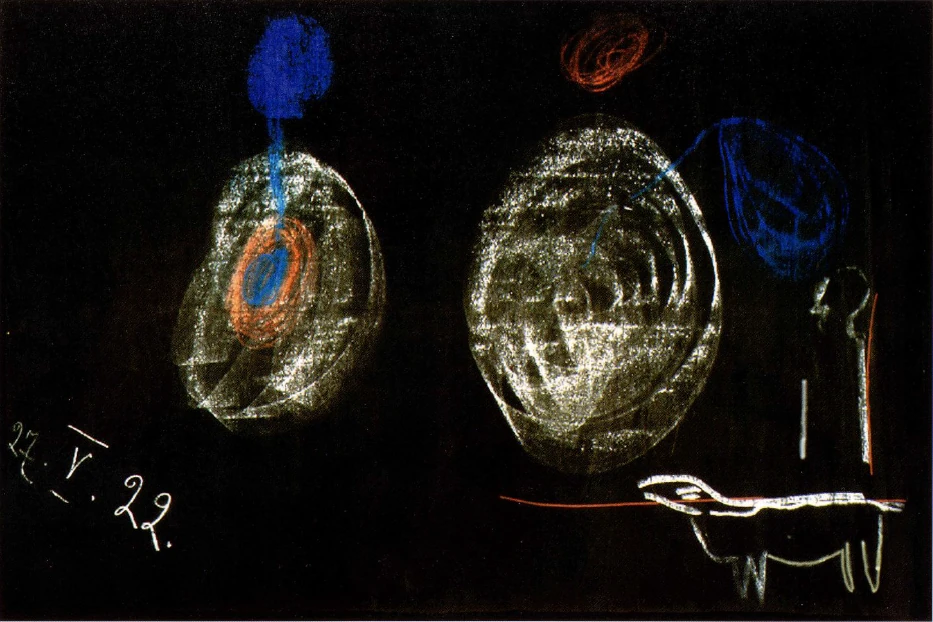
[ 29 ] Thus, in ancient times, knowledge of the pre-birth state was something like a memory. Thus, when properly developed, knowledge of the pre-birth state is, in the present, a viewing of how one was (red). That is the difference.
[ 30 ] Now, this was one way in which the yogi lived his way up into the spiritual worlds. Another way was that he placed his body in certain positions. For example, he did the exercise of remaining with his arms outstretched for a long time, or he assumed a very specific position by crossing one leg over the other and sitting on his own legs, and so on. What did he achieve by doing this?
[ 31 ] By doing this, you see, he gained the ability to perceive what those senses perceive that are hardly taken into account today. We know, of course, that human beings have not only five senses, but twelve. Apart from the ordinary senses, we have, for example, the sense of balance – I have spoken about this often – through which we perceive how we maintain our balance, how we do not fall to the left, right, backward, or forward. Just as we perceive colors, we must also perceive our balance, otherwise we would slide in all directions and fall over. The drunk or the faint-hearted are not aware of this, which is why they stagger. Now, in order to become aware of this sense of balance, the yogi adopted certain postures of the organism. In this way, he developed a fine, strong sense of direction. We talk about up and down, right and left, front and back, as if it were all the same. For the yogi, this gradually became something he felt very strongly and finely by holding his body in certain positions for long periods of time. In this way, he developed a fine sense of these other senses that I have mentioned in addition to the five senses. But when these other senses are experienced, they have a much more spiritual character than the ordinary senses. And the yogi thus lived himself into a perception of the directions of space.
[ 32 ] We must regain this, but in a different way. For reasons that I will explain in more detail on another occasion, we cannot practice in the same way as in ancient yoga. But by performing the mental exercises I have just described, which can be detached from breathing and become attuned to the external rhythm, we experience the difference in directions. We experience what it means that animals have their spine horizontal throughout their lives and that humans have their spine vertical. In ordinary inorganic nature, people know that the magnetic needle only points in a north-south direction, that this north-south direction has a special significance in the earthly realm for the development of magnetic force, because the magnetic needle, which otherwise behaves neutrally, finds itself in this position; that this is therefore a special direction. By finding ourselves in the outer rhythm with our thoughts, we learn to recognize how different it is to maintain the horizontal line with the spine than the vertical line. We learn all this in our thoughts themselves by remaining in our thoughts. The Indian yogi also learned this by crossing his legs, sitting on his own legs, and holding his arms up. He thus learned from the physical realm the invisible significance of spatial directions. Space is not an arbitrary juxtaposition, but is organized in all directions in such a way that the directions have different values. Such exercises, which lead people into the higher world, as I have now described, are more exercises that go toward the side of thought.
[ 33 ] But there are also exercises that go in the other direction, and among the many exercises that exist in this field, we find those of the ascetic life, where the functions of the physical body were suppressed, where all kinds of deprivation and suffering were inflicted on the physical body. This effectively removed the physical body from its normal functions. Modern people cannot imagine what older ascetics achieved in this way, because modern people want to understand their organism as thoroughly as possible. Every time the old ascetic painfully suppressed this or that bodily function, his spiritual and soul life withdrew from the organism.
[ 34 ] Isn't it true that when you live as people normally do, the spiritual-soul element is connected to the physical organism in the same way as it should be between birth and death according to the human organization? If you suppress your physical functions in an ascetic manner, something similar happens to what happens today to a lesser degree to people who injure themselves somewhere.
[ 35 ] Now, if you know what people are like today, when they suffer even the slightest pain, it is clear that there is a great distance between that and what the old ascetics sometimes endured in order to free their soul organism. But then, with the spiritual organism that had been driven out of the body through asceticism, they experienced the spiritual world. Essentially, all the great religious ideas of the past were gained in this way.
[ 36 ] Modern explainers of religious consciousness take the matter a little too lightly. They explain religious ideas as fiction because they adhere above all to the principle that what human beings are supposed to gain about the world through such knowledge must not cause pain. The ancient seekers of religion did not take this view, but were clear that when humans are fully immersed in their physical organism—which is of course the right thing for their earthly work; it should not be portrayed as wrong or unrealistic—they cannot experience anything in the spiritual world. This experience in the spiritual world is what the ancient ascetics sought by numbing the body, even inflicting pain on it. For every time they drove the spiritual-soul element out of a limb through pain, this piece of the spiritual-soul element experienced the spiritual world. And the great religions were not achieved without pain, but through thorough suffering.
[ 37 ] What has been communicated as the results of human development is today accepted through faith. Today, a neat distinction is made between knowledge on the one hand, which is supposed to be knowledge of the external world, and knowledge on the other hand, which is supposed to be knowledge of the spiritual world. - Well, that is acquired through the head. The head is thick-skinned, it does not hurt, especially because the insights are gained through extremely thin concepts. And on the other side: What has been preserved as venerable traditional ideas is accepted, as they say, through faith. But actually, from a certain point of view, one would have to say: The difference between knowledge and belief is that today we have the will to accept as knowledge only that which does not hurt when we acquire it, and that through belief, which also does not hurt, we seek to acquire that which was once acquired in a very painful and suffering way as knowledge that does not, however, belong to the sensory world.
[ 38 ] Now, despite everything I have just said, the ascetic path cannot be the path of modern man. We will consider why on another occasion. But today it is entirely possible, through inner self-discipline, through discipline of the will, by taking control of one's own development, which otherwise comes only through life and education, to intervene in the forces of will growth within one's own personality. If, for example, you say to yourself: You must have acquired a certain habit in five years, and you want to direct all the power of your will during these five years toward acquiring this habit — if you then pursue the development of the will in this way, according to inner perfection, then you will detach the spiritual-soul element from the physical element even without asceticism, and then you will initially feel what you must undertake in this self-perfection as something that must be accomplished through continuous activity on your own behalf.
[ 39 ] Every day you have to accomplish something inwardly. Sometimes these are small tasks, but they must be carried out with iron diligence and irresistible patience. It is often the case that when you recommend exercises to people, such as, “Every morning you should have a specific thought,” they are full of zeal to do so. But it doesn't take long before everything slows down again, and then the thing is supposed to happen by itself. You notice that it becomes mechanical because you don't want to apply the stronger force that is needed more and more. So first you have to overcome this resistance of your own inertia; but then comes the other resistance, which comes from the objective. It is as if one had to work one's way through something dense, and then one actually has the inner experience that the thinking that has gradually developed, that has become alive, that now perceives spatial directions, indeed everything that is alive, that finds its way into the rhythm of the outer world, that this hurts, that every insight that is gained is painful.
[ 40 ] I can well imagine modern people who want to find their way into the higher worlds. They begin. The very first quiet insight comes. It hurts. So I am sick, they say. It is natural that if something hurts, you are sick. But when you gain higher knowledge, it can sometimes hurt a lot, and yet you are not sick. However, instead of continuing on the path that higher knowledge makes necessary—because the spiritual suffering becomes greater and greater—it is easier to seek a cure for this spiritual suffering than to strive to overcome it. One has something prescribed instead of continuing on the path. Of course, this is more comfortable. But it does not advance one's knowledge. For modern people, this immersion in pain and suffering becomes an inner spiritual path, so that it takes place purely in the soul, and the body does not actually participate in it at first, insofar as the body remains robust and strong and able to cope with the outside world, as is usually the case with people today. But by allowing his insights to come to him as something that means suffering, man today enters once again into those regions of spiritual life from which the great religious truths were once drawn. The great religious truths, that is, those truths that are religiously true because of the impression made by the higher world, the supersensible world, the world in which our immortality, for example, has its roots, cannot be attained without painful inner experiences.
[ 41 ] When they are attained in this way, they can then be handed over to the general consciousness of humanity. People today resist such truths for the simple reason that they sense that things are not as they would like them to be.
[ 42 ] Just think how fatal it might be for some people that I said yesterday: Everything that a person does is recorded in this transforming astral body, which then intervenes in the etheric body in the heart, even what he asks another person to do is recorded. This thought alone makes some people feel uneasy inside. And the great truths also require, in a certain sense, an inner courage of the soul that rises up and says: If you experience these things, then you must be prepared to gain knowledge through deprivation and pain.
[ 43 ] This is not meant to discourage you, although today it is discouraging to many people, but it is simply spoken from the truth. What good is it to tell people that they can enter the highest worlds in well-being if it is not true, if entering the higher worlds requires overcoming obstacles and suffering?
[ 44 ] And so, my dear friends, I have tried to describe to you today how to advance toward the human. This human-soul-spiritual is indeed hidden deep within the human being. One must first penetrate to it. But if one does not penetrate to it oneself, one must know that there is something hidden within oneself, and one must learn from the demands of the present time how such things, as they were described yesterday, actually happen.
[ 45 ] Such things can only be found through paths of knowledge such as I have outlined again today and as they have been followed in various ways in ancient and modern times.
[ 46 ] Tomorrow we will combine yesterday's and today's reflections into one that will lead us further into the spiritual worlds, as we have attempted to do today.