

The Human Soul in Relation to World Evolution
GA 212
17 June 1922, Dornach
Translated by Steiner Online Library
Ninth Lecture
[ 1 ] Today it will be my task to discuss some aspects of an area of anthroposophy that is close to human beings. Tomorrow I will tell you something about the recent West-East Congress in Vienna. Today, however, I would like to discuss some aspects of anthroposophy.
[ 2 ] It is true that we humans are connected to the world primarily through our senses, and this is obvious to everyone from the moment we wake up until we fall asleep. We perceive the various realms of existence through our different senses and, through a certain soul activity, we construct a world picture for ourselves. I will only hint at this. Such a hint makes everyone aware of how they can observe the waking course of life themselves and what it contains.
[ 3 ] Now, however, we as human beings are not only placed in the world while awake, but also while asleep. And while asleep, we are placed with our ego and our soul with our body outside of our physical body in a world environment that is initially unknown to the ordinary consciousness of human beings.
[ 4 ] Everything I am about to say is intended primarily for people of the present, that is, for people as they have developed in their soul life since that point in time which we have often described as so extraordinarily important for the more recent development of humanity, since the 15th century.
[ 5 ] Now, however, we must ask ourselves: How do we relate to a world that is closed to ordinary consciousness, as sleeping human beings? However, in the period of human development in which we live today, we immediately encounter a difficulty of description if we do not take into account that humanity has developed and has gone through the most diverse states in its soul life.
[ 6 ] When we consider the soul life of human beings, we find that people in our present-day, so-called civilized world have to make the most varied efforts to form their ideas and concepts. We often look back quite thoughtlessly on earlier periods of human history, when the kind of education that is necessary for people today did not exist. We look, as it were, thoughtlessly at the older human culture that developed in the East and existed without people being guided through education from childhood in the way that is the case today. In Europe today, it is almost impossible to imagine how differently education was thought of in earlier Oriental times, when such tremendous things were created that uplifted the heart and spirit of human beings, such as Oriental literature, the Vedas, and everything contained in Oriental wisdom. Today, we judge everything that comes about in the spirit according to how modern man must grow up from childhood, how he must be educated and taught, and what he then becomes through this education, through this teaching, in the life of our modern external world. And here it becomes apparent, first of all, for the life of imagination, that we must be educated and taught because we must form our own thoughts about life. We would be helpless in the world today if we were not able to form our own thoughts about life. I would say that human beings today are not yet very far advanced in the art of thinking. And it is precisely in education and teaching that we must ensure that we continue to advance in the art of thinking about the things of the world through our own efforts.
[ 7 ] This was already being prepared in Greek times. Greek life was the first cultural life in Europe, but in a certain sense it was still influenced by the Orient and therefore developed a system of education that was aimed at training the powers of imagination only in its earliest stages. The Oriental way of life still flowed into Greek cultural life, which did not encourage people to make a mental effort to, if I may put it trivially, form their own ideas about things.
[ 8 ] Today, within Western intellectual life, Socrates is admired — with a certain degree of justification — as one of the first to urge people to form their own ideas about things. But it would be completely wrong to conclude from this that because Europe was forced by human effort to form its own ideas about things, that the Orient had no intellectual life. The Orient had a very powerful intellectual life, and we find this intellectual life all the more powerful the further back we go in Oriental cultural life. And if we go back to the times when the Vedas and Vedanta philosophy did not yet exist — for the Vedas and Vedanta philosophy, as I have often mentioned, do not represent the very first stages of Oriental intellectual life; these were never written down — there was already a powerful intellectual life in the Orient of ancient times. All of this has been in decline in the East for two or three millennia and is now in a state of complete decay. Today, Easterners admire what I would call the last remnants of what was once a wonderful intellectual life. But this intellectual life was not like ours, in which we — forgive the materialistic expression, it is only meant as an image — in which we have to sweat inwardly to bring it about, in which we have to make an effort to make it happen. The Oriental intellectual life was an inspired one. To the Oriental, thoughts came together as if by themselves. He acquired his worldview in such a way that it corresponded entirely to an inspiration. He always had the feeling that what he thought was given to him. He did not know the effort, the inner soul effort, of putting thoughts together. From the moment he woke up to the moment he fell asleep, he felt that thoughts were given to him. His entire soul life had a corresponding coloring. When he was allowed to entertain thoughts, he was grateful to the gods for giving him thoughts. He felt it as an influx of divine spiritual powers when he could say to himself: Thoughts live in me as a human being. It was a completely different attitude toward the life of thought.
[ 9 ] Therefore, the Oriental thought life of earlier times was not so separated from feeling and sensation, from the heart's concerns of humanity, as it is today for normal consciousness. Precisely because human beings felt that thoughts were a gift, they felt elevated as human beings with every thought, and every thought was linked to a religious feeling. Human beings felt that they had to approach the powers that gave them ready-made thoughts with a kind of religious piety, not so much individual thoughts as the combination of thoughts.
[ 10 ] But what was the objective, external cause for this to be so for Oriental people? The external objective cause was that people in those earlier times slept differently than we do today. When we sleep, we leave the head, the most important part of the soul, behind. The most important metabolic organs and limbs are not as strongly separated from the human being. When a person sleeps, the soul and the ego still protrude into the metabolic body of the limbs. One should not actually imagine that the whole human being is abandoned by the ego and the soul during sleep, but rather that it is primarily the head that is abandoned. I have explained this many times, and I would like to present it schematically once again, so that the waking human being is represented as follows (drawing S$. 172, left), with the I and the soul being drawn in red, permeating the physical body and the etheric body. It would be wrong if I were to draw the sleeping human being in such a way that I had the physical body and the etheric body lying in bed and then simply drew the I and the astral body or the soul next to it. I would like to draw it so that if here (light) are the physical organs, the limbs, but the arms actually belong to them—that I actually only draw at the head how the I and the soul of the human being are outside the human being, because strictly speaking, it is only in relation to the head that the human being is separated from his physical body and his etheric body (red) when asleep.
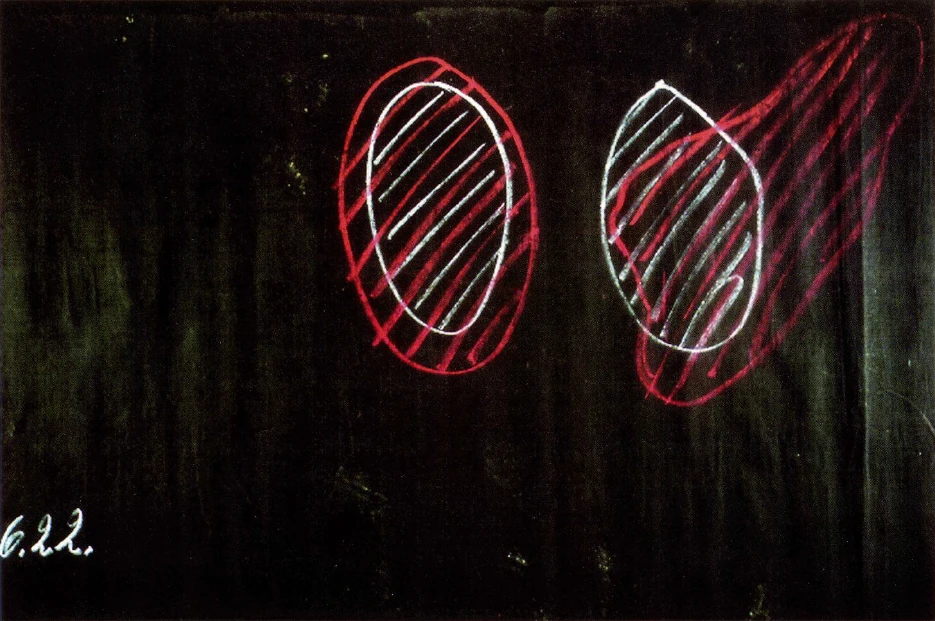
[ 11 ] If we now go back to those earlier times I have just spoken of, we find that during human sleep, the organs of the human head, essentially the nerve and sense system and part of the respiratory system that permeates the head, were the scene on which the divine-spiritual beings who had something to do with the earth carried out their affairs.
[ 12 ] One can say quite seriously, without speaking figuratively, when pointing to realities: In the earliest times of human development, the divine-spiritual beings worked on Earth in such a way that they withdrew from human beings when they were awake. But when human beings slept, they took up residence in their heads. The human ego and the human soul had left the head; the divine-spiritual beings organized their affairs there. And when humans woke up again in the morning, when they submerged themselves back into their heads, they found there the results of what had remained under the influence of the actions of the divine-spiritual beings, who had been so active in their heads from the moment they fell asleep until they woke up that they organized their nervous processes according to their laws and exerted their influence on the events in the blood circulation, on the organic processes in the etheric body and in the physical body. But human beings did not clearly perceive the facts I have just described—those who were trained in the mysteries did perceive them—the great mass of humanity did not perceive these facts, but they experienced them. So when human beings awoke, they found the deeds of the gods in their heads. And when they then lived awake and perceived their thoughts in their connection, this came about because the gods had been active in their heads during sleep. Every morning, so to speak, the ancient Oriental human being found the legacy of what the gods had done as their business during his sleep. And he then perceived this as inspiration with thoughts. So it was not that the divine-spiritual beings directly inspired him while he was awake, but rather that they inspired him during his sleep by carrying out their own affairs there. And everything that led to people behaving in a certain way in those ancient times was basically inspiration. One might say that the divine-spiritual beings at that time had the ability to arrange earthly affairs in such a way that, from the state of sleep, they could organize the mutual trust between people, the obedience that the masses showed to their leaders, and so on. So it was precisely in this way that there was interaction between the divine-spiritual world and the earthly world in those ancient Oriental times. But this was only possible because the entire human organization was different back then.
[ 13 ] I have often mentioned how people today imagine that everything about them, that is, as long as they live historically on earth, has always been as it is today: the physical aspect of the physical organism, the soul aspect of the soul, the spiritual aspect of the soul. When today's historian sets out to write about ancient Egypt and deciphers its documents, he thinks that although people were not as intelligent as he is, they essentially thought, felt, and wanted the same things he does. One has the view: if one goes back far enough, people become a kind of higher ape, and from this stage they then progressed to—well, what one does not know, as the historian imagines. But when the period began that is of historical interest, the view is that one must accept people as they are today in their thinking, feeling, and willing, in the manner of their present etheric-physical organization.
[ 14 ] That is not the case. Humans have changed significantly throughout history. You need only remember what I mentioned earlier as a detail, for example, how the Greeks viewed the world around them in purely physical terms. The Greeks did not see blue as we see it today; they actually saw only a reddish hue. And if a person today imagines that the blue sky is so beautiful and that the Greeks, because they lived in beauty, must have preferred to see this blue sky, that person is mistaken. The Greeks saw the warm, reddish, yellow colors, and they did not distinguish green and blue from each other very much. They therefore saw the sky quite differently from how a normal consciousness sees it today. The eyes themselves have also changed completely in the course of human evolution, even if this is only the case in more intimate and subtle features. The entire sensory organization has changed completely in the course of historical time. And in those ancient Oriental times of which I have just spoken, the sensory organization was indeed such that human beings were not distracted or hindered by it from giving themselves over to what emerged from their organism when they were awake, namely the deeds of the gods, and what remained to them from their state of sleep.
[ 15 ] Gradually, the sensory organization of humanity became such that human beings were so vividly connected to the outside world through their senses that this vivid connection prevented them, as soon as they awoke, from even being attentive to what might exist as a legacy from sleep. Even if the gods still arranged their affairs in his mind during sleep—which they no longer do, because man has been reorganized and it no longer has any further significance for the development of humanity—man would no longer have any benefit from this for his progress and further development. On the contrary, because when he wakes up and is immediately powerfully devoted to the outside world through his now developed senses, he would not be able to pay attention to what he might inherit from sleep. And thus it would go back into the body instead of being taken up by consciousness. Human beings today would not be able to feel within themselves through inspiration what the gods did in their sleep on the stage of their head organization. It would return to them and cause their organism to age prematurely.
[ 16 ] In earlier times, what a person experienced while asleep was taken up by them in the waking state, because their senses were not oriented toward the external world as they are today; and so, at that time, people could live in union with the world of the gods. But this life was a real life with the world of the gods. The gods cannot be seen with the senses anyway, and ancient people were predisposed to at least experience the deeds of the gods because their senses were not yet as oriented toward the outside world as they are today.
[ 17 ] But then came a time—essentially the millennium before the Mystery of Golgotha—when the senses, especially the eyes, of people in the Eastern world also began to become receptive to impressions from the outside world, just as was later the case. Human beings came to accept the later sensory organization more and more and to add it to what had remained within them from earlier times, from their nervous system, which still enabled them to experience divine-spiritual deeds. In earlier times, they had experienced divine-spiritual deeds purely, without mixing in the sensory. Now, humans still experienced something because the gods had not yet completely departed from them, but the sensory organization immediately absorbed this, and the result was that a large part of humanity developed this peculiarity, that the gods, the spiritual beings, were, in a sense, brought into the sensory organization. I can express this by saying: The former purely spiritual view of the divine-spiritual beings became the belief in ghosts.
[ 18 ] The belief in ghosts is not something that is ancient in humanity. What is ancient is the view of the divine-spiritual beings. Belief in ghosts only arose through the interference of sensory perception in the perception of the divine. And when the mystery culture of the Orient came to Europe and was accepted, for example, by the wonderful Greek intellectual life in art and philosophy, the perception of ghosts also came over to a large extent.
[ 19 ] One can say that in the last millennium before the Mystery of Golgotha, the purely Oriental view had already begun to decline, and a kind of ghost-seeing was prevalent among many members of the broad masses. The belief in ghosts migrated to Europe, the genuine spiritual view of the Orient transformed into something sensory. So one can say that the belief in ghosts is the last offshoot, the end of a lofty, albeit dreamy, spiritual view that once represented a high cultural flowering in the development of humanity.
[ 20 ] You see, what I have described, how ancient Oriental people must have perceived their head as the earthly theater of the world of the gods while they were asleep, was something that could only be experienced as a human being; but those initiated into the mysteries knew this. This has its opposite today in the emergence of a new culture.
[ 21 ] This new culture is still in its infancy, and the further west we go, the more strongly it expresses itself. It would have made no sense to the ancient Oriental to say, for example, that human thoughts do not pulsate through the human will. For they knew that what lived in their will, even in their blood, came from the gods. The gods formed their thoughts, and the gods developed a powerful force in their sleep. They experienced this as inspiration.
[ 22 ] Even today, when we look over to the East, to the last remnants of what exists, for example, in Soloviev as philosophy, there is something precisely in Soloviev that shows how he does not understand, would not understand at all, if one were to say, for example: Thoughts are not impulsive in human beings, they do not carry the will.
[ 23 ] But this is precisely the opinion of Western people today, especially Americans. Americans describe what they perceive in this sense down to the details of their physiology and biology. In this respect, American science, when you get down to its innermost principles, is something quite different from European science or even Eastern science.
[ 24 ] Westerners describe how little significance thoughts actually have for human will. They are too aware that it is humans who create thoughts. But they cannot create thoughts out of thin air. That is why, for example, Americans today say: Much more important than the thoughts a person absorbs is the way in which they have grown up in a certain family, in a certain political party, through their social circumstances, or in a sect. All of this exerts an emotional influence on them and determines their will. And you can't really determine the will from thoughts. The will is determined by such underlying factors of life as family, political affiliation, country, sect, and so on. — And the American, the Westerner in general, says: Thoughts are not actually the ruler in man; they are actually only the chief minister of the ruler, which is the human organization, which is will, drive, instinct, even if — as Carlyle says — these thoughts are an expensive minister, but they are only the executive organ.
[ 25 ] And we must actually say that today, the broad masses of people who are rushing forward to assert their own views against the old traditions in the world actually think the same way. That is why people today are so keen to study how primitive man lived, because they believe that he lived by his instincts and drives, and that his thoughts were merely a kind of reflection of his instincts and drives.
[ 26 ] This is how Westerners today look at people and say that they are driven by instincts and drives. Why is that? Because they are not yet organized in these drives and instincts to perceive the spiritual. For them, there is nothing but a drive, an instinct, behind which there is no spiritual element. But when an instinct, a drive asserts itself in a human being, it may, for all I care, be something very evil that asserts itself in one person or another, but even if it is the most brutal drive, it is spirit that lies behind it. Only, human beings cannot yet grasp this spirit today. The human race is still in the process of development. It must first move toward such a spirituality that when human beings look within themselves and perceive their drives, instincts, and desires, they perceive the spiritual in them everywhere. He will do this in the future. It makes no difference whether humans have evil or good instincts; if they are evil instincts, then they are simply Ahrimanic or Luciferic spiritualities that lie within them, but they are still spiritualities.
[ 27 ] With this assumption that we have drives and instincts as the driving forces in human beings, it is no different than it was with ghosts in relation to spirituality in the past. You see, there was once an ancient spirituality in the view of the Oriental (see drawing). This developed further and, as the final product, that is, as I said, in the last millennium before the Mystery of Golgotha, became belief in ghosts, in seeing ghosts (see drawing, blue).
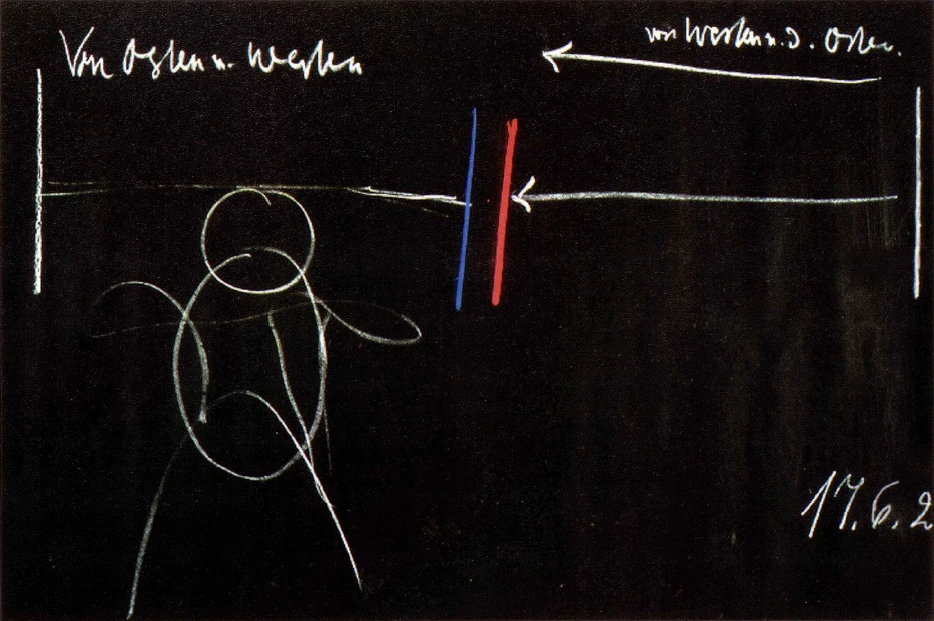
[ 28 ] Now we are so deeply involved in world evolution that, on the one hand, we see how belief in ghosts has emerged from an ancient spirituality; but at the same time, we look ahead to the future, where pure perception will once again prevail. But now there is still a belief in ghosts, an inner belief in ghosts. Just as those who believe in ghosts think that ghosts are sensual, look as they are seen with the eye, so today's human being, the Western human being, does not yet see spirituality when he looks within himself, but perceives the ghostly. All drives, instincts, desires are ghosts that today precede a spirituality (red), while the old ghosts followed an earlier spirituality (blue). One can therefore say that an old, pure spirituality developed from the East to the West; this was followed by belief in ghosts in the course of time, and the remnants are still among us. From the West towards the East, approaching us and realising itself in the distant future, a later spirituality is developing, which in its beginnings shows itself through something that is just as ghostly as the old ghosts, namely drives, instincts, desires and so on, as modern man sees them. Today's scholar must, based on his view, attribute drives, instincts, and desires to human beings and looks down with contempt on the belief in ghosts of the masses. He does not know that this belief in ghosts of the masses has exactly the same value and reality of knowledge as his belief in desires, drives, and instincts. He believes in the ghosts of the beginning, just as the masses believe in the ghosts of the end. And our European civilization has become so chaotic because the old ghosts have collided with the new ghosts.
[ 29 ] I briefly characterized this in an aphorism from the “West-East Aphorisms,” which you have in this week's issue of “Goetheanum,” how, in fact, modern humanity has for some time now been touched on the one hand by an ancient, inherited Eastern spirituality that has become internalized as a belief in ghosts, and on the other hand by something now beginning, germinating, which has not yet been disenchanted from the belief in ghosts, in the instincts, instincts, and desires. The ghosts that are usually called ghosts are spirits that have been sensorialized by the human organization, and the instincts, desires, and passions are modern ghosts that have not yet been brought to spirituality, have not yet been desensitized, and point to the future.
[ 30 ] The inner soul life of European man in particular lives in this special chaotic form of interaction between old and new ghosts, and a spiritual view must be found that brings both to complete clarity. It is not only human worldview that is connected with these things, but universal human life on earth. And how could it be otherwise than that not only spiritual life, but also legal, judicial, governmental, and economic life are connected with it, since all these arise from the special nature of the human being. But where does all this development come from? We must ask ourselves this question. The gods, I said, the divine-spiritual beings, had their earthly affairs in the human head. We distinguish between the threefold human being, the nerve-sense human being, primarily in the head, the rhythmic human being, who lives in the middle, and the metabolic-limb human being, who is contained in the limbs and in the continuations inward, in the actual metabolic organs (see drawing). We distinguish this threefold human being, and we now know that the gods arranged their earthly affairs on earth during the sleep state through the older humanity in such a way that they set up their workshop, so to speak, in the human head while the human being was in the sleep state. What is the case with human beings today?
[ 31 ] Even in modern humans, the gods set up their workshops in humans during sleep, but no longer in the head, but in the limb-metabolism organism. But the limb-metabolism organism—and this is now the essential, the significant point—remains unconscious to humans even during waking life. Think about how often I have said this: the ideas in which humans wake up. But what happens when I have the idea that I am going to lift my arm, that I am going to move my hand—what happens down there so that the muscle actually carries out these movements—this is something that modern humans and normal consciousness do not know. This whole inner workings of his imaginative life in his organism remains obscure to him. This leads to unconscious life even during the waking state. The gods have therefore arranged the scene of their activity on earth in such a way that human beings in the waking state cannot, through their own natural development, take over their inheritance when they wake up.
[ 32 ] It is also true today that a divine-spiritual event takes place in human beings from the moment they fall asleep until they wake up, but due to their natural state, human beings are not able to have impressions of what the gods have done when they wake up. The ancient human being was simply constituted by his organization in such a way that he felt inspired by his thoughts. The human being of today creates his thoughts. But the divine-spiritual deeds do not yet influence this activity. This must first be developed in humanity. And that is the task which, I would say, spiritual science must set itself as a cosmic task. It must bring human beings to such a development. And education must also be included in such a development, so that human beings can recognize the divine-spiritual deeds coming out of themselves with full consciousness. At the same time, they will no longer see things like these inner ghosts, for the way we imagine drives and instincts today are just as much ghosts in relation to the real human inner life as we see ghosts in the external world. They are not mere imaginations, but divine-spiritual forces that are only sensorially perceived and incorrectly, untruthfully imagined.
[ 33 ] But in the same way, the divine-spiritual forces that work in human beings are also imagined to be untrue when they are imagined in the sense of today's instincts and drives. What is despised today are external ghosts. What is regarded as science today is nothing more than ghosts, only internal ghosts, and human beings must, I would say, undergo this transformation that is predestined for them by cosmic evolution. Our entire culture must be permeated by impulses that move in this direction. Therein lies a possibility of emerging from forces of decline—or from a chaotic interaction of forces of decline with forces of ascent, against which humanity is still resisting today—and, inspired and impelled by the spiritual, of moving toward the possible future stages of human development and advancing in the direction of these possible future stages of human evolution. That is what matters.
[ 34 ] What I wanted to give you today is also a kind of East-West perspective, but more for the esoteric, I would say. These East-West considerations are already quite “contemporary” today, whereby I do not use the word in the trivial sense in which it is often used, for it is only by engaging in such considerations that humanity can attain a certain level of consciousness.
[ 35 ] One must therefore say: Once upon a time, in the earlier stages of Earth's development, human beings were also asleep — for they are human beings even when they sleep, when they are not carrying their bodies around with them — and they were in such a relationship with the gods that they could even look with the eyes of their souls, with the eyes of their spirits, and see how the gods dwelt in their heads. Then, when they awoke, more or less only the after-feeling remained. Human beings emerged more and more from the divine-spiritual world, which they nevertheless perceived in dreams when they looked back after emerging from their bodies. That was in earlier times; later, when they entered their bodies, they perceived it only as inspiration.
[ 36 ] But as the gods have, so to speak, drawn themselves further down into his physical form, man is now involved in such a relationship with the gods that they have chosen his limb-metabolism organism as their workshop for the earthly being. However, man does not completely leave this earthly being during sleep. And because he does not leave it completely during sleep, man will again be able to experience an impulse for his will, for his social being, from the world of the gods, but not in sleep; rather, he must experience it as a whole human being, even while awake. This means that man must increasingly acquire conscious knowledge of the spiritual world. That is what we must strive for. That is what I wanted to give you today as a contribution from a West-East perspective. Tomorrow I will report to you on this West-East Congress as it presented itself to me.