

Basic Elements of Esotericism
GA 93a
30 September 1905, Berlin
Translated by Steiner Online Library
Lecture V
[ 1 ] It is always emphasized that in order to advance in the occult, one should be as positive and as little negative as possible, that one should speak less about what is not than about what is. If this is encouraged in everyday life, it is a preparation for work in the occult. The occultist must not ask: Does the stone have life? — but rather: Where is the life of the stone, where is the consciousness of the mineral kingdom to be found? — This is the highest form of non-criticism. It is precisely in relation to the highest questions that one must develop this attitude.
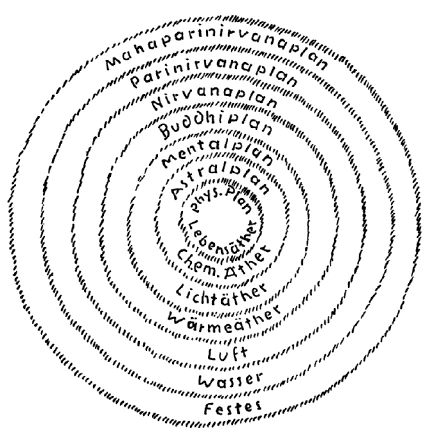
[ 2 ] In ordinary life, we distinguish between three states of matter: solid, liquid, and gaseous or airy. Solid must be distinguished from mineral. Air and water are also mineral. In theosophical writings, four other finer types of matter are added to this list. The next thing that is finer than air is the element that expands it, making it ever larger in terms of volume. What drives air apart is heat; it is actually a fine ethereal substance, the first degree of ether, the heat ether. The second type of ether is the light ether. Bodies that glow emit a substance that is referred to in theosophy as light ether. The third type of ether is the carrier of everything that forms the finest substances, the forming ether, also called chemical ether. This ether causes oxygen and hydrogen to combine. And the very finest ether is that which forms life: prana or life ether.
[ 3 ] Science lumps all four types of ether together. But it will gradually discover them in this way. Our designation is that of the Rosicrucians, while Indian literature speaks of four different degrees of ether.
[ 4 ] Let us first take everything that is solid. What is solid apparently has no life. When one transports oneself with life into the solid, which happens by living awake in the state that is called the dream world and then seeking out the solid, for example, transporting oneself into a rocky mountain landscape, then one feels one's own life changed within oneself, one feels oneself permeated by life. You are not there with your consciousness, but with your own life, your etheric body; you are then in a place, in a state called the Mahaparinirvana plane. On this Mahaparinirvana plane is the life of the solid. This plane is the other pole of the solid. That you were then with life on the Mahaparinirvana plane can be perceived from other effects. When one returns from there, one has experienced the influence of beings in the Mahaparinirvana state. There, the solid stone has its life.
[ 5 ] Second is the liquid, water. When one transports oneself into the sea in the dream state, as if one were the sea itself, then one transports oneself with the life of the liquid to the Parinirvana plane. Through this procedure, one learns something about the different planes.
[ 6 ] Thirdly, when one transports oneself into the air-like state in a dream, one finds oneself on the Nirvana plane. Nirvana literally means “to extinguish,” to extinguish in air, just as one extinguishes a fire. When one seeks life there, one is on the Nirvana plane with one's own life. Human beings breathe in air. When they experience the life of the air within themselves, that is the way to reach the Nirvana plane. Hence the breathing exercises of the yogis. No one can reach the Nirvana plane unless they really do breathing exercises. They are only Hatha Yoga exercises when they are done at the wrong level. Otherwise, they are Raja Yoga exercises. One actually breathes in life, the Nirvana plane.
[ 7 ] Fourth: Below the Nirvana plane is the Buddhi or Shushupti plane. There, warmth has life. When Buddhi is developed in humans, all Kama is transformed into selflessness, into love. Those animals that do not develop warmth are also passionless. At higher levels, humans must regain this passionlessness because their life is on the Shushupti plane. Fifth is the Devachan or mental plane. This is where the light ether has its life. Sunlight lives on the Devachan plane; hence the inner relationship between wisdom and light. When one experiences the light in dream consciousness, one experiences wisdom in it. Whenever God revealed himself in light, this has been the case. In the burning bush, that is, in the light, Jehovah appeared to Moses to reveal wisdom.
[ 8 ] The sixth is the astral plane. This is where the chemical ether lives. When one is somnambulistic, one perceives the properties of chemicals, the chemical properties, on the astral plane, because the chemical ether truly has its life on the astral plane.
[ 9 ] The seventh is the physical plane. This is where the life ether lives in its actual element. With the life ether, one perceives life. The life ether is also called the atomistic ether because it has its own life, its own center, on this plane. What lives on the same plane has its center on the same plane.
[ 10 ] In fact, everything around us contains the seven planes. They are actually around us. One only has to ask: Where does the solid, where does the gaseous have its life? - and so on.
[ 11 ] We have now heard that heat has its own life on the Buddhi or Shushupti plane. Thus, certain relationships exist between all things. The relationship between the ear and speech is striking. The ear existed much earlier in evolution than speech. The ear is the organ of reception, speech is the organ of production for sound. These two things, ear and speech, essentially belong together. Sound, as it appears, is the reproduction of vibrations in the air, and each sound arises from a particular vibration. The Pythagoreans said: When you study what is outside of you in sound, you are studying the arithmetic of the air. Uniform space would be a soundless space, while arithmetically organized space is a sounding space. This is an example of how one can look into the Akashic Records. If one can rise to perceive the inner arithmetic that remains from the sound in space, one can hear again at any time a sound that a person has spoken. For example, one can hear what Caesar said when he crossed the Rubicon. The inner arithmetic of the sound remains present in the Akashic Records. The sound corresponds to something called Manas. What is sound to the ear is the wisdom of the world. One hears the wisdom of the world by perceiving sound. One brings forth the wisdom of the world by speaking oneself. That which is arithmetic in our speech remains present in the Akashic Records. Human beings express themselves directly in wisdom when they hear or speak. Thought is the form in which humans can now express their will in language. Only in thought can we now unfold the will. Only later can humans unfold their will in words beyond thought.
[ 12 ] The next stage is related to warmth. We must seek human activity in what they radiate as inner warmth. Karma arises from what follows from warmth: passions, drives, instincts, desires, wishes, and so on. Just as the parallel organ to the ear is the speech organ, so the parallel organ to the warmth of the heart is the mucous body, the pituitary gland. The heart absorbs warmth from the outside, just as the ear absorbs sound. In this way, it perceives the warmth of the world. The corresponding organ that we must have in order to consciously produce warmth is the mucous body in the head, which is now only at the beginning of its development. Just as one perceives with the ear and produces with the larynx, one absorbs the warmth of the world in the heart and flows it out again through the mucous body in the brain. Once this ability has been acquired, the heart has become the organ it is meant to be. This is referred to in the words in “Light on the Path”: “Before the soul can stand before the Masters, the blood of its heart must wet its feet.” Then our heart's blood flows out, just as our words now flood the world. Later, the warmth of the soul will flood over people.
[ 13 ] Somewhat lower in evolution than the warmth organ is the organ of sight. In development, the organ of hearing was followed by the warmth organ and then the organ of sight. The organ of sight is still at the stage where it can only receive. The ear already perceives the innermost essence from sound, for example from the sound of a bell. The warmth must flow to us from the being itself. The eye has only an image, the ear has the perception of the innermost essence. The perception of warmth is the reception of a radiation. An organ will now also become the active organ for the eye. This is now predisposed in the pineal gland, the epiphysis, which organ will give reality to the images that the eye produces today. These two organs, the pineal gland and the mucous body, must develop as active organs alongside the organ of sight (eye) and the organ of warmth (heart). Imagination today is the predisposition for later creativity. At present, human beings have at most the power of imagination. Later, they will have magical power. This is kriyashakti. This power develops to the same extent as the pineal gland develops physically.
[ 14 ] We have a model in the mutual relationship between the ear and the larynx. Thinking is then later permeated by warmth, and even later, humans learn to create themselves. First, they learn to create an image; then to create radiance, to send it out; then to create beings. Freemasonry calls these three powers: wisdom, appearance (beauty), and power. (See Goethe's “Fairy Tales.”)
[ 15 ] Warmth has its life on the Shushupti plane. Those who know and master the life of warmth can consciously utilize it, just as human beings today master the life of air in a certain way. In their development, human beings must now approach the forces of the Shushupti plane (Buddhi-Manas). The main task of the fifth sub-race (cultural period) is to develop Kama-Manas. Manas is found in everything that is placed at the service of the human spirit. But basically, all of this is now at the service of Kama. The highest achievements of the spirit are placed at the service of Kama. Our time has placed the highest powers at the service of these needs, which the animal satisfies even without these achievements.
[ 16 ] But now Buddhi-Manas must also be developed. Human beings must learn more than just how to speak. Speaking must be combined with another power, as we find in the writings of Tolstoy. It is not so much what he says that matters, but that behind what he says there is an elemental power that has something of the Buddhi-Manas that must enter our culture. Tolstoy's writings have such a powerful effect because, in conscious contrast to Western European culture, they contain something new and elemental. The barbarism that still lies within them will be balanced out later. Tolstoy is merely a very small tool of a higher spiritual power, which also stood behind the Gothic initiate Ulfilas. Tolstoy uses this spiritual power as his tool.