Basic Elements of Esotericism
GA 93a
5 November 1905, Berlin
Translated by Steiner Online Library
Lecture XXXI
[ 1 ] Our fifth root race, the present post-Atlantean humanity, was preceded by the Atlantean race, on the now sunken continent between Europe and America. The Atlanteans cannot be compared in any way with the people who inhabit the globe today. For even the remnants of that ancient race learned different things from the later inhabitants of the fifth continent, and we cannot therefore construct the state of that culture from this. At the beginning of Atlantean culture, there were no tools. Through their clairvoyant powers, the Atlanteans were able to make the earth subservient to them. However, the preparation of metals only appeared towards the end of the Atlantean period.
[ 2 ] A small group was separated from the Atlantean population, just as they are now to be separated again in the Theosophical Society. Their task was to carry a new culture over into the fifth root race. The place where those who were chosen to establish a small colony, separated from the rest of the culture, lived can be found in present-day England and Ireland. That is where the Proto-Semites lived at that time. They were the first people who were capable of thinking rationally. All Atlantean thinking was still pictorial. The forward curvature of the forehead, the formation of the thinking brain, first appeared in the Ur-Semitic population, which bore no resemblance to the present-day Semites. This Ur-Semitic population, which invented thinking, so to speak, migrated through Europe to Asia and first established a culture there. The Ur-Semites formed the fifth sub-race of the Atlanteans. The seven sub-races of the Atlantean root race were as follows: first, the Rmoahals; second, the Tlavatlis; third, the Urtoltecs; fourth, the Urturanians; fifth, the Ur-Semites; sixth, the Urakkadians; and seventh, the Urmongols.
[ 3 ] The fifth root race thus descends from the fifth subrace of the Atlanteans. If we look across to Asia, we find there, as the first subrace of the fifth root race, the ancient Indian race, that people who later migrated further south and formed the progenitors of the later Indians. The most essential characteristic of this ancestral people living in northern India was that they did not develop a true sense of material culture. They had spiritual views of the highest order with a completely undeveloped sense of material culture. The ancient Indians were detached from the world; their soul was still completely similar to that of the Atlanteans in that it could develop an infinitely wonderful world of images within itself. Through yoga practice, from within, they later developed a finely developed view of the world that seems learned to us today. Only fragments of this remain in the external tradition. The Vedas and the Bhagavad Gita no longer give a true picture of the powerful views of the Indians, but only echoes. Even in Vedanta philosophy, only a very abstract echo of the Indians' originally literally taught view has been handed down.
[ 4 ] Imagine the meaning that later emerged in Kabbalistic thought in a form that extended to other things, more to tricky details, and imagine this meaning applied to lofty world ideas. When the Jews were later able to reflect on this in Kabbalistic thought, it was because the later Jewish secret doctrine was only a degenerate reflection, an echo of the finely branched system of thought of the ancient Indians. And what became Brahmanism is by no means only religion in the sense of later systems, but science, poetry, and religion in a single great whole. All this was like the finest selection, like the extracted essence of what had developed in the ancient Atlantean culture.
[ 5 ] The European peoples had also come over from Atlantis to the West and to Central Europe. There, a completely different teaching developed. There remained peoples who had not yet been chosen to found new cultures, but who also had the potential for what had been so magnificently expressed in India, which had only remained at a much, much older stage here. What had originated in Europe advanced further and further towards Asia. A communal teaching formed the basis and remained here in Europe in a certain crudeness.
[ 6 ] The Indian teaching came out in the Vedas. “Veda” means the same as “Edda.” Only what is contained in the Vedas is a finer development of what has remained here in Europe in a coarser form as Edda, and was only recorded at the end of the Middle Ages. We must imagine that this original great spiritual teaching underwent a certain change through the succeeding peoples. Its original greatness consisted in the comprehension of the mighty, divine unity that was recognized by the Indian sages. This was no longer the case with the next race, the Persian race. Another feature of this ancient Indian view is that the concept of time is almost completely absent from it. In the second sub-race, the ancient Persian, the concept of time immediately comes to the fore. Time is recognized by the Indian, but in a more uniform way; the concept of history, of progress from the imperfect to the perfect, is missing. Thinking was dominated by the view that everything emanates from divine perfection.
[ 7 ] Persian thinking is dominated by the idea of time. Zervan Akarana is a major deity among the Persians, and he is actually time. How did the concept of time come about? Anyone who, like the ancient Indians, seeks above all the primordial deity must imagine it as the absolute good. Evil, imperfection in the world, was nothing but illusion for the ancient Indians; illusion was a very important concept. These ancients said: There is nothing imperfect or evil in the world at all. If you believe that there is something evil, then you have not looked at the world without enough illusion. Rust, for example, which eats away at iron, is a great good elsewhere; you only have to look for where. If you look at a criminal through the veil of illusion, he will appear to you as such; but if you look beyond the illusion, you will realize that evil does not exist at all. This teaching is closely connected with a world-renunciation.
[ 8 ] It was different in the second sub-race. There, among the ancient Persian peoples, good was placed in the world process, set as the goal. It was said: Good must be fought for. The world is good and evil—Ormuzd and Ahriman—and what overcomes evil is Zervan Akarana, time. Thus good and evil enter the early Persian worldview as principles of development. The teachings of Zarathustra are based on this position of evil in the world and on the concept of time: human beings are placed in life in order to overcome evil. — This view is related to the fact that the second sub-race was not one that turned away from the world, but one that worked. Active, effective in various branches of human activity, with their gaze directed toward the outer world, concerned with how to create good out of the world itself, such was the second sub-race. This is why the Persians have a multitude of deities; not attributes of the one God, but a multitude of deities, because the world, when viewed not as an illusion but as reality, offers abundance and diversity. The deities worshipped there were more or less personal-spiritual deities.
[ 9 ] The original initiators, who also founded the ancient Indian teachings, were also the teachers of the second sub-race, the ancient Persian race. Here they adapted the entire teaching to a working race. They created the religion that was developed by the various Zarathustras.
[ 10 ] A further initiation took place even further into the Near East: as far as Egypt, to the Babylonians, Assyrians, Chaldeans, these tribal fathers of the Arabs. There, the third sub-race was trained. This third sub-race was one that sought to harmonize the two directions—the inner and the outer—within the human being. Whether you look for the basic view of this third sub-race in Chaldea or Egypt, everywhere you will find a strong awareness of the connection between human work and the forces of nature. This is a significant difference compared to the Persian race. In Persia, you have the two powers, good and evil, fighting each other. Now man tries to bring the various forces of nature or entities into his service. What developed as the Persian religion was based primarily on human ability. Now, within the third sub-race, the awareness arose that nature could be mastered not only through physical strength and moral behavior, but best of all through knowledge. In countries where agriculture was practiced with great skill, such as Egypt and Chaldea, this bringing together of the heavenly spiritual powers with human work developed. Knowledge of the meteorological environment and the stars developed there. Man sought strength for his work in the knowledge of nature. Thus it came about that he turned his gaze to the stars and that astronomy was brought into connection with man on earth. Man's origin was sought in the stars. Thus it came about that we are dealing with science in this sense for the first time. Now, in the third sub-race, we have practical knowledge instead of inner intuition. Hence we hear of great initiates who taught geometry, the art of surveying, and technical skills. The fertilization of human activity with a worldview brought down from heaven occurs in the third sub-race. This gave rise to something that shifted the entire conception of human life into a kind of astronomy. This found different expressions among different peoples. Among the Egyptians, Osiris, Isis, and Horus were regarded as representatives of astronomical phenomena.
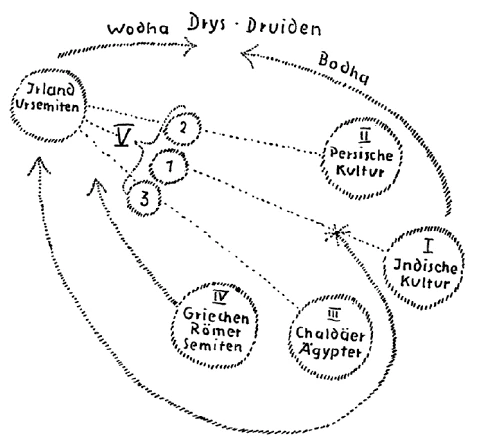
[ 11 ] Three different sub-races formed in Asia. From the Atlantic starting point, a colony crossed over to Asia under the leadership of initiates. One particular result is ancient Indian culture, a second is ancient Persian culture, and the third result is Chaldean-Egyptian culture; they all have a common source of initiation. In Europe, however, remnants always remain of what emerges so magnificently in Asia in the three great cultures. These individual cultures are thoroughly intermingled in Europe in the most diverse ways. In Europe, too, there were initiates who formed mystery schools towards the end of the period under discussion: they were called Druids; Drys means oak. The strong oak was the symbol of the ancient European scholar-priests. For what dominated the peoples of the north was the idea that their ancient culture would eventually perish. The twilight of the gods was taught, and the future of Christianity was magnificently expressed by the Nordic prophets in what later became the Siegfried saga. Compare this with the Achilles saga.
[ 12 ] Achilles is invulnerable all over his body except for his heel, Siegfried except for the spot between his shoulders. Being invulnerable in this way means being initiated. In Achilles, you have the initiate of the fourth sub-race, which lies in the ascending arc of human cultural development; therefore, all the highest parts of Achilles are invulnerable, only the heel, the lower nature, is vulnerable, similar to how Hephaistos is lame. The German Siegfried was also a hero of the fourth sub-race, but vulnerable between the shoulder blades. Here is his vulnerable spot, where only he who bears the cross makes himself invulnerable. In Siegfried, the divine perishes; the Norse gods went to their doom (Götterdämmerung). This gives the Norse saga its tragic aspect, in that it refers not only to the past, but also to the twilight of the gods, to the time that is to come. The Druids taught people about the decline of the Norse gods. Therefore, Boniface's battle against the oak tree symbolically represents the battle against the old priesthood, the Druids.
[ 13 ] Traces of what has been expressed in Asia can also be found everywhere in the North. For example, Muspelheim and Niflheim are counterparts to Ormuzd and Ahriman. The giant Ymir, from whom the whole world is made, corresponds to the dismemberment of Osiris in Egypt. This connection can be traced in every detail among the European peoples in the north and other cultures. When the fourth subrace developed in southern Europe, the Nordic tribes had also reached the fourth stage, so that Tacitus found much that was familiar among the Germanic peoples. Irmin, for example, is the same figure as Hercules in the south. Tacitus also tells us of a kind of Isis cult in the north. Thus, older stages of culture live in opposition to what will emerge as Christianity.
[ 14 ] Imagine Europe, Central Asia, and Egypt littered with what had developed under the influence of the initiation schools. These initiation schools now sent forth from their midst the founder of the fourth sub-race, which had long been preparing in their bosom. This is the personality whom the Bible calls Abraham; he comes from Ur in Chaldea and is formed like an extract of the three ancient cultures. The task represented in Abraham is to bring into humanity everything that was revered outside; to create initiates who attach great value to humanity in order to establish personality cults. This is why personal characteristics appear in the Jewish patriarchs. It is actually a matter of cunning and craftiness. Jacob gains superiority by using cunning and deceit to take what he wants from his brother. This is the reality from which our present culture has developed; it is based on the intellect and greed. In a grandiose way, this comes out like a kind of dawn in the stories of the Old Testament. There could not be a more powerful representation of the origin. Esau is still hairy, which means he represents the type of humanity that is still more caught up in the physical; Jacob represents the one who relies on his intellect and cunning and thereby achieves what is actually developing in human nature now. The overcoming of physical strength by the intellect is inaugurated here. The initiators do not always bring something great into the world, but rather that which must necessarily come. “Israel” means: he who leads people to the invisible God who lives within. Isra-el: El = the goal; Isra = the invisible God. Until now, he was visible, whether as the visible one in the great visions of the Indians, as the one urging good and evil as with the Persians, or as the one who had his body in the stars, in the universe: he was perceived as something visible.
[ 15 ] And now you have depicted the Jewish initiation in Joseph and the Twelve Brothers. It is a beautiful, powerful allegory. The allegorical now comes to the fore; the intellect becomes allegorical where it wants to work.
[ 16 ] First, Joseph's initiation is depicted: he is lifted out of ordinary life, sold for twenty pieces of silver, and thrown into a cistern, where he remains for three days. This is the expression of initiation. Then he comes to Egypt and has a refreshing effect there. And now you have subtly hinted at the shift that took place at that time from the study of the gods of the stars to the study of human beings. Joseph was cast out because he had dreams. He had the dream: the sun, moon, and eleven stars bowed down before him. The eleven stars are the eleven signs of the zodiac. He feels himself to be the twelfth. The symbol of the star religion is now transferred to the human realm. In the twelve brothers, the starting point of the twelve tribes, the study of the star gods is brought down to the personal level. Now, you will not want to claim, says the father, that your brothers will bow down before you. Here we have the turning point: the knowledge of the stars in the heavens is translated into a knowledge that is attached to the personal and human. This finds its expression in Mosaic law.
[ 17 ] From the three ancient cultures, through the initiation of the Jewish patriarchs, this fourth culture, the original Jewish culture, is derived, from which everything that we have as the fourth subrace actually originates, for it also includes the ancient Hellenic and ancient Roman cultures. Greek and Roman (Roman law) also became great precisely because of the personal element, until this idea was incarnated and elevated in Christianity. Thus, it is precisely in this smaller branch that the actual current of the fourth subrace comes to the fore. The Greek-Latin stream is a higher development of the Jewish stream; the personal element is heightened here. This descent to the lowest point and then the ascent do not contradict each other.
[ 18 ] We can observe this everywhere [within the fourth sub-race]. The personal had to be expressed in the way described in the legend of Esau and Jacob in order to find its purification in the beautiful humanity of the Greeks and in the greatness of Roman civilization. In Odysseus, cunning still overcomes the old priestly culture. It is only out of this culture that Christianity can develop, which actually encompasses all ancient cultures and can therefore also absorb them. Jesus Christ is transferred to Galilee according to his origins. “Galilean” means “the stranger” who does not really belong; Galilee was a small enclave where someone could be educated who had to absorb not only Jewish culture but all ancient cultures in his ethnic milieu.
[ 19 ] The clash between Roman culture and the Nordic peoples gave rise to the fifth sub-race, in which we ourselves live. It has still been influenced by the ancient initiation schools in Moorish culture and in Arab culture, which came from Asia. It is always the same influence from the same school of initiators. We can see how the monks of Ireland, as well as those who work scientifically, are completely inspired by Moorish-Arabic science. This gives the same basic character in a new form, as it could be taken up here. Christianity only finds its real expression here. It merely passed through ancient Greek while the fifth culture was still preparing itself, and then took root here, integrating itself into a series of nations. Everything at that time was permeated and inspired by Christianity. Our present age, with its materialistic culture, is the last radical expression of what was inaugurated at that time. The emergence of this new culture is symbolically represented in the Lohengrin legend. Lohengrin is the initiator of urbanism, and urban life, which is working its way up to a new stage of culture, is symbolized in Elsa of Brabant.
[ 20 ] Other currents also pushed their way into all of these, for example the Mongol tribes. What had originally come over from the West was related to what came from the East with the Huns. Thus, something related came together here from the East and West: Mongolian and Germanic tribes. Those who originally came from the west were also the remaining descendants of the Atlanteans, as were the Mongols who came from the east. Basically, both currents were related. It is always one current that crosses the other. However, both have a common mother soil, since they both originate from Atlantis.
[ 21 ] Here in the north, everything that has remained from older times is now taking on a more solid form. At the same time as Jewish prophecy existed, in the centuries before Christ, we find here references to a great ancient Atlantean initiate, Wod-Wodha-Odin. This is a modernized Atlanteanism in a new form, an atavism, a throwback to Atlanteanism. And this is happening everywhere, including over in Asia. In Asia, the W is a B, Wodha = Bodha = Buddha. Buddhism in Asia is the same phenomenon, appearing as a throwback to the Atlantean era. That is why we find Buddhism most widespread among the remnants of the Atlanteans, among the Mongolian peoples. And where it appears most magnificently, like a pillar, in Tibet, we have a modern, monumental expression of ancient Atlantean culture.
[ 22 ] One must be aware of such connections between peoples in order to understand history. When Attila, the fighter for monotheism, appeared in Europe, he stopped short of Christianity because he encountered something greater than what the Huns had. The monotheism of the Huns, as an outflow of Atlantean culture, was of a grandeur that they found in none of the other peoples on their paths. Only Christianity impressed the Huns. Some details in historical development can be understood from these broad considerations.
[ 23 ] The well-known traveler Peters senses that the old Bodhatum and the Wotantum can flow together, but he does not know that we in Europe do not merely represent the ancient, but also something new, a new vortex. The newest, the wisdom pointing to the future, strikes into the old part of the vortex. This relates to the old wisdom as bright daytime consciousness relates to the trance state. With perfectly clear daytime consciousness, the peoples of the future will develop a spiritual culture that will be different from the old one. Therefore, theosophy must not be a transfer of the old, of Buddhism and Hinduism; this would collapse. Something new must emerge from the seeds that lie dormant in Eastern Europe, a union with all that has been developed here.
[ 24 ] The actual [future culture] lies in the burgeoning elements of the peoples of Eastern Europe. We ourselves in Central Europe are the outposts. The material, the human material for what is being established here as an outpost must be found in Eastern Europe.
[ 25 ] The Rosicrucian schools have always taught that Central and Western Europe are merely outposts of what will develop in Eastern Europe, what will emerge from the fertilization of folklore and European knowledge. In Tolstoy, everything is fertilized by Western European culture, but differently than in other people before him. He expresses in a powerful, simple way what neither Kant nor Spencer could have expressed. What seems overripe here still appears imperfect in his work. But that is always the case with what is a seed. It is not from the finely developed plant, but from the seed that the new, future plant grows.
[ 26 ] Whatever one experiences, one can look to the future with deep satisfaction. For just as the crystal only develops from the lye after the lye has been stirred vigorously, so too can something only develop there as a result of great upheavals.