

Cosmogony
GA 94
9 June 1906, Paris
Translated by Steiner Online Library
Lecture Thirteen
[ 1 ] Today, let us try to transport ourselves back in time to the Logos who created our world, and to this end, let us retrace the steps of this evolution to a certain point.
[ 2 ] Contemporary esoteric science dates back historically to the Stone Age, when humans lived in caves and knew no weapons other than hewn stones. Their lives were simple, their horizons limited, and their thoughts confined to defending their lives and searching for food.
[ 3 ] Secret science takes us beyond this Stone Age to another epoch of humanity: that of the people who inhabited the continent of Atlantis. These people differed from subsequent humanity in their physical appearance alone. Prehistoric man—as is well known—still had an undeveloped frontal lobe. This is because the development of the frontal lobe runs parallel to that of the brain and thought. The physical brain was once much smaller than the etheric part, which towered above it on all sides. In the course of evolution, the proportions of the physical and etheric heads have become more similar. A certain point of the etheric brain, which is now located inside the skull, was still outside at that time. There was a point in the evolution of the Atlanteans – which lasted several million years – when this point retreated into the interior of the skull. This moment is of fundamental importance, because from the moment when human beings began to think, to become aware of themselves, to say “I” to themselves, they also began to combine and calculate, which they had not been capable of before. In return, the first Atlanteans possessed a more faithful memory that was less prone to error. Their entire knowledge was based not on an understanding of the relationships between facts, but on the memory of the facts themselves. They knew from memory that a certain event always led to a series of others, but they did not know the cause of these events and could not reflect on them. The concept of causality existed among them only in an embryonic stage.
[ 4 ] They combined this powerful force of memory with another, no less precious: the power of will. Modern man can no longer directly influence the forces of life through his will. For example, he can no longer accelerate the growth of plants through his will. The Atlanteans could do this; indeed, they drew an etheric force from plants that they knew how to use. They did this instinctively, without the aid of the knowledge and precise methods that we today refer to as the spirit of science. As the Atlanteans developed their intellectual powers in conjunction with deliberation, calculation, and thinking, their instinctive and clairvoyant abilities declined.
[ 5 ] If we go back even further in the history of the Atlanteans, we come to a very distant epoch when they became capable of expressing themselves through language, that is, through articulated sounds. This point in time corresponds to when humans learned to walk upright. For language can only appear in beings with an upright posture. One must be able to stand upright in order to pronounce articulated sounds.
[ 6 ] Before the Atlantic continent and the great race of Atlanteans, from which all the races of Europe and Asia emerged, there was another continent and another human race even more immersed in animality: that of the Lemurians. Science considers them only a hypothesis. Certain islands south of Asia and north of Australia are nevertheless evidence of its existence, for they are the metamorphosed remnants of the ancient Lemurian continent.
[ 7 ] The temperature at that time was much higher than it is today. The atmosphere was filled with steam, a mixture of air and water, permeated by countless currents. We encounter rudimentary human beings who breathe not through their mouths but through gills.
[ 8 ] In human evolution, the organs are constantly changing and altering their nature and activity. Thus, primitive man walked on all fours and had neither articulated sounds for speaking nor ears for hearing. However, in order to move in the semi-liquid, semi-gaseous element that surrounded him, he had an organ that served as a device for floating on the water and swimming. When the elements separated and humans stood upright on solid ground, this organ transformed into lungs, their gills into ears, their front limbs into arms and hands, into free working tools. In addition, they acquired articulate speech.
[ 9 ] This transformation was of crucial importance for humanity. We read in Genesis: “The Lord God breathed into his nostrils the breath of life; and man became a living soul.” This passage describes the moment of development when man's gills transformed into lungs and he began to breathe the outside air. With the ability to breathe, he received an inner soul and through it the possibility of feeling within himself, the possibility of gradually feeling how the I lived in the soul.
[ 10 ] Breathing through his lungs, man saw how his blood gained strength. Now souls that were individualized by the I principle and stood higher than the group soul of animals could incarnate in him and thus lead the whole development into its fully human, later divine phases. These souls could not have incarnated before the bodies breathed air. For air is a soul element. At that time, therefore, human beings literally breathed in the divine soul that came to them from heaven. The words of Genesis, understood in the sense of the evolution of the human race, are therefore to be taken literally. To breathe means to become spiritual. This is where the exercises of ancient yoga come from. They are based on the rhythm of breathing and aim to make the body permeable to the spirit inherent in it. In fact, we connect with the world soul through breathing. The air we breathe is the physical garment of this higher soul, just as the flesh of our body is the garment for our lower being.
[ 11 ] These changes in the respiratory system mark the transition from the ancient consciousness, which only reflected images, to the present consciousness, which receives its sensory perceptions from the body and thus acquires its objective character. The imaginative image consciousness could not depict an object on its own, but gave itself inner content through an inherent plastic power. The further we go back into human history, the more we see the soul of the human being not within them, but around them. We come to a point where the organs of sensation only exist in embryonic form and where the human being perceives external objects only through attraction or repulsion, through sympathy or antipathy. This being, which is not yet a human being in the sense we understand it, but only a human germ, directs its movements according to these attractions or repulsions. It has no reason yet, and the pineal gland, which was once an important organ, forms its brain all by itself.
[ 12 ] The answer to all philosophical discussions about the objectivity and reality of the world and the refutation of purely subjective philosophies such as those of Berkeley can be found in the fact of this image consciousness. The universe and man are both subjective and objective. These two poles of being and life are necessary for evolution. The universal subject becomes the objective universe, and man first progresses from the subjective to the objective through the gradual advancement of his physical body. He then returns from the objective to the subjective through the higher development of his soul (manas), his life spirit (budhi), and his spirit man (atma).
[ 13 ] The consciousness we have in the dream state is an atavistic remnant of the former image consciousness.
[ 14 ] A special feature of this image consciousness is that it is creative. In its own essence, it creates forms and colors that do not exist in physical reality.
[ 15 ] Object consciousness is analytical. Subjective consciousness is plastic; it has a magical power.
[ 16 ] We have thus seen how the objective and analytical consciousness of human beings followed the subjective and plastic consciousness. The process by which the soul, which first surrounded humans like a cloud and subsequently permeated the physical body, can be compared to the development of a snail, which first secretes its own shell from its own bodily substance and then retreats into it. In the same way, the soul permeated the body that it had previously modeled and for which it had prepared the sensory organs from outside. The power of sight with which our eyes are endowed today is the same power that once acted on the eye from outside to build it up. The reversal of the soul's power, which once acted from outside and now acts from within, has always been represented by a hieroglyph, namely two whirls of opposite direction. The first movement, inward, is expressed in one direction, the second, from the inside to the outside, is expressed in the other direction.
[ 17 ] This sign—it is that of Cancer in the zodiac—always denotes the end of one direction and the beginning of a new one in the opposite direction.
[ 18 ] In the middle of the third earth period, the Lemurian period, we find the point where the soul moves into the house it has built for itself and where it begins to animate the body from within. If we go back beyond this point, we are dealing only with an astral humanity that also lives on an astral Earth. In an even earlier phase, we see humanity and the Earth only in a purely devachanic state. Humanity no longer has any image consciousness, but is permeated by cosmic thoughts.
[ 19 ] The further back we go in the parallel development of the earth and humanity, the more we find both in a fluid and embryonic state, the closer they are to the spiritual state. Today, when we have reached the lowest point of downward development, the earth and human beings have reached the utmost degree of solidification and are in the process of ascending again to the spiritual state through the exercise of individual will.
[ 20 ] What is the meaning of this whole development? Where were beings when they were nothing but germs in their initial state? Where did the human race originate? Who created it?
[ 21 ] Here it is now necessary to cross the threshold that reveals to us a degree of life and a power of revelation that is superior to human and planetary life. This power is the Logos.
[ 22 ] How does all human and planetary life differ from the life of the Logos?
[ 23 ] At first glance, this question seems to require us to take a leap into the unknown, into a universe of a different order. And yet there are analogous phenomena in our world that can help us understand, or at least sense, the creative power of the Logos.
[ 24 ] Let us assume that human intelligence could encompass the sum of everything accessible to it; that it had an orderly knowledge of all earthly and planetary phenomena. It could revive all forms of development. But it could not, with this ability alone, return to the stage before the appearance of man and the planetary system in the universe. It would remain within the realm of what has been scientifically established by man; our intellectual power does not exceed this limit.
[ 25 ] But we can rise to a different level of consciousness than the one that only reproduces intellectual experiences. There are certain states of creative activity where the human spirit becomes a creator and can create something new, something never seen before. Such is, for example, the state of mind of the sculptor at the moment of conception, when he sees in a flash before his mind the form of a statue whose model he has never seen, but which he creates. Such is also the state of mind of the poet who conceives a work in a draft, in a creative vision of his mind.
[ 26 ] This creative power does not receive its inspiration from an intellectual concept or idea, but from a spiritually inspired feeling. Consider the hen brooding over her eggs. She is completely absorbed in her brooding and feels a sense of well-being as she experiences, as if in a dream, the hatching of the little winged chicks. This feeling of well-being in creation can be found at all stages of cosmic development, and everywhere it gives off a corresponding warmth. If one imagines cosmic intelligence as the world of thoughts accessible to the higher self (Manas), one immediately notices this power of warmth that permeates the universe, emanating, as it were, from the creative source of all life (life spirit: Budhi). And through it, one can sense this world of creative power that existed before ours and envelops it. One then rises from Manas to Budhi and from Budhi to Atma.
[ 27 ] The word that ignites the self in the human being, the microcosm, is the third Logos.
[ 28 ] Imagine the power of the higher self in man, the Manas, extended to the entire universe like a source of warmth that ignites life, and you arrive at the second Logos, which ignites macrocosmic life and from which the human soul receives a reflection in its creative activities (Budhi).
[ 29 ] Their common source is the first Logos, the unfathomable Deity, the center of every manifestation.
[ 30 ] At all times, occultism has represented these three Logoi by the following symbols:
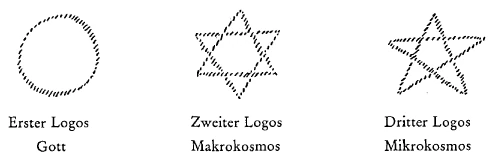
[ 31 ] They have been summarized in the number: 7-7-7, the esoteric number of the three Logoi. The exoteric number is the multiplication of these three sevenfold numbers in the plan of development, namely 343.