

Original Impulses of Spiritual Science
GA 96
28 January 1907, Berlin
Translated by Steiner Online Library
14. The Lord's Prayer: An Esoteric Consideration
[ 1 ] What I want to say today relates to the question: To what extent do religious creeds reveal their spiritual scientific, or let us say, secret scientific basis in very specific examples? Today, I would like to share with you just a very small but infinitely important section from this chapter on the secret scientific basis of religions. You will see that this is a fact known to everyone, even the most naive people in our culture, a spiritual fact within which the deepest esoteric truths and reasons are hidden, which one only has to seek in order to see how wise and mysterious the connections within the spiritual life of humanity are.
[ 2 ] Let us begin with the question of Christian prayer. You are all familiar with what is today called Christian prayer. It has often been discussed here, and some of you may have asked yourselves: How does Christian prayer relate to the spiritual-scientific worldview? Through this worldview, members of the spiritual science movement have in recent years heard something about another form of elevation of the human being, of the human soul, to the divine-spiritual world powers, about meditation, about that way of experiencing spiritual content within oneself, something of what has been given to us by the great leading spirits of humanity or from the spiritual content of the great cultures into which human beings immerse themselves, and which gives them the means to flow together for a short time in their souls with the divine-spiritual currents in the world.
[ 3 ] Those who meditate, even in the simplest way, through any of the meditation formulas originating from the spiritual leaders of humanity, those who meditate and thus allow any of the formulas, any of the significant thoughts, to be present in their minds—you know, it cannot be just any thought content, but must be one given by the masters of wisdom and harmony of feeling — those who meditate and allow these formulas to live in their hearts experience a merging with the higher spirituality, a higher power flows through them. He lives in it. He first creates strength to strengthen, lift, and enliven his ordinary mental powers, and if he has enough patience and perseverance and has allowed this strength to flow into himself, perhaps to the point of moral and intellectual strengthening, then the time comes when deeper powers slumbering in every human soul can be awakened through such meditation content. From the simplest moral strengthening and fortification to the highest realms of clairvoyant ability, there are all kinds of stages that can be reached through such meditation. For most people, reaching higher levels of clairvoyant abilities is just a matter of time, patience, and energy. This meditation is usually regarded as a more Eastern way of rising to one's God. In the West, especially within the Christian community, prayer is known in its place, the prayer through which the Christian rises to his God, through which the Christian tries to gain entry into the higher worlds in his own way.
[ 4 ] Now we must first of all realize that what is often regarded as prayer today would by no means be considered prayer in the original Christian sense, and least of all in the sense of the founder of the Christian religion, Christ Jesus himself. In the true Christian sense, it is never a prayer when any individual asks his God for something that is intended to satisfy his own personal and selfish desires. When anyone implores or asks for the fulfillment of personal desires, they naturally very soon come to disregard the universality and comprehensiveness of the granting of what is sought through prayer. They assume that the deity will satisfy their particular desires. A farmer who has grown this or that crop may need rain, while another farmer next to him may need sunshine. One prays for rain, the other for sunshine. What should the divine world order and providence do in this case? It is unthinkable what the divine world order and providence should do when two armies face each other and each of them prays that they should be granted victory, and each considers its victory to be the only just one. It is immediately apparent how little such a prayer, springing from personal desires, has of universality and general humanity in it, and how even the granting of a request by a god can only be in accordance with the wishes of one of the parties praying. When praying in this way, one disregards the prayer through which Christ Jesus indicated the basic attitude that should prevail in every prayer, namely: “Father, let this cup pass from me, yet not my will but yours be done.” This is the Christian fundamental mood of prayer. Whatever is implored and prayed for, this fundamental mood must live as a bright undertone in the soul of the person praying if he wants to pray in a Christian way. Then the prayer formula becomes merely a means for the person to lift himself up into higher spiritual realms in order to feel God within himself. But then this prayer formula will also bring about the exclusion of every selfish desire and impulse of the will in the sense of the words: “Not my will, but yours be done.” It will result in an opening up, a sinking into this divine world. When this state of mind is achieved as the true mood of prayer, then Christian prayer is exactly the same as meditation, only with a more emotional coloring. And Christian prayer was originally nothing other than what meditation is. Meditation is more intellectual, and through it one attempts to achieve harmony with the divine currents flowing through the world by means of the thoughts of the great leaders of humanity. In prayer, the same is achieved in a more emotional way.
[ 5 ] So we see that both in prayer and in meditation, what is sought is what can be called the union of the soul with the divine currents flowing through the world, that which at the highest level is the so-called Unio mystica, the mystical union with the deity. The beginning of this is in prayer, the beginning of this is in meditation. Human beings could never unite with their God, could never come into contact with the higher spiritual beings, if they themselves were not an outflow of this divine-spiritual being.
[ 6 ] As we all know, human beings are dual in nature. First of all, they have the four members of the human being that we have often mentioned here: the physical body, the etheric or life body, the astral body, and the I. Within the I, they then have the potential for the future: manas, buddhi, atma, or the spirit self, the life spirit, and the spirit man.
[ 7 ] If we want to understand the connection between these two beings correctly, we must go back a little to the time of human evolution. You all know from previous lectures that human beings as they are today represent the harmony of two entities: the three predispositions for the future, Manas, Buddhi, Atma, the upper three members, and the lower four members, the physical body, etheric body, astral body, and I; and that they developed as such in the distant past, which we call the Lemurian epoch of the Earth.
[ 8 ] If we go back through our present epoch to the Greek-Latin, Egyptian-Assyrian-Chaldean, and Persian and Indian cultures, then, as we go further and further back, we gradually come to that great Atlantic flood that is hinted at in the flood legends of all peoples, and we then come to those ancestors who lived in the land that lay between Europe and America, which we call Atlantis. Going further back, we come to ancestors who lived in ancient times in a land that then lay between Australia and India. It was only in the middle of this epoch that what we call the higher trinity of man, spirit self, life spirit, and spirit man, united with what we call the four lower members of human nature, physical body, etheric body, astral body, and ego.
[ 9 ] We can imagine this correctly if we think of it this way: At that time, in the Lemurian epoch, there was not yet a physical human being in our sense as the highest being on this earth, but only a kind of highest animal shell of our present human being, a being or a sum of beings that at that time consisted of the four lower members of human nature. That which is the higher human being, that which is eternal in human nature, that which will continue to develop in the future through the three faculties of manas, budhi, and atma, rested until then in the bosom of the Godhead. If you want to imagine this fact as it occurred at that time, albeit in a somewhat trivial but vivid way, then imagine that all the people who live in the whole of humanity today had, up to that moment, built up bodies that enabled them to receive the human soul, comparable to a sponge that can absorb water.
[ 10 ] Imagine a vessel filled with water. In this water, you can never distinguish where one drop ends and another begins. Now imagine a number of small sponges immersed in this mass of water; each of these sponges will absorb a part of the water. What was previously a uniform mass of water in the vessel is now distributed among many sponges. This is how it was with human souls at that time, if we may use this trivial comparison. Previously, they rested independently in the bosom of the divine primordial spirit, without individuality, but were then absorbed by human bodies and thereby individualized, like water by sponges.
[ 11 ] What was absorbed at that time by the individual bodies, the four lower limbs, continued into our time, developing further and further, and will continue into the future, developing further and further. In the so-called spiritual or secret science, it was always called the upper trinity, and as a diagram for this human being that arose in the middle of the Lemurian race, namely in the Pythagorean school, the triangle and the square were chosen, so that the following diagram results for the composite human being.
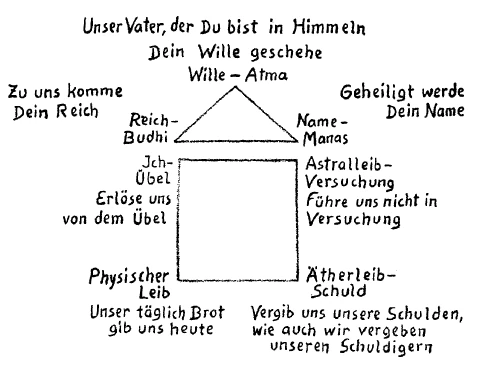
[ 12 ] Now, as you can easily imagine, this higher, eternal aspect that passes through all incarnations can be viewed from two perspectives. On the one hand, it can be regarded as the eternal essence of humanity, but on the other hand, it can also be regarded as part of the divine essence, which it gave up at that time as a piece or a drop of its own content, and which is now immersed in the four-part human vessel, so that what rests in us humans today is a drop of the deity individualized in independence. Thus you come to realize that you cannot regard the three higher members of human nature, its eternal nature, merely as the three highest principles of human nature, but also as three principles in the deity itself. The fact is that what are the three highest members of human nature are at the same time the three lower members of the deity closest to man. If you wanted to list the principles of those deities who once gave the drops of soul to humanity, you would have to begin with the physical body in humans, continue with the etheric, astral, and ego bodies, and ascend from Manas to Atma, begin with Manas, continue with Budhi and Atma, and ascend to the principles that lie above Atma, which modern man can only conceive of when he becomes a disciple of the Initiates. So you see that we can also regard the three principles that human beings contain within themselves as three divine principles.
[ 13 ] Today, let us consider them not as human principles, but as divine principles, and describe their nature. That highest principle, which in human beings is the Atma, which they will develop at the end of their earthly or, let us say, their present planetary career, can be characterized in the sense of spiritual or secret science by comparing its primordial nature with something that is only vaguely known to people today: namely, with what human beings have within themselves as will. The fundamental character of this highest divine principle in human beings is of a volitional nature, a kind of will. What is least developed in human beings today in their inner being, the will, will become their most excellent principle in the future, as human beings ascend higher and higher.
[ 14 ] Today, humans are essentially cognitive beings, and their will is still limited in many ways. Humans can comprehend the world around them, to a certain extent, in its universality. But think how little of what they can comprehend they are able to will, how little power they have over what they can recognize. But what they do not yet have today, the future will bring them: their will will become ever more powerful until they have achieved their great goal, which in spiritual science is called the great sacrifice. This consists in that power of the will where the being that wills is able to give itself completely, not only to give the little that man is able to give with his weak powers of feeling and will, but to give his whole being, to let himself flow out as a being that penetrates into the material world.
[ 15 ] You will get an idea of what is meant by this, by the great sacrifice, the highest expression of the will in the nature of God, if you imagine the following: Imagine that you are standing in front of a mirror and your image is looking at you from this mirror. This image is an illusion that looks exactly like you. Imagine further that you have died by sacrificing your own being, your feelings, your thoughts, your essence, in order to bring this image to life, to make this image what you yourself are. To sacrifice oneself and give one's life to the image is what spiritual science has always called emanation, the out-flowing. If you could do this, you would see that you are no longer there, because you have given everything to awaken life and consciousness in the image.
[ 16 ] When the will has reached such a level that it is capable of accomplishing what is called the great sacrifice, then it creates, it creates a universe, large or small, and this universe is a mirror image that receives its task from the essence of the creator himself. In this way we have characterized what the creative will is in the divine essence.
[ 17 ] What we have to characterize as the second principle in the Godhead, insofar as it has flowed into humanity, is already given by this comparison: it is the mirror image itself. Imagine yourself vividly in a Godhead who, creating the world, is the center of the universe. If you imagine a point here in this room and, instead of the six walls, imagine it surrounded by a hollow sphere reflecting inward, then you will see yourself reflected on all sides as the center. You have the image of a deity as the center of will, reflecting on all sides, and this mirror is both the image of the deity itself and the universe. For what is a universe? It is nothing other than a mirror of the essence of the deity.
[ 18 ] But the fact that the universe lives and weaves is because the deity emanates when it makes the great sacrifice, when it mirrors its universe, as we have just seen in the example of the animation of the mirror image. The entire universe is animated by the universal will, which expresses itself in infinite diversity. This process of infinite diversification, of infinite multiplication, this repetition of the deity, is called the “kingdom” in all esoteric or spiritual science, in contrast to the will. The will is therefore the center, the mirror of the will is the realm, so that you can compare the will with Atma, the spirit man, and the realm, or the mirror image of the will, with Buddhi or the spirit of life.
[ 19 ] Now this kingdom is such that it reflects the essence of the divine in infinite diversity. Take a look at this kingdom in its entirety, insofar as it is our kingdom, our diversity, our universe; look at it in its visible part, in minerals, plants, animals, and humans. The realm is manifested in each of these beings, and we can still sense this today in the expression of our language, insofar as we call these great areas of our universe realms, i.e., the mineral realm, the plant realm, the animal realm. But if we also consider the details, we see that all details are also of a divine nature. All of them reflect nature just as the center would be reflected in a hollow sphere. Thus, those who view the world in the spirit of esoteric research see God reflected in every mineral, every plant, every animal, and every human being, as an expression and imprint of the divine.
[ 20 ] In infinitely graded beings and in infinite diversity, the deity appears in the realm, and one distinguishes the individual beings in the sense of secret science — when one stands at this high level that one can regard them as emanations of the divine — by giving them their “names.” The name is what man then thinks of as the individual entity; it is that by which the individual members of this great diversity are distinguished from one another. It is the third of the three highest human principles that flow out of the divine and would correspond to the manas or the spirit self. The secret science of the various religions has thus taught, naively taught, what has flowed out of the deity and flowed into you and became your eternal image.
[ 21 ] If you want to find yourselves in what you are ultimately to rise to, you will find that it is of a volitional nature.
[ 22 ] If you want to rise to what is the bearer of this will, this Atma, to the Buddhi—in the divine it represents the realm.
[ 23 ] And if you want to rise to what you recognize by names, concepts, or ideas of things—in the divine it represents itself as name.
[ 24 ] What we have now gone through here is an ancient teaching that says that name, realm, and will constitute that part of the deity that has flowed into human nature as the eternal part. Thus, we have recognized what is called the higher trinity of man as a part of the divine.
[ 25 ] To complete our consideration, let us now take a look at the lower four members of the transitory human being. We know that the higher three members can actually be viewed from the other aspect by considering them as members of the Godhead. In a similar way, we can regard the four lower members of the human being as members of the transitory world and as members of the human being.
[ 26 ] Consider the physical body. It is composed of the same substances and forces as the seemingly lifeless world around it. This physical body could not exist if matter and energy from the physical world surrounding it did not constantly flow into it and rebuild it again and again. In fact, the physical body is a constant transit station for everything we have in it. The substances that actually make up the outer universe flow in and out, just as they are temporarily within us. It has often been mentioned here that in the course of seven years the entire material composition of the human body is renewed. None of you today have the same substances that were in you ten years ago. Human beings constantly renew the substance of their physical bodies. What was in us then is now somewhere else entirely, distributed throughout nature, and other substances have moved into us. The life of the body requires a constant flow of matter in and out.
[ 27 ] Just as we have regarded the three higher members of human nature as parts of the Godhead, so we can regard the four parts of lower human nature as parts of the divine nature.
[ 28 ] We can regard the physical body as part of the material part of our planet; its substance is taken from our material planet and returns to it. When we consider the etheric body, we must likewise regard it as a member of what surrounds us here, and the same applies to the astral body.
[ 29 ] Let us consider the life body or etheric body and the astral body in relation to each other. You know that the astral body is the bearer of everything that lives in human beings in terms of drives, desires, and passions, the bearer of everything that ebbs and flows in the human soul in terms of joy and sorrow, pleasure and pain, but that the life or etheric body preserves, represents, and is the bearer of the more lasting, longer-lasting soul qualities.
[ 30 ] I have often compared the development of the life or etheric body and the astral body to the hour and minute hands of a clock. I have pointed out that if you remember what you knew and experienced as an eight-year-old child and what you know and experience now, you will notice a great difference. You have learned an infinite amount and absorbed many ideas; much of what you did then has passed through your soul in experiences of joy and sorrow; not only passed through it, but gone right through it. But if you now compare this with your temperament, your character, your lasting inclinations, you will come to the conclusion that if you were a quick-tempered child at the age of eight, you will probably still be so at your present age. Most people retain throughout their lives what lies within them as the basis of their being. It has often been emphasized here that secret schooling does not consist of theoretical learning, but of directing evolution toward the otherwise stationary structures of the etheric body. The student has done more if he has changed one of these characteristics of his temperament, his basic inclination, and thereby moved the hour hand of the clock a little faster than it would otherwise have done. Everything that develops so slowly — the lasting inclinations, the lasting temperamental characteristics, the lasting habits — is anchored in the etheric or life body. Everything that changes as quickly as the minute hand of the clock is anchored in the astral body.
[ 31 ] If you now apply this to the human environment, to our life in the outside world, you will see that you are connected to your age, your people, and your family through your habits, temperaments, and lasting inclinations. It is precisely those qualities that humans have within themselves as permanent and stationary that will be found not only in them, but in all those with whom they belong in some way, that is, in their family, their people, and so on. The individual members of a people can be recognized by the fact that they have common habits and temperaments. This foundation of human inclinations and habits, which must be changed if a person is to undergo higher spiritual development, is what constitutes their higher being. Such a person is therefore said to be homeless because they must change the etheric body through which they are otherwise connected to their people.
[ 32 ] So when we consider our coexistence with the communities into which we are born, we find that the characteristics that make us belong to a family or a people, that make us feel a kinship with the members of that people, are similar to the characteristics that exist in our age. Imagine how little you would be able to understand each other if a member of the ancient Greek people were to stand before you today. His etheric body is already too different from the etheric body of the present-day human being. People understand each other through the common characteristics in their etheric bodies. But that which sets people apart from what they have in common, that which makes them special in their family, in their people, yet again an individual being in their own right, and not merely French, not merely German, not merely a member of a family, but a special member of the people, the family, and so on, who can grow out of the sum of the characteristics of their gender, is anchored in the astral body, of which the astral body is the carrier. The astral body therefore contains more of the individual, the personal.
[ 33 ] When a person commits mistakes through their etheric or life body, they can become more of a sinner in the circle of their fellow human beings, more likely to neglect the social duties that play out between people and make human social life possible. However, those sins that are more individual in nature, through which the human being fails only as a particular personality, are transgressions brought about by the characteristics of the astral body.
[ 34 ] In all secret sciences, what is wrong with the community, what flows from the faulty etheric body, has always been called “guilt.” The ordinary, trivial word ‘debt’ has a very similar origin to the moral word “guilt,” which refers to what one has become morally indebted to another. Guilt is therefore something that can be traced back to faulty qualities of the etheric body. But what clings to the astral body as a faulty quality is called “temptation.” Temptation is that through which the individual takes on a personal sin. Now there remains the transgression of the ego, the actual personality. This transgression of the ego, that through which the ego in particular can fall, is indicated in the myth of paradise: when the human soul descended from the bosom of the deity and entered the earthly body for the first time, that is, was absorbed by the earthly body like a drop of water by a sponge, its higher soul became the ego.
[ 35 ] This higher soul, this ego, can commit errors within the ego. Man can fall not only through the faulty characteristics of the etheric and astral bodies, but there is a fundamental possibility of sinning that is brought about by the fact that man has attained independence in the first place. In order to gradually ascend to freedom and independence in a conscious manner, human beings had to pass through selfishness and egotism. They descended as souls who were members of the Godhead, who cannot fall into egotism. A member of an organism never imagines itself to be independent. If, for example, a finger were to imagine this, it would tear itself off and wither away. This independence, which man must develop and which will only have its full meaning when the basic characteristic of independence is selflessness, could never have arisen if it had not originated from selfishness.
[ 36 ] Selfishness entered the human body, and as a result, humans became selfish, egotistical beings. Thus, we see how the ego follows all the drives and inclinations of the body. Humans devour their fellow humans, they follow all kinds of drives and desires, they are completely entangled in the earthly vessel like a drop of water in a sponge.
[ 37 ] What man was able to sin by becoming such an ego being, an actually independent being, is indicated in the myth of paradise. Whereas he used to draw from the universal, like the drop that is still in the water, drawing its strength from the communal mass of water, he now has all his drives within himself. This is symbolized by biting into the apple in the myth of Paradise; and not without reason — for all real meanings of words, insofar as they belong to secret science, have a deep inner connection — not without reason does Malum mean “evil” and ‘apple’ in Latin. In secret science, the word “evil” is never used for anything other than a transgression arising from the ego.
[ 38 ] Evil is therefore transgression arising from the ego; guilt is the transgression committed by the etheric body in social life, in coexistence with other people. Temptation is that which can affect the astral body insofar as it is individually, personally flawed. The transgression of the etheric or life body is therefore guilt; the transgression of the astral body is therefore temptation; the transgression of the ego is therefore evil.
[ 39 ] When we consider the relationship of the four lower aspects of human nature to the environment, to the planetary atmosphere, we see that the physical body continually takes in physical matter as nourishment and thereby sustains its existence. We see that the life of the life-body or etheric body in the finite world comes about through the fact that the human being, having grown up within the community of his fellow human beings, sustains this community. We see that the astral body sustains itself by not succumbing to temptation. And finally, we see that the ego sustains itself and undergoes its development in the proper way when it does not succumb to what is called evil.
[ 40 ] Now imagine this whole human nature, the lower fourfold and the higher threefold, brought before your soul, so that you can say to yourself: A divine drop lives in each individual human being, and human beings are developing toward the divine, toward the expression of their deepest inner nature. Once he has expressed this deepest inner nature, he has, through gradual development, transformed his own being into what is called the “Father” in Christianity. What lies hidden in the human soul, what is the great goal of humanity, is the “Father in Heaven.” If man wants to develop toward this, he must have the strength to develop his higher trinity and his lower fourfold nature to the point where they sustain the physical body in the right way: the etheric or life body must live with man in such a way that a balance is achieved with what lives in him as guilt; the astral body must not succumb to temptation, and the ego body must not succumb to evil. Human beings must strive upward through the three higher members to the Father in heaven, through the name, through the kingdom, and through the will. The name must be perceived as such that it is sanctified. — Look at the things around you; in their diversity, they are an expression of the Godhead! When you say their names, you grasp them as members of the divine world order. Whatever you may have in your surroundings, consider it sacred; and in the name you give it, see something that makes it a member of the divine being. Keep it sacred, grow into the kingdom that is an outflow of the Godhead, and develop yourself up to that Will, which will be an Atma, but at the same time a member of the Godhead.
[ 41 ] Now imagine a person who, in meditation, is completely absorbed in this sense of development, and who is to summarize this sense, these seven links of development, in seven petitions in a prayer. What will he say?
[ 42 ] To express what is to be achieved through this prayer, he will say, before uttering the seven petitions: “Our Father, who art in heaven.” This refers to the deepest soul of human nature, to the innermost being of man, which belongs to the spiritual realm according to Christian esotericism. The first three petitions refer to the three higher members of human nature, to the divine content of man: "Hallowed be thy name. Thy kingdom come. Thy will be done—.“
[ 43 ] Now we move from the spiritual realm to the earthly realm: “Thy will be done on earth as it is in heaven.” The last four petitions refer to the four lower members of human nature.
[ 44 ] What shall we say about the physical body, so that it may be sustained in planetary life? “Give us this day our daily bread.”
[ 45 ] What shall we say about the etheric or life body? “Forgive us our debts, as we forgive our debtors.” The compensation for what happens through the transgressions of the etheric or life body.
[ 46 ] What shall we say with regard to the astral body? “Lead us not into temptation.”
[ 47 ] And what shall we say with regard to the ego? “Deliver us from evil.”
[ 48 ] Thus, you see in the seven petitions of the Lord's Prayer nothing other than the expression that the human soul, when it rises to it in the right way, implores the divine will to bring the individual parts of the human being into such a development that the human being finds his right path through the universe, that he develops all parts of his nature in the right way. The Lord's Prayer is therefore a prayer through which human beings, in moments when they need it, should rise to the meaning of the development of their sevenfold human nature, and the seven petitions, even when they occur in the most naive human beings who cannot understand them at all, are an expression of the spiritual-scientific view of human nature.
[ 49 ] Everything that has ever existed in the form of meditation formulas in large religious societies has sprung from secret science. You can take all real prayers and analyze them word for word, and you will never find that they are just a random string of words. It is not that someone followed a dark impulse and strung together beautiful words; no, the great sages derived the prayer formulas from the wisdom teachings that we now call spiritual science. There is no real prayer formula that has not been born out of great knowledge, and the great initiate, the founder of Christianity, Christ Jesus, had the seven members of human nature in mind when he taught prayer, and expressed this sevenfold nature of man in his prayers.
[ 50 ] Thus, all prayers are ordered. If they were not so ordered, they would have no power to work through the millennia. Only that which is ordered in this way has the power to work even in the naive human being, who does not even understand the meaning of the words.
[ 51 ] A comparison of what lives in the human soul with what takes place in nature will make this clearer. Consider a plant: it delights you, and you need not know anything about the great, universal laws that brought it into being. The plant is there, and you can lift yourself up with it. It could not have been created if the eternal laws had not flowed into it. The naive mind does not need to understand these laws. But if the plant is to be created, it must emerge from the laws. If prayer is to be effective, it must not be invented arbitrarily, but must have emerged from the eternal laws of wisdom, just as the plant has emerged from the eternal laws of wisdom. No prayer has real meaning for the wise and the unwise if it has not emerged from the primordial wisdom.
[ 52 ] Today is the age for people who have long contemplated plants and been inspired by them, where they can be led to the wise content of the laws. For two millennia, Christians have prayed as naive people look at plants. In the future, they will recognize the power of prayer from the deep primordial wisdom from which prayer has flowed. All prayers, especially the central prayer of Christian life, the Lord's Prayer, are an expression of this primordial wisdom. And just as light expresses itself in seven colors and the fundamental tone in seven tones in the world, so human life, rising to its God in sevenfold, expresses itself in the seven different feelings of elevation that relate to the sevenfold nature of the human being, in the seven petitions of the Lord's Prayer.
[ 53 ] Thus, standing before the soul of the anthroposophist, the Lord's Prayer is the expression of the sevenfold human being.