

Original Impulses of Spiritual Science
GA 96
27 April 1907, Berlin
Translated by Steiner Online Library
19. Access to Christianity through Spiritual Science
[ 1 ] Today I would like to add a few points to various observations we have made about Christianity in the spiritual scientific sense. First, we will deal with a spiritual scientific interpretation and explanation of Christian parables. Then I would like to say a few words about the Apocalypse, based on what you have heard in the public lectures.
[ 2 ] The parable I would like to discuss first is the parable of the unjust steward. You know that this parable causes many people headaches. Let us consider it, at least as far as we want to explain it today. It will therefore be presented here according to the literary translation. We will discuss it later in an esoteric sense.
[ 3 ] "He also said to his disciples, 'There was a rich man who had a steward, and he was accused of squandering his property. And he called him and said to him, 'What is this I hear about you? Give an account of your stewardship, for you can no longer be my steward. The steward said to himself, 'What shall I do? My master is taking away my office; I cannot dig, and I am ashamed to beg. I know what I will do, when I am removed out of my stewardship, that they may receive me into their houses.“ And he called every one of his master's debtors to him, and said to the first, ”How much do you owe my master?“ He said, ”A hundred measures of oil.“ And he said to him, ”Take your bill, and sit down quickly and write fifty." Then he said to another, ‘And you, how much do you owe? ’ He said, ‘A hundred measures of wheat. ’ And he said to him, ‘Take your bill, sit down quickly, and write eighty. ’ And the master commended the unjust steward for acting wisely, for the children of this world are wiser in their generation than the children of light."
[ 4 ] This parable has caused much head-scratching, and rightly so. Before we go into it, let us briefly point out that parables such as this one have given rise to a wide variety of interpretations over the course of time. We have heard people say that there is a deeper meaning behind such parables. Many have tried to find explanations based on their own understanding. It is quite clear that when everyone comes up with explanations for such parables from their own minds, something intelligent will come out of intelligent people, and something less intelligent will come out of less intelligent people. When everyone contributes their own mind, there can of course be no guarantee that the interpretation is correct. In the spiritual scientific worldview, it is something completely different. For us, it is a matter of explaining such parables as they were explained in the original Christian mysteries; of knowing the deep meaning that was laid into them and from which they sprang.
[ 5 ] I have often mentioned that such Christian mysteries existed. I have repeatedly said that Paul went out and explained Christianity, and that he founded the esoteric Christian school in Athens under Dionysius. In the same way, we too want to explain the parables as they were explained at that time. We do not want to say what comes to mind, but what we can really know. Those who taught in these Christian schools drew on what they had received from Christ Jesus himself.
[ 6 ] In our time in particular, such parables have suffered greatly under the general materialistic way of thinking, even among theologians. To show you what is ultimately possible in this area, I would like to read to you something about this parable from a little book that appeared in the collection “Aus Natur- und Geisteswelt” (From the World of Nature and the Spirit). The author is considered one of the most outstanding representatives of the Harnack school of thought and was appointed associate professor at the University of Jena. A few days ago, he was appointed to the chair of New Testament studies there. This is the spirit that is proclaimed from a theological chair. In addition, this wisdom is brought to the people in a little book that anyone can buy for eighty pfennigs. The best way to spread such a spirit is to include it in inexpensive works. Everything suggests that the matter is more important than is usually understood, for in this way the materialistic sense of theologians finds its way into the hearts and minds of people. The way to explain such a parable is roughly as follows: What people say about a deeper meaning of these parables is nothing special, it is something that is not hidden behind the parables at all. We must return to our childlike, original sense. It is as if Christ wanted to give nothing more than an artfully constructed story. What he says in it is so insignificant that it is entirely in keeping with today's materialistic thinking, which cannot belittle such a thing enough to bring it down to the level of the most everyday triviality. He says the following about it: "Let us take the parable of the unjust steward, which is particularly offensive. We take it entirely on its own, only up to the sentence: The master commended the unjust steward for having acted wisely. Why we separate all the other sayings will become clear later; in any case, it is clear that they can no longer all be used for interpretation because they contain very different ideas. If we take the parable as a parable, it simply means that the steward knew that the reckoning and then his dismissal were coming soon. He then considered what he could do in his situation and immediately applied the only means he could find. That was a wise move. Even his deceived master had to acknowledge this. Now, applying this to Jesus' contemporaries: You too know and believe that God will one day demand an accounting from you, so be wise and prepare yourselves for it! At least be wise, the parable says. Jesus is not appealing here to the goodness and longing of the human heart. A harsh, ironic mood pervades the whole thing. It does not sound like: Blessed are those who mourn, blessed are the pure in heart! Rather, it sounds like: If you do not listen to everything, you should at least be as wise as such a rogue steward! There is a sharp undertone in this parable, which is why the image is so strangely chosen. Jesus considered it superfluous to add that one cannot prepare for God's judgment by committing new acts of villainy like the steward.
[ 7 ] The last three lines clearly show us that the parable could be related to this, where it is said that God may one day demand an accounting from the soul. Now there should be a “be at least good.” But when you read what the Lord says to the unjust steward and uses the phrase “you should be at least as clever as such a rogue steward,” then one has not understood the parable. But such things are proclaimed today in such popular books. This is instilled in young students. It is not materialism that explains the external world in materialistic terms that is the worst, but that which wants to know nothing of any deeper insight into theology. This is the kind of materialism that is the cause of the other kind, scientific materialism. Here materialism sinks into the soul, and then one cannot help but interpret the facts of science in a materialistic way. We will have to learn again to understand the spiritual. And that can only happen through the current that is truly capable of explaining the Bible and other religious documents.
[ 8 ] We understand such a parable when we delve deeper into its meaning. One thing is clear from the outset, namely that it is a parable that appears in the Gospel of Luke, and only in this Gospel. It does not appear in the other Gospels. What does it mean that it only appears in the Gospel of Luke? It means a great deal. If you take the Gospels, the Gospel of Mark and the Gospel of Luke, and compare them with each other, you will find that they are based on a certain mood. In yesterday's lecture, I said that these are certain canonical books that originate from different places of initiation. Luke traces back to the initiation that the Essenes and Therapeuts underwent. That is why you find in him a tendency that has a medical character, that strives for balance among people, that endeavors to bridge the differences between people and to realize that all people are equal before the spiritual world. The Gospel of Luke often seems like a gospel for the oppressed and weary. They can take heart because they are equal before the spiritual world. If we bear this in mind, we will find the underlying tone and mood of the Gospel according to Luke.
[ 9 ] In ancient times, these different Gospels were indeed interpreted differently in tone. Let us stick to that. We must address an essential fundamental characteristic of Christianity, which we are familiar with from earlier lectures. You know that I have often recalled the sentence: “Whoever does not forsake his wife, children, mother, and brother cannot be my disciple.” You know that this saying points to a great advance in the development of humanity. It follows from the fact that in ancient times we had a love in the world that was based on blood ties; but that this love had to disappear as soon as the bonds of blood were broken. In ancient times, in the past, those who were related by blood loved each other. Christ taught love that consists in people loving one another regardless of their blood relationship. This brotherhood will not find people in the greatest possible outward similarity, but in what Christianity teaches as equality in relation to the spiritual worlds.
[ 10 ] Thus, the appearance of Christ Jesus on earth has a profound impact on human development. It provides the impetus for the human race to progress toward a great, global brotherhood. What Christ Jesus gave to human beings is that they can be guided by the power that comes from the manifestations of Christ Jesus to that all-encompassing love that is expressed in the word brotherhood. We draw the strength to establish this brotherhood from the Gospel. We must be clear about this.
[ 11 ] When we understand this, we grasp deeply a word that we find in many different ways in the Gospel, a word that always refers to the old law, to the law that prevailed in ancient times, as described in the Old Testament. Jesus says that not a single dot or tittle of this law should be violated, but he replaces this law with something completely new, something that does not yet exist. He replaces what is regulated by the law today with the free, loving behavior of one person toward another. Laws regulate the way people live together, what one person must do or achieve for another. But times will come when everyone will know, out of immediate feeling, what they have to do and give to their fellow man.
[ 12 ] Now let us look down on the parable from this perspective that Christianity opens up for us. If we take this seriously, we will grasp the deeper meaning and understand that the rich man can indeed be compared to the divine ruler of the world. The comparison is indeed there: the rich man with the divine ruler of the world. But how? — Anyone who asks this question could easily ask why the steward is unjust. Usually, the reason given is that he has only eighty tons recorded instead of a hundred, and so on. People think the steward is unjust because he is imposing something on people that does not correspond to the promissory note. That is completely wrong. The truth is rather that the steward is called unjust because he has acted unjustly in the past, because he has charged too high prices to the people to whom he has sold grain and so on. Now we understand that when his master dismisses him, the people will not support him. If that were not the case, we would have to assume that the rich man himself wants to be unjust. But this is not expressed anywhere in the parable. And if we add the later sentences, which Weinel arbitrarily omits, we will find that we do not need to interpret the rich man as demanding that his steward cheat people. The steward believes he is doing his master a service by charging the highest possible prices. Nevertheless, he could not escape the accusation that he had harmed his master.
[ 13 ] Let us approach the parable with these assumptions in mind and make it clear to ourselves. The steward has been slandered for cheating his master. He knows that, given the way he has managed his affairs and set high prices, he will have no support from the people. So he thinks: What should I do? My master is demanding an accounting, he will dismiss me from my office. Other people will not accept me, he tells himself. And what does he do now? He makes up for some of the wrongs he did earlier as an unjust steward. He gives the people a break, that is, he now sets prices that are humane. He relents somewhat from the unjust mammon he has amassed for his master. If we understand the parable in this way, then we may compare the rich man with the divine ruler of the world, and we may compare the steward with the one who, on behalf of the divine ruler of the world, is set over this old world, where the law had to regulate conditions. Then we may also understand that an account should be given of how the administration has been conducted. In the case of the steward, it turns out that he has become unjust. The same is true of the law. Originally it was good, but gradually it became unjust. It created class distinctions and rights that can no longer be upheld. Therefore, the one who said that not one jot or tittle of the old law would be changed must now demand an accounting from those who are the administrators of the law, from the Pharisees and scribes. The parable was directed at the Pharisees; they were the unjust stewards, the administrators of the law. They were the ones who could not imagine being welcomed into the huts of those who were under the law if they did not find shelter with the supposed God. Now we can also understand why the parable does not need to portray the rich man himself as unjust. That is precisely why he praises the steward for lowering the prices. If a rich man wants to cheat himself, he will not praise someone who gives back some of the high prices. The steward believed he was serving his master and became unjust to others. So those who had to keep the laws believed they were serving their master and became unjust to other people.
[ 14 ] This was transformed the moment Christ came. We also see that those who administered these laws must necessarily make amends for what they did wrong. The law has become unjust. Now that love for all people is required, those who want to conquer the huts of men—which is the parable for souls—must replace the law that has become unjust in certain places with a just one. They must write off some of what has become unjust. Therefore, the Gospel divides the old scribes and Pharisees into those who rigidly and orthodoxically call themselves “the children of God.” These are the ones who are condemned by Christ Jesus as those with whom he wants nothing to do. These are the ones of whom he says that they remain far from him; who say: We serve God, who gave us the laws. Because they hold so fast to the law, they are the children of light. This is the technical term for the servants of God, who are later compared to the unjust steward. The others, who live with people and had to be together with human inclinations, are the children of the world. They did not insist on the rigid letter of the law; they relented because it was no longer possible to administer unjustly. These are those who were formerly unjust, but because they had to live with life, they were forced to change. That is why the children of the world are wiser than the children of light.
[ 15 ] This parable refers to world government. What was good in the past may become martyrdom under certain circumstances, and something else must take its place. What is the situation now with the law and with the integrity of those who administer it? Where are those who no longer stand on the ground of the old law? Where are those who should fear finding no support in the huts of others because what they have done is unjust? This parable becomes clear to us when we give it the old esoteric interpretation from which the parable originally flowed. The parable should not be interpreted in a materialistic-theological way, but quite simply. These parables are there to explain the deep meaning of the great mission of humanity.
[ 16 ] The other parable is the parable of the prodigal son, which you know and which also presents difficulties for some. It would take too long to read the whole parable. You know what it is about. A father had two sons. One demanded his inheritance in order to go out into the world, the other stayed at home, was good and obedient, and worked with his father. The one who went out into the world lost his wealth, became poor, and fell into bitter need and great misery. When he returned, he was welcomed back by his father in the most loving way. When the older son heard this, he became angry and refused to go into the house. His father went out and begged him to come in. But he said to his father, "Look, I have served you for so many years, and you have never given me a goat so that I could have fun with my friends. But now this son of yours has come, who has squandered his property with prostitutes, and you have slaughtered a fattened calf for him.“ But he said to him, ”My son, you are always with me, and everything I have is yours. But you should be happy and cheerful, for this brother of yours was dead and has come back to life. He was lost and has been found."
[ 17 ] Imagine if someone today told the parable of the prodigal son, and it were not for the dust of millennia of venerable “tradition” clinging to it. Do not believe that there are no people today who think it is highly unjust for the father to take back the son who ran away, thereby disadvantaging the other son. Don't think that people would say anything else! — And they do say so. There are people who do not have the same reverence for the Bible as believers do. There are people who regard the Bible as an ordinary worldly book. A few sentences from a person who views the Bible in this way, from a liberal-minded person and a true philistine, will show you this. They are contained in the book “Finsternisse” (Darkness). Here it says: “Our sympathy lies entirely with the older son. ... The treatment that the father gives his younger son is a grave injustice to the older son,” and so on.
[ 18 ] This is philistine, but there will be many people who would judge the same way if the parable were written today. But consider that there is something hidden behind such things. Consider that we can understand the whole nature of these things from what is hidden. We then see that we simply have to interpret a deeper meaning into it. The most important of these parables are also contained in a kind of mystery canon, and they appear in different forms among different peoples. I would like to tell you one from the Hebrew canon, and then you can compare.
[ 19 ] A king had to watch as his son left him and moved away. He sent the tutor who had authority over this son to bring him home. The tutor also softened the son's heart. But the son said, “How can I appear before my father's face again?” And the father sent word to him, “Is it not your father's face that you appear before?” And so on. But there is something else here, namely: So it was with the people of Israel, who in their sinfulness turned away from their Father, the divine ruler of the world. They became unfaithful. — And then it continues: The king sent messengers after his son. But he said, “How can I appear before my father's face?” — Then he answered, “Is it not your father before whose face you stand?”
[ 20 ] The parable is not the same as the one in the Gospel, but it was created many centuries before Christianity with a clear reference to the same motif and has been preserved in the Hebrew tradition. The only difference is that a deeper explanation is given for it. People are made to realize that it refers to the people who are to return to their Father. Jesus only gave the parables, but he explained them to his disciples alone. Just as the Jewish parable refers to the people, to a single people connected by blood ties, so the Christian parable refers to the entire development of humanity.
[ 21 ] Now let us remember how, in the ancient Lemurian era, souls descended from the bosom of the deity, how the soul entered into human beings, and how human beings thereby became individual human beings. Let us follow how the soul becomes more and more individual, let us follow how animals still have a group soul today, how they do not possess an individual soul at all, but have a group soul on the astral plane. If we follow the human race, we also find that humans had group souls, that they were even closer to the divine than they are today. At that time, humans had not yet descended, had not yet entered the body. They acted as the God within them acted. After they entered the human body, they became more and more individual, they became more their own masters in the shell of the human body. But others also remained behind, others remained at the original stage and at earlier stages. As a result, we have different types of people living side by side. We have people who still have almost the soul of the species, in whom we cannot see their own impulses, who act less out of themselves than out of the species. The group soul was what God instilled in them. This was the case until the emergence of the independent human being, who seeks the way back to God.
[ 22 ] Thus, the course of development took place in such a way that human beings were originally a group soul in the bosom of the Godhead. When we look at a human being and the development of the human being today, we can say: primitive man has remained with the Father, he has not come out of the Father's shell; but the other has gone out into the world, has claimed his inheritance so that he can develop freely. There is a moment when the human being who is developing in this way feels lonely, feels impoverished in spiritual goods. Then he seeks to find his way back to God. This is the course of development: descending from God into matter and then ascending again, returning to the Father's house. When we find our way back through our own strength, we return after having been impoverished, having suffered hunger for spiritual goods. But we return as free individuals, and the higher we ascend spiritually, the more we return. Those who were to be initiated felt as if they were returning to the divine Father's house. What they said came from the group soul. If we understand it in the occult sense, it will become clear to us.
[ 23 ] When we study the human organism in an esoteric sense, it is not so simple. As people are today, they have the physical body, the etheric body, the astral body, and the actual I. All these different bodies do not exist on their own; they are not yet independent entities. Forgive the unappetizing analogy, but it makes the matter somewhat clearer. All these bodies contain more or less strange entities, like maggots in cheese. These different entities come and go. The influences that humans suffer from outside are based on completely different beings. The entities that enter and leave the physical body are called phantoms. This makes humans unfree. The beings that pass through the etheric body are called ghosts or specters. And those beings that pass through the astral body are called demons. You know, those people who were not superstitious but knew something about these things are aware of this. What has to do with the ego is what is called spirits.
[ 24 ] How does a person become individual? By purifying themselves. They are purified most strongly by becoming a companion of the spiritual world. Then they work on the astral body so that they become free of demons. When they work on the etheric body, they free themselves from ghosts or specters. If they work on the physical body, they free themselves from phantoms. Once they have accomplished this, they return to the pure divine. But in doing so, they have gained something. They were unfree. But now, after freeing themselves, they return to their Father's house as free beings. This will make it easier for you to understand the reports that refer to Christ's casting out of demons.
[ 25 ] In the parable of the prodigal son, you must imagine the development of all humanity. The spirits will rejoice over the returning soul, for it has not remained as it was when it left. The human being has changed, has become free. That is why his companions rejoice over him. Therefore, we must not regard the area to which the parable refers as lowly or small, but must see it as the great tableau of the world. If you remember that I said that everything is reversed on the astral plane, then you will understand it even more deeply. I said that even numbers in the astral world must be read in mirror image. When we encounter the number 64, we must read not 64 but 46. When your passions leave you, they appear to you as all kinds of beings rushing toward you. If you want to form a parable with a deep moral core for the highest worlds, use many images that appear reversed in the physical world. From this you will recognize the deeper meaning of why some parables that are ethical for the spiritual world are sometimes offensive in the physical world. You must think of many things in parables through which you are driven, through feeling, into the spiritual world. Such is also the mood that lives in such parables. And even that is significant, that such parables are offensive in their physical form.
[ 26 ] Another parable that I would like to mention briefly is that of the five foolish and five wise virgins. This also gives us much to think about. Let us look at it: "Then the heavenly pool will be like ten virgins who took their lamps and went out to meet the bridegroom. But five of them were foolish, and five were wise. The foolish ones took their lamps, but they did not take any oil with them. The wise ones, however, took oil in their vessels, along with their lamps. Now when the bridegroom was delayed, they all became drowsy and fell asleep. At midnight there was a cry, ‘Look, the bridegroom is coming! Go out to meet him!’ Then all those virgins got up and trimmed their lamps. The foolish ones said to the wise, “Give us some of your oil, for our lamps are going out.” But the wise ones replied, “No, lest there be not enough for us and for you; go rather to the merchants and buy for yourselves.” But while they went to buy, the bridegroom came, and those who were ready went in with him to the wedding feast, and the door was shut. Finally, the other virgins also came and said, “Lord, Lord, open to us!” But he said, “Truly, I say to you, I do not know you.” Therefore, watch, for you know neither the day nor the hour in which the Son of Man will come."
[ 27 ] Here it is implied that this parable has something to do with the fact that Christ will appear again in the future. Let us make this clear to ourselves. We can do so by considering the parts of the human being once again. When I work on the astral body, in the Christian sense it becomes the Holy Spirit. When the I works on the etheric body, it becomes what we call Budhi or Christ or the Logos. In my “Theosophy,” the Holy Spirit is called the Spirit Self, and Christ, the Logos, is called Budhi or the Spirit of Life.
[ 28 ] When we look at human beings today, we find that, as they live today, they have developed the physical body, the etheric body, the astral body, and the I. When the I works on the astral body, the Holy Spirit, the Spirit Self, Manas, develops from the astral body. And because the I has already worked on the astral body, there is also something of Manas, something of the Holy Spirit, present in human beings. This Manas works within human beings through the outpouring of the Holy Spirit. A time will come when humanity will enter the sixth of the root races. Then Manas will be developed in those people who have really done something for their development. Manas will be developed in them. They will be ready to receive Budhi, the Christ, the sixth fundamental part. In the sixth race, human beings will develop the Christ, and indeed the majority of human beings. We are moving toward this moment. It is a moment when Christ Jesus will appear. At this moment, people will be given the strength to move to where they can receive Christ in a new form as fruit, where Christ has, as it were, planted the seed, like a mustard seed that will sprout in the soul. Christ will appear visibly to those who have developed the Christ eye within themselves. What human beings develop within themselves is described by a parable, by a symbol. Just as the physical human being is created through the interaction of the male and female, so it is imagined that the other parts of the human being are also fertilized, that the various parts are also fertilized in a certain way. In ancient times, only the physical body existed for human beings. That was in the Saturn period. Then the etheric body developed, and then the astral body. This emergence of new moments of development is imagined as a fertilization. In this example, you can also see how profound the words of the Bible are. It is not for nothing that the Bible says, “And Adam knew his wife,” referring to the fact that she was fertilized, because this is based on the consciousness of spiritual fertilization. To know means to be fertilized with something. Self-knowledge means nothing other than being fertilized with the divine self. Know thyself means: let yourself be fertilized with the divine Self that permeates the world.
[ 29 ] Something similar underlies the parable of the five foolish and five wise virgins in Christian esotericism. It imagines this fertilization in the image of the lamp that has been given oil. Each of these parts of the human being is represented as a virgin who is still unfertilized, and the fertilized parts of the human being are represented as virgins who have poured oil on the lamp. The undeveloped part of humanity remains standing, has no oil on the lamp, does not bring its parts up to Budhi; the developed part has allowed the spirit to work on its bodies, pouring oil on the lamp, so to speak. The others have not poured oil on the lamp; they have not developed their five members. The former have developed them; they have prepared themselves for the important moment when Christ comes. Now the time has come when Christ is coming. Some will have poured oil on their lamps, their souls will become bright and ready to receive Christ. The others, who have remained dark within themselves, will see that others have developed this and they will go to receive wisdom from the others. They will have to get the oil from the merchants. But they will come too late. And what will Christ say to the wise virgins? I know you. — And what will he say to the foolish virgins? I do not know you.
[ 30 ] And now the bridegroom says to the foolish virgins: I do not know you. — If we take such a word from the depths of Scripture, it will always be true. If we continued in this way, we would find that the Bible contains the spiritual scientific teaching letter for letter and that we can learn the spiritual scientific truths from it. We would need no other book. Anyone who says that the Bible contradicts spiritual science does not know the Bible, no matter how highly esteemed the theologians who say so may be. But the spiritual life must be rediscovered in this document.
[ 31 ] Now a few remarks on what I have indicated in the public lectures on the Apocalypse. You know that the sun once separated from the earth, but that it will reunite with the earth in the distant future. The being that enables human beings to become so spiritual that they can reunite with the sun is referred to in occultism as the intelligence of the sun. This good sun spirit is counteracted by an evil one, the demon of the sun. Both forces are active not only in the sun, but also send their effects down to the earth. The forces of the good sun spirit enter into plants, animals, and humans, bringing forth life on earth. The opposing principle of the sun demon, the force that opposes the union of the earth with the sun, is active in the evil forces of human beings.
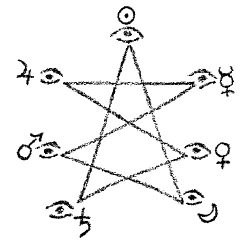
[ 32 ] Since ancient times, there have been occult symbols for this. A seven-pointed sign is the symbol for the good sun spirit. The seven points symbolically represent the seven planets. The pentagram is the symbol for human beings. The occultist draws the stars in the form of seven eyes into the figure [of the septagram]. Surrounded by a line, the forces are all intertwined. They bind everything together. This is also recorded by occultists in the days of the week. If you follow this line, you will have the names of the days of the week in the direction of the line.
[ 33 ] In ancient times, time could not yet be measured externally by the sun's rotation around the earth. The ancient occultists imagined special rulers for the orbit of the sun, and they were right. The whole system revolves, and so time was determined according to the orbit through the twelve signs of the zodiac: Aries, Taurus, Gemini, Cancer, Leo, Virgo, Libra, and so on. Now you know that in the development of a world system, an orbit is called a manvantara, that this is followed by a pralaya as a state of rest, and that such states follow each other like day and night. Therefore, the day has twelve hours and the night has twelve hours. These twelve hours correspond to the great periods of the world day, which are regulated by the ancient rulers of the orbit of the zodiac. I would have to draw twenty-four lords of the cycle around this sign. If I were to draw that for you, you would have the septagram here. You would then have the seven eyes here, which represent the seven stars, and the twenty-four ancient rulers, twelve for the day and twelve for the night.
[ 34 ] The good spirit of the sun is also called the Lamb. We have already spoken of the pentagram as a symbol of man. The black magician uses the pentagram so that the two “horns” point upwards and the one, the tip, points downwards. After completing this development, the good ones have then developed seven “horns.” This is the sign of the Christ spirit.
[ 35 ] Read the passage where John receives the book with the seven seals with this occult knowledge. Let us read it as it is described in the fourth chapter of Revelation. "And immediately I was in the Spirit. And behold, a throne was set in heaven, and one sat on the throne; and he who sat there was like a jasper and a sardius stone... And around the throne were twenty-four thrones, and on the thrones sat twenty-four elders" — whom I have shown you in the twenty-four hours of the world day — day and night. And then, what can be found further in the fifth chapter. “And I saw, and behold, in the midst of the throne and of the four living creatures, and in the midst of the elders, stood a Lamb as though it had been slain, having seven horns and seven eyes, which are the seven Spirits of God sent out into all the earth.” — This occult sign is the basis for John's references to the mysteries of worldly existence in the Apocalypse. Only those who know these mysteries can guess how profound a book the Apocalypse is and what it means when the adversary of the Lamb is described as the beast with two horns. The symbol of the sun demon is drawn as follows:

[ 36 ] The Apocalypse is written entirely in occult script, expressed in words.
[ 37 ] There is also a secret hidden in the number of the beast, 666, which is also said to be the number of a man. According to Aramaic esoteric teachings, this number should be read as 400, 200, 6, 60. These four numbers correspond to the Hebrew letters ת (taw), ר (resh), ו (waw), and ס (samech). In Hebrew, one reads from right to left:
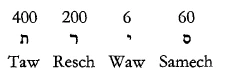
[ 38 ] These letters symbolize the four principles that lead human beings to complete hardening if they do not succeed in transforming them. Samech expresses the principle of the physical body, waw that of the etheric body, resh that of the astral body, and taw the lower self that has not risen to the higher self. Read together, the whole is called Sorat. This is the occult name of the sun demon, the adversary of the Lamb.
[ 39 ] This is the secret that modern theology has made: it is called Nero. One really cannot find a greater fable. The one who invented the story of Nero is regarded as one of the greatest minds in theology. Thick volumes have been written about it. Thus, the meaning of the symbolic signs is misunderstood. Books such as the Apocalypse can only be understood by those who are able to read occult writings.
[ 40 ] The prophetic significance of such symbols also indicates that the spiritual science movement has an important mission. By choosing the seven seals of the Apocalypse as decorations for the hall in Munich, we are also pointing out outwardly what our aspirations are directed toward. The spiritual should also meet us again in the outer world.