

Human Development and Christ-Knowledge
GA 100
17 November 1907, Basel
Translated by Steiner Online Library
The Gospel of John II
[ 1 ] Spiritual Science divides the human being, as we perceive them, into seven parts. The physical body, which is perceptible to our sense organs, is only one part of the human being. Human beings share this physical body with the entire mineral world that surrounds us. The forces at work in our physical body are the same as those in seemingly inanimate nature.
[ 2 ] This physical body, however, is still permeated by higher forces, much as a sponge can be permeated by water. The difference between inanimate and animate bodies is as follows: In an inanimate body, the substances that compose it simply follow physical and chemical laws. In the animate body, on the other hand, the substances are linked together in a very complex manner, and only under the influence of the etheric body can they maintain this unnatural, imposed arrangement. At every moment, the physical substance seeks to group itself according to its nature, which would mean the disintegration of the living body, and at every moment the etheric body fights against this disintegration. When the etheric body withdraws from the physical body, the substances of the physical body group themselves in the manner natural to them, and the body disintegrates, becoming a corpse. The etheric body is thus the constant fighter against the disintegration of the physical body.
[ 3 ] Every organ has this etheric body as its fundamental force. Human beings have an etheric heart, an etheric brain, and so on, to hold the corresponding physical organs together. It is easy to be tempted to create a mental image of the etheric body in a material way, for example as a very fine mist. In truth, the etheric body is a sum of force currents. To the clairvoyant, certain currents appear in the human etheric body that are of great importance. For example, a current rises from the left foot to the forehead, to a point located between the eyes, about one centimeter deep within the brain; it then returns down to the other foot, from there to the opposite hand, from there through the heart to the other hand, and from there back to its starting point. In this way, a pentagram of currents of force is formed.
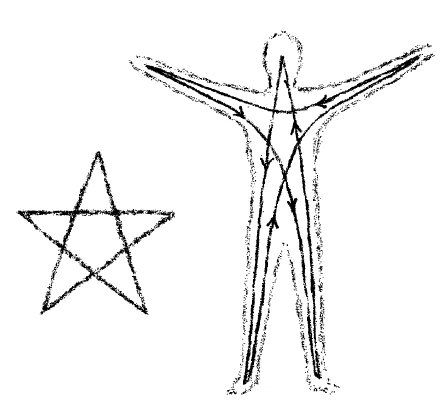
[ 4 ] This current of force is by no means the only one in the etheric body; there are many others. It is specifically to this current of force that human beings owe their upright posture. Animals are bound to the earth by their front limbs, and we do not observe such a current in animals. With regard to the shape, form, and size of the human etheric body, it can be said that its upper parts are a perfect likeness of the physical body. The situation is different with its lower parts, which do not correspond to the physical body. The relationship between the etheric body and the physical body is based on a great mystery that sheds deep light on human nature: the etheric body of the man is feminine, that of the woman is masculine. This explains the fact that we find much that is feminine in every man, and much that is masculine in every woman. In animals, the etheric body is larger than the physical body. Thus, for example, the clairvoyant sees the etheric head protruding above the horse’s head in the shape of a cap.
[ 5 ] There is something within a human being that is much closer to them than blood, muscles, nerves, and so on. These are the sensations of pleasure and suffering, joy and pain—in short, everything that a human being calls their inner self. In esoteric science, this is called the astral body, which is the only thing a human being has in common with animals.
[ 6 ] Just as a person born blind has only an incomplete understanding of the world around them and the world of colors and light does not exist for them, so too is the average person in the same position with regard to the astral world. It is just as real, permeating and surrounding the physical world, but it is not perceived by them. When a person’s astral sense is awakened, the astral world becomes visible to them. The significance and importance of this moment in human development, however, is far greater than when a person born blind regains their sight through surgery. Yet each of us is familiar with this astral world, albeit imperfectly, for every night our astral body is transported into this world. We rest in the astral world to restore the harmony of the astral body, for fatigue, viewed from a standpoint of Spiritual Science, is merely a disharmony in the physical and astral bodies. A parable might shed light on the relationship between the physical and astral bodies. If we take a sponge, cut it into a thousand pieces, and let the contents of a glass of water be absorbed by these small pieces, we have a parable for the average person while awake. If we squeeze out the little sponges and collect the water back into its container, it coalesces into a uniform mass. Thus the human astral bodies, which during the day were individualized like the absorbed drops of water, enter into the common astral substance and are strengthened and invigorated within it. This is evident in the morning by the fact that fatigue has been dispelled. As long as a person is not a seer, their astral body, which has emerged during sleep, mingles with the other astral bodies. For the seer, however, the circumstances are different.
[ 7 ] Individual plants do not have their own astral body; rather, the entire plant kingdom shares a common astral body—that of the Earth. The Earth is a living being, and plants are its limbs.
[ 8 ] The fourth element of the human being is the “I.” The word “I” can only be spoken by a person to themselves. This word can never reach our ears from outside to designate us. When this “I” resounds within a being, then the God within that being speaks. The animal, plant, and mineral worlds are in a different position with regard to the “I.” An animal, for example, can no more say “I” to itself than a finger of our hand can say “I” to itself. If the finger wanted to refer to its “I,” it would have to point to the human “I”; similarly, the animal would have to point to an “I” belonging to a being living in the astral world. All lions, all elephants, and so on have a collective group “I”—that is, a lion “I,” an elephant “I,” and so on.
[ 9 ] If the plant were to point to its own “I,” it would have to refer to a collective “I” at the center of the Earth, in the mental world. It is well known that when an animal is pricked, it feels pain. With plants, it is different, and the seer can tell us that picking flowers or cutting grain gives the earth the same pleasant sensation as milking does for a cow. But if the plant is torn out by the roots, it is as if a piece of flesh were cut out of an animal. This tearing out is experienced as pain in the astral world.
[ 10 ] If one were to ask: Where is the “I” of the mineral world? — one would no longer be able to find such a being, forming a central point, in the spiritual world. Spread everywhere as the force of the entire cosmos, the “I” of minerals is to be found in the super-spiritual world, known in theosophy as the higher Devachan world.
[ 11 ] In Christian esotericism, the world in which the I of animals resides—the astral world—is referred to as the world of the Holy Spirit; the world in which the I of plants resides—the spiritual or devachanic world—is referred to as the world of the Son. When the seer begins to feel in this world, the “Word,” the Logos, speaks to him. The world of the mineral ego, the super-spiritual world, is called the world of the Father Spirit in the Esoteric Doctrine.
[ 12 ] Human beings are creatures in a state of constant development; we have now come to know all four aspects of their nature. These are what Pythagoras referred to in his school as the “lower fourfold.” The savage, the civilized, the idealist, the saint: all possess these four aspects. The savage, however, is a slave to his passions; the civilized person no longer follows his instincts and desires indiscriminately; the idealist does so even less, and the saint has become completely master of them.
[ 13 ] The ego works on the astral body and separates a part from it. This part grows larger and larger in the course of human development, while the inherited part becomes smaller and smaller. In a figure like Francis of Assisi, the entire astral body has been worked through and transformed by the ego. This astral body, transformed by the ego, constitutes the fifth member of human nature: the Spirit-Self, or Manas.
[ 14 ] The ego, however, can also gain mastery over the etheric body or Life-Body. The part of the etheric body transformed by the ego is called the Life-Spirit or buddhi. The impulses of art and religion act to transform the etheric body, the latter to a particularly strong degree because it is repeated daily; and repetition is the magical power that transforms the etheric body. In this sense, conscious work in the secret training has the strongest effect, and meditation and concentration are the means employed here. The speed of the transformation of the etheric body and the astral body show a similar ratio to that of the hour hand to the minute hand on a clock. If one succeeds in changing even the slightest aspect of one’s temperament—which depends on the conditions of the etheric body—this is worth more than the acquisition of even the most ingenious theories.
[ 15 ] The greatest power is required to consciously transform the physical body. The means to do so are taught only in the secret school. It can only be hinted at that the regulation of breathing marks the beginning of this transformation. The physical body, consciously transformed by the I, is called the Spirit-Man or Atma. The power to transform the astral body flows to us from the world of the Holy Spirit. The power to transform the etheric body flows to us from the world of the Son or the Word. The power to transform the physical body flows to us from the world of the Father Spirit or the Divine Father.