

Human Development and Christ-Knowledge
GA 100
21 November 1907, Basel
Translated by Steiner Online Library
The Gospel of John VI
[ 1 ] Among the most important secrets of all secret schools, even the Dionysian ones, is the so-called numerical secret. No one can read a secret writing who is not able to decipher the numerical secret. Where numbers appear in religious documents, there is always a profound meaning behind them. The School of Pythagoras is also based on the secret of numbers. Even if it is true that the letter kills, one must still attach a certain value to the letter when interpreting secret writings, otherwise one runs the risk of interpreting the spirit one wants in it into this writing. In the Gospel of John we find manifold numbers with secret meaning. In the fifth lecture, there was talk of the three women who stood at the cross, of the virgin mother Sophia, Mary and Magdalene. In today's lecture, we will first take a different numerical consideration as a basis.
[ 2 ] Let us first recall the conversation of Christ Jesus with the Samaritan woman (chapter 4, 7ff.). Christ speaks the significant words: “You have had five husbands, and the one you have now is not your husband.” And once again the number five appears, in the healing of the man who had been ill for thirty-eight years (chapter 5,5). The pool Bethesda has five halls. We want to go into the meaning of this mystical number five in more detail. Let us consider the human essence in the context of the evolution of humanity. As we have seen, the human being is composed of nine parts, but these can be traced back to seven. In the evolution of man, these seven bodies gradually unfold. In today's man, not all seven members have been developed. The average person has developed to the consciousness soul, while the spirit self is only beginning to unfold. Let us go back to the point in the evolution of mankind when man learned to consciously say “I” to himself. This point in time was preceded by the ancient Atlantean epoch, in which people were still endowed with dim clairvoyant powers. In the region of Atlantis, which corresponds to present-day Ireland, there lived an Atlantean people who had progressed so far in their development that the covering of the etheric and physical heads had formed in them.
[ 3 ] This was the most advanced people at that time, and it was destined to become the bearer of future development. A highly advanced spirit, Manu, led this group towards the east, through present-day Russia to Central Asia, in the area of the present-day Gobi Desert. There a colony was founded, from which groups were sent out in various directions to spread the culture of this group. This happened at the time when the Atlantic continent was gradually sinking. Present-day Africa and Europe gradually emerged from the floods. Another group of Atlanteans moved west from their settlements and formed the original population of present-day America, who were found by the Europeans when they were rediscovered. A group also moved to the north of Europe. All these groups have preserved their clairvoyant memories in ancient legends and myths. Once we understand these legends and myths correctly, much of the darkness that still hangs over human history will be illuminated; then we will learn to understand many things that are now incomprehensible. However, we must not be pedantic in our explanation of these legends and myths. We must be aware of the complicated way in which clairvoyant experiences and imagination have played a role in the creation of these ancient legends. In this time of the first emergence of the self in the personality, man lived to a greater extent in his environment than later. He also perceived not so much the external outlines of the objects surrounding him as their inner qualities and the relationship they assumed to him, whether they were useful or harmful, friendly or hostile. The more the self was enclosed in the human personality, the more clairvoyant abilities decreased, while the forms of the outside world more and more lit up before the physical eye. When we imagine this fact, we can easily understand that the entry of the self caused a tremendous change. Before, man did not see his own body, but now he began to call it his self.
[ 4 ] In the last days, Atlantis was a land of fog, covered in dense mist; there was no alternation of rain and sunshine, nor was there any appearance of the rainbow. This could only come about in the post-Atlantean period, when the fog dispersed. This event has remained alive in the popular consciousness as the saga of Heimdall and in the story of Noah and the Ark. The memory of the land of fog has been preserved in the Nordic term Niflheim, meaning 'fog-home'. The Nordic peoples have also preserved the impact of the ego on the human personality in the saga of the Nibelungs. There, the ego is represented under the symbol of gold. Gold was dissolved in water, but it contracted into the ring, the treasure of the Nibelungs: the ego, which had previously been scattered throughout the world, contracted into the solid human form. In Wagner's treatment of this saga, one can clearly perceive the unconscious perception of the creative artist. Wagner did not have full consciousness of what he was creating in his work, but he was guided by subconscious knowledge. For example, Wagner may have characterized the conscious ego in the pedal point that runs through the entire overture of the opera “Rheingold”.
[ 5 ] Over in the Far East, under the leadership of a highly developed individuality, the first culture had emerged, as the ancient Vedas still bear witness to. The first impact of this culture was felt in the south in the ancient Indian culture. In the ancient Indian myths and legends, the religious records, the reports of these facts are preserved and can be read by clairvoyants. Some seemingly contradictory facts are revealed as the deepest truth. This culture still had clear memories of the earlier ancient clairvoyance and still felt a deep longing for it as for a precious, unfortunately lost, commodity. People were still so imbued with the reality of the spiritual world that they called the physical world maya, or illusion. Therefore, they also tried to regain this lost good by constantly turning their gaze away from the earthly and towards the spiritual. This is the origin of the yoga exercises, which seek to lead to the spiritual world by dampening the consciousness. They wanted to return to the old state of twilight; they sought the way that leads back to the lost paradise. During the entire Atlantean period, the external world was only perceptible to people in blurred outlines. The Atlanteans still lived predominantly in the spiritual world. For the spiritual researcher, the entire post-Atlantean period signifies only a gradual conquest of the physical plane. The first post-Atlantean cultural epoch, the Indian, had little sense of what is out there in physical nature, which was considered an absolute illusion by the initiates, from which they sought to arrive at the only reality, the spiritual reality.
[ 6 ] The second impact was the ancient Persian culture. The Persian is already closer to the outside world than the Indian; he knows the phenomenon of good and evil, represented by the gods Ormuzd and Ahriman. He seeks to ally himself with the former in order to fight the latter. The earth is a field of work for him to integrate the spirit into physical existence. The third cultural epoch is the Egyptian-Assyrian-Chaldean-Babylonian culture. Man has taken a further step forward in conquering the physical plane. For the Persian, the world was still a physically undifferentiated field of work. Now, man is already applying his knowledge to make the forces of the soil subservient to him. He knows geometry in order to divide up his land; his gaze also goes beyond the earth to the stars, and so astronomy arises.
[ 7 ] The fourth is the Greco-Latin cultural epoch. Whereas previously, in science, man was concerned with external culture, he now incorporates his own inner being, what is specifically human, into matter. We see our own form reappear in the works of art we create; in the epics and dramas we write, we describe our own psychological characteristics. The Roman is the citizen who projects his own laws and thus develops the state and jurisprudence. In the fifth era, in which we still live, man has made even more progress in mastering the external world. Our era signifies the deepest descent of spirit into matter since the Atlantean times. This descent had to come about if humanity was to progress. Only after spirit has descended completely into matter can its ascent begin again. Our era has developed a great deal of science, with the help of which we can control the most diverse forces of nature. In primeval times, when man crushed his grain in a primitive way between two stones, it did not take much spiritual effort to satisfy his basic needs. It is quite different in our time. Just think of the tremendous expenditure of spiritual power that is necessary to satisfy the material needs of modern man. We have locomotives, steamships, telephones, electric light. An enormous amount of spiritual power has been invested in matter here. But the spiritual interests of man recede completely into the background. We see, then, that the whole spiritual development of humanity in the post-Atlantic period signifies a descent of the human spirit into matter. The purpose of this descent, however, is to overcome matter, this great opponent of the spirit. For after the deepest descent, an ascent to conscious spiritual life must now begin.
[ 8 ] We can depict the course of human history in the post-Atlantean period with the curve on the right.
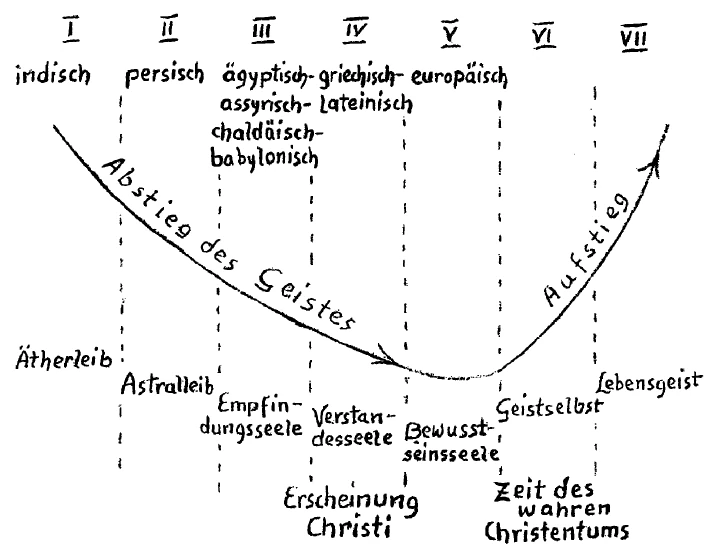
[ 9 ] The force that is to effect this ascent is the power of Christianity. In the middle of the fourth cultural epoch, long before the lowest point of the descending line is reached, the star of Christianity rises. Christ Jesus appears as the exalted personality who brings humanity the strength for the later ascent into the spirit. All previous cultural epochs can also be seen as a preparation for Christianity. In the fifth cultural epoch, Christianity has to endure the most difficult test, as materialistic thinking obscures the spiritual truths of Christianity. In the sixth era, Christianity will unite humanity in the great brotherhood, and the forerunner of this coming era is to be seen in Theosophy, which prepares the spiritualization of humanity. The teachings given to humanity in Christianity are so profound, so full of wisdom, that no coming religion will be able to replace or displace Christianity. Christianity has the ability to adapt to all future forms of civilization.
[ 10 ] Another aspect of human development should also be considered. During the Atlantean period, the physical body was formed, and when the Atlantic continent was flooded, man possessed approximately the same shape that he has today. Now the development of the spiritual limbs began. In the Indian cultural epoch, the etheric body was developed. The Indian people, as the first cultural branch of the post-Atlantic period, were very receptive to the spiritual life. This is connected with the special development of the etheric body.
[ 11 ] The following could be inserted as an aside: Today's European culture is very different from both ancient Indian and present-day Indian culture, and so it is understandable that the means and ways by which an Indian and a European lead a spiritual life must be different. The yoga exercises that are beneficial for the Indian are unsuitable for the European. The paths of initiation are adapted by the masters who give them to the respective stages of development of humanity. What is an excellent method for one stage can be quite disadvantageous for another. It is not without reason that religions have also replaced each other. Even if all of them contain a common core of truth, the different expressions of this truth are conditioned by the differences between the cultural epochs. A tree is a complete whole from root to flower, and yet the root needs different nourishment from that needed by the leaves and flowers. Likewise, for humanity in the various cultural epochs, different methods of religion and initiation are required.
[ 12 ] In Persian culture, the astral body comes to development. In the Egyptian-Assyrian-Chaldean-Babylonian culture, the sentient soul develops in the astral body. In the Greek-Latin culture, the mind soul is developed. Our own culture develops the consciousness soul. In the sixth period, the spiritual self, which is only present in the germinal system today, will develop. It needs the tremendous driving force of the Christ-spirit to bring this germ to development. True Christianity will only flourish when the spirit-self is developed. Then humanity is preparing to receive the Buddhi, the spirit of life. Initially, only a small group of people will develop this power within themselves, but they will achieve a wonderful spiritual life. Today, Christianity is only at the beginning of its development. Those who are preparing themselves today for the training of the spirit self within will make this deeper, spiritual Christianity more and more accessible to humanity in the next period.
[ 13 ] We see how in the third age a small group, the Jewish people, prepare the conditions that make the appearance of Christianity possible; how in the fourth age the power of Christ penetrates into the physical world; how in the fifth period, the greatest descent of humanity into the physical world takes place; and how, after humanity has gained mastery over this physical world, in the sixth period humanity acquires an even greater power and ability to absorb the spiritual life that the Christ-Spirit has brought. Christ appears as the first-born, the man who has gone far ahead of his time, who has already reached the stage which the rest of humanity will only reach in the sixth period. The fifth period is the most material of human development.
[ 14 ] The spiritual perceptions form the basis of the physical conditions and every illness of the body is the expression of some spiritual aberration. Thus leprosy, the terrible disease of the Middle Ages, was an expression in the physical for the fear that the European peoples had of the Huns. The Huns were degenerate descendants of the Atlantean race. Their physical bodies were still sound, but their astral bodies were already permeated with putrefactive matter. Fear and terror are an excellent breeding ground for the putrefactive substances of the astral plane. Thus these putrefying substances of the Atlantean tribes were able to take hold in the astral bodies of the European peoples and from there caused leprosy in the physical body in later generations.
[ 15 ] Everything first lives in a spiritual way, in order to express itself later in the physical body. Even today's nervousness is only a consequence of the materialistic attitude of our time. The wise guides of humanity know that if the high tide of materialism were to continue, great epidemics of nervous diseases would arise among us; children would already be born with trembling limbs. That is why the theosophical movement was brought into the world, to save humanity from the dangers of materialism. Therefore, anyone who spreads materialistic thoughts and feelings is promoting these devastating diseases; anyone who fights materialism fights for the health and developmental capacity of our people. The individual is unable to contribute to his or her own health; he or she is a member of the whole of humanity and draws the substances for his or her sustenance from the source common to all people. Those who look more deeply into the laws of human development must watch with a bleeding heart as the individual suffers and how his suffering is only an expression of the spiritual aberration of all humanity. Theosophy is less called upon to help the individual person than to give the whole of humanity a spiritual uplift and thereby work for the physical recovery of humanity.
[ 16 ] In the sixth and seventh epochs, through the power of Christ, the spirit self and the life spirit will develop in those who lean on Christ. These will at the same time attain healthy thinking and healthy feeling. Christianity brings great health and great healing. The life force of Christ overcomes all disease and death. The human body has developed out of the liquid element, and therefore in spiritual science the liquid element is regarded as the bodily element. The five halls surrounding the Pool of Bethesda represent the five epochs which man uses to penetrate deeper and deeper into physicality, and at the end of which he has completely fallen prey to matter. Only when these five periods have been traversed can the person become healthy. Those who have fallen prey to these five halls cannot be cured unless the great Healer, the Christ, approaches them. Then what is described in the fifth chapter of the Gospel of John will happen. Thus, the description of the man who was ill for thirty-eight years is a prophetic pre-announcement of what will happen in the sixth epoch, when man will no longer need remedies because he will be his own healer.
[ 17 ] At the beginning of the post-Atlantean period, we still find remnants of blood relationship. The words of Christ: “Whosoever doth not forsake father and mother... cannot be my disciple,” point to the stage of humanity in the sixth age. Then, in place of the spirits of the people, the tribal and racial spirits, the one general spirit of humanity will prevail. Then man will no longer be the son of his tribe or people, but the son of humanity, the son of man. Here again, Christ is the first who truly deserves this name (John, chap. 3, 13,14). He already behaved at that time as men will behave when they are sons of men.
[ 18 ] This is expressed by the fact that Christ goes to the Samaritan woman — Samaritans had no community with the Jews. What man has within himself, what makes his development possible, is something feminine, passive, in relation to the spirit, which represents the fertilizing, the masculine, active principle. The consequence of this constant influence of the male principle on the female is first the development of the etheric body, then of the astral body, the sentient soul, the intellectual soul and the consciousness soul. In the latter, the spiritual self then takes shape. This is indicated in the conversation of Christ with the Samaritan woman (ch. 4,18) with the words: “You have had five husbands, and the one you have now is not your husband.” The five husbands that the woman has had are the five spiritual bodies that have affected the physical body, and the sixth, the spirit self, is no longer the man in the old sense. The other five are lower, more transient stages of development, while the sixth, the spirit self, represents the divine, the eternal. Thus, in the conversation with the Samaritan woman, we also see an announcement of the coming time through Christ Jesus.
[ 19 ] While the five bodies require external purification, the spirit self will keep the person himself pure. The body of Christ is already filled with purity. He also wants to purify humanity and therefore goes and cleanses the temple of merchants and money changers (ch. 2, 14-22), that is, He cleanses the temple of the Holy Spirit, the body of man, from the lower principles attached to it and enables it to receive the spirit.
[ 20 ] These explanations should not, however, lead to the idea that the descriptions in the Gospel of John are to be understood only as symbols. In ancient times, the assignment of names was not something arbitrary, but strictly adapted to the character of the personality. Just as it is true, for example, that the three women who stood by Jesus' cross symbolized the three qualities of consciousness, mind and sentient soul, it is equally true that these three persons stood bodily under the cross. When we read the Gospel of John, we are therefore looking at both symbolic images of what will be realized on this earth in the next age, and at something that really happened at the beginning of our era. The historical facts are all set up by the wise powers guiding humanity as symbols of the future development of humanity.