

The Influence of
Spiritual Beings on Man
GA 102
1 June 1908, Berlin
Translated by Steiner Online Library
Eleventh Lecture
[ 1 ] It was, after all, somewhat of a risky territory that we ventured into last time, by directing our attention to certain entities that certainly exist within our reality as spiritual beings, but which nevertheless, in a certain sense, fall outside the regular course of evolution, and whose actual significance lies precisely in the fact that they fall outside of evolution in a certain sense. It was the realm of the elemental beings. We have considered the elemental beings, whom the enlightened mind of our present age naturally regards as the height of superstition, but who, precisely because of the position they occupy in the cosmos, will play a significant role in a not-too-distant future of our spiritual development. We have seen how such elemental beings are formed, being, as it were, irregular, offshoots of group souls. We need only recall what we said at the end of the last lecture, and we will immediately have the nature of such elemental beings before our mind’s eye. We have pointed to one of the most recently formed types of these elemental beings. We have pointed out how a group soul corresponds to every animal form or, if we wish to speak in a rough sense, to a sum of similarly formed animal beings. We have said that these group souls play, so to speak, the same role in the astral world as our human soul—insofar as it is endowed with an “I”—does in the physical world. In fact, the human “I” is a group “I” that has descended from the astral plane to the physical plane. Through this, it has become an individual “I.” The animal “I’s” are still regularly found on the astral plane today, and what we have here on the physical plane as individual animal beings possesses only a physical body, an etheric body, and an astral body on the physical plane, while the ego resides in the astral world—but in such a way that animals of the same form are, so to speak, the members of the group-ego of these animals. We can thus also imagine how what is called birth and death in human life does not have the same meaning for animals. For when an individual animal dies, the group soul or the group-I remains alive. It is just as if, assuming that were possible, a human being were to lose a hand and have the ability to reattach that hand. His ego would not say: I have died through the loss of the hand—but rather it would feel as though it had renewed a limb. In the same way, the group-I of the lions renews a limb when a single individual lion dies and is replaced by another. Thus we can understand that birth and death do not have the same significance for the group soul of animals as they do for human beings in the present cycle of development. The group soul of animals experiences transformations, metamorphoses, knows, so to speak, the severing of limbs that then extend into the physical world, the loss of these limbs, and their renewal.
[ 2 ] But we have said that there are certain animal forms that go too far in this severing, that are no longer capable of sending back to the astral plane everything they bring down to the physical plane. For in a dying animal, that which falls away must be completely absorbed into the surrounding world. Whereas that which spiritualizes and animates the animal must flow back into the group soul, so that it may then be extended anew and grow into a new individual. Now, there are certain animal forms that cannot send everything back to the group soul, and these remaining elements, which have been severed and torn away from the group soul, then lead an isolated existence as elemental beings. And since our evolution has passed through the most diverse forms and stages, and such elemental beings have been severed at every stage, you can well imagine that we have a large number of such types of elemental beings around us in what we call the supersensible world surrounding us.
[ 3 ] If, for example, an enlightened person says: People speak to us of elemental beings called sylphs or lemures; such things do not exist! — one would have to give him a rather strange and paradoxical-sounding answer: You do not see these things because you close yourself off from the development of those organs of perception that would lead you to recognize these beings. But ask the bee, or, in other words, the soul of the beehive! It could not close itself off from the existence of Sylphs or Lemures! For the elemental beings designated by these names dwell in very specific places, namely where a certain contact between the animal kingdom and the plant kingdom takes place, and even there not just anywhere, but in places where this contact occurs under certain conditions. When the ox eats grass, there is indeed also a contact between the animal kingdom and the plant kingdom; but this is, so to speak, a sober, regular one, which lies entirely within the regular course of evolution. On an entirely different page of world evolution lies the interaction that takes place between the bee and the flower, precisely because the bee and the flower are much further apart in their organization and subsequently come together again, and because in the interaction of bee and flower—though only for the occultist—a truly wondrous power is developed. It belongs—if one may use the expression, though we have so few apt terms for these subtle things—to the interesting observations of the spiritual-supernatural worlds: that peculiar auric sheath which always arises when a bee or another such insect sucks on a flower. The peculiar, strange experience that the little bee has when it sucks on the flower is not merely present in the bee’s chewing apparatus or in its body; rather, what arises there as an exchange of flavors between the bee and the flower spreads something like a small ethereal aura. Every time the little bee sips, such a small ethereal aura is present, and whenever something like this arises in the supersensible world, the beings who need such things come near. They are drawn to it; for they find there, to put it crudely once again, their nourishment.
[ 4 ] I have said on another occasion that the question posed by someone who asks, “Where do all these beings you speak of come from?” should not really concern us at all. — Wherever the opportunity arises for certain beings, they are always there. When a person spreads evil, terrible feelings of their own accord, then these terrible, evil feelings are also something that lives around them and attracts beings who are there, waiting just as any physical being waits for food. I once compared it to the fact that there are no flies in a clean room; but if there are all kinds of food scraps in the room, then they are there. So it is with the supersensible beings: one need only provide them with the food. The little bee that sips from the flower spreads a small ethereal aura, and such beings are drawn to it, especially when a whole swarm of bees settles on a tree somewhere and then departs, so to speak, carrying within them the sensation of taste that was there. Then the entire swarm of bees is enveloped in this ethereal aura, but also completely permeated by these spiritual beings, which are called sylphs or lemures. Especially in such border regions, where, so to speak, different realms come into contact with one another, these beings are present, and they truly play a role. For they are not only present when this described fine ethereal aura arises; rather, I would say, they do not merely satisfy themselves, but they also have hunger, and they express this hunger by guiding the animals in question to the relevant sites. They are, so to speak, their guides in a certain sense.
[ 5 ] Thus we see that such beings, who have, so to speak, given up their connection with other worlds to which they were formerly linked, have thereby taken on a strange role. They have become beings who can be put to good use in other worlds. However, when they are used in this way, a kind of organization is established: they are subject to higher beings.
[ 6 ] It was said at the beginning of today’s discussion that human knowledge will, in the not-too-distant future, very much need to know about these beings. In the not-too-distant future, science will take a peculiar course. Science will become more and more, so to speak, sensory-physical, limiting itself solely to a description of external physical-sensory facts. Science will confine itself to the gross material, even though a peculiar transitional state still prevails today. There has indeed been a time of true gross materialism in science. It is not long past. This crude materialism is today regarded as a possibility at most by those who hold the most layman-like views, although only a few thinking minds are striving to replace it with something else. We see a whole host of abstract theories emerging here, in which a coy allusion is made to the supersensible, to the non-physical. The course of events, however, and the force of external sensory facts will completely overturn precisely these strange, fantastical theories that are currently being put forward by those dissatisfied with physical science, and one day scholars will find themselves in a peculiar situation regarding these theories. All the speculations spun about the universality and animacy of this or that world, all these speculations will be swept aside, and people will have nothing left in their hands but the purely physical and sensory facts in the fields of geology, biology, astronomy, and so on. The theories put forward today will be the most short-lived; and for anyone who is able to glimpse even a little into the specific course of science, it becomes clear that the most absolute ode to the purely physical horizon will be there.
[ 7 ] But then the time will also have come when a greater number of humanity’s representatives will be ready to acknowledge these supersensible worlds of which spiritual science or the theosophical worldview speaks today. A phenomenon such as that of the life of bees, in connection with what can be known from the supersensible worlds, offers a wonderful answer to the great mysteries of existence. And from yet another perspective, these things are of great importance: it will become increasingly indispensable for humanity to comprehend the nature of the group souls. For recognizing this nature of group souls will also play a major role in the purely external development of humanity. — If we go back thousands and thousands of years in the course of time, we find that human beings themselves were still beings belonging to a group soul. For the development of the human being on our Earth is a progression from group-soul existence to the individual soul. Humanity advances more and more as the soul, endowed with an “I,” descends into the physical realm, and in the physical realm it has the opportunity to become individual. We can observe various stages in human development. There we will see how the group soul gradually becomes individual.
[ 8 ] Let us go back, for example, to the time of the first third of Atlantean cultural development. There, human life was quite different. In the bodies in which we were incarnated at that time, our souls experienced entirely different processes. We can bring to mind a process that plays a role in human life today—both for the individual and for humanity as a social entity—and which has undergone a tremendous change since that time: the alternation of waking and sleeping.
[ 9 ] In the ancient Atlantean times, you would not have experienced the same alternation of waking and sleeping as you do today. What, then, is the characteristic difference compared to present-day humanity?
[ 10 ] When the physical and etheric bodies lie in bed and the astral body with the I rises, what is called modern consciousness sinks into an indeterminate darkness to the extent that the astral body and the I rise. In the morning, when the astral body and the I re-enter the physical and etheric bodies, the astral body and the I once again make use of the physical organs, and consciousness brightens. This state of daily waking in consciousness and nightly sleeping in unconsciousness did not exist in the past. Rather, if we may use the expression—it does not quite apply to the conditions of that time; we need it for the state in which the human being was connected to his physical body—it was the case that during the day, when he had a day and he was immersed in his physical body, to the extent that was the case back then, by no means saw the external physical entities and things within such boundaries as we do today; rather, he saw everything with indefinite contours blurring outward, as if you were walking through the streets on a foggy evening and saw the streetlights surrounded by a misty aura. That is how it was for the human being of that time with all things.
[ 11 ] And if that was the state of the day, what was the state of the night? When a person went out of the physical body and etheric body during the night, absolute unconsciousness did not come over them. It was merely a different kind of consciousness. In those days, people still perceived the spiritual processes and spiritual beings around them, no longer exactly as in true clairvoyance, but as a last remnant of the old clairvoyance. People lived in a world with blurred, nebulous boundaries during the day. At night they lived among spiritual beings that surrounded them just as everyday objects do today. Thus there was no strict boundary between day and night, and what legends and myths contain are not products of arbitrary popular imagination, but memories of the experiences that ancient humans had in the supersensible world during their state of consciousness at that time. Wotan or Zeus or other supernatural, spiritual-divine beings recognized by this or that people are not figments of the folk imagination, as is claimed at the armchair of scholarship. Only someone who has never familiarized themselves with the nature of the folk imagination can make such a claim. It does not even occur to the people to personify things in this way. These were experiences in ancient times. Wotan and Thor were beings with whom people interacted just as they interact with their fellow human beings today, and the myths and legends are memories of the times of ancient clairvoyance.
[ 12 ] We must, however, be clear that something else was connected with this immersion into the spiritual-supernatural worlds. In these worlds, human beings did not feel themselves to be individual beings. They felt themselves to be members of spiritual entities; they belonged, so to speak, to higher spiritual entities just as our hands belong to us. The slight sense of individuality that human beings already possessed at that time arose when they immersed themselves in their physical body, when they, so to speak, emancipated themselves for a short time from the circle of spiritual-divine beings. That was the beginning of their sense of individuality. It was at a time in which human beings were quite clear that they possessed a group soul; they felt themselves sinking into the group soul when they withdrew from their physical body and entered the supersensible consciousness. That was an ancient time in which the consciousness of belonging to a group soul, to a group-I, was present in human beings with tremendous strength.
[ 13 ] We are considering a second stage of human development—we will omit the intermediate stages—that stage to which the history of the patriarchs in the Old Testament points. We have already mentioned what actually underlies this. We have mentioned the reason why the patriarchs—Adam, Noah, and so on—had such long lifespans. They had such long lifespans because the memory of these people was quite different from that of modern humans. The memory of modern humans has, in fact, also become individual. People remember what they have experienced since birth—some only from a much later point in time. It was not like that in ancient times. Back then, the things the father experienced between birth and death, the experiences the grandfather and great-grandfather had had, were just as much a subject of memory as one’s own experiences between birth and death. As strange as it may seem to modern humans, it is true that there were times when such a memory existed—one that extended beyond the individual and encompassed the entire bloodline. And if we ask ourselves what external signs there are that such a memory existed, they are precisely names like Noah, Adam, and so on. This does not refer to individual human beings between birth and death. The human being who possesses a memory confined to the span between birth and death gives a name to this individual. In the past, the naming extended as far as memory reached back through the generations, as far as the blood flowing through the generations went.
[ 14 ] “Adam is nothing other than a name that lasted as long as people remembered. Anyone who does not know that naming used to be quite different will not be able to understand the nature of these things at all. In those ancient times, a completely different mediating fundamental consciousness existed. Imagine that the forefather had two children, each of whom had two in turn, the next generation two again, and so on. For all of them, memory extends back to the forefather, and they felt at one in that memory, which, so to speak, converges at a single point up there. The people of the Old Testament expressed this by saying—and this applied to every single adherent of the Old Testament—“I and Father Abraham are one.” There, the individual felt secure in the consciousness of the group soul, in “Father Abraham.”
[ 15 ] The consciousness that Christ has bestowed upon humanity goes beyond this. In its consciousness, the “I” is directly connected to the spiritual world, and this is expressed in the sentence: “Before Abraham was, the ‘I’—or the ‘I am’—was.” Here, the impulse to awaken the “I am” enters fully into the individual.
[ 16 ] Thus we see a second stage in human development, the era of the group soul, which finds its outward expression in the blood kinship of generations. A people that has developed this particularly strongly attaches great importance to always emphasizing: as a people, we have a shared national group soul. This was certainly the case for the people of the Old Testament. That is why the conservatives within this Old Testament people resisted the emphasis on the “I am,” the individual self. Anyone who reads the Gospel of John can grasp this with their hands—with spiritual hands—that this is so. One need only read the account of Jesus’ conversation with the Samaritan woman at the well. There it is explicitly pointed out that Christ Jesus also goes to those who are not blood relatives, who do not belong together through blood ties. Read how remarkably this is pointed out: “For the Jews had no fellowship with the Samaritans.” Whoever can truly go through this step by step, and indeed meditatively, will see how humanity has progressed from the group soul to the individual soul.
[ 17 ] History, as it is practiced today, is conducted entirely on the external level. This history is often a fable convenue today, for it is written from documents. Imagine if something had to be described today based on documents, and the most important documents were lost! Then reports would be based on whatever random, haphazardly assembled documents happened to be available. For things rooted in spiritual reality, no documents are needed; for they are inscribed in the faithful and unalterable Akashic Records. However, it is difficult to read the Akashic Records, because the external documents actually serve as an obstacle to reading spiritual “writings.” But we can see how, even in times very close to our own, that development from the group soul to the individual soul took place.
[ 18 ] Anyone who views history spiritually will have to recognize the early Middle Ages as a highly significant period. Previously, human beings were still, if only outwardly, integrated into various groups. To a far greater extent than modern people can imagine, even in the early Middle Ages, human beings derived their significance and standing—including in relation to their labor—from kinship and other social ties. It followed, so to speak, quite naturally that the son did the same as the father. Now came the age of great inventions and discoveries. The world placed ever greater demands on the purely personal competence of the individual, and people were increasingly torn away from their old ties. We see an expression of this throughout the Middle Ages in the founding of cities, which follow one and the same pattern throughout Europe. Even today, we can distinguish the cities formed according to this pattern from those developed according to a different one.
[ 19 ] In the middle of the Middle Ages, there is again such a progression from the group soul to the individual soul. And when we look into the future, we must tell ourselves that human beings are emancipating themselves more and more from everything related to the group soul; they are becoming increasingly isolated. If you could look back at earlier phases of human development, you would see that those cultures, such as the Egyptian and Roman cultures, are as if cast from a single mold. Today, such a unified culture exists only to a very limited extent. Humanity has now degenerated to the point where not only customs and traditions are individual, but even opinions and beliefs are, and there are even people among us who regard it as a lofty ideal that every person should have their own religion. Indeed, the idea floats in the minds of many that there must one day be a time when there can be as many religions and truths as there are people.
[ 20 ] Humanity will not take this path of development. It would take it if it were to continue following the impulse that arises today from materialism. That would lead to disharmony, to the fragmentation of humanity into isolated individuals. However, humanity will only avoid such a course of development if a spiritual movement like that of spiritual science is embraced by humanity. For what will come to pass? The great truth, the great law, will be realized: that the most individual truths, found in the most innermost way, are at the same time the most universally valid ones.
[ 21 ] I have already pointed this out before: Today, there is general agreement only in mathematical truths; for these are the most trivial of all. No one can say that they find mathematical truths through external experience; rather, one finds them by perceiving everything inwardly. If one wishes to show that the three angles of a triangle add up to 180 degrees, one does so by drawing a parallel line through the apex to the base and folding the three angles together in a fan shape; then angle a = d, b = e, c is equal to itself; and thus the three angles are equal to a straight line, equal to 180 degrees. Anyone who has once grasped this knows that it must be so once and for all, just as one knows, once one has grasped it, that three times three is nine; and I do not believe that this could be discovered by induction.
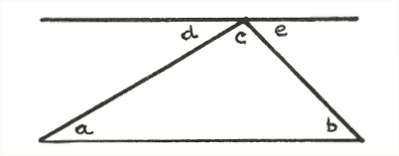
[ 22 ] These most trivial of all truths—the arithmetic and geometric ones—were discovered internally, and yet people do not dispute them. There is absolute agreement on this, because people today have reached the point where they can understand these things. There is no consensus only as long as pure truth is clouded by passions, by sympathy and antipathy. A time will come—even if it is still very far off—when humanity will be increasingly gripped by the realization of the inner world of truth. Then, despite all individuality, and even though each person will find the truth within themselves individually, consensus will prevail. If mathematical truths were not so readily apparent today, passions would still stand in the way of their recognition. If it were up to greed, perhaps some housewives would still vote that two times two is five, and not four. These things are so transparent, so simple, that they can no longer be clouded by sympathy and antipathy. Ever larger spheres will be encompassed by this form of truth, and ever more peace will be able to come to humanity as a result, when truth is grasped in this way. Humanity has outgrown the group soul, and is increasingly emancipating itself from it. If we consider the groups instead of the souls, we have family connections, tribal and national connections, and finally related human races. A group soul corresponds to a race. All these group connections of pre-humanity are ones from which humanity grows out of, and the more we progress, the more the concept of race loses its significance.
[ 23 ] Today we stand at a turning point, and little by little, the concept of race will disappear entirely, to be replaced by something entirely different. People who once again grasp spiritual truth, as it has been characterized, will be brought together through free will. These are the relationships of the future. The relationships of earlier times are such that a person is born into them. A person is born into their people, into their race. Later, we will live in relationships that people create themselves by grouping according to certain criteria, where they form relationships while fully preserving their freedom and individuality. Understanding this is necessary for a proper understanding of an entity such as the Theosophical Society. The Theosophical Society is intended to be a first example of such a voluntary association, although we acknowledge that we have not yet reached that stage today. An attempt should be made to create such a community in which people come together without regard to the old group-soul nature, and there will be many such communities in the future. Then we will no longer speak of racial communities, but of communities formed on the basis of intellectual, ethical, and moral principles.
[ 24 ] Through the fact that people voluntarily allow their feelings to converge, something is formed that goes beyond the merely emancipated human being. The emancipated human being has an individual soul; once attained, it is never lost again. But by coming together in voluntary communities, people group themselves around focal points. The feelings that thus flow together toward a center now in turn give rise to entities that act as a kind of group soul, but in a completely different sense than the old group souls. All earlier group souls were entities that made people unfree. These new entities, however, are compatible with complete freedom and the preservation of human individuality. Indeed, we may say that, in a certain sense, they derive their existence from human unity; and it will depend on the souls of human beings themselves whether they give as many of these higher souls as possible the opportunity to descend to humanity, or whether they do not. The more human beings become fragmented, the fewer exalted souls will descend into the realm of humanity. The more connections are formed, and the more a sense of community is cultivated amidst complete freedom, the more exalted beings will descend to humanity, and the faster the Earth plane will become spiritualized.
[ 25 ] Thus we see that if human beings are to gain any conception at all of future development, they must thoroughly understand the nature of group soulhood; for otherwise it may happen that their individual souls, if they emancipate themselves too long on Earth in isolation, will fail to find their place, will miss the connection, and thereby become a kind of elemental being themselves; and these elemental beings arising from human beings would be of a very evil kind. While the elemental beings arising from earlier kingdoms are very useful for our natural order, the human elemental beings will lack this quality entirely.
[ 26 ] We have pointed out that such isolated entities arise in certain border regions, and they also arise at the boundary, at the transition from group soulhood to free group connections through aesthetic-moral-intellectual connections. Wherever such connections occur, such group entities are present.
[ 27 ] If you could observe certain places, for example springs where there is stone at the bottom and moss grows over it, forming a sort of wall between the plant and the stone, and then the water seeps over it—which is also necessary—you would see that what are called nymphs and undines are something very real; this manifests itself there with particular intensity. And where metals and the rest of the earth meet, there lie whole clusters of those beings called gnomes. A fourth type are the salamanders. They are, so to speak, the youngest generation in the series of all these elemental beings; yet they are nevertheless present in great numbers. For the most part, they are beings who owe their existence to a process of separation from animal group souls. Such beings also seek opportunities to find nourishment, and they find it particularly where the human realm enters into relationships with the animal realm that are sometimes not quite normal, but rather abnormal. Anyone who knows anything about such matters is aware that elemental beings—and quite benign ones at that—develop through that familial relationship between the rider and his horse. In particular, the emotional bonds of certain people with groups of animals give rise to feelings, thoughts, and soul impulses that provide good nourishment for such salamander-like elemental beings. This can be observed particularly in the coexistence of the shepherd with his flock of sheep, and indeed of all herders who live alongside their animals. In the feelings that develop through this intimacy between human and animal, certain salamander-like elemental beings find their nourishment and dwell where such conditions exist. These are also quite intelligent beings who possess a thoroughly natural wisdom. Through these feelings, the shepherd develops abilities whereby these elemental beings can whisper to him what they know; and many of the remedies that originate from such sources have their roots in what has just been explained. It is quite possible that a person is surrounded by such conditions—by subtle spiritual beings who endow him with a knowledge of which our modern intellectuals cannot even dream. All these things have their good reason and can certainly be observed through the methods that occult wisdom can teach.
[ 28 ] Finally, I would like to point out another phenomenon that can show you how certain things, for which only a very abstract explanation is given today, have in many respects sprung from a deeper wisdom. I mentioned earlier that those ancient people in the Atlantean era, when they left their bodies at night, lived among those spiritual beings whom they called the gods. These people were on the path to descending into physical embodiment. But those beings whom they worshipped as gods—for example, Zeus and Wotan—follow a different course of development. They do not descend into physical bodies; they do not touch the physical world. But even there, certain transitions occur. Humanity came into being, after all, because its entire soul and spiritual being solidified into its physical body. In the case of human beings, the entire group souls have descended onto the physical plane, and the human physical body has become an imprint of the group soul. Let us suppose that a being like Zeus, who certainly corresponds to a reality, has, so to speak, only touched the physical plane a little, only reached into it a little. It is as if you were to dip a ball into water and it were just barely moistened at the bottom. In this way, certain beings in the Atlantean era were only touched by the physical world. The physical eyes do not see what remains as spiritual, as astral-etheric. Only the small part of it that extends into the physical is seen. The symbolism in mythology arose from such perceptions. If Zeus has the eagle as his symbol, this stems from the fact that his eagle-nature is the small tip where a being of the higher world touched the physical world. A large part of the bird world consists of severed parts of such developing beings from the supersensible world. And just as with Wotan’s ravens or Zeus’s eagle, so it is everywhere where symbolism is rooted in occult facts. Much will become clearer to you if you consider the beings, workings, and development of the group souls in this way across the various fields.
[ 29 ] I wanted to add this today to our previous remarks in order to have a complete foundation for such considerations.