

The Gospel of John
GA 103
30 May 1908 a.m., Hamburg
Translated by Steiner Online Library
Tenth Lecture
[ 1 ] We were concerned with the whole law of the post-Atlantean development of our humanity, and we sought to understand why the foundation of Christianity had to take place at a very specific time in this post-Atlantean development. We mentioned yesterday at the end of the lecture that the understanding of important questions of the Gospel of John and of Christianity as a whole depends on our having a good grasp of this law of development in the esoteric-Christian sense. Only in this way will we be able to gain a full understanding of the meaning of the words “Holy Spirit”, “Father and Mother of Jesus”. Above all, let us remember that it has become clear to us in the course of the last lectures that post-Atlantean humanity, that is, the humanity to which we ourselves belong in the narrower sense, which developed after the Atlantean flood, is divided into seven subdivisions. I have deliberately avoided using the term “sub-races” because the term “race” does not actually correspond entirely with what we are talking about. We are dealing with periods of cultural development, and what we are still experiencing as a racial law in our present-day humanity is actually an echo of the Atlantean development. The development of humanity that preceded the Atlantean flood, that is, which took place for the most part on the continent between today's Europe and today's America, the ancient Atlantis, we also divide this development of humanity into seven successive stages. The term “racial development” still applies to these seven stages. For these seven successive stages of humanity on ancient Atlantis were still very different from one another physically, internally and externally - the external body also includes the internal configuration of the brain, blood and other humors - whereas there can be no question of the first humanity of the post-Atlantean period, the ancient Indians, being so different from us that we could still apply the term “race” to them. We must always maintain the continuity of Theosophy, and therefore it is often necessary to refer to this old concept of races. But it is too easy to create false ideas by using the word race, because one overlooks the fact that the motive for dividing humanity that we have today is a much more inner one than that which is connected with the expression of race. And even to that which will replace our culture, the culture according to the seventh subdivision, the term race will no longer be allowed to be used at all, because humanity will then be divided according to quite different basic laws.
[ 2 ] From this point of view you must take it when we divide the post-Atlantean period firstly into the old Indian epoch, secondly into the old Persian, thirdly into the Babylonian-Assyrian-Chaldean-Egyptian, fourthly into the Greek-Latin and fifthly into the epoch in which we now live; ours will be replaced by a sixth and a seventh epoch of development.
[ 3 ] So we are now in the fifth post-Atlantean cultural epoch and say to ourselves: Christianity entered the development of humanity in its full depth and significance in the fourth epoch. It has worked as far as mankind of the fifth epoch could be grasped, and we will predict prophetically how it will continue to work, as far as it is possible to predict from spiritual science. But we already mentioned yesterday that the mission of Christianity was prepared in the third cultural epoch. The Egyptian culture belongs to the third cultural epoch, and out of its womb the confessionalism of the Old Testament led the Hebrew cultural development in such a way that Christianity was born, so to speak, out of the womb of the third cultural epoch, which then came fully into the world for the fourth epoch with Christ Jesus. We can therefore say that humanity in the post-Atlantean period experienced a certain spiritual influence in the third cultural epoch. This influence continued into the fourth epoch; there it concentrated in Christ Jesus, continued into the fifth cultural epoch, into ours, and will work from ours into the sixth epoch, which will follow ours. And now we must understand exactly how these effects have happened.
[ 4 ] Let us remember exactly that in the course of human evolution the various basic parts of man experience their development. Let us remember how it was in the last Atlantean period. We have explained that the etheric head sank into the physical body, that man received the first disposition to say “I-am” to himself. When the Atlantean flood occurred, the physical body of man was permeated by the power of this “I-am”; that is, man was then ready to have prepared the physical tool for the I-consciousness or self-consciousness. So that we understand ourselves exactly: If we went back to the middle of the Atlantean period, no human being would have been able to develop such self-consciousness as to pronounce “I am an I!” or “I am” from within himself. This could only occur if that part of the etheric head of which we have spoken united with the physical part of the head. At that time, until the sinking of Atlantis by the Atlantean flood, man formed the first thing that had to be formed in order to be able to become a bearer of this self-consciousness: he formed the physical brain and the other formations of the body. So the physical body became mature enough to be a carrier of the ego by the time of the Atlantean flood.
[ 5 ] So we can ask: What was the mission of Atlantism? The mission of Atlanteanism was to inculcate the ego in man, to imprint it on him; and this mission then carries over into our time via the Atlantean Flood, which is described as the Flood. But in our post-Atlantean cultural epoch something else must come: Manas or the spirit-self must slowly enter the human being. With our post-Atlantean time the influence of manas or spirit-self begins. So we know that when we have gone through various embodiments in our sixth and seventh epochs, we will already be overshadowed to a certain degree by manas or spirit-self. But it requires a longer preparation for the human being to become a suitable tool for this manas or spirit self. He had to become an ego-bearer in the true sense beforehand - even if it took thousands of years. He had to make not only his physical body into an instrument of the ego, but also the other members of his being.
[ 6 ] In the first cultural epoch of the post-Atlantean period, man first makes his etheric body into an ego-bearer, just as he had previously made his physical body into one. This was the old Indian culture. It consists essentially in the fact that man acquires the ability to have not only a physical tool for the ego, but also an etheric body suitable for this purpose. That is why the first epoch, the old Indian culture, is described in this table as “etheric body” (see page 181).
[ 7 ] If we now want to consider the further development of these cultural epochs in relation to the human being, we must not only superficially assume the soul as an astral body, but go to work more precisely and take as a basis the structure of the human being that you will find in my “Theosophy”. There you know that we do not merely distinguish in general the seven members of the human being, but that the middle part of the human being is again divided into the sensory body, the sensory soul, the intellectual soul and the consciousness soul; and then we have the spirit self, the life spirit and the spirit man. We usually distinguish only seven members; the fourth, which we summarize under the word “I”, must be further subdivided because it is structured in this way in human development.
[ 8 ] What is now formed during the ancient Persian cultural epoch is the actual astral body or the sensory body; it is the carrier of the actual powers of activity of the human being, therefore the transition from Indianism to Persianism consists in the transition to the working of matter. The raining of the hands and what is connected with it, the transition to work, that is what characterizes this cultural epoch. Ancient India was inclined, to a much greater degree than one might imagine, not to rain the hands, but to rise in contemplation above the material to the higher worlds. One had to immerse oneself deeply if one wanted to remember the previous state. Therefore, for example, the Indian yoga initiation generally consists of the etheric body receiving special care and training.
[ 9 ] Now we move on. The culture of ancient Persia consists in the lowering of the ego into the sentient body. The culture of the Assyrians, Babylonians, Chaldeans, Egyptians consists in the fact that the ego ascends into the sentient soul. What is the sentient soul? That which is primarily directed outwards in the sentient human being, whereby the perceiving human being is active with the eyes and the other senses and perceives the ruling spirit outside in nature. Therefore, at this time the eye is directed towards the material things spread out in space, towards the stars and their course. That which is outwardly spread out in space has an effect on the sentient soul. In the Egyptian-Chaldean-Assyrian-Babylonian period, little of what one could call inner personality and intellectual culture was already present in man. Even people today no longer really imagine what the Egyptian wisdom of this era was actually like. This wisdom was not actually thinking, speculation, as it came to be later; rather, when man looked out, he received the law that he read outside with his senses. It was a reading of the laws, not a science of concepts, a science of perception, a science of sensations.
[ 10 ] If our scholars were to reflect - after all, it is a hard sentence - they would be pointed to what has just been said with fingers, so to speak, but with spiritual fingers. For if no thought has been given to the actual inner powers of understanding, this means no more and no less than that there could not have been an actual conceptual science, a logical science, at that time. Nor did it exist! History proves to you that the actual founder of logic is Aristotle. If there had been a logic, a conceptual science in the past - these people would have been able to write it down in a book.
[ 11 ] Logic, that which is thought in the ego itself, where one connects and separates concepts in the ego, where one judges logically, not reads off things, that only occurs in the fourth cultural epoch. That is why we call this fourth epoch the epoch of the intellectual soul.
[ 12 ] And we ourselves are in an epoch - humanity entered this epoch around the middle of the Middle Ages, from the 10th, 11th, 12th century onwards - we ourselves are in the epoch of the entry of the ego into the consciousness soul. It only came that late. The ego only entered the consciousness soul around the middle of the Middle Ages. This too could very easily be proved historically, and one could shine a light into every corner if one had time to point out some of the things that come into question. At that time, people were imbued with a very specific concept of individual freedom, of individual ego efficiency. If you look back to the first period of the Middle Ages, you would still find everywhere that man is valid in a certain way because of the way he is placed in society. One inherits status and rank and dignity from one's father and relatives, and it is by virtue of these impersonal things, which are not consciously connected with the ego, that one acts and works in the world. It was only later, when trade expanded and inventions and modern discoveries came, that the ego-consciousness began to expand, and we can see that everywhere in the European world the outer images of this consciousness-soul appear in a very definite kind of town constitutions, city constitutions and the like. From the history of Hamburg, for example, one could easily demonstrate how these things have developed historically. What was called a “free city” in the Middle Ages is the outward impression of this breathing of the self-conscious soul through humanity. And if we now let our gaze wander into the future, we say: We are now in the process of forming this personality consciousness in the conscious soul. All the demands of recent times are nothing other than that people unconsciously bring out the demands of the consciousness soul.
[ 13 ] But if we let our gaze wander further, we see something else in the spirit. In the next cultural epoch man will ascend to Manas or the spirit-self. That will be a time in which people will have a common wisdom to a far greater degree than today, will be immersed in common wisdom, so to speak. Something will begin to be felt of the fact that man's most primal nature is at the same time the most universal. That which in today's sense is understood as man's individual good is not yet an individual good on a high level. Today, individuality, the personality of man, is still to a great extent connected with the fact that people argue, that people have different opinions and claim: if one were not allowed to have different opinions, one would not be an independent person. Precisely because they want to be independent people, they have to come to different opinions. But that is a subordinate point of view. People will be at their most peaceful and harmonious when they are at their most individual. As long as people are not yet completely overshadowed by the spirit self, there will be opinions that differ from one another. These opinions are not yet felt in the true innermost being of man.
[ 14 ] Today there are only some precursors for the things felt in the true innermost being. These are mathematical and geometrical truths. You can't vote on them. If a million people were to tell you that 2x 2= 5, and you yourself admit within yourself that it is 4, you know it, and you also know that the others must be mistaken - just as if someone were to claim that the three angles of a triangle do not add up to 180 degrees.
[ 15 ] This is Manas culture, when the sources of truth are increasingly perceived in the individual, personal aspects of man, which have become strong, and when at the same time what is perceived as higher truth also agrees from person to person, like the mathematical truths. People already agree on these today because they are the most trivial truths. With regard to the other truths, people argue, not because there can be two different correct opinions about the same thing, but because people have not yet come so far as to recognize and fight down everything that divides them in terms of personal sympathy or antipathy. If, in the case of simple mathematical truths, one's own opinion still came into consideration, many housewives would perhaps vote that 2x 2=5 and not 4. For those who look deeper into the nature of things, it is simply impossible to argue about the higher nature of things; there is only the possibility of developing upwards towards it. Then the truth found in one soul coincides exactly with the truth in the other soul; then there is no more arguing. And that is the guarantee of true peace and true brotherhood, because there is only one truth, and this truth really has something to do with the spiritual sun. Think of how the individual plants grow in order; each plant grows towards the sun, and there is only one sun. So when, in the course of the sixth cultural epoch, the spirit self will move into people, there will actually be a spiritual sun to which all people will turn and in which they will agree. This is the great perspective that we can look forward to in the sixth epoch. And in the seventh epoch the spirit of life or the buddhi will enter our development in a certain way.
[ 16 ] These are distant futures into which we can only glimpse. But now we realize that this sixth cultural epoch will be a very important one, for it will bring peace and brotherhood through common wisdom. Peace and brotherhood through the fact that then the higher self, at first in its lower form, as spirit-self or Manas, will sink in, not only for individual selected human beings, but for the part of humanity in normal development. A union of the human ego, as it has gradually developed, with the higher ego, with the unifying ego, will then take place. We can call this a spiritual marriage - and in Christian esotericism this is what the connection of the human ego with the manas or the spirit self has always been called. But things are deeply interrelated in the world, and man cannot, so to speak, reach out by himself and draw this manas or spirit-self to him; but he will still have to reach a much higher stage of development so that he can help himself with regard to these things.
[ 17 ] In order for this to happen at all, for man to unite with the higher I in the post-Atlantean period, help must come to the development of mankind. If anything is to be achieved, it must be prepared. If a child is to become something at the age of fifteen, one must also work towards it from the age of six or seven. Everywhere a development must prepare its impulses. What was to happen to humanity in the sixth period had to be prepared slowly. The force and the power had to come from outside for what was then to happen to humanity in the sixth period.
[ 18 ] The first preparation was one still working entirely from outside out of the spiritual, one that had not yet descended into the physical world. This is indicated to us by the great mission of the Hebrew people. When Moses, the initiate into the Egyptian mysteries, received from the spiritual world leadership that commission which we could characterize with the words: “Tell them as my name, when you tell them my laws, I am the ‘I-am’ (Exodus 3:14), he was instructed with these words: ”Prepare them by pointing to the formless, invisible God. Point out that - while the Father-God is still working in the blood - the “I-am” is being prepared for those who can understand it, which is then to descend into the physical plan! - This was, so to speak, predisposed within the third cultural epoch. And from the Hebrew people we see the mission flowing forth to transmit the God of humanity, who then descends deeper, who appears in the flesh. Before he was proclaimed, afterwards he appeared to the outer eye in the flesh. Thus was expressed in the right sense what had been prepared by Moses.
[ 19 ] Let us consider this point in time: the spiritual proclamation by Moses and the conclusion of this proclamation, the appearance of the proclaimed Messiah in the Christ. From this epoch, which we could describe as the first phase in the history of Christianity, the real impulse towards unity and brotherhood, which is to come in the sixth period, is laid into the development of mankind. It is as if a force is sunk into something, which then continues to work so that the fruit gradually emerges. Thus this power continued to work right into our time, into the time which we had to describe as one in which humanity with its intellectual and spiritual powers descended completely into matter. One could now ask: Why did Christianity have to come into the world as the immediate precursor of the deepest material epoch?
[ 20 ] Think for a moment that humanity would have entered this deepest material epoch without Christianity. It would then have been impossible for them to find the upward impulse again. Imagine the impulse implanted in humanity by the Christ, and the whole of humanity would have to fall into decadence, would have to unite with matter for ever; it would, as occultism says, be “seized by the gravity of matter” and thrown out of its development. Thus we have to imagine that in the post-Atlantean cultural epoch mankind will take a lurch down into matter. And before the lowest level was reached, the other impulse came into humanity, which pushes up again in the opposite direction. This was the Christ impulse. If the Christ impulse had worked earlier, humanity would not have come to material development at all. Had he fallen into the old Indian cultural epoch, humanity would certainly have been permeated by the spiritual element of Christianity, but humanity would never have descended so deeply that it could have brought forth all that which we today call outer physical culture.
[ 21 ] It may seem strange to say that without Christianity there would be no railroads, steamships, etc., but to those who see things in context, it is so. These cultural means would never have emerged from the old Indian cultural epoch. There is a secret connection between Christianity and all that is today the so-called pride of mankind. By waiting until the right time, Christianity has made external culture possible; and by entering at the right time, it has made it possible for those who connect themselves with the Christ-principle to rise again out of matter.
[ 22 ] But because Christianity has been received as something misunderstood, it has been badly materialized. It has been misunderstood to such an extent that it has itself become materialistic. And so in a certain sense it is even a badly distorted, materialistic form that Christianity has assumed in the course of time, which we have just considered up to us and which we can describe as a second phase. For example, instead of grasping the higher spiritual idea of the Lord's Supper, the Lord's Supper was materialized, was presented as a crude transformation of substance. And so we could cite hundreds and hundreds of examples of how Christianity as a spiritual phenomenon has not been understood. Now we have arrived at about the time when this second epoch is coming to an end, when humanity must necessarily tie in with spiritual Christianity, with what Christianity is really meant to be, in order to extract the true spiritual content from it. And this will happen through the anthroposophical deepening of Christianity. By applying anthroposophy to Christianity, we are following the world-historical necessity of preparing the third Christian epoch, which lives towards the influx of mana in the sixth period. This will be the third chapter, so to speak. - The first chapter is the time of the pre-proclamation of Christianity up to the appearance of Christ Jesus and a little beyond. The second chapter is the deepest immersion of the human spirit into matter and the materialization of Christianity itself. And the third chapter is to be the spiritual comprehension of Christianity through anthroposophical deepening.
[ 23 ] It is connected with the whole materialistic development that such a document as the Gospel of John has not been understood until our time. A materialistic culture, as it has gradually developed, could not fully understand the Gospel of John. The spiritual culture that must begin with the anthroposophical movement will understand precisely this document in its true spiritual form and prepare what is to lead over into the sixth cultural epoch.
[ 24 ] For the one who attains a Christian initiation or a Rosicrucian initiation - incidentally also for the one who attains initiation at all - a very special phenomenon emerges. For him the things that happen there take on a double meaning: the one that takes place outside in the physical world, the other through which the things that take place in the physical world are pointers to great, comprehensive spiritual events. And so you will understand me if I now try to describe a little the impression which, on a certain occasion, the one who wrote the Gospel of John had.
[ 25 ] There was a special event in the course of the life of Christ Jesus, and this event happened on the physical plane. The one who describes it in the sense of the Gospel of John, however, describes it as an initiate. Therefore, for him the event represents at the same time the perceptions and experiences during the act of initiation. Now think of the final conclusion of the act of initiation.
[ 26 ] Three and a half epochs, which in ancient times, as we have already mentioned, were represented by three and a half days, the initiate was in a lethargic sleep. On each day the initiate experienced something different in relation to the spiritual worlds. On the first day he had certain experiences which presented themselves to him as events in the spiritual world, on the second day others and on the third day still others. Now the one who is spoken of here in the passage in question was shown what is always spiritually evident to the clairvoyant faculty: the future of mankind. If we know the impulses of the future, we can implant them into the present and thereby lead the present towards the future.
[ 27 ] Think of the seer of that time. He experienced the spiritual meaning of the first of the chapters described, from the moment when the cry is heard: “Tell your people: I am the ‘I am’, until the descent of the Messiah. In the second chapter, he experienced the descent of Christ into matter. And as the third chapter he experienced how humanity is gradually prepared to receive the spirit or the spirit self, Manas, in the sixth period. And he experienced this in an astral premonition. He experienced the marriage between humanity and the spirit. This is an important experience, but humanity can only bring it to external expression through the fact that the Christ has entered into time, into history. Before that, humanity did not live in such brotherhood, which is brought about by the spirit that has arisen within, where there is peace between man and man. Before, there was only love, which was prepared materially through blood relations. This love gradually develops into spiritual love, and this spiritual love descends. As the final result of the third chapter of initiation we therefore say: Humanity celebrates its marriage with the spirit self or Manas. This can only occur when the time has come, when the time is ripe for the full realization of the impulse of the Christ. As long as it has not come, the relationship based on blood relationship is still valid, as long as love is not spiritual. Wherever numbers are mentioned in the old documents, the mystery of the number is mentioned. And when we read: “On the third day there was a wedding in Cana of Galilee” (2:1), every insider knows that something special is meant by this “third day”. What is it? The writer of the Gospel of John points out here that it is not only a real experience, but at the same time a great, powerful prophecy. This wedding expresses the great wedding of humanity, which manifested itself in the inauguration on the third day. On the first day was shown what takes place in the first epoch when passing from the third to the fourth cultural epoch, on the second day what takes place when passing from the fourth to the fifth cultural epoch, and on the third day what will happen when humanity passes from the fifth to the sixth cultural epoch. These are the three days of initiation. And the Christ impulse had to wait until the third day. Before that, the time is not there when it can work.
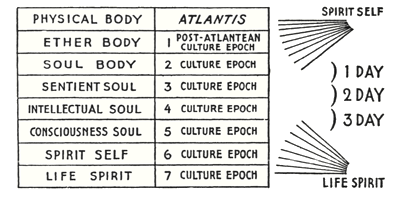
[ 28 ] In the Gospel of John, a special relationship between “me and you”, between “the two of us” is indicated. This is what it says, not the absurd: “Woman, what have I to do with you?” When the mother asks Christ to perform the sign, he says: “My time has not yet come” (2:4) to officiate at weddings, that is, to bring people together. The time will come. What is based on blood ties still has an effect now and will continue to have an effect; hence the reference to relationships between mother and son at the wedding.
[ 29 ] When we look at this document in this way, everything real and external stands out from a significant spiritual background. We look into an abyss-like depth of spiritual life when we see through what such an initiate as the writer of the Gospel of John has given to mankind and what he could only give it by the fact that the Christ has implanted his impulse for the development of mankind.
[ 30 ] So we have seen that these things must be explained not by a hollow allegory or symbolism, but out of the astral reality which the initiate experiences. It cannot be just a symbolic interpretation, but a narration of what the initiate experiences. If it is not put in this way, it is quite right that those who stand outside say that spiritual science brings nothing more than allegorical interpretations! If we now apply the spiritual-scientific interpretation at this point, as we have now understood it, then we learn how through three world-days - from the third into the fourth, from the fourth into the fifth and from the fifth into the sixth cultural epoch - the Christ-impulse works within humanity. And we look at this development in the sense of the Gospel of John in such a way that we say: The impulse of the Christ was such a great one that mankind has only understood it in the smallest part today and that it will only be fully understood in a later time.