

The Apocalypse of John
GA 104
20 June 1908, Nuremberg
Translated by Steiner Online Library
Third Lecture
[ 1 ] Yesterday we were able to point out at the end of our meditation what is specifically Christian and what is later, i.e. roughly Christian Rosicrucian, in terms of the initials in a large, significant symbol. We have pointed out the significance of this symbol, this sign of initiation, which is also referred to as the Son of Man, who has the seven stars in his right hand and the sharp, two-edged sword in his mouth. We have seen that this initiation makes man aware, to a certain higher degree, within his ego and his astral body, outside of the physical and etheric bodies. We shall discuss all this in more detail.
[ 2 ] Through each initiation, however, the human being comes to really see and recognize that which can only be seen with spiritual eyes, which is only transparent to supersensible perception. Now, one of the first and most important things that the person to be initiated in the Christian sense has to recognize is the development of humanity in our age, so that everyone can understand the tasks of man to a higher degree. For everything that is to give man higher knowledge, higher perfection, is connected with the question: What am I and what am I destined for in our age? It is the answer to this question that is of great importance in the first instance.
[ 3 ] Each stage of initiation leads to a higher point of view of human observation. Already in the first lesson we were able to point out how man gradually ascends, first into what we call the imaginative world, where he learns to recognize the seven seals in the Christian sense, then to what we call inspired knowledge, where he and finally to an even higher level, where he is able to see through the true meaning and essence of spiritual beings, the level of the so-called bowls of wrath. But now we have to consider a specific level of initiation, so to speak. We imagine that the person has reached the level of initiation where what was described at the end of the last lecture has happened to him. We imagine him at the very boundary where, between the finest entities of our physical world and the next higher, the astral world, he is allowed to stand as if on a summit and look down. What can a person see at this first summit of initiation?
[ 4 ]Then he sees in his mind's eye everything that has happened since the Atlantic flood destroyed the ancient Atlantis and the post-Atlantic man came into existence, according to his inner being. He sees how the cycles of civilization follow one another until the time comes when our age will also meet its demise, in order to give rise to a new one. The old Atlantis was destroyed by the waters of the Atlantic flood. Our age will meet its demise through what we call the war of all against all, through terribly devastating moral complications. And this great age, from the Atlantic flood to the mighty war of all against all, we again divide into seven successive main cultural epochs, into seven cultural periods, as can be seen from the above scheme. At one end we have the great Atlantic flood, at the opposite end the great world war, and that we divide into seven sub-ages, into seven cultural epochs. The entire epoch containing these seven sub-eras is again the seventh part of a longer epoch, so that you have to imagine seven such links as our epoch between the flood and the war, two forward, after the great war, and four backward before the Atlantic flood. Our epoch, the post-Atlantic epoch, is therefore the fifth great epoch.
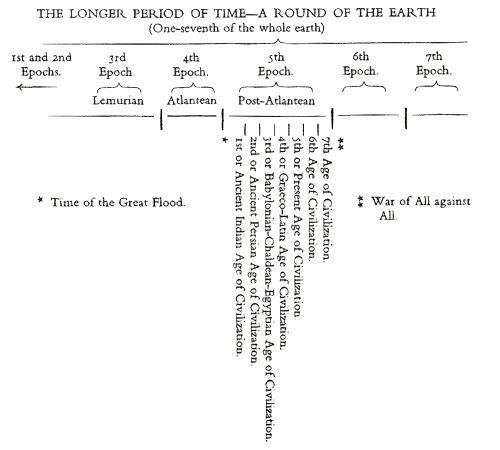
[ 5 ] One must again ascend to an even higher summit of initiation, then one overlooks these seven times seven epochs. They can be seen when one has reached the boundary of the astral and the spiritual, the devachanic world. And so it goes up step by step. We will see what the even higher steps are.
[ 6 ] Now we have to realize that one can first reach a summit from which, as from a mountain, the wide plain of the seven cultural ages of the post-Atlantic period becomes visible. We all already know these cultural epochs. We know that when the Atlantic flood had swept away the old Atlantis, the ancient Indian culture flourished first and that it was followed by the ancient Persian culture. We know that the Assyrian-Babylonian-Chaldean-Egyptian-Jewish culture followed, and that the fourth cultural epoch, the Greek-Latin, followed that, and that the fifth, the one we live in, followed that. In the sixth, which will follow the one we live in, what we have to build in terms of spiritual culture will, in a certain respect, have to be absorbed into the fruit. The seventh cultural epoch is taking place before the war of everyone against everyone. We see this terrible devastation of culture approaching and we see the small group of people who have understood how to absorb the spiritual principle within themselves and who will save themselves from the general destruction caused by selfishness.
[ 7 ] We therefore live in the fifth sub-age, as I said. From the summit of initiation, the sequence of these cultural ages appears as if we were looking at towns and villages and forests from the top of a mountain. We can see their significance. They represent what expands on our physical plane as human culture. That is why we speak of cultural epochs in contrast to races. Everything that is associated with the concept of race is a remnant of the period that preceded our own, the Atlantean period. We live in the period of cultural epochs. The Atlantean period was the period in which seven successive great races gradually formed. Of course, the fruits of this racial formation also extend into our own age, which is why we still speak of races today. However, these are already blurring of those sharp divisions in the Atlantic period. Today, the concept of culture has already replaced the concept of race. Therefore, we speak of the ancient Indian culture, of which the culture that is announced to us in the Vedas is only an echo. The ancient-holy Indian culture is the first dawn of the post-Atlantic culture, it follows immediately after the Atlantic time.
[ 8 ] Let us once again visualize how man lived in that time, which is now more than eight or nine thousand years behind us. If we speak of the real periods of time, these numbers apply. This culture, of which we speak here, was directly influenced by the Atlantic flood or the great ice age epoch, as it is called in modern science. Atlantis had gradually sunk, one chunk after another had been swallowed up by the flood. And now a race of men lived on the earth, a part of which had worked its way up to the highest level of development that could be achieved. This was the ancient Indian people, a race that lived over there in distant Asia and lived more in the memory of ancient times than in the present. The greatness and power of that civilization, of which the written records such as the Vedas and the Bhagavad Gita are only echoes, is that people lived in the memory of what they themselves had experienced in the Atlantean time. Think of the first lecture in this cycle. It was said that people in that time were largely able to develop a certain dimmed clairvoyance. People were not limited to this physical-sensual world. They lived among divine spiritual beings. They saw these divine spiritual beings around them. The transition from the Atlantean time to the post-Atlantean time consisted in the fact that people's view of the spiritual, astral-etheric world became closed and limited to this physical world. The first cultural epoch was characterized by the fact that people had a longing, a deep longing for what their ancestors in ancient Atlantis had seen, but from which the door had closed. Our ancestors had seen ancient wisdom with their spiritual eyes, even if only dimly. They lived among spirits and interacted with gods and ghosts. This is how they felt, these people of the ancient and sacred Indian culture: they longed with all their being to look back and see what their ancestors had seen and of which ancient wisdom told them. And so the land that had just appeared before the physical eyes of men - the rocks of the earth that had only now become visible, which were formerly still seen spiritually - all that appeared to them to be less than what they could remember. Maja, the great illusion, was what the physical eyes could see, the great deception from which one wanted to escape. And the best of this first age were to be raised by that initiation method, of which there are some remnants in yoga, to the level of their ancestors. From this arose a basic religious sentiment that can be expressed as follows: The vain deception that surrounds us here in the external world is worthless. The truth and the real are above in the spiritual world that we have left. The spiritual leaders of the people were those who could transport themselves to the regions where people used to live. That was the first epoch of the post-Atlantic period. And all epochs of the post-Atlantic period are characterized by the fact that man learned to understand more and more the reality of the outer senses, to recognize more and more: What is given to us here for the outer senses is not to be treated as mere appearance, it is a gift of the spiritual beings, and it is not for nothing that the gods have given us the senses. What establishes a culture of the material world here on earth must be gradually understood.
[ 9 ] What the ancient Indian still spoke of as Maja, what he fled from, what he longed for, that was spoken by those who belonged to the second epoch as their field of work, as something they had to work on. And so we now have the ancient Persian epoch, which dates back about five thousand years, the cultural epoch in which the land around them initially appeared hostile to people, but no longer as an illusion to flee, but as a field of work in which one's own spirit had to be imprinted. This earth is ruled in its material nature by evil, by a power opposed to good, by the god Ahriman. He rules it, but the good god Ormuzd helps people — people place themselves in his service. When they carry out his will, they transform this world into a field in the upper spiritual world, and they shape the real world of the senses according to what they themselves recognize in the spirit. One field of work for the second epoch was the physical and real world. For the Indian, the sensual world was still deception, Maja. For the Persian, it was ruled by evil demons, but still such a world from which man had to expel the evil and integrate the good spiritual beings, the servants of the god of light Ormuzd.
[ 10 ] And in the third epoch, man comes even closer to external sensual reality. It is no longer a mere hostile power that he has to overcome. The Indian looked up at the stars and said to himself: Ah, everything that is there, that I can see with my external eyes, is only maja, deception. The Chaldean priests observed the course and position of the stars and said to themselves: By observing the positions of the stars and following their course, I can create a script from which I can recognize the will of the divine spiritual beings. I recognize what the gods want in what they have done. — The physical, sensual world was no longer Maya to them. Just as the writing of a human being is the expression of his will, so for them what is written in the stars in the sky, what lives in the forces of nature, was a divine writing. And with love they began to decipher the writing of nature. Thus arose that wonderful science of the stars, which is hardly known to people today. For what is known today as astrology arose from a misunderstanding of the facts. It is the deep wisdom of the starry writing that was revealed to the old Chaldean priest as astrology, as the secrets of what he saw with his eyes. He regarded this as the revelation of something inner and spiritual. And what did the earth become for the Egyptians? We need only point to the invention of geometry, where man learned to divide the earth according to the laws of space, according to the rules of geometry. There the laws were explored in the Maja. In the ancient Persian culture, the earth was plowed up; now it was learned to divide it according to the laws of space. The laws are beginning to be studied and more is being done. People say to themselves: it is not for nothing that the gods have left us a writing in the stars, it is not for nothing that the gods have made their will known to us in the laws of nature. If man wants to bring about salvation through his own work, then he must create a replica in the institutions he sets up here of what he can research from the stars. Oh, if you could look back into the working chambers of the Egyptian initiates! Their work was different from that of today in the field of science. Then the initiates were the scientists. They studied the course of the stars and recognized the regularity in the position and course of the stars and in the effect of their positions on what was taking place on the earth below. They said to themselves: When this or that constellation is in the sky, then this or that must happen in the life of the state below, and when another constellation comes, something else must also happen. After a century, certain constellations will be there, they said, and then something corresponding to that must happen. — And for millennia to come, it was determined what was to be done. This is how the Sibylline Books came about. What they say is not a delusion. After careful observation, the initiates wrote down what had to happen for thousands of years, and their successors knew that this had to be adhered to. And they did nothing that was not prescribed in these books for the millennia to come according to the course of the stars. Let us say that it was a matter of making some law or other. They did not vote on it as we do, they consulted the sacred books, in which was written what had to happen here on earth so that it would be a mirror of what was written in the stars, and what was in the books was carried out. The Egyptian priest knew when he wrote these books: My successors will carry out what is written in them. They were convinced of the necessity of the law.
[ 11 ] The fourth cultural epoch has developed out of the third. Only scant remnants of this prophetic art of the Egyptians have survived. You can still see one such remnant. If you wanted to practice this prophetic art in ancient Egypt, you divided the next period into seven parts and said: the first must contain this, the second that, the third that, and so on. — Then the descendants followed what happened. But that was precisely the main characteristic of the third cultural epoch. The fourth showed only weak echoes of it. You can still recognize these weak echoes when the origin of ancient Roman culture is told to you. Aeneas, son of Anchises of Troy, a site of the third epoch, migrates and finally comes to Alba Longa. This name indicates a place of ancient, holy priestly culture: Alba Longa or the long Alba, the city of a priestly culture from which the culture of Rome was to originate. We still have an echo of this in the vestments of Catholic priests. In the old priestly manner, a seven-part cultural epoch was predicted. Oh, these seven Roman periods of kingship were foretold! And the historians of the nineteenth century have once again allowed themselves to be tricked with regard to these seven royal periods. They have come to the conclusion that in the profane material sense, these Roman kings are nothing; but what is behind it, that here a culture of the Sibylline books, prophetically pre-arranged according to the holy number seven, is traced, they could not come up with.
[ 12 ] This is not the place to get involved with the individual kings. You would be able to see from the individual kings, from Romulaus, Numa Pompilius, Tullus Hostilius and so on, how they correspond exactly to what the successive cultural epochs are according to the seven principles that show themselves to us in so many different fields.
[ 13 ] Thus, in the third epoch, the Mayans had gradually been able to penetrate the human spirit. This was accomplished in the fourth cultural epoch. Look at Greco-Latin culture, where in the marvelous works of art man created a complete image of himself in the external material world, where he allowed his human destinies to arise in drama, as with Aeschylus. In contrast, look at how in Egyptian culture they were still investigating the will of the gods. The conquest of matter, as we see it in Greek times, means a further step in which man comes to love material existence, and in Roman times man has fully emerged onto the physical plane. Anyone who understands this also knows that we have to see the complete emergence of the personality principle in it. Therefore, it was in Rome that what we call the concept of law first arose, where we first have man before us as a citizen. Only a confused science can trace jurisprudence back to all kinds of previous times. What was previously understood by law was something else. The Old Testament describes the ancient law much more correctly in the Ten Commandments. What God commanded there belonged to what contained the concepts of law. It is absurd in our time to want to trace legal concepts back to Hammurabi and so forth. In Rome, the actual right, the actual concept of the human being as a citizen, was first brought to bear. In Greece, the citizen was still a member of the city-state. The Athenian, the Spartan was much more a citizen than an individual. He felt he was a member of the city-state. It was only in Rome that the individual human being became a citizen. This could be demonstrated in detail. What we call a will today did not exist in this sense before ancient Roman times. The will in its present-day sense only emerged at that time, because it was only then that the individual human being was to be decisive in his selfish will in order to pass this will on to his descendants. Before that, there were other impulses besides personal will that held the whole together. Many examples could be given of how man emerged on the physical plane.
[ 14 ] We now live in the fifth, in that period when culture has descended even lower than man. We live in the time when man is the slave of external circumstances, of the environment. In Greece, the spirit was used to spiritualize matter, and spiritualized matter confronts us in an Apollo form, a Zeus form, in the dramas of a Sophocles and so on. There man has risen to the physical plane, but has not yet descended among men. Even in Rome this is still the case. The deep descent below the sphere of the human has only now happened. In our time, the spirit has become the slave of matter. An infinite amount of spirit has been used in our time to penetrate the outer plan in its natural forces, to make this outer physical plan, so to speak, as comfortable a place as possible for man. Let us compare the ancient times with our own time. In those ancient times, man saw the great star writing of the gods, but with what primitive means the cultural achievements of that time, the pyramids, the sphinxes were created! How did man feed himself! And what a wealth of external means of culture he has acquired to this day! What power of the spirit was needed to conceive and produce the steam engine, to invent the railroad, the telegraph, the telephone, and so on! Enormous powers of the spiritual life had to be applied to invent and produce these purely material means of culture. And what are they used for? Is there essentially any difference for the spiritual life between the time when man ground his grain between two stones, which of course required very little spiritual effort, and the time when we are able to telegraph to America to get large quantities of grain from there and grind it into flour with the help of marvelously devised mills? The whole apparatus is set in motion simply for the sake of the stomach. Let us realize what enormous sums of spiritual life forces are invested in mere material culture. Very little of the spiritual culture is yet furthered by the outer means of culture. The telegraph is very rarely used in, let us say, anthroposophical matters. If you were to make a statistical comparison between what is used for material culture and what benefits spiritual life, you would realize that the spirit has descended below the human, becoming a slave to material life. Thus we have in the most decisive sense a descending cultural path down to our time, into the fifth cultural epoch, and it would go deeper and deeper. Therefore, humanity must be saved from a complete slide into matter by a new impulse. Never before has the essence of man descended so deeply into matter. A strong, the strongest of the earth impulses had to come. The appearance of Christ Jesus provided the impetus for a new spiritual life. We have the mighty impulse that came through Christ Jesus to thank for the forces of ascent in our spiritual life during the descent. Spiritual impulses were always present during this descent into matter. The Christian life developed, slowly at first, then more and more. Today it is only just beginning, but in the future it will rise to tremendous glory because humanity will only in the future understand the Gospels. But when they are fully understood, then people will see what an enormous amount of spiritual life is present in these gospels. The more the gospel spreads in its true form, the more humanity will have the opportunity to develop a spiritual life despite all material culture, to ascend again into the spiritual worlds.
[ 15 ] The developments that take place in post-Atlantean culture from period to period are imagined by the apocalypticist in such a way that they express themselves in smaller communities, and so these smaller communities, spread throughout the outer earth in space, become representatives of these cultural epochs. When he speaks of the community or church at Ephesus, he means: I assume that such a community lived at Ephesus, which in a certain respect had indeed adopted Christianity. But because everything develops gradually, something always remains of each cultural epoch. In Ephesus we have an initiatic school, but we have colored the Christian teaching there so much that one can still recognize the ancient Indian culture everywhere. — He wants to show us the first epoch in the post-Atlantic period. This first epoch in the post-Atlantic period is thus represented in the Ephesian community, and that which is to be proclaimed is to be proclaimed in a letter to the community of Ephesus. We have to imagine it something like this: the character of that distant Indian cultural epoch remained natural, it continued in various cultural currents. In the community of Ephesus, we still have something of this character. Christianity was embraced by this community in such a way that it was still determined by the typical character of ancient Indian culture.
[ 16 ] Thus, in each of these letters, we have addressed a representative of one of the seven post-Atlantic cultural epochs. In each letter it is said: You are like this! This and that side of your nature corresponds to the spirit of Christianity, the other must become different. — This is what the apocalyptic says to each cultural epoch, what can be retained and what is no longer right and should become different.
[ 17 ] Let us now try to see if there is really something in the seven consecutive letters about the character of the seven consecutive cultural epochs. Let us try to understand how these letters should be written if they are to correspond to what has just been said. The apocalyptic thinks: In Ephesus there is a community, a church. It has accepted Christianity, but it shows Christianity in a coloration that still characterizes the first cultural epoch, alien to the outer life, not filled with love for what is the actual task of post-Atlantic man. That she has abandoned the worship of coarse sensuality, that she has turned to the spiritual life – so says he who addresses the letters to the community – that pleases him about her. We recognize what the apocalyptic wanted to say by this from the fact that Ephesus was the place where the mystery cult of the chaste Diana was cultivated. He points out that the turning away from matter was particularly flourishing there, the turning away from the sensual life and the turning towards the spiritual. “But I have against you that you have left your first love,” the love that the first post-Atlantic culture must have, which expresses itself in seeing the earth as a field into which the divine seed must be transplanted.
[ 18 ] How does the person who dictated this letter characterize himself? He characterizes himself as the forerunner of Christ Jesus, as it were, as the leader of the first cultural epoch. Christ Jesus speaks, as it were, through this leader or master of the first cultural epoch, that epoch when the initiate looked up to the worlds beyond. He says of Himself that He holds the seven stars in His right hand and the seven golden lampstands. The seven stars are nothing other than symbols for the seven higher spiritual beings who are the guides of the great cultural epochs. And the seven lampstands are specifically mentioned because they are spiritual beings that cannot be seen in the material world. In the Yoga Initiation, too, they are clearly indicated, but it is also pointed out that a person never works in the sense of evolution if he hates external works, if he abandons love for external works. The community at Ephesus has abandoned love for external works. Thus it is quite correctly stated in the Apocalypse of John: You hate the deeds of the Nicolaitans. “Nicolaitans” is nothing more than a term for those people who express life only in sensual matter. At the time to which this letter refers, there was a sect of Nicolaitans who saw everything that should be valuable to man only in the external, carnal, sensual life. “You must not do that,” says the one who inspired the first letter. But do not let go of the first love, he also says, because by having love for the outer world, you enliven that outer world, you bring it up to the spiritual life. He who has ears to hear, let him hear: To him who overcomes I will give to eat, not of the perishable tree, but of the tree of life, that is, he will be able to spiritualize what is here in the sensual in order to lead it up to the altar of spiritual life.
[ 19 ] The representative of the second cultural epoch is the community or church of Smyrna. This is addressed by the leader of humanity in his second ancestor, in the inspirer and master of the ancient Persian culture. The attitude of the ancient Persian culture is this: Once there was a god of light who had an enemy, the outer matter, the dark Ahriman. First I was connected with the spirit of light, with the first one that was there. Then I was incorporated into the world of matter, into which the remaining hostile power: Ahriman, was incorporated. And now I will work together with the spirit of light on matter and incorporate the spirit into it; then, after the defeat of the evil deity, the good, the deity of light, will reappear. — “I am the one who is the first and the last,” the one who dies in material life and comes to life again in spiritual resurrection. Thus we read in the second letter: “I am he that liveth, and was dead; and, behold, I am alive for evermore, Amen; and have the keys of hell and of death” (Revelation 1: life; and, behold, I am alive for evermore, Amen; and have the keys of hell and of death). It would be going too far to go through each sentence in this way, but there is one sentence that we must quote in more detail, the sentence that characterizes exactly how a member of the community of Smyrna behaves when it is transformed into a Christian principle. It says that one gives life to death, that one spiritualizes the dead. One does not perish in the dead. If one were to perish, then death would be an event for man that leads him to a spiritual life in which the fruits of this earthly life cannot be found. Take a person who has not applied his life in such a way that he can draw out the genuine fruits. He takes no fruits with him into the spiritual life. But he can only live on these fruits in the spiritual realm. If he did not bring any fruit, he would experience the “second death.” By working this earthly field, he is saved from the “second death”: “He who has ears to hear, let him hear what the Spirit says to the churches. He who overcomes shall not be hurt by the second death” (Revelation of John 2:11).
[ 20 ] Now we move on to the community of Pergamus. It represents the epoch of humanity that increasingly emerged on the physical plane, where man saw in the starry writing what his mind could fathom. This is given to man in the third cultural epoch. Man works through what is within him. It is because he has an inner being that he can explore the outer world. It is only because he was endowed with a soul that he could study the path of the stars and invent geometry. This was called exploration through the word, which in the Apocalypse of John is expressed by “the sword of the mouth”. The person who wrote this letter therefore suggests that the force of this epoch is a sharp word, a sharp, double-edged sword. This is the Hermes word of the ancient priests, it is the word through which one studied the forces of nature and the stars in the old sense, it is the kind of culture that is primarily won through the inner astral-spiritual powers of the human being here on the physical plane. When it is still won in that old way, it really is a very double-edged sword. Here wisdom stands close to the edge between what is white and black magic, between what leads to bliss and what leads to ruin. That is why he says that he well knows that where the representatives of this epoch dwell is also the seat of Satan. This points to everything that can lead away from the real great goals of development. And the “doctrine of Balaam” is none other than the doctrine of the black magicians, for that is the doctrine of the devourers of the people. The devourers of the people, the destroyers of the people, are the black magicians who work only in the service of their own personality and destroy all community, therefore devour everything that lives in the people. But the good thing about this culture is that man can start right there to purify and transfigure his astral body. This is called the “hidden manna”. That which is merely for the world, changed into the food of the gods, that which is only for the selfish man, transformed into the divine, that is called “hidden manna”. All the symbols here indicate that man purifies his soul in order to become a pure carrier of Manas.
[ 21 ] To do this, however, it is still necessary to go through the fourth cultural epoch. There the Redeemer, Christ Jesus, appears in person. It is the church at Thyatira. There he announces himself as the “Son of God, who has eyes like flames of fire and his feet like brass”. Now he announces himself as the Son of God, now he is the leader of the fourth cultural epoch, where man has descended to the physical plane, where he himself has created his image in the external means of culture. Now the period has come when the deity itself becomes human, itself becomes flesh, itself becomes a person, the age in which man has descended to the level of the personality, where in the sculptures of the Greeks the individualized deity appears as a personality, where in the Roman citizen the personality enters the world plan. This age had to receive an impulse at the same time through the appearance of the Divine in human form. Descended man could only be saved through the appearance of the God Himself as man. The “I am” or the I in the astral body had to receive the impulse of Christ Jesus. What formerly only showed itself in the germ, the I or “I am”, was to enter the outer plane of world history. Therefore the Son of God, as the Leader of the future, may say: “And all the churches shall recognize the I AM, who tests the hearts and kidneys” (Revelation of John 2, 23). Here emphasis is laid on the “I AM”, on the fourth link of the human entity. “As I have received from my Father, so I give to him the morning star“ (Revelation of John 2:28).
[ 22 ] What does ‘morning star’ mean here? We know that the Earth passes through Saturn, the Sun, the Moon, the Earth, Jupiter, Venus and Vulcan. That is the usual way of saying it and it is also correct. But I have already pointed out that the evolution of the earth is divided into the Martian and Mercury periods because of the mysterious connection that exists between the earth and Mars in the first half of the earth's state and between the earth and Mercury in the second half. Therefore, Mars and Mercury are also used in place of the earth. It is said that the earth goes through its development through Saturn, Sun, Moon, Mars, Mercury, Jupiter, Venus. So we have Mercury as the star that presents itself as the actual tone-setting power in the second period of the earth. Mercury is the star that represents the guiding force, as the direction upwards that man must take.
[ 23 ] Here I come to a point where we have to reveal a little secret, so to speak, which basically can only be revealed at this point. In occultism, those who would only misuse spiritual science and would have done so in the past have always had what one might call a mask. They did not express themselves directly, but presented something that was intended to conceal the true state of affairs. Now, medieval esotericism knew of no other way to help itself than by using crude means. It called Mercury Venus and Venus Mercury. In truth, if we want to speak in the sense of esotericism, as the apocalyptic did, we would have to address Mercury as the morning star. By morning star he means Mercury: I have given your I the upward direction, through the morning star, Mercury. — You can also find in certain books of the Middle Ages, which really hit the mark, that the stars of our planetary system are listed as follows: Saturn, Jupiter, Mars, and the Earth is not followed by Venus and Mercury, as it is now, but by Mercury and Venus in reverse order. Therefore it says here: “As I have received from my Father; and will give him the morning star.”
[ 24 ] And now we should enter into our epoch, to which we belong, and we should ask ourselves: Does this revelation of the apocalypticist fulfill itself into our time? If it were to be fulfilled, the one who spoke through the four previous epochs would have to speak to us, and we would have to learn to understand his voice, we would have to be able to find our way into what our task is for spiritual life. If there is to be a spiritual movement of minds and if it is to understand world mysticism, then this movement, insofar as it is to agree with the Apocalypse of John, must fulfill what the speaker, the great inspirer, demands of this epoch. What does he demand, and who is he? Can we recognize him? Let us try. “And to the angel of the church in Sardis write” — we ourselves must feel addressed here —: “These things says he who has the seven Spirits of God and the seven stars” (Revelation of John 3:1). What are they here, the seven spirits and the seven stars? In the tone of the apocalyptic, man, as he appears to us here, is an external expression of the seven human principles that we have enumerated. The principle of the physical body, of which the external physical body is the expression; the principle of the life body, of which the ether body is the expression; the principle of the astral body, which when transformed yields manas, or buddhi, or the transformed ether body; the atma, or the transformed physical body; and standing in the midst, the ego principle. these are the seven spiritual ingredients into which the divine essence of man is divided, like the blades of a fan. In occult terminology, these seven principles are called the seven spirits of God in man. And the seven stars are the stars by which we understand what man is today and what he should become in the future. If we list them, the successive stars of earthly embodiment: Saturn, Sun, Moon, Earth, Jupiter, Venus and Vulcan, then these are the seven stars that make the development of the human being understandable to us. Saturn has given man the disposition for his physical body, the Sun for his etheric body, the Moon for his astral body, and the Earth has given him the I. The next three, Jupiter, Venus and Vulcan, develop the spiritual elements of the human being. If we understand the call of the spirit that holds these seven stars and the seven spirits of God, the seven-part nature in its hand, then we are practising anthroposophy in the sense of the apocalyptic. There is nothing else to anthroposophy but to know that here is indicated the fifth human developmental epoch of the post-Atlantic period, to know that in our time, when we have descended the furthest into matter, we are to ascend again in the spiritual life in the wake of the great individuality, who gives us the seven Spirits of God and the seven stars for leadership, so that we may find our way on the path.
[ 25 ] And when we follow this path, we bring the true spiritual life of wisdom and love into the sixth epoch. Then what we develop as anthroposophical wisdom becomes the impulse of love for the sixth epoch, represented by the community that already expresses itself in its name as a representative of the sixth epoch: the Community of Brotherly Love, Philadelphia. All these names have not been chosen in vain. Human beings will develop their ego to the proper height, so that they become independent and freely extend love to every other being in the sixth epoch, which is represented by the Philadelphia community. This is to be prepared as the spiritual life of the sixth epoch. There we will have found the individual ego within us to a higher degree, so that no external force can act upon us anymore unless we will it; so that we can lock it, and no one can unlock it without our will, and when we unlock it, no opposing power can lock it. This is the “key of David.” That is why the one who inspired the letter says that he has the key of David. “And to the angel of the church in Philadelphia write: Thus says the Holy One, the True One, who has the key of David, who opens and no one shuts, who shuts and no one opens”—“Behold, I have set before you an open door, and no one can shut it”—the Self that has found itself within itself (Revelation 3:7).
[ 26 ] And the seventh period will gather those who have found this spiritual life around the great Leader; he will unite them around this great Leader. They will already belong so fully to the spiritual life that they will be distinct from those who have fallen away, from those who are lukewarm, “neither cold nor hot.” The small group that has found spirituality will understand the one who may say, by revealing himself: I am the one who embodies the true ultimate being toward which everything is heading. — For this final being is designated by the word “Amen.” Hence chapter 3, 14: “And to the angel of the church in Laodicea write: Thus says the Amen”—he who in his essence represents the essence of the end.
[ 27 ] Thus we see how the content of an initiation is presented in the Apocalypse of John. And the very first stage of this initiation, where we see the inner progression of the seven post-Atlantean epochs, where we still see the spirit of the physical plane, shows us that we are dealing with an initiation of the will. For right up to our own time, this content can have an inspiring effect on our will if we recognize that we should listen to the inspirers who teach us, if we learn to understand what the seven stars and the seven spirits of God signify, if we learn to understand that we are to carry spiritual knowledge into the future.