

From the Pictorial Script
of the Apocalypse of John
GA 104a
14 May 1909, Oslo
Translated by Steiner Online Library
Fifth Lecture
[ 1 ] The period of human development that is considered the fourth and is characterized by the letter to the church in Thyatira begins in the 7th or 8th century BCE and lasts until the 13th or 14th century CE. From there, we begin counting our fifth period, or the Germanic cultural period. The fourth period stands in the middle of seven periods and has expressed in the most diverse ways the life between birth and death and the love of the material; it reached its highest flowering in the beauty of Greek art.
[ 2 ] But the soul would have had to go through a period of darkness if the event at Golgotha had not taken place, if the light that emanated from this event had not exerted its effect. After human beings have come to full consciousness of their earthly ego in this fourth period, when they have stepped out into the physical world, the concept of the will comes into being among other things as a sign that the will of human beings has become so important that it survives death. But this first appears in ancient Rome, not yet in Greece. Likewise, Greece did not yet know the concept of the individual human being firmly rooted on earth; only gradually did the feeling develop that the individual human being is not only a social being but also an individual. The concept of personality, the concept of the divine-spiritual anchored in the human being, would not have been understood before. In ancient Greece, it was only possible to understand that the divine-spiritual dwells in the spiritual world. Now, however, the Greeks feel in the most eminent sense what it means to know with human consciousness that the I lives, but still not to recognize that the I is divine. Over in the Orient, this had been proclaimed by Moses. For the Greeks, it did not exist as something divine between birth and death. And it was a deeply tragic feeling that passed through all souls... [Gap in the transcript.] So the Greeks said that man had descended from the divine-spiritual world; but they did not know that he could work his way back up again and that he could return to the spiritual world in the future.
[ 3 ] And this was expressed in the myth of Prometheus; it was expressed so tragically in the drama of Aeschylus, where the mad Io appears to Prometheus. Io was the ancient clairvoyant consciousness, which in this fourth period could no longer appear in normal states of consciousness, but only in a state of madness.
[ 4 ] In the sense in which science exists today, it did not yet exist in the early periods of our culture. Man is only gradually becoming a seeker in the fields of that science which searches independently in the outer world. That is why something like science only came into being with Thales. To speak of an Eastern philosophy is an abstraction. Those who began science with Thales were right; before that, it was always inspired, born out of the mysteries. This was the case with Heraclitus, who was still inspired by the ancient wisdom of the mysteries. We are told that he sacrificed his book on the altar of the goddess at Ephesus.
[ 5 ] To the same extent that external science grows in man, what is actually wisdom becomes paralyzed. In the Apocalypse, we are told how, in the fourth letter, people must find the connection. Let us assume that the Christ principle, the revelation of Golgotha, had not come. Then, in relation to external science, there would have been such outstanding people as Marcus Aurelius, Seneca, and so on, but science would have become more and more intellectual, and all this would not have brought about the re-ascent to the spirit. Celsus, a contemporary of Marcus Aurelius, recounts the events of Golgotha only as external historical gossip. But scientifically, all these people are on a high level.
[ 6 ] However, what came into this current was what is called skepticism, and in Roman culture, alongside a sophisticated science in relation to the spiritual, one finds complete skepticism. Let us look, on the other hand, at a personality such as Augustine; he is unable to come to anything other than doubting what he has come to know as Greek-Roman science. Now he encounters Manichaeism, which he gets to know in a false form. He learns a doctrine that reckons with everything that had been taught by Zarathustra. But his soul is not yet ready to take all this in, because the soul of a person of that time was not designed to undertake such a high flight of the spirit and to see the spirit everywhere behind the physical world. The science that had reached the stars fell into decline, and even if this science had reached the Europeans, no soul would have been able to understand it. The soul had to remain attached to what one sees in the outer sensory world.
[ 7 ] It was not until the Renaissance that science reawakened. What had been inspired by Greece and Rome became Arab wisdom, the spirit of Mohammedanism. Arabism then spread from Spain throughout Europe. This science is great in everything that relates to the immediate senses. The science that became the most eminent inspiration for European science, which influenced Bacon and Spinoza, sprang from Spanish Arabism; it came from Spain. However, it cannot rise above a pantheism that cannot arrive at concrete spiritual beings. Arabism did not reach the concrete; it rose to the level of the sensual human being, but what was seen above that was only an abstract divine unity, of which one does not know what it is. A poor and convenient worldview! One has no knowledge of the spirit when one summarizes it in a unity. Therein lies the poverty of pantheism.
[ 8 ] Thus, human beings entered the fifth period with an external science that began to flourish in the 13th and 14th centuries. We see this, for example, in the scholastics. Here we experience the dawn of a new science, but one that is completely bound to the sensory world and cannot take a single step beyond it. And so we see how the division between faith and knowledge arises. Augustine could not understand the hint of a spiritual realm behind the sun; he did not understand Manichaeism because it spoke of a veil of the senses spread over the spiritual realm. He could believe in Christ who descended into physical man. But faith and knowledge had already become completely divided at that time. All believers who based their beliefs on medieval science wanted faith and science to be completely separate. We can illustrate this schematically by showing how what continued from the Greek-Latin period only applied to the outer physical world. Human development proceeds in such a way that we are now once again experiencing the knowledge that was cultivated in the Chaldean-Egyptian period, only illuminated and spiritualized by the Christ impulse. We see ancient Egyptian traditions emerging everywhere in Europe, but illuminated by the Christ principle. In our time, human beings will only be able to consciously absorb this more and more through the Rosicrucian teachings.
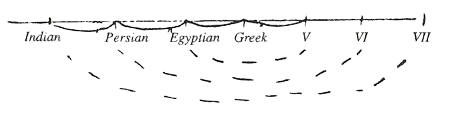
[ 9 ] When the ancient Egyptians spoke of the stars, they meant the spiritual essence of the stars, which they still knew about. Through the penetration of a wonderful consciousness of ancient knowledge into the science of Copernicus and Kepler, we see how what the ancient Egyptians knew emerges in physical form. Whereas they had seen beings passing through the spaces of the world, now only spheres moving in elliptical lines could be seen.
[ 10 ] But the fifth period was destined to rediscover the spiritual world behind sensory existence, and theosophy had to come about in order to lead people back to permeating all knowledge more and more with the Christ principle.
[ 11 ] If a clairvoyant being had been able to observe the earth for thousands of years, it would have seen how, when the Redeemer died on Golgotha, the entire aura of the earth suddenly took on a different hue and shone in different colors. The Ahura Mazdao proclaimed by Zarathustra became the elemental spirit of the earth at that time. Christ expresses this when he says at the Last Supper: “This is my body” (Matthew 26:26), and for the grape juice he finds the expression: “This is my blood” (cf. Matthew 26:28).
[ 12 ] If we now study the earth in the real sense, we must again see in everything that grows and lives the members of the Christ spirit, even in the smallest things we see. The future human being will not speak of atoms; he will scientifically understand the earth as an expression of Christ.
[ 13 ] We are only at the beginning of this development; Christ must first be understood in the simplest way. All science will find Christ in the future, even if today it sees only something dead and corpse-like in the sensory world. But that this will come about can only be perceived in the fifth epoch as a prospect, in that it will understand in a new way what Zarathustra meant when he spoke of Ahura Mazdao.
[ 14 ] In the sixth epoch, the ancient wisdom of Zarathustra will reappear in a new form. And finally, the time of the holy Rishis will return in a new form. Even if only a small group understands Theosophy in this period, even if only a tiny group hears the revived wisdom of Zarathustra in the sixth period, and even if only a fraction remains for the seventh period, the further course of human development will be such that more and more people will gather together who will once again understand what Zarathustra proclaimed.
[ 15 ] But then a time will come upon the earth when those who wage war against all will be victorious. But the souls that will have been preserved from the sixth period will have to establish a new culture after the war of all against all. The seventh period will have neither people who are passionate about the spiritual, nor those who are passionate about the sensory existence; these people will be too jaded even for that. In the seventh period, very little of the Indian, the first culture, will be felt on earth; but carried up into the spiritual world, purified and Christianized, these souls from the sixth period will walk, as it were, ethereally, no longer touching the earth, while now people will be able to conquer what the whole earthly culture has to offer. The seventh period will be such that those who make the highest inventions and discoveries will live here below in ever denser physical bodies. In the seventh period, people who are completely entangled in matter will no longer have much to fear from theosophy, for there will no longer be many on earth of those spiritualized people who have now taken up theosophy and will have become increasingly spiritualized during the sixth period.
[ 16 ] Those who have understood the call of the Masters today will be carried over into a distant future. The key will be turned in the sixth cultural epoch. Those who have heard the call will be co-founders of a new humanity. If few people become entangled only with matter, then the church of Laodicea will not last long. It is up to the free will of human beings to belong to the church of Philadelphia or to that of Laodicea.