

The Gospel of St. John
in comparison with the other three Gospels,
particularly the Gospel of Luke
GA 112
4 July 1909, Kassel
Translated by Steiner Online Library
Eleventh lecture
[ 1 ] From the lectures given so far in this cycle, it will have become clear to you that spiritual scientific research must regard the Christ event as the most essential event in the entire development of humanity, that we have to see in the Christ event something that brought a completely new impulse to the entire development of the earth. So we had to say: Through the mystery of Golgotha, through the fact of Palestine and everything connected with it before and after, something entirely new entered into human evolution, and human evolution would have had to take a very different course if the Christ event had not occurred. If we want to understand the mystery of Golgotha, we must take a closer look at the intimate details of Christ's development itself.
[ 2 ] Of course, even in fourteen lectures on a subject that would encompass the whole world, it is not possible to say everything. You can see this already in the words of the writer of the Gospel of John: that there is much more to be said, but the world would not be able to produce enough books to say everything that needs to be said. So you cannot expect that everything connected with the Christ event and its description in the Gospel of John and the other related Gospels can be said in fourteen lectures.
[ 3 ] Yesterday and the day before yesterday, we saw how, through the dwelling of the Christ Spirit, the Christ Individuality, in the threefold shell of Jesus of Nazareth, it was gradually possible to bring about what is described in the Gospel of John up to and including the chapter on the raising of Lazarus. We have seen that Christ had to gradually develop the threefold body, the physical body, the etheric body, and the astral body, which had been sacrificed to him by the great initiate Jesus of Nazareth. However, we will only be able to understand what Christ actually accomplished in the threefold shell of Jesus of Nazareth if we first consider the connection between the individual members of the human being.
[ 4 ] So far, we have only indicated in broad strokes that in the waking state, the human being appears to clairvoyant consciousness in such a way that the physical body, etheric or life body, astral body, and I-self interpenetrate each other, forming a permeating whole; that during the night, when we lie in bed, the physical body and the etheric body remain behind, and the astral body and the I-self are lifted out. Now, in order to describe the mystery of Golgotha more precisely, we must ask ourselves: What is the precise interpenetration of the four members of the human being in the waking state? That is, how do the I and the astral body actually penetrate the etheric body and the physical body in the morning when we wake up? It will be best if I clarify this for you with a schematic drawing.
[ 5 ] Let us assume, schematically drawn, that we have the physical body of the human being here at the bottom of this drawing, and above it we have the etheric body of the human being. In the morning, when the astral body and the I penetrate from the spiritual world into this physical body and etheric body, this happens in such a way that essentially — please pay attention to this word! — the astral body enters the etheric body and the I enters the physical body. So that here in the drawing, the horizontal lines represent the astral body and the etheric body, and the vertical lines represent the I and the physical body.
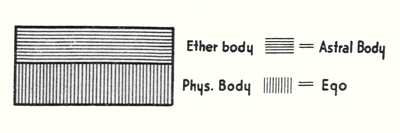
[ 6 ] I said “essentially” because, of course, everything interpenetrates in human beings, so that one can also say: The I is also in the etheric body, and so on. As it is meant here, this is indirectly the case, essentially. If we take the strongest interpenetration, then what I have drawn schematically here applies.
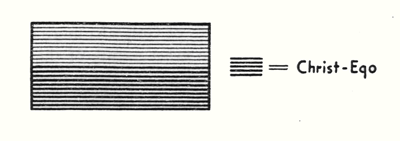
[ 7 ] Now we ask ourselves: What actually happened at the baptism of John? At the baptism of John, we said, the I of Jesus of Nazareth emerged from the physical body, etheric body, and astral body and left this threefold shell behind for the Christ being. So we can schematically draw what was then present in Jesus of Nazareth: the physical body, the etheric body, and the astral body. The I left the physical body. Instead of this I of Jesus of Nazareth, the Christ being entered into this threefold shell — again essentially, and mainly into the physical body. With this, however, we have touched upon the edge of a profound mystery. For if we now consider what actually happened, we must say: What happened touches all those great human relationships that we have indicated in recent days.
[ 8 ] I have indicated to you in recent days that everything that is general in human beings, everything that, so to speak, makes human beings equal within a certain group, lies in the female element of heredity. I have told you that through women, over the course of generations, that which, when we look at the external, would make one face similar to another within a people is passed on. Through the male element, what distinguishes one human being from another is passed on from generation to generation, what makes him an individual being here on earth, what places his ego on its own ground. Those spirits who are in contact with the spiritual world have always felt this in the right way. And human beings learn to truly know and appreciate what great people who had a relationship with the spiritual world have said when they penetrate into these depths of world facts.
[ 9 ] Let us look again at the first schematic figure. Human beings say to themselves: An etheric body lives within me, and within this etheric body is the astral body. The astral body is the carrier of ideas, thoughts, feelings, and emotions; it lives in the etheric body. But we have seen that the etheric body is what first works on the physical body to the fullest extent, so to speak, and contains the forces that shape the physical body. We must therefore say: in this etheric body, when it is permeated by the astral body, lies everything that shapes the human being into a human being, everything that gives him a certain form, so to speak, from within, from the spiritual parts. What makes one human being the same as another comes from what works within them, what is not merely external, what is not attached to the physical body, but to the etheric body and the astral body. For these are the inner members. Therefore, the person who looks into such things will feel that what permeates his etheric body and astral body comes from the maternal element. But what gives his physical body its specific form, which is imposed on it by the I, by the I in the physical body, the person must say is his paternal inheritance.
“From my father I have my stature,
The seriousness of life,
From my mother, my cheerful nature
And my love of storytelling,”
[ 10 ] says Goethe. And you see, this is an interpretation of what I have sketched out for you as a schematic figure. “From my father I have my stature,” that is, what is worked out by the ego; from my mother, the ideas, the gift of storytelling — that lies in the etheric body and astral body. Sayings of great spirits are far from being understood when one thinks one has understood them through trivial human ideas.
[ 11 ] But now we must apply what we have illustrated to the Christ event. We must ask ourselves from this point of view: What would have happened to humanity if the Christ event had not occurred?
[ 12 ] If the Christ event had not occurred, the course of human evolution would have continued as we saw it begin in the post-Atlantean era. We have seen that in ancient times, at the foundation of human culture, there was a love that was closely linked to the bond of tribal kinship, of blood kinship. Those who were related by blood loved one another. And we have seen how, in the course of human evolution, this bond of blood was increasingly broken. Now go back from the earliest times of human evolution to the time when Christ Jesus appeared.
[ 13 ] While from the earliest times marriages were contracted within the same tribe, you will find how, at the time of Roman rule—and that is the time when the Christ event took place—close marriages were increasingly broken up, how the most diverse peoples were thrown into confusion precisely by the Roman conquests, how, to the greatest extent, distant marriages had to take the place of close marriages. Blood ties had to break down more and more in the course of human evolution because human beings were destined to stand on their own two feet.
[ 14 ] Let us assume that Christ had not come to infuse new strength, to replace the old blood love with a new, spiritual love. What would have happened then? Then that which brings people together, love, would have disappeared more and more from the earth; that which unites people in love would have died in human nature. Without Christ, the human race would have gradually seen love die among themselves. People would have been driven into individuality. If one looks at things only with external science, one does not see, of course, that deep truths lie at the foundation. If you were to examine the blood of people today and of people several millennia before the appearance of Christ—not with chemical means, but with the means available to spiritual research—you would find that this blood has changed, that it has taken on a character that makes it less and less a carrier of love.
[ 15 ] How, then, must the course of future development have appeared to an insightful person of ancient times, who was able to look deeply into the course of human evolution and who knew prophetically how everything would come to pass if only the one direction that had been developing since time immemorial had continued without the Christ event? What images would he have had to paint before the human soul if he wanted to hint at what would happen in the future if the love of blood were not replaced to the same extent by soul love, by Christ love? He had to say: If people become more and more isolated from one another, if each person becomes more and more hardened in his own ego, if the dividing lines that separate soul from soul become stronger and stronger, so that soul and soul can understand each other less and less, then people in the outer world will increasingly come into conflict and strife, and the conflict of all against all on earth will take the place of love. That would have been the result if the development of human blood had taken place without the Christ event. All human beings would have been hopelessly exposed to strife between all, which will indeed come, but only for those who have not permeated themselves in the right way with the Christ principle. Thus, such a prophetically seeing person saw an end to the earth's development that filled his soul with terror. He saw that because soul can no longer understand soul, soul must rage against soul!
[ 16 ] I have told you in recent days that only gradually can human beings be brought together through the Christ principle. I have shown you an example of how two noble spirits are opposed to each other in their opinions, so that one believes he is proclaiming the true Christ, Tolstoy, and the other believes he is proclaiming the true Christ, Solovyov, and that one regards the other as the Antichrist. For Soloviev regards Tolstoy as the Antichrist. What initially struggles between soul and soul in opinions would gradually express itself in the outer world, that is, man would rage against man. This is what the development of the blood demands.
[ 17 ] Do not object that, despite the Christ event, we still see strife and discord today, that we are far removed from any realization of Christian love. I have already told you that we are only at the beginning of Christian development. The great impulse was given that, in the further course of Earth's development, Christ will take up residence in human souls and bring them together spiritually. What still exists today in the way of strife and discord, and what will lead to even greater excesses, stems from the fact that humanity has not yet been permeated in the slightest degree by the real Christ principle. What has existed in humanity since time immemorial continues to prevail. This can only be overcome slowly and gradually. We are slowly and gradually seeing the Christ impulse flowing into humanity.
[ 18 ] This is what someone who had clairvoyantly seen the course of human development in pre-Christian times would have foreseen. He could have said: I have received the last remnants of the old clairvoyant power. In ancient times, you humans had the opportunity to look into the spiritual world through dull, dim clairvoyance. This has gradually disappeared. However, like heirlooms from those ancient times, there is still the possibility of looking into the spiritual world in abnormal states of mind, in dreamlike states. There, human beings can still see something of what lies behind the outer surface of things. All the old legends, fairy tales, and myths, which truly contain deeper wisdom than modern science, tell of the high degree to which the gift of entering into special states once existed. Call it a dream, but in this dream events were foretold. But not in such a way that human beings would be sufficiently protected by ancient wisdom from conflict between all people. The ancient sage denied this, and he denied it in the strongest possible terms. He said: We have received an ancient wisdom. Back then, in the Atlantean era, people perceived it in abnormal states. Even now, individual people can perceive them when they are placed in abnormal states. There, what will happen in the near future is foreshadowed. — But what was foreshadowed in the dream gave people no security; it was deceptive and will become more and more deceptive. This is what the teacher of the pre-Christian era taught, and this is how he presented it to the people.
[ 19 ] That is why it is important that, when one understands the full sharpness and strength of the Christ impulse, one comes to the recognition of a great truth. One must realize that without the Christ impulse, the isolation and separation of human beings, the setting of human beings against one another, would bring about something like a struggle for existence — which is also presented to people today by a materialistic Darwinian theory — a struggle for existence as it prevails in the animal world, but as it should not prevail in the human world. One could speak grotesquely and say: At the end of the earth's days, the earth will present the picture that certain materialists, in the spirit of Darwinian theory, paint of humanity, taking it from the animal world! Today, however, this theory, when applied to humanity, is false. It is correct for animal nature, for the very reason that in animal nature there is no such impulse that transforms strife into love. Christ, through his deeds, as a spiritual force in humanity, will refute all materialistic Darwinism!
[ 20 ] But in order to understand this, one must realize that human beings can only avoid standing in opposition to one another in the sensory outer world through their different opinions, feelings, and deeds if they fight within themselves and resolve within themselves what would otherwise flow out into the outer world. Those who first fight against what needs to be fought within themselves, who establish harmony within themselves between the different parts of their being, will not fight against the opinions of others. They will face the external world not as a fighter, but as a lover. This is what it is all about: diverting conflict from the outside to the inside of the human being. The forces at work in human nature must fight each other internally. We must view two opposing opinions in such a way that we say: This is one opinion, and it is valid. This is the other opinion, and it is also valid. But if I only recognize one opinion as valid, if I only consider what I want to be valid and fight against the other opinion, then I enter into conflict on the physical plane. To merely reinforce my opinion is to be selfish. To consider my action as the only valid one is to be selfish.
[ 21 ] Let us assume that I accept the opinion of the other person, seek to establish harmony within myself, then I will relate to the other person in a completely different way. Then I will begin to understand him first. By deriving the conflict in the outer world from a harmonization of the inner forces of the human being, we could also express the progress in human evolution. Through Christ, human beings had to be given the opportunity to become harmonious within themselves, to find within themselves the possibility of harmonizing the conflicting forces in their own inner being. Christ gives human beings the strength to first eliminate conflict within themselves. Without Christ, this is no longer possible. And the ancient, pre-Christian people rightly regarded one thing as the most terrible in relation to external conflict: the conflict of the child against its father and mother. And in the times when people knew how things would develop without the Christ impulse, patricide was regarded as the most terrible and abominable crime. The ancient sages who foresaw that Christ would come made this clear. But they also knew what would happen in the outer world if the struggle were not first carried out within ourselves.
[ 22 ] Let us look into our own inner selves. We have seen that within the human being, where the etheric body and the astral body interpenetrate, the mother reigns, and that where the I is in the physical body, the father is expressed. This means that in our general nature, in what is common to our species, in our inner life of wisdom and imagination, the mother reigns, the female element reigns; in what arises from the union of the I and the physical body, in the outwardly differentiated form, in what makes the human being an “I,” the father reigns, the male element. What, then, did the ancient sages who thought in this way have to demand above all else from human beings? They had to demand that human beings gain clarity within themselves about the relationship between the physical body and the I, and between the etheric body and the astral body; that they gain clarity within themselves about the maternal and paternal elements at work within them. Because human beings have an etheric body and an astral body within themselves, they have the motherly within themselves. In addition to the outer mother who stands on the physical plane, they have, so to speak, the motherly element, the mother, within themselves. And in addition to the father who stands on the physical plane, they have the fatherly element, the father, within themselves. Bringing the father within oneself and the mother within oneself into the right relationship must appear as an ideal, as a great ideal. If human beings do not bring their father and mother into harmony within themselves, the disharmony between the paternal and maternal elements must spread from the human being out into the physical plane and cause devastation there. So the ancient sage said: The human being has the task of creating harmony within himself between the paternal and maternal elements. If this does not succeed, then what must appear to us as the most terrible thing comes into the world.
[ 23 ] How did the ancient sages present to people what we have just expressed, so to speak, in anthroposophical terms? They said: In ancient times we inherited an ancient wisdom. Today, people can still be placed in abnormal states in which they can access this wisdom. But the possibility of reaching this state is becoming increasingly rare, and even the old initiation cannot carry people beyond a certain point in human evolution. Let us consider once again this old initiation as we have described it in recent days. What happened during such an initiation?
[ 24 ] In such an initiation, the etheric body and the astral body were lifted out of this structure of physical body, etheric body, astral body, and I, but the I remained behind. Therefore, the human being could have no self-consciousness during the three and a half days of initiation. Self-consciousness was extinguished. The person received consciousness from the higher spiritual world, which was instilled in them by the priest-initiator who guided them completely; he made his ego available to them. What actually happened as a result? Something happened that was expressed by a formula that will seem strange to you. But once you understand this formula, it will no longer seem strange to you. It was expressed as follows: When a person was initiated in the old sense, the maternal element emerged and the paternal element remained behind. This means that the person killed the paternal element within themselves and united with their mother within themselves. In other words, they killed the father within themselves and married their mother. So when the old initiate lay in a three-and-a-half-day lethargic state, he had united with his mother and killed his father within himself. He had become fatherless. This had to be so, because he had to give up his individuality; he had to live in a higher spiritual world. He became one with his people. But what lived in his people was precisely what was given in the maternal element. He became one with the entire organism of his people. He became what Nathanael was, and what was always named with the name of the people in question, among the Jews an “Israelite,” among the Persians a “Persian.”
[ 25 ] In the world, there can only ever be wisdom that flows from the mysteries, nothing else. Those who learn the corresponding things in the mysteries become messengers to the outer world, and the outer world learns what is seen in the mysteries. But this was learned in the sense of the ancient wisdom, which was acquired by uniting with one's mother within oneself and killing the father within oneself. But this inherited wisdom cannot take human beings beyond a certain point in their development. Something else, something completely new, had to take the place of this ancient wisdom. If humanity were to receive only this ancient wisdom that was gained in this way, then humanity would, as we have already said, be driven into conflict with everyone else. Opinion would rebel against opinion, feeling against feeling, will against will; and it would lead to the terrifying picture of the future in which the human being unites with the mother and kills the father. But the ancient initiates, who had received initiation but were awaiting Christ, painted this in meaningful images, in great and powerful images. And you have preserved the imprint of this view of the ancient pre-Christian sages in your legends and myths. We need only recall the name Oedipus; there we can pick up on something in which the ancient sages expressed what they had to say in this direction. This is the ancient Greek legend, which the Greek tragedians depict in such a grand and powerful way:
[ 26 ] There was a king in Thebes. His name was Laius. Jocasta was his wife. For a long time, they had no children. So Laius asked the Oracle at Delphi if he could have a son. And the Oracle gave him this answer: If you want a son, he will be one who will kill you! — And in a state of intoxication, that is, in a state of diminished consciousness, Laius did what led him to have a son. Oedipus was born. Laius knew that this would be the son who would kill him, and he decided to abandon him. And so that he would be completely destroyed, he had his feet pierced; then he was abandoned. A shepherd found the child and took pity on him. He took him to Corinth, and there Oedipus was raised in the royal household. When he grew up, he learned of the oracle: that he would kill his father and unite with his mother. But it could not be prevented. He was to leave the place where he was, because there he was believed to be the king's son. On his way, he met his real father, and without knowing him, he killed him. He came to Thebes. And because he answered the questions of the Sphinx, because he solved the riddle of the gruesome monster that had brought death to so many, the Sphinx had to kill herself. Therefore, he was initially a benefactor of his fatherland. He was elevated to king and received the hand of the queen, and that was the hand of his mother. Without knowing it, he had killed his father and married his mother. Now he ruled as king. But because he had come to power in this way, because this terrible thing clung to him, he brought unspeakable misfortune upon his country, so that in Sophocles' drama he finally appears as the blind man who has taken his own eyesight.
[ 27 ] This is an image that emerged from the ancient centers of wisdom. And it was meant to say that, in a certain sense, Oedipus was still connected to the spiritual world in the old sense. How did he come into contact with the spiritual world? His father had consulted the oracle. These oracles were the last remnants of ancient clairvoyance. But these last remnants were not enough to bring peace to the outer world. They could not give people what needed to be achieved: harmony between the maternal and paternal elements.
[ 28 ] That Oedipus is meant to be someone who simply came to a certain clairvoyant view in the old sense through heredity is indicated by the fact that he solved the riddle of the Sphinx, that is, he recognized human nature to the extent that the last remnants of the ancient primordial wisdom could give such knowledge. It could never lead to holding back the rage against one another in humanity, that which was established in patricide and in union with the mother. Oedipus, despite his connection to the ancient primordial wisdom, cannot see through the connections through this ancient primordial wisdom. This ancient wisdom no longer makes one see. That is what the ancient sages wanted to establish. Had it made people see in the old blood sense, then blood would have spoken when Oedipus stood before his father, and it would have spoken when he stood before his mother. But blood no longer spoke! Thus the disintegration of the old primordial wisdom is vividly presented to us.
[ 29 ] What had to happen to make it possible once and for all to find within oneself the harmonious balance between the maternal and the paternal, between one's own ego, which has the paternal, and between the maternal? The Christ impulse had to come! And now we look from yet another angle into certain depths of the wedding at Cana in Galilee.
[ 30 ] It says there: “The mother of Jesus was there. Jesus and his disciples were also invited to the wedding.” Jesus — or rather, the Christ — was to present to humanity the great example of a being who had found unity within himself, between himself and the maternal principle. At the wedding in Cana in Galilee, he pointed this out to his mother: “Something is passing from me to you.” This was a new “going from me to you.” It was no longer in the old sense; it meant a renewal of the entire relationship. This was once and for all the great ideal of balance within oneself, without first killing the father, that is, without first leaving the physical body, finding balance with the maternal principle in the I. Now the time had come when human beings learned to fight the excessive power of egoism, of the I principle, within themselves, when they learned to bring it into the right relationship with what reigns in the etheric body and in the astral body as the maternal principle. Therefore, a beautiful image of this relationship between the self, which is the paternal principle, and the maternal principle should be presented to us in the wedding at Cana as the inner harmony, as the love that reigns in the outer world between Christ Jesus and his mother. This should be an image of the harmonious balance between the self and the maternal element within oneself. This did not exist before; it only came about through the deed of Christ Jesus. But since it came about through the deed of Christ, it brought with it the only possible refutation—refutation through deed—of everything that would have had to come about under the influence of those old pieces of wisdom that would have led to the killing of the father and union with the mother. So what is being fought against by the Christ principle?
[ 31 ] When the old sage who looked at Christ contrasted the old and the new, he could say: If union with the mother is sought in the old sense, then nothing good can ever come to humanity. But if, in the new sense, as shown by the wedding at Cana, union with the mother is sought, if man unites himself in this way with the astral body and etheric body living within him, then salvation, peace, and brotherhood will come more and more among men in the course of time, and the old principle of killing the father and uniting with the mother will be fought against. — So what was the hostile element that Christ had to remove? It was not the old wisdom; it did not need to be fought against. It lost its power and gradually dried up of its own accord. And we see how those who entrust themselves to it, like Oedipus, fall into disharmony precisely because of it. But the evil would not dry up by itself if people wanted to turn away from the new wisdom, that is, from the way the Christ impulse works, if they remained rigidly attached to the old principle. It was felt to be the greatest progress that people did not remain with the old principle, that they did not cling rigidly to the old line, but that they recognized what had come into the world through Christ. Is this also implied to us? Yes! Sayings and myths contain the deepest wisdom. There is a legend—it is not in the Gospel, but it is no less a Christian legend and also a Christian truth—and it goes like this:
[ 32 ] There was a married couple. This couple had no son for a long time. Then the mother was revealed in a dream — pay close attention here! — that she would have a son, but that this son would first kill his father, then unite with his mother, and bring terrible disaster upon his entire tribe.
[ 33 ] Once again, we have a dream, as in the case of Oedipus and the oracle, which means that we have here a relic of ancient clairvoyance. The mother was told in the old way what would happen. Is this enough to understand the ways of the world and prevent the disaster that was revealed to her? Let us ask the legend. The legend tells us more:
[ 34 ] Under the impression of this wisdom that came to her from the dream, the mother took the child she had given birth to to the island of Kariot. There it was abandoned, but found by a neighboring queen. She took the child in and raised it herself, because the couple had no children. Later, this couple had a child of their own, and the foundling soon felt threatened. As a result of his passionate temperament, he killed the royal couple's son. Now he could no longer stay there; he had to flee and came to the court of the governor Pilate. There he soon became a supervisor in his household. Then he got into a quarrel with his neighbor, whom he knew only as his neighbor. In the quarrel, he killed him, not knowing that it was his own father. And then he married the neighbor's wife, his mother! This foundling was Judas of Kariot. And when he realized his terrible situation, he fled again. And he found mercy in his situation only in the one who had mercy on all who came into his presence, who not only sat at table with tax collectors and sinners, but who, despite his deep insight, also took this great sinner into his company; for it was his task to work not only for the good, but for all people, and to lead them from sin to salvation. Thus Judas of Kariot came into the circle of Christ Jesus. And now he brought the calamity that had been foretold, and which, according to Schiller's saying, “That is the curse of evil deeds, that they must always beget evil,” had to come to pass in the circle of Christ Jesus. He became the traitor of Christ Jesus. Basically, what was to be fulfilled in him had already been fulfilled with the murder of his father and his marriage to his mother. But he remained, so to speak, as a tool, because he was to be a tool, the evil tool that was to bring about the good, in order to commit, so to speak, one more act beyond fulfillment.
[ 35 ] The one who is presented to us in Oedipus loses his eyesight as a consequence of the disaster he has brought about, from the moment he becomes aware of this disaster. But the one who has the same fate through his connection with the ancient heritage of wisdom does not go blind, but is chosen to fulfill destiny fulfill destiny and do what the mystery of Golgotha brings about, which causes the physical death of the one who is the “light of the world” and who brings about the light of the world in the healing of the man born blind. Oedipus had to lose his sight; Christ gave sight to the man born blind. But he died at the hands of someone who had the character of Oedipus, who was meant to show us how the old wisdom is gradually drying up in humanity, how it is no longer sufficient to bring salvation, peace, and love to people. For this, the Christ impulse with the event of Golgotha was necessary. For this, it was necessary that what appears to us as an outer image of the relationship between the Jesus Christ I and his mother at the wedding in Cana in Galilee should first take place. For this, it was further necessary that something else should take place, which the writer of the Gospel of John describes as follows:
[ 36 ] Down below, at the cross, stood the mother, and down below stood the disciple whom “the Lord loved,” Lazarus John, whom he himself had initiated, and through whom the wisdom of Christianity was to come to posterity, who was to influence the astral body of human beings in such a way that the Christ principle could live in them. The Christ principle was to live within the human astral body, and John was to pour it in. But to do this, the Christ principle had to be united from the cross with the etheric principle, with the mother. That is why Christ calls out from the cross: “From this hour on, this is your mother, and this is your son!” In other words, he binds his wisdom together with the maternal principle!
[ 37 ] Thus we see how profound not only the Gospels are, but how profound all connections are in the mystery teachings. Yes, the ancient legends are connected with the proclamations and Gospels of the new age, like predictions and fulfillments! The ancient legends, in the stories of Oedipus and Judas, clearly show us one thing: there was once a divine, ancient wisdom. But it dried up. And a new wisdom must come. And this new wisdom will bring people to what the old wisdom could never have brought them. The legend of Oedipus tells us what would have happened without the Christ impulse. The legend of Judas teaches us what the opposition to Christ was: the rigid adherence to the old wisdom. But what the ancient legends and myths already explained as insufficient is now revealed to us in a new light by the new proclamation, the Gospel. The Gospel answers us what the ancient legends expressed as images of ancient wisdom. They said: What humanity needs for the future can never come from ancient wisdom. But the Gospel, as the new wisdom, tells us: I proclaim to you what humanity needs, and what could never have come without the influence of the Christ principle, without the event of Golgotha.