

The Gospel of Luke
GA 114
21 September 1909, Basel
Translated by Steiner Online Library
Seventh Lecture
[ 1 ] In the past few days, we have tried to form ideas about the most important beings that the Gospel of Luke tells us about. We have gained a comprehensive understanding of what underlies this document. But there is one thing we still need to do: to follow the further development of the main being, and thus of the main being of our Earth, Christ Jesus himself. In doing so, it will be necessary to first recall what has already been said, namely that Christ Jesus, who later stands before us and is described in the Gospel of Luke, was born physically, so to speak, as the Nathanic Jesus from the house of David. This child grows up to about the age of twelve. At the time when his development has progressed to this point, that ego-ness enters his body which was once incorporated into the being that initiated the Persian culture, so that from the age of twelve onwards we have the ego of Zarathustra in the body of the Nathanic Jesus. Now it will be our task to follow the development of this being more closely. Here we must remember something for which we have been prepared by our previous spiritual scientific considerations.
[ 2 ] We know that the development of the human being normally proceeds in such a way that an important period falls between the first and seventh years of life; another important period in development falls between the seventh and approximately fourteenth years, that is, until puberty; another phase lasts from the fourteenth to the twenty-first year, then comes a period until the twenty-eighth year, and then another until the thirty-fifth year. These periods should not, of course, be understood in a pedantic sense, as if their end always coincides exactly with the date of the year, but we must place that important transition in human development, which is roughly marked by the end of the seventh year, in the period of tooth replacement. This transition does not take place all at once, but gradually during the period of tooth replacement. The same is true of the other stages. We now know — this is described in more detail in the little book “The Education of the Child from the Perspective of Spiritual Science” — that at the end of the seventh year something happens spiritually that is similar to what happens physically when a child leaves the womb: a kind of etheric birth takes place. At the age of fourteen, with sexual maturity, an astral birth takes place; what is the human astral body becomes free. If we now follow human development closely, with the eyes of the spirit, it appears to us as much more complicated. As human beings usually observe in life, they fail to notice those important differences in the whole of human life that nevertheless appear in later years. Today, it is believed that from a certain point in time, not much happens to human beings. But this is only a crude observation. In truth, if we observe more closely, we can perceive certain differences in human development even in later years.
[ 3 ] When the physical mother shell is stripped away, what is now born of the human being is actually only the physical body, so that what emerges freely in the first seven years of life is the physical body. In the various lectures on child education, it has been emphasized how important it is for the educator to know this. Then, when the etheric shell is stripped away, the etheric body lies free; when the astral shell is stripped away at the age of fourteen, the astral body lies free. Strictly speaking, however, we can only understand the human being if we start from the division indicated in my “Theosophy.” There, the higher, soul members of human nature are divided further. First, we find what is called the sentient body attached to the life body, and strictly speaking, it is only at the age of twenty-one that the sentient body is completely free in relation to the outer world. At the age of twenty-one, what is called the sentient soul gradually becomes free in the human being; at the age of twenty-eight, the intellectual or emotional soul becomes free, and afterwards the conscious soul. This is how it is with the present human being. And anyone who observes human life guided by the knowledge of spiritual science knows very well that these stages of development exist. And those who are the great leaders of humanity also know why the age of thirty-five is so important. Dante knew why he referred especially to his thirty-fifth year when he explained that it was then that he had those powerful visions of the world which are recorded in his great world poem. Right at the beginning of the Divine Comedy, we find a reference to the fact that he had these visions in his thirty-fifth year. At that stage, the human being has developed to such an extent that he can make full use of those abilities which are attached to the sentient body, the sentient soul, and the intellectual or emotional soul.
[ 4 ] Those who have spoken of man in terms of our development have always known this division. It was somewhat different among the Orientals, because times change somewhat. Therefore, it was right for Oriental culture not to make the same distinctions in its classification. In the West, however, it was always necessary to make them. The Greeks, for example, described what we have here in slightly different words. When they wanted to describe the soul, they started with what we call the life body and called it Treptikon; what we call the sentient body was called, with a very descriptive expression, Aesthetikon; our sentient soul was called Orektikon, the intellectual soul Kinetikon, and what is the consciousness soul, the most precious gift that human beings now acquire, was called dianoetic. Thus, when we look at it closely and precisely, we have before us the development of the human being.
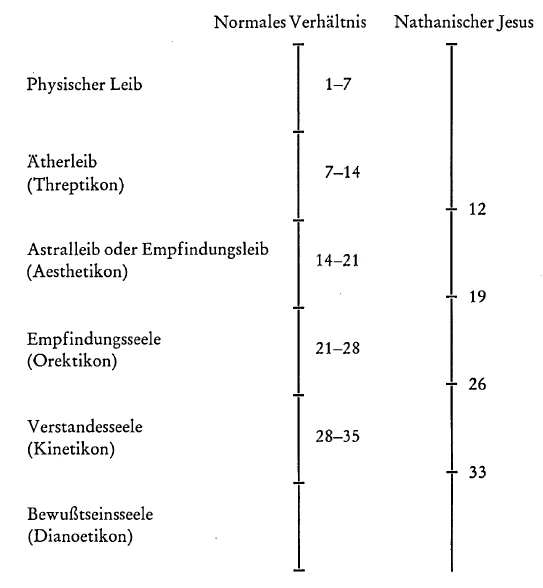
[ 5 ] Now, due to certain circumstances, which will become clear to us today, the development of the Nathanic Jesus was somewhat advanced, somewhat accelerated. This was also possible because sexual maturity occurred earlier in his region. But there were also very special reasons why what usually occurs at the age of fourteen occurred at the age of twelve in his case. And so what usually happens at the age of twenty-one happened to him at the age of nineteen, and what usually happens at the ages of twenty-eight and thirty-five happened to him at the ages of twenty-six and thirty-three. This is, so to speak, the pattern of the development of our earthly center being. We must now bear in mind that up to the age of twelve we have the physical Jesus of Nathan before us, but that from the age of twelve onwards the I of Zarathustra continues to live in the Jesus of Nathan. What does this actually mean? It means nothing other than that this I, this mature I, from the age of twelve onwards, worked on the sentient body of the Jesus of Nathan, the sentient soul and the intellectual soul, and developed these qualities of human nature in the way that only such a mature I, which has gone through the most diverse incarnations and experienced the destinies of the Zarathustra I, can develop human abilities. Thus we have before us the wonderful fact that at the age of twelve the I of Zarathustra incarnated itself in the body of the Nathanic Jesus and developed the abilities in the soul in the most delicate way imaginable. Thus, a sentient body developed that was able to look up into the cosmos and have the sensations of the ancient Ahura Mazdao, of what he is in his spiritual essence; a sentient soul developed that was able to hold within itself the knowledge and wisdom which gradually developed within humanity on the basis of the teachings of Ahura Mazdao; and then a mind soul developed which could comprehend all this, that is, it could grasp in concepts, in words, in easily comprehensible words what humanity had previously attained only through its spiritual currents from outside.
[ 6 ] Thus, this Nathanic Jesus developed with the Zarathustra-I within him. And he developed in this way until he approached the age of thirty. Then a new fact came to the fore. The phenomenon that had already appeared in a certain way in the Nathanic Jesus at the age of twelve, namely that his innermost being had been filled with a new ego, occurred once again, but now in a more universal and significant way. Towards the age of thirty, we see how the Zarathustra ego completed its task in the soul of the Nathanic Jesus, how it developed his abilities in the highest way. It had, so to speak, completed its mission for this soul, it had worked into this soul everything it had gained through its earlier incarnations, and could now say: My task is now complete. And one day the Zarathustra ego left the body of the Nathanic Jesus.
[ 7 ] The Zarathustra ego thus lived until the age of twelve in the body of the Solomon Jesus. This boy could not have developed further on earth. He remained, so to speak, at his former level because the Zarathustra ego that had lived in him had left him. He had, however, attained a high and rare maturity because such a high ego was within him. Anyone who had observed the Solomon Jesus child outwardly would have found him to be a child of the highest degree of precocity. But from the moment the Zarathustra ego left him, he remained where he was, unable to go any further. And when the time approached when the mother of the Nathanic Jesus died relatively early and was taken up into the spiritual world in relation to the spiritual members, she took with her that which was of eternal value, that which was formative power in the Solomon child Jesus. This child also died at about the same time as the mother of the Nathanic Jesus died.
[ 8 ] It was a valuable etheric shell that left the body of the Solomon Jesus at that time. We know that from that time on, the etheric body acquires its special formation when a child has passed the age of about seven, between the seventh year and puberty. So this was an etheric body that had been formed by the forces that the Zarathustra I had. We know that at death the etheric body leaves the physical body, that everything that is not useful for eternity is cast off in normal human life, and that a kind of extract is taken from the etheric body. In the case of the Solomonic Jesus child, the greatest possible quantum of the etheric body was usable for eternity. The entire life body of this child was taken into the spiritual world by the mother of the Nathanic Jesus.
[ 9 ] Now, however, the etheric body is the former and builder of the physical human body. We can now imagine that there was indeed a deep relationship between this etheric body, which had been taken into the spiritual world as the etheric body of the Solomon's Jesus, and the I of Zarathustra, for the same was one with him in his earthly life until the age of twelve. And when, through the development of Jesus of Nazareth, it left his body, so to speak, came out of the body of the Nathanic Jesus, the forces of attraction between the Zarathustra I and the etheric body that originated from the Solomon Jesus child came into play. They came together again and built a new physical body. The Zarathustra ego was so mature that it did not need to pass through another devachan. With the help of the etheric body we have just described, it was able to build a new physical body in a relatively short time. And thus, for the first time, the being was born that would appear again and again, always in such a way that relatively short periods of time elapsed between physical death and a new birth, so that whenever this being left the physical body in death, it soon reappeared on earth in a new incarnation.
[ 10 ] This being, which thus sought out again the etheric body it had laid down in the manner described, subsequently passed through human history. As you can imagine, it became the greatest helper of those who wanted to understand the great event in Palestine. As the so-called “Master Jesus,” this individuality wanders through the turning point of time; so that Zarathustra, the Zarathustra-I, after rediscovering his etheric body, began his career through human evolution as the “Master Jesus,” who has since lived incarnated on our Earth again and again to guide and direct that spiritual current which we call Christian. He is the inspiration for those who want to understand the living development of Christianity; within the esoteric schools, he has inspired those who have had to continuously cultivate the teachings of Christianity. He stands behind the great spiritual figures of Christianity, always teaching what the great event in Palestine actually means.
[ 11 ] This Zarathustra-I, which had animated the body of the Nathanic Jesus from the twelfth to the thirtieth year, was now outside this body. Another being now entered this body. The moment when this happened, when, so to speak, a “highest I” entered into the Nathanic Jesus in place of the Zarathustra I, is characterized in all the Gospels as the moment of John's baptism in the Jordan. It has already been pointed out in the discussion of the Gospel of John that baptism in those earlier times was something quite different from what it later became, when it was only a symbol. It was also performed differently by John the Baptist. Those who were baptized were immersed in water with their entire physical body. But you know from the various preparatory anthroposophical lectures that something very special can happen in such a situation. Even in ordinary life, for example, when a person is close to drowning and experiences a shock, they see their entire life pass before them as if in a large tableau. This is because, for a moment, what normally only happens after death occurs: the etheric body is lifted out of the physical body and becomes free from the forces of the physical body. This happened to most of John's baptized disciples, and it happened especially during the baptism of the Nathanic Jesus: his etheric body was drawn out. And during this moment, that high being whom we call the Christ being was able to descend into the body of the Nathanic Jesus and take possession of him.
[ 12 ] Thus, from that moment of John's baptism, the Nathanic Jesus is permeated by the Christ Being. This is the meaning of the words written in the older Gospel documents: “This is my beloved Son, today I have begotten him” — that is, it is now the Son of Heaven who begot Christ. The fertilizer was the unified divinity that weaves through the world, and the recipient was the body and the entire organization of the Nathanic Jesus, who had been prepared to receive the seed from the heights. “This is my beloved Son, today I have begotten him,” is what it used to say in the older Gospel manuscripts, and this is what should really be written in the Gospels (Luke 3:22).
[ 13 ] Who is this being who united itself with the etheric body of the Nathanic Jesus at that time? Again, we cannot understand this Christ being if we direct our gaze only to the development of the earth. This Christ being is the being we must call the leader of those spiritual beings who, when the sun separated from the earth, left the earth with the sun and established a higher realm in order to work on the earth from this sun, that is, from outside. So when we go back to the pre-Christian era—from the time when the Sun separated from the Earth until the appearance of Christ on Earth—we have to say that when people looked up at the Sun, if their senses were mature, they would have felt what Zarathustra taught, that what reaches us in the sunlight and in the warmth of the sun is only the physical garment of those high spiritual beings who stand behind the sunlight; for behind it are hidden the spiritual rays of power that penetrate from the sun into the earth. But the leader of all the other beings who send their beneficial effects down from the sun to the earth is the being who was later called Christ. In pre-Christian times, therefore, it was not to be sought on Earth, but on the sun. And Zarathustra was right when he called it Ahura Mazdao, placed it on the sun, and said: When we walk on the earth, we do not find this spirit of light, but when we look at the sun, what lives spiritually on the sun is Ahura Mazdao, and what streams to us as light is the body of the sun spirit, Ahura Mazdao, just as the human physical body is the body of the human spirit. — But this high being drew ever closer through the great cosmic processes of the Earth sphere. One could sense, clairvoyantly, so to speak, the approach of Christ to the Earth. And a clear recognition of this Christ came when the great predecessor of Christ Jesus, Moses, received his revelations on Mount Sinai in a flash of lightning.
[ 14 ] What did these revelations of Moses mean? They meant that what was approaching the earth as the Christ being was initially showing itself as in a reflection, as in a mirror image. Let us imagine the process we perceive every full moon night as spiritualized. When we look up at the full moon, we see the sun's rays reflected back, mirrored. It is sunlight that flows toward us; we only call it moonlight because it appears to be reflected by the moon. Who did Moses see in the burning bush and in the fire on Mount Sinai? Christ! But just as we do not see the sunlight directly on the moon, but only reflected, so he saw Christ in a reflection. And just as we call the sunlight reflected by the moon moonlight, so Christ was called Yahweh or Jehovah at that time. Therefore, Yahweh or Jehovah is nothing other than the reflection of Christ before he appeared on earth himself. Thus, Christ revealed himself indirectly to human beings, who were not yet able to see him in his true essence, just as sunlight is revealed through the moon's rays on an otherwise dark full moon night. Yahweh or Jehovah is the Christ, but not seen directly, rather as reflected light.
[ 15 ] Human knowledge and perception should come closer and closer to this Christ. This means that he should walk on Earth for a time, be a human among humans, become a human cohabitant on our Earth, as he had previously revealed himself to the initiated from the cosmos. The right time had to come first. Those who had penetrated the wisdom of the world had always known that Christ existed. And because he revealed himself in many different ways, he was given many different names. Zarathustra called him Ahura Mazdao because he revealed himself to him in the garment of sunlight. Those great teachers of humanity who appeared in ancient India in the first epoch after the Atlantean catastrophe, the holy Rishis, knew all about this being because they were initiates; but they knew that it could not yet be attained through earthly wisdom in that epoch, that it would only be possible to attain it through earthly wisdom in a later epoch. Therefore, the formula for that time was that this being lived beyond the region of the seven rishis. It was called Vishva Karman. Thus they also taught about that being whom they called Vishva Karman, whom Zarathustra called Ahura Mazdao. These are different names for this being, who slowly approached from spiritual heights, from cosmic locations on Earth.
[ 16 ] But the evolution of humanity had to be prepared so that a body could receive this being. To this end, a being such as that which lived in Zarathustra had to mature from incarnation to incarnation in order to develop, in a body as pure as that of Jesus of Nazareth, the abilities of the sentient body, the sentient soul, and the intellectual soul, so that this human being could become capable of receiving such a high being. This had to be prepared slowly. In order for a sentient soul and a rational soul to be prepared in this way, an I had first to go through the many experiences and adventures that Zarathustra went through, and had to transform the abilities in the Nathanic Jesus. This was not possible in an earlier time. For it was not only the Zarathustra ego that had to work on the Nathanic Jesus child, but also that high being whom we have characterized as the Nirmanakaya of the Buddha. It worked especially from the outside in, from birth until the twelfth year of life. But first it had to be there. That Bodhisattva himself first had to ascend to Buddhahood in order to make it possible within himself to develop the spirit body of the Nirmanakaya, so that he could work on the Nathanic Jesus child from birth to the age of twelve. The Bodhisattva himself first had to transcend the Buddha stage in order to have the power within himself to prepare a body for that great event. He had not yet developed this ability in that incarnation when he became Buddha. His Buddha life was necessary for this.
[ 17 ] Once humanity truly understands what is preserved as great mysteries in the legends, it will be able to read in the relevant passages that everything we decipher from the Akashic Records is contained in a wonderful way in the ancient legends. We are told, and rightly so, that the Christ Being was also taught in ancient India as a cosmic Being beyond the sphere of the seven holy Rishis. They knew that this Being lives in the heights and only gradually approaches the earth. Zarathustra also knew that he had to turn his gaze away from the earth to the sun; and the ancient Hebrew people, through the qualities and abilities we emphasized yesterday, were able to receive the first proclamation of the reflection of the Christ Being. This is also hinted at in a story about how the Buddha, just as he was about to become a Buddha, came into contact with Vishva Karman, who was later called Christ. The legend tells us that when he was approaching the age of twenty-nine, he made that famous departure from his palace, where he had been cherished and cared for until then. There he first saw an old man, then a sick man, then a corpse, and thus gradually learned about the misery of life; then he saw a monk who had left this life, in which there is old age, sickness, and death. Then, according to the legend, which proclaims a profound truth, he decided not to leave immediately, but to return once more. But on this outing, the legend tells us, he was adorned from the spiritual heights with that power which the god-artist Vishva Karman, who appeared to him, sent down to earth. The Bodhisattva was adorned with the power of Vishva Karman himself, who was later called Christ. So Christ was still something external to him, not yet united with him. At that time, the Bodhisattva was also approaching the age of thirty; but at that time he would not yet have been able to bring about the complete reception of Christ in a human body. He first had to be ready for that. It was precisely through his existence as Buddha that he made himself ready. And when he appeared as Nirmanakaya, his task was to prepare the body of Nathan's Jesus, which he did not take on himself, to receive Vishva Karman, the Christ.
[ 18 ] Thus, the forces of Earth's evolution had worked together to bring about this great event. Now the question must arise: How does this Christ, this Vishva Karman, relate to such beings as the Bodhisattvas, one of whom, for example, later became the Buddha?
[ 19 ] This question brings us to the very edge of one of the greatest mysteries of our earth's development. It is generally difficult for people today, with their feelings and sensibilities, to even begin to imagine the enormity of what lies behind this mystery. There are twelve beings like the Bodhisattva who became Buddha and whose mission was to incorporate the great teaching of compassion and love into humanity. Such beings exist in connection with our cosmos, to which the Earth belongs. That Bodhisattva who became Buddha five to six centuries before our era is one of these twelve. All Bodhisattvas have a specific mission. Just as this one had the mission of bringing the teaching of compassion and love to Earth, so too do the others have their missions, which must be fulfilled in the various Earth epochs. The Buddha is particularly close to the mission on Earth because the development of moral consciousness is precisely the task of our age, from the time when the Bodhisattva appeared five to six centuries before our era until this Bodhisattva is succeeded by his Bodhisattva successor, who will later live on Earth as the Maitreya Buddha. This is how earthly development proceeds in general: the Bodhisattvas descend and, from time to time, incorporate into earthly development that which is the object of their mission. If we were to survey the entire development of the earth, we would find twelve such Bodhisattvas. They belong to that mighty community of spirits which from time to time sends one of the Bodhisattvas to earth as a special messenger, as one of the great teachers. We must recognize a great lodge of twelve Bodhisattvas as the ruling lodge of our entire earth development. These twelve Bodhisattvas essentially correspond to the concept we know on lower levels of existence as the concept of the teacher. They are teachers, great inspirers for this or that part of what human beings have to learn.
[ 20 ] Where do the Bodhisattvas receive what they have to proclaim from epoch to epoch? If you could look into the great spiritual lodge of the Bodhisattvas, into the circle of the twelve Bodhisattvas, you would find that in the midst of the twelve Bodhisattvas in our world existence there sits a thirteenth being whom we cannot call a teacher in the same sense as the twelve Bodhisattvas, but whom we must call the being from whom wisdom itself flows substantially. Therefore, it is quite correct to describe the situation as follows: The twelve Bodhisattvas sit in the great spiritual lodge around their center; they are absorbed in contemplating the great Being who pours into them everything they then have to carry into the development of the earth as their mission. Thus, what the others have to teach flows out from this thirteenth being. They are the teachers, the inspirers; the thirteenth is, as an entity, that which the others teach. Through him they proclaim from epoch to epoch. This thirteenth is the one whom the ancient Rishis called Vishva Karman, whom Zarathustra called Ahura Mazdao; he is the one we call Christ. And so he stands with all Bodhisattvas, he is the leader and guide of the great lodge of Bodhisattvas. And so the content of the proclamation throughout the entire choir of Bodhisattvas is the teaching of Christ, of Vishva Karman. He who became Buddha from Bodhisattva five to six centuries before our era was adorned with the powers of Vishva Karman. He who, as the Nathanic Jesus, had taken Christ into himself, was not merely “adorned,” but “anointed,” that is, permeated, saturated with Vishva Karman, with Christ.
[ 21 ] Wherever people had an inkling or, through initiation, an insight into this fact, into these great mysteries of human evolution, this mystery was reflected as in a symbol, as in a picture. We see, for example, in those little-known, mysterious mysteries of northern Europe, in the Drotten mysteries, how before the appearance of Christianity an earthly symbol was created of the spiritual reality of the lodge of the twelve Bodhisattvas. In the Drotten mysteries of ancient Europe, those who were teachers in spiritual development always belonged to a community of twelve. They had a message to proclaim. And they had a thirteenth who did not teach, but who, by his mere presence, radiated the wisdom that the others received. This was the image on earth of a heavenly, spiritual reality. — And on the other hand, in the poem “The Secrets,” where Goethe refers to his Rosicrucian inspiration, we are reminded of how twelve sit around a thirteenth and how the latter does not need to be a great teacher; for Brother Markus is to be addressed by the twelve — after the thirteenth has departed from them — in his simplicity as this thirteenth. He is to be the bringer not of a teaching, but of spiritual substance itself. And wherever one had an inkling or insight into this lofty fact, it was so.
[ 22 ] Thus, with the baptism of John in the Jordan, the moment had come in human evolution when this heavenly thirteenth appeared on earth as the spiritual substance itself, from which all others—Bodhisattvas and Buddhas—were to teach; and those tremendous preparations were necessary so that this being could sink into a human body. This is the secret of the baptism in the Jordan. And this is the being described to us in the Gospels: Vishva Karman, Ahura Mazdao, or Christ, as he was later called, in the body of the Nathanic Jesus. As such, this being was to walk the earth for three years in human form, a human being among humans, in that tested earthly existence which, up to the age of thirty, had experienced everything we have heard in the course of these lectures. This Nathanic Jesus was illuminated and permeated by the being who had previously hidden in the shining and warming rays of the sun shining down from the cosmos, that being who had departed with the sun when it separated from the earth.
[ 23 ] Now, however, we can ask ourselves another question: Why did this being unite itself so late with the development of humanity on Earth? Why did it not descend to Earth earlier? Why did it not penetrate a human etheric body earlier, as it did at the baptism of John in the Jordan? We can understand this if we examine more closely the event described in the Old Testament as the Fall of Man. This event consists in the fact that certain beings, which had remained at the stage of the old lunar evolution, entered the human astral body during the old Lemurian epoch. At that time, the astral body was permeated by the Luciferic beings. This is depicted figuratively in the Fall of Man in Paradise. As a result of these forces entering the human astral body, human beings became more deeply entangled in earthly affairs than would otherwise have been the case. If he had not received this Luciferic influence, he would have completed his course of development on earth in higher spheres, less entangled in earthly matter. As a result, human beings descended to earth earlier than they should have. If nothing else had happened, if only what has just been indicated had taken place, then the entire effect of the Luciferic forces anchored in the human astral body would have made itself felt in the human etheric body as well. But the world powers had to prevent this. Therefore, something very special had to happen. What this means will become clear from another perspective in my forthcoming book, The Secret Science. Human beings could not remain as they were after they had taken the Luciferic forces into their astral bodies. They had to be protected from the effect of the Luciferic forces on their etheric bodies. This was achieved by making human beings incapable of using their full etheric body at that time. Part of the etheric body was withdrawn from human will. If this blessing from the gods had not come, human beings would have retained power over their full etheric body and would never have been able to find their way through earthly evolution in the appropriate manner. Certain parts of the human etheric body had to be withdrawn at that time in order to be preserved for later times. Let us now try to visualize which parts these were.
[ 24 ] Human beings consist primarily of the parts that we also see outside in the world, of the earthly or solid, of water or liquid, and of air or gas. These are the elements that form the physical human body, just as they form everything physical. The etheric begins with the first state of ether, which we call the state of fire ether or simply fire. Fire or heat, which modern physics does not regard as a substance but only as a mere movement, is, however, the first state of ether. The second state of ether is light ether or simply light, and the third state is that which does not appear to humans in its original form; humans can only perceive a reflection, a shadow, as it were, of this ether in the physical world as sound. But underlying what is outwardly sound is something finer, more ethereal, something spiritual, so that we must describe physical sound as merely a shadow image of spiritual sound, of the sound ether or also the number ether. The fourth ether realm is the life ether, that which underlies all actual life.
[ 25 ] As physical human beings are today, everything that is soul-like in them is expressed in their physical and etheric bodies. But everything soul-like is assigned, so to speak, to certain substances of the etheric. What we call the will is expressed etherically in what we call fire. Anyone who is even slightly receptive to certain sensory connections will feel that we are justified in saying that the will, which expresses itself physically in the blood, lives in the fire element of the etheric; physically, it expresses itself in the blood, or rather in the movement of the blood. What we call feeling is expressed in the part of the etheric body that corresponds to the light ether. Because this is so, the clairvoyant also sees the impulses of the human will as flames of fire flashing through the etheric body and radiating into the astral body, and he sees the feelings as forms of light. But what humans experience as their thinking in their souls, and what we express in words, are also only shadow images of thinking, as you can easily imagine, because physical sound is also only a shadow image of something higher. Words have their organ in the sound ether. Our words are based on thoughts; words are forms of expression for thoughts. These forms of expression fill the etheric space by sending their vibrations through the sound ether. Sound is merely the shadow of the actual vibrations of thought. But what is the inner essence of all our thoughts, what gives our thoughts meaning, belongs, according to its etheric state, to the actual life ether.
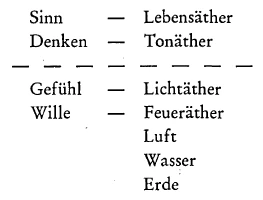
[ 26 ] Of these four etheric forms, only the two lower ones were left to humans for free, arbitrary use in the Lemurian epoch after the Luciferic influence: fire ether and light ether; the two higher etheric forms, on the other hand, were taken away from humans. This is the inner meaning when we are told that after human beings had attained the ability to distinguish between good and evil through the Luciferic influence — symbolically expressed in the enjoyment of the “tree of knowledge” — the enjoyment of the “tree of life” was taken away from them. That is, they were deprived of what would have freely and arbitrarily permeated the thought ether and the sense ether. As a result, humans now had to develop in the following way: whatever corresponded to their will was placed in every human being's arbitrariness. Human beings can assert their will as their own, as well as their feelings. Feelings and will are freely available to the individual human being for personal use, hence the individuality of the world of feelings and the world of will. However, individuality ceases immediately when we ascend from feeling to thinking, and even to the expression of thoughts, to words on the physical plane. While every human being experiences their feelings and will as something personal, we immediately enter into something general when we ascend into the world of words and thoughts. Not everyone can form their own thoughts. If thoughts were as individual as feelings, we would never understand each other. Thought and meaning were therefore removed from human arbitrariness and temporarily stored in the sphere of the gods, only to be given to humans later. That is why we can find individual people everywhere on earth with individual feelings and individual impulses of will, but we have the same thinking and the same language among all peoples. Where there is a common language, there is a common national deity. This sphere is removed from human arbitrariness; for the time being, the gods work within it.
[ 27 ] When Zarathustra pointed upward with his disciples to the realm of the spiritual, he could say: Warmth and fire stream down from heaven; light streams down from heaven. These are the garments of Ahura Mazdao. But behind these garments is hidden that which has not yet descended, that which has remained in the spiritual heights above, that which has cast only a shadow down into the physical thoughts and words of human beings. Behind the warmth of the sun, behind the light of the sun, lies that which lives in sound, in meaning, which revealed itself only to those who could see behind the light, which relates to the earthly word as the heavenly word relates to that part of life which is temporarily hidden from humanity. That is why Zarathustra said: Look up to Ahura Mazdao! You see how he reveals himself in the physical garment of light and warmth. But behind this is the divine word of creation, which is approaching the earth.
[ 28 ] What is Vishva Karman? What is Ahura Mazdao? What is Christ in his true form? The divine word of creation! That is why we encounter the remarkable statement in the teachings of Zarathustra that Zarathustra is initiated to perceive his Ahura Mazdao in the light, but also the divine word of creation, Honover, which was to descend to earth and which first descended at the baptism of John into a single human etheric body. What had been preserved since the Lemurian era, the word, the spirit word, penetrated from the etheric heights into the etheric body of the Nathanic Jesus at the baptism of John. And when the baptism was complete, what had happened? The word had become flesh.
[ 29 ] What did Zarathustra or those who knew his secrets proclaim from time immemorial? As seers, they proclaimed the “Word” hidden behind warmth and light. They were “servants of the Word.” And the writer of the Gospel of Luke wrote down what the “self-seers” proclaimed, who thereby became “servants of the Word.”
[ 30 ] Thus, we see again in this example how the Gospels are to be taken literally. What had to be withheld from humanity for so long because of the Luciferic principle had first become flesh in a single personality, had descended to earth, and lived on earth. Therefore, this being is the greatest example for those who will gradually come to understand his nature. Therefore, our wisdom on earth must take the Bodhisattvas as its example. They always have the task of proclaiming what the Thirteenth among them is. But we must gather our spiritual science, use our wisdom, our knowledge, the results of spiritual research to penetrate the being and nature of Vishva Karman, of Ahura Mazdao — of Christ.