

The Gospel of Luke
GA 114
21 September 1909, Basel
Translate the original German text into any language:
Versions Available:
The Gospel of Luke, tr. SOL
Siebenter Vortrag
Seventh Lecture
[ 1 ] Wir haben uns in den verflossenen Tagen Vorstellungen zu bilden versucht über die wichtigsten Wesenheiten, von denen uns das LukasEvangelium zu sagen hat. Wir haben umfassende Begriffe gewonnen von dem, was dieser Urkunde zugrunde liegt. Eines aber haben wir noch nötig: die weitere Entwickelung der Hauptwesenheit, und damit der Hauptwesenheit unserer Erde, des Christus Jesus selber zu verfolgen. Es wird dabei notwendig sein, daß wir uns zunächst an das erinnern, was schon gesagt worden ist, daß der Christus Jesus, der dann später vor uns steht, von dem die Schilderung im Lukas-Evangelium handelt, sozusagen leiblich geboren worden ist als der nathanische Jesus aus dem davidischen Hause. Dieses Kind wächst heran bis ungefähr zum zwölften Jahre. In der Zeit, als seine Entwickelung bis dahin vorwärtsgeschritten ist, tritt in seinen Leib diejenige Ichheit ein, welche einstmals inkorporiert war in der Wesenheit, welche die persische Kultur eingeleitet hat, so daß wir also vom zwölften Jahre an in dem Leibe des nathanischen Jesus das Ich des Zarathustra haben. Jetzt wird es uns obliegen, genauer die Entwickelung dieser Wesenheit zu verfolgen. Da müssen wir uns an etwas erinnern, wofür wir ja durch unsere vorhergehenden geisteswissenschaftlichen Betrachtungen vorbereitet sind.
[ 1 ] In the past few days, we have tried to form ideas about the most important beings that the Gospel of Luke tells us about. We have gained a comprehensive understanding of what underlies this document. But there is one thing we still need to do: to follow the further development of the main being, and thus of the main being of our Earth, Christ Jesus himself. In doing so, it will be necessary to first recall what has already been said, namely that Christ Jesus, who later stands before us and is described in the Gospel of Luke, was born physically, so to speak, as the Nathanic Jesus from the house of David. This child grows up to about the age of twelve. At the time when his development has progressed to this point, that ego-ness enters his body which was once incorporated into the being that initiated the Persian culture, so that from the age of twelve onwards we have the ego of Zarathustra in the body of the Nathanic Jesus. Now it will be our task to follow the development of this being more closely. Here we must remember something for which we have been prepared by our previous spiritual scientific considerations.
[ 2 ] Wir wissen, daß die Entwickelung des Menschen im normalen Falle so fortschreitet, daß ein wichtiger Zeitabschnitt in die Zeit vom ersten bis zum siebenten Lebensjahre fällt; ein weiterer wichtiger Abschnitt in der Entwickelung fällt in die Zeit vom siebenten bis ungefähr vierzehnten Jahre, das heißt bis zur Geschlechtsreife; ein weiterer Abschnitt geht vom vierzehnten bis einundzwanzigsten Jahre, dann kommt ein Zeitabschnitt bis zum achtundzwanzigsten und darauf ein weiterer bis zum fünfunddreißigsten Jahre. Diese Zeitabschnitte sind natürlich nicht in pedantischer Weise so aufzufassen, daß etwa ihr Ende immer genau zusammenfällt mit dem Jahresdatum, sondern wir haben jenen wichtigen Übergang in der menschlichen Entwickelung, der ungefähr mit dem Ablaufe des siebenten Jahres bezeichnet wird, in die Zeit des Zahnwechsels zu setzen. Dieser Übergang geht also nicht auf einmal vor sich, sondern allmählich in der Zeit des Zahnwechsels. Ebenso geht alles bei den übrigen Abschnitten allmählich vor sich. Wir wissen nun — genauer ist das dargestellt in der kleinen Schrift «Die Erziehung des Kindes vom Gesichtspunkte der Geisteswissenschaft» —, daß mit dem Ablauf des siebenten Jahres geistig etwas Ähnliches geschieht wie physisch mit dem Verlassen des Mutterleibes: eine Art ätherischer Geburt geht dann vor sich. Mit dem vierzehnten Jahre, mit der Geschlechtsreife, geht eine astralische Geburt vor sich; da wird das frei, was des Menschen Astralleib ist. Wenn wir nun die menschliche Entwickelung genau verfolgen, verfolgen mit den Augen des Geistes, so stellt sie sich uns noch viel komplizierter dar. Wie der Mensch im Leben gewöhnlich beobachtet, entgehen ihm jene wichtigen Unterschiede im ganzen Menschenleben, die doch auch noch in den späteren Lebensjahren auftreten. Man hält heute dafür, daß von einem gewissen Zeitpunkte an nicht mehr viel mit dem Menschen vorgehe, Das ist aber nur eine grobe Betrachtung, die das meint. In Wahrheit können wir auch für die späteren Lebensjahre, wenn wir feiner beobachten, gewisse Unterschiede in der menschlichen Entwickelung wahrnehmen.
[ 2 ] We know that the development of the human being normally proceeds in such a way that an important period falls between the first and seventh years of life; another important period in development falls between the seventh and approximately fourteenth years, that is, until puberty; another phase lasts from the fourteenth to the twenty-first year, then comes a period until the twenty-eighth year, and then another until the thirty-fifth year. These periods should not, of course, be understood in a pedantic sense, as if their end always coincides exactly with the date of the year, but we must place that important transition in human development, which is roughly marked by the end of the seventh year, in the period of tooth replacement. This transition does not take place all at once, but gradually during the period of tooth replacement. The same is true of the other stages. We now know — this is described in more detail in the little book “The Education of the Child from the Perspective of Spiritual Science” — that at the end of the seventh year something happens spiritually that is similar to what happens physically when a child leaves the womb: a kind of etheric birth takes place. At the age of fourteen, with sexual maturity, an astral birth takes place; what is the human astral body becomes free. If we now follow human development closely, with the eyes of the spirit, it appears to us as much more complicated. As human beings usually observe in life, they fail to notice those important differences in the whole of human life that nevertheless appear in later years. Today, it is believed that from a certain point in time, not much happens to human beings. But this is only a crude observation. In truth, if we observe more closely, we can perceive certain differences in human development even in later years.
[ 3 ] Wenn die physische Mutterhülle zurückgestreift wird, so ist das, was jetzt vom Menschen geboren ist, eigentlich nur der physische Leib, so daß das, was in den ersten sieben Lebensjahren frei hervortritt, der physische Leib ist. In den verschiedenen Vorträgen über die Erziehung des Kindes ist betont worden, wie wichtig es für den Erzieher ist, gerade dieses zu wissen. Dann, wenn die ätherische Hülle abgestreift wird, liegt frei der Ätherleib; wenn mit dem vierzehnten Jahre die astralische Mutterhülle abgestreift wird, liegt frei der Astralleib. Genau gesprochen können wir aber die menschliche Wesenheit nur verstehen, wenn wir von jener Gliederung ausgehen, die in meiner «’Theosophie» angegeben ist. Dort sind die höheren, die seelischen Glieder der menschlichen Natur noch weiter geteilt. Da finden wir zunächst an den Lebensleib sich anschließend das, was man den Empfindungsleib nennt, und eigentlich ist bis zum einundzwanzigsten Jahre, genau gesprochen, gegenüber der äußeren Welt erst der Empfindungsleib vollständig frei. Mit dem einundzwanzigsten Jahre wird allmählich im Menschen dasjenige frei, was man die Empfindungsseele nennt; mit dem achtundzwanzigsten Jahre wird die Verstandes- oder Gemütsseele frei, und nachher die Bewußtseinsseele. So ist es beim gegenwärtigen Menschen. Und wer, geleitet durch die Erkenntnis der Geisteswissenschaft, das menschliche Leben beobachtet, der weiß sehr wohl, daß diese Entwickelungsstadien vorhanden sind. Und die, welche die großen Führer der Menschheit sind, wissen auch, warum das fünfunddreißigste Jahr ein so wichtiges ist. Dante wußte, warum er besonders auf sein fünfunddreißigstes Jahr hinwies, als er erklärte, daß er da jene gewaltigen Weltvisionen hatte, die in seinem großen Weltengedichte niedergelegt sind. Gleich im Anfange der «Göttlichen Komödie» finden wir darauf hingewiesen, daß er diese Visionen im fünfunddreißigsten Lebensjahr hatte. Da ist die Wesenheit des Menschen so weit, daß sie diejenigen Fähigkeiten als Werkzeuge voll benutzen kann, welche am Empfindungsleib, an der Empfindungsseele und an der Verstandes- oder Gemütsseele hängen.
[ 3 ] When the physical mother shell is stripped away, what is now born of the human being is actually only the physical body, so that what emerges freely in the first seven years of life is the physical body. In the various lectures on child education, it has been emphasized how important it is for the educator to know this. Then, when the etheric shell is stripped away, the etheric body lies free; when the astral shell is stripped away at the age of fourteen, the astral body lies free. Strictly speaking, however, we can only understand the human being if we start from the division indicated in my “Theosophy.” There, the higher, soul members of human nature are divided further. First, we find what is called the sentient body attached to the life body, and strictly speaking, it is only at the age of twenty-one that the sentient body is completely free in relation to the outer world. At the age of twenty-one, what is called the sentient soul gradually becomes free in the human being; at the age of twenty-eight, the intellectual or emotional soul becomes free, and afterwards the conscious soul. This is how it is with the present human being. And anyone who observes human life guided by the knowledge of spiritual science knows very well that these stages of development exist. And those who are the great leaders of humanity also know why the age of thirty-five is so important. Dante knew why he referred especially to his thirty-fifth year when he explained that it was then that he had those powerful visions of the world which are recorded in his great world poem. Right at the beginning of the Divine Comedy, we find a reference to the fact that he had these visions in his thirty-fifth year. At that stage, the human being has developed to such an extent that he can make full use of those abilities which are attached to the sentient body, the sentient soul, and the intellectual or emotional soul.
[ 4 ] Diejenigen, welche von dem Menschen im Sinne unserer Entwickelung gesprochen haben, haben diese Einteilung immer gekannt. Bei den Orientalen war es etwas anders, da Ändern sich die Zeiten etwas. Daher aber hatte man für die orientalische Kultur recht, wenn man nicht dieselben Unterschiede machte in der Einteilung. Im Abendlande aber mußte man sie immer machen. Die Griechen zum Beispiel haben nur mit etwas anderen Worten das bezeichnet, was wir hier haben. Indem sie das Seelische bezeichnen wollten, fingen sie an bei dem, was wir den Lebensleib nennen, und nannten es Treptikon; was wir den Empfindungsleib nennen, nannte man mit einem sehr bezeichnenden Ausdruck Aesthetikon; unsere Empfindungsseele bezeichnete man als Orektikon, die Verstandesseele als Kinetikon, und was die Bewußtseinsseele ist, das kostbarste Gut, was sich der Mensch jetzt erwirbt, nannte man Dianoetikon. So haben wir die Entwickelung des Menschen vor uns, wenn wir sie genau und exakt betrachten.
[ 4 ] Those who have spoken of man in terms of our development have always known this division. It was somewhat different among the Orientals, because times change somewhat. Therefore, it was right for Oriental culture not to make the same distinctions in its classification. In the West, however, it was always necessary to make them. The Greeks, for example, described what we have here in slightly different words. When they wanted to describe the soul, they started with what we call the life body and called it Treptikon; what we call the sentient body was called, with a very descriptive expression, Aesthetikon; our sentient soul was called Orektikon, the intellectual soul Kinetikon, and what is the consciousness soul, the most precious gift that human beings now acquire, was called dianoetic. Thus, when we look at it closely and precisely, we have before us the development of the human being.
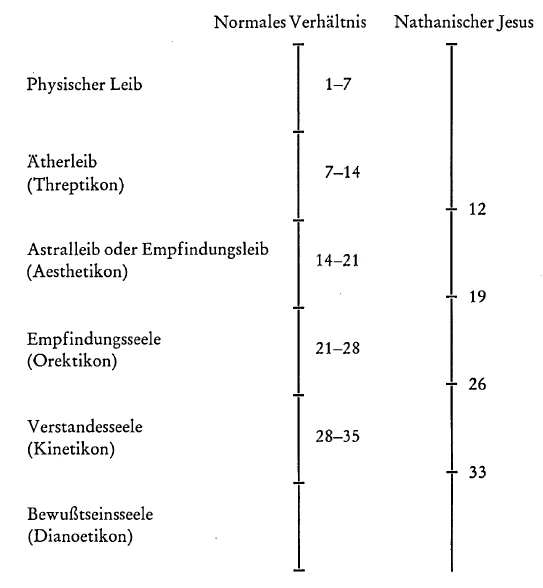
[ 5 ] Nun war durch gewisse Verhältnisse, die uns heute auch noch zum Teil klarwerden sollen, die Entwickelung des nathanischen Jesus etwas vorangeschoben, etwas beschleunigt worden. Das war ja dadurch auch möglich, daß in seinen Gegenden die Geschlechtsreife früher fiel. Aber es Jagen bei ihm noch ganz besondere Gründe vor, daß dasjenige, was sonst im vierzehnten Jahre eintritt, bei ihm im zwölften Jahre eintrat. Und so trat das, was sonst mit einundzwanzig Jahren eintritt, bei ihm mit neunzehn Jahren ein, und was sonst mit achtundzwanzig und fünfunddreißig Jahren vorgeht, das ereignete sich bei ihm mit sechsundzwanzig und dreiunddreißig Jahren. Das ist sozusagen das Schema der Entwickelung unseres irdischen Mittelpunktwesens. Wir haben nun zu beachten, daß wir bis zum zwölften Jahre leiblich den nathanischen Jesus vor uns haben, daß aber vom zwölften Jahre an in dem nathanischen Jesus weiterlebt das Ich des Zarathustra. Was heißt das eigentlich? Es heißt nichts anderes, als daß dieses Ich, dieses reife Ich, von dem zwölften Jahre angefangen, an des nathanischen Jesus Empfindungsleib, Empfindungsseele und Verstandesseele arbeitete und diese Eigenschaften der menschlichen Natur in der Weise ausarbeitete, wie nur ein so reifes Ich, das durch die verschiedensten Inkarnationen hindurch dieSchicksale des Zarathustra-Ich durchgemachthat, die menschlichen Fähigkeiten ausarbeiten kann. So haben wir jene wunderbare Tatsache vor uns stehen, daß in den Leib des nathanischen Jesus hinein mit dem zwölften Jahre sich das Ich des Zarathustra verkörperte, daß es die Fähigkeiten in der Seele in der denkbar feinsten Weise ausarbeitete. Also es entwickelte sich ein Empfindungsleib heran, der imstande war, so hinaufzuschauen in den Kosmos, daß er die Empfindungen haben konnte von dem alten Ahura Mazdao, was dieser seiner geistigen Wesenheit nach ist; es entwickelte sich eine Empfindungsseele, welche das Wissen, die Weisheit in sich hegen konnte, die nach und nach sich erst auf Grundlage der Ahura-Mazdao-Lehre innerhalb der Menschheit entwickelte; und es entwickelte sich dann eine Verstandesseele, die das alles begriff, das heißt in Begriffe, in Worte, in leichtfaßliche Worte fassen konnte, was die Menschheit früher nur durch ihre geistigen Strömungen von außen erlangt hatte.
[ 5 ] Now, due to certain circumstances, which will become clear to us today, the development of the Nathanic Jesus was somewhat advanced, somewhat accelerated. This was also possible because sexual maturity occurred earlier in his region. But there were also very special reasons why what usually occurs at the age of fourteen occurred at the age of twelve in his case. And so what usually happens at the age of twenty-one happened to him at the age of nineteen, and what usually happens at the ages of twenty-eight and thirty-five happened to him at the ages of twenty-six and thirty-three. This is, so to speak, the pattern of the development of our earthly center being. We must now bear in mind that up to the age of twelve we have the physical Jesus of Nathan before us, but that from the age of twelve onwards the I of Zarathustra continues to live in the Jesus of Nathan. What does this actually mean? It means nothing other than that this I, this mature I, from the age of twelve onwards, worked on the sentient body of the Jesus of Nathan, the sentient soul and the intellectual soul, and developed these qualities of human nature in the way that only such a mature I, which has gone through the most diverse incarnations and experienced the destinies of the Zarathustra I, can develop human abilities. Thus we have before us the wonderful fact that at the age of twelve the I of Zarathustra incarnated itself in the body of the Nathanic Jesus and developed the abilities in the soul in the most delicate way imaginable. Thus, a sentient body developed that was able to look up into the cosmos and have the sensations of the ancient Ahura Mazdao, of what he is in his spiritual essence; a sentient soul developed that was able to hold within itself the knowledge and wisdom which gradually developed within humanity on the basis of the teachings of Ahura Mazdao; and then a mind soul developed which could comprehend all this, that is, it could grasp in concepts, in words, in easily comprehensible words what humanity had previously attained only through its spiritual currents from outside.
[ 6 ] So entwickelte sich dieser nathanische Jesus mit dem ZarathustraIch in sich. Und er entwickelte sich so lange in dieser Weise, bis das dreißigste Jahr herannahte. Da machte sich eine neue Tatsache geltend. Diejenige Erscheinung, die in einer gewissen Weise schon mit zwölf Jahren bei dem nathanischen Jesus aufgetreten ist, daß sein Innerstes mit einer neuen Ichheit erfüllt worden ist, die tritt noch einmal ein, jetzt jedoch in einer universelleren, bedeutenderen Weise. Gegen das dreißigste Jahr sehen wir, wie das Zarathustra-Ich seine Aufgabe an der Seele des nathanischen Jesus vollendet hat, wie es die Fähigkeiten in der höchsten Weise ausgebildet hat. Da hatte es sozusagen die Mission für diese Seele vollendet, da hatte es alles das, was es durch die früheren Inkarnationen gewonnen hatte, in diese Seele hineingearbeitet und konnte nunmehr sagen: Meine Aufgabe ist jetzt vollendet.- Und es verließ das Zarathustra-Ich eines Tages den Leib des nathanischen Jesus.
[ 6 ] Thus, this Nathanic Jesus developed with the Zarathustra-I within him. And he developed in this way until he approached the age of thirty. Then a new fact came to the fore. The phenomenon that had already appeared in a certain way in the Nathanic Jesus at the age of twelve, namely that his innermost being had been filled with a new ego, occurred once again, but now in a more universal and significant way. Towards the age of thirty, we see how the Zarathustra ego completed its task in the soul of the Nathanic Jesus, how it developed his abilities in the highest way. It had, so to speak, completed its mission for this soul, it had worked into this soul everything it had gained through its earlier incarnations, and could now say: My task is now complete. And one day the Zarathustra ego left the body of the Nathanic Jesus.
[ 7 ] Das Zarathustra-Ich lebte also bis zum zwölften Jahre in dem Leibe des salomonischen Jesus. Dieser Knabe hätte sich irdisch nun nicht weiterentwickeln können. Er blieb sozusagen deshalb, weil das Zarathustra-Ich, das in ihm gewohnt hatte, ihn verlassen hatte, auf seinem damaligen Standpunkte stehen. Er war allerdings bis zu einer hohen und seltenen Reife gelangt, weil ein so hohes Ich in ihm war. Wer äußerlich das salomonische Jesuskind beobachtet hätte, würde gefunden haben, daß es ein im höchsten Maße frühreifes Kind war. Aber von dem Momente an, als das Zarathustra-Ich es verlassen hatte, blieb es stehen, da konnte es nicht weiter. Und als der Zeitpunkt heranrückte, wo verhältnismäßig früh die Mutter des nathanischen Jesus starb, in bezug auf die geistigen Glieder in die geistige Welt entrückt wurde, da nahm sie dasjenige, was an Ewigkeitswert, an bildender Kraft in dem salomonischen Jesuskinde war, mit sich. Dieses Kind starb auch, also ungefähr zur gleichen Zeit, als die Mutter des nathanischen Jesus starb.
[ 7 ] The Zarathustra ego thus lived until the age of twelve in the body of the Solomon Jesus. This boy could not have developed further on earth. He remained, so to speak, at his former level because the Zarathustra ego that had lived in him had left him. He had, however, attained a high and rare maturity because such a high ego was within him. Anyone who had observed the Solomon Jesus child outwardly would have found him to be a child of the highest degree of precocity. But from the moment the Zarathustra ego left him, he remained where he was, unable to go any further. And when the time approached when the mother of the Nathanic Jesus died relatively early and was taken up into the spiritual world in relation to the spiritual members, she took with her that which was of eternal value, that which was formative power in the Solomon child Jesus. This child also died at about the same time as the mother of the Nathanic Jesus died.
[ 8 ] Es war eine wertvolle Ätherhülle, welche damals den Leib des salomonischen Jesus verließ. Wir wissen, daß der Ätherleib von jener Zeit an seine besondere Ausbildung erlangt, wenn ein Kind ungefähr das siebente Jahr überschritten hat, zwischen dem siebenten Jahre und der Geschlechtsreife. Das war also ein Ätherleib, der durch die Kräfte ausgebildet war, die das Zarathustra-Ich hatte. Wir wissen, daß beim Tode der Ätherleib den physischen Leib verläßt, daß alles, was nicht für die Ewigkeit brauchbar ist, im normalen Menschenleben abgestreift wird und daß eine Art Extrakt von dem Ätherleibe mitgenommen wird. Bei dem salomonischen Jesusknaben war das denkbar größte Quantum des Ätherleibes für dieEwigkeit brauchbar. Der ganze Lebensleib dieses Kindes wurde von der Mutter des nathanischen Jesus in die geistige Welt mitgenommen.
[ 8 ] It was a valuable etheric shell that left the body of the Solomon Jesus at that time. We know that from that time on, the etheric body acquires its special formation when a child has passed the age of about seven, between the seventh year and puberty. So this was an etheric body that had been formed by the forces that the Zarathustra I had. We know that at death the etheric body leaves the physical body, that everything that is not useful for eternity is cast off in normal human life, and that a kind of extract is taken from the etheric body. In the case of the Solomonic Jesus child, the greatest possible quantum of the etheric body was usable for eternity. The entire life body of this child was taken into the spiritual world by the mother of the Nathanic Jesus.
[ 9 ] Nun ist aber der Ätherleib der Bildner und Aufbauer des physischen Menschenleibes. Wir können uns nun vorstellen, daß in der Tat eine tiefe Verwandtschaft war zwischen diesem Ätherleibe, der als der Ätherleib des salomonischen Jesus in die geistige Welt entrückt worden war, und dem Ich des Zarathustra, denn dasselbe war bis zum zwölften Jahre eins mit ihm im Erdenwandel. Und als es durch die Entwickelung des Jesus von Nazareth dann dessen Leib verließ, sich sozusagen herausbegab aus dem Leibe des nathanischen Jesus, da machten sich die Anziehungskräfte geltend zwischen dem Zarathustra-Ich und dem Ätherleibe, welcher dem salomonischen Jesuskinde entstammte. Die kamen wieder zusammen und bauten sich dann einen neuen physischen Leib auf. Das Zarathustra-Ich war so reif, daß es nicht einen weiteren Durchgang durch ein Devachan brauchte. Es konnte sich nach verhältnismäßig kurzer Zeit mit Hilfe jenes Ätherleibes, den wir eben charakterisiert haben, einen neuen physischen Leib aufbauen. Und dadurch wurde nunmehr zum ersten Male dasjenige Wesen geboren, welches nachher immer wieder und wieder erschien, immer so erschien, daß verhältnismäßig kurze Zeiträume zwischen dem physischen Tode und einer neuen Geburt verliefen, so daß dieses Wesen immer, wenn es den physischen Leib im Tode verließ, bald wieder auf der Erde neu inkarniert erschien.
[ 9 ] Now, however, the etheric body is the former and builder of the physical human body. We can now imagine that there was indeed a deep relationship between this etheric body, which had been taken into the spiritual world as the etheric body of the Solomon's Jesus, and the I of Zarathustra, for the same was one with him in his earthly life until the age of twelve. And when, through the development of Jesus of Nazareth, it left his body, so to speak, came out of the body of the Nathanic Jesus, the forces of attraction between the Zarathustra I and the etheric body that originated from the Solomon Jesus child came into play. They came together again and built a new physical body. The Zarathustra ego was so mature that it did not need to pass through another devachan. With the help of the etheric body we have just described, it was able to build a new physical body in a relatively short time. And thus, for the first time, the being was born that would appear again and again, always in such a way that relatively short periods of time elapsed between physical death and a new birth, so that whenever this being left the physical body in death, it soon reappeared on earth in a new incarnation.
[ 10 ] Diese Wesenheit, welche also ihren auf die geschilderte Weise abgelegten Ätherleib wieder aufgesucht hat, wandelte nachher durch die Geschichte der Menschheit. Sie wurde, wie Sie sich vorstellen können, der größte Helfer derjenigen, welche das große Ereignis von Palästina begreifen wollten. Als sogenannter «Meister Jesus» wandelt diese Individualität durch der Zeiten Wende; so daß also der Zarathustra, das Zarathustra-Ich, nach der Wiederauffindung seines Ätherleibes seine Laufbahn durch die Menschheitsentwickelung als der «Meister Jesus» begann, der seitdem auf unserer Erde immer wieder und wieder verkörpert lebt zur Lenkung und Leitung jener Geistesströmung, die wir die christliche nennen. Er ist der Inspirator derjenigen, welche das sich lebendig entwickelnde Christentum verstehen wollen; er hat innerhalb der esoterischen Schulen diejenigen inspiriert, welche die Lehren des Christentums fortdauernd zu pflegen hatten. Hinter den großen geistigen Gestalten des Christentums steht er, immerdar lehrend, was eigentlich das große Ereignis von Palästina bedeutet.
[ 10 ] This being, which thus sought out again the etheric body it had laid down in the manner described, subsequently passed through human history. As you can imagine, it became the greatest helper of those who wanted to understand the great event in Palestine. As the so-called “Master Jesus,” this individuality wanders through the turning point of time; so that Zarathustra, the Zarathustra-I, after rediscovering his etheric body, began his career through human evolution as the “Master Jesus,” who has since lived incarnated on our Earth again and again to guide and direct that spiritual current which we call Christian. He is the inspiration for those who want to understand the living development of Christianity; within the esoteric schools, he has inspired those who have had to continuously cultivate the teachings of Christianity. He stands behind the great spiritual figures of Christianity, always teaching what the great event in Palestine actually means.
[ 11 ] Dieses Zarathustra-Ich, das den Leib des nathanischen Jesus vom zwölften bis zum dreißigsten Jahre belebt hat, es war nunmehr außerhalb dieses Leibes. Eine andere Wesenheit drang jetzt in diesen Leib ein. Der Zeitpunkt, da dies geschah, da nun sozusagen ein «höchstes Ich» statt des Zarathustra-Ich in den nathanischen Jesus eindrang, dieser Zeitpunkt wird uns in allen Evangelien charakterisiert als derjenige der Johannes-Taufe im Jordan. Es ist schon bei Gelegenheit der Besprechung des Johannes-Evangeliums darauf aufmerksam gemacht worden, daß die Taufe in jenen älteren Zeiten noch etwas ganz anderes war, als sie später geworden ist, wo sie nur ein Symbol ist. Sie wurde auch anders von Johannes dem Täufer vorgenommen. Die getauft wurden, sie wurden ihrer ganzen Leiblichkeit nach, mit ihrem ganzen Körper in das Wasser eingetaucht. Nun wissen Sie aber aus den verschiedenen vorbereitenden anthroposophischen Vorträgen, daß bei einer solchen Tatsache etwas ganz Besonderes geschehen kann. Schon im gewöhnlichen Leben, wenn der Mensch zum Beispiel dem Ertrinken nahe ist und einen Schock bekommt, tritt das ein, daß er sein bisheriges Leben wie in einem großen Tableau vor sich stehen hat. Das kommt daher, weil da für einen Augenblick das geschieht, was sonst nur nach dem Tode eintritt: der Ätherleib wird herausgehoben aus dem physischen Leibe, wird frei von den Gewalten des physischen Leibes. Das vollzog sich bei den meisten Täuflingen des Johannes, und das vollzog sich besonders bei der Taufe des nathanischen Jesus: sein Ätherleib wurde herausgezogen. Und während dieses Momentes konnte in den Leib des nathanischen Jesus untertauchen und Besitz von ihm nehmen jene hohe Wesenheit, die wir die Christus-Wesenheit nennen.
[ 11 ] This Zarathustra-I, which had animated the body of the Nathanic Jesus from the twelfth to the thirtieth year, was now outside this body. Another being now entered this body. The moment when this happened, when, so to speak, a “highest I” entered into the Nathanic Jesus in place of the Zarathustra I, is characterized in all the Gospels as the moment of John's baptism in the Jordan. It has already been pointed out in the discussion of the Gospel of John that baptism in those earlier times was something quite different from what it later became, when it was only a symbol. It was also performed differently by John the Baptist. Those who were baptized were immersed in water with their entire physical body. But you know from the various preparatory anthroposophical lectures that something very special can happen in such a situation. Even in ordinary life, for example, when a person is close to drowning and experiences a shock, they see their entire life pass before them as if in a large tableau. This is because, for a moment, what normally only happens after death occurs: the etheric body is lifted out of the physical body and becomes free from the forces of the physical body. This happened to most of John's baptized disciples, and it happened especially during the baptism of the Nathanic Jesus: his etheric body was drawn out. And during this moment, that high being whom we call the Christ being was able to descend into the body of the Nathanic Jesus and take possession of him.
[ 12 ] So ist von jenem Zeitpunkte der Johannes-Taufe an der nathanische Jesus durchdrungen von der Christus-Wesenheit. Das bedeuten die Worte, welche in den älteren Evangelienurkunden handschriftlich stehen: «Dies ist mein vielgeliebter Sohn, heute habe ich ihn gezeuget» — das heißt, es ist jetzt der Sohn des Himmels, der Christus gezeugt. Der Befruchter war die einheitliche Gottheit, die durch die Welt webt, und empfangend war derLeib und die ganze Organisation des nathanischen Jesus, der vorbereitet worden war, um den Fruchtkeim aus den Höhen zu empfangen. «Dies ist mein vielgeliebter Sohn, heute habe ich ihn gezeuget», so hieß es sonst in den älteren Evangelienhandschriften, und so sollte es in Wahrheit in den Evangelien stehen (Lukas 3, 22).
[ 12 ] Thus, from that moment of John's baptism, the Nathanic Jesus is permeated by the Christ Being. This is the meaning of the words written in the older Gospel documents: “This is my beloved Son, today I have begotten him” — that is, it is now the Son of Heaven who begot Christ. The fertilizer was the unified divinity that weaves through the world, and the recipient was the body and the entire organization of the Nathanic Jesus, who had been prepared to receive the seed from the heights. “This is my beloved Son, today I have begotten him,” is what it used to say in the older Gospel manuscripts, and this is what should really be written in the Gospels (Luke 3:22).
[ 13 ] Wer ist diese Wesenheit, die sich damals mit dem Ätherleibe des nathanischen Jesus vereinigte? Diese Christus-Wesenheit können wir wieder nicht verstehen, wenn wir unseren Blick nur auf die Erdenentwickelung lenken. Diese Christus-Wesenheit ist diejenige Wesenheit, welche wir nennen müssen den Führer jener geistigen Wesenheiten, welche damals, als die Sonne sich von der Erde getrennt hat, mit der Sonne aus der Erde hinausgingen und sich einen höheren Schauplatz begründeten, um von dieser Sonne aus, also von außen herein, auf die Erde zu wirken. Wenn wir uns also in die vorchristliche Erdenzeit zurückversetzen — von der Zeit an, als sich die Sonne von der Erde getrennt hat, bis zu der Erscheinung des Christus auf der Erde -, so müssen wir sagen: Wenn der Mensch zur Sonne hinaufschaute, so hätte er bei einer Reife seiner Empfindungen dasjenige empfinden müssen, was der Zarathustra gelehrt hat, daß das, was im Sonnenlicht und in der Sonnenwärme zu uns dringt, nur das physische Kleid ist jener hohen geistigen Wesenheiten, die hinter dem Sonnenlichte stehen; denn dahinter verbergen sich die geistigen Kraftstrahlen, die von der Sonne auf die Erde hereindringen. Der Führer aber aller der anderen Wesenheiten, welche da ihre wohltätigen Wirkungen von der Sonne heruntersenken auf die Erde, das ist das Wesen, das später der Christus genannt worden ist. Man hat es also in den vorchristlichen Zeiten nicht auf der Erde zu suchen gehabt, sondern man hatte es auf der Sonne zu suchen. Und Zarathustra tat recht, wenn er es mit dem Namen Ahura Mazdao bezeichnete, es auf die Sonne versetzte und sagte: Wenn wir über die Erde wandeln, finden wir ihn nicht, diesen Lichtgeist, wenn wir aber auf die Sonne schauen, dann ist dasjenige, was auf der Sonne geistig lebt, der Ahura Mazdao, und was als Licht zu uns strömt, das ist der Leib des Sonnengeistes, des Ahura Mazdao, wie der menschliche physische Leib der Leib des Menschengeistes ist. — Aber immer mehr näherte sich dieses hohe Wesen durch die großen kosmischen Vorgänge der Erdensphäre. Man konnte hellseherisch sozusagen immer mehr und mehr verspüren die Annäherung des Christus an die Erde. Und ein deutliches Erkennen dieses Christus trat ein, als der große Vorgänger des Christus Jesus, als Moses auf dem Sinai im Blitzesfeuer seine Offenbarungen empfing.
[ 13 ] Who is this being who united itself with the etheric body of the Nathanic Jesus at that time? Again, we cannot understand this Christ being if we direct our gaze only to the development of the earth. This Christ being is the being we must call the leader of those spiritual beings who, when the sun separated from the earth, left the earth with the sun and established a higher realm in order to work on the earth from this sun, that is, from outside. So when we go back to the pre-Christian era—from the time when the Sun separated from the Earth until the appearance of Christ on Earth—we have to say that when people looked up at the Sun, if their senses were mature, they would have felt what Zarathustra taught, that what reaches us in the sunlight and in the warmth of the sun is only the physical garment of those high spiritual beings who stand behind the sunlight; for behind it are hidden the spiritual rays of power that penetrate from the sun into the earth. But the leader of all the other beings who send their beneficial effects down from the sun to the earth is the being who was later called Christ. In pre-Christian times, therefore, it was not to be sought on Earth, but on the sun. And Zarathustra was right when he called it Ahura Mazdao, placed it on the sun, and said: When we walk on the earth, we do not find this spirit of light, but when we look at the sun, what lives spiritually on the sun is Ahura Mazdao, and what streams to us as light is the body of the sun spirit, Ahura Mazdao, just as the human physical body is the body of the human spirit. — But this high being drew ever closer through the great cosmic processes of the Earth sphere. One could sense, clairvoyantly, so to speak, the approach of Christ to the Earth. And a clear recognition of this Christ came when the great predecessor of Christ Jesus, Moses, received his revelations on Mount Sinai in a flash of lightning.
[ 14 ] Was bedeuteten diese Offenbarungen des Moses? Sie bedeuteten, daß sich das, was als Christus-Wesenheit sich der Erde näherte, zunächst wie in einer Reflexion zeigt, wie in einem Spiegelbilde. Denken wir uns den Vorgang vergeistigt, den wir jede Vollmondnacht am Vollmonde wahrnehmen. Wenn wir zum Vollmond hinaufblicken, sehen wir die Sonnenstrahlen zurückgestrahlt, gespiegelt. Es ist Sonnenlicht, was uns da entgegenströmt; nur heißen wir es Mondenlicht, weil es vom Monde widergespiegelt erscheint. Wen sah Moses im brennenden Dornbusch und im Feuer auf dem Sinai? Den Christus! Aber wie man das Sonnenlicht nicht auf dem Monde direkt sieht, sondern gespiegelt, so sah er in einer Spiegelung den Christus. Und wie wir das Sonnenlicht, wenn wir es vom Monde gespiegelt erblicken, Mondenlicht nennen, so wurde damals der Christus Jahve oder Jehova genannt. Daher ist Jahve oder Jehova nichts anderes als die Widerspiegelung des Christus, bevor dieser selbst auf der Erde erschien. So verkündigte sich der Christus der menschlichen Wesenheit, die ihn noch nicht in seiner ureigenen Wesenheit zu schauen vermochte, indirekt, wie in der sonst dunklen Vollmondnacht das Sonnenlicht sich durch die Mondenstrahlen verkündigt. Jahve oder Jehova ist der Christus, aber nicht direkt gesehen, sondern als reflektiertes Licht.
[ 14 ] What did these revelations of Moses mean? They meant that what was approaching the earth as the Christ being was initially showing itself as in a reflection, as in a mirror image. Let us imagine the process we perceive every full moon night as spiritualized. When we look up at the full moon, we see the sun's rays reflected back, mirrored. It is sunlight that flows toward us; we only call it moonlight because it appears to be reflected by the moon. Who did Moses see in the burning bush and in the fire on Mount Sinai? Christ! But just as we do not see the sunlight directly on the moon, but only reflected, so he saw Christ in a reflection. And just as we call the sunlight reflected by the moon moonlight, so Christ was called Yahweh or Jehovah at that time. Therefore, Yahweh or Jehovah is nothing other than the reflection of Christ before he appeared on earth himself. Thus, Christ revealed himself indirectly to human beings, who were not yet able to see him in his true essence, just as sunlight is revealed through the moon's rays on an otherwise dark full moon night. Yahweh or Jehovah is the Christ, but not seen directly, rather as reflected light.
[ 15 ] Immer mehr und mehr sollte sich menschlichem Erkennen, menschlichem Wahrnehmen dieser Christus nähern. Das heißt, er sollte eine Zeitlang selber auf der Erde wandeln, Mensch unter Menschen sein, menschlicher Mitbewohner auf unserer Erde werden, wie er vorher aus dem Kosmos herunter für die Eingeweihten sich kundgetan hat. Dazu mußte erst der richtige Zeitpunkt kommen. Daß er vorhanden ist, der Christus, das hat man dort, wo man die Weisheit der Welt durchdrungen hat, immer gewußt. Und weil er sich in der verschiedensten Weise geoffenbart hat, so hat man ihn auch mit den verschiedensten Namen benannt. Zarathustra hat ihn Ahura Mazdao genannt, weil er sich ihm in dem Sonnenlichtkleide offenbarte. Jene großen Lehrer der Menschheit, die in der ersten Epoche nach der atlantischen Katastrophe im alten Indien aufgetreten sind, die heiligen Rishis, sie haben, da sie Eingeweihte waren, durchaus von diesem Wesen gewußt; nur wußten sie, daß es mit Erdenweisheit in dieser Epoche noch nicht zu erreichen ist, daß es sich mit Erdenweisheit erst in einer späteren Epoche wird erreichen lassen. Daher war die Formel für jene Zeit die, daß dieses Wesen lebe jenseits der Region der sieben Rishis. Vishva Karman nannte man es. So also lehrten auch sie von jenem Wesen, das sie Vishva Karman nannten, das der Zarathustra Ahura Mazdao nannte. Das sind verschiedene Namen für diese Wesenheit, die sich langsam aus Geisteshöhen, aus kosmischen Örtlichkeiten der Erde näherte.
[ 15 ] Human knowledge and perception should come closer and closer to this Christ. This means that he should walk on Earth for a time, be a human among humans, become a human cohabitant on our Earth, as he had previously revealed himself to the initiated from the cosmos. The right time had to come first. Those who had penetrated the wisdom of the world had always known that Christ existed. And because he revealed himself in many different ways, he was given many different names. Zarathustra called him Ahura Mazdao because he revealed himself to him in the garment of sunlight. Those great teachers of humanity who appeared in ancient India in the first epoch after the Atlantean catastrophe, the holy Rishis, knew all about this being because they were initiates; but they knew that it could not yet be attained through earthly wisdom in that epoch, that it would only be possible to attain it through earthly wisdom in a later epoch. Therefore, the formula for that time was that this being lived beyond the region of the seven rishis. It was called Vishva Karman. Thus they also taught about that being whom they called Vishva Karman, whom Zarathustra called Ahura Mazdao. These are different names for this being, who slowly approached from spiritual heights, from cosmic locations on Earth.
[ 16 ] Aber es mußte die Menschheitsentwickelung vorbereitet werden, damit ein Leib dieses Wesen aufnehmen konnte. Dazu mußte erst eine solche Wesenheit, wie sie in dem Zarathustra gelebt hat, heranreifen von Inkarnation zu Inkarnation, um dann in einem so reinen Leibe, wie es der des Jesus von Nazareth war, die Fähigkeiten des Empfindungsleibes, der Empfindungsseele und der Verstandesseele auszuarbeiten, so daß diese menschliche Wesenheit fähig wurde, ein so hohes Wesen aufzunehmen. Das mußte langsam vorbereitet werden. Damit eine Empfindungsseele, eine Verstandesseele so vorbereitet werden konnte, mußte erst ein Ich durch die vielen Erfahrungen und Erlebnisse durchgehen, durch die der Zarathustra durchgegangen ist, und mußte umgestalten die Fähigkeiten in dem nathanischen Jesus. Das war nicht möglich in einer früheren Zeit. Denn an dem nathanischen Jesuskinde mußte nicht nur das Zarathustra-Ich arbeiten, sondern auch jene hohe Wesenheit, die wir charakterisiert haben als den Nirmanakaya des Buddha. Sie arbeitete insbesondere von außen herein von der Geburt bis zum zwölften Lebensjahre. Dazu mußte sie aber erst da sein. Es mußte jener Bodhisattva selbst erst zum Buddha-Dasein aufsteigen, um in sich möglich zu machen, den Geistleib des Nirmanakaya zu entwickeln, damit er das nathanische Jesuskindlein von der Geburt bis zum zwölften Jahre bearbeiten konnte. Der Bodhisattva selbst mußte erst die Buddha-Stufe übersteigen, um in sich die Kraft zu haben, einen Leib reif zu machen zu jenem großen Ereignis. Er hatte es in jener Inkarnation, als er Buddha wurde, noch nicht dazu gebracht, diese Fähigkeit auszubilden. Dazu war erst sein Buddha-Leben notwendig.
[ 16 ] But the evolution of humanity had to be prepared so that a body could receive this being. To this end, a being such as that which lived in Zarathustra had to mature from incarnation to incarnation in order to develop, in a body as pure as that of Jesus of Nazareth, the abilities of the sentient body, the sentient soul, and the intellectual soul, so that this human being could become capable of receiving such a high being. This had to be prepared slowly. In order for a sentient soul and a rational soul to be prepared in this way, an I had first to go through the many experiences and adventures that Zarathustra went through, and had to transform the abilities in the Nathanic Jesus. This was not possible in an earlier time. For it was not only the Zarathustra ego that had to work on the Nathanic Jesus child, but also that high being whom we have characterized as the Nirmanakaya of the Buddha. It worked especially from the outside in, from birth until the twelfth year of life. But first it had to be there. That Bodhisattva himself first had to ascend to Buddhahood in order to make it possible within himself to develop the spirit body of the Nirmanakaya, so that he could work on the Nathanic Jesus child from birth to the age of twelve. The Bodhisattva himself first had to transcend the Buddha stage in order to have the power within himself to prepare a body for that great event. He had not yet developed this ability in that incarnation when he became Buddha. His Buddha life was necessary for this.
[ 17 ] Wenn einmal die Menschheit wirklich verstehen wird, was als große Weistümer in den Legenden aufbewahrt ist, dann wird sie an den entsprechenden Stellen lesen können, daß alles, was wir aus der AkashaChronik entziffern, in einer wunderbaren Weise in den alten Legenden enthalten ist. Es wird uns erzählt, und mit Recht, daß die ChristusWesenheit auch im alten Indien gelehrt worden ist als kosmische Wesenheit jenseits der Sphäre der sieben heiligen Rishis. Sie wußten, daß diese Wesenheit in der Höhe lebt und sich erst allmählich der Erde nähert, Zarathustra wußte auch, daß er den Blick hinauszuwenden hatte von der Erde zur Sonne; und das althebräische Volk war durch die Eigenschaften und Fähigkeiten, die wir gestern hervorgehoben haben, in der Lage, die Widerspiegelung der Christus-Wesenheit zuerst verkündigt zu erhalten. - Auch das wird uns angedeutet, und zwar in einer Erzählung, wie der Buddha, als er sich eben anschickte, von dem Bodhisattva zu einem Buddha zu werden, in Berührung kam mit dem Vishva Karman, der später der Christus genannt wurde. Die Legende erzählt ja, daß er, als sein neunundzwanzigstes Jahr heranrückte, jene berühmte Ausfahrt aus seinem Palaste machte, wo er bis dahin gehegt und gepflegt worden war. Da sah er zuerst einen alten Mann, dann einen Kranken, dann einen Leichnam, und lernte so nach und nach das Elend des Lebens kennen; dann sah er einen Mönch, der dieses Leben verlassen hatte, in dem Alter, Krankheit und Tod sind. Da beschloß er, so erzählt die Legende, die eine tiefe Wahrheit verkündet, zunächst nicht gleich hinauszuziehen, sondern erst noch einmal zurückzukehren. Aber bei dieser Ausfahrt, so sagt uns diese Legende, wurde er von den geistigen Höhen herein geschmückt mit jener Kraft, welche der Götterkünstler Vishva Karman, der ihm erschien, auf die Erde heruntersandte. Geschmückt wurde der Bodhisattva mit der Kraft des Vishva Karman selbst, der später der Christus genannt wurde. Also etwas Äußerliches war der Christus noch für ihn, war noch nicht mit ihm vereinigt. Damals hatte sich auch der Bodhisattva dem dreißigsten Jahre genähert; damals aber hätte er noch nicht vollständig die Christus-Aufnahme in einem menschlichen Leib bewirken können. Dazu mußte er erst reif sein. Gerade durch sein Buddha-Dasein hat er sich erst reif gemacht. Und als er indem Nirmanakaya erschien, hatte er die Aufgabe, diesen Leib des nathanischen Jesus, den er nicht selber einnahm, reif zu machen für die Aufnahme des Vishva Karman, des Christus.
[ 17 ] Once humanity truly understands what is preserved as great mysteries in the legends, it will be able to read in the relevant passages that everything we decipher from the Akashic Records is contained in a wonderful way in the ancient legends. We are told, and rightly so, that the Christ Being was also taught in ancient India as a cosmic Being beyond the sphere of the seven holy Rishis. They knew that this Being lives in the heights and only gradually approaches the earth. Zarathustra also knew that he had to turn his gaze away from the earth to the sun; and the ancient Hebrew people, through the qualities and abilities we emphasized yesterday, were able to receive the first proclamation of the reflection of the Christ Being. This is also hinted at in a story about how the Buddha, just as he was about to become a Buddha, came into contact with Vishva Karman, who was later called Christ. The legend tells us that when he was approaching the age of twenty-nine, he made that famous departure from his palace, where he had been cherished and cared for until then. There he first saw an old man, then a sick man, then a corpse, and thus gradually learned about the misery of life; then he saw a monk who had left this life, in which there is old age, sickness, and death. Then, according to the legend, which proclaims a profound truth, he decided not to leave immediately, but to return once more. But on this outing, the legend tells us, he was adorned from the spiritual heights with that power which the god-artist Vishva Karman, who appeared to him, sent down to earth. The Bodhisattva was adorned with the power of Vishva Karman himself, who was later called Christ. So Christ was still something external to him, not yet united with him. At that time, the Bodhisattva was also approaching the age of thirty; but at that time he would not yet have been able to bring about the complete reception of Christ in a human body. He first had to be ready for that. It was precisely through his existence as Buddha that he made himself ready. And when he appeared as Nirmanakaya, his task was to prepare the body of Nathan's Jesus, which he did not take on himself, to receive Vishva Karman, the Christ.
[ 18 ] So hatten die Kräfte der Erdenentwickelung zusammengewirkt, um das große Ereignis zustande zu bringen. Nun muß sich uns die Frage auf die Lippen legen: Wie steht dieser Christus, dieser Vishva Karman, zu solchen Wesenheiten wie den Bodhisattvas, von denen zum Beispiel jener Bodhisattva einer war, der später zum Buddha geworden ist?
[ 18 ] Thus, the forces of Earth's evolution had worked together to bring about this great event. Now the question must arise: How does this Christ, this Vishva Karman, relate to such beings as the Bodhisattvas, one of whom, for example, later became the Buddha?
[ 19 ] Mit dieser Frage kommen wir hart an den Rand eines der größten Geheimnisse unserer Erdenentwickelung heran. Es wird im allgemeinen für die heutigen Gefühle und Empfindungen der Menschen schwer, das Gewaltige auch nur zu ahnen, was sich hinter diesem Geheimnis verbirgt. Solcher Wesenheiten, wie der Bodhisattva eine ist, der zum Buddha wurde und der die Mission hatte, die große Lehre vom Mitleid und von der Liebe der Menschheit einzuverleiben, solcher Wesenheiten gibt es im Zusammenhange mit unserem Kosmos, zu dem die Erde gehört, zwölf. Jener Bodhisattva, der fünf bis sechs Jahrhunderte vor unserer Zeitrechnung zum Buddha wurde, ist einer von diesen zwölfen. Alle Bodhisattvas haben eine bestimmte Mission. Wie dieser eine die Mission hatte, die Lehre vom Mitleid und von der Liebe auf die Erde zu bringen, so haben auch die anderen ihre Missionen, die in den verschiedenen Erdenepochen erfüllt werden müssen. Der Buddha steht der Erdenmission deshalb besonders nahe, weil dieEntwickelung der moralischen Gesinnung gerade die Aufgabe unseres Zeitalters ist, von dem Zeitpunkte an, da der Bodhisattva fünf bis sechs Jahrhunderte vor unserer Zeitrechnung erschien, bis dieser Bodhisattva von seinem Bodhisattva-Nachfolger abgelöst werden wird, der später auf der Erde als der Maitreya Buddha zu leben hat. So geht überhaupt die Erdenentwickelung vorwärts: die Bodhisattvas steigen herab und haben der Erdenentwickelung das, was Gegenstand ihrer Mission ist, von Zeit zu Zeit einzuverleiben. Würden wir die ganze Erdenentwickelung überblicken, so fänden wir eben zwölf solcher Bodhisattvas. Sie gehören jener gewaltigen Geistergemeinschaft an, welche also von Zeit zu Zeit einen der Bodhisattvas als einen besonderen Sendboten auf die Erde zu senden hat, als einen der großen Lehrer. Gleichsam eine große Loge von zwölf Bodhisattvas haben wir als regierende Loge unserer ganzen Erdenentwickelung anzuerkennen. Diese zwölf Bodhisattvas decken sich im wesentlichen mit dem Begriffe, den wir auf niederen Stufen des Daseins als den Begriff des Lehrers kennen. Lehrer sind sie, große Inspiratoren für diesen oder jenen Teil dessen, was sich die Menschen anzueignen haben.
[ 19 ] This question brings us to the very edge of one of the greatest mysteries of our earth's development. It is generally difficult for people today, with their feelings and sensibilities, to even begin to imagine the enormity of what lies behind this mystery. There are twelve beings like the Bodhisattva who became Buddha and whose mission was to incorporate the great teaching of compassion and love into humanity. Such beings exist in connection with our cosmos, to which the Earth belongs. That Bodhisattva who became Buddha five to six centuries before our era is one of these twelve. All Bodhisattvas have a specific mission. Just as this one had the mission of bringing the teaching of compassion and love to Earth, so too do the others have their missions, which must be fulfilled in the various Earth epochs. The Buddha is particularly close to the mission on Earth because the development of moral consciousness is precisely the task of our age, from the time when the Bodhisattva appeared five to six centuries before our era until this Bodhisattva is succeeded by his Bodhisattva successor, who will later live on Earth as the Maitreya Buddha. This is how earthly development proceeds in general: the Bodhisattvas descend and, from time to time, incorporate into earthly development that which is the object of their mission. If we were to survey the entire development of the earth, we would find twelve such Bodhisattvas. They belong to that mighty community of spirits which from time to time sends one of the Bodhisattvas to earth as a special messenger, as one of the great teachers. We must recognize a great lodge of twelve Bodhisattvas as the ruling lodge of our entire earth development. These twelve Bodhisattvas essentially correspond to the concept we know on lower levels of existence as the concept of the teacher. They are teachers, great inspirers for this or that part of what human beings have to learn.
[ 20 ] Woher empfangen die Bodhisattvas das, was sie von Epoche zu Epoche zu verkünden haben? Wenn Sie hineinschauen könnten in die große Geistloge der Bodhisattvas, in den Kreis der zwölf Bodhisattvas, so würden Sie finden, daß inmitten der zwölf Bodhisattvas in unserem Weltendasein ein dreizehntes Wesen sitzt, das wir nicht in demselben Sinne einen Lehrer nennen können wie die zwölf Bodhisattvas, sondern das wir nennen müssen dasjenige Wesen, von dem die Weisheit selber substantiell ausströmt. Daher sagt man ganz richtig, wenn man den Tatbestand bezeichnen will: Die zwölf Bodhisattvas sitzen in der großen Geistloge um ihren Mittelpunkt herum; sie sind in dem Anschauen der großen Wesenheit versunken, die ihnen alles zuströmt, was sie dann als ihre Mission in die Erdenentwickelung hineinzutragen haben. So strömt von diesem Dreizehnten das aus, was die anderen zu lehren haben. Sie sind die Lehrer, die Inspiratoren, der Dreizehnte ist als Wesenheit selber das, was die anderen lehren. Über ihn verkünden sie immer von Epoche zu Epoche. Dieser Dreizehnte ist derjenige, den die alten Rishis nannten Vishva Karman, den Zarathustra nannte Ahura Mazdao; das ist der, den wir den Christus nennen. Und so steht er zu allen Bodhisattvas, so ist er der Führer und Lenker der großen Loge der Bodhisattvas. Und so ist der Inhalt der Verkündigung durch den ganzen Chor der Bodhisattvas hindurch die Lehre von dem Christus, von dem Vishva Karman. - Derjenige, der fünf bis sechs Jahrhunderte vor unserer Zeitrechnung vom Bodhisattva zum Buddha geworden ist, er wurde geschmückt mit den Kräften des Vishva Karman. Derjenige, der als nathanischer Jesus den Christus in sich aufgenommen hatte, er wurde nicht bloß «geschmückt», sondern «gesalbt», das heißt durchdrungen, durchtränkt von dem Vishva Karman, von dem Christus.
[ 20 ] Where do the Bodhisattvas receive what they have to proclaim from epoch to epoch? If you could look into the great spiritual lodge of the Bodhisattvas, into the circle of the twelve Bodhisattvas, you would find that in the midst of the twelve Bodhisattvas in our world existence there sits a thirteenth being whom we cannot call a teacher in the same sense as the twelve Bodhisattvas, but whom we must call the being from whom wisdom itself flows substantially. Therefore, it is quite correct to describe the situation as follows: The twelve Bodhisattvas sit in the great spiritual lodge around their center; they are absorbed in contemplating the great Being who pours into them everything they then have to carry into the development of the earth as their mission. Thus, what the others have to teach flows out from this thirteenth being. They are the teachers, the inspirers; the thirteenth is, as an entity, that which the others teach. Through him they proclaim from epoch to epoch. This thirteenth is the one whom the ancient Rishis called Vishva Karman, whom Zarathustra called Ahura Mazdao; he is the one we call Christ. And so he stands with all Bodhisattvas, he is the leader and guide of the great lodge of Bodhisattvas. And so the content of the proclamation throughout the entire choir of Bodhisattvas is the teaching of Christ, of Vishva Karman. He who became Buddha from Bodhisattva five to six centuries before our era was adorned with the powers of Vishva Karman. He who, as the Nathanic Jesus, had taken Christ into himself, was not merely “adorned,” but “anointed,” that is, permeated, saturated with Vishva Karman, with Christ.
[ 21 ] Überall, wo Menschen eine Ahnung oder auch durch dieEinweihung eine Erkenntnis hatten von diesem Tatbestand, von diesen großen Geheimnissen der Menschheitsentwickelung, da bildete sich wie in einem Symbolum, wie in einem Bilde dieses Geheimnis ab. Wir sehen, wie zum Beispiel in jenen wenig bekannten, geheimnisvollen Mysterien des europäischen Nordens, in den Drotten-Mysterien, vor der Erscheinung des Christentums ein irdisches Symbolum von dem geistigen Tatbestand der Loge der zwölf Bodhisattvas geschaffen wurde. In den Drotten-Mysterien gehörte in den alten Zeiten Europas immer zu denjenigen, die innerhalb der geistigen Entwickelung die Lehrer waren, eine Gemeinschaft von Zwölf. Die hatten zu verkündigen. Und einen Dreizehnten hatten sie, der nicht lehrte, sondern der durch seine bloße Gegenwart die Weisheit ausstrahlte, welche die anderen empfingen. Das war das Bild auf der Erde von einem himmlischen, geistigen Tatbestand. -— Und anderseits werden wir in dem Gedicht «Die Geheimnisse», wo Goethe auf seine Rosenkreuzer-Inspiration hingewiesen hat, daran erinnert, wie Zwölf herumsitzen um einen Dreizehnten und wie dieser nicht ein großer Lehrer zu sein braucht; denn der Bruder Markus soll von den Zwölfen — nachdem der Dreizehnte von ihnen gegangen sein wird — in seiner Einfachheit als dieser Dreizehnte angesprochen werden. Er soll der Bringer nicht einer Lehre, sondern der spirituellen Substanz selber sein. Und überall, wo man eine Ahnung oder eine Erkenntnis von diesem hohen Tatbestand hatte, war es so.
[ 21 ] Wherever people had an inkling or, through initiation, an insight into this fact, into these great mysteries of human evolution, this mystery was reflected as in a symbol, as in a picture. We see, for example, in those little-known, mysterious mysteries of northern Europe, in the Drotten mysteries, how before the appearance of Christianity an earthly symbol was created of the spiritual reality of the lodge of the twelve Bodhisattvas. In the Drotten mysteries of ancient Europe, those who were teachers in spiritual development always belonged to a community of twelve. They had a message to proclaim. And they had a thirteenth who did not teach, but who, by his mere presence, radiated the wisdom that the others received. This was the image on earth of a heavenly, spiritual reality. — And on the other hand, in the poem “The Secrets,” where Goethe refers to his Rosicrucian inspiration, we are reminded of how twelve sit around a thirteenth and how the latter does not need to be a great teacher; for Brother Markus is to be addressed by the twelve — after the thirteenth has departed from them — in his simplicity as this thirteenth. He is to be the bringer not of a teaching, but of spiritual substance itself. And wherever one had an inkling or insight into this lofty fact, it was so.
[ 22 ] Es war also mit der Johannes-Taufe im Jordan derjenige Zeitpunkt für die Menschheitsentwickelung eingetreten, wo dieser himmlische Dreizehnte als die geistige Substanz selber auf der Erde erschien, von der alle anderen - Bodhisattvas und Buddhas - zu lehren hatten; und es waren jene gewaltigen Vorbereitungen notwendig, damit sich diese Wesenheit in einen menschlichen Leib hineinsenken konnte. Das ist das Geheimnis der Jordan-Taufe. Und das ist das Wesen, das uns in den Evangelien geschildert wird: Vishva Karman, Ahura Mazdao oder der Christus, wie er später genannt worden ist, in dem Leibe des nathanischen Jesus. Als solcher sollte dieses Wesen durch die drei Jahre auf der Erde wandeln in Menschengestalt, Mensch unter Menschen, in jener geprüften Erdenwesenheit, die bis zu ihrem dreißigsten Jahre das alles erlebt hatte, was wir im Laufe dieser Vorträge gehört haben. Diesen nathanischen Jesus durchleuchtete, durchströmte die Wesenheit, die sich früher in den leuchtenden und wärmenden Sonnenstrahlen verbarg, die aus dem Kosmos herunterleuchteten, jene Wesenheit also, welche mit der Sonne bei ihrer Trennung von der Erde weggegangen war.
[ 22 ] Thus, with the baptism of John in the Jordan, the moment had come in human evolution when this heavenly thirteenth appeared on earth as the spiritual substance itself, from which all others—Bodhisattvas and Buddhas—were to teach; and those tremendous preparations were necessary so that this being could sink into a human body. This is the secret of the baptism in the Jordan. And this is the being described to us in the Gospels: Vishva Karman, Ahura Mazdao, or Christ, as he was later called, in the body of the Nathanic Jesus. As such, this being was to walk the earth for three years in human form, a human being among humans, in that tested earthly existence which, up to the age of thirty, had experienced everything we have heard in the course of these lectures. This Nathanic Jesus was illuminated and permeated by the being who had previously hidden in the shining and warming rays of the sun shining down from the cosmos, that being who had departed with the sun when it separated from the earth.
[ 23 ] Nunmehr können wir uns aber noch eine andere Frage vorlegen, die Frage: Warum hat sich diese Wesenheit so spät erst mit der Menschheitsentwickelung auf der Erde vereinigt? Warum ist sie nicht früher auf die Erde heruntergestiegen? Warum durchdrang sie nicht früher einen menschlichen Ätherleib, wie sie ihn bei der Johannes-Taufe im Jordan durchdrungen hat? Das können wir begreifen, wenn wir etwas genauer noch jenes Ereignis verstehen, das uns im Alten Testament als der Sündenfall dargelegt wird. Dieses Ereignis besteht darin, daß gewisse Wesenheiten, die auf der Stufe der alten Mondenentwickelung stehengeblieben waren, in der alten lemurischen Zeit ihren Einzug hielten in den menschlichen Astralleib. Derselbe ist damals durchdrungen worden von den luziferischen Wesenheiten. Das wird uns bildlich dargestellt in dem Sündenfalle des Paradieses. Dadurch, daß diese Kräfte in den menschlichen Astralleib eindrangen, ist der Mensch tiefer in die Erdenangelegenheiten verstrickt worden, als es sonst geschehen wäre. Wenn er diesen luziferischen Einfluß nicht erhalten hätte, würde er gleichsam in höheren Sphären, weniger in die Erdenmaterie hineinverstrickt, seine Entwickelungslaufbahn auf der Erde vollendet haben. Der Mensch ist dadurch früher heruntergestiegen auf die Erde, als er eigentlich hätte heruntersteigen sollen. Wäre nun sonst nichts eingetreten, wäre nur das alles geschehen, was eben jetzt angedeutet worden ist, so hätte sich damals die ganze Wirkung der luziferischen Kräfte, welche im Astralleib des Menschen verankert waren, auch im menschlichen Ätherleibe geltend gemacht. Das aber mußten die Weltenmächte verhindern. Daher mußte etwas ganz Besonderes eintreten. — Was damit gemeint ist, wird noch von einer anderen Seite her klarwerden durch meine demnächst erscheinende «Geheimwissenschaft». — Der Mensch durfte nicht so bleiben, wie er war, nachdem er die luziferischen Kräfte in seinen Astralleib aufgenommen hatte. Er mußte behütet werden vor der Wirkung der luziferischen Kräfte auf seinen Ätherleib. Das wurde dadurch erreicht, daß der Mensch damals unfähig gemacht wurde, seinen vollen Ätherleib zu benutzen. Es wurde ein Teil des Ätherleibes der Willkür des Menschen entzogen. Wäre diese Wohltat der Götter nicht gekommen, hätte der Mensch die Kraft über seinen vollen Ätherleib beibehalten, so hätte er nimmermehr den Weg durch die Erdenentwickelung in entsprechender Weise finden können. Gewisse Teile des menschlichen Ätherleibes haben damals herausgezogen werden müssen, um aufgespart zu werden für spätere Zeiten. Versuchen wir jetzt einmal uns vor das geistige Auge zu führen, welche Teile dieses waren.
[ 23 ] Now, however, we can ask ourselves another question: Why did this being unite itself so late with the development of humanity on Earth? Why did it not descend to Earth earlier? Why did it not penetrate a human etheric body earlier, as it did at the baptism of John in the Jordan? We can understand this if we examine more closely the event described in the Old Testament as the Fall of Man. This event consists in the fact that certain beings, which had remained at the stage of the old lunar evolution, entered the human astral body during the old Lemurian epoch. At that time, the astral body was permeated by the Luciferic beings. This is depicted figuratively in the Fall of Man in Paradise. As a result of these forces entering the human astral body, human beings became more deeply entangled in earthly affairs than would otherwise have been the case. If he had not received this Luciferic influence, he would have completed his course of development on earth in higher spheres, less entangled in earthly matter. As a result, human beings descended to earth earlier than they should have. If nothing else had happened, if only what has just been indicated had taken place, then the entire effect of the Luciferic forces anchored in the human astral body would have made itself felt in the human etheric body as well. But the world powers had to prevent this. Therefore, something very special had to happen. What this means will become clear from another perspective in my forthcoming book, The Secret Science. Human beings could not remain as they were after they had taken the Luciferic forces into their astral bodies. They had to be protected from the effect of the Luciferic forces on their etheric bodies. This was achieved by making human beings incapable of using their full etheric body at that time. Part of the etheric body was withdrawn from human will. If this blessing from the gods had not come, human beings would have retained power over their full etheric body and would never have been able to find their way through earthly evolution in the appropriate manner. Certain parts of the human etheric body had to be withdrawn at that time in order to be preserved for later times. Let us now try to visualize which parts these were.
[ 24 ] Der Mensch besteht zunächst aus den Teilen, die wir auch draußen in der Welt sehen, aus dem Erdigen oder Festen, aus Wasser oder Flüssigem und aus Luft oder Gasförmigem. Das sind die Elemente, die den physischen Menschenleib bilden, wie sie auch alles Physische bilden. Das Ätherische beginnt mit dem ersten Ätherzustande, den wir den Zustand des Feueräthers oder des Feuers schlechtweg nennen. Feuer oder Wärme, was die heutige Physik nicht als ein Substantielles, sondern nur als eine bloße Bewegung ansieht, ist aber der erste Zustand des Äthers. Der zweite Ätherzustand ist der Lichtäther oder Licht schlechtweg, und der dritte Zustand ist das, was für den Menschen zunächst gar nicht in seiner ursprünglichen Gestalt erscheint; nur einen Abglanz, gleichsam einen Schatten dieses Äthers kann der Mensch in der physischen Welt wahrnehmen als Ton, als Schall. Aber dem, was äußerlich Schall ist, liegt etwas Feineres, Ätherisches, etwas Geistiges zugrunde, so daß wir den physischen 'Ton nur als ein Schattenbild des geistigen Tones, des Tonäthers oder auch Zahlenäthers zu bezeichnen haben. Das vierte Äthergebiet ist der Lebensäther, das, was allem eigentlichen Leben zugrunde liegt.
[ 24 ] Human beings consist primarily of the parts that we also see outside in the world, of the earthly or solid, of water or liquid, and of air or gas. These are the elements that form the physical human body, just as they form everything physical. The etheric begins with the first state of ether, which we call the state of fire ether or simply fire. Fire or heat, which modern physics does not regard as a substance but only as a mere movement, is, however, the first state of ether. The second state of ether is light ether or simply light, and the third state is that which does not appear to humans in its original form; humans can only perceive a reflection, a shadow, as it were, of this ether in the physical world as sound. But underlying what is outwardly sound is something finer, more ethereal, something spiritual, so that we must describe physical sound as merely a shadow image of spiritual sound, of the sound ether or also the number ether. The fourth ether realm is the life ether, that which underlies all actual life.
[ 25 ] Wie nun der heutige physische Mensch ist, so prägt sich alles, was sein Seelenhaftes ist, in seiner physischen Leiblichkeit und in seiner ätherischen Leiblichkeit aus. Aber alles Seelische ist sozusagen gewissen Substanzen des Ätherischen zugeteilt. Was wir den Willen nennen, drückt sich ätherisch aus in dem, was wir das Feuer nennen. Wer nur ein wenig empfänglich ist für gewisse empfindungsgemäße Zusammenhänge, der wird fühlen, daß man ein gewisses Recht hat, so von dem Willen zu sprechen, daß dieser Wille, der sich physisch im Blute ausdrückt, in dem Feuerelement des Ätherischen lebt; physisch drückt er sich im Blute aus, beziehungsweise in der Bewegung des Blutes. Was wir Gefühl nennen, drückt sich aus in dem Teile des Ätherleibes, der dem Lichtäther entspricht. Weil das so ist, deshalb sieht auch der Hellseher die Willensimpulse des Menschen wie Feuerflammen, die seinen Ätherleib durchzucken und in den Astralleib hineinstrahlen, und die Gefühle sieht er als Lichtformen. Was aber der Mensch als sein Denken in seiner Seele erlebt und was wir in den Worten aussprechen, das sind auch nur Schattenbilder des Denkens, wie Sie sich ja leicht denken können, weil ja der physische Ton auch nur ein Schattenbild eines Höheren ist. Die Worte haben ihr Organ in dem Tonäther. Unseren Worten liegen zugrunde die Gedanken, die Worte sind Ausdrucksformen für die Gedanken. Diese Ausdrucksformen erfüllen den ätherischen Raum, indem sie ihre Schwingungen durch den Tonäther schikken. Was Ton ist, das ist eben nur die Abschattung der eigentlichen Gedankenschwingungen. Das aber, was das Innerliche aller unserer Gedanken ist, was unseren Gedanken Sinn gibt, das gehört seinem ätherischen Zustande nach dem eigentlichen Lebensäther an.
[ 25 ] As physical human beings are today, everything that is soul-like in them is expressed in their physical and etheric bodies. But everything soul-like is assigned, so to speak, to certain substances of the etheric. What we call the will is expressed etherically in what we call fire. Anyone who is even slightly receptive to certain sensory connections will feel that we are justified in saying that the will, which expresses itself physically in the blood, lives in the fire element of the etheric; physically, it expresses itself in the blood, or rather in the movement of the blood. What we call feeling is expressed in the part of the etheric body that corresponds to the light ether. Because this is so, the clairvoyant also sees the impulses of the human will as flames of fire flashing through the etheric body and radiating into the astral body, and he sees the feelings as forms of light. But what humans experience as their thinking in their souls, and what we express in words, are also only shadow images of thinking, as you can easily imagine, because physical sound is also only a shadow image of something higher. Words have their organ in the sound ether. Our words are based on thoughts; words are forms of expression for thoughts. These forms of expression fill the etheric space by sending their vibrations through the sound ether. Sound is merely the shadow of the actual vibrations of thought. But what is the inner essence of all our thoughts, what gives our thoughts meaning, belongs, according to its etheric state, to the actual life ether.
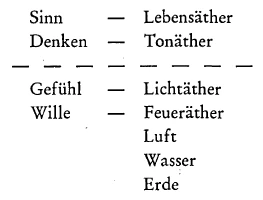
[ 26 ] Von diesen vier Ätherformen wurden in der lemurischen Zeit nach dem luziferischen Einflusse dem Menschen nur die zwei unteren zur freien, willkürlichen Verfügung gelassen: Feueräther und Lichtäther; dagegen wurden die zwei oberen Ätherarten dem Menschen entzogen. Das ist der innere Sinn, wenn uns gesagt wird: Nachdem die Menschen durch den Iuziferischen Einfluß die Unterscheidung von Gut und Böse erlangt hatten - bildlich ausgedrückt durch den Genuß vom «Baume der Erkenntnis» —, wurde ihnen entzogen der Genuß vom «Baume des Lebens». Das heißt, es wurde ihnen entzogen, was frei, willkürlich durchdrungen hätte den Gedankenäther und den Sinnesäther. Dadurch mußten sich die Menschen nun in folgender Weise entwickeln: In jedes Menschen Willkür war das gestellt, was seinem Willen entspricht. Der Mensch kann seinen Willen als seinen persönlichen geltend machen, ebenso auch seine Gefühle. Gefühl und Wille ist dem einzelnen Menschen für das Persönliche freigegeben, daher das Individuelle der Gefühlswelt und der Willenswelt. Das Individuelle hört aber sofort auf, wenn wir aufsteigen vom Gefühl zum Denken, ja sogar schon zu dem Ausdruck der Gedanken, zu den Worten auf dem physischen Plan. Während jeder Mensch seine Gefühle und seinen Willen persönlich hart, kommen wir sofort in etwas Allgemeines hinein, wenn wir in die Wortwelt und in die Gedankenwelt hinaufrücken. Es kann nicht jeder sich seine eigenen Gedanken machen. Wenn die Gedanken so individuell wären wie die Gefühle, so würden wir uns nie verstehen. Es wurden also Gedanke und Sinn der menschlichen Willkür entzogen und vorläufig in der Göttersphäre aufbewahrt, um später erst dem Menschen gegeben zu werden. Daher können wir auf dem Erdenkreis überall individuelle Menschen finden mit individuellen Gefühlen und individuellen Willensimpulsen, aber wir haben überall gleiches Denken, gleiche Sprache bei den Völkern. Wo eine gemeinsame Sprache ist, da herrscht eine gemeinsame Volksgottheit. Diese Sphäre ist der menschlichen Willkür entzogen; da wirken vorläufig die Götter hinein.
[ 26 ] Of these four etheric forms, only the two lower ones were left to humans for free, arbitrary use in the Lemurian epoch after the Luciferic influence: fire ether and light ether; the two higher etheric forms, on the other hand, were taken away from humans. This is the inner meaning when we are told that after human beings had attained the ability to distinguish between good and evil through the Luciferic influence — symbolically expressed in the enjoyment of the “tree of knowledge” — the enjoyment of the “tree of life” was taken away from them. That is, they were deprived of what would have freely and arbitrarily permeated the thought ether and the sense ether. As a result, humans now had to develop in the following way: whatever corresponded to their will was placed in every human being's arbitrariness. Human beings can assert their will as their own, as well as their feelings. Feelings and will are freely available to the individual human being for personal use, hence the individuality of the world of feelings and the world of will. However, individuality ceases immediately when we ascend from feeling to thinking, and even to the expression of thoughts, to words on the physical plane. While every human being experiences their feelings and will as something personal, we immediately enter into something general when we ascend into the world of words and thoughts. Not everyone can form their own thoughts. If thoughts were as individual as feelings, we would never understand each other. Thought and meaning were therefore removed from human arbitrariness and temporarily stored in the sphere of the gods, only to be given to humans later. That is why we can find individual people everywhere on earth with individual feelings and individual impulses of will, but we have the same thinking and the same language among all peoples. Where there is a common language, there is a common national deity. This sphere is removed from human arbitrariness; for the time being, the gods work within it.
[ 27 ] Wenn nun Zarathustra mit seinen Schülern hinaufwies in das Reich des Geistigen, so konnte er sagen: Aus dem Himmel herunter strömt die Wärme, das Feuer, aus dem Himmel herunter strömt das Licht. Das sind die Kleider von Ahura Mazdao. Aber hinter diesen Kleidern verbirgt sich das, was noch nicht heruntergestiegen ist, was noch in den geistigen Höhen oben geblieben ist, was in den physischen Gedanken und den physischen Worten des Menschen nur einen Schatten hinuntergeworfen hat.— Hinter der Sonnenwärme, hinter dem Sonnenlichte verbirgt sich das, was im Tone, im Sinn lebt, was sich nur denjenigen verkündete, die hinter das Licht schauen konnten, was sich verhält zu dem irdischen Wort wie das himmlische Wort zu dem vor der Menschheit vorläufig bewahrten Teile des Lebens. Daher sagte Zarathustra: Blicket hinauf zu Ahura Mazdao! Ihr seht, wie er sich offenbart in dem physischen Kleide des Lichtes und der Wärme. Dahinter ist aber das göttliche Schöpfungswort; das nähert sich der Erde.
[ 27 ] When Zarathustra pointed upward with his disciples to the realm of the spiritual, he could say: Warmth and fire stream down from heaven; light streams down from heaven. These are the garments of Ahura Mazdao. But behind these garments is hidden that which has not yet descended, that which has remained in the spiritual heights above, that which has cast only a shadow down into the physical thoughts and words of human beings. Behind the warmth of the sun, behind the light of the sun, lies that which lives in sound, in meaning, which revealed itself only to those who could see behind the light, which relates to the earthly word as the heavenly word relates to that part of life which is temporarily hidden from humanity. That is why Zarathustra said: Look up to Ahura Mazdao! You see how he reveals himself in the physical garment of light and warmth. But behind this is the divine word of creation, which is approaching the earth.
[ 28 ] Was ist Vishva Karman? Was ist Ahura Mazdao? Was ist der Christus in seiner wahren Gestalt? Das göttliche Schöpfungswort! Daher tritt uns in der Zarathustra-Lehre die merkwürdige Mitteilung entgegen, daß Zarathustra eingeweiht wird, um in dem Lichte seinen Ahura Mazdao wahrzunehmen, aber auch noch das göttliche Schöpfungswort, Honover, das herniedersteigen sollte auf die Erde und das zuerst herniedergestiegen ist bei der Johannes-Taufe in einen einzelnen menschlichen Ätherleib. Was seit der lemurischen Zeit aufgespart worden ist, das Wort, das Geistwort, drang bei der Johannes-Taufe aus den Ätherhöhen ein in den Ätherleib des nathanischen Jesus. Und als die Taufe vollendet war, was war geschehen? Das Wort war Fleisch geworden.
[ 28 ] What is Vishva Karman? What is Ahura Mazdao? What is Christ in his true form? The divine word of creation! That is why we encounter the remarkable statement in the teachings of Zarathustra that Zarathustra is initiated to perceive his Ahura Mazdao in the light, but also the divine word of creation, Honover, which was to descend to earth and which first descended at the baptism of John into a single human etheric body. What had been preserved since the Lemurian era, the word, the spirit word, penetrated from the etheric heights into the etheric body of the Nathanic Jesus at the baptism of John. And when the baptism was complete, what had happened? The word had become flesh.
[ 29 ] Was haben Zarathustra oder die, welche um seine Geheimnisse wußten, von jeher verkündet? Als Sehende haben sie verkündet das «Wort», das sich hinter der Wärme und dem Licht verbirgt. «Diener des Wortes» waren sie. Und der Schreiber des Lukas-Evangeliums schrieb das auf, was die «Selbstseher» verkündet haben, die dadurch «Diener des Wortes» geworden sind.
[ 29 ] What did Zarathustra or those who knew his secrets proclaim from time immemorial? As seers, they proclaimed the “Word” hidden behind warmth and light. They were “servants of the Word.” And the writer of the Gospel of Luke wrote down what the “self-seers” proclaimed, who thereby became “servants of the Word.”
[ 30 ] So sehen wir wieder an diesem Beispiel, wie die Evangelien wörtlich zu nehmen sind. Was wegen des luziferischen Prinzips so lange der Menschheit vorenthalten werden mußte, das war in einer einzelnen Persönlichkeit zunächst Fleisch geworden, war heruntergestiegen auf die Erde, lebte auf der Erde. Daher ist diese Wesenheit das größte Vorbild derer, die allmählich seine Natur verstehen werden. Daher muß unsere Weisheit auf der Erde sich zum Beispiele nehmen die Bodhisattvas. Diese haben immer die Aufgabe, das zu verkündigen, was der Dreizehnte unter ihnen ist. Wir aber haben unsere Geisteswissenschaft zusammenzunehmen, haben unsere Weisheit, unsere Kenntnisse, die Ergebnisse der Geistesforschung dazu zu benutzen, um Wesen und Natur des Vishva Karman, des Ahura Mazdao - des Christus zu durchdringen.
[ 30 ] Thus, we see again in this example how the Gospels are to be taken literally. What had to be withheld from humanity for so long because of the Luciferic principle had first become flesh in a single personality, had descended to earth, and lived on earth. Therefore, this being is the greatest example for those who will gradually come to understand his nature. Therefore, our wisdom on earth must take the Bodhisattvas as its example. They always have the task of proclaiming what the Thirteenth among them is. But we must gather our spiritual science, use our wisdom, our knowledge, the results of spiritual research to penetrate the being and nature of Vishva Karman, of Ahura Mazdao — of Christ.