

Macrocosm and Microcosm
The Greater and the Lesser World Questions
of the Soul, Life, and Spirit
GA 119
22 March 1910, Vienna
Translated by Steiner Online Library
Second Lecture
[ 1 ] In general, the relationship between the human waking state and the sleeping state has already been touched upon, and it has been said that it is from the sleeping state that a person draws the forces needed during the waking state to build up their inner life. Now, these matters are actually much more complicated than is usually thought, and today we will have something more precise to say about the difference between the human waking and sleeping states from the perspective of spiritual research. I would just like to note, as it were, in passing, as a sort of aside, that we can refrain here from touching upon or listing all the more or less interesting hypotheses that contemporary physiology has put forward to explain the difference between the sleeping and waking states. That could easily be done, but it would only distract us from the actual spiritual-scientific consideration of these states. It suffices to say that ordinary modern science, when it has a person in the sleeping state before it, actually considers only that which of the human being remains in the physical world—what we were able to characterize yesterday as the physical body and the etheric or life body of the human being. This is completely foreign to physical science—and one need not therefore condemn it, it has a certain right to assert its standpoint in a one-sided manner—what can only mean a reality for spiritual research, for the open gaze of the seer, namely that which, upon falling asleep, emerges from the etheric or life body and the physical body of the human being, and which we were able to characterize yesterday as the human ego and the astral body. This human ego and the astral body are thus, while the human being sleeps, in a spiritual world, whereas when the human being is awake, they are in the physical world, as it were submerged in the physical body and the etheric or life body.
[ 2 ] Now let us take a look at this sleeping person. It is, of course, quite natural that, for normal human consciousness, the state of sleep is something uniform that is not examined further. After all, in everyday life we do not ask whether, when a person is in the spiritual world at night, multiple influences and forces act upon their body-less soul, or whether there is only a single, unified force? When a person is in the spiritual world, are they exposed to only one force that permeates the entire spiritual world, or can we distinguish between different forces to which a person is exposed during the state of sleep? — Yes, we can now quite precisely distinguish between the various influences that affect a person while they sleep—mind you, not primarily referring to what remains in bed, but to that which has emerged from this outer human being who remains in bed as the person’s true soul, as their astral body and their I.
[ 3 ] Let us now turn to familiar experiences and facts to explore the various influences that act upon the sleeping person. One need only observe more closely what a person experiences when falling asleep to notice that, as it were, that inner activity—every action through which one moves one’s limbs while awake, through which one performs all that we might call setting our body in motion with the help of our soul—begins to subside. Anyone who engages in a little self-observation at the moment of falling asleep will notice that something like the following sensation arises: I can no longer exercise that control over my own limbs. — A kind of powerlessness begins to take hold of the external activities. At first, a person will feel unable to direct the movement of their limbs through their will, and at the moment of falling asleep, they will be unable to exercise any control over what we call speech. This is indeed the first thing a person feels after that state of powerlessness to move their limbs: that they feel unable to exercise control over speech. Then, little by little, the person also feels the possibility of entering into any connection with the outside world at all slipping away. All the impressions of the day then gradually fade away. Then, little by little, the sensory faculties of taste and smell cease, and finally the faculty of hearing. In this gradual fading of inner soul activity, the human being feels himself stepping out of his physical shell.
[ 4 ] With this, however, we have already described a first influence that acts upon human beings during sleep—the influence that, in a sense, drives them out of their bodies. Those who engage in self-observation will sense how this is a power that comes over them, for in the ordinary, normal state of life, a person does not command themselves: “You shall now fall asleep; you shall now cease to speak, to taste, to smell, to hear”—rather, it is like a power that asserts itself within the person. This is the first influence from that world into which the human being sinks in the evening; this is the influence that, so to speak, drives them out of their physical body and etheric or life body. But if this influence alone were to assert itself during sleep, what would then happen to the human being? Then, normally, an absolutely peaceful sleep, undisturbed by anything, would set in. But we know, of course, that in ordinary, normal life, this normal, undisturbed sleep is by no means the only form of sleep present; rather, there is a twofold possibility that this sleep manifests itself in a different form. We are all familiar with a state we call the dream state, in which more or less chaotic or more or less distinct images—dream images—intrude into the life of sleep. If only the first influence were to affect human sleep—the one that seems to tear a person out of their consciousness and into a spiritual world—then only what we call sleep undisturbed by any dream could ever exist. So that we can distinguish between that influence which simply extinguishes consciousness by driving us out of our outer physical shell, and that influence which, in the bodiless state, conjures up the dream world before our soul, which intrudes into our sleep life with the world of dreams.
[ 5 ] But that is not the only way in which normal sleep can take on a different form in humans. There is a third type as well. This third type occurs only in a small number of people, but everyone knows that it does exist in a certain number of people: this third type is when a person begins, without being aware of it, to speak or perform certain actions while asleep. Usually, the person has no recollection during the day of the impulses that led them to such actions during sleep. Such behavior during sleep can escalate to what is commonly called sleepwalking. In some cases, a person may also, while sleepwalking, have certain dreams enter their sleep state, but in the majority of cases this is not the case at all; rather, the sleepwalker acts and speaks without having dreams in their inner life. They then act, in a certain sense, like an automaton, under obscure impulses of which they need not even be consciously aware in a dreamlike state. These actions, in which the person, as it were, comes into contact with the external world from within sleep just as during waking life—only that during waking life it is conscious and during the night it is unconscious—these actions are subject to a third influence that acts upon the person during sleep.
[ 6 ] Thus, we can identify three distinct influences on the inner human being—who is separated from the outer self during sleep—that affect the state of sleep. These three influences, to which the human being is exposed during sleep, are always present, and spiritual science can truly demonstrate, through methods we will learn about in the course of these lectures, that they exist in every human being. However, in the vast majority of people, the first influence predominates to such an extent that they spend the greater part of their sleep time in dreamless, peaceful sleep. Then, for almost all people, the second influence does occur from time to time, so that the dream state intrudes into their sleep consciousness. But these two states are so strong for the vast majority of people that speaking and acting while asleep are rare occurrences. Yet the third influence, which occurs in the sleepwalker, is present in every human being. It is just that in the sleepwalker, the third influence is so strong that it drowns out the other two and gains dominance over the two weaker influences, whereas in other people, the other two influences are so strong that the third influence does not come into play at all and does not drive the person to any actions. But it is present in every human being. Every person is predisposed to be subject to these three influences.
[ 7 ] In spiritual science, these three influences have always been distinguished from one another, and we must assume that there are three spheres within the human soul, such that one sphere may be subject more to the first influence, the second sphere more to the second, and the third more to the third. The human soul is thus a threefold being, for it can be subject to three kinds of influences. Now, in spiritual science, the part of the human soul that is subject to the first influence described—the one that drives the human soul out of the physical body in the first place—is called the feeling soul. The part of the soul upon which the influence characterized in the second place exerts its effect—the influence that brings dream images into the human soul life during the night—is called the intellectual or emotional soul. And that part of the human soul which, for most people, does not reveal its distinctive nature at all in the life of sleep because the other two influences predominate is called the conscious soul. Thus, during human sleep, we must distinguish three influences, and the three aspects of the soul life that are subject to these three influences are distinguished as the feeling soul, the intellectual or emotional soul, and the conscious soul. So when a person is lulled into dreamless, peaceful sleep by the power we have described, an influence from the world into which they enter acts upon their sensory soul. When a person’s sleep is interspersed with images from the dream world, an influence is exerted upon their intellectual or emotional soul; and when they even begin to speak at night or act out of sleep, an influence is exerted upon their conscious soul.
[ 8 ] But so far we have described only one aspect of human soul life during sleep. We must also describe the other aspect of this sleep life, which consists of the opposite. We have described the person falling asleep; let us now consider the person waking up, who returns from the life of sleep back into the physical world. What actually happens to the person who returns to the physical world upon waking in the morning? In the evening, a certain power drove them out of their physical body and their etheric or life body. This power is able to drive them out in the evening because the person is initially subject to it. In later stages of sleep, they succumb to the other two influences: those acting upon the intellectual or emotional soul and upon the conscious soul. But once these influences have taken effect, the person is different from what they were before. The human being changes during the sleep life, and the change is evident simply in that the person is tired in the evening and must leave their physical body, and that in the morning they are no longer tired and have the ability to return. That which has happened to them during sleep gives them the ability to return once more to their physical life. The same influence that makes itself felt in certain abnormal states in our dream world also acts upon the human being throughout the entire sleep life, even when there are no dreams; and the third influence is also always present, which manifests itself in the sleepwalker but does not fully play out in other people. All these influences make themselves felt during the sleep life. When the latter two influences—that on the intellectual or emotional soul and that on the conscious soul—have taken effect, then the human being is strengthened and invigorated; they have drawn from the spiritual world those forces they need in the coming day to once again perceive and enjoy the external physical world. It is primarily the influence on the intellectual or emotional soul and on the conscious soul that strengthens the human being during the night. But then, once they are strengthened, it is the same influence that drove the person out of their physical life, only now it asserts itself in the opposite way, leading the person back into their physical and etheric bodies upon waking in the morning. The same power that drove the human being out in the evening brings them back in the morning; it is the influence on the feeling soul. Everything we must describe as the content of the feeling soul was weary and tired in the evening. How do we feel in our sensory soul in the evening? We can easily picture this: When we step fresh into daily life, we are interested in the impressions of the physical world—the impressions of color, light, and all the objects around us; they fill us with sympathy and antipathy and bring us joy, pleasure, and pain. We are devoted to the outer world. What feels joy, pain, sorrow, pleasure; what takes an interest in the external objects within us; what is, as it were, kindled within us when we are devoted to the external world with our feelings? That is precisely the feeling soul. And this lively participation in the external world we feel as if exhausted, as if paralyzed, when we feel the need to fall asleep. The very thing we feel paralyzed by in the evening, we feel strengthened and refreshed by in the morning. We grow into the ordinary state of the day; we feel that the same phenomena of the soul of sensation, which were as if paralyzed in the evening, arise anew, asserting themselves in a renewed form. From this we recognize that it is the same power that led us out in the evening and that in the morning leads the awakening soul back into the body, for what we feel, so to speak, dying in the evening, we feel reborn in the morning. It has the same character, only it moves in one direction at one time and in the opposite direction at another.
[ 9 ] If we want to draw a diagram of this, we can do so as follows. I would like to emphasize that this is intended to be a schematic diagram. I want to indicate the moment of falling asleep—the moment when a person is driven into unconsciousness—by placing a dot here, and the descent into the state of sleep by drawing a line upward, and waking up in the morning as a return from the state in which a person is during the night. I would then depict the course of life during the day with this lower line and the descent back into the state of sleep with this line, so that with this looping line we would have characterized first the state of waking, then the state of sleeping. The upper part is meant to denote the state of sleeping, the lower part that of waking. Then, when we consider the moment of falling asleep, we can say that a force is acting here from the spiritual world, drawing us in; let us designate this with the first third of this line. When we fall into dreams, let us designate the influence then exerted on our intellectual or emotional soul with the second third of the line. That state in which a force would act upon the conscious soul—this third influence—we would designate with the third part of the quarter of the entire line. We would then, as it were, have the same force in the morning that drew us in here, as a force propelling us out of the life of sleep and leading us into daily life. This would correspond to the same force that acts upon the feeling soul. And in the same way, we would have here that force which acts upon the intellectual or emotional soul. And here the entire space, both the first and the second part, would signify the influence on the conscious soul. So that during the night, the human being, so to speak, goes through a kind of cycle. As he moves from falling asleep, as it were, into the middle of that state that lies between falling asleep and waking up, he moves toward that influence where the force acts most strongly upon his conscious soul. From that point on, he moves again toward the force that in turn acts upon his feeling soul and brings him back to the waking state.
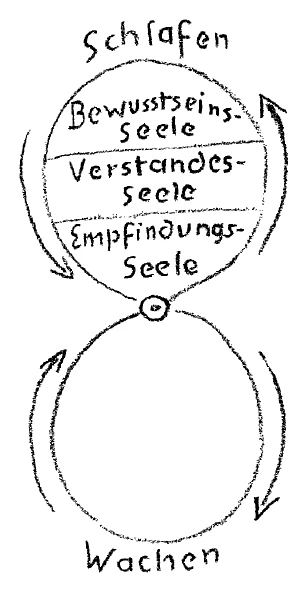
[ 10 ] So we have three forces that act upon the human being during sleep. These three forces have had very specific names in spiritual science since ancient times, and I ask you now not to think of anything else when you hear these names, other than what has just been described. You are, of course, familiar with these names, but I ask you to think of nothing other than the names given to the forces in question, which act upon these three parts of the human soul during the night. For it is indeed the case that if you were to go back to ancient times, these three names were given to these three forces, and if they are now used for other things, they are not original but borrowed. Originally, these names were given to these three forces. The force that acts upon the sensory soul during falling asleep and waking up was designated by a name which, in ancient languages, would correspond to the word Mars. (In the following discussion, the names Mars, Jupiter, etc., will be added to the diagram on page 69; see diagram on page 75.) Mars is nothing other than a name for the force that acts upon the sensory soul, which in the evening drives the human being out of his physical body and in the morning sends him back into it. The force that acts upon the intellectual or emotional soul after falling asleep and before waking up is the force that drives the world of dreams into the intellectual or emotional soul—this force bears the name that would correspond to the word Jupiter. And the force that, under certain circumstances, would cause a person to sleepwalk—that is, the force that acts upon the human consciousness soul during the state of sleep—is called Saturn in the sense of ancient spiritual science. So that one speaks in the sense of spiritual science when one would say: Mars has lulled the human being to sleep, Jupiter has sent dreams to the human being in his sleep, and the dark, gloomy Saturn is the cause that stirs the human being—who cannot resist its influence—in his sleep and drives him to unconscious actions. When considering these names, you must not think of what they signify in the sense of ordinary astronomy. For the time being, let us take their original meanings, which denote forces that are entirely of a spiritual nature and that act upon the human being when he is in the spiritual world outside of his physical body and his etheric or life body while he sleeps.
[ 11 ] Well, when a person wakes up in the morning—I’ve highlighted this moment of waking up because, after all, when a person wakes up, they do in fact enter a completely different world—what happens when a person wakes up? They are transported into a world that modern people generally regard as their own, a world in which impressions from the outside world strike their senses. These sensory impressions are such that they cannot look beyond them. They are simply there; when they wake up in the morning, they appear before their soul. When a person wakes up, the entire tapestry of the sensory world is spread out before them. But there is something else present for the person, namely, that they do not merely perceive this external world with their senses, but that whenever they perceive this or that from this external world, they always feel something in the process. Even if the joyful feeling upon perceiving a particular color is ever so slight, it is an inner psychological process; a certain feeling is present. For everyone will realize that the color violet affects them differently than red, and blue differently than green. All external sensory impressions act in such a way that they evoke inner states. Everything that the external sensory impressions thus evoke in terms of feelings belongs to the feeling soul, whereas we call the cause within the human being that enables them to receive sensory impressions the feeling body. The feeling body causes the human being to see yellow or red. The sentient soul is responsible for the fact that he feels this or that about this yellow or red. We must make a very fine distinction: that which is conjured up before our soul from the outside is caused by the sensory body; that which we experience inwardly in the process—pleasure and pain or any nuance of the impression the color makes on us—belongs to the sentient soul. In the morning, the soul of sensation begins to be devoted to the impressions of the sensory body; we could also say, to the impressions of the external world that it takes in through the powers of the sensory body. So the very same thing that was exposed to the influence of Mars during the night while we slept—the soul of sensation—is exposed to the impressions of the external world upon waking in the morning; it is surrendered to the sensory world. Now, in the sense of spiritual science, we designate the entire sensory world—insofar as it evokes certain sensations of pleasure and suffering, joy and pain in our soul—with a special name: the name Venus. I ask again that you think of nothing else under this term than what has just been characterized, that is, that which exerts an influence on our soul of feeling from the outer tapestry of the sensory world, which does not leave us indifferent and cold, but fills us with certain feelings. This influence on our feeling soul, which makes itself felt from the morning onward, is called the power of Venus. So that just as we have called the influence on the feeling soul after falling asleep Mars, we call this influence after waking up the power of Venus.
[ 12 ] Likewise, however, an influence emanates from the physical world upon our intellectual or emotional soul while it is immersed in the physical body during the day; this is the influence through which we can withdraw from the external impressions of the sensory world and process them. Note that there is a difference between experiencing in the feeling soul and experiencing in the intellectual or emotional soul; the feeling soul experiences something only as long as the human being is devoted to the external world; it simply perceives the impressions of the external world. But when, during waking hours, a person pays no attention at all to the impressions of the external world for a while, but instead allows the external impressions to fade and processes them in their soul, then the person is absorbed in their intellectual soul. This is thus somewhat more independent of the feeling soul. Now, those influences that make it possible for a person during the day not merely to stand there, so to speak, with eyes open, gazing at the tapestry of external sensory impressions, but to turn their attention away from all that and form thoughts through which they combine the impressions of the external world and become independent of it—we designate these influences as the power of Mercury. So that we can say: Just as the influences of Jupiter make themselves felt upon our intellectual or emotional soul during the night, so do the influences of Mercury make themselves felt upon our intellectual or emotional soul during the day. — Note that there is a certain correspondence between the influences of Jupiter and Mercury. In today’s average person, the influences of Jupiter enter their soul life as dream images, while the corresponding influences during the day—the influences of Mercury—act as their thoughts, as their inner experiences. Yet with the influences of Jupiter in dreams, the person does not know where things actually come from, whereas during waking consciousness, with the influences of Mercury, they do know. These are also inner processes that take place in the soul as inner images. This is the correspondence between the influences of Jupiter and Mercury.
[ 13 ] But there are also influences that affect the conscious soul during the day. What, then, is the difference between the sensory soul, the intellectual or emotional soul, and the conscious soul? Well, the sensory soul comes into play when we simply stare at things in the external world. If we withdraw for a while from the impressions of the external world, pay no attention to them, and process them, then we are devoted to our intellectual or emotional soul. When we now take what we have processed and turn once more to the external world and relate to it by moving on to action, then we are devoted to our conscious soul. For example, if you have this bouquet of flowers before your eyes: as long as you merely look at it and the white of the rose triggers feelings within you, you are devoted to your feeling soul. But if I now turn my gaze away and no longer see the bouquet at all, but instead think about it, then I am in touch with my intellectual or emotional soul; there I process the impressions I have received through combination. If I now, because I liked the bouquet and have processed the impressions it made on me, say to myself, I would like to bring joy to someone with it, and if I then take it and thus move to action, then I step out of the intellectual or emotional soul; I then enter into the conscious soul, where I once again enter into a relationship with the external world. And this is a third force that asserts itself in the human being, enabling them not only to process the impressions of the external world within themselves, but also to re-enter into a relationship with the external world.
[ 14 ] Notice that there is again a connection between the activity of the consciousness soul during waking life and the activity of the consciousness soul during sleep. We have said that when such an influence is present during sleep, the person begins to sleepwalk; they speak and act in their sleep. Only when they sleepwalk are they driven by the power of dark Saturn; during the day, they are present with their ego and act consciously. We refer to that which acts upon the human consciousness soul during the day so that it can emerge from ordinary life into independence as the power of the Moon. Forget, for the moment, what you have previously imagined this term to mean; you will yet understand why these things are precisely as they are. For now, let us retain these names as designations.
[ 15 ] We have thus traced the life of the human soul through the states of sleep and wakefulness. We have found that it breaks down into three distinct parts, that it is subject to three kinds of influences. When a person is immersed at night in that world which we must call the spiritual world, then they are immersed in the forces that are referred to in spiritual science as the forces of Mars, Jupiter, and Saturn. When, during the waking hours of the day, they unfold their soul life through the feeling soul, the intellectual or emotional soul, and the conscious soul, they are subject to those forces that are referred to in spiritual science as the forces of Venus, Mercury, and the Moon.
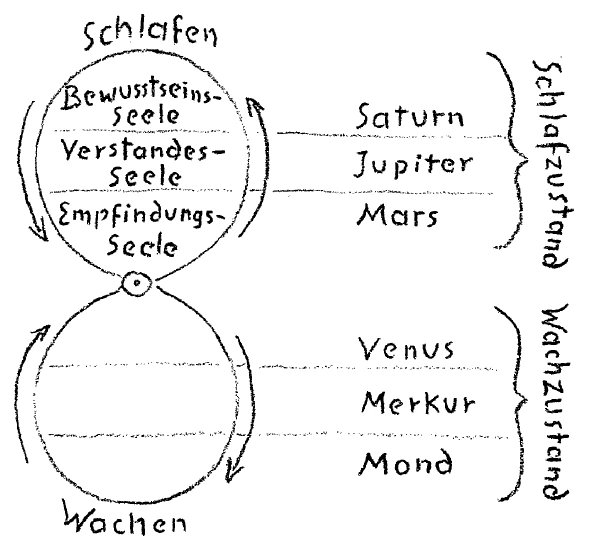
[ 16 ] We have thus described the human being’s daily journey, the path he traverses within twenty-four hours. Now, without attaching any particular significance to it for the time being, let us set alongside it another series of phenomena—a series of phenomena that is not usually considered from the perspective we wish to adopt today. But I ask you to view this lecture series in such a way that its individual lectures belong together, and that some things said at the beginning will only be properly illuminated later on. I will therefore now have to place something alongside this series of phenomena that belongs to an entirely different field and that we are placing alongside this series for certain reasons. We are placing it there for reasons that will become apparent in the course of the lectures.
[ 17 ] You are all familiar with the Earth’s orbit around the Sun from conventional astronomy, and we would now like to take a very general, rough look at the Earth’s orbit around the Sun and what that entails. If we view this orbit of the Earth around the Sun, as well as the orbits of the other planets that belong to the Sun, in the way they are usually viewed in today’s conventional science, then this view is, for spiritual science, only the very, very first beginning. For spiritual science, what takes place in the outer physical world is a parable, an outer image of inner spiritual processes, and what we learn from ordinary elementary astronomy—what we have been accustomed to learning from childhood about our planetary system—can be compared, in relation to what actually underlies it, to what a child learns when it becomes familiar with the movement of a clock. If you want to make the workings of the clock understandable to the child, you explain to them that there are twelve numbers and two hands on the dial, that one of these moves slowly and the other more quickly. You explain to the child what the twelve numbers and the two hands conventionally mean, and you explain what has been conventionally established, so that the child learns to tell you that when one hand is over this number and the other over that one, it is, for my sake, 12:00. But that wouldn’t mean much if the child only knew how to describe the clock that way. The child must learn more; the child must learn, for example, that if in the morning one hand is over 6 and the other hand is over 12, that means, at a certain time of year, that the sun is rising. It must learn to relate what is expressed on the clock face to other major events. That is to say, the child must learn to view the conditions of the world as what really matters, and to see what the clock expresses as, so to speak, merely a parable, an image of the conditions of the world. Thus, when a person is like a child in relation to the vast world, they learn that the Sun is at the center of our solar system, that first what is called the planet Mercury orbits around it, then what is called Venus; that then the Earth and the Moon orbit, followed by Mars, Jupiter, and Saturn. Let us leave the others aside for now. So what one learns in this way in external astronomy—what you can read, for example, further on in the calendar—if you have one that lists the individual celestial phenomena—is that in certain months Saturn or Mars and so on can be found here and there. If you know the course of the individual planets, and you know their relative positions to one another in certain seasons, then you have learned as much about the heavens as a child who knows that when the hands of the clock are at certain numbers, it is half past nine.
[ 18 ] Now, one can learn even more about all of this. Just as a child can learn to understand how the relationships on the clock face correspond to the relationships in life, so too can we learn to view those cosmic forces—which, though invisible, act upon our space from the powers of the macrocosm—as the forces behind the great cosmic clock; and our solar system, with the various positions of the planets relative to one another, expresses—in a similar way—what one might attribute to a mighty cosmic clock. From this clock of our planetary system, one can move on to the great spiritual cosmic relationships. Then every position of the planets in our solar system will become an expression of something that one can assume lies behind it. One will be able to say: So there are reasons why, for example, Venus is in one such relationship to Jupiter at one time and in another at another time. There are reasons to say: These things are arranged by divine-spiritual powers lying behind them, just as there are reasons why the clock is constructed in a certain way. — Thus the thought of the movements of the planets in the solar system expands into a meaningful whole for us. The planetary system becomes for us a kind of world clock. If there were nothing behind the planetary system, it would be comparable to someone having built a clock just for fun, without any meaning. We can therefore say that the planetary system becomes for us a kind of world clock, a means of expression for what truly lies behind the movements and individual bodies of our solar system.
[ 19 ] Let us first consider this world clock on its own; let us examine it so that we are not overly criticized by conventional science—though we could also view it differently—in the manner customary in conventional elementary science.
[ 20 ] First, I would like to say that the idea that this planetary system formed on its own is very easy to refute. You have all experienced how the formation of the planetary system was presented to you in school. You were told something like this: Once upon a time, a giant cosmic nebula began to rotate, and then the Sun formed in the center, with the planets forming around it. — How could anyone doubt that history unfolded as it is taught in schools, since the matter is demonstrated experimentally? It’s such a neat demonstration, isn’t it, where you take a small droplet of some substance; you cut a small sheet of paper that can be passed through the equatorial plane of the droplet, then insert a pin from above and place the whole thing in a liquid where it floats, and set it spinning using the pin. There one can even show how, through the rotation, the outer droplets break away, how a larger drop remains in the center, and how the smaller ones rotate around it. There, of course, one can very easily demonstrate: Well, there we have the whole thing on a small scale; we have depicted a planetary system! — How could anyone doubt that this is how it happened on a grand scale? The one, however, who would be something of a rascal, would say: “But dear teacher, you’ve forgotten something; you’ve forgotten something that’s otherwise very nice to forget, but in this case it just won’t do—you’ve forgotten yourself.” Fine, you did make it spin up there! — Logically, one shouldn’t forget the most important thing. One would have to at least assume that a giant teacher is sitting in outer space and has set the entire solar system in motion. For, logically, when applying the analogy, one must not omit something that is essential to the matter’s coming into being. That is quite clear. So the experiment points to something that lies outside the phenomenon itself. From this we can already conclude that behind what is rotating out there in outer space—what is happening to the external eye—there is something. Just as the teacher stands behind the rotating drop of oil in the experiment, so forces and powers stand behind the entire cosmic structure that we have before us in our solar system.
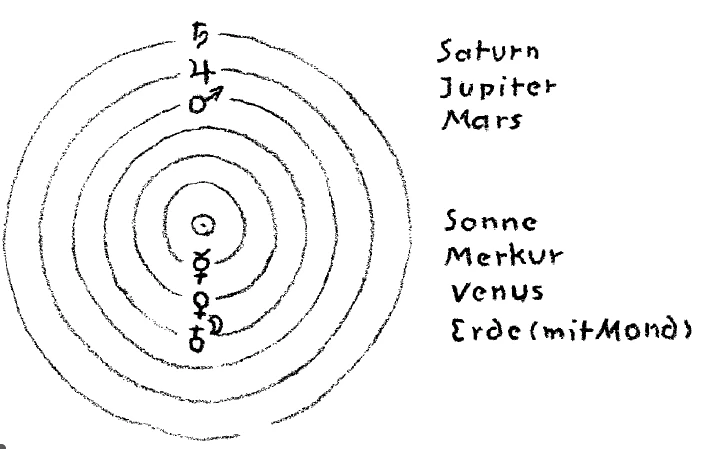
[ 21 ] And now let’s take a look at this solar system from the outside, so to speak. All we need to do is draw the Sun in the center. First, let’s have the Earth rotate around it. I’ll leave out the details. We know that the Earth performs this motion around the Sun over the course of a year. But we also know that at a certain time of year, for example, our Earth is here, and at another time, here. We then know that the Moon rotates around the Earth. So I’ll draw the Moon here. We also know that rotating closer to the Sun is the body commonly referred to as Mercury, followed by the one referred to as Venus. We then know that, further out from our Earth, rotate the bodies referred to as Mars—the proportions are of course not correct, but that is not important here—as Jupiter, as Saturn (see drawing). Let us leave the other planets aside for now. And now let us consider the position of the Earth as it is—though this will, of course, be very rarely the case—where the Earth, in its orbit around the Sun, is situated such that the Sun is here and the Earth is here, with Mars, Jupiter, and Saturn located farther away from both the Earth and the Sun. If we now assume that our Earth is positioned such that it comes to lie between Mars and the Sun, then we must imagine that the space between the Earth and the Sun contains what is commonly called Venus and what is called Mercury. I would like to emphasize explicitly that a change has taken place over time regarding the naming of these two planets. What is called Mercury today was formerly called Venus, and what is called Venus today was formerly called Mercury. Therefore, you must think of these names in reverse, so that they no longer correspond to today’s names. One must designate what is closer to the Sun as Venus, and what is farther from it as Mercury. Then comes the Moon. But if you were to imagine the other configuration, so that the Earth lies on the other side of the Sun (Earth’s position as in Figure D), then, moving from the Earth toward the Sun, you would first encounter the Moon, then what is Mercury according to the old naming convention, then—according to the old naming convention—Venus, and further beyond the Sun, Mars, Jupiter, and Saturn. And if you were to consider this sequence and omit the Earth, starting from the Sun, you would have Venus, Mercury, and the Moon on one side, and Mars, Jupiter, and Saturn on the other. If you now connect these various bodies so that the Sun marks the intersection point, you obtain the same looping line that I previously described as the schematic line representing the course of a human day. That is to say, there is a possible configuration in the solar system where the various planets are arranged in such a way that they indicate a spatial arrangement that corresponds exactly to the pattern of a human day, if one designates the moment of waking and falling asleep as the intersection point.
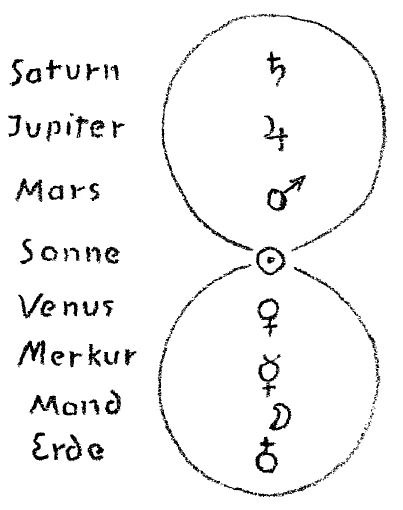
[ 22 ] So, strangely enough, we can map out the same relationships in our planetary system that we could schematically map out in the course of a human day. And here you can now gain a preliminary perspective that the arrangement of our planetary system may be based on immense forces—we can say for the time being: may be—which regulate the entire vast system, this great cosmic clock, in space just as our personal lives are regulated in time over the course of twenty-four hours. And the idea will then no longer seem absurd to you that in the macrocosm, mighty, great forces are truly analogous to the forces that make us fall asleep and wake up, that guide us during the day and the night. And from such a thought arose in ancient science the similar naming of the planets after the forces that act upon us, in that it was said: The force that drives Mars around the Sun out there in the macrocosm, in the great world, bears a resemblance to, and is of a kindred nature with, the force that makes us fall asleep. The force that drives Jupiter is similar to the force that sends dreams into the intellectual soul. The force that drives Venus around out there in the macrocosm is akin to the force that governs our feeling soul during the day. Saturn, which is far away and therefore exerts a weak influence, manifests itself in its effect within the solar system in a manner similar to that weak force which only comes into play in special cases on the conscious soul—a force that is active only in the sleepwalker. And the Moon, which is very close to the Earth, is driven around our Earth by a force similar to the force that governs us in our conscious actions of daily life—actions that are, in fact, the ones closest to us. Here you already have external indications that spatial distances signify something that is expressed in our own temporal human life as stronger and weaker effects. We will delve into much deeper relationships regarding these matters; today, attention should simply be drawn to them. But if you consider only superficially that Saturn is the farthest planet, which has the least effect on our Earth, you can compare this to how the dark Saturn forces act only weakly upon the sleeping human being. And the force that drives Jupiter around the Sun is something that, in terms of its distance from the Sun, can also be compared to that which enters our lives relatively rarely: the world of dreams. Here you have a remarkable correspondence between what human life is, what daily human life is, and what takes place out there in space in the great cosmic clock, which acts as a force in the movement of the individual planets around their sun. We have a correspondence between the microcosm and the macrocosm.
[ 23 ] You can see from this that the world is indeed much more complicated than is generally believed, and that when we look within ourselves as human beings, we can truly come to terms with ourselves—and understand our humanity—only when we take into account everything in our humanity that is connected to the wider world. And for this very reason—because they knew this—spiritual researchers of all ages have chosen appropriate terms for the phenomena and for the individual things of the wider world, as well as for what takes place within ourselves, in our seemingly so small world, in the physicality of the human being enclosed within the skin.
[ 24 ] Today I was able to point out to you, so to speak, only from a distance, a certain correspondence between the microcosm—the human being—and the macrocosm, namely our solar system. Using a schematic line that can be drawn into both human daily life and the solar system, I was able to illustrate that such a correspondence exists. We have, so to speak, only hinted at a great distance at beings who permeate our space and who, through their powers, regulate the movements of the world system in a clockwork manner, just as the movement of the hands of our ordinary pocket or wall clock is regulated. We have cast a glance to the very limits of those realms where we can hope that entire spiritual worlds will open up to us. In the coming lectures, we will have the task of getting to know the planets, as it were, as the world hands of the great world clock, and we will have the opportunity to point to the beings themselves who set the entire course of the solar system in motion, who move the planets around the sun, and who reveal themselves to be related to what takes place within the human being. And so we will understand how the human being, as a microcosm, as a small world, is born out of the macrocosm, out of the great world.