

The Mission of Individual Folk-souls
in their Connection with Germanic-Norse Mythology
GA 121
16 June 1918, Oslo
Translate the original German text into any language:
Versions Available:
The Mission of Folk-Souls, tr. Unknown
Zehnter Vortrag
Lecture Ten
[ 1 ] Bevor wir dasjenige entwickeln, was sich in Anknüpfung an das bedeutsame Bild der Götterdämmerung ergeben wird, wird es gut sein, wenn wir uns dafür eine Grundlage schaffen. Denn es wird sich darum handeln, das Wesen der germanisch-nordischen Volksseele aus den gewonnenen Resultaten heraus genauer zu schildern. Wir müssen sehen, wie in Europa das gesamte europäische Geistesleben zusammenwirkt, wie durch die Tätigkeit der verschiedenen Volksgeister ein Fortschritt der Menschheit bewirkt wird — aus uralten Zeiten heraus, durch unsere Gegenwart hindurch, in die Zukunft hinein. Jedes einzelne Volk, ja sogar alle einzelnen, kleineren Volkssplitter haben in diesem großen Gesamtgemälde ihre besondere Aufgabe, und aus dem, was gesagt worden ist, können Sie erkennen, daß, in gewisser Beziehung, gerade der vor- und nachchristlichen Kultur Europas die Aufgabe, die Mission zugefallen ist, das Ich durch die verschiedenen Stufen der menschlichen Wesenheit hindurch zu erziehen, es herauszubilden und nach und nach zu entwickeln. Es wurde ja in gewisser Beziehung dieses Ich in uralter Zeit noch aus der geistigen Welt heraus, wie wir dies am germanisch-nordischen Volke gezeigt haben, hellseherisch dem Menschen gezeigt. Es wurde gesagt, wie dieses Ich den Menschen verliehen wird von einem der Engelwesen, das sogar zwischen dem Menschen und der Volksseele mitten darinnen steht: von dem Donar oder Thor. Wir haben gesehen, daß sich der einzelne noch vorkam wie Ich-los, wie unpersönlich. Er sah das Ich wie eine Gabe an, die ihm aus der geistigen Welt geschenkt wurde.
[ 1 ] Before we can develop all that can be extracted from the significant picture of the ‘Twilight of the Gods’, it will be well to form a foundation, a basis, to work from. For we shall deal with the nature of the Germanic Scandinavian Folk-soul, and from the results of our investigation describe it more minutely. We must see how in Europe the whole collective spiritual life worked in co-operation, how through the activity of the various Folkspirits progress was brought about in mankind, beginning from the earliest ages and proceeding through our present age on into the future. Each individual people, yea, even all the smaller subdivisions of peoples have their special task in this great collective picture; and you will perceive from what has been said, that in a certain respect it was just to the pre-Christian and post-Christian cultures of Europe that the task, the mission was given to educate the ‘I’ through the different stages of the human being, to form it and gradually to develop it. As we have shown to be the case in the Germanic Scandinavian people, the ‘I’ was in primal ages still clairvoyantly shown to man from the spiritual world. It was shown that this ‘I’ was bestowed upon man by an Angelic Being, who stands between man and the Folk-soul, by Donar or Thor. We have seen that each single individual felt himself to be ‘I’-less, impersonal; to him the ‘I’ was a gift, presented to him from the spiritual world.
[ 2 ] In solcher Weise hat man natürlich im Orient, als das Ich überhaupt erwachte, das Ich nicht gefunden. Da war der Mensch schon subjektiv so weit entwickelt zu einer hohen Stufe menschlicher Vollkommenheit, daß er das Ich nicht als fremdes, sondern als eigenes empfand. Als der Mensch im Orient zum Ich erwachte, war die orientalische Kultur schon so weit, daß sie fähig war, eine so fein ausgesponnene Spekulation, Logik und Weisheit nach und nach zu entwickeln, wie wir sie in der orientalischen Weisheit vor uns sehen. Also den ganzen Prozeß des Empfangens des Ich wie aus einer höheren, geistigen Welt unter der Beihilfe einer solchen göttlich-geistigen Individualität wie der Thor es war, hat der Orientalismus nicht mehr mitgemacht. Ihn hat mitgemacht der Europäismus, und daher empfindet dieser Europäismus auch dieses allmähliche Hinaufsteigen zu dem individuellen Ich wie das Herauskommen aus einer Art von Gruppenseele. Der germanisch-nordische Mensch fühlte sich selbst noch wie mit einer Gruppenseele behaftet, wie zu einer ganzen Gemeinschaft gehörig, wie ein Glied in der großen Zusammengehörigkeit des Stammes. Nur so konnte es kommen, daß noch fast hundert Jahre, nachdem der christliche Impuls der Erde gegeben worden ist, Tacitus die Germanen Mitteleuropas so schildern konnte, daß sie immer als zu einzelnen Stämmen gehörig erscheinen, daß sie wie die Glieder eines Organismus sind und zu der Einheit des Organismus gehören. So fühlte sich der einzelne in jener Zeit noch wie ein Glied des StammesIch. Er fühlte das nach und nach Heraus-geboren-Werden des individuellen Ich aus dem Stammes-Ich, und er fühlte in dem Gotte Thor den Geber, den Verleiher des Ich, den Gott, der ihn eigentlich mit dem individuellen Ich begabte. Aber er fühlte diesen Gott noch verbunden mit dem gesamten Geiste des Stammes, mit dem, was in der Gruppenseele lebt. Für diese Gruppenseele findet sich nun der Ausdruck «Sif». Das ist der Name für die Gemahlin des Thor. Sif muß sprachlich verwandt sein mit dem Worte Sippe, Stammeszusammengehörigkeit und ist es auch in der Tat, wenn das auch maskiert und verborgen ist. Okkult bedeutet aber Sif die Gruppenseele der einzelnen Gemeinschaft, aus der herauswächst das einzelne Individuum. Sif ist diejenige Wesenheit, die sich verbindet mit dem Gotte des individuellen Ich, mit dem Geber des individuellen Ich, mit Thor. Sif und Thor empfindet der individuelle Mensch als die Wesenheiten, die ihm das Ich gaben. Die empfand der nordische Mensch noch so, als den Völkern in anderen Gegenden Europas bereits andere Aufgaben in der Erziehung des Menschen zum Ich hin zugeteilt waren.
[ 2 ] Naturally in the East, when the ‘I’ actually awoke, they did not find it in that way. There man had already evolved subjectively to such a high stage of human perfection, that he did not feel the ‘I’ as something foreign to him, but as his own. When in the East man awoke to the ‘I’, Eastern culture had already proceeded so far, that it was capable of gradually developing that delicately spun speculation, logic and wisdom, which we have before us in the Eastern Wisdom. Therefore the East did not experience the whole process of receiving the ‘I’ as though coming from a higher spiritual world, with the assistance of a divine spiritual individuality such as Thor. This was experienced in Europe, and hence the European felt this gradual ascent to the individual ‘I’ as the emerging from a kind of group-soul. The Germanic Scandinavian still felt himself attached to a group-soul, belonging to a whole community, as if he were a part in the great body of his people. Thus only could it come about that nearly 100 years after the Christ-impulse had been given to the earth, Tacitus could describe the Germans of Central Europe as appearing to belong to separate tribes, and yet as members of one organism and belonging to the unity of the organism. At that time each individual still felt himself to be a member of the tribal ‘I’. He felt his individual ‘I’ being gradually born out of the tribal ‘I’, and in the God Thor he recognized the giver, the bestower of the ‘I’, the God who really presented him with the individual ‘I’. But he felt this God to be still united with the collective spirit of the tribe, with that which dwelt in the group-soul. To this group-soul was given the name Sif. That is the name of the spouse of Thor. Sif must linguistically be connected with the word Sippe-tribal relationship,—and this connection really exists, although veiled and hidden. Occultly, however, Sif signifies the group-soul of the individual community from which the single individual grows forth. Sif is the being who unites herself with the God of the individual ‘I’, with the giver of the individual ‘I’, with Thor. The individual man recognized Sif and Thor as the Beings who gave him his ‘I’. The Northman still felt thus about them, at a time when to the peoples in other parts of Europe other tasks had already been given in the educating of man up to the ‘I’.
[ 3 ] Jedes einzelne Volk hat seine besondere Aufgabe. Da finden wir vor allen Dingen dasjenige Volk, diejenige Völkerzusammengehörigkeit, diejenige Volksgemeinsamkeit ausgebreitet, die wir unter dem Namen der Kelten kennen. Der Volksgeist der Kelten, von dem wir aus den vorangegangenen Darstellungen wissen, daß er später ganz andere Aufgaben bekommen hat, hatte die Aufgabe, das noch junge Ich der europäischen Bevölkerung heranzuziehen. Dazu aber mußte noch eine Erziehung, ein Unterricht der Kelten selbst vorhanden sein, der unmittelbar aus der höheren Welt vermittelt war. Daher ist es durchaus richtig, daß die Kelten durch ihre Eingeweihten, die Druiden-Priester, einen Unterricht aus höheren Welten erhielten, den sie aus eigener Kraft nicht hätten empfangen können, und den sie an die übrigen Völker dann weiterzugeben hatten.
[ 3 ] Every single people has its particular task. There above all we find that people, that collection of peoples, that community of peoples whom we know by the name of Celts. The Folk-spirit of the Celts—of whom from former lectures we know that later he received quite different tasks—then had the task of educating the still youthful ‘I’ of the peoples of Europe. For this it was necessary that the Celts should receive an education and instruction which was communicated directly from the higher world. Hence it is perfectly true that through their Initiates, the Druid Priests, the Celts did receive instruction from the higher worlds which they could not have acquired by their own strength, and which they then had to hand on further to the other nations.
[ 4 ] Die gesamte europäische Kultur ist eine Gabe der europäischen Mysterien. Die fortschreitenden Volksseelen sind immer die Lenker der Gesamtkultur der Menschheit in ihrem Fortschritt. Aber in der Zeit, in welcher diese Volksgeister Europas die Menschen dazu anleiten sollten, aus sich selber heraus zu arbeiten, aus sich selber heraus wirksam zu sein, war es notwendig, daß sich die Mysterien mehr zurückzogen. Daher trat mit dem Zurückziehen des keltischen Elementes auch eine Art Zurückziehung der Mysterien in viel geheimere Untergründe ein. Ein viel direkterer, unmittelbarer Verkehr der Geistwesen mit dem Volke durch die Mysterien war zur Zeit der alten Kelten vorhanden, weil das Ich noch gebunden war an die Gruppenhaftigkeit, und doch sollte das keltische Element der Verleiher des Ich für die übrige Bevölkerung sein. Wir können also sagen: In der Zeit, die vor der eigentlichen germanisch-nordischen Entwickelung liegt, konnte nur durch die alten keltischen Mysterien der europäischen Kultur die Mysterien-Erziehung gegeben werden. Diese MysterienErziehung hat gerade so viel an die Oberfläche kommen lassen, als notwendig war, um eine Grundlage für die gesamte Kultur Europas zu geben. Aus dieser alten Kultur haben sich nun durch Vermischung mit den verschiedensten Rassensplittern, Volksbestandteilen und Rassengemeinschaften die verschiedensten Volksseelen und Volksgeister befruchten können und haben immer das Ich in andere Lagen gebracht, um es zu erziehen, das Ich, das sich herauswühlte aus dem Untergrunde dessen, was unter dem Ich des Menschen liegt. Man kann sagen, daß, nachdem die alte griechische Kultur bis zu einem gewissen Grade ihren Höhepunkt erreicht hatte in der Ausbildung desjenigen, was sie eben als ihre besondere Mission hatte, eine ganz andere Seite dieser selben Mission im alten Römertum und seinen verschiedenen Kulturperioden zutage trat. Wir haben bereits erwähnt, wie in einer strengen Stufenfolge aufeinanderfolgen die einzelnen nachatlantischen Kulturen. Wenn wir uns einen Überblick verschaffen wollen über diese Stufenfolge der nachatlantischen Kulturen, so können wir sagen: Die alte indische Kultur arbeitete am menschlichen Atherleibe. Daher der hellsichtige, wunderbar weisheitsvolle Charakter der alten indischen Kultur, weil sie — nach Ausbildung der besonderen menschlichen Fähigkeiten — eine im menschlichen Ätherleibe reflektierte Kultur ist, so daß wir die alte indische Kultur etwa in der folgenden Weise fassen können.
[ 4 ] The collective culture of Europe is a gift of the European Mysteries. The progressive Folk-souls are, as they progress, always the leaders of the collective culture of humanity. But at the time when these Folk-spirits of Europe had to direct men to work from out of themselves, it became necessary that the Mysteries should begin to withdraw. Hence with the withdrawal of the Celtic element there took place a kind of withdrawal of the Mysteries into much more secret depths. At the time of the old Celts there was, through the Mysteries, a much more direct intercourse between the spiritual Beings and the people, because the ‘I’ was still united to the group-soul nature, and yet the Celtic element was to be the donor of the ‘I’ to the other part of the population. We might therefore say, that before the actual Germanic Scandinavian evolution began, the mystery-education could only be given to European civilization by the old Celtic Mysteries. This mystery-education allowed just so much to come to the surface as was necessary to form a foundation for the whole culture of Europe. Now out of this old culture, through intermingling with the many different races, peoples and subdivisions of peoples, the most varied Folk-souls and Folkspirits were able to fertilize themselves, and they brought the ‘I’ into ever different conditions in order to educate it, the ‘I’ which has worked its way up out of the foundations of all that lies below the ‘I’ of man. After the old Greek culture had to a certain extent reached a culminating point in the fulfillment of its special mission, we see quite a different aspect of this same mission in the Roman Empire and its various stages of culture. We have already mentioned that the several post-Atlantean civilizations follow one another in certain order. If we wish to obtain a survey over these successive stages of post-Atlantean civilization, we may say that the old Indian culture worked upon the human etheric body. Hence the wonderfully wise, clairvoyant character of the old Indian culture, because—after the development of the special human capacities—it was a culture that was in the human etheric body; so that we may say, the ancient Indian culture is to be understood somewhat as follows (see diagram).
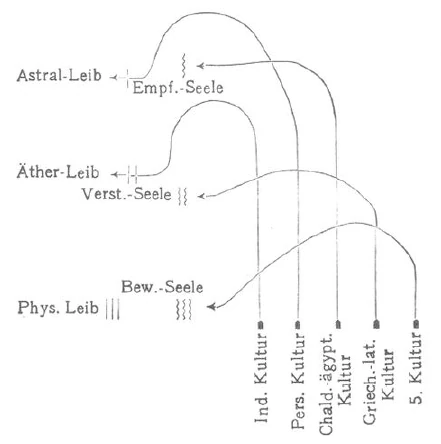
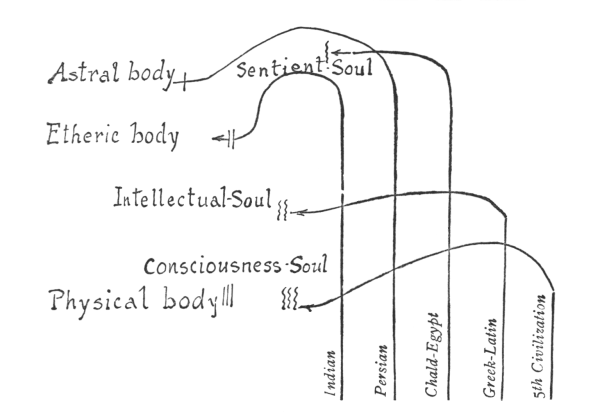
[ 5 ] Von der atlantischen bis zur späteren nachatlantischen Zeit hat der indische Volksgeist die ganze Entwickelung der inneren Seelenkräfte durchgemacht, ohne daß sein Ich erwacht war. Er hat dann wieder den Weg zurück genommen bis zu seiner Arbeit im menschlichen Atherleibe. Das ist das Wesentliche der alten indischen Kultur, daß mit fertig ausgebildeten Seelenkräften, mit Seelenkräften, die im höchsten Grade verfeinert waren, der Inder wiederum hineingeht in den Atherleib, zurückgeht bis zum Ätherleib und in demselben jene wunderbar feinen Kräfte ausbildet, deren späteren Reflex wir in den Veden und in noch verfeinerterem Zustande in der Vedanta-Philosophie sehen. Das war alles nur möglich dadurch, daß sich die indische Volksseele bis zu einem hohen Grade entwickelt hatte, bevor das Ich angeschaut, wahrgenommen worden ist, und schon wieder zu einer Zeit, als der Mensch mit den Kräften des Ätherleibes selber sehen konnte. Die persische Volksseele war nicht so weit gekommen. Die war nur so weit gekommen, in dem Empfindungsleibe oder Astralleibe wahrzunehmen. Noch anders war es in der babylonisch-chaldäisch-ägyptischen Kultur. Da war es so, daß der Teil, den wir als die Empfindungsseele bezeichnen, wahrnehmen konnte. Wir müssen also diese ägyptisch-chaldäische Kultur als eine solche bezeichnen, welche in der Empfindungsseele arbeitet. Beim griechisch-lateinischen Volksgeiste war das so, daß er geleitet worden ist bis zur Verstandes- oder Gemütsseele; in dieser Verstandes- oder Gemütsseele arbeitete er. An der Verstandes- oder Gemütsseele konnte er selbst nur dadurch arbeiten, daß diese Verstandes- oder Gemütsseele wiederum im Ätherleibe eine Art Ausprägung ihres Wesens hatte. Aber es ist dies gleichsam eine weniger reale, weniger anschauliche und der Wirklichkeit eingeprägte Form des Weltbildes, wie es jetzt im Griechentum herauskam. Während ein unmittelbares Arbeiten im Atherleibe bei der alten indischen Kultur da war, ist jetzt ein verwischtes, ein abgeschattetes, ein matteres Abbild der Wirklichkeit vorhanden, wie ich es charakterisiert habe dadurch, daß ich sagte: Es ist wie eine Erinnerung an das, was diese Völker einst erlebt hatten, wie eine Erinnerung, die zurückstrahlt auf ihren Atherleib (vgl. die schematische Abbildung).
[ 5 ] From the Atlantean down to the later post-Atlantean epoch the Indian Folk-spirit went through the whole of the development of the inner soul forces, without his ‘I’ being wakened. He then returned to his work in the human etheric body. The essential thing in the old Indian culture is that the Indian, with completely developed soul-forces, with soul-forces refined to the highest point, goes back again into the etheric body, and within that he perfects those wonderfully delicate powers, the later reflection of which we see in the Vedas and in a still more refined condition in the Vedantic philosophy. All this was only possible because the Indian Folk-soul had evolved to high degree before the ‘I’ was seen and realized, and this again occurred at a time when man could perceive by means of the forces of the etheric body itself. The Persian Folk-soul had not progressed so far as this, only so far as to perception in the sentient body or astral body. It was again different at the time of the Egyptian-Babylonian-Chaldæan culture. That part of man which we describe as the Sentient Soul was then able to perceive, and we must therefore describe this Egyptian-Chaldæan culture as working in the Sentient Soul. The Græco-Latin Folk-spirit was directed to the Intellectual Soul or Soul of the Higher Feelings, and worked in that. He himself was only able to work upon this Intellectual Soul or Soul of the Higher Feelings because it had a sort of expression of its nature in the etheric body. But this form of world-conception which now appeared in Greece was less real, as it were, less objective, it bore less of the stamp of reality. Whereas in the old Indian culture there was a more direct activity in the etheric body, there was a more blurred, a fainter image of the reality, which, as I have said, was like a memory of what these peoples had once experienced, a memory reflected in their etheric body.
[ 6 ] Bei den anderen Völkern, die jetzt auf das griechische Volk folgten, haben wir es zu tun mit dem vorzugsweisen Gebrauche des physischen Leibes zur stufenweisen Ausbildung der Bewußtseinsseele. Daher war die griechische Kultur eine solche, die wir nur begreifen können, wenn wir sie aus dem Innern heraus zu begreifen vermögen; wenn wir uns klar sind, daß bei ihr als äußere Erfahrung wichtig ist, was aus dem Innern des Griechen heraussprudelt. Dagegen haben die Völker, die mehr nach Westen und Norden gelegen sind, die Aufgabe, unter Leitung ihrer Volksseelen den Blick in die Welt hinauszurichten und das in der Welt zu sehen, was auf dem physischen Plane zu sehen ist, auszubilden das, was auf dem physischen Plane eine Rolle spielen soll. Die germanisch-nordischen Völker hatten noch die besondere Aufgabe, daß sie das alles so ausbilden sollten, wie sie es ausbilden konnten, da sie noch die Gnade, die welthistorische Gnade genossen, im alten Hellsehen hineinzusehen in die geistige Welt und hineinzutragen die uralten Erfahrungen, die sie wie lebendig empfanden, in das, was auf dem physischen Plane eingerichtet werden sollte.
[ 6 ] In the other peoples which then follow upon the Greek people we have to deal principally with the use of the physical body for the development, stage by stage, of the Spiritual Soul. Hence the Greek culture was one which we can only understand if we try to do so from within, if we realize that in this culture what is important in external experience is that which pours forth from the inner nature of the Greeks. On the other hand the peoples lying more towards the West and the North have the task, under the guidance of their Folk-souls, of directing their gaze out into the world, and of seeing what is there to be seen on the physical plane, and of perfecting that which has to play a part on that plane. The Germanic Scandinavian peoples had also the special task of perfecting this as they alone could, because they still enjoyed the blessing of being able to see into the spiritual world with the old clairvoyance, and to carry the primeval experiences which they perceived so vividly, into that which had to be arranged on the physical plane.
[ 7 ] Ein Volk gab es, das in seiner späteren Zeit diese Gnade nicht mehr hatte, ein Volk, das keine solche Vorentwicklung zunächst durchgemacht hatte, das daher gleichsam wie mit einem Sprung vor die Geburt des menschlichen Ich auf dem physischen Plane gestellt wurde und daher nur unter Anleitung seiner Volksseele, seines Erzengels für alles das sorgen konnte, was dieses menschliche Ich auf dem physischen Plane förderte, was zur Wohlfahrt dieses menschlichen Ich auf dem physischen Plane notwendig war. Dies war das römische Volk. Alles, was das römische Volk unter Anleitung seines Volksgeistes für die gesamte Mission Europas zu leisten hatte, war dazu bestimmt, dem Ich des Menschen als solchem Geltung zu verschaffen. Daher konnte das römische Volk dasjenige ausbilden, was das Ich zwischen die anderen Iche hineinstellt. Es konnte die ganze Summe der Privatrechte begründen. Daher wurde es der Schöpfer der Jurisprudenz, die rein auf das Ich gebaut ist. Wie das Ich dem Ich gegenübersteht, das war die große Frage in der Mission des römischen Volkes. Die anderen Völker, die aus der Kultur des römischen Volkes herausgewachsen sind, hatten schon mehr von dem, was sozusagen aus der Empfindungsseele, aus der Verstandes- oder Gemütsseele und aus der Bewußtseinsseele selbst heraus dieses Ich in irgendeiner Weise befruchtet, dieses Ich in die Welt hineintreibt. Dazu waren notwendig alle von der äußeren Geschichte aufgezählten Rassenvermischungen, die auf der italischen und pyrenäischen Halbinsel, im heutigen Frankreich und im heutigen Großbritannien zustande gekommen sind, um das Ich nach den verschiedenen Nuancen, nach der Empfindungsseele, nach der Verstandes- oder Gemütsseele und nach der Bewußtseinsseele auszubilden auf dem physischen Plan. Das war die große Mission der Völker, die sich nach und nach im Westen Europas in der verschiedensten Weise ausgebildet haben.
[ 7 ] One people there was, which, at its later stage no longer possessed this blessing; which in the first place had not gone through such a previous evolution, but had been placed on the physical plane at one bound, as it were, before the birth of the human ‘I’ and therefore was only able under the guidance of its Folk-soul, of its Archangel, to look after that which helped this human ‘I’ on the physical plane, that which was necessary for its well-being there. This was the Roman people. Everything that the Roman people had, under the guidance of its Folk-spirit, to accomplish for the collective mission of Europe, was for the purpose of giving importance to the ‘I’ of man as such. Hence the Roman people was able to develop that which places the ego among other egos. It was able to found the whole system of the rights of the individual. Hence it was the creator of jurisprudence, which is built up purely on the ‘I’. The relation of one ‘I’ to another was the great question in the mission of the Roman people. The other peoples, which grew out of the Roman civilization, already possessed more of what—coming so to say from the Sentient Soul, the Intellectual Soul or Soul of the Higher Feelings and from the Spiritual Soul itself—in some way or other fertilizes the ‘I’ and drives it out into the world. Therefore all the mixtures of races of which external history relates, which occurred on the Italian and Pyrenean Peninsula, in present-day France and in present-day Great Britain, were necessary in order to develop the ‘I’ in the different shades of the Sentient Soul, the Intellectual Soul or Soul of the Higher Feelings, and the Spiritual Soul on the physical plane. That was the great mission of those peoples which gradually developed in various ways in Western Europe.
[ 8 ] Alle einzelnen Kulturnuancen und Missionen im Westen Europas finden zuletzt ihre Erklärung darin, daß in der Richtung nach der italischen und pyrenäischen Halbinsel hin dasjenige auszubilden war, was durch die Impulse der Empfindungsseele in das Ich hinein ausgebildet werden konnte. Studieren Sie die einzelnen Volkscharaktere nach ihren Licht- und Schattenseiten, da werden Sie finden, daß Sie bei den Völkern der italischen und pyrenäischen Halbinsel die eigentümliche Mischung des Ich mit der Empfindungsseele haben. Bei den Völkern aber, die auf Frankreichs Boden bis in die neueste Zeit herauf gelebt haben, werden Sie ihre Eigenart begreiflich finden, wenn Sie das Werden und die Vermischungen der Verstandes- oder Gemütsseele mit dem Ich betrachten. Die großen, welthistorischen Erfolge aber, als deren Repräsentant wir Großbritannien betrachten können, sind darauf zurückzuführen, daß der Impuls der Bewußtseinsseele in das menschliche Ich hineingedrängt worden ist. Mit dem, was als welthistorische Mission aus den britischen Ländern hervorging, ist auch zusammenhängend das, was aus der Begründung der äußeren, staatsrechtlichen Form hervorging. Die Verbindung der Bewußtseinsseele mit dem Ich war noch nicht innerlich vorhanden. Wenn Sie aber durchschauen, wie diese Verbindung der Bewußtseinsseele mit dem nach außen getriebenen Ich zustande kam, so werden Sie finden, daß die großen welthistorischen Eroberungen der Bevölkerung jener Insel von diesem Impulse herrühren. Sie finden aber auch, daß das, was da geschieht an Begründungen der parlamentarischen Regierungsformen, sofort verständlich wird, wenn man weiß, daß damit ein Impuls der Bewußtseinsseele auf den Plan der Weltgeschichte hingestellt werden sollte.
[ 8 ] All the several shades of culture and the missions of the peoples of Western Europe can finally be explained by the fact that there had to be developed in the direction of the Italian and Pyrenean peninsulas that which could be formed in the ‘I’ through the impulse of the Sentient Soul. If you study the several folk-characters in their light and shadow sides, you will find that in the peoples of the Italian and Pyrenean peninsulas there is a peculiar mingling of the ‘I’ with the Sentient Soul. Then you will be able to understand the peculiar nature of those peoples who till now have lived in the land of France, if you consider the growth and mingling of the Intellectual Soul or Soul of the Higher Feelings, with the ‘I’. The great world-historical effects, however, which we may consider as represented by Great Britain, are to be traced back to the impulse of the Spiritual Soul penetrating into the human ‘I’. With the world-historical mission that proceeded from Great Britain is also connected that which proceeded from the founding of the external constitutional form. The union of the Spiritual Soul with the ‘I’ did not exist as yet inwardly. If, however, you recognize how this union came about between the Spiritual Soul and the ‘I’ that had been driven outwards, you will find that the great historical conquests made by the inhabitants of that island proceed from that impulse. You will also find that what took place there in the founding of the parliamentary forms of government at once becomes comprehensible, if you know that an impulse of the Spiritual Soul was to be placed on the plane of the world's history.
[ 9 ] Es waren also viele Nuancen notwendig, denn durch viele Stufen des Ich waren die einzelnen Völker zu führen. Wir würden wahre Geschichtsbilder finden, wenn wir Zeit genug hätten, diese Dinge weiter zu verfolgen, die uns zeigen, wie die Grundkräfte sich verzweigen und sich in der verschiedensten Weise auswirken. So wirkte die Seelenkonstitution bei den westlichen Völkern, die für sich selbst nicht die unmittelbare, elementare Erinnerung hatten an die hellseherisch erlebten Dinge der geistigen Welt von früher. Ganz anders mußte in der späteren Zeit im germanisch-nordischen Gebiet sich ausbilden dasjenige, was unmittelbar aus einer nach und nach erfolgten Entwickelung des schon in die Empfindungsseele hineingegossenen, ursprünglichen Hellsehens hervorging. Daher jener Zug der Innerlichkeit, der ja nur die Nachwirkung innerlicher, in der Vorzeit erfolgter hellseherischer Erfahrung ist. Die südlich-germanischen Völker hatten zunächst ihre Aufgabe auf dem Gebiet der Bewußtseinsseele. Die griechisch-lateinische Zeit hatte auszubilden die Verstandes- oder Gemütsseele. Sie hatte aber nicht bloß den Impuls zu geben mit der Verstandes- oder Gemütsseele, sie hatte hineinzuwirken mit einer wunderbaren, mit hellseherischer Erfahrung ausgestatteten vorzeitlichen Entwickelung. Das alles ergoß sich in die Bewußtseinsseelen der mitteleuropäisch-nordisch-germanischen Völker. Das wirkte bei diesen als Seelenanlage nach, und die südlicheren Teile der germanischen Menschheit hatten zunächst auszubilden das, was dazu gehört, um die Bewußtseinsseele innerlich vorzubereiten, innerlich mit dem auf den physischen Plan umgesetzten Bewußtseinsinhalt des alten Hellsehens zu erfüllen.
[ 9 ] Thus many shades were necessary, for the several peoples had to be guided through many stages of the ‘I’. If we had sufficient time to follow these things on further we should find pictures in history which would show us how the basic forces branch and work out in the most various ways. Thus did the peculiar constitution of the soul work among the western peoples, who had not preserved in themselves the direct elementary remembrance of the clairvoyantly experienced things of the spiritual world of former times. In later times, in the Germanic Scandinavian domains, that which proceeded directly from a gradual, successive evolution of primeval clairvoyance and which had already been poured into the Sentient Soul, had to develop in quite a different way. Hence that current of inwardness, which indeed is only the after-effect of a more inward clairvoyant experience gone through in a former age. The Southern Germanic peoples had in the first place their task in the domain of the Spiritual Soul. The Græco-Latin age had to develop the Intellectual Soul or Soul of the Higher Feelings. But it had not merely to give the impulse with this soul, it had to work also with a wonderful premature development that was endowed with clairvoyant experience. All this was poured into the Spiritual Souls of the Central European and Northern Germanic peoples. It worked among these souls as an inner capacity, and the Germanic peoples living more to the South had first of all to develop what pertains to the inward preparation of the Spiritual Soul, to fill it inwardly with the consciousness resulting from the old clairvoyance, but transposed on to the physical plane.
[ 10 ] Scheinbar liegen weit ab von dem mythologischen Gebiet die Philosophien Mitteleuropas, diese Philosophien, welche Fichte, Schelling und Hegel noch im neunzehnten Jahrhundert vertraten. Dennoch sind sie nichts anderes, als das Resultat des sublimiertesten alten Hellsehens, des im Innern des Menschen eroberten Zusammenarbeitens mit göttlich-geistigen Mächten. Unmöglich hätte sonst ein Hegel in seinen Ideen Realitäten sehen können, unmöglich hätte ein Hegel den sonderbaren Ausspruch tun können, der ihn so sehr charakterisiert, indem er auf die Frage: «Was ist das Abstrakte?» antwortet: «Das Abstrakte ist zum Beispiel ein einzelner Mensch, der seine täglichen Verrichtungen tut, nehmen wir an: ein Zimmermann.» Dasjenige also, was für den Abstraktling etwas Konkretes ist, das war für Hegel etwas Abstraktes. Das, was für den Abstraktling nur Gedanken sind, das waren für ihn große, gewaltige Werkmeister der Welt. Die Ideenwelt Hegels ist der letzte sublimierteste Ausdruck der Bewusstseinsseele und enthält in reinen Begriffen das, was der nordische Mensch noch als sinnlich-übersinnliche, göttlich-geistige Mächte gesehen hat in Verbindung mit dem Ich. Und als bei Fichte das Ich zum Ausdruck kam, da war es nichts anderes als der Niederschlag dessen, was der Gott Thor der menschlichen Seele gegeben hat, von Fichte nur gesehen aus der Bewußtseinsseele, in dem scheinbar ärmsten Gedanken, dem Gedanken «Ich bin», von dem die Fichtesche Philosophie ausgeht. Eine gerade Entwickelungslinie geht von der Begabung des alten nordischen Volkes mit dem Ich ausströmend durch den Gott Thor oder Donar aus der Geistwelt bis in diese Philosophie. Dieser Gott hatte das alles vorzubereiten für die Bewußtseinsseele, damit sie einen ihr angemessenen Inhalt habe, denn sie ist darauf angewiesen, in die äußere Welt hineinzuschauen und innerhalb dieser Welt zu wirken. Aber diese Philosophie findet nicht bloß die äußere, grobsinnliche, materialistische Erfahrung, sondern sie findet den Inhalt der Bewußtsseinsseele selber in der äußeren Welt und sieht die Natur nur an als die Idee in ihrem Anderssein. Nehmen Sie diesen fortwirkenden Impuls, so haben Sie darin die Mission der germanisch-nordischen Völker in Mitteleuropa.
[ 10 ] The philosophies of Central Europe, those philosophies which were represented by Fichte, Schelling and Hegel as late as in the nineteenth century, are apparently far removed from the sphere of mythology, but they are nevertheless nothing but the result of the most penetrating old clairvoyance, acquired by man when he worked in co-operation with the divine spiritual Beings. It would otherwise have been impossible for a Hegel to have looked upon his ideas as realities, it would have been impossible for him to make the strange statement so characteristic of him, when, in answer to the question, ‘what is the abstract?’, he replied, ‘The abstract is for instance an individual man who performs his daily duties, let us say a carpenter.’ That, therefore, which to the abstract scientist is concrete, was abstract to Hegel. That which to the abstract scientist are mere thoughts, to him were the great, mighty architects of the world. Hegel's world of ideas is the final, the most highly sublimated expression of the Spiritual Soul, and contains in pure concepts that which the Northman still saw as sensible-super-sensible, divine spiritual powers in connection with the ‘I’. And when the ‘I’ was expressed in Fichte, it was nothing but a precipitation of what the God Thor had given to the human soul, now viewed from the Spiritual Soul in what seems to be the simplest of thoughts, the thought ‘I am,’ which is the starting-point of Fichte's philosophy. A straight line of evolution goes from the presentation of the ‘I’ by the God Thor or Donar to the old Northern peoples from the spiritual world, down to this philosophy. This God had to prepare all this for the Spiritual Soul in order that the latter might receive its fitting contents, for its task is to look out into the outer world and to work within that world. But this philosophy does not discover merely the external, crude, materialistic experience, it discovers in the external world the contents of the Spiritual Soul itself, and looks upon Nature merely as the other side of idea. Take this on-working impulse, and in it you have the mission of the Northern Germanic peoples in Central Europe.
[ 11 ] Nun müssen wir uns fragen, da alle Entwickelung einen Fortgang zu nehmen hat: Wie schreitet diese Evolution vorwärts? Wir können da Merkwürdiges sehen, wenn wir in ältere Zeiten zurückschauen. Wir haben gesagt: Im alten Indertum fand die erste Kultur im Ätherleibe statt, nachdem die entsprechende Ausbildung der geistigen Kräfte da war. Es gibt aber auch noch Kulturen, die sich die alte, atlantische Kultur bewahrt und sie hineingetragen haben in die Menschen der nachatlantischen Zeit. Während der Inder von dieser Seite aus an seinen Ätherleib herankommt und aus diesem heraus, mit den Kräften desselben, seine gewaltig große Kultur und sein großartiges Geistesleben schafft, haben wir von der anderen Seite eine Kultur, welche im Artlantiertum wurzelt und hineinarbeitet in die nachatlantische Zeit eine Kultur, welche gleichsam zu ihrer Begründung und Ausbildung die andere Seite des Atherleib-Bewußtseins herausarbeitet. Das ist die chinesische Kultur. Die Einzelheiten der chinesischen Kultur werden Sie begreifen, wenn Sie diesen Zusammenhang ins Auge fassen und sich erinnern, daß die atlantische Kultur ein unmittelbares Verhältnis hatte zu dem, was wir in unseren früheren Darstellungen den «Großen Geist» nannten, so daß also diese Kultur ein unmittelbares Verhältnis hatte zu den höchsten Stufen der Weltentwickelung. Aber diese Kultur wirkt noch hinein in moderne Menschenkörper, und zwar von einer ganz anderen Seite. Daher wird auch begreiflich erscheinen, daß gerade in diesen beiden Kulturen einmal zusammenstoßen werden die zwei großen Gegensätze der nachatlantischen Zeit: das Indertum, das in gewissen Grenzen entwickelungsfähig ist, und das Chinesentum, das sich abschließt und starr bleibt, das wiederholt, was in der alten atlantischen Zeit da war. Man bekommt förmlich den Eindruck von einer okkult-wissenschaftlich-poetischen Art, wenn man das Chinesenreich in seiner Entwickelung beobachtet, wenn man an die chinesische Mauer denkt, die nach allen Seiten hin dasjenige abschließen sollte, was aus den uralten Zeiten stammte und in der nachatlantischen Zeit sich entwickelt hatte. Ich sage jetzt, es beschleicht einen etwas wie eine poetisch-okkulte Empfindung, wenn man die chinesische Mauer vergleicht mit dem, was es einmal in früheren Zeiten gegeben hat. Ich kann diese Dinge nur andeuten. Sie werden finden, wenn Sie dies mit den heute schon vorhandenen wissenschaftlichen Ergebnissen vergleichen, wie außerordentlich aufschlußgebend diese Dinge sind. Betrachten wir hellseherisch den alten Kontinent der atlantischen Welt, den wir zu suchen haben da, wo jetzt der Atlantische Ozean ist, zwischen Afrika und Europa einerseits und Amerika anderseits. Dieser Kontinent war umschlossen von einer Art von warmem Strom, von einem Strom, bezüglich dessen das hellseherische Bewußtsein ergibt, daß er, so sonderbar es klingen mag, von Süden heraufging, durch die Baffins-Bai gegen das nördliche Grönland verlaufend und es umfassend, dann herüberfloß nach Osten, sich allmählich abkühlte, dann in der Zeit, in welcher Sibirien und Rußland noch lange nicht zur Erdoberfläche gehoben waren, in der Gegend des Ural hinunterfloß, sich umkehrte, die östlichen Karpathen berührte, in die Gegend hineinfloß, wo die heutige Sahara ist, und endlich beim Meerbusen von Biskaya dem Atlantischen Ozean zuging, so daß er ein ganz geschlossenes Stromgebiet hatte. Sie werden begreifen, daß dieser Strom nur noch in den allerletzten Resten vorhanden sein kann. Dieser Strom ist der Golfstrom, der einst den atlantischen Kontinent umflossen hat. — Und jetzt werden Sie auch begreifen, daß bei den Griechen das Seelenleben Erinnerung ist. Es tauchte in ihnen auf das Bild des Okeanos, der eine Erinnerung ist an jene atlantische Zeit. Ihr Weltbild ist nicht so unrichtig, weil es aus der alten atlantischen Zeit geschöpft ist. — Den Strom, der über Spitzbergen als warmer Strom herunterkam und nach und nach sich abkühlte usw., dieses geschlossene Stromgebiet haben sich die Chinesen förmlich wiedererschaffen in ihrer von der Mauer umschlossenen, aus der atlantischen Zeit herübergeretteten Kultur. Das Geschichtliche war in der atlantischen Kultur noch nicht vorhanden. Daher hat auch die chinesische Kultur etwas Ungeschichtliches behalten. Daher haben wir da etwas Vorindisches, etwas aus der Atlantis Stammendes.
[ 11 ] Now, as all evolution has to progress, we must inquire: How does this evolution advance? When we look back into the ancient times we can see something remarkable. As we have said, in old India the first culture took place in the etheric body, after the necessary perfecting of the spiritual forces had been accomplished. But there are other civilizations besides, which have preserved the old Atlantean culture and carried it over into the people of the post-Atlantean epoch. Whereas on the one hand we have the Indian, coming thus to his etheric body, and from this and its forces creating his mighty civilization and his magnificent spiritual life, we have coming from the other side a culture which originated in Atlantis and continued to work on in the post-Atlantean epoch; a culture which for its foundation and development works out the other side, as it were, of the consciousness of the etheric body. That is the Chinese culture. If you bear this connection in mind, and remember that the Atlantean culture was directly related to what in our earlier lectures we called ‘The Great Spirit,’ you will understand the details of the Chinese culture. This culture was directly connected with the highest stages of the evolution of the world. But it still works into modern human bodies, and from a completely different side. It will therefore seem quite comprehensible that the two great opposites of the post-Atlantean epoch will one day clash in these two civilizations: the Indian, which, within certain limits, is capable of development; and the Chinese, that shuts itself off and remains rigid, repeating what existed in the old Atlantean epoch. You really obtain an occult, scientific, poetic impression of this Chinese Empire if you observe it in its evolution, and think of the Great Wall of China, which was intended to enclose on all sides that which came from the primal ages and developed in the post-Atlantean epoch. I say that something like an occult poetic feeling steals over one, if one compares the Wall of China with something which existed in former times. I can only indicate these things. If you compare this with the results that have been obtained by science, you will find how extraordinarily illuminating these things are. Let us clairvoyantly observe the old continent of Atlantis, which must be sought where the Atlantic Ocean now lies, between Africa and Europe on the one side, and America on the other. This continent was encircled by a sort of warm stream, a stream about which clairvoyant consciousness reveals that, strange as it may sound, it flowed upwards from the South, through Baffins Bay, towards the north of Greenland, encircling it and then, flowing over to the East, gradually cooled down; then, at a time when Siberia and Russia had not yet risen to the surface, it flowed down near the Ural mountains, turned, touched the Eastern Carpathians, flowed into the region occupied by the present Sahara, and finally streamed towards the Atlantic Ocean near the Bay of Biscay; so that it flowed in a perfectly unbroken stream. You will understand that only the remnants of this stream still remain. This is the Gulf Stream, which at that time encircled the Atlantean Continent. You will now also understand that, with the Greeks, the life of the soul is remembrance. The picture of Oceanos arose in them, which is a memory of that Atlantean epoch. Their picture of the world is not so very incorrect, because it was drawn from the old Atlantean epoch. The stream that came down by Spitzbergen as a warm current, and gradually cooled and so on,—the region encircled by this stream the Chinese have literally reproduced by enclosing within their Great Wall the culture which they rescued from the Atlantean epoch. There was as yet no history in the Atlantean civilization, hence the Chinese civilization is also in some ways lacking in history. Thus we have there something pre-Indian, something coming from Atlantis.
[ 12 ] Wenden wir uns jetzt zu der Schilderung im Weitergange des germanisch-nordischen Volksgeistes zu dem, was auf ihn folgt. Was wird das nächste sein, wenn ein Volksgeist sein Volk so leitet, daß das Geistselbst sich besonders entwickeln kann? Erinnern wir uns daran, daß der Atherleib in der indischen Kultur, der Empfindungsleib in der persischen Kultur, die Empfindungsseele in der ägyptisch-chaldäischen Kultur, die Verstandes- oder Gemütsseele in der griechischlateinischen Kultur, die Bewußtseinsseele in unserer, noch nicht abgeschlossenen Kultur zur Entwickelung kommt. Nun folgt aber das Ergreifen des Geistselbst durch die Bewußtseinsseele, so daß hineinleuchtet das Geistselbst in die Bewußtseinsseele, was als Aufgabe der sechsten Kulturstufe nach und nach vorbereitet werden muß. Diese Kultur, die im eminentesten Sinne eine empfängliche Kultur sein muß, denn sie muß hingebungsvoll das Hereindringen des Geistselbst in die Bewußtseinsseele abwarten, wird vorbereitet durch die Völker Westasiens und die vorgeschobenen slawischen Völker Osteuropas. Die letzteren sind aus gutem Grunde mit ihren Volksseelen vorgeschoben, aus dem Grunde, weil alles, was in Zukunft kommen wird, in einer gewissen Weise seine Vorbereitung vorher erfahren muß, sich schon hineinschieben muß, um die Elemente für das Spätere abzugeben. Im höchsten Grade interessant ist es, diese vorgeschobenen Posten einer für die späteren Epochen sich vorbereitenden Volksseele zu studieren. Daher das Eigenartige der für uns zunächst östlich wohnenden slawischen Völker. Ihre ganze Kultur muter den Westeuropäer an als sich im Vorbereitungsstadium befindend, und in sonderbarer Weise schieben sie vor, durch die Medien ihrer vorgeschobenen Posten, dasjenige, was dem Geiste nach etwas ganz anderes ist, als irgendeine Mythologie. Es würde verkennen heißen dasjenige, was von Osten herüber vorgeschoben wird als zu erwartende Kultur, es würde diese Kultur verkennen heißen, wenn man sie vergleichen wollte mit dem, was die westeuropäischen Völker in sich haben, die einen geradlinig fortlaufenden Impuls, der noch im alten Hellsehen seine Wurzel und Quelle hat, besitzen. Das Eigenartige, wodurch sich die Seele dieser osteuropäischen Völker darlebt, das drückt sich in dem ganzen Verhältnis aus, das diese Völker immer offenbarten, wenn ihre Beziehungen zu den höheren Welten in Betracht kamen. Diese Beziehung ist, wenn wir sie mit dem vergleichen, was sich in unseren Mythologien, in Westeuropa, zeigt, mit den sonderbaren, bis ins Individuelle ausgearbeiteten Götterfiguren, etwas ganz anderes. Sie tritt uns so entgegen, daß wir das, was sie uns gibt als unmittelbaren Ausfluß des Volkswesens vergleichen können mit unsern verschiedenen Planen oder Welten, durch die wir uns vorbereiten zum Begreifen einer geistigen, höheren Kultur. Da finden wir zum Beispiel im Osten folgende Vorstellung: Empfangen hat der Westen aufeinanderfolgende, nebeneinanderliegende Welten. Wir haben da zunächst ein deutliches Bewußtsein von einer Welt des kosmischen Vaters. Alles dasjenige, was in Luft und Feuer, was überhaupt in den Elementen, die in und über der Erde sich finden, schöpferisch tätig ist, das tritt uns wie in einem großen, umfassenden Gesamtbegriffe, der zugleich Gesamtempfindung ist, entgegen als der Begriff des Himmelsvaters. So wie wir uns etwa die Welt des Devachan unsere Erde befruchtend denken, so tritt uns diese Himmelswelt, diese väterliche Welt, von Osten her entgegen, und sie befruchtet dasjenige, was als Mütterliches empfunden wird, den Geist der Erde. Wir haben keinen anderen Ausdruck und kein anderes Mittel, als den gesamten Geist der Erde unter dem Bilde des Befruchtetwerdens des mütterlichen Erdenwesens uns zu denken. Da stehen sich dann zwei Welten gegenüber, nicht einzelne, individuelle Götterfiguren. Und als eine dritte Welt steht jenen zwei Welten dasjenige gegenüber, was man als das Segenskind der beiden empfindet. Das ist nicht ein individuelles Wesen, nicht eine Empfindung der Seele, sondern etwas, was das Erzeugnis des Himmelsvaters und der Erdenmutter ist. So wird, aus der geistigen Welt heraus, das Verhältnis von Devachan zur Erde empfunden. Was da entsteht als der Segner, als der Frühling und als das, was da sprießt und sproßt im materiellen Leibe, das wird durchaus als Geistiges empfunden, und was da sproßt und sprießt in der Seele, das wird empfunden als die Welt, die zugleich empfunden wird als Segenskind vom Himmelsvater und der irdischen Mutter. So universell diese Vorstellungen auch sind, wir finden sie bei den vorgeschobenen slawischen Völkern, die nach Westen vorgedrungen sind. Als so universelle Empfindung finden wir das bei keiner westeuropäischen Mythologie. Da finden wir klar ausgearbeitete Göttergestalten, aber nicht dasjenige, was wir in unsern geistigen Planen darstellen; diese finden wir mehr in dem Himmelsvater, in der irdischen Mutter und dem Segenskinde des Ostens. In dem Segenskinde ist wieder eine Welt darinnen, die eine andere durchdringt. Das ist die Welt, welche allerdings schon individuell vorgestellt wird, weil sie an die physische Sonne mit ihrem Licht geknüpft ist, Dieses Wesen, das uns vielfach in der persischen Mythologie entgegengetreten ist, hat auch — allerdings in einer anders ausgebildeten Empfindungs- und Vorstellungsform — das slawische Element; es hat das Sonnenwesen, das seine Segnungen hineingießt in die anderen drei Welten, so daß das Schicksal des Menschen eingesponnen ist in die Schöpfung, in die gegebene Erde, durch die Befruchtung der Erdenmutter mit dem Himmelsvater und durch das, was hineinspinnt der Sonnengeist in diese beiden Welten. Eine fünfte Welt ist das, was alles Geistige umfaßt. Es empfindet das osteuropäische Element in allen Naturkräften und Geschöpfen die zugrunde liegende geistige Welt. Aber die müssen wir uns in einer ganz anderen Empfindungsnuance denken, vielleicht mehr mit den Naturwesen, Naturtatsachen und Naturschöpfungen verknüpft.
[ 12 ] Let us now turn, in the further progress of the Germanic Scandinavian Folk-spirit, to the description of what follows it. What happens first of all, when a Folk-spirit so leads his people that the Spirit-Self can specially develop? Let us recollect that the Etheric Body was evolved during the Indian civilization, the Sentient Body in the Persian, the Sentient Soul in the Egyptian-Chaldæan, the Intellectual Soul or Soul of the Higher Feelings in the Græco-Latin, the Spiritual Soul in our own, which is not yet completed. Then comes the laying hold of the Spirit-Self by the Spiritual Soul, so that the Spirit-Self shines into the Spiritual Soul, which, as that is the task of the sixth stage of civilization, must be prepared for gradually. That civilization, which must be pre-eminently a receptive one, for it must reverently await the penetrating of the Spirit-Self into the Spiritual Soul, is being prepared by the peoples of Western Asia and the Slav peoples of Eastern Europe. These latter were pushed forward with their Folk-souls, for the very good reason that everything which is to happen in the future, must in a certain way be prepared beforehand, must already push itself in, in order to provide the elements for what is to follow. It is extremely interesting to study these advance guards of a Folk-soul who is preparing himself for later epochs. This accounts for the peculiar nature of the Slav peoples at present living to the East of us. Their whole culture gives the Western European the impression of being in a preparatory stage, and they put forward in quite a curious way, through the medium of their advance guards, that which in spirit is quite different from any mythology. It would be misunderstanding what is being pushed forward from the East as a civilization of the future, it would be misunderstanding this culture if we were to compare it with that which the Western European peoples possess, viz., an impulse that continues in a straight line, which is still rooted in and has its source in the old clairvoyance. The peculiarity attaching to the souls of these Eastern European peoples is expressed in the whole attitude they have always shown when their relations to the higher worlds have come into question. This relation, if we compare it with what appears in our mythology in Western Europe and the strange divine figures worked out even down to the individual character, is quite different. That which it offers appears to us in such a way that we may compare what it gives us as a direct out-pouring of the Folk-spirit, with our various planes or worlds, through which we prepare ourselves to understand a spiritual, a higher culture. For instance, we find there in the East the following conception: The West has received a series of successive worlds, lying side by side. In the East we find in the first place a distinct consciousness of a world of the Cosmic Father. Everything that is creatively active in air and fire, in all the elements in and above the earth, meets us as one great, all-embracing idea, which is at the same time an all-embracing feeling, the concept of the Heavenly Father. In somewhat the same way as we think of the Devachanic world as fertilizing our earth, so do we find this heavenly world, the world of the Father, coming towards us from the East, and it fertilizes that which is felt to be the Mother, the Spirit of the Earth. We have no other expression and can think of no other way of picturing the whole Spirit of the Earth than in the picture of the fertilization of Mother Earth. Two worlds, then, confront one another there, instead of single individual Divine Figures. And what is felt to be the Blessed Child of these two worlds, stands in front of them as a third world. That is not an individual being, not a feeling in the soul, but something which is the product of the Heavenly Father and the Earth-Mother. In this way the relation of Devachan to the Earth is felt from the spiritual world. There, that which blossoms in the material body is felt as something altogether spiritual; and that which grows and blossoms in the soul, is perceived as the world which is at the same time felt to be the Blessed Child of the Heavenly Father and the Earth-Mother. Universal as these conceptions are we find them among the Slav peoples which have been pushed forward towards the West. In no Western European mythology do we find this conception so universal. We find in them clearly defined Divine Figures, but not that which we present in our Anthroposophy as the different worlds; these we find more in the Heavenly Father, the Earth-Mother, and the Blessed Child of the East. In the Blessed Child there is again a world which permeates another one. It is a world which is, however, conceived of as being individual, because it is connected with the physical sun and its light. The Slav element also has this Being,—although in a differently developed form of conception and feeling,—which we have so often found in the Persian mythology; it has the Sun-being who so pours his blessings into the other three worlds that the destiny of man is woven into the creation, into the Earth, through the fertilization of the Earth-Mother by the Heavenly Father, and through that which the Sun-spirit weaves into both these worlds. A fifth world is that which comprises everything spiritual. The Eastern European element feels the spiritual world as underlying all the forces of Nature and their creations. But this we must think of in quite a different shade of feeling, connected more with the facts, creations and beings of Nature.
[ 13 ] Wir müssen uns vorstellen, daß diese östliche Seele in der Lage ist, in einem Naturvorgange Wesen zu sehen, nicht bloß das AußerlichPhysisch-Sinnliche, sondern das Astral-Geistige. Daher die Vorstellungen einer ungeheuren Anzahl von Wesenheiten in dieser eigenartigen geistigen Welt, die sich höchstens vergleichen läßt mit der Welt der Lichtelfen. Die geistige Welt, welche von den geisteswissenschaftlichen Vorstellungen als die fünfte Welt angesehen wird, ist ungefähr die Welt, die da aufdämmert dem Volksgemüte des Ostens. Ob Sie sie mit diesem oder jenem Namen benennen, darauf kommt es nicht an, aber darauf kommt es an, daß die Empfindungen nuanciert und schattiert sind, daß die Vorstellungen, durch welche dieser fünfte Plan oder diese fünfte geistige Welt charakterisiert worden ist, sich in der Welt des Ostens findet. Mit dieser Empfindung arbeitete diese Welt des Ostens demjenigen Geiste vor, der das Geistselbst in die Menschen hineinbringen soll, für jene Epoche, wo aufsteigen soll die Bewußtseinsseele zum Geistselbst im sechsten nachatlantischen Kulturzeitraum, der unseren fünften ablösen wird. In einer höchst eigenartigen Weise tritt uns das nicht nur in den Schöpfungen der Volksseelen entgegen, die so sind, wie ich sie eben charakterisiert habe, sondern auch in einer wunderbar vorbereitenden Weise in den mancherlei anderen Äußerungen Osteuropas und seiner Kultur.
[ 13 ] We must conceive of this Eastern soul as being in a position to see an entity in an occurrence of Nature, of seeing not only the physically-sensible, but the astrally-spiritual. Hence the ideas of an immense number of beings in this unique spiritual world, which we may at the most compare with the world of the Elves of Light. It is that spiritual world, which is looked upon in Anthroposophy as the fifth world, which dawns more or less in the feelings of the peoples of the East. Whether they call it by this name or that, does not signify; what does signify is that the feelings are colored and shaded, that the concepts which characterize this fifth plane or spiritual world are to be found in the world of the East. By means of these feelings this world of the East is preparing for that Spirit which is to bring the Spirit-Self into man, in readiness for that epoch when the Spiritual-Soul shall ascend to Spirit-Self, in the sixth age of post-Atlantean civilization, which is to succeed our own. We meet with this in a very unique manner not only in the creations of the Folk-Souls, which are as I have just described, but also in a wonderful preparatory fashion, in the various externalities of Eastern Europe and its culture.
[ 14 ] Es ist sehr merkwürdig und im höchsten Grade interessant, wie dieser Osteuropäer seine Anlage für Empfänglichkeit dem reinen Geiste gegenüber dadurch ausdrückt, daß er die westeuropäische Kultur mit großer Hingebung aufnahm, dadurch prophetisch andeutend, daß er noch Größeres mit seinem Wesen wird vereinigen können. Daher auch das geringe Interesse, das er den Einzelheiten dieser westeuropäischen Kultur entgegenbringt. Er nimmt das sich Darbietende mehr in großen Zügen und weniger in den Einzelheiten auf, weil er sich vorbereitet, dasjenige sich anzueignen, was als Geistselbst in die Menschheit hineintreten wird. Insbesondere interessant ist es zu sehen, wie unter diesem Einfluß im Osten ein viel fortgeschrittenerer ChristusBegriff hat zustande kommen können als in Westeuropa, soweit er dort nicht durch die Geisteswissenschaft zustande gekommen ist. Von allen ihr Fernstehenden hat den fortgeschrittensten Christus-Begriff der russische Philosoph Solowjow. Er hat einen solchen ChristusBegriff, daß er nur von Schülern der Geist-Erkenntnis verstanden werden kann, weil er ihn immer weiter hinaufentwickelt und in unendlicher Perspektive zeigt, so daß von ihm gezeigt wird, daß das, was heute die Menschen davon erkennen, nur der Anfang ist, weil der Christus-Impuls erst wenig der Menschheit offenbaren konnte von dem, was er in sich enthält. Aber wenn wir in bezug auf den Christus-Begriff hinschauen, wie er zum Beispiel bei Hegel gefaßt ist, so werden wir finden, daß man sagen kann: Hegel faßt ihn so, wie die feinste, die sublimierteste Bewußtseinsseele ihn fassen kann. Ganz anders aber tritt uns der Christus-Begriff bei Solowjow entgegen. Da wird die Zweigliedrigkeit im Christus-Begriffe klar, und es wird alles dasjenige abgelehnt, was in den verschiedensten theologischen Streitigkeiten zum Ausdruck gekommen ist und was im Grunde genommen auf tiefen Mißverständnissen beruht, weil gewöhnliche Begriffe nicht ausreichen, um den Christus-Begriff in seiner zweifachen Wesenheit verständlich zu machen, nicht ausreichen, um zu verstehen, daß das Menschliche und das Geistige darin genau unterschieden werden müssen. Gerade darauf beruht der ChristusBegriff, daß genau gefaßt wird, was geschah, als in den Menschen Jesus von Nazareth, der ausgebildet hatte alle erforderlichen Eigenschaften, der Christus hineinkam. Da hat man dann zwei Naturen darinnen, die zunächst erfaßt werden müssen, obwohl sie sich auf einer höheren Stufe wieder in eine Einheit zusammenfassen. So lange hat man den Christus nicht in seiner vollen Gestalt erfaßt, als man diese Zweigliedrigkeit nicht erfaßt hat. Dies kann aber nur dasjenige philosophische Erfassen, das vorausahnt, daß der Mensch selber in eine Kultur hineinkommen wird, wo seine Bewußtseinsseele in dem Zustand sein wird, daß das Geistselbst ihm zukommen kann, so daß der Mensch sich in dieser sechsten Kulturperiode als eine Zweiheit fühlen wird, bei der die höhere Natur die niedere in Zaum und Zügel halten wird. Diese Zweigliedrigkeit trägt Solowjow in seinen Christus-Begriff hinein und macht ausdrücklich geltend, daß der Christus-Begriff nur dann einen Sinn haben kann, wenn man eine göttliche und eine menschliche Natur annimmt, die nur dadurch, daß sie real zusammenwirken, daß sie nicht eine abstrakte, sondern eine organische Einheit sind, begriffen werden können. Solowjow erkennt bereits, daß in diesem Wesen zwei Willenszentren vorgestellt werden müssen. Wenn Sie die Solowjowschen Theorien von der wahren Bedeutung der ChristusWesenheit nehmen, wie sie durch das Vorhandensein des nicht bloß gedachten, sondern spirituell wirklichen indischen Einflusses entstanden, dann haben Sie da den Christus so, daß in ihm ausgebildet ist in den drei Leibern das Moment des Fühlens, das Moment des Denkens und das Moment des Wollens. Sie haben da ein menschliches Fühlen, Denken und Wollen, in das sich hineinsenkt das göttliche Fühlen, Denken und Wollen. Das wird die europäische Menschheit erst ganz verarbeiten, wenn sie zur sechsten Kulturstufe hinaufgestiegen sein wird. Prophetisch ist das in wunderbarer Weise zum Ausdruck gekommen in dem, was bei Solowjow als Christus-Begriff wie die Morgenröte einer späteren Kultur voranleuchtet. Daher geht diese Philosophie des östlichen Europa mit solchen Riesenschritten über das Hegeltum und den Kantianismus hinaus, und man fühlt, wenn man in die Atmosphäre dieser Philosophie kommt, plötzlich etwas wie einen Keim einer späteren Entfaltung. Das geht deshalb so weit, weil dieser Christus-Begriff als ein prophetisches Voranleuchten, als die Morgenröte der sechsten nachatlantischen Kultur empfunden wird. Dadurch wird das ganze Christus-Wesen und die ganze Bedeutung des Christus-Wesens für die Philosophie in den Mittelpunkt gerückt, und es wird dadurch zu etwas ganz anderem als dem, was die westeuropäischen Begriffe davon zu geben vermögen. Der ChristusBegriff, soweit er auf nicht geisteswissenschaftlichem Gebiete ausgearbeitet ist und begriffen wird als lebendige Substanz, die hineinarbeiten soll wie eine geistige Persönlichkeit in alles staatliche und soziale Wesen, — der empfunden wird wie eine Persönlichkeit, in deren Dienerschaft sich der Mensch als «Mensch mit dem Geistselbst» befindet, diese Christus-Persönlichkeit wird in einer wunderbar plastischen Weise ausgearbeitet in den verschiedenen Auseinandersetzungen, die Solowjow gibt über das Johannes-Evangelium und seine Eingangsworte. Wiederum nur auf geisteswissenschaftlichem Felde kann sich ein Verständnis für das finden, wie bei Solowjow tief erfaßt wird der Satz: «Im Urbeginne war das Wort oder der Logos», wie anders das Johannes-Evangelium gerade erfaßt wird durch eine Philosophie, bei der gefühlt werden kann, daß sie eine keimende Philosophie ist, daß sie in einer merkwürdigen Weise in die Zukunft hineinweist.
[ 14 ] It is very remarkable and extremely interesting to see how the Eastern European expresses his tendency of receptivity towards the pure Spirit by receiving with great devotion Western European culture, thus indicating prophetically that he will be able to unite something still greater with his being. Hence also the little interest he has in the details of this Western European culture. He receives what is presented to him more in broad outlines and less in details, because he is preparing himself to take up that which as Spirit-Self is to enter into mankind. It is particularly interesting to see how, under this influence, a much more advanced conception of Christ has been able to come in the East than in Western Europe, excepting where it has come about through Anthroposophy. Of all non-Anthroposophists the most advanced conception of Christ is that held by the Russian philosopher, Solovioff. It is so advanced that it can only be understood by Anthroposophists, because he develops it higher and higher and gives it an endless perspective, showing that what man is able to recognize in Christ to-day is only the beginning, because the Christ-impulse has as yet only been able to reveal to man a small degree of what it contains within it. But as regards the conception of Christ, if we look for instance at the way in which Hegel understood Him, we shall find that one may say: Hegel understood Him as only the most refined, most sublimated Spiritual Soul could. But in Solovioff the concept of Christ is a very different one. He fully recognizes the two parts in this conception, and everything which has been expressed in the many theological disputes, and which in reality rest upon great misunderstandings, is put aside, because the ordinary conceptions do not suffice to make the idea of Christ in His twofold nature comprehensible; they do not suffice to make one understand that therein the human and the spiritual must be clearly distinguished. The concept of Christ rests upon clearly grasping what took place when the Christ entered into the Man Jesus of Nazareth, who had developed all the necessary qualities. There were, then, two natures which must first of all be comprehended as such, although at a higher stage they again form unity. As long as one has not grasped this duality, one has not realized Christ in His complete form. This can, however, only be done by the philosophical comprehension which has a premonition that man himself will reach a culture in which his Spiritual Soul will attain to a state into which the Spirit-Self can come; so that man will in the sixth age of civilization feel himself to be a duality in whom the higher nature will hold the lower nature under complete control. Solovioff carries this duality into his conception of Christ and brings emphatically into notice that there can be no meaning in it unless one accepts the facts of a divine and a human nature, both really working together, so that they do not merely form an abstract but an organic unity, that thus only can this be understood. Solovioff recognizes that two Will-centers must be thought of in this Being. If you take the teachings of Spiritual Science as to the true significance of the Christ-Being, which proceed from the existence of, not an imaginary, but a spiritually real Indian influence, you then have to think of Christ as having developed within His three bodies the capacities of feeling, thought and will. There you have a human feeling, thinking and willing into which the divine Feeling, Thinking and Willing has immersed itself. The European will only thoroughly assimilate this when he has risen to the sixth stage of culture. This has been prophetically expressed in a wonderful way in Solovioff's conception of Christ, which like a rosy dawn announces a later civilization. Hence this philosophy of Eastern Europe strides with giant steps beyond that of Hegel and Kant, and when one enters the atmosphere of this philosophy, one suddenly feels as it were the germ for a future unfolding. It goes so much further because this conception of Christ is felt to be a fore-shining, the morning dawn of the sixth post-Atlantean civilization. By means of this the whole Christ-Being and the whole significance of Christ becomes the central point of philosophy, and it thus becomes a very different thing from what the Western European conceptions are able to offer concerning it. The conception of Christ,—so far as it has been worked out in non-Anthroposophical circles, in which it is comprehended as living substance which, as a spiritual personality, is to work into the social life and the life of the States, which is felt as a Personality in Whose service man finds himself as ‘man with the Spirit-Self,’—this Christ-Personality is worked out in a wonderful, plastic manner in the various expositions Solovioff gives of St. John's Gospel and its opening words. Again it is only on the ground of Spiritual Science that a comprehension can be found of what is so profoundly understood by Solovioff in the sentence, ‘In the beginning was the Word, or the Logos,’ and so on, of how differently St. John's Gospel is understood by a philosophy, which can be felt as a germinating philosophy which points in a remarkable manner to the future. Although on the one hand it must be admitted that in the domain of philosophy Hegel's work represents a most mature fruit, something that is born from the Spiritual Soul as a very ripe philosophical fruit, on the other hand this philosophy of Solovioff is the germ in the Spiritual Soul for the philosophy of the Spirit-Self, which will be added in the sixth age of culture.
[ 15 ] Wenn man auf der einen Seite sagen muß, daß Hegel auf philosophischem Gebiete eine reifste Frucht darstellt, etwas, was als reifste philosophische Frucht aus der Bewußtseinsseele herausgeboren ist, so ist auf der anderen Seite diese Philosophie Solowjows der Keim in der Bewußtseinsseele für die Philosophie des Geistselbst, das in der sechsten Kulturperiode eingegliedert wird. Es gibt vielleicht keinen größeren Gegensatz, als den im eminentesten Sinne christlichen Staatsbegriff, der als hohes Ideal dem Solowjow wie ein Traum der Zukunft vorschwebt, diesen christlichen Staats- und Volksbegriff, der alles, was da ist, nimmt, um es darzubringen dem herabströmenden Geistselbst, um es der Zukunft entgegenzuhalten, um es von den Gewalten der Zukunft durchchristen zu lassen — es gibt also keinen größeren Gegensatz, als diesen Begriff der im Solowjowschen Sinne gehaltenen christlichen Gemeinschaft, wobei der Christus-Begriff ein ganz zukünftiger ist, und den Begriff des Gottesstaates des heiligen Augustinus, der den Christus-Begriff zwar aufnimmt, aber den Staat so konstruiert, daß er der römische Staat ist, der den Christus aufnimmt in die Vorstellung vom Staate, die ihm der römische Staat gegeben hat. Das, worauf es ankommt, ist dasjenige, was das Wissen abgibt für das in die Zukunft hineinwachsende Christentum. Im Solowjowschen Staate ist der Christus das Blut, das alles soziale Zusammenleben durchrinnt. Und das Wesentliche ist, daß der Staat gedacht wird mit aller Konkretheit der Persönlichkeit, so daß er zwar als geistiges Wesen wirken, aber auch mit allen Charaktereigentümlichkeiten der Persönlichkeit seine Mission erfüllen wird. So sehr durchdrungen von dem Christus-Begriff, der uns vorleuchtet in der Geisteswissenschaft auf höheren Höhen, und dabei so sehr im Keime geblieben ist keine andere Philosophie. Alles, was wir im Osten finden, vom Volksgemüt angefangen bis hinauf zur Philosophie, das erscheint uns als etwas, das erst den Keim einer zukünftigen Entwickelung in sich trägt, und das deshalb auch die besondere Erziehung jenes Zeitgeistes sich hat angedeihen lassen müssen, den wir schon kennen, nachdem wir gesagt haben, daß der Zeitgeist des alten griechischen Volkes, als Impuls dem Christentum gegeben, mit der Mission versehen worden ist, der wirkende Zeitgeist für das spätere Europa zu werden. Demjenigen Volksgemüt, das die Keime für den sechsten Kulturzeitraum auszubilden haben wird, hat dieser Zeitgeist nicht allein Erzieher, sondern Pfleger sein müssen von der ersten Stufe des Daseins an. So können wir förmlich sagen — wobei Vater- und Mutterbegriff ihren getrennten Sinn verlieren —, daß das, was russisches Volksgemüt ist und sich allmählich zur Volksseele entwickeln soll, nicht nur erzogen, sondern ernährt, gesäugt worden ist von demjenigen, wovon wir gesehen haben, daß es aus dem alten griechischen Zeitgeist heraus gebildet worden ist und dann einen anderen Rang nach außen angenommen hat.
[ 15 ] There is perhaps no greater contrast than that eminently Christian conception of the State which hovers as a great ideal before Solovioff as a dream of the future, that Christian idea of the State and the people, which takes everything it finds in order to offer it to the down-streaming Spirit-Self to hold it towards the future so that it may be Christianized by the powers of the future:—there is really no greater contrast than this conception by Solovioff of a Christian community in which the Christ-idea is still a future one,—and the conception of the divine State held by St. Augustine, who accepted, it is true, the Christ-idea, but constructed the State in such a way that it was still the Roman State; he took up Christ into the idea of the State given him by the Roman State. The essential point is, that which provides the knowledge for the Christianity which is growing on into the future. In Solovioff's State Christ is the blood which runs through all social life, and the essential point is that the State is thought of in all the concreteness of personality, so that it acts indeed as a spiritual being, but it will fulfill its mission with all the characteristic peculiarities of a personality. No other philosophy is so permeated by the Christ-idea,—the Christ-idea which shines forth to us from still greater heights in Anthroposophy,—and yet remaining only at the germinal stage. Everything that we find in the East, from the general feeling of the people up to its philosophy, comes to us as something that bears only the germ of a future evolution within it, and that therefore had to submit to the special education of that Spirit of the Age whom we already know; for we have said that the Spirit of the Age of the ancient Greeks was given as an impulse to Christianity, and was entrusted with the mission of becoming later on the active Spirit of the Age for Europe. The national temperament which will have to develop the germs for the sixth age of civilization had not only to be educated but to be taken care of, from the first stages of its existence, by that Spirit of the Age. So that we may literally say,—whereby the ideas of Father and Mother lose their separate sense,—that the Russian temperament, which is gradually to evolve into the Folk-soul, was not only brought up, but was suckled and fed by that which, as we have seen, was formed out of the old Greek Spirit of the Age and then acquired another rank, outwardly.
[ 16 ] So verteilen sich die Missionen zwischen West-, Mittel- und Nord-Europa und dem Osten Europas. Eine Andeutung von diesen Dingen wollte ich Ihnen geben. Wir werden auf der Grundlage dieser Andeutungen noch einige Betrachtungen anstellen und zeigen, wie sich die europäische Zukunft ausnehmen wird, die gelten lassen wird, daß wir unsere Ideale aus solchen Erkenntnissen heraus bilden müssen; wir werden zeigen, wie sich der germanisch-nordische Volksgeist durch diesen Einfluß nach und nach zu einem Zeitgeiste umwandelt.
[ 16 ] Thus are the missions divided between Western, Central, Northern and Eastern Europe. I wished to give you an indication of these things. We shall work further on the foundations of these indications, and show what will distinguish the future of Europe, and also show that we must form our ideals from such knowledge. We shall show how through this influence the Germanic Scandinavian Folk-spirit gradually transforms himself into a Spirit of the Age.