

The Mission of Individual Folk-Souls
in their Connection with Germanic-Norse Mythology
GA 121
10 June 1910, Oslo
Translated by Steiner Online Library
Fourth Lecture
[ 1 ] If one wishes to explore the relationship between the human races—which, after all, form the foundation from which individual ethnic groups emerge—one must take into account that the human being before us, that is, ourselves, is actually a rather complex being and could only have come into being in its present form and nature through the interaction of many, many cosmic entities. We know, of course, from the study of the “Akashic Records” and from other investigations into human evolution, that our Earth itself—before reaching its present state—had to pass through three stages. In the course of these three stages, the three so-called members of the human being—the physical body, the etheric or life body, and the astral body—were gradually formed and developed to their present degree. It is only during the present incarnation of the Earth that the human being has become capable of incorporating a fourth member, an “I,” within itself. These four members of its being reveal to us everything that has transpired through the three or four incarnations of our Earth—through its incarnations as Saturn, Sun, and Moon, and through the Earth era itself, as far as it has progressed to date. If you let all the beings who have worked together there pass before your eyes—these spirits of will or “Thrones,” the spirits of wisdom, spirits of movement, spirits of form, spirits of personality, archangels, down to the angels, and above the spirits of will or Thrones the cherubim and seraphim— then you will be able to say to yourself that only through a highly complex interplay could that which makes the human being’s present organization possible have come into being. We have seen that it was not only necessary for so many beings and natural forces to interact in the cosmos, but that for the emergence of the human being it was also necessary that, at certain epochs, certain beings renounced the normal course of their development, remained behind, so that they could intervene in the human organization in a different way than would have been possible in the course of their normal development.
[ 2 ] So, if we truly wish to understand human beings as they appear to us today, we are looking into a wonderfully complex and diverse tapestry. We must also be clear that only by, so to speak, unraveling this tapestry and observing the individual beings at work can we begin to understand how human beings came into being through the interplay of these entities. We can now say: The most important being relevant to modern humanity is the one that has given humanity the ability to say “I” to itself, to gradually arrive at the consciousness of the “I.” And we know that this ability was first granted by the spirits of form, by those beings we call the Exusiai. If we were to observe these very beings in the work they do for humanity and ask ourselves, so to speak: What would become of humanity if only these beings—and specifically only that type of these beings that is in a state of normal development—were primarily active within humanity?—then we would find: They are the bestowers of the “I” organization. This already implies, however, that when we consider them in terms of their own nature, their primary interest lies in leading the human being to his or her ego. Yet what these beings actually have to accomplish in the human being does not become relevant in modern human life until a certain age; it only comes to light at a certain age.
[ 3 ] If you recall what has been said about the upbringing of the child from the perspective of spiritual science, you will realize that human beings develop their physical body primarily between physical birth and the change of teeth—that is, up to the age of seven. These spirits of form have no particular interest in the development of this physical body, for this is essentially a repetition of what happened to the human being on ancient Saturn, something that has already been repeated many times, and which, after the last physical birth, has been repeated in a special way for the time being for the last time up to the age of seven. Then comes the period from the seventh to the fourteenth year, that is, until sexual maturity. This, too, is a time in which the spirits of form have no particular interest; it is a repetition of the ancient Sun era, and the spirits of form actually intended to intervene with their main activity—the bestowal of the I—only in the state of earthly life. We then come to the third stage of life, which takes place between the ages of fifteen and twenty-one or twenty-two. During this time, the astral body, which normally belongs to the lunar phase of development, is repeatedly developed in the human being. Here, the spirits of form, which develop normally, still have no interest in the human being, so that we must say: The three stages of human life that precede the actual birth of the ego—which does not occur until around the age of twenty—hold no immediate interest for the spirits of form. They intervene—one might say, by their very nature—only around the age of twenty, so that, when you consider this, you will no longer find it quite so strange when it is said: According to the actual intention of the spirits of form, the human being would only need to be present in the state in which he finds himself around the age of twenty. What develops in the human being up to that point is, in essence, a kind of embryonic, a kind of germinal state for these spirits of form. And if I may speak figuratively, I would like to say: The spirits of form, having developed normally, would prefer it if everything proceeded with a certain regularity, if no one interfered with their work until then. If no one were to interfere with these spirits of form until the age of twenty, then during the first seven years of development, the human being would possess the consciousness that pertains to the physical body; for this is a very dull consciousness, like that of the mineral world. In the second stage—from the seventh to the fourteenth year—he would have a sleeping consciousness. From the fourteenth to the twentieth year, he would be intensely active inwardly, yet lead a kind of dream-like existence. Only after this consciousness as a lunar being, around the age of twenty-one, would the human being truly awaken. Only then would he attain ego-consciousness. If development proceeded normally, he would only then step out of himself and survey the external world within the worldview that is our familiar worldview today.
[ 4 ] So you see that, essentially, if we consider only the activity of the spirits of form, human beings attain consciousness—as they have it today—very prematurely; for you know that in modern humans this consciousness awakens to a certain degree soon after physical birth. It would not awaken in such a way that it clearly and distinctly perceives the physical external world if other spirits—who are actually spirits of movement—had not remained behind and renounced the development of certain abilities that they could have attained by the time of Earth’s evolution, had they not halted their own development, so that they can now intervene in human development in a special way during Earth’s evolution. Because they have undergone their development in a different way, they are able to teach human beings at an earlier stage what they would otherwise only achieve around the age of twenty. Thus, these are spiritual beings who have renounced the possibility of continuing their development in the normal way up to the development of the Earth; spiritual beings who could have been Spirits of Movement during the development of the Earth, but who have remained at the stage of the Spirits of Form and who now act as Spirits of Form in the development of the Earth. In this way, during Earth’s evolution, they can bestow upon human beings—who are not yet truly ready for this and who still have much to make up for from earlier times—what the normal course of development would not bestow until around the age of twenty. Thus, the human being enters existence and receives from the abnormal spirits of form abilities that he or she would otherwise not receive until around the age of twenty.
[ 5 ] All of this has very significant consequences. Just imagine for a moment that it were not so. If it were not so, if these spirits with abnormal development did not intervene, then human beings would only come into consideration for the physical world in the state they are in around the age of twenty; that is to say, they would have to be born as physical beings in this state, and they would have to go through entirely different embryonic stages. In fact, through these abnormal spirits of form, human development is already projected into the physical world from birth until the age of twenty; that is roughly the first third of our earthly life. We must therefore say: The first third of our earthly life is governed not by the spiritual beings that rule the earthly state, but by other, abnormal spiritual beings; and because these participate in our development, we humans do not have the form we would have if we were born in the state we are in around the age of twenty. Human beings must pay for this by spending a third of their lives—the time up to their twentieth year—in such a way that they are subject to the great influence of these abnormal beings. Human beings actually undergo their entire growth under the influences of these abnormal beings. They must pay for this by the fact that, after the middle third has elapsed—which essentially belongs only to the normal spirits of form—the descending path, a retreat, begins, and their etheric and astral organization disintegrates, so that life breaks down into three parts or divisions: an ascending, a middle, and a descending third. It is in the middle section that the human being actually becomes human during his earthly life, and in the final third he must give back what he received during the first, ascending third; he must make the corresponding down payment. If human beings had in fact been subjected exclusively to the influences of the normal spirits of form, then everything that happens today up to the age of twenty would have a completely different face, a completely different form. Everything would have unfolded quite differently, so that everything connected with human development today in the first of the three epochs of life is, in essence, an existence that anticipates much of the later epochs of life. As a result, by the second epoch of their life, human beings have become more material beings than they would otherwise have become. Otherwise, up to this point in his life, human beings would have experienced only spiritual states and would not have descended to the current level of material density until the stage of development they now undergo in their twentieth or twenty-first year, when they find themselves bound to the earth. Spiritual science thus tells us that, had this development proceeded in this way, human beings would not have truly descended to Earth until they reached the state they attain today in their twentieth or twenty-first year of life; they would not have been able to undergo the preceding states on Earth. They would have had to undergo them elevated above the Earth, in the sphere surrounding the Earth. And now you understand the entire course of human childhood and adolescent development.
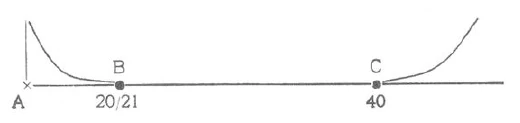
[ 6 ] We can see that if we designate this straight line B C as the path to Earth, it would be the spirits of form who would have destined human beings to descend only at this point (20/21 in the drawing). Here, then, human beings would have reached Earth for the first time, and they would ascend again after the fortieth year, spending the last third of their lives in a spiritualized state. The abnormal beings compelled humanity to descend already here (at A in the drawing) and begin life on Earth. This is the mystery of our existence. Thus we see that we are fully governed by the normal beings who actually direct us only during the middle third of our lives, while our periods of growth and decline are under the influence of entirely different beings who have, in some way, renounced their normal development. If all this had turned out as it did not, if human beings had spent the first and third thirds of their lives elevated in the orbit of the Earth and had touched the Earth only in the middle part—that is, had essentially become a completely different being—then human beings would not be bound to the Earth to the degree to which they are actually bound to it today. If that had occurred, then all human beings who set foot on Earth would be of the same form and nature; then all human beings who have walked the Earth would have been of the same form. There would be only one humanity. That which makes us into such beings that the specific characteristics of the races, which find expression in humanity, arise from it—this is not contained in the middle third of life. Through everything that lies in the time before, what takes place in the first third of life, we are bound to the Earth with all our powers more than the normal spirits of form have intended for us. As a result, however, the human being has become more dependent on the Earth on which he lives than he otherwise would have been. He has become dependent on the place on Earth where he lives. Because the human being—so to speak, against the intentions of the spirits of form—descends to Earth earlier, he becomes dependent on the place, because he connects with the Earth in a state that is not at all intended for him. The human being would have become independent of whether he had set foot on Earth in the north or south, in the east or west, if only he had set foot on it in the middle third of his life. But because he becomes dependent on the Earth, because he goes through a youth in the manner we have described, he becomes earthbound; he becomes a being connected to and belonging to the region where he was born. Consequently, they become dependent on all the earthly conditions associated with that place—on the incidence of the sun’s rays, on whether the region lies near the equator in the tropical zone or in a more temperate area, and on whether they are born in a low-lying area or on a high plateau. After all, one breathes quite differently on the plain than in the mountains. Human beings thus become entirely dependent on earthly conditions, on the place where they are born. Thus we see that human beings have literally grown together with their Earth Mother through the fact that they are so closely connected to the place, to the region of the Earth where they are born, and that they are shaped by the qualities they acquire as a result of these Earth forces—which are determined by the specific location—acting within them. All of this determines their racial character, and in this roundabout way, the abnormal spirits of form—those spirits of form or forces that, at a time other than between the twenty-first and forty-third years, give human beings what we call modern earthly consciousness—are the cause of human racial diversity across the entire Earth, which thus depends on the place on Earth where a person is born.
[ 7 ] During this period—which is, in essence, under the dominion of the abnormal spirits of form—human beings also acquire the ability to produce their own kind. This ability, too, is acquired during a time when human beings are not guided purely by the normal spirits of form. This makes it possible not only for human beings to become dependent on the place where they are born in the manner described, but also for the characteristics they acquire in this way to be passed on to their descendants; in other words, racial affiliation is expressed not only in the influences of the place of residence, but also in what is inherited through the race. Herein lies the explanation for why race is that which is hereditary, and we will understand what spiritual science reveals: that only in the past were racial characteristics brought about by the place where people were born. This was the case in the late Lemurian and early Atlantean periods, when human beings were directly dependent on their earthly environment. In later times, the race begins to take on the character of being bound to heredity and no longer to the place. Thus we see in the race something that was originally bound to a specific place on Earth and that then propagated itself within humanity through heredity, but became increasingly independent of the place. From what I have just said, you will recognize in which period of evolution it first makes sense to speak of the concept of race. It makes no sense—in the true sense of the word—to speak of a concept of race before the Lemurian period, for it is only in this period that humanity first descends to Earth. Before that, they were in the vicinity of the Earth; then they came to Earth, and the racial characteristics were inherited during the Atlantean period and right up into our post-Atlantean epoch. We will see how, in our time, national characteristics are what are beginning to separate the racial traits again, what is beginning to erase them. We will see all of this later. We must now only guard against viewing the world as if evolution were merely a wheel rolling endlessly around itself; the image of the rolling wheel, which is so extensively expounded in many mystical worldviews, brings terrible confusion to the concept of actual human evolution. If one imagines the process as everything moving, so to speak, around a permanent center, divided into so many races, then one actually has no concept of the fact that everything is in a state of development, and that the races, too, are developing. The races have arisen and will one day pass away; they will no longer be there. They do not repeat themselves in exactly the same way, as is incorrectly portrayed by Sinnett in *Esoteric Buddhism*. In the ancient Lemurian era, we must look for the emergence of racial characteristics and traits; we must then trace their propagation up to our own time, but we must be clear that when our present fifth epoch of evolution is succeeded by the sixth and seventh, there can be no longer any question of a state that we can describe as a race. But if we imagine this development as if it were simply rolling on uniformly, then we have nothing more than a kind of millwheel in our heads, and are far removed from an understanding of what is really taking place in the world.
[ 8 ] We can see, then, that racial evolution first begins in the Lemurian epoch through the influence of the abnormal spirits of form. There, these spirits allow the forces of our Earth to intervene at the place where human beings are to spend their first lifetime, and this is in a certain way carried over into later life as well, because human beings have a memory through which they recall the time actually spent abnormally on Earth before the age of twenty-one, even in later life. Human beings would be entirely different beings if only the normal spirits of form were at work. Through the abnormal spirits of form, human beings are dependent on the point on Earth where they live. The deviation from the laws of the normal spirits of form arose in the manner just described, so that the point on Earth where a human being lives in a particular incarnation became significant.
[ 9 ] We will gain a more precise understanding of these conditions through the following consideration. Here we can, in a certain sense, describe how the subsoil, the earth’s foundation, radiates its essence upward and permeates the human organism, so that human beings become dependent on this earth’s subsoil. In this regard, we can thus identify specific points on the earth that are historically linked to the development of the human being. We will examine these relationships in greater detail. For now, I wish to characterize them in the abstract.
[ 10 ] For example (see figure), there is a point located in the heart of Africa. At this point, all the forces that can affect human beings—particularly during early childhood—seem to radiate out from the Earth. Later, the influence of such forces on a person diminishes; they are then less exposed to these forces, but they still leave a profound imprint on the person through what emanates from them. Thus, the point on Earth where a person lives exerts its strongest influence during early childhood and thereby shapes those people who are entirely dependent on these forces throughout their entire lives, so that this point permanently imprints the characteristics of early childhood upon them. This is, roughly speaking, a characteristic of all those people—in terms of their racial character—who, so to speak, receive the determining forces from the earth around this point on the earth. What we call the black race is essentially determined by these characteristics.
[ 11 ] If you now move further toward Asia, you will find a point on the Earth’s surface where the characteristics of later youth are permanently imprinted on human beings by the forces of the Earth, where the specific qualities of the later youth are transmitted to human beings from the essence of the Earth and give them their racial character. The races under consideration here are the yellow and brown races of our time.

[ 12 ] If we then continue from east to west, we find a point that lies between Asia and Europe and that permanently imprints upon human beings the latest characteristics—those characteristics that come to them precisely in the later stage of life following early youth—the point where human beings are not already seized by the forces of the earth in childhood, but rather when youth transitions into later life. In this way, human beings are taken hold of by the forces that determine their lives from the Earth, so that when we consider these individual points, we obtain a line that runs in a remarkable way. This line also holds true for our time. The African point corresponds to those forces of the Earth that imprint the first childhood characteristics on the human being; the Asian point to those that give the human being the characteristics of youth; and the most mature characteristics are imprinted on the human being by the corresponding point in the European region. This is simply a law of nature. Since all human beings pass through the various races in different reincarnations, there is no actual disadvantage, even though one might object that Europeans have an advantage over the Black and Yellow races. Here the truth is sometimes veiled, but you see, with the help of esoteric science one does arrive at remarkable insights.
[ 13 ] If we then extend this line further, we move westward toward the American regions, into those areas where the forces that lie beyond the middle third of life are at work. And there we arrive—please do not misunderstand what I have just said; it applies only to the human being insofar as he is dependent on the physical-organizational forces, on the forces that do not constitute his essence as a human being, but in which he lives—there we come to the forces that have a great deal to do with the dying of the human being, with that part of the human being that belongs to the final third of life. This law-governed line certainly exists; it is a truth, a real curve, and expresses the lawfulness in the way our Earth acts upon human beings. This is the course taken by the forces that act upon human beings in a race-determining way. It is not because the Europeans pleased themselves that the Native American population died out, but because the Native American population had to acquire the forces that led to their extinction. What takes place on the surface of our Earth with regard to the races—what is brought about by forces not under the influence of the normal spirits of form—depends on the peculiarity of this line. Where racial characters come into play, they operate in this manner. In our time, however, the racial character is gradually being overcome.
[ 14 ] This pattern was already clearly established in the very earliest period of Earth’s history. If we were to go back to the ancient Lemurian era, we would find the very first starting points of racial development in the regions of present-day Africa and Asia. Later, we see a migration of humanity toward the west, and as the forces determining the races move westward, we can observe their decline among the Native Americans. Humanity had to go west in order to die out as a race. To revitalize humanity with new youthful energy, the movement toward the east takes place—the movement that travels from Atlantis across Europe to Asia. Then a repetition of the movement toward the West occurs. However, what is now repeating is not the movement of the races, but, as it were, a higher stage of racial development: the development of cultures. In a certain sense, one can see that the development of cultures takes on a character that lies in the sense of a continuation of the racial line. Thus, for example, we have the culture—which we have already characterized in this discussion with sufficient admiration—the ancient Indian culture, which appeared as the first post-Atlantean culture; we can describe it as the epoch corresponding to early childhood, where humanity is still asleep in regard to the appreciation of physical nature, and the revelations of a spiritual world are working into the soul. Indeed, the first, Indian culture is a revelation from above, a revelation from spiritual heights, and it could only work its way into human beings because they came under the influence of the Indian earth, under which they had already stood in times long past. Back then, in the distant past, the physical racial character was determined by the earth; now, with repeated presence in the same earthly location, it was more a disposition of the soul that determined that of the ancient Indian people. Through the movement from west to east, such a youthful freshness arose that this process allowed the distinctive spiritual configuration to emerge which characterizes the original Indian culture. You will see that a very ancient Indian culture, which has not yet been researched and of which what science today calls Indian culture is but a descendant, finds its explanation in this way, namely in that the Atlantean culture is repeated in a certain respect in the ancient Indian culture.
[ 15 ] If we now consider the cultures that have succeeded one another in the post-Atlantean era, we can see that they represent the successive repetition of conditions previously experienced in the physical body, but which have become entirely different through rejuvenation. Thus, in Persian culture, we see one that is in a certain way connected with what we might call a struggle between the human being who lives primarily in the first human life force—where he is still subject to the influences of the abnormal spirits of form—and the forces that originate from the normal spirits of form. This contrast is contained in Persian culture in the consciousness and in the form of light and darkness, of Ormuzd and Ahriman.
[ 16 ] The further west we travel, the more we see the characteristics of a more mature stage of civilization taking shape. Although we must admit that, up to the present day, human creations are still to a greater degree dependent on the abnormal forces and entities of the universe, we will nevertheless find it understandable when it is said that people no longer go westward relying exclusively on racial characteristics. We can also understand that, in a certain sense, the course of culture is such that the full youthful vigor of culture—its productive element—fades more and more the further west it goes.
[ 17 ] Anyone who looks at things objectively can see from many circumstances that our contemporary culture, too, is governed by this law. But people are not inclined to view things objectively. If, however, you consider the facts—that all culture is indeed in a state of flux—you will see that the further west we go, the less productive the culture becomes. As a culture, it is thus approaching extinction. The further west one goes, the more only the outer aspects of culture will flourish—those that do not experience renewal through youthful vitality, but instead, in a certain sense, play out their lives into senility. Therefore, people in the West will still be able to achieve great and mighty things for humanity in terms of physical, chemical, and astronomical discoveries—for everything that is independent of the refreshing vitality of youth. But that which requires productive power indeed needs a different configuration of the forces acting upon human beings.
[ 18 ] Let us assume that a person grows from childhood to a certain stage; it is only then that their spiritual nature truly begins to blossom. At first, a person is a physically growing being. What is crammed into a small space within a little child must first expand physically. Then the development of the human being is compressed inward. — But this is also true of humanity on a grand scale. We see a peculiar law at work when we trace the characteristic curve. We even find it expressed in the continents. We see that there is first a kind of original starting point of physical human development in Africa, that then the space in which humanity develops expands into the vastness. We find this then in the vast expanses of Asian civilization. There, humanity inhabits large, mighty expanses.
[ 19 ] Let us now turn our attention to the recurrence of racial formation in post-Atlantean cultures. Just as a young person gazes curiously at their surroundings, so too does the human being of ancient Indian culture look out upon the world. This is closely connected to the fresh, youthful forces that expand the human being and organize their growth into the vastness of the world. Then the spiritual must begin, and the physical must contract; here we see that, as culture progresses in Europe, the space over which this humanity is spread is, in a remarkable way, compressed into smaller dimensions. We see that Europe is the smallest continent, and the further humanity advances westward, the more it strives toward a contraction. It reaches out into the sea in peninsulas and constricts itself ever more toward the west.
[ 20 ] All of this is connected to the spiritual course of development. Here you are gaining a unique insight into the mysteries of spiritual development. But the shift toward the West brings with it a crisis. There is a crisis through which a more unproductive element begins to take effect. Productivity is, in a certain sense, dying out in the peninsular regions to the west. This unproductivity is evident in what was described earlier, namely that, so to speak, even culture itself, the further west it goes, takes on a rigid, senile element that is heading toward decay. This is something that has always been known in the secret schools. You will now understand why I said that what I am about to share could be somewhat dangerous, because people might be outraged. And by no means can everything be said that served to make human beings independent in regard to the higher realms of their being, so that they may perceive what rises from the earth to determine the race, what later determines the character of culture, and what will again become insignificant in even later times, when human beings return to the spiritual. You will therefore understand that this entire course of human development is connected to the course of spiritual development, which has always been known to those who were more deeply initiated into the mysteries of existence. The truth of what has been said does not depend on whether one is more enthusiastic about one aspect or less about another; it depends on the necessity of development. Anyone who were to speak against necessity would achieve nothing. To speak against it is to place obstacles in its path. It is therefore only natural that, in a certain sense, people moving into the region further to the west must once again seek renewal from the east, must receive an impulse from the east, while the Central European region must reflect on its own productivity as it existed before the formation of the peninsula. That is the reason why in Europe—I mean within the region that encompasses our common territory: Scandinavia and Germany—people must reflect on their own spiritual nature, and why, in contrast, it is precisely in the West that one must seek out that part of humanity that is to receive something transmitted from the East. This is deeply conditioned by the overall character of humanity on Earth. You see that even in theosophical development this is still repeating itself. We also encounter this in the fourth post-Atlantean culture in Roman and Greek civilization. It is a fact that the Romans are in a certain respect more advanced than the Greeks, but that they derive their spiritual life from the people they conquered, who live further east.
[ 21 ] The law that is becoming evident here will prove itself more and more true the further west the regions lie. These great truths can, in essence, only be hinted at. They provide us with what corresponds to the inner character of our mission for every part of the Earth’s surface. You see that we must understand what we must do in order to rise to the common character of humanity. Therein lies the great responsibility one bears when one wishes to intervene in the great movement of humanity. Where the great movement of humanity is concerned, no personal sympathy or personal enthusiasm may play a role. For that is not what matters, but rather what is determined by the great laws of humanity. One must recognize this from the great laws and not allow oneself to be influenced by a bias toward this or that. Such, in essence, is the character of the entire Rosicrucian movement. Rosicrucianism is to work in the interest of the development of all humanity. When one recognizes the ground on which one stands, all the way back to the formation of islands and peninsulas, then one will feel the emotion that must overcome one when one wishes to work in the interest of humanity’s development.
[ 22 ] Once upon a time, human beings were brought down to Earth by the abnormal spirits of form, bound to various points on the Earth’s surface; this laid the foundation for racial development. But then we see the races mixing more and more. We see the development of peoples intervening in racial development—that is, rising up from it. We see it intervening even in the development of the individual human being. A great mystery is expressed when one asks, for example: Who was Plato in terms of his outer being, in terms of his birth into humanity? He was a human being who had grown into the Solonid lineage, belonged to the Ionian tribe, the Greek people, and the entire Caucasian race. — The realization that Plato was a Solonid, an Ionian, a Greek, a Caucasian—when one penetrates its underlying law—expresses a profound mystery. It reveals the mystery that shows us how, on the broad foundation of the entire Earth, the normal and abnormal spirits of form interact—spirits that actually have the greatest interest in making human beings into Earth-dwellers. It reveals how, through this interaction, humanity becomes specified, and how the other beings then intervene—beings we have already discussed in characterizing the individual peoples. Every human being, through their being, is involved in the processes through which all the higher beings, these higher spirits, jointly shape the development of the world.
[ 23 ] One cannot understand an individual person unless one sees how he or she has come to be in his or her overall development through the interaction of these entities. It was through the mysterious interaction on our Earth of the spirits of form that have undergone normal development and those that have undergone abnormal development—an interaction that once created the Caucasian race—that the very foundation was laid for a Plato to come into being at all. By seeing the abnormal and normal archangels, down to the angels, intervening, we see the path that was necessary to bring forth a Plato who could appear before us as a human being, with a human face, possessing very specific qualities of intellect, feeling, and will. Between the race and the individual lies the national character, situated right in the middle.
[ 24 ] That is why we had to characterize the fundamental conditions of the race in general today. Tomorrow we will consider the emergence of national character from the races, the intervention of other spirits of the hierarchies, and in particular their intervention in the work of the spirits of form.