

The Mission of Individual Folk-Souls
in their Connection with Germanic-Norse Mythology
GA 121
9 June 1910, Oslo
Translated by Steiner Online Library
Third Lecture
[ 1 ] Throughout this series of lectures, we will offer reflections that will, so to speak, easily touch everyone’s heart, because each person will be able to take a direct and intense interest in them. However, since the whole would otherwise remain incomprehensible, we must also engage in reflections that are necessary for the sake of completeness and understanding, and which will be somewhat more difficult than what constitutes, so to speak, the main body of our lectures. For example, today we will be compelled to take a look into the inner nature of those entities we spoke of in the two previous reflections—into the inner nature of the normal national spirits.
[ 2 ] We have already stated what is necessary regarding their external characteristics: that they are beings two levels higher than human beings, beings who are working on the transformation of their etheric bodies—that is, who are currently in the process of transforming their etheric bodies into what is called the life spirit or buddhi. Human beings are woven into this work. To the extent that the development of these beings progresses in such a way that human beings are woven into this development, the reflection of this national spirit manifests itself in the human individuality itself as the national character of the individual human being.
[ 3 ] Now we will have the opportunity to look into the inner workings of such a national soul. If we wish to shed light on the inner life of modern human beings, we must conceive of this inner life as threefold, dividing it into:
the sensory soul, so to speak the lowest link in the human inner being,
the intellectual or emotional soul, the middle link, and
the conscious soul, the highest link of the human inner being, where the human ego is truly brought to consciousness.
[ 4 ] It is really only in the conscious soul that what is called human self-consciousness is truly present. Nevertheless, the human ego is active in all three parts of the inner life—in the sensory soul, the intellectual or emotional soul, and the conscious soul.
[ 5 ] In the sensory soul, this “I” is at work in such a way that the human being is barely aware of its existence. In this respect, the human being is completely given over to all drives and passions in the sensory soul. The “I” lies dormant within what we call the sensory soul. The ego only then works its way out, only comes to the fore in the intellectual or emotional soul, and becomes fully clear only in the conscious soul. If we wish to examine these three members of the human inner being separately, we must regard them as three modifications, as three parts within the astral body. It is true, however, that these three modifications, these three members of the astral body, work to transform the astral body itself, the etheric body, and the physical body. But these transformations are not what confronts us as the actual human inner being, as the soul. The soul, the inner being of the human being, consists of three modifications of the astral body. These three modifications must make use of certain instruments, and these manifest themselves in such a way that in the astral body the sensory soul has a kind of instrument, in the etheric body the intellectual or emotional soul, and in the physical body the conscious soul. Thus we can distinguish the human inner being from what constitutes the human outer nature. The human inner nature, therefore, consists of three modifications of the astral body.
[ 6 ] Just as in human beings the inner self—that in which the “I” works and expresses itself—manifests itself in these three modifications of the astral body, so too in those spiritual beings we call national spirits, the actual inner self—or that which we can compare to the human inner self—manifests itself in three members, three modifications of the etheric body. Just as we distinguish between the feeling soul, the intellectual soul, and the conscious soul in human beings, so too must we distinguish three modifications in the etheric body of the archangelic beings, the normal national spirits. But because these three modifications are not in the astral body but in the etheric body, they are quite, quite different—fundamentally different—from the three modifications in the soul life of human beings. Therefore, you must also conceive of the form of consciousness, the entire soul life of these national spirits, differently from the soul life of human beings. We are thus, as it were, moving from an external characteristic into the inner life of the soul of these folk spirits. This will not be entirely easy, but we must try to cross this Rubicon. The task now will be to start from some concept that may be familiar to you, a concept that offers, so to speak, something similar to the inner life of the folk spirits. People do not have many such things in their normal lives; on the contrary, they have extraordinarily little in their own consciousness of what lives in the consciousness of folk spirits. But you can still form an idea of it if you patiently engage in the following reflection with me.
[ 7 ] You all learned in school that the three angles of a triangle add up to 180°, and you know that you could never learn this through any external experience. Imagine, for my sake, iron or wooden triangles. If you now measure the sum of the three angles with a protractor, this external experience will never be able to teach you that these three angles add up to 180°. But you will be immediately convinced—whether you draw these three angles or merely imagine them—when you experience from within that the three angles total 180°. You must experience this from within through the power of your own soul. To do so, you need only carry out the following in your mind. What I am now drawing is done only to illustrate the idea.
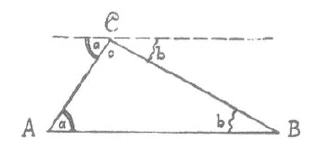
[ 8 ] In this figure, you have clear proof that the three angles add up to 180°. If you allow this figure to truly sink into your mind, it will give you this certainty in every situation. You can construct this figure in your mind without drawing it down on paper. You are then performing a purely mental operation through the power of your own inner self; you do not need to step outside yourself at all. You can imagine for a moment that what is called the sensory world—and what enters a person through the external senses—does not exist at all. So if you were to completely remove the external world from your mind—constructing space in thought—then in this space all triangles would have a sum of angles equal to 180°. To arrive at a geometric-mathematical insight, there is no need for an external object to approach your senses; all that is required is inner experience, that which takes place within consciousness itself.
[ 9 ] I had to use this example because it is the simplest and most practical one; people already know it since they learned it in school. I could also give you the example of Hegelian logic, in which case you would also have a set of internal concepts, but we would find much that is unfamiliar in it, since Hegelian logic is unknown to the vast majority of people. From this you can see, then, how a person can arrive at insights solely from within, without being stimulated to do so by anything external.
[ 10 ] If you imagine what is accessible in the external world only in a mathematically constructive way, then you have grasped a part of how the consciousness of the archangels works. For they do not perceive the world as it presents itself to the outer human being—a world of external colors and sounds. Such a being never has these sensations; it never has the possibility of approaching anything with its sense of touch and thereby receiving perceptions. Such a being never has these experiences. But it does have the experience that can be expressed in words: Now something is coming to me from a world that inspires me; this world has passed through my consciousness and fills my consciousness. Now, the archangels are not beings who merely conceive in mathematical terms; rather, human beings are so imperfect that they can only imagine the activity of the archangels in such abstractions as mathematical truths. They are what appears normal to both human beings and the national spirits. From this, however, you can infer that the outer physical world, which exists for human beings through the senses, has nothing to do with the archangels. In the form in which the physical world exists for human beings, in the way human beings receive the manifestations of the physical world through their senses—in this way, the world does not exist for the archangels. So if you exclude from your worldview what exists only as physical sensation, if you set aside everything you have taken in through external perceptions, then you are excluding from your worldview precisely that which is of no concern to the archangels. So we will ask ourselves: Well, what of that which can also become human consciousness is still present for the archangels? What of the same is present for the national spirits? Everything you experience in the feeling soul—what you experience as ordinary pleasure brought about by the external world, as ordinary suffering brought about by the external world—everything that consists of colors, sounds, and sensory perceptions of the external world in general—is of no concern to these beings. So set aside the entire content of the human sensory soul, and tell yourself: whatever is present in the world picture by virtue of the sensory soul being there for the human being is of no significance to the archangels; they do not intervene there. Even a part of the intellectual soul is not yet an element of significance to the archangels, insofar as it is stimulated by external sensations. What has been stimulated from without, what the human being processes with the intellect and experiences through the emotions—this, too, is of no concern to the archangels. But certain things do play a role in the human intellectual soul, which the human being experiences, so to speak, on the same plane as the archangels. We can perceive quite clearly that such things play a role in the human intellectual or emotional soul when we see, for example, how in our lives that which we call our moral ideals approaches us. There would be no moral ideals if we were limited to forming impressions only of that which evokes pleasure or pain, and to reflecting on what confronts us from the external world as sensory perception. We would indeed be able to take pleasure in the flowers of the field, and in a beautiful landscape, but we would never be able to be inspired in our hearts by an ideal that cannot shine toward us from the external world, that we cannot inscribe in our soul, and for which we can then be inspired. But we must not only be inspired and feel within the feeling soul; we must also think about it. A person who only feels, who does not think, may be a dreamer, but can never be a practical person. We must not take ideals into the feeling soul from the outside, but let them flow in from the spiritual world and process them in the intellectual or emotional soul. Artistic and architectural ideals, and so on, are present in the intellectual or emotional soul and in the conscious soul. They are connected to that which a person cannot perceive from the outside, but which nevertheless glows through and permeates their inner being, so that it constitutes a part of their life.
[ 11 ] Take a look at the lives of peoples from one era to the next—how they unfolded, and how ever-new ideas and mysteries of the world emerged within them. Where could the Greeks have gotten their ideas about Zeus and Athena if they had relied solely on external perception! What is contained in the wisdom, mythologies, religions, and sciences of the peoples arose from within. Thus we must see that half of our inner being—the half comprising our intellectual or emotional soul and our conscious soul—is filled from within, and to the very extent that a human being is inwardly permeated by what has just been described, to that extent can the archangels penetrate into the human inner being, and that is also the extent of the archangels’ actual life. You must therefore exclude from your inner life that which is taken in from the outside by the soul of feeling and processed by the soul of understanding or the emotional soul. But then you also have what we call the “I.” For us, the ego is the highest link in our being. What we bring into our moral consciousness are ideals—moral, aesthetic, and ideal thoughts. Just as the view is, so to speak, closed to the human being inwardly, yet can open outward to the external world through the senses, so he can say: I perceive colors, sounds, cold, and warmth. But they also have the awareness that behind these perceptions of colors, sounds, warmth, and cold there is something more essential. These are the beings of the animal, plant, and mineral kingdoms. That is what lies behind them; so that human beings can, in the manner indicated, continue to conceive of the world beyond. Beyond that, however, the view is closed to the ordinary person. If that were not the case, there could be no materialism at all. If human beings had a clear view of the realm that extends upward from the intellectual soul and the conscious soul, then it would be just as foolish to doubt the spiritual world as it would be foolish today to doubt the existence of the animal, plant, and mineral worlds.
[ 12 ] Now consider how the “I” in human beings—the highest link in the human soul—encompasses within itself the soul of sensation, the soul of understanding, and the soul of consciousness. In the case of the archangel, his soul life begins with his experiences in the soul of understanding or the emotional soul, then ascends into the “I,” which, however, extends into a world of higher realms, into a realm of spiritual realities, in which it lives just as the human being lives in the realm of animals, plants, and minerals. So that we can say: We must indeed recognize that this archangelic being can possess in its soul life what we call the human ego; however, we cannot say that the archangel’s ego is of the same kind as this ego. The archangel’s ego is therefore not identical with the human ego. The archangel’s ego lies precisely two levels higher, so that the archangel is rooted with its ego in a higher world. Just as the human being, through his or her sensory perception, looks at colors and hears sounds, so the archangel looks down upon the world that the ego encompasses as objective truth, only that something else is grouped around this ego from that part of the astral realm which we humans know within ourselves as the intellectual or emotional soul. Imagine these beings looking into a world that does not extend to the mineral, plant, and animal realms. Imagine that their gaze—which is a spiritual one—is directed toward their world picture, and that they perceive centers there. These centers are the human I’s, around which something else is grouped that looks like a kind of aura. There you have the image of how the archangelic being looks down upon the national personalities that belong to the archangel, that make up the people. Its world consists of an astral field of perception in which certain centers are located. These centers, these focal points, are the individual human personalities; they are the individual human I’s. Just as colors and tones, warmth and cold lie within our field of perception and constitute the meaningful world for us, so for the archangelic beings, for the national spirits, we ourselves—with a part of our inner life—constitute the field of perception, and just as we enter the outer world and work on it and transform it into instruments, so are we those objects—insofar as we belong to this or that national spirit—that belong to the field of activity of the archangels or national spirits.
[ 13 ] There, strange as it may sound, we gain insight into a higher epistemology of the archangels. This is, in fact, quite different from the epistemology of human beings, for even what is given to the archangels is entirely different. For human beings, the given is what is spread out in space, what confronts us through the senses as color, sound, warmth, cold, hardness, and softness. For the archangels, the given is what appears within the field of human consciousness. For them, this is a sum of centers, of focal points, around which the inner experiences of human beings are woven, insofar as these experiences take place in the intellectual or emotional soul; their activity, however, is of a higher order in this case.
[ 14 ] How does the worldview of the archangels or folk spirits become more specialized? For human beings, the worldview becomes more specialized in that when they grasp an object with their hand, they perceive it as warm or cold. The archangel experiences something similar when encountering human individuals. There he meets people who are more animated by inner activity, who possess a richer inner life; these make a more intense impression on him. Others he finds casual, lethargic, with a poor inner life; these are the beings who appear to him as warmth and cold do in the worldview of the human soul. This is how the archangel’s worldview becomes specialized, and depending on this, he can make use of individual human beings, work for them, by weaving that which, from his very being, is meant to guide the entire people.
[ 15 ] But in other respects as well, the life of this archangel is connected in a certain way to the life of the people he presides over. Just as human beings experience periods of ascent and descent in life—a time of ascent in youth and a time of descent in old age—so too does the archangel experience his youth and old age within the ascending and descending culture of a people.
[ 16 ] Now we must once again look into the inner life of such an archangel. You have probably already noticed from what I have said that what the human being receives from the outside, the archangel receives from within; in return, when the national individualities appear as centers within him, the archangel has the sensation that what approaches him does indeed arise from within his consciousness, but is nevertheless, so to speak, something foreign to him. It is something that arises in him much like the flashes of thought in our own consciousness. In a reverse way, this also approaches him, just as youth and old age approach a human being. In a human being, youth is experienced in such a way that he feels fresh in his limbs, that they are in the process of striving upward, of developing. In old age, these limbs become, so to speak, limp and fail to perform their service. This is something that a human being feels coming from within himself. The Archangel, however, feels everything as coming from within himself; yet the rise and fall of a people appears to him as something foreign, as something he feels is independent of him—something with which he therefore has no direct connection, but which nevertheless prompts him to incarnate in a particular people at a specific time. When the opportunity arises to incarnate, when a people exists that is living in the ascending phase of its life, in the full vigor of its ascent, then the archangel descends, just as a human being descends after having lived through the period between death and a new birth. Thus the archangel likewise descends into a people and incarnates within it. Likewise, the archangel feels his death, the necessity of withdrawing from the people in question, when the individual perceptions, the centers he perceives, begin to be less productive, less active, when they begin to have less content. Then comes the time when he leaves such a national community; he then enters his Devachan, his life between death and new birth, to seek out a national community in a different way at a later opportunity. Thus the youthfully ascending life of a people signifies the youth of the national spirit, and he perceives it as a fresh, flowing element in which he lives. It perceives the descending period of national life as a drying up of the centers within its sphere of perception. — This, then, should serve as a kind of insight into the inner life of such a national soul.
[ 17 ] If we bear in mind what has just been said, we can say that, in a certain sense, such a national soul is actually quite distant from the life of the individual human being; for within the individual, that which resides in the soul of feeling and in the lower part of the soul of understanding constitutes a realm into which the national spirit, the archangel, does not reach. For the human being, however, it is something very real. Here the human being feels quite strongly that this is connected to the innermost, most intimate part of his own life. In a certain sense, the Archangelic nature, the guiding national nature, is something that hovers above the individual human being. The Archangel who guides the people stands aloof from the personal experiences that human beings have through their sensory perceptions. — But there are mediators, and it is important that we understand that such mediators exist. These are the beings we call angels, who stand between the Archangel and human beings. Take this in the strictest sense of the word: national spirits are archangels, spirits who have completed the transformation of their astral body into the spiritual self or Manas, and are now transforming their life body into Buddhi. In the midst of these beings and humanity stand the angelic beings. These are beings who are engaged in transforming their astral bodies into Manas or the spiritual self, but have not yet completed this work. Human beings are at the beginning of this work in the present age; the angelic beings are nearing the end of it, but are by no means finished with it. Therefore, the realms of these beings are much more intimately connected with those in which human beings stand and live. We can say that the angelic beings, with their entire soul-nature, are inclined toward what we call the astral body. That is why they have full understanding for everything that the human personality can experience through suffering and joy. But because, on the other hand, they tower far above the human ego, because they have a higher ego, because they can take in a part of the higher world, their world of consciousness extends into those realms where the world of consciousness of the archangels is located. They are thus truly the mediators between the archangels and the individual human soul. They, in turn, receive the commands of the national spirits and carry them into the individual souls, and through this mediation arises what the individual can accomplish, not merely for his own progress and development, but for his entire people.
[ 18 ] Human beings experience these two currents side by side. One current is the one that carries them forward from incarnation to incarnation; it concerns their own affairs, which they must attend to above all else in order to fulfill the duty that is, after all, the most demanding of all, for it is their very own duty. They must not stand still, for otherwise they would leave the seeds inherent within them fallow if they did not tend to them. But this is his very own business, through which he progresses from incarnation to incarnation. What he contributes to his national community, however—what pertains to the affairs of his immediate national community—constitutes the inspiration of the angel who conveys the archangel’s commands to individual human beings. We can therefore quite well imagine that we have a people in a certain region of the earth, and spread over this people is the national aura, the etheric aura, and here again the forces of the national spirit come into play and modify the human etheric body according to the three kinds of forces. That which plays a role in this national aura is the archangel. We conceive of him as a higher being, as a being who stands two steps higher in evolution than the human being, who hovers over the entire people and issues directives regarding what this people must accomplish on a grand scale. The archangel knows what must be done during the people’s ascent, during their youthful vigor; he knows how the people’s transition from youth to old age must be utilized so that their impulses may work correctly.
[ 19 ] The Archangel shapes these broad outlines. Here on this physical plane, however, the individual human being must do the work; here, the human being must ensure that these great goals are realized. Between the individual human being and the Archangel stand the angels as mediating beings, who then urge the human being toward the place where he must be urged, so that what corresponds to the Archangel’s great arrangements may take place in the collective consciousness. We form a true picture of the matter when we imagine what I have described not merely as an allegory, but as reality as far as possible.
[ 20 ] Now, within the entire fabric woven by the archangel, there are at work those we have called the abnormal archangels—the spirits of language—in the sense I described yesterday. But we have also described how the abnormal spirits of the personality, the Archai, exert their influence. Here we can now look toward the realm where the archangel issues his commands, where he assigns the missions that are carried further into individual human beings by the angels. But the archangel can also work into the realm of the abnormal spirits of personality, and in the mutual interaction between the archangel and the abnormal spirits of personality—because they pursue entirely different goals than the archangels—the archangel’s actions can, in a certain sense, be thwarted. When this happens, when these abnormal spirits of the personality thwart the Archangel’s measures, then we may observe that groups with specific tasks form within a people itself. Through the formation of such groups with specific tasks within a people, the activity of the spirits of the personality becomes outwardly visible. This can continue for many centuries. For example, precisely in the region where we are now called upon to work in the field of spiritual science—in Germany—you have witnessed this interplay of the Archangel of the Germans with the sometimes resistant individual spirits of personality over the course of centuries. In the fragmentation of the unified German nation into smaller ethnic groups, you have seen an interplay between the abnormal spirits of personality and the Archangel.
[ 21 ] Such peoples are not very centralized; they place greater emphasis on the development of individuality. In a certain sense, this has its advantages, because it allows for great diversity and the expression of many nuances of folk culture.
[ 22 ] But you can also consider the opposite scenario, in which it is not the abnormal spirit of the personality, but rather the normal spirit of the personality—as expressed in the zeitgeist—that, at a given moment, becomes, so to speak, more important than it otherwise is in the ordinary course of events.
[ 23 ] So when we look at a people, we look to the archangel as its primary power. Then the spirit of the age intervenes, giving its commands to the archangel, who in turn passes them on to the angels, and they convey them to the individual human being. Since one usually sees only what is closest to oneself, one regards the work of the archangels as the most important aspect of this composite process. But it can also happen that the Zeitgeist must issue more serious, weightier commands, that it is, so to speak, compelled to take something away from the archangel, because it must separate out a part of the people so that what is the task of the time, the mission of the Zeitgeist, can be fulfilled. In such a case, ethnic communities then split off from others. Here the Zeitgeist visibly gains the upper hand over the work of the archangel. Such a case occurred when the Dutch people split off from the foundation they shared with the German people. Holland and Germany originally had a common Archangel, and the split occurred because the Zeitgeist, at a certain moment, set aside a part and then entrusted to that part what has become the important concerns of the modern Zeitgeist. Everything you can read in Dutch history—though history is merely an outer expression, a Maya, of what is an inner process—is merely a reflection of this inner process. Thus, in this case, we see the outward unfolding of the separation of the Dutch people from the common German peoplehood. The inner core, however, is that the Zeitgeist needed a tool to carry out what was the Zeitgeist’s overseas mission. The entire mission of the Dutch people has been a mission of the Zeitgeist. And for that purpose, they were split off to enable the Zeitgeist to carry out something important with this part at a specific time. What historians describe is merely external Maya, which conceals the true facts more than it reveals them.
[ 24 ] Nowhere else will you encounter what has strikingly occurred in this regard, namely, that a part of a people had to secede from the common body of the nation. This is the case with the Portuguese people. You will search in vain for any other reason for this than that it is simply a victory of the spirit of the times over the archangel. If you go through the individual events, you will find that the opportunity was seized here to form a distinct national identity—there were not many such opportunities. The Spanish people formed a parent nation together with the Portuguese. The external reasons are perhaps that the rivers are only navigable as far as the Portuguese border. There are no other external reasons. In contrast, there is the internal reason that the tasks had to be fulfilled—tasks that were specifically the tasks of the Portuguese and were different from the tasks of the common Spanish people. Here we see the spirits of the age developing, for a time, a more intense activity than they usually carry out. We see the previous harmony replaced by another. We see the Zeitgeist, instead of issuing its commands to the Archangel, intervening directly in the history of the people, and we see how the other spirits use this opportunity to incarnate. When such a folk is split off, the Zeitgeist, for a time, in the initial enthusiasm that has permeated the individual human beings, performs the functions of the Archangel to such an extent that the split exists hardly as anything other than a rushing and pressing within this people. One sees the haste and the urging, the liveliness that comes from the mission of the Zeitgeist. But then the possibility arises that a normal and an abnormal archangel will incarnate in the split-off part of the people. Thus we see the growth of the Dutch and Portuguese peoples, who then receive their own normal and their own abnormal archangels. In what is embodied therein, in the diversity of the people’s temperament as expressed in the individual personalities, we see the interplay of what we have called these spiritual beings. In a most remarkable way, we see the interplay of these spiritual beings, and we then recognize that the history unfolding externally is merely a result of their activity.
[ 25 ] Little by little, the statement that the external world is maya, or illusion, takes on an increasingly concrete meaning. What happens in external history is merely the outward reflection of spiritual, supersensory beings, just as the outer human being is merely the outward reflection of the inner human being. That is why I had to say—and this must be emphasized again and again—that the statement “The world is Maya” is of the utmost importance. However, it is not enough to emphasize it in the abstract; rather, one must be able to apply it in detail.
[ 26 ] But we have now seen that other spirits and hierarchies are also at work in what we call the world. We have spoken of the normal and abnormal archangels. The abnormal archangels have now revealed themselves to us as true spirits of form or powers that have merely renounced a certain aspect of their development. We may then ask: But what about the normal spirits of form? We regard the normal spirits of form as standing four degrees higher than human beings. — We will have more to say about these normal spirits of form in our next meditation. — These are, then, beings that are four degrees higher than human beings. But what we referred to yesterday as hierarchies is not limited to what we have concluded by calling spirits of form. Higher than these stand the spirits of movement, the dynameis, the powers; even higher are the beings we call kyriotetes, lordships, or spirits of wisdom. You will find these various spiritual beings described both in my *Secret Science* and in my work on the *Akashic Records*.
[ 27 ] Now you will be able to understand that the law of renunciation, of remaining behind, also applies to the higher spirits; that is, even the spirits of movement can remain behind with certain qualities—spirits of movement that are five levels higher than human beings—and that certain spirits of movement are currently contained within human development as if they were first and foremost spirits of form, forces. In terms of certain qualities, these are actually spirits of motion, and in terms of other qualities—those to which they have renounced—they are spirits of form. So we have normal spirits of form that stand four levels higher than human beings, and other spirits that operate on the same plane as the spirits of form, but who are actually spirits of motion. This is therefore a realm in which—just as we have found a realm where normal and abnormal archangels interact—the normal and abnormal spirits of form, the spirits of movement that have remained behind, interact. Through this interaction, however, something occurs that very much concerns human beings; through it comes about the formation of what we call the human races, which we must distinguish from the peoples.
[ 28 ] When we look at the matter this way, we do not end up with a confusing concept, but rather a clear one; we must not lump everything together. A people is not a race. The concept of a people has nothing to do with the concept of a race. A race can be divided into a wide variety of peoples. Races are different communities than ethnic communities. We certainly speak rightly of a German, a Dutch, or a Norwegian people; but we speak of a Germanic race. What, then, is at work in the concept of race? At work there are those entities we call the normal spirits of form or forces, and those entities we have come to know as the abnormal spirits of form—which are actually spirits of movement with missions of the spirits of form. That is why human beings are divided into races. That which makes people the same across the entire globe, that which makes every human being, regardless of which race they belong to, a human being, a member of the whole of humanity—that is brought about by the normal spirits of form. But that which plays out across the entire Earth, that which divides all of humanity into races, is brought about by the abnormal spirits of form, who have relinquished their role in favor of the fact that not a single humanity appears on Earth, but rather a multitude of people.
[ 29 ] In this way, we gain, so to speak, the foundation, the ground from which the individual national identities first emerge. Through this, we gain a view of the entire Earth, find that the Earth is destined to bear humanity through the normal spirits of form, and find that the spirits of movement that have lagged behind enter this realm of the spirits of form and, as abnormal spirits of form, divide humanity across the entire globe into the individual races. When we look into what these spirits actually want, when we delve into the goals and tasks of these normal and abnormal spirits of form, then we will understand what they intend with the human races, how through them a foundation is created for what emerges from them. When we then consider a people on its own, we will have grasped and understood that people.