

The Mission of Individual Folk-Souls
in their Connection with Germanic-Norse Mythology
GA 121
15 June 1910, Oslo
Translated by Steiner Online Library
Ninth Lecture
[ 1 ] If there are listeners among you who wish to analyze yesterday’s lecture philosophically, you might encounter difficulties—or what appear to be difficulties—for the reason that you have heard from earlier lectures on similar topics that our entire post-Atlantean period, and indeed already the final stages of Atlantean development, were intended to gradually develop the human ego as such, bringing it ever more fully into consciousness. In connection with this, it was said that, in a sense, the members of the ancient Indian culture were the very first who, having still possessed insight into a spiritual world in ancient Atlantis through the old clairvoyance found within humanity, were immediately transported from this clairvoyance into the physical world. They viewed this physical world in such a way that a certain mood pervaded the entire first post-Atlantean cultural period: that which lies behind us in the spiritual world within is the true reality. But out there in the world is Maya, or illusion. Now it was explained yesterday—as is indeed the case—that the members of this ancient Indian culture had, so to speak, undergone a rich development of the soul, and it was said that they had attained this with a more or less dormant ego, that is, that the ego only awoke after this mature development of the soul had already been achieved.
[ 2 ] You might be wondering: What has actually happened to the Indian people in the meantime? The Indian population must, so to speak, have undergone this entire soul development in a completely different way than the European, namely the Germanic population, which was present with the “I” as the faculties gradually developed, and which observed how the divine-spiritual powers worked into its soul. You might find it difficult to reconcile this with what has been said if you were to think philosophically about yesterday’s lecture. Only for those who wish to analyze the lecture not out of complete impartiality but from such a philosophical perspective must I add a few words in parentheses by way of clarification.
[ 3 ] You will immediately resolve this apparent contradiction if you proceed as follows, telling yourself: With regard to the self and its knowability, human beings are in a completely different situation than with regard to any other object. When you perceive any other object—an object or being other than the self—you are actually always dealing with two things in the act of perception: the perceiver, the faculty of perception, and that which is perceived. Whether that which is perceived is a human being, an animal, a tree, or a stone is irrelevant to the purely formal act of perception. The situation is different, however, with regard to the “I.” Here, that which perceives and that which is perceived are one and the same. What is significant is that in human evolution, in human development, these two things become separated. Those who had developed the mature Indian culture in the post-Atlantean period developed the ‘I’ subjectively as a cognizing entity, and this subjective elevation of the ‘I’ to a certain height within the human soul power can exist for a long time before the human being also acquires the ability to perceive the ‘I’ objectively, as a being. In contrast, the peoples of Europe developed, relatively early on—even while they were still immersed in ancient clairvoyance—the perception of the objective I; that is, within what they surveyed clairvoyantly, they perceived the I as a being among other beings. If you distinguish this clearly, you will also be able to handle philosophy—as with all matters of spiritual science—if you only do it correctly. One could express it this way, if one takes pleasure in philosophical formulas: Indian culture represents a soul that attains a high flowering of the subjective “I” long before the perception of the objective “I” existed. The Germanic-European peoples developed the concept of the “I” long before they became aware of the actual inner impulse toward the “I.” They clairvoyantly beheld the dawn of their own “I,” the imaginative image of the “I.” In the astral world that surrounded them, they had long viewed the “I” objectively among the other beings they perceived clairvoyantly. — Thus we must conceive of the contrast in purely formal terms; then we will also understand that it was precisely the European soil that was destined to relate the human ego, in the manner I emphasized yesterday with regard to mythology, to the other beings, the angels and archangels.
[ 4 ] If you consider this, you will understand that the European continent was destined to relate this “I”—which also appeared to human senses as the sensible world—to that world in a wide variety of ways, and that the “I,” the very core of human being, can enter into the most diverse relationships with the external world. In the past, before human beings perceived their ego, before they became aware of it, these relationships were dictated to them by higher beings, and they themselves could do nothing about it. It was an instinctive relationship into which they were placed with the external world. This is the essential point in the development of the ego: that it increasingly takes it upon itself to shape the ego’s relationships with the external world. Essentially, it was the task of the European nations to shape this relationship of the ego to the whole world in some way, and the leading national soul had and has the task of instructing the European human being to place his ego in relation to the external world, to other human beings, and to the world of divine-spiritual beings, so that, in essence, it was only within European culture that one began to speak of the relationship of the ego-human being to the entire universe. Hence the entirely different underlying tone when speaking cosmologically within ancient Indian culture and when speaking cosmologically within European mythological culture. Over in the Orient, everything is impersonal, and above all, one is required to become impersonal in one’s cognition, to suppress the ego, so to speak, in order to merge into Brahma and to find Atma within oneself. Thus, the highest requirement there is that of impersonality. Here in Europe, this very human ego—as it is predisposed from the very beginning and as it gradually takes shape through evolution—is placed at the very center of human life. That is why, here in Europe in particular, there is a very special interest in viewing everything in relation to the ego, in clarifying everything clairvoyantly in relation to the ego, and in understanding what has contributed to this development of the ego in earthly existence.
[ 5 ] Now you all know that two forces, coming from different directions, have played a part in the development of the human being on Earth, who was destined to gradually come to his I. Since the Lemurian epoch, the forces we call the Luciferic forces have imprinted themselves upon the inner being of the human being, within his astral body. You know that these forces have sought their point of attack within the human being above all by insinuating themselves into human desires, drives, and passions. Through this, humanity has gained two things: First, it has gained the ability to become an independent, free being, to burn with enthusiasm for what it thinks, feels, and wills, whereas otherwise it would have been guided in its own affairs by divine-spiritual powers. But on the other hand, precisely through the Luciferic forces, human beings had to accept the risk of falling into evil through instincts, desires, and passions. Lucifer thus sits in our earthly existence in such a way that his point of attack lies within the human being, where the human astral realm is active. There, too, the ego—where the astral has become integrated—has been permeated by the Luciferic power. So when we speak of Lucifer, we speak of that which has drawn humanity deeper into material, sensual existence than it would have been without this influence. Thus there is a best aspect in humanity: freedom; and a pitfall for human nature: the possibility of evil, for which we have the Luciferic powers to thank.
[ 6 ] We also know, however, that because these Luciferic forces intervened in the entire structure of human nature, other forces were later able to enter into human nature—forces that would not have come had Lucifer not inserted himself into the human organism. Humanity would view the world differently if it had not been subjected to the influence of Lucifer and other beings in his retinue, if it had not had to allow yet another power to approach it after having made access possible for the Luciferic power. Ahriman approached from the outside and crept into the vast sphere of the sensory world surrounding human beings, so that the Ahrimanic influence is a consequence of the Luciferic influence. Human beings are, as it were, seized from within by Lucifer, and as a result, they are seized by that which acts upon them from the outside, by Ahriman.
[ 7 ] Spiritual science throughout the ages, which truly knows the facts, also speaks of Luciferic and Ahrimanic forces. Now you will find it most curious that in the beliefs of various peoples, where these beliefs find their expression in mythology, there is not always a clear awareness of Lucifer on the one hand and Ahriman on the other. A clear awareness of this is not present, for example, wherever a religious view has developed based on the Old Testament and the entire Semitic tradition. There is only a certain awareness of the Luciferic influence. You can already see this from the Old Testament story of the serpent, which is nothing other than a symbol of Lucifer. From this you can see that there is a clear awareness that Lucifer participated in evolution. This awareness is clearly present in all traditions related to the Bible. But the awareness of the Ahrimanic influence is not present there in the same way. It is present only where spiritual science has been taught. That is why those who wrote the Gospels also took this into account. You will therefore find that, because at the time of the Gospel writers the word “demon” was taken from Greek, in the Gospel of Mark, where the temptation of Jesus is not mentioned, a “demon” is spoken of. But where Ahriman is mentioned, the word “Satan” is used. Yet who notices the important difference between these terms in the Gospels of Mark and Matthew? In exoteric circles, such subtleties are not noticed at all. In the outer traditions, this difference does not exist.
[ 8 ] This difference is particularly striking in the contrast between the Indian and Persian worlds. At a certain point in time, it becomes strikingly evident. Persertum is less influenced by Lucifer; there, the Ahrimanic influence was seen more clearly. There, the struggle is particularly against the forces that give us an external, false worldview and lead us into darkness and gloom—that is, those forces concerning humanity’s relationship to the external world. Ahriman is primarily named as an adversary of the good and the light. Where does this come from? Because in the second post-Atlantean cultural epoch, human perception developed in relation to the perception of the external world. Consider that Zoroaster aims to make the Sun Spirit, the Spirit of Light, recognizable. He must therefore first point out that, alongside the Spirit of Light, the Spirit of Darkness is mingled into this world, clouding our perception of the external world. The Persian focuses his primary attention on defeating Ahriman and uniting with the spirits who are the great, luminous powers in this realm. He is organized to act in the realm that lies outward. Hence he has his Ahuras or Asuras. In contrast, for the adherent of the Persian religion, it is a dangerous thing to enter the world that a person can reach by delving into their own inner self; where the Luciferic powers are hidden, there they do not engage with the good powers either. There they have seen a danger. They turn their gaze outward and imagine the light Asuras in opposition to the dark Asuras.
[ 9 ] The Indians, on the other hand, are doing exactly the opposite at this time. They are in a period where they are trying to elevate themselves through immersion in their own inner selves in order to reach the higher realms. They see salvation in connecting with the forces found in the realm of inner vision. Therefore, they regard it as dangerous to look into the outer world, where they would have to struggle with Ahriman. They fear the outer world; they regard it as dangerous. While the Devas were what the Persians shun, they become for the Indians what they seek, the realm in which they strive to be active. The Persians, however, turn away from this realm and avoid the sphere where, above all, the battle against Lucifer is waged.
[ 10 ] You can examine a wide variety of mythologies and worldviews, and nowhere will you find such a clear and profound understanding of the fact that two distinct forces influence human beings as in Germanic-Norse mythology. Since the Germanic-Norse person was still capable of clairvoyant perception, he saw these two forces as real and positioned himself between them. He said to himself: Humanity, as it has developed, has seen certain forces approaching that enter into its inner being, into its astral body. These forces acted from the world outwards, but upon the astral body, and because he was called to develop the ego, the independence of the human being, he felt not merely the possibility of evil; above all, he sensed in these forces approaching the astral body—for the purpose of leading it to freedom and independence—the element of freedom; one might say he felt the rebellious element manifesting itself in these forces. The Luciferic element was felt in that power which was even involved in the formation of the races in the Germanic-Nordic regions, insofar as it gave human beings their external form and color and made them independent beings active in the world. At first, in his clairvoyant vision, the Germanic-Nordic human felt Lucifer as that which makes a human a free human being—one who does not merely wish to surrender to some external powers, but who possesses within himself a firm core of being and wishes to act out of himself.
[ 11 ] The Germanic-Nordic people perceived this Luciferic influence as a beneficial one. Now, however, they realize that other things also stem from this influence. Lucifer hides behind the figure of Loki, who has a strangely iridescent appearance. Because they saw reality, they saw that the ideas of human freedom and independence could be traced back to Loki. But one also knew through ancient clairvoyance that whatever repeatedly leads human beings, in their desires and actions, to stand lower in their entire being than if they were devoted solely to Odin and the Aesir—that this was attributable to the influence of Loki. And now one feels, above all else, the terrifying grandeur of this Germanic-Norse mythology. People sensed with compelling certainty what will only gradually return to human consciousness through spiritual science.
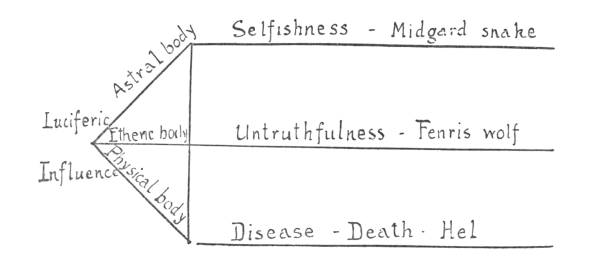
[ 12 ] How, then, does the Luciferic influence work? It takes up residence in the astral body, but through this it affects all three aspects of the human being—the astral body as well as the etheric and physical bodies. Outside of our Society, one can only offer hints about this Luciferic influence today. What you will come to understand more and more is that the Luciferic influence manifests itself in three ways: in the astral body, the etheric body, and the physical body of the human being.
[ 13 ] In the etheric body, that which becomes the human impulse toward untruthfulness and lying is brought about. Lying and untruthfulness are something that goes beyond the inner being of the human being. In the astral body, the pure inner self of the human being, the Self is permeated by the Luciferic influence, and this then manifests as selfishness in the human being. The etheric body is permeated from within by the impulse to be untruthful and is thereby predisposed to the possibility of lying. In the physical body, illness and death are brought about. For those who attended my last course, this will be easy to understand. But here I would like to point out once again that everything that occurs in the human physical body as illness and death is karmically linked to what we call the Luciferic influence. If we briefly summarize all this once more, Lucifer brings about in the astral body: selfishness; in the etheric body: lying and untruthfulness; in the physical body: illness and death. Of course, all materialistically minded people of the present day will be immensely surprised that in spiritual science, illness and death are attributed to a Luciferic influence. For this, too, is connected with karma. Illness and death would never befall human beings if the Luciferic influence had not taken place. This is precisely the karmic effect of the Luciferic influence: that human beings descend more deeply into the physical realm, and this is balanced on the other side by illness and death.
[ 14 ] We can therefore say: As the Luciferic influence entered into human beings, the physical, etheric, and astral bodies were overtaken by illness and death, lies and untruthfulness, and selfishness. — I would also like to point out that today’s materialistic science offers the same explanation for death in the animal and plant bodies as it does for human death. These materialistically minded people cannot comprehend that one external phenomenon can look exactly like another and yet have entirely different causes.
[ 15 ] What constitutes an external fact can stem from a wide variety of causes. For example, death in animals does not result from the same causes as in humans, even though it has the same outward appearance. These are matters that, if one were to attempt to prove them epistemologically, would take far too much time. Basically, I just wanted to say here that there is something very wrong with what science calls causality. Errors rooted in such ambiguities are, in fact, made almost constantly. Consider, for example: A person has climbed onto a roof, falls down, sustains a fatal wound, and is found dead. What could be more obvious than to say: The person fell down, sustained a fatal wound, and died from the injury. — But the situation could also be quite different. The person could have been struck by a blow while up there and fallen down dead; the injury could have been caused by the fall, so that outwardly the situation would be exactly as described above, but death would have occurred from an entirely different cause. The case is presented here in a very extreme way, but science frequently makes this kind of mistake. The external facts can often be exactly the same, and yet the internal causes are completely different.
[ 16 ] Let us therefore simply accept as a finding of spiritual scientific research that the Luciferic influence brings about selfishness in the astral body, lying and untruthfulness in the etheric body, and illness and death in the physical body. What, then, would Germanic-Norse mythology have had to say if it had attributed to Loki, the Lucifer, the ability to bring about this threefold effect? It would have had to say: Loki has three offspring. The first is the one who brings about selfishness. This is the Midgard Serpent, that through which the influence of the Luciferic spirit on the astral body is expressed. The second is that which interferes with human cognition as falsehood. In human beings on the physical plane, these are the things that live in their minds and do not correspond to the external world. There it is that which is not true. Among the Nordic peoples, who lived even more on the astral plane, what for us is an abstract lie manifested itself as an astral being and lived as such on the astral plane. The symbol for everything that is obscurity, not seeing correctly, is some kind of animal being, here in the North mainly the Fenris wolf. This is the second aspect: the influence on the etheric body exerted by Loki, which causes the human being to have an inner impulse to deceive themselves, to think untruthfully about things—that is, things in the external world do not appear to them in the correct way. This is essentially what the old Germanic-Norse mythology depicts in some way with a wolf figure. This is the astral figure for the lie and everything that is untruthfulness arising from an inner impulse.
[ 17 ] But here, where the human being enters into a relationship with the external world, Lucifer and Ahriman already encounter one another, so that every error that creeps into knowledge—including clairvoyant knowledge—every illusion and every Maya is the result of the tendency toward untruthfulness that comes into play there. In the Fenris Wolf, then, we must see the form that surrounds human beings because they do not see things in their true form. Wherever something of the outer light, of the truth, is obscured for the ancient Norse people, there they speak of a wolf. This runs through the entire Norse consciousness, and you will find that the image is used in this sense everywhere, down to the outer facts. When the ancient Norse people wanted to describe what they saw during a solar eclipse—of course, in the days of ancient clairvoyance, people saw things differently than they do today with the use of a telescope—they chose the image of the wolf that pursues the sun and, the moment it reaches it, causes the solar eclipse. This is in the deepest harmony with the facts. This terminology is part of what is magnificent, indeed even eerily magnificent, in Norse mythology. I can only offer hints here. But if we could spend weeks discussing Norse mythology, you would see how this is carried through in every aspect of Norse mythological thought. This is because mythology is a product of ancient clairvoyance, in which, however, the ego plays a role everywhere.
[ 18 ] Today’s materialistic people will say: But that’s just superstition. After all, no wolf chases the sun. The ancient Nordic, imaginative person simply sees these facts in images, and I could perhaps list many so-called scientific truths for you that harbor more of Ahriman’s influence, more error, than is present when one describes the corresponding astral perception and says: The wolf chases the sun. — For the occultist, there is something that is even more of a superstition. That is the belief that a solar eclipse occurs because the moon passes in front of the sun. This is entirely correct from the external perspective, just as correct as the story of the wolf is from the astral perspective. The astral perception is even more accurate than what you find in current books, for that is even more prone to error. When humanity one day recognizes the true facts in place of this external view, then it will find that the Norse myth is correct. I know that I am saying something terribly absurd from today’s perspective, but I also know that in theosophical circles we have already reached the point where we may point out where our physical worldview is most influenced by Maya, deception, or illusion.
[ 19 ] Now we come to Loki’s influence on the physical body. In it, he causes illness and death. The third offspring is thus that which causes illness and death. That is Hel. In this way, you have indeed wonderfully depicted the influence of Loki or Lucifer in the figures of Hel, Fenrir the Wolf, and the Midgard Serpent, in the form in which ancient clairvoyance—which we might, in a certain sense, describe as dream-like clairvoyance—perceived him. If we were to go through the entire story of Loki, we would find everywhere that these things illuminate the matter completely, down to the finest details.
[ 20 ] We must always be clear that what the clairvoyant sees is not some allegorical or symbolic representation, but actual beings. He sees beings. Now, however, the Germanic-Nordic people knew not only of their Loki, of the Luciferic influence, but also of the influence of Ahriman, who came from the other side, and they knew more, namely that being afflicted by the Ahrimanic influence is a consequence of the Loki influence. You must now transport yourselves back to the time when human beings did not yet view the world through external, physical perception, but rather observed it with the ancient clairvoyance, and there you will find that the myth in question is shaped for this clairvoyance. What does the myth say? Loki’s influence has come upon humanity, which is expressed in the workings of the Midgard Serpent, the Fenris Wolf, and Hel. Humanity has become such that its perception—its clear, luminous insight into the spiritual world—has been clouded by the fact that the Luciferic influence has increasingly asserted itself. In the time when this perception was developing, human beings alternated in their lives between seeing into the spiritual world and living on the physical plane, just as one alternates in life between waking and sleeping. When they looked into the spiritual world, they saw the world from which they had been born. That is indeed the essential point: that the myth arose out of clairvoyant consciousness. Human consciousness, however, consisted of this alternating between looking into and not looking into the spiritual world. When the state of dream-consciousness was present, one looked into the spiritual world; when the state of waking was present, one was blind to it. Thus the state alternated between blindness and seeing into the spiritual world. Consciousness alternated, just as a certain world being alternated between the blind Hödur and the clairvoyant Baldur, who looked into the spiritual world.
[ 21 ] Man was predisposed to Baldur's influence, and he would have become man in accordance with that influence had he not been subject to Loki's influence. But that influence caused Hödur’s nature to triumph over Baldur’s nature. This is expressed by Loki bringing the mistletoe with which the blind Hödur kills the sighted Baldur.
[ 22 ] Loki is thus the destructive force, like Lucifer, who drove humanity toward Ahriman. As humanity becomes devoted to the blind Hödur, the ancient clairvoyant vision fades away. This is the killing of Baldur. The Nordic people feel that what is Baldur-like—the ability to look into the spiritual world—has truly been lost little by little. The Nordic people have perceived the fading of clairvoyance in such a way that Loki killed their clairvoyance in Baldur, and what remains to them is powerlessness in the face of this clairvoyance. Thus, a major event in world history—the gradual fading of the old, unclouded insight—is expressed in the myth of Baldur, Hödur, and Loki. On the one hand, we have Loki with his clan, the three beings, and on the other hand, the tragic act of the killing of Baldur.
[ 23 ] Thus, in Norse mythology we see reflected what we can glean from spiritual science: the dual influence of the Luciferic and the Ahrimanic. This is what spiritual science will always present to you as a representation of the clairvoyant knowledge of ancient times and as an elaboration of the myth from ancient clairvoyance, which then gradually fades away.
[ 24 ] It would take us too far afield to delve any deeper into this subject. But simply by explaining the basic principles to you, you can sense the eerie grandeur of this myth, which is unparalleled because no other mythology has adapted so precisely to the ancient, clairvoyant facts. Greek mythology is merely the memory of something experienced in ancient times, expressed in a vivid manner. But such a direct connection to the facts, as found in Germanic-Norse mythology, is not present in Greek mythology. The latter is more serene; the figures appear with much more rounded contours, and thus in a highly vivid manner, but have lost the elemental quality of the most primal impression. Something of the old clairvoyance remained with the Nordic people for a long time. The old clairvoyance of the people in the rest of Europe had long since faded away, while in the North it was preserved for a long time. Only little by little, slowly and gradually, did the physical worldview alone come into the field of human vision. Thus, when Christianity began to spread, what is expressed in the Baldur myth—in the death of Baldur—became a reality for the majority of people. Yet there were still a few individuals who could perceive directly what the Nordic people experienced through clairvoyance.
[ 25 ] Thus, a direct perception of this spiritual world persisted for a long time, and because all of this was so fundamental—arising so directly from clairvoyant experience—the awareness remained even as Christianity began to spread; this awareness could not be as strong among other peoples as it was among the ancient Germanic-Nordic peoples. They then felt: Everything we once experienced in connection with the divine-spiritual ancestral homeland is fading away. It only began to fade in the North when the Germanic-Nordic people received the consolation of Christianity. But this offered him no immediate insight. He had felt the fate of Baldur far too deeply to be comforted by the fact that a god had been sent down to the physical plane so that people, who can perceive only the physical plane, might also be able to ascend to a consciousness of God. Just as the people of the Near East were able to feel the words, “Change the disposition of your souls, for the Kingdom of Heaven is at hand,” so too could one not in the Nordic regions. Over there, where Christ had appeared, one could find only old memories of the fact that there had once been an ancient clairvoyance. For three thousand years already, the Kali Yuga, the dark age, had been in the East, a time when people could no longer look into the spiritual world. But they had always longed for the spiritual world, and they had always spoken of such a world into which human beings could once look spiritually, but which had now vanished from view. They had experienced the spiritual world in a much more distant past than the people of the Nordic region and knew only from memory that the spiritual world had once been accessible. Therefore, in the Near Eastern regions, the words: “Change the state of your souls, for the Kingdom of Heaven has drawn near” could be well understood. People understood when it was said: The realms of heaven have come down to the physical plane; therefore, look upon the unique figure who will appear in the region of the Palestinian kingdom; look upon the Messiah, who contains God within himself, through whom you will find the connection with the Divine, even if you cannot rise above the physical plane. Understand the figure of Palestine; understand the Christ figure. — This is the profound word of John the Baptist.
[ 26 ] The Nordic people must have felt this differently, having experienced far more—and for a much longer time—than merely the recollection of having looked into the divine-spiritual world. Thus a thought dawned upon them of immense, truly colossal significance: the thought that this stepping out onto the physical plane, into the physical world—this inability to see the divine-spiritual world—can only be a transitional phase. Humanity will have to go through this as a school and see what it can acquire in the physical world. It needs this passage; it must therefore step out of the spiritual world; it must go through the experiences of the physical world as a school. But precisely by going through it as a school, it will re-enter the world from which it has stepped out. The Baldur-gaze will be able to inspire them once more. — In other words: The great idea that arose in the course of Germanic-Nordic development—that the world which had vanished and been withdrawn from the clairvoyant gaze would become visible again—led to the reign on the physical plane being perceived as an interim period.
[ 27 ] His initiates made it clear to the Nordic people that, in the divine-spiritual world during this interim period—while they are unable to glimpse into it—something is taking place that will one day cause this divine-spiritual world to appear different from how they were accustomed to seeing it in the past. They made this clear to him by speaking to him something like this: You used to look into the divine-spiritual world; there you saw the Archangel of Speech, the Archangel of the Runes, the Archangel of Breath, Odin, and the Angel of the I, Thor. You were in contact with them, and those who are prepared for it will gain the opportunity to enter this spiritual world again. But then it will look different; other powers will have joined, and the spheres of influence and power relations of these ancient spiritual leaders of the human race will have changed. You will then look into this world, but you will see something different from what you have experienced so far.
[ 28 ] They described to him what humanity will then see as a vision of the future—the very vision that will one day unfold before the human soul when humanity can once again look into the spiritual world and see what fate the ancient divine figures met, and how they related to other powers. They painted this vision of the future for him—as the initiates had beheld it—in which, in fact, that which comes from Lucifer will, in a certain sense, have entered into conflict with that which comes from the gods, and will also play out its course. The initiates painted this vision of the future for humanity in the image of the twilight of the gods. The Twilight of the Gods, Ragnarök, is thus the image that the initiates presented to the Germanic-Nordic people as a vision of the future. And once again we will find that all the events depicted there as future events could not be portrayed—down to the finest details—any better, any more terminologically correct, or any more aptly than they have been portrayed in the wonderful image of the Twilight of the Gods. This is the occult background of the image of the Twilight of the Gods.
[ 29 ] How, then, should a human being view himself? He should view himself as having absorbed everything from earlier times as the cause of his development; he should consciously take in what he has received as a gift from Odin, while perceiving himself as having undergone the development that followed. He should take into himself the teachings that Odin has implanted within him—Odin comes to meet him as an archangel. He should make himself a son of Odin; he should enter the struggle, and indeed enter this struggle soon. The initiate, the leader of the esoteric school, makes this clear especially to the Nordic person by pointing to the divine-spiritual being that appears so mysterious to us, which actually only assumes a specific role at the Twilight of the Gods, because it itself overcomes the very power through which Odin is first overcome. Odin’s avenger is given a special role and plays it in the Twilight of the Gods. When we come to understand this role, the wonderful connection will become clear to us between the predispositions of the Germanic-Nordic people and what we can imagine as the vision of the future. In a marvelous way, down to the finest details, all of this has found expression in the great vision of the Twilight of the Gods.