

The Mission of Individual Folk-Souls
in their Connection with Germanic-Norse Mythology
GA 121
16 June 1910, Oslo
Translated by Steiner Online Library
Tenth Lecture
[ 1 ] Before we explore what will emerge in connection with the significant image of the twilight of the gods, it would be wise to lay a foundation for this. For our task will be to describe more precisely the nature of the Germanic-Nordic national soul based on the findings we have obtained. We must see how the entire European spiritual life interacts in Europe, how the activity of the various national spirits brings about the progress of humanity—from ancient times, through our present, into the future. Every single people, indeed even all the individual, smaller fragments of peoples, have their special task in this great overall picture, and from what has been said, you can see that, in a certain sense, it is precisely the pre- and post-Christian culture of Europe that has been entrusted with the task, the mission, of educating the “I” through the various stages of human existence, of forming it and gradually developing it. In a certain sense, this “I” was, in ancient times, still revealed to human beings clairvoyantly from the spiritual world, as we have shown in the case of the Germanic-Nordic peoples. It was said how this “I” is bestowed upon human beings by one of the angelic beings who stands right in the midst between the individual and the national soul: by Donar or Thor. We have seen that the individual still felt as if he were “I”-less, as if he were impersonal. He regarded the “I” as a gift bestowed upon him from the spiritual world.
[ 2 ] Naturally, when the ego first awakened in the East, it was not found in this way. There, humanity had already developed subjectively to such a high degree of human perfection that it perceived the “I” not as something foreign, but as its own. When humanity in the East awoke to the “I,” Eastern culture had already reached a stage where it was capable of gradually developing such finely spun speculation, logic, and wisdom as we see before us in Eastern wisdom. Thus, Orientalism did not undergo the entire process of receiving the “I” as if from a higher, spiritual world with the aid of a divine-spiritual individuality such as Thor was. European culture underwent this process, and therefore this European culture also perceives this gradual ascent to the individual “I” as emerging from a kind of group soul. The Germanic-Nordic person still felt as if endowed with a group soul, as if belonging to an entire community, as a member of the great solidarity of the tribe. Only in this way could it come to pass that, nearly a hundred years after the Christian impulse had been given to the earth, Tacitus could describe the Germanic peoples of Central Europe in such a way that they always appear as belonging to individual tribes, that they are like the members of an organism and belong to the unity of that organism. Thus, the individual in that time still felt himself to be a member of the tribal self. He felt the gradual emergence of the individual “I” from the tribal “I,” and he saw in the god Thor the giver, the bestower of the “I,” the god who actually endowed him with the individual “I.” But he still felt this god connected to the entire spirit of the tribe, to that which lives in the group soul. The term “Sif” is now used to denote this group soul. This is the name of Thor’s consort. Linguistically, Sif must be related to the word “clan,” denoting tribal kinship, and indeed it is, even if this connection is masked and hidden. In an occult sense, however, Sif signifies the group soul of the individual community from which the individual emerges. Sif is the being who unites with the god of the individual ego, with the giver of the individual ego, with Thor. The individual human being perceives Sif and Thor as the beings who gave him the ego. The Nordic people still perceived them in this way, even as peoples in other regions of Europe had already been assigned different tasks in the education of the human being toward the ego.
[ 3 ] Every single people has its own special mission. Above all, we find the people, the sense of national unity, and the national community that we know by the name of the Celts. The national spirit of the Celts—which, as we know from the preceding descriptions, was later assigned entirely different tasks—had the task of nurturing the still-young ego of the European population. For this, however, there had to be an education, a teaching of the Celts themselves, which was conveyed directly from the higher worlds. Therefore, it is entirely correct that the Celts, through their initiates, the Druid priests, received a teaching from higher worlds that they could not have received on their own, and which they then had to pass on to the other peoples.
[ 4 ] The entire European culture is a gift from the European mysteries. The evolving national souls are always the guiding forces behind the progress of humanity’s overall culture. But in the era when these national spirits of Europe were to guide people to work from within themselves, to be effective from within themselves, it was necessary for the mysteries to withdraw more. Thus, with the withdrawal of the Celtic element, a kind of retreat of the mysteries into much more secret depths also took place. A much more direct, immediate interaction between the spiritual beings and the people through the Mysteries existed in the time of the ancient Celts, because the ego was still bound to group consciousness, and yet the Celtic element was to be the bestower of the ego for the rest of the population. We can therefore say: In the period preceding the actual Germanic-Nordic development, the education of the mysteries could be imparted to European culture only through the ancient Celtic mysteries. This education of the mysteries brought to the surface just as much as was necessary to provide a foundation for the entire culture of Europe. From this ancient culture, through intermingling with the most diverse racial fragments, ethnic groups, and racial communities, the most varied national souls and national spirits were able to be enriched and have always placed the “I” in different situations in order to educate it—the “I” that emerged from the depths of what lies beneath the human “I.” One can say that, after ancient Greek culture had reached its zenith to a certain degree in the development of what was precisely its special mission, a completely different aspect of this same mission came to light in ancient Rome and its various cultural periods. We have already mentioned how the individual post-Atlantean cultures follow one another in a strict sequence of stages. If we wish to gain an overview of this sequence of post-Atlantean cultures, we can say: Ancient Indian culture worked on the human etheric body. Hence the clairvoyant, wonderfully wise character of ancient Indian culture, because—following the development of specific human faculties—it is a culture reflected in the human etheric body, so that we can understand ancient Indian culture in roughly the following way.
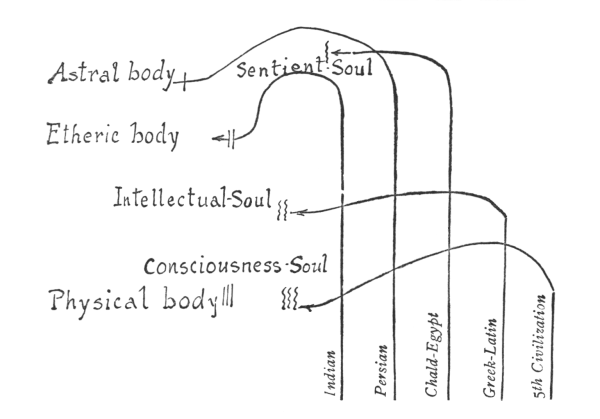
[ 5 ] From the Atlantean era through to the later post-Atlantean period, the Indian national spirit underwent the entire development of the inner soul forces without its ego having awakened. It then retraced its path back to its work in the human etheric body. This is the essence of ancient Indian culture: that with fully developed soul forces—soul forces refined to the highest degree—the Indian re-enters the etheric body, returns to the etheric body, and develops within it those wonderfully subtle forces, the later reflection of which we see in the Vedas and, in an even more refined state, in Vedanta philosophy. All this was possible only because the Indian national soul had developed to a high degree before the I had been beheld or perceived, and at a time when human beings could still see with the powers of the etheric body themselves. The Persian national soul had not progressed that far. It had only progressed to the point of perceiving through the sensory body or astral body. It was different still in the Babylonian-Chaldean-Egyptian culture. There, the part we call the feeling soul was able to perceive. We must therefore describe this Egyptian-Chaldean culture as one that works in the feeling soul. In the case of the Greek-Latin national spirit, it was the case that it had been guided up to the intellectual or emotional soul; it worked within this intellectual or emotional soul. It could itself work on the intellectual or emotional soul only insofar as this intellectual or emotional soul, in turn, had a kind of expression of its nature within the etheric body. But this is, as it were, a less real, less vivid, and less reality-imbued form of the world picture than what emerged in Greek culture. Whereas in ancient Indian culture there was direct work within the etheric body, there is now a blurred, a shadowed, a duller image of reality, as I have characterized it by saying: It is like a memory of what these peoples had once experienced, like a memory that radiates back onto their etheric body (cf. the schematic illustration).
[ 6 ] In the case of the other peoples who followed the Greek people, we are dealing with the predominant use of the physical body for the gradual development of the soul of consciousness. Therefore, Greek culture was one that we can only understand if we are able to grasp it from within; if we realize that what is important in it as an external experience is what wells up from within the Greek. In contrast, the peoples situated further to the west and north have the task, under the guidance of their national souls, of directing their gaze out into the world and of seeing in the world what is to be seen on the physical plane, of developing what is to play a role on the physical plane. The Germanic-Nordic peoples had the special task of developing all this as best they could, since they still enjoyed the grace—the world-historical grace—of looking into the spiritual world through ancient clairvoyance and of carrying the ancient experiences, which they felt as if they were alive, into what was to be established on the physical plane.
[ 7 ] There was a people who, in their later days, no longer possessed this grace—a people had not initially undergone such a preliminary development, which was therefore, as it were, placed on the physical plane before the birth of the human I in a single leap, and could therefore, under the guidance of its national soul, its archangel, provide only for all that promoted this human I on the physical plane, all that was necessary for the well-being of this human I on the physical plane. This was the Roman people. Everything the Roman people had to accomplish under the guidance of their national spirit for the entire mission of Europe was destined to establish the human ego as such. Therefore, the Roman people were able to develop that which the ego places between the other egos. It was able to establish the entire body of private rights. Thus it became the creator of jurisprudence built purely upon the ego. How the ego stands in relation to the ego—that was the great question in the mission of the Roman people. The other peoples who grew out of the culture of the Roman people already possessed more of what, so to speak, springs from the feeling soul, from the intellectual or emotional soul, and from the conscious soul itself—that which in some way fertilizes this “I,” propels this “I” into the world. To this end, all the racial mixtures recorded by external history—those that took place on the Italian and Pyrenean peninsulas, in present-day France, and in present-day Great Britain—were necessary in order to develop the “I” on the physical plane according to its various nuances, according to the soul of feeling, the soul of understanding or the soul of the mind, and the soul of consciousness. That was the great mission of the peoples who gradually developed in the West of Europe in the most diverse ways.
[ 8 ] All the individual cultural nuances and missions in Western Europe can ultimately be explained by the fact that, as one moves toward the Italian and Pyrenean peninsulas, what was to be developed was that which could be formed within the “I” through the impulses of the feeling soul. Study the individual national characters in terms of their light and dark sides, and you will find that among the peoples of the Italian and Pyrenean peninsulas there is a peculiar blending of the ego with the feeling soul. But among the peoples who have lived on French soil up to the present day, you will find their character understandable if you consider the development and intermingling of the intellectual or emotional soul with the ego. The great, world-historical achievements, however—of which we may regard Great Britain as the representative—are attributable to the fact that the impulse of the consciousness soul has been driven into the human ego. What emerged from the British Isles as a world-historical mission is also connected to what emerged from the establishment of the external, constitutional form. The connection of the consciousness soul with the ego was not yet present internally. But if you look closely at how this connection of the consciousness soul with the ego, driven outward, came about, you will find that the great world-historical conquests of the people of that island stem from this impulse. You will also find, however, that what is happening there in terms of the establishment of parliamentary forms of government becomes immediately understandable when one realizes that the aim was to bring an impulse of the conscious soul onto the stage of world history.
[ 9 ] Many nuances were therefore necessary, for the individual peoples had to be guided through many stages of the “I.” We would discover true historical pictures if we had enough time to pursue these matters further, which show us how the fundamental forces branch out and exert their effects in the most diverse ways. Thus did the soul constitution work among the Western peoples, who did not possess for themselves the immediate, elementary memory of the clairvoyantly experienced things of the spiritual world of earlier times. In later times, in the Germanic-Nordic region, what emerged directly from a gradual development of the original clairvoyance already infused into the feeling soul had to take shape in a completely different way. Hence that trait of inwardness, which is, after all, merely the aftereffect of inner clairvoyant experiences that took place in ancient times. The South Germanic peoples initially had their task in the realm of the conscious soul. The Greco-Latin era had to develop the intellectual or emotional soul. But it did not merely have to provide the impulse through the intellectual or emotional soul; it had to work into it a wondrous, prehistoric development endowed with clairvoyant experience. All of this poured into the consciousness souls of the Central European-Nordic-Germanic peoples. This had a lasting effect on them as a soul predisposition, and the more southern parts of the Germanic peoples first had to develop what was necessary to prepare the consciousness soul internally, to fill it internally with the content of consciousness from ancient clairvoyance, now translated onto the physical plane.
[ 10 ] The philosophies of Central Europe—those espoused by Fichte, Schelling, and Hegel as late as the nineteenth century—seem to lie far removed from the realm of mythology. Nevertheless, they are nothing other than the result of the most sublimated ancient clairvoyance, of the cooperation with divine-spiritual powers conquered within the human being. Otherwise, it would have been impossible for a Hegel to see realities in his ideas; it would have been impossible for a Hegel to utter the peculiar statement that so characterizes him, when, in response to the question, “What is the abstract?” he answers: “The abstract is, for example, a single human being going about his daily tasks—let us say, a carpenter.” Thus, what is concrete for the abstract thinker was abstract for Hegel. What for the abstract thinker are merely thoughts, for him were great, mighty masters of the world. Hegel’s world of ideas is the ultimate, most sublimated expression of the conscious soul and contains, in pure concepts, what the Nordic man still saw as sensuous-supersensuous, divine-spiritual powers in connection with the ego. And when the “I” found expression in Fichte, it was nothing other than the manifestation of what the god Thor had given to the human soul—viewed by Fichte solely from the perspective of the conscious soul—in the seemingly simplest thought, the thought “I am,” from which Fichte’s philosophy proceeds. A straight line of development extends from the gift of the ego bestowed upon the ancient Nordic people—emanating through the god Thor or Donar from the spiritual world—all the way to this philosophy. This god had to prepare all of this for the soul of consciousness so that it might have a content appropriate to itself, for it is dependent on looking into the outer world and acting within that world. But this philosophy does not merely encounter the external, gross-sensory, materialistic experience; rather, it finds the content of the consciousness soul itself in the external world and regards nature solely as the Idea in its otherness. Take this enduring impulse, and you have therein the mission of the Germanic-Nordic peoples in Central Europe.
[ 11 ] Now, since all development must move forward, we must ask ourselves: How does this evolution proceed? We can observe something remarkable when we look back to earlier times. We have said: In ancient India, the first culture took place in the etheric body, after the corresponding development of the spiritual powers had occurred. But there are also cultures that have preserved the ancient Atlantean culture and carried it over into the people of the post-Atlantean era. While the Indian approaches his etheric body from this side and, from within it and using its powers, creates his immensely great culture and magnificent spiritual life, we have, on the other hand, a culture rooted in the Atlantean era that works its way into the post-Atlantean period—a culture that, as it were, draws upon the other aspect of etheric-body consciousness for its foundation and development. This is Chinese culture. You will grasp the details of Chinese culture if you consider this connection and remember that Atlantean culture had a direct relationship to what we called the “Great Spirit” in our earlier descriptions, so that this culture had a direct relationship to the highest stages of world development. But this culture still exerts an influence on modern human beings, albeit from a completely different angle. It will therefore seem understandable that it is precisely in these two cultures that the two great opposites of the post-Atlantean era will one day clash: Indian culture, which is capable of development within certain limits, and Chinese culture, which closes itself off and remains rigid, repeating what existed in the ancient Atlantean era. One literally gets the impression of an occult-scientific-poetic nature when observing the development of the Chinese Empire, when thinking of the Great Wall of China, which was intended to enclose on all sides that which originated in ancient times and had developed in the post-Atlantean era. I say now that one is overcome by something like a poetic-occult sensation when one compares the Great Wall of China with what once existed in earlier times. I can only hint at these things. You will find, when you compare this with the scientific findings already available today, how extraordinarily revealing these things are. Let us look clairvoyantly at the ancient continent of the Atlantean world, which we must seek where the Atlantic Ocean is now, between Africa and Europe on the one hand and America on the other. This continent was surrounded by a kind of warm current, a current about which clairvoyant perception reveals that, strange as it may sound, it flowed up from the south, running through Baffin Bay toward northern Greenland and encircling it, then flowed eastward, gradually cooling, then, in the time when Siberia and Russia were still far from having risen to the Earth’s surface, flowed down into the Ural region, turned back, touched the eastern Carpathians, flowed into the region where the Sahara is today, and finally reached the Atlantic Ocean at the Bay of Biscay, so that it had a completely enclosed current system. You will understand that this current can now only exist in its very last remnants. This current is the Gulf Stream, which once flowed around the Atlantic continent. — And now you will also understand that, for the Greeks, the life of the soul is memory. The image of Okeanos arose within them, which is a memory of that Atlantic era. Their worldview is not so incorrect, because it is drawn from the ancient Atlantean era. — The current that flowed down over Spitsbergen as a warm current and gradually cooled, etc.—the Chinese have literally recreated this enclosed current system in their culture, which is enclosed by the Wall and preserved from the Atlantean era. The historical dimension was not yet present in Atlantean culture. That is why Chinese culture has also retained something ahistorical. That is why we find there something pre-Indian, something originating from Atlantis.
[ 12 ] Let us now turn to the description of the further development of the Germanic-Nordic national spirit and what follows it. What will be next when a national spirit guides its people in such a way that the spiritual self can develop in a special way? Let us recall that the etheric body develops in Indian culture, the feeling body in Persian culture, the feeling soul in Egyptian-Chaldean culture, the intellectual or emotional soul in Greco-Roman culture, and the conscious soul in our own, as yet unfinished, culture. Now, however, the grasping of the spiritual self by the consciousness soul follows, so that the spiritual self shines into the consciousness soul—a process that must be gradually prepared as the task of the sixth cultural stage. This culture, which must be a receptive culture in the most eminent sense, for it must devotedly await the entry of the Spirit-Self into the soul of consciousness, is being prepared by the peoples of Western Asia and the advanced Slavic peoples of Eastern Europe. The latter have been advanced with their national souls for good reason, namely because everything that is to come in the future must, in a certain sense, undergo its preparation beforehand, must already begin to take shape in order to provide the elements for what is to come later. It is of the utmost interest to study these advanced outposts of a national soul preparing for later epochs. Hence the peculiarity of the Slavic peoples living to our east. Their entire culture appears to Western Europeans as being in a preparatory stage, and in a strange way they advance, through the mediums of their outposts, that which in spirit is something entirely different from any mythology. It would be a mistake to regard what is being advanced from the East as the expected culture; it would be a mistake to regard this culture if one were to compare it with what the Western European peoples possess within themselves—that straightforward, continuous impulse which still has its root and source in ancient clairvoyance. The distinctive quality through which the soul of these Eastern European peoples lives is expressed in the entire attitude these peoples have always revealed when their relationship to the higher worlds was considered. This relationship is, when we compare it with what is evident in our mythologies in Western Europe—with the peculiar, highly individualized divine figures—something entirely different. It presents itself to us in such a way that we can compare what it gives us—as a direct outflow of the national character—with our various planes or worlds through which we prepare ourselves to comprehend a spiritual, higher culture. There we find, for example, the following conception in the East: The West has received successive, juxtaposed worlds. Here we have, first of all, a clear awareness of a world of the cosmic Father. Everything that is creatively active in air and fire, indeed in all the elements found in and above the earth, confronts us—as in a great, all-encompassing total concept that is at the same time a total feeling—as the concept of the Heavenly Father. Just as we conceive of the world of Devachan as fertilizing our Earth, so this heavenly world, this fatherly world, comes to meet us from the East, and it fertilizes that which is perceived as the Motherly, the spirit of the Earth. We have no other expression and no other means than to conceive of the entire spirit of the Earth under the image of the fertilization of the maternal Earth being. There, then, two worlds stand opposite one another, not individual, separate divine figures. And as a third world, facing those two worlds, stands that which is perceived as the blessed child of the two. This is not an individual being, not a feeling of the soul, but something that is the offspring of the Heavenly Father and the Earth Mother. Thus, from the spiritual world, the relationship of Devachan to the Earth is perceived. What arises there as the bestower of blessings, as spring, and as that which sprouts and grows in the material body is perceived as thoroughly spiritual; and what sprouts and grows in the soul is perceived as the world, which is simultaneously perceived as the blessed child of the Heavenly Father and the Earthly Mother. As universal as these concepts may be, we find them among the Slavic peoples who have advanced westward. We do not find such a universal perception in any Western European mythology. There we find clearly defined divine figures, but not what we depict in our spiritual visions; these we find more in the Heavenly Father, the Earthly Mother, and the Child of Blessing of the East. Within the Child of Blessing there is yet another world that permeates another. This is the world that is, however, already conceived of individually, because it is linked to the physical sun with its light. This being, which we have encountered many times in Persian mythology, also possesses—albeit in a differently developed form of feeling and imagination—the Slavic element; it possesses the solar being that pours its blessings into the other three worlds, so that the destiny of humanity is woven into creation, into the given earth, through the fertilization of the Earth Mother by the Heavenly Father and through what the Sun Spirit weaves into these two worlds. A fifth world is that which encompasses all that is spiritual. The Eastern European element perceives the underlying spiritual world in all natural forces and creatures. But we must conceive of this in a completely different emotional nuance, perhaps more closely linked to natural beings, natural facts, and natural creations.
[ 13 ] We must imagine that this Eastern soul is capable of perceiving, within a natural process, not merely the outer physical-sensory aspect, but also the astral-spiritual aspect. Hence the concept of a vast number of beings in this peculiar spiritual world, which can at best be compared to the world of the light elves. The spiritual world, which is regarded by spiritual science as the fifth world, is roughly the world that dawns upon the popular imagination of the East. Whether you call it by this or that name is not important, but what is important is that the feelings are nuanced and nuanced, that the concepts through which this fifth plane or this fifth spiritual world has been characterized are found in the world of the East. With this feeling, this Eastern world prepared the way for the Spirit who is to bring the Spiritual Self into human beings, for that epoch when the consciousness-soul is to rise to the Spiritual Self in the sixth post-Atlantean cultural epoch, which will succeed our fifth. In a most peculiar way, this confronts us not only in the creations of the folk souls, which are as I have just characterized them, but also in a wonderfully preparatory way in the manifold other expressions of Eastern Europe and its culture.
[ 14 ] It is very curious and extremely interesting how this Eastern European expresses his innate receptivity to the pure spirit by embracing Western European culture with great devotion, thereby prophetically hinting that he will be able to unite his being with something even greater. Hence also the scant interest he shows in the details of this Western European culture. He takes in what is presented to him more in broad strokes and less in the details, because he is preparing to assimilate that which will enter into humanity as the Spirit itself. It is particularly interesting to see how, under this influence, a much more advanced concept of Christ has been able to emerge in the East than in Western Europe, insofar as it has not come about there through spiritual science. Of all those outside this sphere, the Russian philosopher Soloviev has the most advanced concept of Christ. His concept of Christ is such that it can only be understood by students of spiritual knowledge, because he develops it ever further and presents it in an infinite perspective, thereby showing that what people recognize of it today is only the beginning, since the Christ impulse has so far been able to reveal to humanity only a little of what it contains within itself. But if we look at the concept of Christ as it is conceived, for example, by Hegel, we will find that one can say: Hegel conceives it in the way that the finest, the most sublimated soul of consciousness can conceive it. The concept of Christ, however, presents itself quite differently to us in Soloviev. There the twofold nature of the concept of Christ becomes clear, and everything that has found expression in the most diverse theological disputes is rejected—disputes that are fundamentally based on deep misunderstandings, because ordinary concepts are insufficient to make the concept of Christ intelligible in its dual nature, insufficient to understand that the human and the spiritual must be precisely distinguished within it. The concept of Christ is based precisely on grasping exactly what happened when Christ entered into the human being Jesus of Nazareth, who had developed all the necessary qualities. Therein we have two natures that must first be grasped, even though they merge into a unity again on a higher level. As long as this twofold nature has not been grasped, Christ has not been grasped in his full form. But this can only be grasped philosophically by one who foresees that humanity itself will enter a culture in which the soul of consciousness will be in a state where the spiritual self can come to it, so that in this sixth cultural epoch, humanity will feel itself as a duality in which the higher nature will keep the lower in check. Soloviev incorporates this duality into his concept of Christ and explicitly asserts that the concept of Christ can only make sense if one assumes a divine and a human nature, which can only be understood through their real interaction—that is, as an organic rather than an abstract unity. Soloviev already recognizes that two centers of will must be posited within this being. If you take Soloviev’s theories on the true meaning of the Christ-being, as they arose through the presence of the Indian influence—which is not merely imagined but spiritually real—then you have the Christ such that within him, in the three bodies, the element of feeling, the element of thinking, and the element of willing are formed. Here you have human feeling, thinking, and willing, into which the divine feeling, thinking, and willing sink. European humanity will only fully assimilate this once it has ascended to the sixth cultural stage. This has been expressed in a wondrous way in a prophetic sense in what shines forth in Soloviev as the concept of Christ, like the dawn of a later culture. That is why this philosophy of Eastern Europe takes such giant strides beyond Hegelianism and Kantianism, and when one enters the atmosphere of this philosophy, one suddenly senses something like the seed of a later unfolding. This goes so far because this concept of Christ is perceived as a prophetic foreshadowing, as the dawn of the sixth post-Atlantean culture. Through this, the entire Christ-being and the entire significance of the Christ-being for philosophy are brought into focus, and it thereby becomes something entirely different from what Western European concepts of it are capable of conveying. The concept of Christ, insofar as it is developed in a non-spiritual-scientific context and understood as a living substance intended to work its way—like a spiritual personality—into all state and social entities, — who is perceived as a personality in whose service humanity finds itself as “human beings with a spiritual self”—this Christ-personality is elaborated in a wonderfully vivid manner in the various discussions Soloviev offers on the Gospel of John and its opening words. Once again, it is only in the field of spiritual science that an understanding can be found of how deeply Soloviev grasps the statement: “In the beginning was the Word or the Logos,” and how differently the Gospel of John is grasped by a philosophy in which one can sense that it is a germinating philosophy, that it points in a remarkable way toward the future.
[ 15 ] If, on the one hand, one must say that Hegel represents the ripest fruit in the realm of philosophy—something born from the soul of consciousness as the ripest philosophical fruit—then, on the other hand, Soloviev’s philosophy is the seed within the soul of consciousness for the philosophy of the spiritual self, which will be incorporated into the sixth cultural epoch. There is perhaps no greater contrast than that between the concept of the Christian state in the most eminent sense—which, as a lofty ideal, appears to Soloviev like a dream of the future—and this Christian concept of state and people, which takes everything that exists in order to present it to the descending Spirit-Self, to hold it up to the future, to allow it to be permeated by the powers of the future —there is, therefore, no greater contrast than that between this concept of Christian community in the Solovievian sense, wherein the concept of Christ is an entirely future one, and the concept of the City of God by St. Augustine, who, while incorporating the concept of Christ, but constructs the state in such a way that it is the Roman state, which incorporates Christ into the conception of the state that the Roman state has given it. What matters is what knowledge yields for Christianity as it grows into the future. In Soloviev’s state, Christ is the blood that flows through all social coexistence. And the essential point is that the state is conceived with all the concreteness of the personality, so that while it acts as a spiritual being, it will also fulfill its mission with all the character traits of the personality. No other philosophy has been so deeply imbued with the concept of Christ, which shines before us in spiritual science at higher levels, and yet has remained so much in its infancy. Everything we find in the East, from the national character on up to philosophy, appears to us as something that bears within it only the seed of a future development, and which therefore also had to undergo the special education of that spirit of the age which we already know, since we have said that the spirit of the ancient Greek people, having given an impulse to Christianity, was entrusted with the mission of becoming the active spirit of the age for later Europe. For that national character which is to develop the seeds of the sixth cultural epoch, this spirit of the age must have been not only an educator but also a nurturer from the very first stage of existence. Thus we can literally say—whereby the concepts of father and mother lose their separate meanings—that what constitutes the Russian national character and is to gradually develop into the national soul has not only been educated but nourished and nurtured by that which we have seen was formed out of the ancient Greek spirit of the age and then assumed a different rank outwardly.
[ 16 ] This is how the missions are distributed among Western, Central, and Northern Europe and Eastern Europe. I wanted to give you a glimpse of these matters. Based on these hints, we will make a few further observations and show what the future of Europe will look like, which will make it clear that we must shape our ideals based on such insights; we will show how the Germanic-Nordic national spirit is gradually transforming into a zeitgeist through this influence.