

Occult History
Esoteric Reflections on the Karmic Connections
between Personalities and Events in World History
GA 126
29 December 1910, Stuttgart
Translated by Steiner Online Library
Third Lecture
[ 1 ] Some of what has been said so far as a sketchy insight into the occult course of human development will already have pointed out to you that the course of incarnations, as given by the individual character and individual development of human beings themselves, is modified by the intervention of spiritual forces from the higher hierarchies. Reincarnation is not quite as simple an event in human evolution as one would like to assume out of a certain theoretical convenience. Certainly, the fact remains that human beings incarnate again and again, that what we call their core essence appears in ever new incarnations; and it is equally true that there is a causal connection between the lives that later appear as incarnations and the earlier lives. The law of karma also exists, which is, so to speak, the expression of this causal connection. But beyond this there is something else, and it is this something else that leads us to an understanding of the historical course of human development. The development of humanity would proceed quite differently if nothing else were taken into account than the causal connections between one incarnation of the human being and the next, or between previous and subsequent incarnations. However, in every incarnation, other forces intervene in human life to a greater or lesser extent — and especially in the case of historically leading personalities — and use human beings as instruments. From this we can conclude that the actual karmic course of life, which lies purely within the human being, is modified through the incarnations; and this is indeed the case.
[ 2 ] Now we can speak of a certain lawfulness — let us limit ourselves for the moment to the post-Atlantean times — of a lawfulness in the way the influences of other worlds and the individual karma of human beings have been connected in the post-Atlantean times up to the present. And there is no other way than to use a schematic drawing to make clear to you how these influences are formed and how they relate to the individuality of the human being. Let us imagine that the area drawn here in the middle of the board is what we are accustomed to calling the human I, our present human core being. (See drawing on p. 47.) And now let us draw in the other elements of the human being, leaving aside for the moment the division of the soul into the sentient soul, the intellectual soul, and the conscious soul. So here we have schematically represented the astral body, the etheric body, and the physical body.
[ 3 ] Now, because we want to remain with post-Atlantean development, let us clarify what the future of human beings will consist of, according to what we have already discussed in various places. We know that we are in the middle of post-Atlantean development, although we have already passed the actual middle point. It is only necessary to repeat briefly what has been said on other occasions: that during the Greco-Latin cultural epoch, what we call the intellectual or emotional soul underwent a special development, and that we are now in the development of the consciousness soul. In the Babylonian-Egyptian cultural period, the sentient soul developed, preceded by the development of the sentient or astral body in the Persian epoch and the etheric body in ancient Indian development. The adaptation of the physical body to our post-Atlantean earthly conditions already took place in the last epochs before the great Atlantean catastrophe. So that when we now go on to describe the other members, we can say: The I develops within our post-Atlantean time in such a way that during the Indian period the development takes place mainly in the etheric body, during the Persian period in the astral body, that of the Egyptian-Chaldean period in the sentient soul, that of the Greek period in the intellectual soul, and our culture in the consciousness soul — in the fifth member of the human being, if we count the individual soul members. In a sixth cultural epoch, human beings will develop further upward, and in a certain way the soul element of the human being will grow into manas. In a seventh, the last post-Atlantean cultural epoch, a kind of growth of the human being into the life spirit or Buddhi will then come about, while that which could grow into Atma after the great catastrophe that will conclude our post-Atlantean era will only develop in a later age.
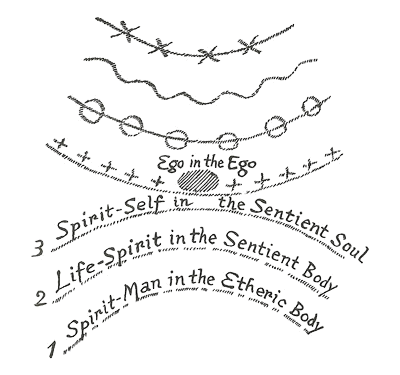
[ 4 ] These are things that are known from the cycle on the Apocalypse. Now, however, we must take into account that during the first period, the Indian period, human beings were still below the level of the ego in terms of their development; that, basically, the ancient Indian, pre-Vedic culture was essentially an inspired culture, that is, a culture that flowed into the human soul, as it were, without the work of the ego that we know today as our thinking and imagining. Since the Egyptian cultural period, human beings have had to behave actively with their ego, so to speak. They have had to turn their ego around in the sphere of the outer world through the senses in order to receive impressions; they have had to be actively involved in working on themselves with their own share, so to speak. Ancient Indian culture was a more passive culture, a culture that was achieved, so to speak, through devotion to what flowed into the human being as inspiration. It therefore seems understandable that we must trace this ancient Indian culture back to an activity other than that which the human ego performs today; that, so to speak, the activity of the ego today had to be replaced for the Indian soul of that time by higher beings sinking into the human being and inspiring the human soul. When we ask what was brought into the human soul from outside, so to speak, what was lowered into it by beings of the higher hierarchies, we can say: it is the same thing that human beings will later achieve as their own activity, as their own activity, when they have raised themselves up to what we call the Atma or spiritual human being. In other words, in the future, human individuality will rise to a working into Atma. This working will be the work of the human soul, of the core of the human being, something directly connected with the innermost being. And just as human beings will then work within themselves, so did beings of higher hierarchies work on the Indian soul. If we want to describe what was happening in the etheric bodies of the Indian souls, we can say that a darkened ego consciousness, lying in a twilight slumber, was still at work; Atma was working in the etheric body. We can say quite well that the ancient Indian soul was a theater in which, basically, a superhuman work was taking place: a work of higher beings within the etheric body of the ancient Indians. And what was woven into the etheric body was a work such as human beings will later achieve in the manner indicated when Atma works on the etheric body. — In Persian culture, it was then the case that Buddhi, or the life spirit, worked in the astral body, in the sentient body. — And in the Chaldean-Babylonian-Egyptian culture, Manas, or the spirit self, worked in the sentient soul. Thus, in Egyptian-Babylonian-Chaldean culture, the full active work of the I within the soul itself is still not pronounced. Human beings are still, albeit to a lesser degree than before, a passive arena for the work of Manas in the sentient soul. It is only in the Greek-Latin period that human beings enter fully and actively into their own soul life, so to speak. We know that it is the intellectual soul in which the ego first asserts itself as an independent inner human member, and we can therefore say that within Greek culture, the ego works in the ego, that is, the human being as such works in the human being. We will see in the course of these lectures that within the Greek epoch, the peculiarity of the culture of that time emerges precisely through the fact that the I works in the I.
[ 5 ] But we have now been beyond this cultural epoch for quite some time; and while in pre-Greek times it was the case that higher beings, so to speak, immersed themselves in the core of the human being and worked there, we have a different task to fulfill in our time. We must first acquire in a wholly human way what we have worked out through our ego, what we are able to take in through our activity from the impressions of the outer world. But then we must not remain at the stage where the people of the Greek-Latin era remained, working out only the human, pure humanity as such. Instead, we must carry what we have worked out upward and weave it into what is to come; we must, so to speak, take the direction upward toward what is to come later: Manas or the spirit self. But this can only be expected in the sixth cultural period. We now stand between the fourth and sixth. The sixth promises humanity that it will be able to carry up into higher regions what is worked out through the external impressions that the I receives through its senses. In our fifth cultural epoch, we are only able, so to speak, to make the initial effort to shape everything we acquire through external impressions and through the processing of these impressions in such a way that it can receive the upward direction. In this respect, we are truly living in a transitional epoch, and if you remember what was said yesterday about the spiritual power at work in the Virgin of Orleans, you will see that something was already at work in the Virgin of Orleans that moved in the opposite direction to the influences of higher powers in pre-Greek times. If, for example, a member of the Persian culture received the influence of a supersensible power that used him as an instrument, this power worked into the core of his human being; it lived out there, and the person saw and experienced what this spiritual power implanted in him, with which it inspired him. When people of our time come into contact with such spiritual powers, they can, so to speak, carry up to them what they experience in the physical world through the work of their ego, through the impressions of their ego; they can give it an upward direction. That is why, in the case of personalities such as the Virgin of Orleans, the manifestations of those spiritual powers that want to speak to her are indeed in the sphere to which she rises, but something stands before this revelation which, although it does not impair the reality of these revelations, gives them a certain form; it is what the ego experiences here in the physical world. In other words, the Maid of Orleans has revelations, but she cannot see them as directly as the ancients did. Instead, between her ego and these objective powers stands the world of ideas that the Maid of Orleans has absorbed in the physical world: the image of the Virgin Mary and the Archangel Michael, as she has absorbed them from her Christian ideas; these stand between them.
[ 6 ] Here we have an example of how we must distinguish between the objectivity of a revelation and the objectivity of the content of consciousness when dealing with spiritual matters. The Virgin of Orleans saw the Virgin Mary and the Archangel Michael in a certain image. We must not imagine these images directly into spiritual reality; we must not attribute immediate objectivity to the form of these images. But if someone were to say that it was only imagination, that would be nonsense. For the Virgin receives revelations from the spiritual world which human beings will be able to see in the form in which they are to be seen in the post-Atlantean period, albeit only in the sixth cultural epoch. But even if the Virgin of Orleans does not see the true form, this true form nevertheless descends upon her. The Virgin of Orleans confronts her with the religious ideas of her time, covering them, as it were; her world of ideas is challenged by the spiritual power. Thus, the revelation must be addressed as objective. Even if someone in our time can prove that subjective elements flow into a manifestation from the spiritual world, even if we cannot regard the image that the person concerned has of the spiritual world as objective, even if it is a veil, we must not interpret objective revelations as such veils. They are objective. They conjure up the content from our own soul. We must distinguish between the objectivity of the content and that of the facts that come from the spiritual world. I had to emphasize this in particular because in this field, both those who recognize the spiritual world and its opponents make mistakes, albeit opposite ones.
[ 7 ] Thus, the Virgin of Orleans presents us, as it were, with a historical figure who already acts entirely in the spirit of our age, where everything we can produce on the basis of our external impressions must be directed toward the spiritual. But what does this mean when we apply it to our culture? It means that we may initially turn our gaze naively toward our surroundings. But if we continue to focus our eyes solely on external impressions, then we are not doing our duty. We only do our duty when we are aware that we must relate external impressions to the spiritual forces behind them. If we pursue science and do it like scholars, then we are not doing our duty. We must view everything we can learn about the laws of natural phenomena and the laws of spiritual phenomena as a language that will lead us up to a divine-spiritual revelation. If we are conscious that we must regard all physical, chemical, biological, physiological, and psychological laws in such a way that we relate them to something spiritual that reveals itself to us, then we are doing our duty.
[ 8 ] This is true of the sciences of our time, and it is true of art. The art that we characterize as Greek art, which reflected more simply on human beings, which depicted entirely what was merely human, the working of the I with the I, insofar as the I expresses itself in sensual-physical material, this art has had its epochs. In our time, the truly great artistic personalities have instinctively felt the urge to make art a kind of sacrificial service to the divine-spiritual worlds, that is, to regard what is clothed in sound, for example, as an interpretation of spiritual mysteries. From a cultural-historical-occult perspective, we will one day have to examine Richard Wagner in all his details. We will have to regard him as a representative figure of our fifth cultural epoch, who always felt the urge to express in sound what lived within him, the pull toward the spiritual world, who regarded the work of art as an outer language of the spiritual world. And there, in our time, the remnants of the old culture and the dawn of a new culture stand sharply, even starkly, opposed to one another. We have seen how the purely human weaving in the tones, the purely formal music that Richard Wagner wanted to overcome, was fiercely defended by Richard Wagner's opponents because they were unable to feel that it was precisely in Richard Wagner that a new impulse was instinctively dawning like a dawn.
[ 9 ] I don't know if most of you are aware that Richard Wagner had the harshest, most terrible critics and detractors for a long time. These critics and detractors were led in a certain way by the extraordinarily intellectual musical work of Eduard Hanslick in Vienna, who wrote the interesting little book “On the Musical Beautiful.” I don't know if you are aware that this was, so to speak, opposed to the dawn of a new historical era. This book, “On the Beautiful in Music,” may become a historical monument for the latest times. For what did Hanslick want? He says: One cannot make music in the manner of Richard Wagner; that is not music at all, because there music takes a run-up, so to speak, to point to something that lies outside the musical, to something supernatural. Music, however, is “arabesque in tones” — that was one of Hanslick's favorite expressions. That is, an arabesque-like juxtaposition of tones, and the musical-aesthetic enjoyment can consist in purely human delight in the way the tones sound in and after one another. Hanslick said that Richard Wagner was not a musician at all, that he did not understand the essence of music. The essence of music must lie in the mere architecture of the tonal material. What can one say about such a phenomenon? Nothing other than that Hanslick was, in the most eminent sense, a laggard, a reactionary of the fourth cultural epoch. He was right—for that cultural epoch; but what is right for one cultural epoch is no longer valid for the next. From his point of view, one could say that Richard Wagner was not a musician. But then one would have to go on to say: that epoch is now over, we must now be content with what comes from that epoch, we must reconcile ourselves to the fact that, in Hanslick's sense, music expands beyond itself into something new.
[ 10 ] And so we could study this clash between the old and the new in many areas, especially in our cultural epoch. This is particularly interesting in the individual branches of science. It would go too far to show how there are reactionaries everywhere and those who work out from the individual sciences what science should be: the expression of the divine-spiritual behind appearances. The fundamental element that must permeate the present in order to make the divine-spiritual more and more conscious as the goal, as the perspective for our work, should be spiritual science, and spiritual science should everywhere awaken the impulses from below to above; it should everywhere call upon the human soul to sacrifice, that is, to sacrifice what we acquire through external impressions in comparison to what we should achieve in working our way up into the regions of the spirit itself, the life spirit, and the spirit human being.
[ 11 ] If we keep this picture of human history, of occult history, before our eyes, we will find it understandable that a soul that was incarnated in the Indian and then in the Persian epoch could be permeated by the inspiring elements of an individuality of the higher hierarchies; but that then, when it entered the Greek-Latin epoch, this soul was alone, that this soul worked in such a way that the I worked in the I. Everything that appears in the pre-Greek epoch for all the individual cycles of the post-Atlantean cultures as a divine inspiration, as a revelation from above — and this also applies at the beginning of the Greek cultural period for the 9th, 10th, 11th centuries of the pre-Christian era — what appears to us as an inspired culture into which flows from outside what it is to receive spiritually, this develops more and more into a purely human-personal way of living. And this finds its strongest expression precisely in Greek culture. No previous age has seen such an expression of the outer human being as he lives in the physical world, of what man is as a self-conscious being, and no age after this will ever see it again. The purely human-personal, the human-personal that is completely self-contained, comes to light historically in the ancient way of life of the Greeks and in their creations. Let us compare how the Greek sculptor has imbued his god-figures with the human-personal! We can say: to the extent that a Greek plastic work of art confronts us, insofar as it can be recognized by physical means, the human being stands before us entirely as a personality. And if we could not forget, when looking at Greek works of art, that this incarnation expressed to us was preceded by other incarnations and will be followed by others, if we could think for just a moment that the figures of Apollo and Zeus are based on only one incarnation out of many, we would not feel correctly toward Greek works of art. We must be able to forget that the human being has incarnated in successive incarnations. Here, the personality is completely poured into the form of one personality. And so was the whole life of the Greeks.
[ 12 ] If we go further back, however, the figures become symbolic; they hint at something that is not purely human, they express something that man does not yet feel within himself. He could only express in symbols what came in from the divine-spiritual worlds. Hence the ancient symbolic art. And let us see again how art arises precisely among the people which is to provide the material for our fifth cultural epoch — we need only think of older German art — we see that we are not dealing with symbolism, nor with an expression of the purely human, but with the soul in its deepest depths; we see how the soul cannot, so to speak, enter completely into the human form. Who could characterize Albrecht Dürer's figures other than by saying that in them, what longs for the supersensible world in human beings finds, one might say, in the Greek sense, only an imperfect expression in the outer form of physicality. Hence the deepening toward the soul the further art advances.
[ 13 ] And now you will no longer find it incomprehensible that I said in the first lesson: What was formerly embodied appears in the physical world as an image; beings from the higher hierarchies flowed into individuality. So that when we have to say of a person of the Greek world in earlier times that he was incarnated, we must not only see this self-contained being, but behind it the individuality of a higher hierarchy. This is how Alexander appears to us in the Greek-Latin period, this is how Aristotle appears to us. We trace their individualities backwards. We must go back from Alexander to Gilgamesh and say: in Gilgamesh we find this individuality, which is then projected onto the physical plane and appears as Alexander; behind it we must see a fire spirit that uses him as its instrument. And in Aristotle, going back in time, we see the powers of ancient clairvoyance at work in the friend of Gilgamesh. Thus we see both young and old souls, behind whom clairvoyance once stood, fully revealed in the Greek era on the physical plane. And this is particularly evident in the great mathematician Hypatia, in whom, so to speak, all the mathematical and philosophical wisdom of her time lived as personal ability, as personal science and wisdom. This was complete in the personality of Hypatia. And we will see how this individuality had to take on the female personality in order to express the gentle unity of everything she had previously absorbed in the Orphic mysteries, in order to express as her personal mode of activity everything she had absorbed there as a disciple of the Orphic mysteries through her inspirers.
[ 14 ] So we see how influences from the spiritual world enter in a modifying way in successive human incarnations. And I can only point out that precisely such an individuality as that which was incarnated as Hypatia, who thus brought with her the wisdom of the Orphic mysteries and lived it out personally, was then called upon in a subsequent incarnation to take the opposite path: to carry all personal wisdom back up to the divine-spiritual. This is why Hypatia appears at the turn of the 12th to the 13th century as an important, comprehensive, universal spirit of modern history, who has a great influence on what is the synthesis of scientific and philosophical knowledge. So we see how historical forces penetrate into the successive incarnations of individual beings.
[ 15 ] If we look at the course of history in this way, we really see a kind of descent from spiritual heights down to the Greco-Latin period and then an ascent again: a gathering of the material to be gained purely from the physical plane during the Greek period — which of course continues into our time — and a transfer back into the spiritual world, for which an impulse is to be created through spiritual science, and for which an instinctive impulse was already present in a personality such as Hypatia, who was reincarnated in the 13th century.
[ 16 ] At this point, my dear friends, because the general Theosophical Society is in a certain sense a playground for misunderstandings, I would like to point out that an infinite number of these misunderstandings are purely fabricated. For example, people like to contrast what is presented here within our German movement with what was originally the revelation of the theosophical movement in modern times. That is why I am happy to take this opportunity to point out how what is given here from originally Rosicrucian sources is in harmony with much of what was originally given to the theosophical movement. And we have the opportunity at this moment to point out something of this nature. I have said, and this has been developed quite independently of traditions, that certain later historical personalities are, as it were, the shadow images of earlier personalities represented by myths, behind whom higher hierarchies stand. This should not be brought into contradiction with the manifestations brought into the Theosophical Society by H.P. Blavatsky. Otherwise, through a mere misunderstanding, one could very well find oneself in contradiction to the good old teachings that flowed into the theosophical movement through the extraordinary and useful instrument of H.P. Blavatsky. But in relation to what has been developed here, I would like to read to you a passage from Blavatsky's later writings, where she refers to “Isis Unveiled,” her oldest occult work. I would like to read the following passage to you so that you can see how what is said about such contradictions is, in essence, I cannot say otherwise, pulled out of thin air:
[ 17 ] “Apart from constantly repeating the ancient and ever-existing fact of reincarnation and karma — in the manner taught by the oldest science in the world, not by today's spiritualism — occultists should teach a cyclical reincarnation that keeps pace with evolution: that kind of rebirth which is mysterious and still incomprehensible to the many who know nothing of that history of the world to which we have cautiously referred in Isis Unveiled. A general rebirth for every individual with intermediate periods of Kama Loka and Devachan, and a cyclical conscious incarnation with a great and divine goal for a few. Those great characters who tower like giants in the history of humanity, such as Siddhartha Buddha and Jesus in the spiritual realm, and Alexander of Macedonia and Napoleon the Great in the realm of physical conquest, are nothing but reflections of great archetypes that existed—not ten thousand years ago, as was cautiously mentioned in The Veils of Isis, but during millions of successive years, from the beginning of the Manvantara. For, as explained above, with the exception of the real avatars, these images of their archetypes, each corresponding to its own parent flame, are the same unbroken rays (monads), called devas, Dhyan Chohans or Dhyanii Buddhas, or even planetary spirits, and so on, which shine like their archetypes through eons of eternity. Some humans are born in their image, and when some special humanitarian goal is in view, the latter are hypostatically animated by their divine archetypes, which are brought forth again and again by the mysterious powers that guide and direct the destinies of the world.”
[ 18 ] “More could not be said at the time when “The Veil of Isis” was written; therefore, what was said was limited to the mere remark that there is no outstanding character in the annals of sacred or profane history whose archetype we cannot find in the half-legendary and half-real traditions of past religions and mythologies. Just as the star that shines in the boundless infinity of the heavens at an immeasurable distance above our heads is reflected in the still waters of a lake, so the image of humanity in antediluvian times is reflected in those periods that we can encompass with a historical review...”
[ 19 ] As I said, I am happy to take this opportunity to emphasize the correspondence between what we can investigate in the immediate present and what was, in a certain sense, original revelation. You know that it is a principle here to adhere faithfully, in a certain sense, to the traditions of the Theosophical Movement; but I emphasize that nothing is repeated here without being tested; that is what matters. Where a correspondence between what has been recognized and something else can be emphasized, it should be sharply highlighted for the sake of continuity in the Theosophical Society, in accordance with justice; but nothing should be repeated simply without being tested. This has to do with the mission we have within our German Theosophical movement—namely, to bring our own individual contribution to this Theosophical movement. But such examples can give you a picture of how unfounded the prejudice is that arises here and there, as if we always wanted something different in things. We continue to work faithfully; we do not, so to speak, constantly dig up old dogmas; we also examine what is offered today from other sources. And we represent what can be said with the best occult conscience on the basis of the original occult research and methods handed down to us through our own sacred traditions of the Rosicrucians.
[ 20 ] It is now extremely interesting to show, using a single personality, how the old, which was inspired into humanity under the influence of higher powers, took on a character that was, so to speak, oriented toward the physical plane in the people of the Greek-Latin age. We can cite as an example how Eabani, in one of his incarnations between the personalities of Eabani and Aristotle, was able to absorb, under the influence of the ancient mystery teachings with their forces descending from the supersensible worlds, that upon which the further development of the human soul is actually based in certain mystery schools. We do not wish to repeat here the characteristics of the various mystery schools, but we do wish to turn our spiritual gaze to one of them, where the soul was developed through the arousal of very specific feelings, so that it learned to penetrate the superphysical world. In such mysteries, those feelings and impulses were aroused in the soul that were capable of eradicating all egoism from the soul. It was made clear to the soul how, in essence, it must always be egoistic when embodied in the physical body. The entire scope and meaning of egoism for the physical plane was, so to speak, unloaded in impulses onto the corresponding soul. And such a soul felt deeply, deeply contrite, having to say to itself: I have known nothing but egoism up to now; I cannot be anything other than an egoist in the physical body. Yes, such a soul has been led far away from the cheap standpoint of those people who say every other word: 'I don't want this thing for myself, but for someone else. ' Overcoming egoism and acquiring the tendency toward the universal human and cosmic is not as easy as some people imagine. This acquisition must be preceded by a complete crushing of the soul over the extent of egoism in the impulses of this soul. The soul had to learn compassion for everything human, for everything cosmic, in the mysteries I am referring to, compassion through the overcoming of the physical plane. Then one could hope that it would bring down from the higher worlds true compassion for all living things and all that exists.
[ 21 ] But another feeling should be developed as a main feeling alongside many others. If human beings are to penetrate the spiritual world, they must be clear that everything there is different from the physical world. One must stand before the spiritual world as before something completely unknown when one comes face to face with it. There is a real feeling of being in danger, a feeling of fear of the unknown. And that is why, in such mysteries, the soul had to experience everything that the human soul could possibly experience in terms of fear, anxiety, terror, and horror, in order to wean itself of these feelings of fear, anxiety, terror, and horror. Then the human being was equipped to ascend into the spiritual world, which was unknown to him in terms of its content. Thus, the soul of the student of the mysteries had to go through an education that led to a comprehensive universal feeling of compassion and a universal feeling of fearlessness. Every soul went through this in the ancient mysteries in which Eabani participated when he reappeared in the incarnation between Eabani and Aristotle. He also went through this. And now this came to light in Aristotle as a memory of earlier incarnations. He was able to give the theory of tragedy because, out of such memories, when he looked at Greek tragedy, he realized how it was an echo, as it were, an external afterplay of the mystery education, carried out on the physical plane, where the soul is purified through compassion and fear. Thus, the dramatic hero and the entire structure of a tragedy were supposed to bring to life before the audience something that the audience could experience in a mitigated form: compassion for the fate of the tragic hero and fear of the outcome of his fate, of the gruesome death that awaited him. Thus, what was going on in the soul of the ancient mystic was woven into the dramatic progression of the tragedy, into the weaving and life of the tragedy: purification, cleansing, catharsis through fear and compassion. And like an echo, the members of the Greek cultural period were supposed to experience the passage through fear and pity on the physical plane. Artistically, one was supposed to experience and aesthetically enjoy what had formerly been a great educational principle. And when what Aristotle had learned in earlier incarnations came into his personality, he was the right man to give this peculiar definition of tragedy, which has become so classic and has had such a magnificent effect that it was still taken up by Lessing in the 18th century and played such a role throughout the 19th century that entire libraries have been written about this definition. Incidentally, we would not lose much if most of what is in the libraries were burned, for it was written with a complete misunderstanding of what has been said earlier, namely that we are dealing with something being projected down into art from the spiritual realm. And those who wrote this did not suspect that Aristotle was revealing an ancient mystery when he said: A tragedy is a combination of successive actions grouped around a hero and capable of arousing feelings of fear and pity in the audience, so that a purification of the soul may take place.
[ 22 ] Thus we see that in a single personality, in what it wants and says, there is a shadow of something that only becomes understandable to us when we see through the personality to the one behind it, to the inspirer. Only when you look at history in this way can you see what the personality and the superpersonal forces mean for historical life, how something comes into play in the individual incarnations, what Madame Blavatsky calls the interplay of personal individual incarnations, and what she describes when she says: “But alongside the ancient and ever-existing fact of reincarnation and karma, occultists should proclaim a cyclical reincarnation that keeps pace with evolution,” and so on. She calls this conscious reincarnation, because for most people today, successive incarnations remain unconscious to the ego, while the spiritual forces that work from above do indeed consciously transfer their power from one age to another in a cyclical manner.
[ 23 ] So what is written there as a revelation of what Blavatsky said in her early days from the Rosicrucian mysteries can be thoroughly verified and confirmed by original research. From this, however, you will see that the convenient way of always understanding incarnation as merely the effect of a previous embodiment is significantly modified. And you will understand that reincarnation is a much more complicated reality than is usually assumed, and that we can only understand it completely if we connect human beings to a higher, superphysical world that continuously influences our world. We can say that in that intermediate space which we call the Greco-Latin culture, human beings were given time to relive and allow to resonate within themselves, through a long series of incarnations, everything that had been placed in the soul from higher worlds. What the Greek-Latin world lived out was like a human-personal living out of infinite memories that had previously been placed into the same individualities by higher worlds. Should we therefore be surprised when the most significant spirits of the Greek world in particular bring this to consciousness? When they looked into their inner world, they said to themselves: There it flows out, there worlds expand into our personality; but these are memories of what was previously poured into us from the spiritual worlds. Read in Plato how he traces what human beings can experience back to a memory of the soul of its past experiences. There you see how, out of a deeply real consciousness of the fourth post-Atlantean epoch, a spirit such as Plato was able to create. We can only begin to understand what such an individual statement by such a striking personality means when we are able to look occultly into the spirit of the epochs.