

An Occult Physiology
GA 128
20 March 1911, Prague
Translated by Steiner Online Library
First Lecture
[ 1 ] In this series of lectures, organized at the request of our friends in Prague, we will address a topic that is of immense personal relevance to human beings, as it directly touches upon the very essence of humanity and concerns matters that pertain to their physical lives. While this topic is, on the one hand, so close to human beings because it concerns them personally, one must nevertheless say that, on the other hand, it is a very difficult subject to grasp. For even a glance at the one might say, from mystical-occult heights, the urgent demand “Know thyself” shows us the fact that self-knowledge—real, true self-knowledge—is, in essence, quite difficult for human beings, and this refers not only to individual, personal self-knowledge, but above all to the knowledge of the human being in general. And because human beings—as can be seen from this eternal demand, “Know thyself”—are so far removed from their own nature, and have such a long way to go to understand themselves, the subject of the following reflections over the coming days will, in a certain sense, appear as something distant, the understanding of which requires a great deal of diverse knowledge. It was not without reason that I myself only set out to speak on this topic after a long time and careful consideration. For it is a topic in relation to which—if one is to arrive at a true, authentic contemplation—something is absolutely necessary that is so often disregarded in ordinary scientific inquiry: It is necessary to have reverence for the essence of the human being—mind you, not for the essence of the individual human being, especially not when that individual human being is ourselves—but for the essence of the human being in general. And it must be regarded as a fundamental prerequisite for our subsequent reflections that one have reverence for what the human essence truly signifies.
[ 2 ] How, then, can one truly revere this? In no other way than by first setting aside the way human beings—whether ourselves or others—appear to us in everyday life, and by rising to the realization: This human being, with his entire development, is not here for his own sake; he is here to reveal the Spirit, the entire world of the Divine-Spiritual; he is a revelation of the World-Godhead, of the World-Spirit. And for those who recognize that everything surrounding us is an expression of divine-spiritual forces, it is also possible to feel this reverence, not only for the divine-spiritual itself, but also for the manifestations of this divine-spiritual. And when we speak of humanity striving for ever more perfect self-knowledge, we must be clear that it is not merely curiosity—or, for that matter, a thirst for knowledge—that should prompt us to strive for self-knowledge, but that we must feel it as a duty to make humanity’s understanding of the revelations of the World Spirit ever more perfect. In this sense, the following words are to be understood: To remain ignorant where knowledge is possible constitutes a sin against humanity’s divine destiny. For the World Spirit has placed within us the power to become knowing; and if we do not wish to become knowing, we reject—which we really ought not to do—the role of being a revelation of the World Spirit, and increasingly represent not a revelation of the World Spirit, but a caricature, a distorted image of it. It is our duty to strive for knowledge in order to become, more and more, an image of the World Spirit. Only when we can attach meaning to these words, “to become an image of the World Spirit,” only when it becomes meaningful for us to say in this sense: We must know, it is our duty to know—only then can we truly feel the sense of awe toward the essence of the human being that was called for earlier. And for those who wish to contemplate human life and the human being in the occult sense, this permeation with awe toward human nature is an absolute necessity simply because this permeation with awe is the only thing capable of awakening our spiritual eyes and ears, our entire spiritual vision, that is, those powers that allow us to penetrate into the spiritual depths of human nature. Whoever, as a seer or spiritual researcher, could not feel the highest degree of awe toward human nature, who cannot permeate even the innermost fibers of his soul with a sense of reverence for human nature, the image of the Spirit—to such a person, no matter how open his eye may be to this or that spiritual mystery of the world, it would remain closed to everything that pertains to the actually deeper essence of the human being himself. And there may be many clairvoyants who can perceive this or that within the spiritual sphere of our existence: if they lack this reverence, then they lack the ability to look into the depths of human nature, and they will have nothing true to say about what the human being truly is.
[ 3 ] The study of human physiological processes is known as “physiology.” This science is not to be considered here in the manner it is in external science, but rather as it presents itself to the spiritual eye, so that from the external forms of the human being, from the shape and life processes of his organs, we always look toward the spiritual, supersensory foundation of the organs, the life forms, and the life processes. And since there is no intention of pursuing this “occult physiology,” as one might call it, in any unscientific manner here, it will be necessary to make, in a certain unbiased way, references in some places to things that will sound quite improbable at first to the more or less uninitiated. It must be expressly emphasized that this lecture series, even more so than many others I have given, forms a whole, and that nothing from the individual lectures—especially the early ones—can be judged out of context, because certain things will have to be stated without reservation. And only after one has heard the concluding lectures will one be able to form a judgment about what is actually intended to be said. For the subject will be treated here in a somewhat different way than in external physiology. The initial premises will also be confirmed by what we will encounter at the end. We will not, so to speak, have to describe a straight line from beginning to end, but we will proceed in a circular path, so that in the end we arrive back where we started.
[ 4 ] What is presented here is intended to be a consideration of the human being. At first, this human being appears to us through the external senses in terms of his or her external form. We know, of course, that what a purely external, layman’s observation of the human being can initially know is now supplemented by a great deal of what science has discovered through research. Therefore, what we can know about human beings today in an external way, through external experience and observation, must necessarily be compiled from what even the layperson is able to observe in themselves and in others, and from what science has succeeded in researching—science which arrives at its findings regarding the physical nature of human beings through admirable methods and admirable instruments.
[ 5 ] If we take into account everything that a layperson can observe purely externally in human beings—things one may have already encountered in various popular descriptions—then it may not be difficult to understand when it is pointed out that even the external form of the human being, as it appears to us in the external world, consists of a duality. For anyone who wishes to penetrate the depths of human nature, it is absolutely necessary to realize that even the outer human being, in terms of its form and structure, essentially represents a duality.
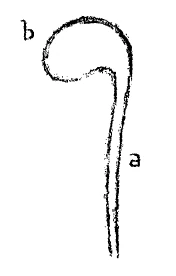
[ 6 ] The one thing we can clearly distinguish in human beings is everything that is enclosed within organs that provide the greatest possible protection against the outside world. It is everything that we can classify as belonging to the realm of the brain and the spinal cord. Everything that, in this respect, belongs to human nature—to the brain and spinal cord—is firmly enclosed within secure, protective bony structures. If we wish to schematically represent what belongs to these two areas, we can illustrate it as follows: If a (see diagram) schematically represents the stack of vertebrae running along the spinal cord, and b represents the skull vault and the bones of the skull, then enclosed within the canal formed by the stacked vertebrae as well as by the bones of the skull is everything that belongs to the realm of the brain and the spinal cord. One cannot look at a human being without realizing that everything belonging to this realm essentially forms a self-contained whole, and that everything else in the human being—which we can physiologically associate in various ways—such as the neck, torso, and limbs—is connected to the brain and spinal cord through, figuratively speaking, more or less thread-like or ribbon-like structures. These must first break through the protective covering so that a connection can be established with the part enclosed within these bony structures. Thus we can say: Even upon superficial observation, everything that is human reveals itself as a duality; one part lies within the bony structures described above, enclosed in firm and secure protective shells, the other outside of them.
[ 7 ] Now we must first take a very cursory look at what lies within these bony structures. Here we can again easily distinguish between that large mass embedded in the skull bones as the brain, and the other part that hangs from it like a stalk or strand, which is organically connected to the brain and extends into the spinal canal like a kind of thread-like outgrowth of the brain—the spinal cord. If we distinguish these two structures from one another, then we must already draw attention to something that external science need not draw attention to, but to which occult science—which must penetrate into the depths of the essence of things—must certainly draw attention. Attention must be drawn to the fact that everything we say on the basis of a consideration of the human being initially refers only to the human being. For the moment one delves into the deeper reasons behind the individual organs, one becomes aware—we will see in the course of these lectures that this is indeed the case—that an organ can have a completely different function in its deeper meaning in humans than a similar or analogous organ in the animal world. Anyone who views things from the perspective of ordinary external science will say: What you have told us here can also be said with regard to mammals. - But what is said about the significance of the organs in relation to human beings cannot, when one delves deeper into the matter, be said in the same way for animals; rather, occult science has the task of considering animals in their own right and examining whether what applies to human beings regarding the spinal cord and brain also applies to animals. For the fact that animals closely related to humans also have a spinal cord and a brain does not prove that these organs perform the same functions for humans and animals, just as, to use a comparison, one can hold a knife in one’s hand to carve a calf, for example, or to use it for erasing. In both cases, one is dealing with a knife, and anyone who considers only the shape of the knife will believe that it is the same thing in both instances. In the same position would be the person who believes that, because humans and animals possess the same organs—the brain and spinal cord—these serve the same functions. But that is not true. This is something that has become commonplace in external science and has led to certain inaccuracies, and which can only be corrected if external science is willing to gradually address what can be said from the depths of supersensible research regarding the characters of beings.
[ 8 ] If we now consider the spinal cord on one side and the brain on the other, we will easily see that there is a certain truth to what thoughtful observers of nature have been pointing out for more than a hundred years. There is a certain accuracy in saying: When one looks at the brain, ‘it looks, as it were, like a transformed spinal cord.’ — This becomes even easier to understand when one recalls that Goethe, Oken, and other observers of nature focused their attention above all on the fact that the bones of the skull bear certain similarities in form to the vertebrae of the spine. It was Goethe, who closely observed the morphological similarities of the organs, who noticed very early in his reflections that if one imagines individual vertebrae being transformed—flattened and expanded—one then arrives, through such a transformation of the vertebrae, at the skull bones. As it were, by inflating a vertebral bone in all directions so that it becomes flat in its dimensions, one can gradually derive the shape of the skull bone from a vertebral bone. Thus, in a certain sense, the skull bones can be called transformed vertebral bones. Just as one can regard the skull bones that enclose the brain as transformed vertebrae, so one can imagine the mass of the spinal cord as if it were expanded, made more differentiated and complex, and from the spinal cord, through a process of transformation, one obtains the brain. Just as a plant that initially has only green leaves transforms and differentiates them to produce colorful petals—just as the petals are differentiated leaves—so we can imagine that the brain was formed through transformation, through differentiation of form, through the elevation of the spinal cord to a higher level. One can thus imagine that we can see a differentiated spinal cord within our brain.
[ 9 ] Now let us look at the two organs from this perspective. Which of these organs must we naturally regard as the younger one? That is the question we must ask ourselves. But undoubtedly not the one that exhibits the derived form, but rather the one that possesses the original form. That is to say, we must conceive of the spinal cord as being at a first stage of development; it is younger, and the brain is at a second stage. It first passed through the stage of the spinal cord; it is a transformed spinal cord and must therefore be regarded as the older organ. In other words, when we consider this new duality that presents itself to us in human beings as the brain and the spinal cord, we can say: All the forces that led to the formation of the brain must be older forces, for they must first have formed the rudiment of the spinal cord at an earlier stage and then continued to work toward the transformation of the spinal cord into the brain. There must therefore have been, as it were, a second development in our spinal cord, which as such is not yet so far advanced, but has remained at an earlier stage of development. So, if we wish to express ourselves with pedantic precision, we must regard the spinal cord nervous system as a spinal cord of the first order, and our brain as a spinal cord of the second order—a transformed, older spinal cord, a spinal cord that was once such but has been transformed into the brain.
[ 10 ] We have thus first pointed out in great detail what must be taken into account if we are to properly consider the organ masses enclosed within these bony protective shells. Now, however, another factor comes into play, one that can only be encountered in the realm of occultism. One can raise the question: When such a transformation takes place from a first-stage organ formation to a second-stage organ formation, is the developmental process progressive or regressive? That is to say, can it be a process that leads to higher stages of perfection in an organ, or rather a process that causes the organ to degenerate, to gradually die off? Let us consider an organ such as our spinal cord. As it is now, it appears to us as a relatively undeveloped organ; one could call it young, for it has not yet managed to become a brain. But we can think of this spinal cord in two ways. First, we can imagine that it possesses the potential to one day become a brain; in that case, it is in a state of progressive development. Or we can imagine that it lacks the capacity to ever reach this second stage; in that case, it would be in a state of descending development, heading toward decay and destined to hint at the first stage but never to reach the second. If we now imagine that our present brain was once based on a spinal cord, then that spinal cord of the past undoubtedly possessed progressive forces, for it did indeed become a brain. But if we now ask ourselves about our present spinal cord, the occult perspective tells us: As our spinal cord is today, it does not in fact possess the potential for progressive development, but is preparing to complete its development at the present stage. — If I may put it grotesquely: Human beings should not believe that their spinal cord, as it is today in the form of a thin strand, will one day be as puffed up as the brain is today. We shall yet see what underlies the occult perspective that allows us to say such a thing. Even from a mere comparison of the form of this organ, the spinal cord, as it appears in humans and as it does in animals, you can see an external indication of what has just been said. For example, if you take a snake, you can see how the spine begins behind the head in countless rings, filled with the spinal cord, and how the spine is formed in a way that could continue almost endlessly. In humans, we see how the spinal cord, running downward from the point where it connects to the brain, in fact closes in more and more and, as it descends, increasingly loses the structure it exhibits in the upper regions. Thus, even through external observation, it is already apparent how what continues backward in the snake is approaching a conclusion, a kind of degeneration, in the human being. This is, for the time being, an external, comparative perspective. We shall see what the occult perspective looks like.
[ 11 ] If we now consider this as a whole, we may say: Enclosed within that bony structure of the skull is a spinal cord that, through progressive development, has become the brain, which is now at a second stage of its evolution. And we are, as it were, making another attempt to form such a brain in our spinal cord, but an attempt that already shows it will not succeed.
[ 12 ] Let us now set this line of thought aside and turn to what we already know from a superficial, layman’s perspective: the functions that the brain and spinal cord are responsible for. It is, after all, more or less common knowledge that the brain is the instrument for the so-called higher mental activities, and that these higher mental activities are directed by the brain. It is also common knowledge that the more unconscious mental activities are directed by the spinal cord and the nerves connected to it—namely, those mental activities in which little deliberation intervenes between the external stimulus and the action that follows it. If, for example, you are stung by an insect on your hand, you pull your hand back; you flinch; there is no great deliberation between the sting and the withdrawal of the hand. These mental activities are rightly regarded by external science as having the spinal cord assigned to them as their instrument. We have other mental activities in which a richer deliberation intervenes between the external impression and what ultimately leads to action; these have their organ in the brain. To take a striking example right away, think of an artist who observes the external world, who strains his senses and gathers countless impressions; then a long time passes during which he processes these impressions in his soul. Finally, often only after years, he proceeds to fix through external actions what has become of the external impressions through a long process of mental activity. Here, a richer mental activity intervenes between the external impression and what the human being makes of the external impression. The same is true of the scientific researcher, but also of every person who considers the things they wish to do and does not rush headlong into them like a bull seeing the color red. Whenever a person does not act out of a reflexive impulse but deliberates on their actions, we speak of the brain as an instrument of soul activity.
[ 13 ] If we delve even deeper into this matter, we will ask ourselves: Yes, how does this activity of our soul—for which we use the brain as a tool—manifest itself? It manifests itself in two ways. First, we become aware of it in our waking daily life. What do we do there? We gather external impressions through the senses and process them in the brain through rational thought. We must imagine that external impressions flow into us through the gates of the senses and stimulate certain processes in our brain. If we could look into the brain and see what is happening there, we would see how our brain is set in motion by the stream of external impressions pouring into it, and we would see what becomes of these impressions through the workings of human reasoning. We would then see how the consequences of these impressions that are less influenced by reflection also come into play—that is, deeds and actions that we must attribute more to its instrument, the spinal cord.
[ 14 ] Now we must turn our attention to the two states in which modern human beings alternate throughout their lives: waking life and unconscious sleep. From earlier lectures, we are familiar with the fact that during the day the four constituent parts of the human being are united, whereas during sleep the astral body and the ego stand apart. Now we are all familiar with that peculiar state that lies between waking life and unconscious sleep: the dream state. For the time being, we shall speak of the dream state only in terms of how the layperson can observe it. We see that the dream state bears a remarkable resemblance to that subordinate soul activity which we associate with the spinal cord. For when these images appear in our soul, they do not appear as ideas arising from deliberation, but they arise out of necessity, much like the involuntary movement of the hand when we shoo away a fly that has landed on our hand; an action arises as an immediate, necessary defensive movement. In the dream life, it is somewhat different; there is no action, but images enter the horizon of our soul with an equally immediate necessity. But just as we have no influence through deliberation in waking daily life over the hand movement we make when a fly lands on our hand, so too do we have no influence over the dream images that surge chaotically within us. Therefore, we can say: When we observe a person in waking life and disregard everything that is going on within them, when we consider only their reflex movements—all the gestures and facial expressions they perform solely in response to external impressions, that is, without deliberation—we have before us a sum of such actions that occur in humans out of necessity. If, on the other hand, we observe a person dreaming, we see a multitude of images working into the person’s being, which do not now lead to actions but have only an imaginal character. Just as in waking daily life the person’s actions take place without deliberation, so the world of images appears within the person as chaotic, intermingling dream-images.
[ 15 ] If we now turn our attention to our brain and wish to view it as an instrument of dream consciousness, what must we do? We must imagine that there is something within this brain that behaves, in a certain sense, similarly to our spinal cord, which governs unconscious actions. After all, we must first regard the brain as an instrument of waking mental life, where we create our deliberate thoughts. We must now discover how a mysterious spinal cord, as it were, underlies dream images—one that sits embedded in the brain, yet does not lead to actions, but only to images. While our spinal cord leads to actions, even if they do not arise through deliberation, in this case the brain leads only to images. It remains, so to speak, halfway; there is something in the brain like a mysterious foundation for unconscious mental activity, which can be imagined as a kind of insert with the character of the spinal cord. Could we not therefore say: The dream world leads us in a strange way to be able to mysteriously point to that ancient spinal cord that once formed the basis of the brain? — When we look at our brain as it is formed today as an instrument of waking daily life, it is as familiar to us as it appears when we remove it from the cranial cavity. But there must be something enclosed within it that emerges when waking daily life is extinguished. And occult observation reveals that within the brain there is a mysterious spinal cord serving as the instrument of dream life (see drawing on p. 24, hatched).
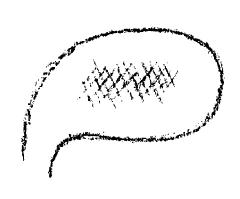
[ 16 ] If we were to sketch it out schematically, we could depict it as follows: within the brain, beneath the world of waking day-to-day life, lies a mysterious, ancient spinal cord that is invisible to external perception and is somehow hidden there. I will first state this purely hypothetically: this spinal cord becomes active when a person sleeps and dreams, and then functions as a spinal cord ought to, namely in such a way that it necessarily produces its effects. But because it is compressed within the brain, it does not lead to actions, but to mere images, to pictorial actions; for in dreams we act only in images. Thus, even from this peculiar, strange, chaotic life we lead in dreams, we would have indications that our instrument of waking daily life—which we rightly regard as our brain—is based on a mysterious organ that is perhaps an older formation from which it has developed. When the new formation, the present-day brain, is silent, then what the brain once was reveals itself; for this old spinal cord conjures forth what it is capable of. But because it is enclosed, this old spinal cord does not give rise to actions, but merely to images.
[ 17 ] Thus, the very act of contemplating life divides the brain into two stages. The fact that we are capable of dreaming indicates that the brain underwent a development in which it was still at the level of today’s spinal cord before it evolved into the instrument of waking daily life. But when waking daily life falls silent, the old organ still makes itself felt.
[ 18 ] Thus, from what has been said so far, we have already gained some insight into a fundamental characteristic that can be demonstrated simply by observing the forms: waking life relates to the life of dreams as the fully developed brain relates to the spinal cord. If we now proceed to a clairvoyant observation, we can add something to what the observation of forms can provide us. We shall see later in what way occult vision, the clairvoyant eye, can serve as a foundation for a truly essential observation of human nature, and upon what occult research the views regarding the organs enclosed within the skull and the spinal column are based.
[ 19 ] Now, as we know from earlier considerations, the human being’s visible body is only a part of the human being’s entire being. The moment the clairvoyant eye opens, one experiences that this physical body appears to be enclosed, embedded within a supersensible organism—in what is, roughly speaking, called the human aura. This is stated here initially as a fact, and we will return to it later to discuss the extent to which it can be justified. This human aura, within which the physical human being is merely a core, appears to the clairvoyant eye as a formation of colors in which various colors ebb and flow. One must not, however, imagine that this aura could be painted. It cannot be rendered with ordinary colors, for the colors of the aura are in constant motion, in a state of ceaseless arising and passing away. Any picture one might attempt to paint of it could only be approximately correct, just as no one can paint a flash of lightning correctly; it would merely become a rigid form. Just as one cannot paint a flash of lightning correctly, so one can do so even less with the aura, for the auric colors are exceedingly unstable and mobile; they arise and pass away continuously.
[ 20 ] Now the colors of the aura extend across the entire human organism in the most remarkable ways; and it is interesting to note the auric image that presents itself to the clairvoyant eye when we view the top of the skull and the spine from behind. If we imagine the part of the aura—viewed from behind—in which the skull and spine, that is, the brain and spinal cord, are embedded, it becomes apparent that we can identify a particularly distinct base color for the part of the aura belonging to the lower regions of the spinal cord: it appears greenish. And we can again specify a distinct color, which in its nature does not appear in any other part of the body, for the upper regions of the head, where the brain is located: it is a kind of violet-blue. This color covers the skull from back to front like a cap or a helmet.
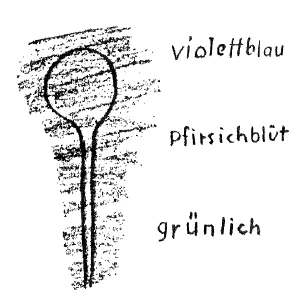
[ 21 ] Below the violet-blue sections, one generally sees a shade that is best described by comparing it to the color of a young peach blossom. Between this color and the greenish color of the lower parts of the spine, we find other, indefinable shades in the middle section of the back that are extremely difficult to describe because they do not occur among the ordinary colors familiar to us from our sensory environment. Thus, the green is followed by a color that is neither green, nor blue, nor yellow, but rather like a mixture of all three; colors appear between the brain and the end of the spine that, strictly speaking, do not exist at all within the physical-sensory world. While this may be difficult to describe, one thing can be said with certainty: at the top, near that so-to-speak inflated spinal cord, we have a violet-blue, and, moving down toward the end of the spine, we arrive at a distinctly greenish hue.
[ 22 ] Today, then, we have added to a purely external examination of the human form certain facts that can only be revealed through clairvoyant research. Tomorrow we shall attempt to consider the other parts of the physical human body—those connected to the ones already discussed—in their duality, so that we may then proceed further and see how the entire human being presents itself to us.