

An Occult Physiology
GA 128
28 March 1911, Prague
Translated by Steiner Online Library
Eighth Lecture
[ 1 ] In this final lecture today, my task will be to to bring together the reflections of the past few days on occult physiology—which have attempted, albeit in a somewhat sketchy manner, to depict the processes of the human organism—into a kind of overall picture, which can, of course, only be sketchy, but through which we may be enabled to gain an insight into the living life and activity of the human organism. We would do best to start once again with the most general aspects—the interrelationship between the human organism and the external world, our physical Earth, in the absorption of nutrients.
[ 2 ] Once ingested, these nutrients are transformed in a wide variety of ways and gradually altered by the various organ functions so that they can be directed to the individual parts of the human organism, to the individual systems of the human physical being. It is not difficult to see that everything that the human organism makes out of these nutrients is, in essence, what actually makes the human being, as he stands before us in the physical world, a physical human being in the first place. There is, of course, a certain difficulty in understanding this. However, if we take the principles we have upheld so far seriously and truly apply supersensible knowledge to the study of the human being, we must say that it is only the nutrients that are substantially taken up into the human organism from the external world. All other influences acting upon the human being we must, in essence, conceive of as supersensible, invisible forces. If you were to imagine for a moment that everything filling the human organism—derived from nutrients—were removed, you would be left, in physical terms—forgive the trivial expression—with far less than an empty sack: namely, nothing at all. For even what exists in the form of skin, the covering of the physical organism, exists only because appropriately processed nutrients have been directed to the relevant parts. If you set aside the nutrients and what becomes of them, you must conceive of the human organism behind them solely as a supersensible system of forces that brings about the distribution of the assimilated nutrients in all directions. If you truly bring this thought, as it has now been expressed, before your soul, you will say to yourself: But one thing is actually the prerequisite before anything, even the smallest thing, can be absorbed from the nutrients, for these substances cannot be transported from the external world into just any being so that what takes place in the human organism might take place within it. From the very first intake of food, the human being must be able to counter the physical foodstuffs with an inner force that originates from the supersensible world, and the human being as such must already be contained within this inner system of forces. In occultism, we call that which is thus initially set against the actual physical building materials of the human being—and which must certainly be conceived as supersensible—we call this, in the broadest sense, the human form. When we consider the very lowest boundary of the human organism, we must imagine that physical matter stands opposite the supersensible form, which, as a system of forces born out of the supersensible worlds, is destined to receive the matter—not like a physical sack or bag, but as something superphysical, something supersensible—and to shape that which first makes the human being appear physically and sensually at all. It is only through the assimilation of the nutritional material into this supersensible form that the otherwise purely supersensible human organism becomes a physical-sensory organism that can be seen with the eyes and grasped with the hands. What is thus set against physical matter is called “form” for this reason, because in fact such a law operates throughout all of nature—an exactly identical law that is called the “principle of form” everywhere. When we observe the external world, we find that the principle of form is at work everywhere, right down to the crystal. The substances that enter the crystal must, in order to become what the crystal appears to be, be captured, as it were, by the principle of form, and it is this principle that, with the help of the substances, makes the crystal what it is. Take, for example, table salt, sodium chloride: here you have chlorine and sodium, a gas and a metal, combined as physical substances. You will easily see that these two substances, as they are before they are captured by a formative entity and thereby crystallize into a chemical compound in the form of cubes, each exhibit completely different forms on their own. Before they enter into this principle of form, they have nothing in common; but they are harnessed, taken up by this principle of form, and this forms the physical body of table salt.
[ 3 ] Thus, everything that appears in the human organism as transformed nutrients presupposes the lowest supersensible entity, the supersensible form. When new nutrients are to enter the human organism—which is already demarcated externally by the action of the form principle—they must, under normal circumstances, be taken in through the mouth into the digestive tract. In doing so, they undergo their very first transformation right from the moment they leave the mouth. Further transformations are brought about through the digestive tract. These transformations of the most complex nature could not take place if a higher principle—which we have called the form principle—were not integrated into the human organism; through its activity, the nutrients—which initially, when ingested, behave neutrally and indifferently toward one another—are modified so that they are able to form living organs. Although the process is entirely different in humans because it occurs on a different level, we can imagine this transformation of nutrients in the human digestive tract, by way of comparison, as if plants were absorbing their nutrients from the mineral soil and transforming them in such a way that they build themselves up into the form of the plant in question. This is only possible because, in the plant, the flow of nutrients is taken up by a life process or, as we say in occultism, by the etheric body as the first supersensible principle. In the same way, the nutrients entering the human organism are processed by the etheric body; that is, the etheric body ensures their transformation and their integration into the inner laws of the human organism. We must therefore regard this first supersensible member of the human being, the etheric body, as the agent of the initial transformation of the nutrients. Once these nutrients have been transformed to the point where they are incorporated into the life process, they must then be further processed and adapted to the human organism in the sense described in the preceding lectures. They must be processed in such a way that they can gradually serve those organs in the human organism that are an expression of the higher supersensible principles, the astral body and the ego. In short, we must be clear that the higher principles—the astral body and the ego—must extend their unique mode of activity down to the processes in the organs of the alimentary and digestive systems, and that they must work their way down into the transformed nutrients.
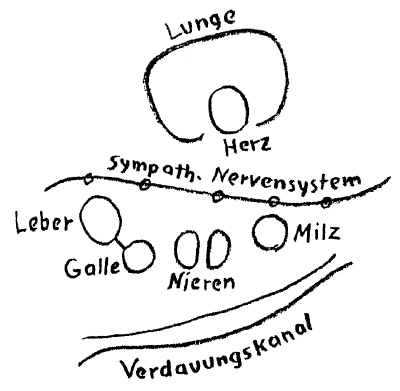
[ 4 ] Here, the organs we are already familiar with—those we have referred to as the seven organs of the inner world system—stand in opposition to the flow of nourishment. Let us once again sketch out the inner world system of the human being in a very schematic way:
[ 5 ] Nutrients are thus absorbed and initially processed in a wide variety of ways in the digestive tract; they are then processed further by the liver, gallbladder, spleen, heart, lungs, kidneys, and so on. Now that we understand that these organs, through their corresponding energy systems, are designed to further process the flow of nutrients, we may ask: What is the purpose of this further transformation? — If the flow of nourishment were processed only to the extent that occurs in the digestive tract in order to serve the life form, then human beings would be able to lead only an unconscious, plant-like existence, for they would not have developed such organs that can serve as tools for their higher faculties. The seven organs, however, further transform the food stream, and we know that these processes are prevented by the sympathetic nervous system from entering human consciousness. Therefore, in the sympathetic nervous system, together with the seven organs, we have that which opposes the food stream.
[ 6 ] We have thus already penetrated to a high degree from the outside into the interior of the human organism. But what takes place in there—one might call it the mutual interaction of the seven organs—is something that could not occur anywhere else in our earthly world as it does in there. It can only happen this way because this inner realm is completely sealed off from the outside world, and the substances are prepared for this inner activity through the digestive tract. So we are already standing right inside the human organism.
[ 7 ] Now we must note the peculiar fact that, since we are situated so deep within the organism, the organism must organize itself internally and differentiate itself internally. In order to meet all the demands placed upon it, the organism must develop a multitude of interacting organs. It is precisely this multiplicity of organs that is necessary for the manifold inner processes. We shall see in the following what must be achieved through them. If we imagine that only the flow of nourishment were transformed by the seven organs of the inner world system, then human beings would never be able to open up their being to consciousness. He would not even be able to possess the most rudimentary form of consciousness, because everything that takes place there is veiled, kept from consciousness by the sympathetic nervous system. A connection is therefore necessary between these internal organ systems—built up, so to speak, from the outside—and what lies further within the human organism. This connection is established by the fact that, through everything the nutritional process provides in its entirety, the entire form of the human organism is permeated by what we call, in the broadest sense, tissue. A certain type of tissue of the simplest organization permeates all the individual parts of the human being, capable of transforming and developing itself in such a way that the most diverse organs can form. Certain types of tissue, for example, transform themselves by incorporating special cells to become muscles; others transform themselves by hardening and incorporating bone cells as they assimilate the corresponding substances. So that in the individual organs of the human organism we must always bear in mind what underlies them, namely the tissue that permeates the body in all directions, from which the individual organs develop. This formative tissue, however, no matter how capable it might be of growing and forming the most diverse organs from within itself, would still represent nothing other than, at its core, something plant-like; for that is indeed the essence of the plant-like: that plant beings grow, that they produce organs from within themselves, and the like. But as the human being rises above the plant-like, a completely new element must present itself to us, through which the human being is enabled to add to plant life that which elevates him above plant life. Human beings must add consciousness, initially the simplest form of consciousness, the dull consciousness that enables them to perceive their own inner life. As long as a being does not consciously experience its own inner life, as long as it is not yet able to, as it were, reflect inwardly upon itself in order to experience this inner life, we cannot say that it rises above the plant-like state. It is only by doing this—by not merely having life within itself, but by consciously experiencing this life, by first reflecting on and witnessing these inner processes—that a being rises above the plant-like state.
[ 8 ] How does experience actually come about? We have already coined a term for this. We have already shown in earlier lectures that experience arises through secretion processes. Therefore, we must look to secretion processes as the foundations of inner experience—that dull experience of consciousness permeating the inner life processes. We will have to assume that secretion processes take place everywhere within the tissues; and indeed, these secretion processes are already evident to us upon external observation of the human organism, when we see how substances are continuously absorbed from all parts of the tissue through what we call the lymphatic vessels, which, like a kind of separate system alongside the circulatory system, permeate the entire organism. The secretory processes that mediate the dull inner experience flow, so to speak, from all regions of the human organism into the lymphatic system. If we could, in the abstract, imagine the entire blood system removed and conceive of the tissue as having nothing of a blood-like character, we would have to imagine that higher processes take place in the blood system compared to those of the lymphatic system. In these secretions, the human being feels, as it were, his own physical body in a dull, animal-like consciousness. It reflects his organization in a dull manner. And just as, on the one hand, the sympathetic nervous system keeps everything from reaching consciousness that seeks to rise up from the digestive and nutritional processes and the seven organs, so, on the other hand, through a sort of reflection of the activity of the sympathetic nervous system, through connection and interaction with the lymphatic channels, a dull consciousness is formed—one that is, however, overshadowed by the bright daylight consciousness of modern human beings. It is overshadowed by the bright daylight consciousness of the ego, just as a weak light is overshadowed by a strong one. This dull consciousness is, as it were, the other side of that consciousness which makes use of the sympathetic nervous system as its instrument.
[ 9 ] If human beings had developed their organism only to the point of forming the bodily tissues and organs necessary for internal digestive processes and for secretions into the lymphatic system, they would be able to perceive their inner life only with a dull awareness. However, they would not be able to achieve the development of ego-consciousness; this can only be acquired when they do not merely experience themselves internally, but also open themselves outward. Here we again observe an opening outward. We have already spoken earlier of how breathing enables human beings to enter into direct contact with the external world. Now we can go further and say: Insofar as we consider the inner human being, we may actually only go as far as the digestive system, for we can say: Insofar as the extensions of the organs of the inner world system turn toward the digestive tract, we must already see in this contact of the inner world system with the digestive tract an opening up to the outside world, for the human being is, as it were, ready to take in nutrients from the outside. By coming into close contact with nutrients taken from the environment, the human being is, in fact, no longer merely internal. We have encountered a further opening outwards in respiration, and to an even greater extent it can be recognized in those organs that serve the soul functions.
[ 10 ] Thus we see that human conscious life is grounded, on the one hand, in a subdued inner life and, on the other hand, in the ability to open oneself to the external world and to connect with it. Only through this can a human being be an “I”-being. Only by sensing not only the resistances within his own inner being during his processes of separation, but also the resistances that the external world opposes him, can a human being develop his sense of self. Thus, the fact that a human being can also open himself up to the outside world again provides the foundation for the physical selfhood of the human being. But this also requires that human beings have the opportunity to develop the organ of this ego in the most manifold ways. And we have indeed seen how the organ of the ego, the blood, integrates itself into the organism and how the blood circulation permeates all the organs to serve as an instrument for the ego. Just as the ego permeates and interweaves the entire human being spiritually and psychologically, so the blood circulation physically permeates the entire human organism, turning, as it were, in two directions: toward the inner being of the human being with its seven organs and so on, and then we have again an opening outwards, a coming into connection with the external world. We can therefore speak, in the highest sense of the word, of a circulation of forces that lie behind physical phenomena and that find a point of connection through the ego.
[ 11 ] Now we need to take a closer look at the individual phases of this cycle. First of all, we must once again trace the process of nutrition—the intake of nutrients—which, by being taken up by the etheric body, or rather by the power of the etheric body, become a living stream within the human organism; then the inner world system, the seven organs, stands opposite them, precisely because—as we have already seen—otherwise the human being would not be able to transcend a plant-like existence. At a further, higher stage, it is necessary for the functions of these seven organs to oppose the stream of nourishment. Thus, what comes from the actual astral nature of the human being counteracts the animated stream of nourishment; the stream of nourishment comes from outside, and what constitutes the inner human nature counteracts it. First, the stream of nourishment—that is, the external world taken in—encounters the etheric body, which transforms the nutrients in the digestive system; then the human astral body opposes it, further transforming the nutrients and integrating them in such a way that they become increasingly adapted to the organism’s inner activity. In its further course, the stream of nourishment must also be taken up by the forces of the ego, of the blood itself. That is to say, the instrument of the ego must reach down with its activity to the point where the stream of nourishment is taken in. Does the blood do this? Is what we must say from the occult perspective true?
[ 12 ] Yes, the blood is driven down into the digestive organs as well as into all other organs. In the digestive organs, it undergoes a process through which it can finally become the complete instrument of the human ego in the physical world. We know that the blood, as the instrument of the human ego, must undergo a transformation from so-called red blood to blue blood. The ego works through its instrument, the blood, all the way down to the very beginnings of the digestive and nutritional processes. Here, too, we are once again confronted with a resistance. How does this happen? It happens as the blood enters the liver via the portal vein system, where bile is produced from this, so to speak, transformed blood, and the bile in turn directly confronts the flow of food. Here in the bile, we have a wonderful connection between the two ends of the inner human organism. On the one hand, the stream of food absorbed from the digestive tract represents the outermost material that enters our physical organism; on the other hand stands the I, the noblest thing a human being can possess within the earthly world, with its instrument, the blood. The ego establishes a direct connection with the outermost material by preparing the bile at the end of the blood process via the liver, and in the bile—in the transformed, altered blood—the ego stands in opposition to the flow of food.
[ 13 ] Here we see the ego working its way down into the coarsest material realm and then producing highly organized substances such as bile. And anyone who wishes to understand these intimate processes between blood, bile, and the digestive process can find in these very facts something that makes many of the human organism’s mysteries appear clearer to them; and by continuing to study these processes—including, for example, abnormal processes resulting from a backflow of bile or a reflux of bile into the blood, as seen in so-called jaundice—they can assess and treat them more accurately. But that would take us too far afield today if we were to elaborate on such matters as well.
[ 14 ] Thus we see how the seven organs actually extend down into the workings of the etheric body and have taken in the influences of the I from above. We thus have in the gall something that, under the influence of the ego, directly opposes the flow of food. If the gall is to act upon the flow of food, which has already become a living substance in the digestive process, it must also be able to oppose it as a living substance. This occurs because it is formed within an organ that belongs to the seven members of the inner world system which animate the inner being of the human being, so that the bile, as an inner life force, encounters that which comes from without.
[ 15 ] Just as the gallbladder is connected to the liver, so too is the liver connected to the spleen. When we consider these organs—the liver, gallbladder, and spleen—we must say that it is these organs that directly confront the flow of nourishment and transform it in such a way that it becomes capable of ascending to higher levels of the human organism. However, they must also supply those organs that open outward—namely, the heart, the lungs, and even the digestive tract itself—but above all the organs of the head, the sensory organs.
[ 16 ] We have already established that all inner experience is closely linked to secretory processes. That is why we have also given special attention to these secretory processes. In terms of those processes within the overall organism, the liver, gallbladder, and spleen initially have nothing directly to do with secretory processes; they do secrete substances, but this is related to nutrition. They mediate the ascending life that turns away from the lowest forms of life toward the organ of consciousness, toward consciousness itself. But as the heart joins these organs as a fourth organ and the heart, through the circulation of blood, also opens itself to the outside, the human being attains self-consciousness. However, he would not be able to experience this “I” as that which stands opposite the external world if he did not relate this outward-looking “I” to what he already possesses as a dull awareness of his inner bodily life. He must add yet another process to the secretory processes of the inner organism, one that also conveys to him an experience of his inner self through the “I,” which has its instrument in the blood.
[ 17 ] At first, through the secretion of lymph, a person experiences their inner life only with a vague sense of awareness. But then secretion must also be possible from the blood, and in this secretion the person becomes aware that they stand before the external world as a distinct being, as an inner self. However, in their experience of the external world, human beings would face it in such a way that they would lose themselves internally if they did not know that the being which breathes the air and takes in and processes nutrients from the outside is the same being as the one they experience within. That human beings do not lose themselves, that they stand before the external world with their own being—this is made possible by the fact that they excrete carbon dioxide from the transformed blood through the lungs and excrete the transformed substances that come out of the blood through the kidneys.
[ 18 ] This characterizes, in terms of their function, both the organs that mediate an ascending process—the liver, gallbladder, and spleen—and those that mediate a descending process—the lungs and kidneys. However, we must not oversimplify this—which is entirely inappropriate in theosophical considerations—but rather recognize that the lungs, by opening outward, also mediate an ascending process. We thus see how these seven most important members of the inner human world system are connected to the inner experience of the human being and to the opening outwards. On the one hand, these seven members transform the inherent activity of the nutrients into the inner activity of the organism and supply the human organism with these transformed substances. They make it possible for the human being to open outwards again. But they also make it possible for what the human being develops as excessive inner activity to be expelled outward through the excretory processes of the lungs and kidneys. Through the work of the lungs and kidneys, we thus have a regular regulation of the activity of the human organ systems. This entire relationship between the human organ systems is expressed in such a way that, in occultism, one could indeed give no better image of it than to say: The heart, as the sun, stands at the center and influences the three organs of the inner world system that carry out the ascending processes—the liver, gallbladder, and spleen. Just as in the macrocosm the Sun stands in the planetary system in relation to the outer planets Jupiter, Mars, and Saturn, so in the microcosm, in the human organism, the inner Sun, the heart, stands in relation to the liver-Jupiter, the gallbladder-Mars, and the spleen-Saturn. I would have to speak not for weeks, but for months, if I were to explain to you all the reasons why, in the context of precise and intimate occult observation, the relationship of the Sun to the outer planets of our solar system may truly be set in parallel with the relationship that the heart has, within the human organism, to the inner world system—to the liver, gallbladder, and spleen. In fact, the outer relationship is so precisely mirrored that the interaction of these organs reflects what is taking place in the great world of the macrocosm, in our solar system. And it is equally justified to speak of the processes taking place between the Sun and the inner planets down to our Earth as being reflected in the relationship of the heart to the lungs and to the kidneys. Thus, in this inner world system of the human being, we have something that mirrors the outer world system.
[ 19 ] We have already hinted at this during the course of the lectures: when we delve into our own inner being through clairvoyance, we cease to perceive our internal organs merely as they appear to the physical eye. We must move beyond the mental image that external anatomy forms of our organs by rising to contemplate the true form these organs possess, when we take into account that these organs are, in fact, systems of force. The true nature of these organs cannot be fathomed through external anatomy, for it sees in them only the transformed nutrients that have been stuffed into them. And precisely because external science is willing to accept only this view, it cannot recognize the inner systems of forces that underlie the organs. But for those who are able to perceive, through clairvoyant observation, what underlies these organs as systems of forces, it becomes clear how justified it is to name the organs after the planets, because they recognize how the relationship between the planets of our outer solar system is repeated in our inner organ system.
[ 20 ] Now, we said yesterday that the organs can develop excessive internal activity. Each individual organ can develop excessive activity, and this irregularity can manifest in such a way that it affects the entire organism. Now, I already pointed out yesterday that if, as a result of such excessive internal activity, something like a willful life of its own arises in the internal organs, it is necessary to counteract it with something that dampens this internal activity. That is to say, if the internal organs are processing too vigorously, if they are transforming the external activities of the nutrients too intensely, if they are producing an excessive internal metabolic product, then we must counteract them with something from the outside that restrains them, that dampens the excessive internal activity.
[ 21 ] How can this be done? If we wish to treat an organ of the internal system that has developed excessive internal activity, we must look for something in the external world that possesses the opposite activity and introduce it into the organism in order to counteract the organ’s excessive activity. That is to say, we must try to identify those external activities that correspond to the activities of the individual organs. In the Middle Ages, people still knew a great deal about how environmental substances—that is, external substances—can counteract the excessive activity of the organs. To modern people, who often encounter such things only in distorted medieval texts in which they see nothing but colorful superstition, this sounds quite strange. But in occult science, the correspondence between the organs of the inner world system and certain external substances has been carefully, deeply, and thoroughly investigated over millennia, and countless observations made with the clairvoyant eye have proven that, for example, the excessively active inner Jupiter—the liver—can be restrained by the metallic substance of tin. We combat the excessive inner activity of the gallbladder through that which is expressed in the metallic substance of iron. This is not at all surprising, for iron is the only metal we must have in our blood as an essential component for the instrument of the ego, and we have indeed seen that the gallbladder is precisely the organ that mediates the connection between the ego and the densest material stored within the human being—the stream of nourishment. Likewise, we can say that the spleen has its external counterpart in the metal lead. The heart—the Sun—corresponds to gold. The lungs—Mercury—as the name itself suggests, correspond to mercury, and the kidneys to the metal copper, that is, Venus. (It is written on the board:)
[ 22 ] Saturn Spleen Lead
Jupiter Liver Tin
Mars Gallbladder Iron
Sun Heart Gold
Mercury Lungs Mercury
Venus Kidneys Copper
[ 23 ] Now, if we wish to combat the excessive activity of the inner organism using the active forces found in these metals, we must be clear that everything in the organism is more or less interconnected and that the individual organ systems are formed in parallel with one another; in other words, human beings did not first emerge as headless beings; rather, the organs associated with the upper circulatory system—the brain-spinal cord system—develop naturally at the same time as the organs of the internal world system.
[ 24 ] Just as we have seen that there is an upward and a downward blood circulation, so too do we have an upward action of the lymphatic process—to which we have attributed a dull consciousness—toward the upper parts of the human organism. And it is now a fact that what is integrated into the upper blood circulation corresponds in a certain way to what is integrated into the lower blood circulation, and we can see that the metals mentioned earlier also have a connection to the upper organ system of the human being. You know that the lungs open outward toward the larynx, which is an organ of the upper human organism. Just as we see a connection between the gallbladder in the lower organ system and iron, so we can relate iron in the upper organ system to the larynx. These things are, of course, difficult, but I would still like to hint at some of them. Just as we have noted a connection between the gallbladder and the larynx in relation to iron, so too, in relation to tin—Jupiter—there is a certain correspondence between the upper part of our head, with everything that belongs to the forehead and the brain, and the liver; and in relation to lead—Saturn—a correspondence between the back of the head and the spleen.
[ 25 ] In this way, we have been able to extend our considerations to everything that is integrated into the human circulatory system within the seven members of the inner world system, and to how it relates to the outer world. We can take these correspondences into account for both normal and abnormal life. In these correspondences between the metals and the internal organs, we have a highly interesting fact. And if the manifold information contained in our therapeutic books were to be examined and compiled not in a chaotic manner but systematically, then these correspondences would prove themselves quite naturally from the external facts. And if such explanations are still regarded today as figments of the imagination, the occultist can remain quite calm about it, for he knows that the time must come when external facts will confirm his assertions.
[ 26 ] Now, we must not assume that, for example, in the case of kidney disease, we should simply administer ordinary copper; that would, of course, be a mistake. If we wish to introduce metallic substances into the organism, we must heat them so that they transform into a kind of metallic vapor. In the process, something like vapor-like particles develops, and in this form the metallic quality can act upon the internal organs. If we now consider the blood system, however, metals would be of no help in cases of disease. We have already pointed out that a kind of salt deposition takes place in the blood system. And just as the metallic acts on the internal organs, so the salty acts on the blood system. If one now wishes to influence the blood system through external means, one must supply it with salty substances. This can be done by inhaling salty air, through salt baths, or the like. However, we can also introduce salts or salt-forming substances from the other side, through the digestive process, so that we are able to induce the process of salt formation and salt deposition from two sides.
[ 27 ] If you recall what I explained yesterday regarding the physical effects of inner mental and emotional processes, you will easily be able to see that everything that stands in contrast to the processes at work in the metallic realm is the physical effect of emotional processes, for these emotional processes are closely connected with the swelling processes in the blood, which, however, can be halted by the introduction of external metallic substances that exhibit the opposite activity. If, for example, digestive activity gets out of hand and develops its own activity where the flow of nourishment is taken up by the etheric body, we can counteract this by administering appropriate salts; for if the etheric body exaggerates this process of seizing the flow of nourishment, it means an excessive uptake of salt. It must be tempered by the introduction of the external activity of a salt.
[ 28 ] Then we have processes that manifest externally as combustion or oxidation processes; these are processes in which something combines with the oxygen in the air. All those substances that readily combine with the oxygen in the air, when taken into the organism, permeate the organism most deeply with their vitality. While salts, when we introduce them into the organism, affect the organism only to a moderate degree, the metallic nature can act right into the inner world system. And in the air—that is, in the substances that readily combine with oxygen in the air—we have something that, when taken into the body, permeates the entire organism right down into the blood system. Thus we will be able to understand that through such processes, which create excessive inner activity in the development of heat—which is, after all, the outward expression of the impulses of the will—we feel ourselves influenced throughout our entire organism. This is not the case with the organic repercussions of the thinking process; when we focus our attention on these, we feel that these effects take place only in certain organs. You can see from this how extraordinarily complex the entire apparatus of the human organism is and how complex its relationship to the external world is.
[ 29 ] We have now shown how the human organism, with its own inner vitality, can be contrasted with external, inorganic, inanimate nature, and how salts and vaporized metallic substances can be used to influence the organism. But we also have the ability to influence human beings through other aspects of nature. We can also counter the human organism with what the active forces in the plant world are. If we simply consume a plant remedy as food, we would not achieve much by doing so, because, as we have seen, the internal organs ensure that the substances ingested are stripped of their own vitality. If, then, the plant is to be taken into the human organism in such a way that it continues to act in its capacity as a plant, this cannot happen if we consume it as food. This plant substance cannot act upon the ego, for the plant, as the highest member, has only an etheric body. The plant substance is thus simply absorbed where the flow of nourishment is captured by the etheric body, so that the plant substance cannot yet be considered as a remedy in the digestive tract, but only in those organs into which, in addition to the etheric body, the human astral body is already acting. For this reason, the plant realm begins to act only on the inner world system and on the sympathetic nervous system and the lymphatic system. The effect of the plant realm no longer extends to where the human being, through the blood, opens up once more to the outer world. The plant is associated with the middle part of the human organism, so that whatever activity can be found in the plant realm can only act upon everything that belongs to the inner world system and upon the corresponding organs of the head and the upper part of the organism. When the activities and functions of these organs are disturbed, when they function abnormally, then the influence of the plant realm comes into play to counteract this.
[ 30 ] We have thus discussed the effects of metals, salts, and plants. It is not appropriate at this time to delve further into other methods of combating irregularities or disturbances in the human organism, not so much because time is short, but mainly because theosophists would do well to stay away from all the areas that are currently drawn into partisan disputes. What has been listed so far does not belong to the partisan disputes; one can simply take it in, and then one will already see its truth; or else people may simply consider it pure nonsense, mere fantasy. That does not matter. For then, as a Theosophist, one would have to remain silent altogether if one did not want to say all the things that people regard as nonsense. But if we were to investigate the effects of animal substances on humans, we would become entangled in the dispute between the parties, and one might then think that Theosophy wishes to interfere in this dispute, which is taking place between the advocates and the opponents of therapeutic methods in the field of animal-based treatments. And it can never be the task of the theosophist to meddle in such fanatical disputes, for then we would run the risk of abandoning the objective, universal human standpoint.
[ 31 ] We have seen, however—even if the indications were all only sketchy—that this human organism is a complex system of individual organs that are at different stages of development and are connected in the most manifold ways both among themselves and with the organism as a whole. What is visible as the physical organism of the human being—what we can see with our eyes and grasp with our hands—is only a part of the human organism; but the supersensible, which works within it, we do not perceive in this way through our senses; it reveals itself only to the spiritual eye of the seer. We must not, therefore, say that all organs have developed uniformly; rather, it has become clear that we must view the human organism in such a way that we can discern older and younger elements within it. We have already emphasized, for example, that we must regard the brain as an older, more highly developed organ than the spinal cord, and that the brain was, so to speak, once at the level of the spinal cord. In a similar way, we can consider the digestive and circulatory systems in relation to the lymphatic system. Here we must place the lymphatic system comparatively at the level of the spinal cord; it is thus the younger system, whereas the complex digestive and circulatory systems have already undergone numerous transformations and are older than the lymphatic system, which does not open outward and secretes its metabolic products only inward into the tissues. This is a very important point of view. We must therefore view our present-day lymphatic system as something that, if it were not integrated into the other systems, would, with further development, become a digestive and circulatory system.
[ 32 ] We find a simpler system for mediating consciousness in the lymphatic system; the more complex system is found in the digestive-circulatory system. We must therefore look for organs within the human organism that have evolved from organ systems which previously had different functions. The statements made here on this subject could also be very clearly demonstrated to external science if one were willing to familiarize oneself with them. Everything that has been said about the transformation of organs can be verified through embryological studies. In every living being, what appears later in the course of development is already preformed in the embryonic structure. If we trace back from the fully developed human organism to the fertilized embryo, we could, using appropriate methods, find the complex organ systems already hinted at in their very earliest stages of development—and in such a way that even in these earliest stages they already reveal how they actually relate to one another.
[ 33 ] If you take a look at what we have before us as the outer covering, as the boundary of the human being in his skin, and then further at what leads to the sensory organs embedded within it, you will be able to say to yourself that everything that is present within this outermost boundary of the human being must already have been transformed from something else. For it is already a very complex system, of which the brain is also a part; and it is impossible to conceive of a brain without lengthy preparation. We must therefore conclude that the human outer covering is a product of transformation, just as we have described the brain as a transformed spinal cord and the circulatory and blood systems as products of the transformation of the lymphatic system. While the spinal cord and the lymphatic system showed an ascending tendency in earlier stages, we must say of today’s spinal cord and lymphatic system that they are in a state of descending development. One could also show that the blood, in its present configuration, is a double product of transformation. Because the digestive and circulatory systems open outward, they become a transformed lymphatic system. If the digestive system, with its movements, were developed only inwardly—if it were completely closed off inwardly—we would find in it an activity similar to that of the present-day lymphatic activity. In the latter, only that which is supplied via the tissues is absorbed.
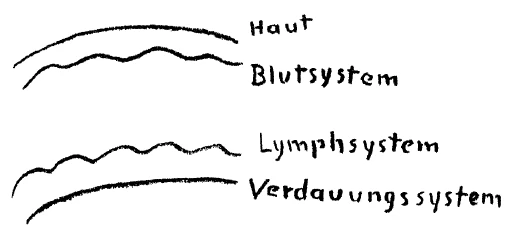
[ 34 ] Thus, on the one hand, in the outer boundary of the human being—the skin system—we see a transformation from another system, the blood system, which I will attempt to sketch here; and in the digestive system as well, we see a transformation from another system that is currently in a state of descending development. We must now try to determine whether we find this ascending and descending nature of organ systems already indicated in the embryonic structure. And indeed, it becomes apparent that we find the entire organism indicated in the embryonic structure—I will sketch it schematically—in the four superimposed germ layers, which are called: the outer germ layer—ectoderm—, the inner germ layer—endoderm—, and the mesoderm—the outer and inner middle germ layers.
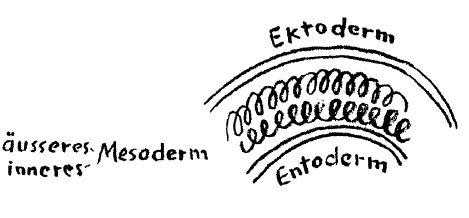
[ 35 ] In accordance with our view of development, we must regard the outer germ layer, the ectoderm—which in modern anatomy is also called the skin-sensory layer—as a product of transformation that first manifests itself in the outer middle layer, the outer mesoderm. In this, we have before us as an embryonic structure what appears to us at a higher stage in the skin-sensory layer. And in the inner mesoderm, we have the earlier formation of what later manifests itself in the endoderm, the intestinal-glandular layer.
[ 36 ] When we observe the development of the human embryo, we see the earliest signs of human form in the two middle germ layers, the mesoderm; the other two germ layers, the ectoderm and endoderm, have already undergone transformation. The two middle layers are thus those that represent the original state, while the ectoderm and endoderm show the higher stage of development.
[ 37 ] We now know that the human germ system capable of development arises from the union of two systems—the female and male germ systems—and that new life can only come into being through the living interaction of these two systems. Thus, all the processes that together form the germ system of the human organism must be contained separately within the two germ systems.
[ 38 ] What, then, does occultism reveal to us regarding the conditions prevailing here? It shows us that under today’s physical conditions, the female germ [endoderm] is only capable of producing a human physical constitution that, if it were to develop on its own, could not develop what we call the formative principle, which ultimately leads to the formation of the skeletal system that gives the human being its strength; nor could the main sensory system be provided by the female germ. The female germ is constituted in such a way that one could almost say that what arises there would be too good for the world as it exists today, for not all the processes in the external physical world are present that would be necessary for such an organism. This female human organism could not, so to speak, progress to that “mineralization” as expressed in the developed skeletal system, and it would not have the ability to be connected to the external world through the senses. It would have to find support in external conditions to compensate for its softer inner material, which it would have in place of the solid skeletal framework; it could not open itself outwardly, but would remain closed off in its inner life. This is the feminine aspect of the embryonic structure; it would overshoot the limits of what is possible in our present earthly existence, simply because the physical conditions on Earth today do not provide the environment required by such a refined organism, which is so ill-suited to earthification and opening up to the outside world. Such an organism would be doomed to death from the outset under present-day earthly conditions. Thus, precisely because of the tendency for human beings to go too far in their further development, the very cause of humanity’s doom is already imprinted upon the human germ.
[ 39 ] The other part of the germ layer, the male [ectoderm], is in the exact opposite position. If the male germ layer were to develop on its own, this would lead to a powerful unfolding of that which manifests itself in the outward opening of the skin-sense system, and of that which leads to solidification in the skeletal system—thus overshooting the mark in the opposite direction. Such one-sidedness would be just as incapable of producing a viable germ layer as the female germ alone, for the organism that the male germ would develop would unleash such powerful forces that it would have to destroy itself and perish under the conditions that exist on Earth today; that is, it would not be able to survive as an organism under these present-day conditions on Earth. The male germ can therefore only come to life if it interacts with the female germ. Only through the two germs balancing each other—through that which is destined for death in the female germ balancing out that of the male germ through the process of fertilization—is a living, complete human organism possible. The forces concentrated within the male germ would, if allowed to develop on their own, lead infinitely downward into the earthly realm; they would result in a much greater hardening of the skeletal system, in a far greater opening up and merging with the external world. These two organic germ cells must unite for further development already in their very earliest stages of formation, for individually, each of them is doomed to death. Only the living interplay of what, on both sides, prevents one from gaining the upper hand over the other, yields the germ cell necessary for human existence on Earth.
[ 40 ] Thus we see, even if only in a sketchy way, that we can trace spiritual realities back to the point where human beings give rise to their own kind. We could, of course, present this in much greater detail, but it is naturally impossible to say everything in a short lecture series. If we were to delve even deeper, we would see how true it is that even the most minute details can be traced back to spiritual realities, all the way to what has been said here about the supersensible systems of forces that find their outward expression in the organ systems which human beings develop so that their species may live on the earth.
[ 41 ] We have seen that the Earth, as a result of the densest “process of earthification,” has produced within us the skeletal system, and as the least condensed, the most active, the circulatory system. And it should only be briefly added that everything that takes place in the earthly-physical human organism extends up to the processes that occur in the blood; these are the processes of warming. In these warming processes of the blood, we must see the direct expression of the ego and thus the highest level, with the other processes of the human organism taking place beneath it. The warming process is thus the highest; our ego-soul activity intervenes directly in these. That is why we also feel something like a transformation of our ego-soul activity into an inner warming that can extend to physical warming in the blood process. We thus see how the spiritual-soul aspect, moving from top to bottom through the warming process, intervenes in the organic and the physiological, and we could demonstrate through many other facts how the spiritual-soul aspect comes into contact with the organic in warming processes. We also have warming processes through the activities in the digestive organs. Through the activity of the complex apparatus of the digestive system, the most manifold transformations take place, through which heating processes occur in the physical organism. These extend from the bottom up. Thus, in the heating process, the human physical organism extends all the way up into the spiritual-soul realm. Do the transformations stop there? Or do they continue? What follows can only be hinted at; it must first be left to the further reflection and, above all, the inner feeling of each listener. If we can view these transformations with a sense of genuine reverence for the human organism, we come to realize that physiology need not be a dry science, but can be a source of the highest human insight.
[ 42 ] The inner warmth that the organism produces in our blood—the warmth it channels to us through all its internal processes—shows that in these warming processes we can see something like a blossoming of all the other processes in the organism. The organism’s inner warmth penetrates all the way up into the spiritual-soul realm and can be transformed into the spiritual-soul realm. This is the highest, the most beautiful thing that can be transformed from the physical into the spiritual-soul realm through the power of the human body. When everything inherent in the human earthly organism has become warmth and this warmth is transformed by the human being in the right way, then compassion and interest in other beings arise from this inner warmth. When we ascend through all the processes of the human organism to the highest level—the processes of warming—we pass, as it were, through the gateway of the human organism formed by these warming processes, up to the point where the warmth of the blood is utilized by what the soul makes of it. Through a living interest in all beings, through compassion for everything around us, we expand—as our physical life leads us up to the warmth—our spiritual-soul life over the entire earthly existence, and we become one with the whole of existence. It is a wonderful fact that the world spirit has taken the detour through our physical organism in order to ultimately give us the inner warmth that we humans, in our earthly mission, are called upon to transform through our ego into living compassion for all beings.
[ 43 ] Heat is transformed into compassion during the Earth mission!
[ 44 ] We use the activity of the human organism, so to speak, as fuel for the spirit. This is the meaning of the earthly mission: that the human being, as a physical organism, is so integrated into the earthly organism that all physical processes ultimately find their fulfillment, their crowning glory, in the warmth of the blood; and that the human being, as a microcosm fulfilling its destiny, in turn transforms this inner warmth to radiate it outward as living compassion and love for all that surrounds us. Through everything we take into our soul out of living interest, our soul life is expanded. And when we have then passed through many incarnations in which we have utilized all the warmth that has been given to us, then the Earth will have reached the goal that was to be fulfilled within the Earth’s mission; then it will sink down as the Earth’s physical body and be left to decay. And the totality of all those human souls who have transformed physical warmth into warmth of the heart will ascend. Just as the individual soul, once the human being has passed through the gate of death, ascends to a spiritual world after the physical body has been surrendered to the forces of the Earth, so too will the Earth’s body one day be surrendered to the forces of the worlds, and the individual human souls will advance to new stages of existence. Nothing in the world is lost. What human souls have attained as fruits on Earth will be carried forward by them into eternity.
[ 45 ] In this way, spiritual science allows us to connect even the physiological processes in the human organism to our eternal destiny. If spiritual science (theosophy) is not merely a theory, not merely abstract knowledge for us, but if we view it in such a way that it shows us: we as human beings do not merely stand upon the earth, but belong to the entire world system—and if we learn to think of the human destiny in such a way that we draw our powers from the earth in order to work into eternity, then through spiritual science (theosophy) we take in what must be attained through it. And when people who sense or recognize this high ideal come together in brotherhood and agree in their striving, that is, when we recognize that within ourselves lie the seeds of further development that can bear fruit for the continued evolution of the Earth and humanity, then we can, in all humility, feel that as Theosophists (Anthroposophists), through the development of our own powers, we can contribute to the fulfillment of the Earth’s mission.
[ 46 ] We have gathered here and will now go out again to live in the world, perhaps taking with us some of what could only be presented here in sketch form as a source of inspiration, and bringing it to further fruition. But even though we are scattered throughout the world, let us work together harmoniously through living thoughts and feelings and with all our will. In this spirit let us part from one another, and in this spirit let us also find one another again when the opportunity arises.