

Drafts, Fragments and Paralipomena to the Four Mystery Dramas
GA 44
Translated by Steiner Online Library
Egypt. Seventh and eighth images, with facsimile
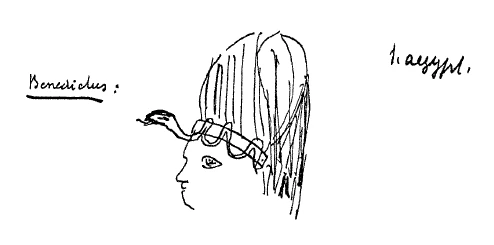
BENEDICTUS: (celebrating high priest) Egyptian priest with majestic headdress—in which a snake writhes, striking its tongue forward. Headgear red-yellow; copper-colored belt — breastplate: dark yellow; undergarment: golden yellow; triangle hanging around the waist at the front.
HILARIUS: (celebrating high priest) similar to Benedictus — but without snake, and with less majesty —
JOHN: Egyptian female figure — yellow clothing — with blue cloak-like covering (not a cloak that completely covers her, but one that leaves the undergarment completely exposed at the front). Headdress at the front.
MARY: Priest similar to Benedictus — without snake — but with scarab-like headdress — clothing white-yellow in various shades of the same color — with panther skin —
LUCIFER: as a sphinx, with more emphasis on the cherub.
AHRIMAN: as a sphinx, with more emphasis on the bull.
MAGNUS BELLICOSUS: priest's robe, white and yellow.
ALBERT TORQuATUS: priest's robe, white and yellow.
CAPESIUS: Robe as worn by the guardians of the Pharaonic treasure or similar. Blue and reddish in color.
FRIEDR. TRAUTMANN: Pharaoh's robe — light blue in color.
STRADER: Robe of a Pharaonic minister.
THEODORA: young priest = light yellow with reddish = panther skin.
Felix Balde: Thesmophor, Mrs. Balde: Portophor: both in long Egyptian priest's robe — dark red with silver belts. 1See Bibl. No. 187, Complete Edition 1968: Fourth Lecture, Dornach, December 27, 1918.
Philia — Luna — Astrid and four other figures dressed as priests. —
CAPESIUS: My Thesmophor, is everything prepared with dignity so that the consecration festival can take place?
THESMOPHOR: As far as man can foresee, everything is well prepared.
CAPESIUS: My Portophor, the priest who will receive the consecration today has been chosen as our king's advisor. Have you designed the test in such a way that he can also devote his attention to the affairs of this world and not lose himself solely in spiritual matters?
PORTOPHOR: What could happen has happened. His soul is not overly devoted to thoughts of the welfare of the people and the management of earthly matters. He lives entirely in the spirit; he can often be seen in a state of ecstasy, his whole being almost lost in other worlds—one might think that he revels in such rapture.
CAPESIUS: You have seen him like this often?
PORTOPHOR: Very often; I always had to think that it was not the king, but our priesthood that was the right place for him.
CAPESIUS: Very well; you go to your duties, that nothing may be lacking at the consecration festival. But you, my Thesmophor, stay here a little longer. — You know that I understand your true nature; you stand far higher in spiritual rank than your position in the temple acknowledges. You see through souls — —
(Th: makes a defensive gesture)
— — I could discuss this with you as with no one else from the priesthood — our powers of divination always showed us the same thing — I ask you — do you have confidence in the man who is to receive the consecration today? —
THESMOPHOR: Trust — who will follow my lead — my voice doesn't count anyway.
CAPESIUS: My Thesmophor — who trusts you. I do — and today you shall stand by my side at this consecration festival.
THESMOPHOR: That is my duty — how could it be otherwise?
CAPESIUS: I don't mean that. This time I need the support of your soul —
THESMOPHOR: — My soul —
CAPESIUS: Precisely. We must pursue this consecration with the strictest spiritual eyes — and if there is even the slightest thing about this priest that violates the dignity of the consecration, I will do everything possible to prevent him from coming to power.
THESMOPHOR: What should happen at the consecration ceremony?
CAPESIUS: I know that he is unworthy of the honor he receives—his mysticism is nothing more than sensual passion, which he does not admit to himself, which he justifies to himself by interpreting it as a spiritual impulse. His heart, his whole being, feels earthly—only his imagination carries his feelings to spiritual heights, which in truth want to take a completely different direction—I do not accuse his will, nor his consciousness, which believe themselves to be in spiritual heights—but his soul is not true—it distorts the will and also the thought. — Does the spirit from the worlds of light really penetrate such souls; does the word that comes from the worlds of the stars speak in them; no, passion steams like mystical light and wants to lie to heaven that gods are reflected in souls on earth. — When the lie is so unconsciously rooted in the soul: even if this lie of life in earthly existence does not become conscious of itself, the weed will continue to grow; and if such a soul is to act, then the action must bring harm.
THESMOPHOR: My wise Melanophor, you are very strict.
MELANOPHOR: I must consider seriously what is happening here at the place of consecration. Every action that is seen here sends out its waves into the worlds that encompass everything that is alive, everything that is dead, everything that dwells in the body, everything that has a spiritual shell—the temple must not lend souls powers that make them stronger in the world stream than they are formed by the gods, unless it is certain that they are only carrying out the gods' command. Now you know, my Thesmophor, what soul ministry I entrust to you—keep the eye of the spirit open.
THE GUARDIAN OF THE THRESHOLD:
You have found your way here.
You have not turned your gaze backward —
Now unlearn seeking being within yourself,
Until now you were nothingness; your being was here.
Learn to find your being here.
It was lost to you before you imagined yourself to be.
THE MYSTE:
Recognize now that your being is the earth
Contained within itself; feel yourself in its power.
ROMANUS:
Experience yourself in earthly existence; connected to it
You always try to overcome it;
Only in its balance can you be a human being.
THE MYSTIC:
Recognize now that your being is water,
Feel yourself in its waves.
TORQUATUS:
Seek to hold yourself in the water,
Only beauty ripples in it;
You must lose it if you
do not master the waves of water.
THE MYSTIC:
Now recognize that your being is the air,
feel yourself in its breath.
BELLICOSUS:
In the breath of the air you are yourself,
But you are estranged from it;
and in the darkness of the earth
Held captive.
The awakening of the soul
THE MYSTIC:
Now recognize that your being is fire,
Feel yourself in its pleasure.
STRADER:
Burn in the fire the pleasure
That wants to keep you alive.
HILARIUS:
I carry in my words,
What will paralyze you, if untruth
Lives in your soul in the future.
If you take it from me, you will never again
be able to lose it. Do you want to take it?
MARIA: I want to take it from the wise man's soul.
CAPESIUS:
I carry in my words
What will crush you if you
Do not live in spirit with a pure heart.
If you want it, you will always
Feel it in your heart.
MARIA: I want to take it from the wise man's soul.
THEODORA: I carry in my words what ...
Ägypten. Siebentes und achtes Bild, mit Faksimile
BENEDICTUS: (celebrierender Oberpriester) ägyptischer Priester mit majestätischem Kopfputz—in dem sich eine Schlange windet, die nach vorne züngelt. Kopfbedeckung rot-gelb ; Gürtel kupfer-farben — Brustgewand: dunkelgelb; Unterkleid: goldgelb ; vorn ein um die Taille hängendes Dreieck.
HILARIUS: (celebrierender Oberpriester) ähnlich dem Benedictus — doch ohne Schlange, und die Majestät gemildert —
JOHANNES: ägypt. Frauengestalt — Kleidung gelb gehalten —mit blauer mantelartiger Umhüllung (nicht ganz bedeckender Mantel, sondern so, daß vorn das Untergewand ganz frei bleibt). Kopfschmuck vorn.
MARIA: Priester ähnlich dem Benedictus — ohne Schlange — dafür Scarabäusartiger Kopfschmuck — Kleidung weißgelb gehalten verschiedene Nuancen derselben Farbe — mit Pantherfell —
LUCIFER: als Sphinx, bei welchem der Cherub mehr betont ist.
AHRIMAN: als Sphinx, bei welchem der Stier mehr betont ist.
MAGNUS BELLICOSUS: Priestergewand weißgelb.
ALBERT TORQuATUS: Priestergewand weißgelb.
CAPESIUS: Gewand, wie es die Aufseher des Pharaonischen Schatzes oder dgl. getragen haben. Blau und rötlich gehalten.
FRIEDR. TRAUTMANN: Pharaonen Gewand — hellblau gehalten.
STRADER: Gewand eines Pharaonischen Ministers.
THEODORA: junger Priester = hellgelb mit rötlich = Panther-fell.
Felix Balde: Thesmophor, Frau Balde: Portophor: beide im langen ägypt. Priestergewand — dunkelrot gehalten mit Silbergürteln.1Vgl. Bibl.-Nr. 187, Gesamtausgabe 1968: Vierter Vortrag, Dornach 27. Dezember 1918.
Philia — Luna — Astrid und noch 4 andre Gestalten in Priester kleidern. —
CAPESIUS: Mein Thesmophor, ist alles in Würde vorbereitet, daß das Weihefest geschehen kann?
THESMOPHOR: Soweit der Mensch es vorzusehn vermag, ist alles wohl bereitet.
CAPESIUS: Mein Portophor, zu unsres Königs Rater ist der Priester ausersehn, der die Weihe heut' empfängt. Habt Ihr die Prüfung so gestaltet, daß er auch der Erdendinge Führung mit Aufmerksamkeit sich widmen kann und nicht allein in Geisteswelten sich verliert.
PORTOPHOR: Es ist geschehen, was geschehen konnte. Nicht allzustark ist seine Seele den Gedanken an des Volkes Wohlfahrt und der Erdendinge Führung hingegeben. Er lebt im Geiste ganz; verzückt kann man ihn oft sehen, all sein Wesen an Überwelten fast verloren — man könnte finden, daß er in solchem Entzücken schwelgt.
CAPESIUS:Ihr habt ihn so wohl öfter gesehen?
PORTOPHOR: Sehr oft; ich mußte mir dann immer denken, daß nicht des Königs, daß unsre Priesterschaft für ihn die rechte Nähe wäre.
CAPESIUS: Es ist gut; ihr geht an euer Amt, daß am Weihe-feste nichts fehle. Doch du mein Thesmophor, bleibst noch ein wenig hier. — Du weißt, ich kenne deinen rechten Sinn, du stehst im Geistesrang weit höher, als dein Grad im Tempel dir zuerkennt. Du durchschaust Seelen — —
(Th: macht eine abwehrende Bewegung)
— — ich konnte mich darüber mit dir besprechen, wie mit niemand aus der Priestersehaft — unsre Seherkräfte zeigten uns stets dasselbe — Ich frage dich — hast du zu dem Manne Vertrauen, der heut die Weihe empfangen soll. —
THESMOPHOR: Vertrauen — wer wohl wird nach dem bei mir sich richten — meine Stimme zählt doch nicht.
CAPESIUS: Mein Thesmophor — wer zu dir Vertrauen hat. Ich habe es — und heute sollst du mir bei diesem Weihefest zur Seite stehn.
THESMOPHOR: Dies ist doch meines Amtes — wie sollt' es anders sein?
CAPESIUS: Ich meine nicht dieses. Ich brauche dieses Mal den Beistand deiner Seele —
THESMOPHOR: — Meiner Seele —
CAPESIUS: Eben ihn. Wir müssen diese Weihetat verfolgen mit den strengsten Seelenaugen — Und wenn auch nur das geringste an diesem Priester ist, das gegen der Weihe Würde verstößt, so werde ich alles tun, was möglich, um zu verhindern, daß er zur Macht gelangt.
THESMOPHOR: Was sollte sich ergeben beim Weihefest?
CAPESIUS: Ich weiß, daß er der Ehre unwürdig ist, die er empfängt — Seine Mystik ist andres nicht, als Sinnenleidenschaft, die er sich nicht gesteht, die er vor sich selbst rechtfertigt, indem er sie als Geistestrieb sich selber deutet. Sein Herz, sein ganzes Wesen, fühlt irdisch — nur seine Einbildungskraft trägt die Gefühle in Geisteshöhen, die in Wahrheit eine ganz andre Richtung nehmen wollen — Ich klage nicht seinen Willen, nicht sein Bewußtsein an, die glauben in Geisteshöhn zu sein — doch seine Seele ist nicht wahr — sie verfälscht den Willen und auch den Gedanken — Dringt in solche Seelen wirklich der Geist aus den Lichteswelten; spricht in ihnen das Wort, das aus den Sternenwelten kommt; nein, es dampft die Leidenschaft als Mystenlicht und will den Himmel belügen, daß auf der Erde in Seelen Götter sich bespiegeln. — Wenn so unbewußt die Lüge in der Seele wurzelt: es wird selbst dann, wenn diese Lebenslüge im Erdensein nicht ihrer selbst bewußt wird, das Unkraut weiter wachsen; und soll eine solche Seele handeln, dann muß die Handlung Schaden bringen.
THESMOPHOR: Mein weiser Melanophor, ihr seid sehr strenge.
MELANOPHOR: Ich muß mit Ernst betrachten, was hier am Weiheort sich vollzieht. Jede Handlung, die hier geschaut wird, pflanzt ihre Wellen hinaus in die Welten, welche umschließen alles, was lebend, was tot ist, was im Leibe wohnt, was Geisthüllen hat —der Tempel darf nicht Seelen Kräfte leihn, die sie stärker im Weltenstrom machen, als sie von Göttern gebildet sind, wenn er nicht sicher ist, daß sie der Götter Auftrag nur vollziehn. Nun weißt du, mein Thesmophor, welches Seelenamt ich dir vertraue — halte das Geistesauge offen.
DER SCHWELLENHÜTER:
Du hast den Weg hieher gefunden.
Nach rückwärts hast du nicht denBlick gewendet —
Verlerne jetzt, das Sein in dir zu suchen,
Du warst bisher das Nichts; dein Sein war hier.
Erlerne, dein Sein hier zu finden.
Verloren ging es dir, bevor du dich seiend wähntest.
DER MYSTE:
Erkenne jetzt, daß dein Sein die Erde
In sich birgt; erfühle dich in ihrer Kraft.
ROMANUS:
Im Erdensein erfahre dich; verbunden ihm
Versuchst du es doch stets zu überwinden;
In seinem Gleichmaß nur kannst du Menschenwesen sein.
DER MYSTE:
Erkenne jetzt, daß dein Sein das Wasser,
Erfühle dich in seinem Wellen.
TORQUATUS:
Im Wasser suche dich zu halten,
In ihm nur wellet Schönheit;
Du mußt sie verlieren, wenn du
Des Wassers Wellen nicht bemeisterst.
DER MYSTE:
Erkenne jetzt, daß dein Sein die Luft,
Erfühle dich in ihrem Atem.
BELLICOSUS:
Im Lüfteatem bist du selbst,
Doch bist du ihm entfiohn; und in der Erde Finsternis
Im Bann gehalten.
Der Seelen Erwachen
DER MYSTE:
Erkenne jetzt, daß dein Sein das Feuer,
Erfühle dich in seiner Lust.
STRADER:
Im Feuer verbrenne die Lust,
Die dich am Leben halten will.
HILARIUS:
Ich trage in meinem Worte,
Was dich lähmen wird, wenn Unwahres
Künftig in deiner Seele lebt.
Entnimmst Du es mir, so wirst du es niemals wieder
Verlieren können. Willst du es nehmen.
MARIA: Ich will es aus des Weisen Seele nehmen.
CAPESIUS:
Ich trage in meinem Worte,
Was dich zermalmen soll, wenn du
Reinen Herzens nicht im Geiste lebst.
Willst du es, so wirst du es stets
Im Herzen fühlen.
MARIA: Ich will es aus des Weisen Seele nehmen.
THEODORA: Ich trag in meinem Worte, was ...