Consciousness — Life — Form
GA 89
2 July 1904
Translate the original German text into any language:
Versions Available:
Consciousness — Life — Form, tr. SOL
Die Logoi
The Logoi
[ 1 ] Wenn der Mensch ein Ding sieht, frägt er nach der Entstehung, setzt etwas voraus, aus dem das Betreffende hervorgegangen ist. Nur anwendbar auf Dinge, die in der Welt vorgehen. Wir müssen voraussetzen etwas, wo wir nicht mehr fragen, woraus es entstanden ist. Das ist der Logos. Es darf auch nicht die Frage aufgeworfen werden: wann ist der Logos entstanden, denn er würde dadurch begrenzt sein, daß er früher oder später [entstanden] ist. Er war jetzt und immer. Alle Zeitbegriffe hören auf, dem Logos gegenüber eine Bedeutung zu haben. Was wir jetzt vom Logos sagen, gilt, wie es vor Urmillionen Jahren gegolten. Er ist nicht in der Zeit, sondern vor aller Zeit.
[ 1 ] When humans see something, they ask about its origin, assuming that there is something from which it emerged. This only applies to things that exist in the world. We must assume something where we no longer ask what it came from. That is the Logos. Nor should the question be raised: when did the Logos come into being, for it would then be limited by the fact that it came into being sooner or later. It was and always will be. All concepts of time cease to have any meaning in relation to the Logos. What we say about the Logos now is as true as it was millions of years ago. It is not in time, but before all time.
[ 2 ] Einige Begriffe werden wir entwickeln.
[ 2 ] We will develop some concepts.
[ 3 ] Wenn wir das in sich Absolute, das alles dasjenige nicht hat, was wir überhaupt kennen, als das Übersein bezeichnen, haben wir in abstrakter Form einen Begriff hingepfahlt, als den wir uns den Logos denken: den in sich begriffenen, gegründeten, ruhenden, absoluten Logos. Erster Logos — Sat -Vater.
[ 3 ] If we describe the absolute, which has nothing that we know at all, as the super-being, we have nailed down a concept in abstract form, which we think of as the Logos: the Logos that is conceived, founded, resting, and absolute in itself. First Logos — Sat -Father.
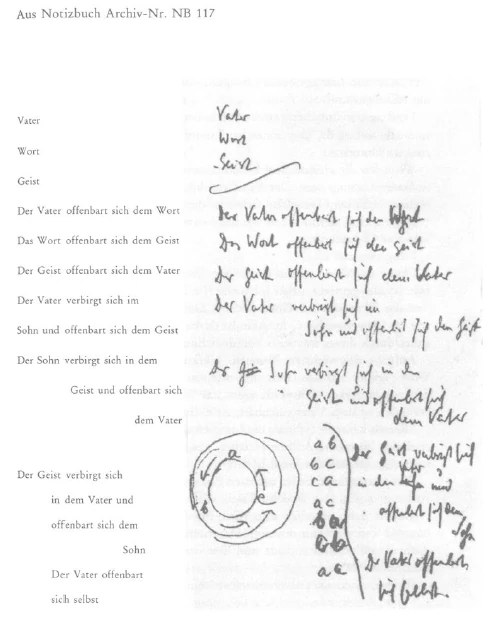
[ 4 ] Wenn dieser Logos allein angenommen wird, ist er eben in sich ruhend, da und nicht da, über dem Sein, niemals wahrnehmbar, weil über aller Wahrnehmung, über das Dasein erhaben. Nun geht daraus hervor, daß dieser Logos das absolut Verborgene, Okkulte ist, weil über alle Offenbarung erhaben. Soll er nicht okkult sein, muß er sich offenbaren. Dann haben wir es mit seinem Spiegelbild, dem geoffenbarten Logos zu tun. Wenn wir dies bedenken, werden wir sogleich in diesem Begriff zwei Begriffe erkennen, so daß wir ein Dreifaches haben, denn im Offenbarer muß sich offenbarende Tätigkeit sein:
[ 4 ] If this Logos is accepted alone, it is resting within itself, there and not there, above being, never perceptible because it is above all perception, above existence. Now it follows from this that this Logos is the absolutely hidden, occult, because it is above all revelation. If it is not to be occult, it must reveal itself. Then we are dealing with its mirror image, the revealed Logos. When we consider this, we immediately recognize two concepts in this term, so that we have a triad, for in the revealer there must be revealing activity:
[ 5 ] Pünktchen ... bezeichnen die in den Notizen Marie Steiners markierten Lücken. Einfügungen in gewöhnlichen runden Klammern ( ) entsprechen den Notizen. Einfügungen in eckigen Klammern [ ] stammen hingegen von den Herausgebern.
[ 5 ] Dots ... indicate gaps marked in Marie Steiner's notes. Insertions in ordinary round brackets ( ) correspond to the notes. Insertions in square brackets [ ] originate from the editors.
1. Logos: Offenbarer
2. Logos: Offenbarung, Tätigkeit
3. Logos: Geoffenbartes Spiegelbild
[Indisch] Sat, Ananda, Chit
[Christlich] Dreifaltigkeit:
1. Vater
2. Sohn, Wort
3. Heiliger Geist
1. Logos: Revealer
2. Logos: Revelation, activity
3. Logos: Revealed reflection
[Indian] Sat, Ananda, Chit
[Christian] Trinity:
1. Father
2. Son, Word
3. Holy Spirit
[ 6 ] Diese Drei sind zunächst so erhaben, daß wir sie für alles, was man im gewöhnlichen Sinne als offenbar oder wahrnehmbar bezeichnet, wieder als okkult bezeichnen müssen. Also drei okkulte Wesenheiten. Sie müssen zunächst offenbar werden. Es sind nur drei da, also können sie nur einander sich offenbaren:
[ 6 ] These three are so sublime that we must refer to them as occult in relation to everything that is commonly referred to as apparent or perceptible. So, three occult entities. They must first become apparent. There are only three, so they can only reveal themselves to each other:
Der Vater offenbart sich dem Worte,
Das Wort offenbart sich dem Heiligen Geiste,
Der Heilige Geist offenbart sich zurück dem Vater.
The Father reveals himself to the Word,
The Word reveals itself to the Holy Spirit,
The Holy Spirit reveals itself back to the Father.
[ 7 ] Dies sind drei Arten des Offenbarens. Wir denken sie uns auf drei Wesenheiten übertragen, so daß die Tätigkeit dieser Wesenheiten darin besteht, daß sie es übernehmen, dies zu übertragen. Die drei können verschiedene Verhältnisse eingehen:
[ 7 ] These are three types of revelation. We think of them as being transferred to three beings, so that the activity of these beings consists in taking on the task of transferring this. The three can enter into different relationships:
[ 8 ] Es ist möglich, daß sich der Vater im Worte verbirgt und in dieser Verborgenheit sich mitteilt. Er verhüllt sich im Worte und offenbart sich dem Geiste.
[ 8 ] It is possible that the Father hides himself in the Word and communicates in this hiddenness. He veils himself in the Word and reveals himself to the Spirit.
[ 9 ] Dann ist möglich: das Wort verhüllt sich im Heiligen Geist und offenbart sich in dieser Umhüllung dem Vater.
[ 9 ] Then it is possible that the Word veils itself in the Holy Spirit and reveals itself to the Father in this veiling.
[ 10 ] Dann ist möglich, daß der Heilige Geist sich im Vater verhüllt und sich dem Worte offenbart.
[ 10 ] Then it is possible that the Holy Spirit veils itself in the Father and reveals itself to the Word.
[ 11 ] Nun ist nur noch möglich, daß der Vater sich in beiden, in Wort und Geist hüllt, und sich selbst offenbar wird.
[ 11 ] Now it is only possible that the Father veils itself in both, in Word and Spirit, and reveals itself.
[ 12 ] Was wir haben - 1. 2. 3. 4. 5. 6. 7. — denken wir uns wesenhaft vorhanden: so entsteht dies Wesenhafte, die [sieben] Verhältnisse der drei Logoi, sieben wesenhafte Formen.
[ 12 ] What we have—1, 2, 3, 4, 5, 6, 7—we think of as essentially present: thus arises this essentiality, the [seven] relationships of the three Logoi, seven essential forms.
[ 13 ] 1. Verhältnis — Allmacht: Der Vater offenbart sich dem Worte.
[ 13 ] 1st relationship—omnipotence: the Father reveals himself to the Word.
[ 14 ] 2. Verhältnis — Allweisheit: Das Wort offenbart sich dem Geist.
[ 14 ] 2nd relationship — Omniscience: The Word reveals itself to the Spirit.
[ 15 ] 3. Verhältnis — All-Liebe: Der Heilige Geist offenbart sich dem Vater.
[ 15 ] 3rd relationship — Omni-love: The Holy Spirit reveals itself to the Father.
[ 16 ] 4. Verhältnis — Allgerechtigkeit: Der Vater verhüllt sich im Worte und offenbart sich dem Geist.
[ 16 ] 4th relationship — Omni-justice: The Father veils itself in the Word and reveals itself to the Spirit.
[ 17 ] 5. Verhältnis — Allerlösung: Das Wort verhüllt sich im Geist und offenbart sich dem Vater.
[ 17 ] 5. Relationship — All-redemption: The Word veils itself in the Spirit and reveals itself to the Father.
[ 18 ] 6. Verhältnis — Allheiligung: Der Heilige Geist verhüllt sich im Vater und offenbart sich dem Wort.
[ 18 ] 6. Relationship — All-sanctification: The Holy Spirit veils itself in the Father and reveals itself to the Word.
[ 19 ] 7. Verhältnis — Allseligkeit: Der Vater hüllt sich in Wort und Geist und wird sich selbst offenbar.
[ 19 ] 7. Relationship — All-bliss: The Father veils himself in Word and Spirit and reveals himself.
[ 20 ] So sind die Wesenheiten entstanden aus gegenseitigem Befruchten. Das sind die sieben Regierer, die sieben Mächte, die vor dem Throne [Gottes] stehen und dies sind ihre Eigenschaften. Die Eigenschaften entstehen aus den Verhältnissen der drei Logoi. Nur sieben sind möglich.
[ 20 ] Thus, the entities arose from mutual fertilization. These are the seven rulers, the seven powers that stand before the throne [of God], and these are their characteristics. The characteristics arise from the relationships of the three Logoi. Only seven are possible.
[ 21 ] Die Allmacht besteht darin, daß sich der Vater dem Worte offenbart. Dies bezeichnet man als erste Schöpfung oder als Chaos.
[ 21 ] Omnipotence consists in the Father revealing himself to the Word. This is referred to as the first creation or chaos.
[ 22 ] Nachdem die Allmacht ihre Aufgabe vollbracht hat, regiert Ali-Weisheit, ordnet alles nach Maß und Zahl.
[ 22 ] After omnipotence has accomplished its task, Ali-Wisdom reigns, ordering everything according to measure and number.
[ 23 ] Nachdem All-Weisheit ihre Aufgabe vollbracht hat, regiert All-Liebe, bringt in die ganze Schöpfung das Prinzip von Sympathie und Antipathie hinein.
[ 23 ] After All-Wisdom has accomplished its task, All-Love reigns, bringing the principle of sympathy and antipathy into all creation.
[ 24 ] Nachdem All-Liebe ihre Aufgabe getan hat, kommt Allgerechtigkeit, sie regiert, bringt Karma hinein, das heißt Geburt und Tod.
[ 24 ] After All-Love has done its work, All-Justice comes, reigns, and brings in karma, that is, birth and death.
[ 25 ] Nachdem Allgerechtigkeit ihre Aufgabe vollbracht hat, beginnt All-Erlösung ihr Werk und bringt überall Erlösung hinein, das heißt letztes Gericht.
[ 25 ] After All-Justice has accomplished its task, All-Salvation begins its work and brings salvation everywhere, that is, the Last Judgment.
[ 26 ] Nachdem letztes Gericht gewirkt hat, beginnt die Allheiligung ihr Werk und bringt überall Heiligung hinein, und dann beginnt die Allseligkeit.
[ 26 ] After the Last Judgment has taken effect, All-Sanctification begins its work and brings sanctification everywhere, and then All-Bliss begins.
[ 27 ] Denken wir uns dies verteilt auf sieben Planeten. In Wahrheit sind alle sieben da, aber einer hat immer die Macht (die andern sind im Unteramt).
[ 27 ] Let us imagine this distributed across seven planets. In truth, all seven are there, but one always has the power (the others are in subordinate positions).
[ 28 ] Wenn wir die vierte Kugel herausnehmen, ist es die unsere. Also ist unser Losungswort: Der Vater verhüllt sich im Worte und offenbart sich dem Geist. Und damit ist das Christentum gegeben.
[ 28 ] When we take out the fourth sphere, it is ours. So our watchword is: The Father veils himself in the Word and reveals himself to the Spirit. And with that, Christianity is given.
[ 29 ] Mit diesem Cherub haben wir das Leitwort und damit auch den Sinn des Christentums.
[ 29 ] With this cherub, we have the guiding principle and thus also the meaning of Christianity.
[ 30 ] Pfingstwunder ...
[ 30 ] Pentecost miracle ...
[ 31 ] Durch das Wort, das auf einer Seite den Vater in Involution enthält, ist alles gemacht, daher Johannes: [Im Urbeginne war das Wort; und das Wort war bei Gott, und ein Gott war das Wort. Dieses war im Urbeginne bei Gott. Alles ist durch dasselbe geworden; und außer durch dieses ist nichts von dem Entstandenen geworden.]
[ 31 ] Through the Word, which on one side contains the Father in involution, everything is made, hence John: [In the beginning was the Word; and the Word was with God, and the Word was God. This was in the beginning with God. All things were made through it; and without it nothing was made that has been made.]
[ 32 ] Aufgabe des nächsten Planeten, Merkur, 5. Allerlösung: Das Wort verhüllt sich im Geist und offenbart sich dem Vater. Wenn das, was in unserer Entwicklung ist, das Wort, Christus, sich selbst verhüllt und dem Vater offenbart, ist nächste ...
[ 32 ] Task of the next planet, Mercury, 5th universal solution: The Word veils itself in the Spirit and reveals itself to the Father. When that which is in our development, the Word, Christ, veils itself and reveals itself to the Father, the next ...
[ 33 ] Niemals kann der Sohn zu dir kommen als durch mich, Geist. Soll er, Geist, im nächsten Planeten leben, ausgebreitet sein, evolvieren, muß sich das Wort in Geist hüllen.
[ 33 ] The Son can never come to you except through me, Spirit. If he, Spirit, is to live on the next planet, spread out, evolve, the Word must veil itself in Spirit.
[ 34 ] Was tonangebend ist im nächsten Planeten, muß in diesem schon vorbereitet sein. Das Wort muß sich, vorbereitend für den Heiligen Geist, der dann offenbart sein wird, involutionieren. Das ist aber hier der Tod. Es kann nur die Mission erfüllt sein, wenn sich das Wort einhüllt bis zum Tode und dies ist der Sinn des Todes am Kreuze.
[ 34 ] What sets the tone on the next planet must already be prepared on this one. The Word must involute in preparation for the Holy Spirit, who will then be revealed. But here that is death. The mission can only be fulfilled if the Word veils itself unto death, and this is the meaning of death on the cross.
[ 35 ] So weit sind wir, zu verstehen, er wurde gekreuzigt zum Tode...
[ 35 ] This is how far we have come in understanding that he was crucified unto death...
[ 36 ] Dies ist der Sinn des christlichen Zentralmysteriums. ... In der Bibel sagt Jesus: Ich widerstrebe nicht dem Buche der Gerechtigkeit im Sinne Melchisedeks. Melchisedek ist der Engel der irdischen Umlaufzeit.
[ 36 ] This is the meaning of the central Christian mystery. ... In the Bible, Jesus says: I do not resist the book of righteousness in the sense of Melchizedek. Melchizedek is the angel of the earthly cycle.
[ 37 ] In nächster planetarischer Entwicklung wird also der Sohn dem Vater das zuführen, was er jetzt gesammelt hat durch den Geist.
[ 37 ] In the next planetary development, the Son will therefore bring to the Father what he has now gathered through the Spirit.