

Awareness - Life - Form
GA 89
9 November 1904
Translated by Steiner Online Library
Planetary Development: Eleventh Lecture
[ 1 ] People often talk about principles as if they were all the same and only differed in degree. But if we want to understand the connections, we must learn about the nature of the principles themselves.
[ 2 ] We must distinguish between three things in the world, three kinds of effects. Because only that which has an effect can be considered by a perceiving being, we focus our attention on the effects. There are three ways in which something can have an effect: first, the spiritual effect; second, the soul effect; and third, the physical effect. The spiritual effect, everything that can act as spirit in some way, is called budhi; Everything that can have a psychic effect is called Kama; everything that can have a physical effect is called Prana. These are the three forms of effect: Budhi, Kama, Prana. As forms of effect, they are similar, only at different levels.
[ 3 ] For example, if Kama is to occur in a certain way, there must be a limit. So in order to become limited effects, Budhi, Kama, and Prana must set limits for themselves. In theosophical literature, these limits are called “Shariras,” meaning shells, envelopes, or sheaths. When Budhi sets a limit, this limit is called Karana Sharira; if Kama sets itself a limit, it is called Linga Sharira; if Prana sets itself a limit, it is called Sthula Sharira. These Shariras are therefore the limits, the shells, that the three modes of action set for themselves.
[ 4 ] The following can now occur [scheme I is now developed on the board, written from bottom to top]
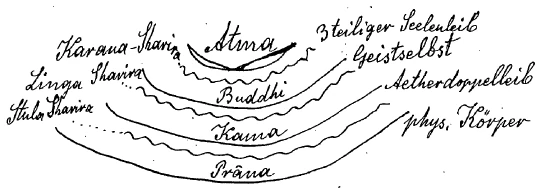
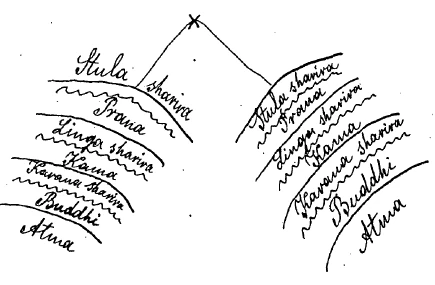
[ 5 ] First we have Prana in action; then Prana sets itself a boundary to the outside: Sthula Sharira. Prana thus limits itself on one side and remains undulating and open on the other. Kama now joins Prana and sets itself a boundary: Linga Sharira. As a result, Prana no longer remains open on this side either, because Kama pushes in with its boundary; but Kama remains open on the other side. Now Budhi joins and sets itself a boundary against Kama, and Karana Sharira is created. The three principles therefore have intermediate layers. If this is a being, then an ego consciousness must also live in these three principles and their intermediate layers: this is called Atma.
[ 6 ] Human beings consist of the three principles and the intermediate layers and the ego consciousness or Atma. Each individual principle can have subdivisions. If we understand this, we have the composition of the human being as such.
[ 7 ] Here, in the human being [diagram I], the physical body forms the outer shell, and Atma rests within. Now, the arrangement can also be quite different. [In the case of the planetary spirit], prana first manifests itself inwardly and sets a boundary. Then the following would arise [diagram on the next page]:
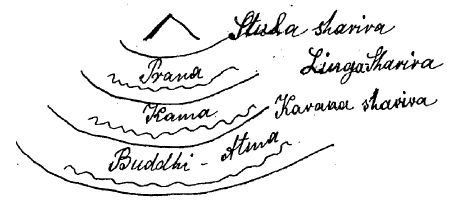
[ 8 ] Prana is then limited inwardly by Sthula Sharira, Kama by Linga Sharira, Budhi by Karana Sharira, and we would now have a being in which Atma lies first on the outside, then Budhi, then Kama, and finally Prana. Then [according to the following diagram] Atma would appear to be spread out completely around the circumference [a sphere], and Sthula Sharira would be a point in the center.

[ 9 ] Such a being is a Dhyan-Chohan, a planetary spirit, and must act in the opposite way to a human being. In humans, Sthula Sharira is on the outside, in Dhyan-Chohans it is Atma, then comes Budhi and so on.
[ 10 ] The following example gives a clear mental image of this. When we close our eyes, it is dark at first, and when we open them again, we see the light. But we only see the light because we have a sensation for it and can therefore receive it. However, it must be there before we can receive it. And just as we must be there to perceive light, so there must be a being outside that reveals light. We are light receivers; outside there must be light givers, light revealers. And just as we can only perceive light because we have Kama, the astral body, within us, so a planetary being must have a Kama that radiates light. So Kama acts here towards the center and there in the radius of the circle.
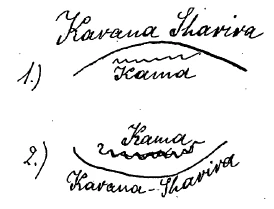
[ 11 ] The circle that is convex at the top is for us, for feeling, for the receiver, the one striving toward the giver. The circle that is convex downward is the Kama of the dhyanic entity. Thus, the Kama of revelation acts downward: Karana Sharira. Just as man has a Kama that strives toward its center, so the planetary spirit has a Kama that strives outward, toward the circumference, which is light-revealing, while the Kama of man is light-receiving. Two beings of complementary natures always belong together. One being must possess desire: the receiving being; another must be able to give: the giving being. Human desiring Kama presupposes that there is giving Kama, Kama of love.
[ 12 ] Human budhi conveys knowledge. That which is revealed to us by things in terms of knowledge is received through our budhi. The planetary spirit must therefore be thought-giving, while human budhi must be receptive. The planetary spirit thus behaves in a manner that is completely opposite to and complementary to the human spirit.
[ 13 ] Every single thing in the world exists only in the context of the world; it is a link in the whole. As a link, it belongs to the whole planetary Earth spirit. For example, the table first has a material substance through which it is a being that confronts us in space; secondly, it has power in that it offers resistance, for otherwise it would not be there for us; and thirdly, this power does not express itself arbitrarily, but according to certain laws (laws of nature).
[ 14 ] What is power? What is it that makes life possible within us? It is a force that is engaging, that sustains life. The life force of human beings manifests itself in that it holds together the matter within them. Therefore, matter and the force that belongs to it are directed inward in human beings; it builds them up from within; otherwise, they could not be perceived as living beings. The table, on the other hand, has matter that is directed outward, and this manifests itself through the law. Matter itself cannot be perceived, only its properties, such as colors, sounds, and so on. Matter itself completely eludes perception. There is a prana in matter that completely eludes perception, but gives itself over to revealing itself. In addition, we recognize the law in matter, the thought that expresses itself in it.
[ 15 ] Budhi expresses itself outwardly in nature. Every body that is the outward expression of the planetary spirit radiates outwardly all the time, which means it has turned Budhi outward. It becomes the light that is perceived. Budhi is in the properties of things, in what lies outwardly. The law must reveal itself through Karana Sharira. The revealing Manas is the law. By shining, a body sends us budhi. The thought, the expression of spirit through which it sends it, is karana sharira. Kama, on the other hand, is kept by the planetary spirit for itself; it withdraws it from perception. Its matter ... [there is a gap marked here in Marie Steiner-von Sivers' notes]. — In contrast, it reveals the cosmic thoughts that human beings must first fathom deep within themselves. And what the planetary spirit expresses and gives on the very surface is its budhi.
[ 16 ] This is expressed in the Bible. It is said that the planetary spirit's first expression was an expression of light. It is budhi qualities (light) that the spirit reveals at the first stage. This ancient sacred teaching about the contrast between human beings and the planetary spirit is beautifully expressed in Christian esotericism. In Kabbalistic language, the budhi qualities that reveal themselves are called “powers.” Therefore, the powers of light and darkness are revealed first. Thus, Genesis can be taken literally again.
[ 17 ] It is therefore Budhi qualities that the spirit reveals at the first stage. At the second stage, it reveals its Karana Sharira; it orders things according to laws. What is now arranged convexly in the macrocosm is concave in the microcosm. What man recognizes last comes first in the macrocosm; the microcosm comes last in recognizing the sensation in the macrocosm.
[ 18 ] Now the question arises whether there is a transition between the two entities, between man and planetary spirit. Consider an entity with a consciousness: that is the human being; he has different members, but with a common consciousness. (Conflict between patricians and plebeians). This could be represented as follows:
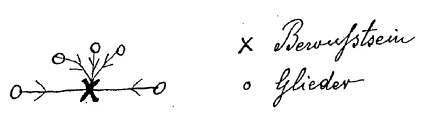
[ 19 ] These are individual members, all of whom radiate toward the common consciousness. If we regard the common consciousness as a force and the members as well, we can say that the common consciousness is the predominant one; it acts upon all the others. Now imagine many such entities acting in this way:
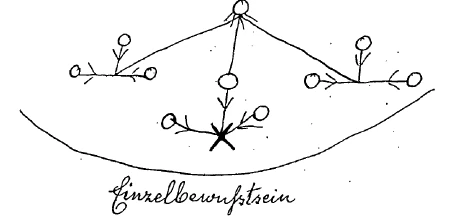
[ 20 ] Each of the beings has its own existence. Through [the common ideal], it can connect other existences with its own. These different consciousnesses set themselves a common center; they strive toward a common, specific ideal. This then lives as a communal spiritual ideal in the various consciousnesses. When they reach the point where their spiritual ideal is more valuable to them than themselves, they are attracted to this ideal in the same way that they previously attracted the members of their consciousness to themselves. Whereas they previously formed the center for these different spheres, the common ideal then forms the center for the greater sphere. The individual existences then become members of the communal existence themselves, give up their special nature, and live in the communal ideal. They cease to be centers themselves and give themselves a communal center. In this way, individual human beings form a brotherhood. When there is such a strong communal ideal that it attracts all the individual centers of consciousness, these people form a body that has a higher kind of soul. This creates a brotherhood with a completely communal spirit. And so we are dealing with a new being. A soul could never have descended into human beings if they were not a shell made of limbs. Nothing higher can ever descend unless the individual consciousnesses become limbs of life, the form for a higher shell, so that the communal consciousness can be expressed within it.
[ 21 ] This brings us to the transition; another center is created. Human development is an inversion, a reversal of all principles. Since humans express themselves in seven ways, not one center arises, but seven centers. These will be the seven Elohim, the Pitris for the next planet.
[ 22 ] Thus, humans transition from beings that absorb their surroundings to beings that reveal themselves. The two completely opposite entities, man and the Elohim or Dhyani, are only forms of one entity. What man is here, he will no longer be in the future, but rather a dhyan-chohanic entity. In esotericism, this is called the “secret of man's becoming God.”
[ 23 ] When all individual consciousnesses turn toward a center and everything outside becomes Atma, there will be only a single core of Sthula Sharira within, that is, unity in the highest degree.
[ 24 ] This unity cannot be achieved on earth; it can only be formed by seven exalted spirits. This is then the Logos, which has Atma in its orbit. In Kabbalah, the crown of everything is the “Kingdom,” the union. This principle also underlies the Church, namely that all people become members of one consciousness.
[ 25 ] The law of form is birth and death. The law of life is rebirth. The law of the spirit is karma. Life goes through birth and death and appears in ever new forms. Form is transitory, life repeats itself, the spirit is imperishable, eternal.