

Awareness - Life - Form
GA 89
10 November 1904
Translated by Steiner Online Library
Planetary Development: Twelfth Lecture
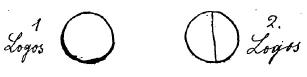
[ 1 ] Today we will try to clarify for ourselves the transition of the Logos to a new system, to a new creation.
[ 2 ] People usually ask first: How did everything come into being? — This is probably the most difficult question, but it is often asked. One can only give an approximate mental image of this. First of all, we must realize that it is our intellect that asks how things came into being and makes it plausible how we ourselves would have created the world if we had been the creator. But the human intellect is one of the things that originate from the Logos, and it is clear that the consciousness of the Logos is far greater; Therefore, we cannot judge the Logos with the human mind. That is why the question cannot be posed as follows: Why did the world have to emerge from the Logos? Instead, we can only ask how the world emerged from the Logos, how things came into being, not why — because the why would imply a compulsion. The emergence of the world from the Logos must be a free act of the Logos, not an act of necessity.
[ 3 ] The creative power of the Logos can only be described by means of a mental image, by imagining a being and its mirror image. One must say to oneself: the reflection contains everything that is present in the being itself. It looks exactly the same, but it is not alive, it does not contain the principle of life. If we want to understand how the reflection can become equal to the being, we must imagine that this is only possible if the being gives its life, its existence, to the reflection — then we have the concept of the first sacrifice. The surrender of one's own existence, the transfer of one's own life to the reflection, that is the original sacrifice.
[ 4 ] It is exactly the same with the Logos. The first Logos relates to the second as when we stand before the reflection and resolve to give our own life to the reflection. The surrender of life is the original sacrifice in free action. That is the act of the first Logos. The second Logos is exactly the same as the first Logos, except that it has received its existence through a sacrifice. If we now study the effect of the second Logos, we find that the essence of the second Logos consists in radiating, reflecting back, the essence of the first Logos toward the first Logos. Thus, the second Logos is a reflection of the first Logos, from which it received its own life, the life that flowed out from the first Logos.
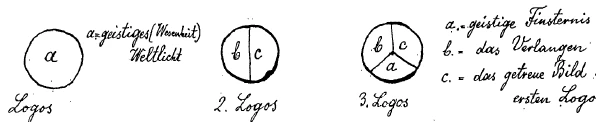
[ 5 ] First, the first Logos is reflected, then it gives its life to the reflection. While in the first Logos everything is directed outward, its existence acts outwardly, the second Logos has, first, the existence it has received and, second, the property of reflecting its content back to the first Logos. Thus, we now have a duality in the second Logos. The life and content of the second Logos are twofold. The content is the same as in the first Logos, but the life is different from that in the first Logos:
[ 6 ] The line in the middle of the second circle means that in the second Logos, life and content are two different things, that they are divided.
[ 7 ] When it comes to content, the image and reflection are the same in both, but life is two different things. This in itself would not yet constitute a world system, because here only one Logos would relate to the other; there would be no diversity. Diversity can only come about through a further sacrifice. A second reflection must take place: the relationship that the two have to each other must also be reflected.
[ 8 ] First, the first Logos is reflected once more; second, the reflection is reflected. This then gives rise to the third Logos as the reflection of the other two Logoi. The third Logos therefore contains:
1. the reflection of the first Logos
2. the reflection of what the first Logos has effected in the second Logos, namely its life
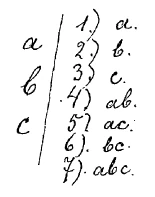
3. the reflection of what the second Logos reflects back to the first.
[ 9 ] Let us now form a mental image: The first Logos is reflected in a. If the first Logos is the outward-striving, creative activity, then its reflection in the third Logos is precisely the opposite activity of the first Logos. In the first Logos, a is the highest spiritual light of the world; in the third Logos, a is the utmost spiritual darkness.
[ 10 ] b is the life that the second Logos received from the first Logos. It is not the life that sacrifices itself, but the life that has been accepted. The life that sacrifices itself in the first Logos is love. The opposite of this in the third Logos is the absolute desire, longing, striving for Logos. b is therefore the absolute desire in the third Logos.
[ 11 ] c is, in the second Logos, the reflection of the first Logos, which the second Logos reflects back.
[ 12 ] In our own reflection, we distinguish between:
1. The radiated image that returns from the darkness.
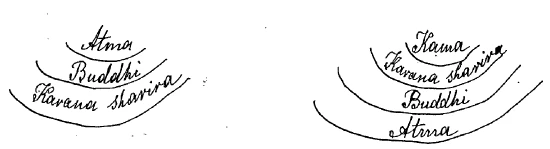
2. That which we have given returns as desire.
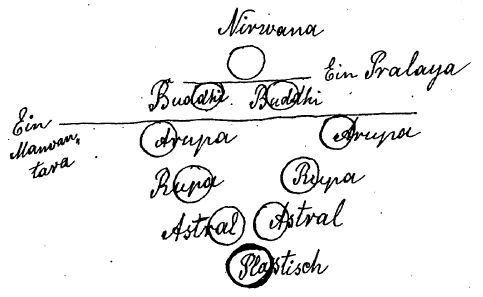
3. The image itself, which is ourselves.
[ 13 ] This corresponds to the three parts in the third Logos:
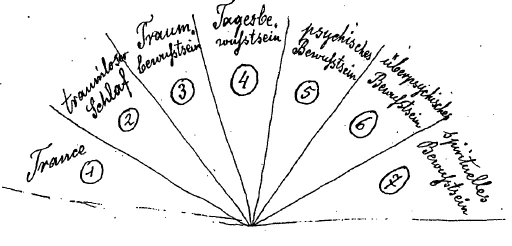
a spiritual darkness = Tamas
b absolute desire = Rajas
c the simple reflection of the first Logos = Sattwa
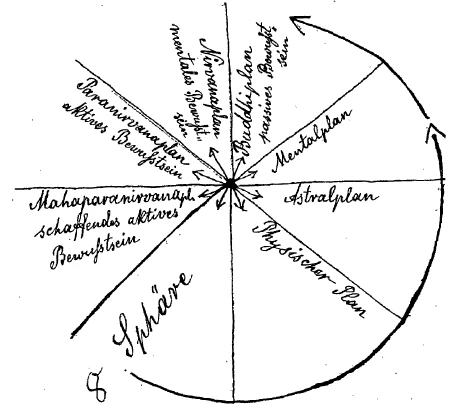
[ 14 ] Tamas, Rajas, Sattwa are the three Gunas, the three parts of the third Logos.
[ 15 ] First, a, b, and c are present. When a is present alone, it is Tamas. When a—spiritual darkness or Tamas—combines with b—Rajas, absolute desire—darkness combines with desire, and there is a striving toward the first Logos. When a and c—Tamas and Sattwa—are combined, we have the image of the first Logos, created out of darkness. Similarly, we can combine b with c. Each can occur on its own and be combined with one of the others. All three combined are what the first Logos itself is. We have seven possible combinations of the three Gunas:
[ 16 ] These, then, are the seven different combinations of the gunas. Mental image these seven possible combinations as the next world-creating principle that can emerge from the three gunas. These seven beings really exist. They are the so-called seven creative spirits before the throne of God, the seven next creative forces after the three Logoi:

[ 17 ] From these seven creative forces emerges what we call the Prajapatis. Since each one can repeat this fact exactly at subordinate levels of consciousness, life, and form, we get three everywhere: that is, three times a, three times b, three times c, three times ab, three times ac, three times bc, three times abc, that is, three times seven = 21 PraJapatis. Each one behaves like an original Logos. This gives us the 21 creators of a particular solar system.
[ 18 ] The first concept we encounter is that of the completely free sacrifice. Once we grasp this concept, the question of why ceases to have any meaning. Human progress consists in no longer asking this question, but rising to the concept of the creative Logos.
[ 19 ] If you have a mechanical instrument, such as a clock or a machine, you can predict how it will behave. This is somewhat less possible with natural processes, but to a certain extent it is possible there too. A solar eclipse, for example, is predictable. One can speak of a necessity here. It is still possible to predict what a plant will do under certain conditions. However, the further we move up in the realm of nature, the less possible it becomes to say what a being will do in a certain situation. The higher a person stands in terms of talent and content, the less possible it is to predict anything about their actions, because one cannot see their reasons and motives. Then there is nothing else to do but wait and see what they will do in a given situation.
[ 20 ] Likewise, one must accept the creation of the world as a free act of the Logos. And progress consists in knowing that one must not ask the universe why, that the question of the reason is unjustified. All who have understood this have not spoken of a reason for the world. Jakob Böhme speaks of a “groundlessness” of the world. If we want to ascend to the knowledge of the creative world power, we can do nothing else but go to where we know that our own development must be the goal, for that is where the Creator must once have stood. The Creator must possess everything we possess in reverse. Atma is the deepest point within us. But the Creator has Atma as pure points in his sphere. At the beginning of the solar system, the world-creating Logos had the qualities that we have found to be the goal of our development: Atma, Budhi, Karana Sharira or Manas, Kama, Linga Sharira, Prana, Sthula Sharira, all in its essence.
[ 21 ] We must become clear about where the activity of this creative Logos can lie. To do this, we first examine where the various metamorphoses take us. The form metamorphoses are: one physical, two astral, two mental, two arupic, seven in total. When we have reached the height of the mental plane, we have become Karana Sharira from the outside; then we become Budhi, then Atma [left diagram]. When the Earth has reached its goal, we will be active on the higher mental plane. Then the transition begins that takes us over to the next planet. To do this, we must have Atma on the outside. So Karana Sharira and Budhi must also disappear on the outside [right diagram]:
[ 22 ] Amar, the consequence of this is that we must not have a mental image that nothing happens during the transition to a new planet—Pralaya is not inactivity and sleep—but during Pralaya, Karana Sharira and Budhi are still being shed. On the budhi plane, we must shed Karana Sharira, and on the nirvana plane, we must shed Budhi itself. Thus, the development takes the following course:
[ 23 ] Budhi itself. Thus, the development takes the following course:
[ 24 ] Pralaya is an activity of a completely different kind than the activity during a Manvantara. In order to form a new planetary chain, the entity must have passed through the Budhi and Nirvana planes on the other side. The significance of the Budhi and Nirvana planes lies in the fact that on them the entities between the planets go through exactly the same thing that humans go through in Devachan. There are also great pralajas: Mahapralajas. If we follow the metamorphoses of consciousness from one planet to another, we have day consciousness on Earth, dream consciousness on the Moon, and so on (see diagram on p. 201):
[ 25 ] One must pass through the Nirvana plane to move from one state of consciousness to another. Once the highest state of consciousness has been attained, and Atma has shed all its veils and truly become the All-Encompassing, it becomes capable of forming a new solar system. To do so, it must pass through two further planes of consciousness. By then, it has attained a kind of universal vision and can survey the entire world system.
[ 26 ] Present-day consciousness can survey the mineral kingdom; psychic consciousness can survey life; intellectual consciousness can survey sensation; and spiritual consciousness can survey all that exists. Atma has then reached the highest level. Atma is universal consciousness.
[ 27 ] If Atma is to radiate outward, it must first acquire the ability to give everything; it must be creative. It becomes so by enveloping itself with Budhi and Manas. Then it can begin a new world system on the Arupa plane. Thus, when consciousness has reached the final stage, it must still pass through two other planes. The first plane is where it does not shed Budhi but adds to it; this is called the Paranirvana Plane. The one where the being descends again to be able to act once more on the Arupa Plane is called the Mahaparanirvana Plane. Each pair of opposing planes corresponds to one another. The lowest is the physical plane; its opposite is Nirvana:
[ 28 ] On the astral plane, desire reigns; on the Paranirvana plane, love—Budhi—reigns. On the mental plane, knowledge reigns, which receives thought; on the Mahaparanirvana plane, creative thought reigns. The Budhi plane is absolute, loving devotion to the Divine. Its opposite is the absolute turning away from all that is Divine. If the Budhi plane has something blissful, its opposite is absolute misery. This is the eighth plane, the eighth sphere.
[ 29 ] Imagine that some being, on some plane in the course of evolution, had turned away from the process of development and gone its own way; it would then fall into the eighth sphere and would have to wait there until the entire cycle of development had run its course. It could only be taken along again in the next evolution as the lowest being. In this cosmic compass rose, the opposites are clearly expressed. - When we have reached the Nirvana plane, the being has reached the point where its Atma is entirely outward-directed. We are then dealing with a Logos of the kind we have designated as the Seven. These are the seven creative spirits; that is why we also have seven different races, [the so-called root races, each with seven sub-races].
[ 30 ] The seven different spirits belong to the Nirvana plane. As we then pass through the Paranirvana plane and the Mahaparanirvana plane, we arrive at the first and second Logos themselves. On the Paranirvana plane, the second Logos arises, and on the Mahaparanirvana plane, the first Logos. On the Nirvana plane, the world system is perfected by the 7 × 3 = 21 Prajapatis. The last of them is abc, the third Logos itself. Only the first Logos can take back what has fallen into the eighth sphere. It takes it along with the dust of the worlds. To be cast out of the course of development means to link one’s life to something that inevitably remains behind, and to wait there until evolution once again reaches that particular state. A savage inhabited by the soul of a savage is relatively happy; but imagine a developed being in the body of a savage or a dog—that is indeed exile. The higher soul has taken the path into a lower manifestation. In fact, “to go into the eighth sphere” means: not to progress with evolution, not to be able to participate in the development of others, but to be cast back to a lower level.
[ 31 ] Consciousness is first a consciousness of cognition up to the Nirvana plane. From the Nirvana plane onward, it is no longer mere perception, but inner creation. On the Paranirvana plane, it is outward creation. On the Mahaparinirvana plane, it is the creative consciousness of the Logos. From there, the consciousness of the Logos passes through the eighth sphere onto the physical plane and becomes creative forces of nature there. In truth, they are the expression of divine thoughts, which appear to us as forces because we cannot comprehend them.