

Self-Knowledge and God-Knowledge II
GA 90b
18 August 1905, Berlin
Translate the original German text into any language:
Versions Available:
Self-Knowledge and God-Knowledge II, tr. SOL
13. Die Sieben Prinzipien
13. The Seven Principles
[ 1 ] Atma besteht beim Menschen aus sieben Prinzipien: 1. aurische Hülle, 2. Budhi, 3. Manas, 4. Kama Manas, 5. Kama, 6. Physis.
[ 1 ] Atma consists of seven principles: 1. auric covering, 2. Budhi, 3. Manas, 4. Kama Manas, 5. Kama, 6. Physis.
[ 2 ] Dieses aus sieben Prinzipien bestehende Wesen hat drei Bewusstseinszustände, auch ‹Bestimmungen› oder ‹Upadhis› genannt. Atma lebt in drei Upadhis:
[ 2 ] This seven-principle being has three states of consciousness, also called 'destinies' or 'upadhis'. Atma lives in three upadhis:
1. kraftend - physisch
2. lebend - astralisch
3. denkend - manasisch
1. physical - strength
2. astral - living
3. manasic - thinking.
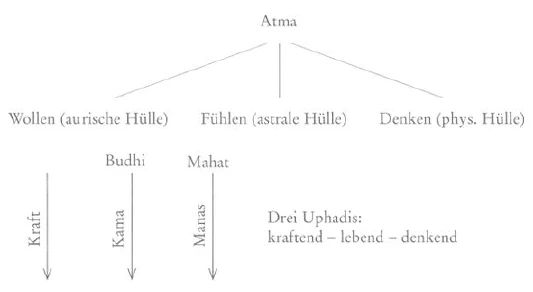
[ 3 ] Sthula Sharira: Das ganze Mineralreich ist nicht in sich erwacht. Es kraftet, das heißt, es ist, aber es fühlt nicht und denkt nicht sein Sein.
[ 3 ] Sthula Sharira: The entire mineral kingdom has not awakened. It is powerful, that is, it is, but it does not feel and does not think its being.
[ 4 ] Linga Sharira: Pflanzen und Tiere sind teilweise in sich erwacht. Sie leben, das heißt, sie fühlen, aber denken nicht ihr Sein.
[ 4 ] Linga Sharira: Plants and animals have partially awakened. They live, that is, they feel, but they do not think their being.
[ 5 ] Karana Sharira: Menschen sind erwacht. Sie denken, das heißt, sie denken ihr Sein.
[ 5 ] Karana Sharira: People have awakened. They think, that is, they think their being.
[ 6 ] Denken wir uns eine Persönlichkeit, sie ist und sie wird wahrgenommen. Wir haben also Subjekt und Objekt. Außerdem nimmt das Subjekt sich selbst wahr, es stellt sich gleichsam außer sich und macht sich zum Objekt; sein Ich steht über dem äußeren Ausdruck seines Ich. Es ist, nimmt sich wahr und denkt.
[ 6 ] Let us imagine a personality, it is perceived and it is recognized. We therefore have subject and object. Furthermore, the subject perceives itself, it places itself, as it were, outside of itself and makes itself an object; its I stands above the external expression of its I. It is, perceives itself and thinks.
[ 7 ] Denken wir uns Atma. Um sich selbst wahrzunehmen, muss Atma sich manifestieren, das heißt durch eine Willenshandlung kundgeben; es muss sein und umgibt sich deshalb mit einer feinen Hülle, die wir die aurische Hülle nennen. - Erster Aspekt: die Welt als Wille/Atma.
[ 7 ] Let us imagine Atma. In order to perceive itself, Atma must manifest itself, that is, it must make itself known through an act of will; it must be and therefore surrounds itself with a fine shell, which we call the auric shell.
[ 8 ] Nun nimmt Atma sich wahr, er fühlt, empfindet sich als seiendes Wesen und bildet dadurch in der aurischen die astrale Hülle. - Zweiter Aspekt: die Welt als Fühlen/Budhi.
[ 8 ] Now Atma perceives itself, it feels, senses itself as a being and thereby forms the astral shell in the auric shell. - Second aspect: the world as feeling/Budhi.
[ 9 ] Um von sich eine Vorstellung zu haben, muss Atma aus sich heraustreten, er macht sich nun objektiv und schafft sich so die physische Hülle. - Dritter Aspekt: die Welt als Denken / Mahat.
[ 9 ] In order to have an idea of itself, Atma must step out of itself, it now makes itself objective and thus creates the physical shell. - Third aspect: the world as thinking / Mahat.
[ 10 ] Wir haben nun hier Atma, das alles durchflutet siebenmal: dreimal subjektiv und dreimal objektiv in seinen Aspekten, und einmal als sich selbst.
[ 10 ] We now have Atma, which permeates everything seven times: three times subjectively and three times objectively in its aspects, and once as itself.
[ 11 ] Betrachten wir die objektive Seite in ihrem Niederstieg, in der Trennung von Atma, so finden wir Wille ohne Geist als Kraft, Fühlen ohne Geist als Kama, Denken ohne Geist als konkreten Manas. In ihrem Aufstieg, das heißt in ihrer Rückkehr zum quellenden Atma wird Kama zu Budhi, Manas zu Mahat, die Kraft zur aurischen Hülle. Alles geht wieder ein in Atma: Wenn ein Wesen zu sich kommen soll, muss es aus sieben Prinzipien bestehen. Die Sieben-Zahl in der objektiven Welt und im Menschen:
[ 11 ] If we consider the objective side in its descent, in the separation of Atma, we find will without spirit as force, feeling without spirit as Kama, thinking without spirit as concrete Manas. In its ascent, that is, in its return to the welling Atma, Kama becomes Budhi, Manas becomes Mahat, the force becomes the auric covering. Everything is absorbed again into Atma: if a being is to come to itself, it must consist of seven principles. The number seven in the objective world and in man:
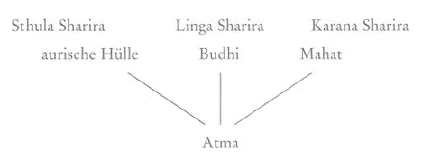
[ 12 ] Ein Wesen kann in drei Bewusstseinszuständen erwachen, das heißt in seinen drei Hüllen: kraftend, lebend - oder fühlend - und denkend.
[ 12 ] A being can awaken in three states of consciousness, that is, in its three shells: as energy, as life – or as feeling – and as thought.
[ 13 ] Im Mineralreich ist das Wesen nur kraftend erwacht; im Pflanzenreich lebend; im Tierreich lebend und fühlend; im Menschen -— denkend.
[ 13 ] In the mineral kingdom, the being has awakened only as energy; in the plant kingdom, as life; in the animal kingdom, as life and feeling; in the human kingdom – as thought.