Basic Elements of Esotericism
GA 93a
30 October 1905, Berlin
Translate the original German text into any language:
Versions Available:
The Foundations of Esotericism, tr. Compton-Burnett
XXVII
Lecture XXVII
[ 1 ] Der Gang der Entwickelung in der Welt tritt uns in drei Stufen entgegen: in Bewußtsein, Leben und Form. Das Bewußtsein in seinen verschiedenen Arten drückt sich aus in den sieben Planeten: Saturn, Sonne, Mond, Erde, Jupiter, Venus, Vulkan. Auf jedem Planeten geht es durch sieben Lebensteiche, und jedes Lebensreich geht durch sieben Formzustände.
[ 1 ] The course of evolution in the world appears to us on three levels: consciousness, life and form.73Rudolf Steiner had explained these concepts to a part of his audience in lectures of October/November 1904 especially 22.10.1904 in Notes on 13 Lectures (Typescript), and 25.10.1904 in History of the Middle Ages (Typescript). Similar presentations are to be found later in lectures 15.9.1907 Occult Signs and Symbols and 17.6.1909 Evolution, Involution and Creation out of Nothing (also contained in The Being of Man and his Future Evolution). Consciousness in its different manifestations finds its expression in the seven Planetary evolutions: Saturn, Sun, Moon, Earth, Jupiter, Venus, Vulcan. On each Planet there are seven Kingdoms of Life and each Kingdom goes through seven Conditions of Form.
[ 2 ] Unsere physische Erde ist ein solcher Formzustand, der vierte Formzustand oder Globus in dem vierten Lebensreiche des vierten Planeten oder Bewußtseinszustandes. Wir denken uns nun die Erde, wie sie jetzt ist und fragen uns: Was tun wir hier? - Wir nehmen die Gegenstände draußen im Raume, zunächst im Mineralreiche, und bilden daraus Kunstwerke. Da kombinieren wir; wir bilden aus Einzelheiten ein Ganzes. Dies ist ein Schaffen innerhalb der Form. Nun kann noch auf andere Weise etwas Neues entstehen, nämlich auf ähnliche Art wie zum Beispiel aus einer Pflanzenwurzel Stengel, Blätter und Blüten entstehen. Diese Blüte setzt man nicht zusammen wie eine Maschine, durch Kombination, sondern sie muß hervorwachsen aus dem, was schon da ist. Das ist ein Vorgang innerhalb des Lebens. Aus dem, was da ist, wird etwas Neues geschaffen.
[ 2 ] Our physical Earth is such a Condition of Form, the fourth Condition of Form or Globe, in the fourth Kingdom of Life, of the fourth Planet, or Condition of Consciousness. We think of the Earth as it now is and ask ourselves: What are we doing here? We take things from outside in space, mainly from the mineral kingdom, and out of them construct artifacts. This is a process of combination; out of separate things we construct a whole, a creation within a form. Now there are other ways in which something new can arise, for instance in a way similar to that in which stalk, leaves and blossoms arise out of the root of a plant. A blossom cannot be put together like a machine, through combination, but it must grow out of what is already there. This is a process within the realm of life. Out of what is there something new is created.
[ 3 ] Bei der dritten Art der Hervorbringung, bei derjenigen aus dem Bewußtsein, geht etwas hervor auf solche Weise, daß wir sagen können: Es war vorher im Grunde genommen eigentlich nichts da — ein Nichts.
[ 3 ] In the case of the third kind of production, out of consciousness, something arises in such a way that we can say: previously there was in fact nothing there—a nothingness.
[ 4 ] Versetzen wir uns an den Uranfang einer solchen planetarischen Entwickelung, ganz an den Anfang der Saturnentwickelung. Was haben wir da zu beobachten? Es war noch kein physischer Planet da, nicht einmal in der feinsten Arupaform war ein Planet vorhanden, sondern wir sind da noch vor dem Augenblicke, wo der Saturn im ersten Anfange da ist. Da ist von unserer Planetenkette noch gar nichts vorhanden; wohl aber die ganze Frucht der vorhergehenden Planetenkette ist da, so ähnlich, wie wenn wir am Morgen aufwachen, noch nichts getan haben und lediglich die Erinnerung an das, was wir am vorherigen Tage getan haben, in unserem Geiste enthalten ist. So haben wir - wenn wir uns so ganz in den Anfang der Saturnentwickelung versetzen - in den sich offenbarenden Geistern die Erinnerung an eine vorherige Planetenkette, an das, was vorher gewesen ist.
[ 4 ] Let us transfer ourselves to the primal beginning of such a planetary evolution, at the very beginning of Saturn. What is to be observed there? There was as yet no physical planet, not even in the finest Arupa-form was a planet present, we are there even before the moment when Old Saturn entered into its first beginning. Nothing of our series of planets existed; certainly however there was the entire outcome of the preceding planetary chain, in much the same way as when we wake up in the morning, having as yet done nothing, and only the memory of what we did on the previous day is contained in our mind. So when we thus transfer ourselves completely into the beginning of the Saturn evolution, we have in the spiritual beings then in manifestation, the memory of a previous planetary chain and its happenings.
[ 5 ] Nun versetzen wir uns an das Ende der Planetenkette, in die Zeit, da die Vulkanstufe zu Ende geht. Während der Planetenkette ist nach und nach als Schöpfung zutage getreten, was an Anlage am Anfange vorhanden war. Wir haben also zuerst einen Ausfluß des Bewußtseins; aus dem Inhalt des Früheren heraus, aus der Erinnerung heraus schafft das Bewußtsein das Neue. Es ist am Ende also etwas da, was am Anfange nicht da war: nämlich alle Erfahrungen. Was am Anfange da war, ist herausgeflossen in lauter Dinge und Wesenheiten. Ein neues Bewußtsein ist am Ende entstanden mit einem neuen Inhalt, ein neuer Bewußtseinsinhalt. Es ist etwas, was aus dem Nichts hervorgegangen ist, aus Erfahrungen. Wenn wir das Erneuern im Leben betrachten, müssen wir uns sagen, es muß ein Same da sein, der das möglich macht. Aber der neue Bewußtseinsinhalt am Ende einer planetarischen Entwickelung ist tatsächlich aus dem Nichts hervorgegangen, aus Erfahrungen; dazu braucht man keine Grundlagen, es schafft etwas, was aus dem Nichts entsteht. Man kann nicht sagen, wenn eine Persönlichkeit die andere anschaut, sie habe der anderen etwas entzogen, wenn sie in der Folge die Erinnerung an die andere Persönlichkeit in sich trägt. Diese Erinnerung ist aus dem Nichts hervorgegangen. Das ist eine dritte Art des Schaffens: aus dem Nichts heraus. Die drei Arten des Schaffens sind also folgende:
[ 5 ] Now let us transfer ourselves to the end of the planetary chain, to the time when the Vulcan evolution will have come to an end. Whereas the chain of planets has gradually come to manifestation as creation, the tendency to it was already there in the beginning as inherent consciousness. So we have to begin with an outpouring of consciousness; out of the content of the earlier, out of memory, consciousness creates the new. At the end therefore something is present which was not there at the beginning: that is, all experiences. What was there at the beginning has flowed out into astral things and beings. At the end a new consciousness has come about with a new content of consciousness. It is something which has come forth from nothingness, out of experiences. When we observe something new we must say to ourselves: to make this possible a seed had to be there. The new condition of consciousness however, at the end of a planetary evolution, has in fact come forth out of nothing, out of experiences; for this no foundations are necessary, something is created which arises out of nothing. When one personality looks at another, it cannot be said that he has taken something from the other one, when as a result he bears within him the memory of the other personality. This memory has come forth out of nothing. Thus the three ways of creating are as follows:
Kombinieren der vorhandenen Teile (Form)
Hervorgehenlassen neuer Gebilde mit neuem Lebensinhalt aus vorhandenen Grundlagen (Leben)
Schaffen aus dem Nichts heraus (Bewußtsein).
Combining of existing parts: Form
Formations with new Life content out of existing foundations: Life
Creating out of nothing: Consciousness
[ 6 ] Es sind dies drei Definitionen von Wesenheiten, die eine Planetenkette hervorbringen, einer planetarischen Kette zugrunde liegen. Man nennt sie die drei Logoi. Der dritte Logos bringt aus der Kombination hervor. Wenn aus der einen Substanz etwas anderes hervorgeht mit neuem Leben, so ist das der zweite Logos, der hervorbringt. Überall aber, wo wir ein Hervorgehen haben aus dem Nichts, da haben wir den ersten Logos. Daher nennt man den ersten Logos oft auch das in den Dingen selbst Verborgene, den zweiten Logos die in den Dingen ruhende Substanz, die Lebendiges aus Lebendigem schafft, den dritten Logos den, der alles Vorhandene kombiniert, aus den Dingen die Welt zusammensetzt.
[ 6 ] Here we have three definitions of Beings who bring about, who underlie a planetary chain. They are called the three Logoi. The Third Logos produces by means of combining. When out of one substance something else having new life comes into being, this is brought forth by the Second Logos. Everywhere, however, where we have to do with a coming forth out of nothing, we have the First Logos. This is why the First Logos is also often called the One who is immanent in things, the Second Logos the One who in the quiescent substance in things creates life out of the living, the Third Logos the One who combines everything existing, who puts the world together out of things.
[ 7 ] Diese drei Logoi gehen in der Welt immer durch- und ineinander. Der erste Logos erfährt auch die innere Weisheit und auch den Willen. Im Schaffen des ersten Logos ist Erfahrung, das heißt, Gedankensammeln aus dem Nichts und dann wieder Schaffen nach den Gedanken aus dem Nichts. Die Schöpfung aus dem Nichts ist aber nicht so gemeint, als ob gar nichts dagewesen wäre, sondern daß im Laufe der Entwickelung Erfahrungen gemacht werden und daß im Laufe des Werdens Neues geschaffen wird, daß das, was da ist, gleichsam abschmilzt und aus der Erfahrung heraus Neues geschaffen wird.
[ 7 ] These three Logoi always manifest in the world in and through one another. The First Logos also experiences both the inner wisdom and the will. In the creative activity of the First Logos there is experience, that is to say, the gathering of thoughts out of nothing and then creating once more in accordance with these thoughts out of nothing. Creation out of nothing is however not meant in such a way as if nothing at all had been there. On the contrary, in the course of evolution experiences are made and in the course of becoming the new is created, so that what is there melts away and out of experience there is the creation of the new.
[ 8 ] Diese Schöpfung geschieht vergleichsweise so: Jemand sieht einen anderen Menschen an und merkt sich das Bild. Wäre er schöpferisch begabt wie der erste Logos, dann könnte er sich folgendes sagen: Ja, ich habe NN gesehen und ich kenne auch den Begriff des umgekehrten NN. Ich kann mir auch ein negatives Bild von ihm machen: Also statt wo Schwarz ist, Weiß und umgekehrt. So hat er aus der Erfahrung des Objekts und dessen Negativs ein vollständig neues Gebilde geschaffen. Dies könnte er mit Leben begaben. Es wäre ein neues Gebilde, das früher nicht da war. Nehmen wir nun an, jemand macht dieses so mit vielen Menschen und die vielen Menschen würden zugrunde gehen, so würde der Beobachter nach seinen Erfahrungen eine neue Welt schaffen können.
[ 8 ] This creation may be compared with the following: Somebody sees another person and observes his appearance. If he were creatively gifted like the First Logos he would be able to say: Yes, I have seen N and I also have a concept of the reversed N. I can also form a complementary picture of him, i.e. white where there is black and vice versa. In this way, out of the experience of the object and its negative, he has created a completely new form. This he could imbue with life. It would be a completely new creation that was not previously there. Let us assume that somebody did this with a number of people and that these people were to perish: then, from his experiences, the observer would be able to create a new world.
[ 9 ] Indem man die Welt betrachtet, sieht man fortwährend die drei Logoi ineinanderwirken. Wir wollen uns innerhalb unseres Planetensystems das Wirken der drei Logoi in bezug auf den Menschen vorstellen. Denken wir uns den Punkt des Anfanges der Saturnentwickelung, als noch nichts da war. Was geschieht da? Da wird alles, was vorher vorhanden war, gleichsam wie ausgeträufelt. Alle Dinge, die vorher da waren, werden ausgeströmt. Was auf diese Weise entsteht, das würde die allererste Stoffergießung sein aus der Summe der Erfahrungen von früher. Alles was früher aufgenommen worden ist, wird in Form von Stoff ausgeströmt. Darin ist auch der Stoff enthalten, aus dem später die Menschheit entsteht. Dieser Stoff ist zunächst bloß als Stoff da. Diese Ausströomung muß dann fortwährend aufgebaut, zusammenkombiniert werden. Diese Kombination des ausgeströmten Stoffes ist eine neue Schöpfung. Das ist zunächst ein Schaffen des dritten Logos; nach der Ausströmung des Stoffes also ein Schaffen des dritten Logos.
[ 9 ] In contemplating the world one continually sees the interaction of the three Logoi. Let us form within the framework of our planetary system, a mental picture of the working of the three Logoi in regard to man. Let us think of the very beginnings of the Saturn evolution, when as yet nothing at all was there. What is it that then happens? Then everything that was present previously drips down as it were. All the things that were there earlier stream out. What arises in this way is to become the very first outpouring of substance from the sum of earlier experiences. Therein is contained the substance out of which man developed later,. This substance is to begin with simply there as substance. This out streaming must then be continually worked upon and combined together. The combining of the out streaming substance is a new creation. This is above all a creative activity of the Third Logos. It happens after the out streaming of substance and therefore is a creative activity of the third Logos.
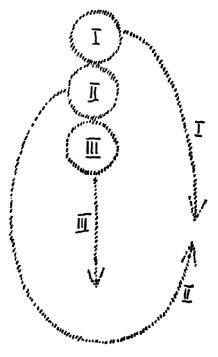
[ 10 ] Was bedeutet das nun für den Menschen? Für den Menschen bedeutet das nun, daß zunächst alle die Teile zusammenkombiniert werden, die dann seinen physischen Körper bilden. Der Mensch war damals, auf dem Saturn, ein richtiger Automat. Wenn man damals in ihn ein Wort hineingesprochen hätte, hätte er es wieder herausgesprochen. Formen der Wesen werden gebildet. Dies nennt man die Arbeit des dritten Logos und sie dauert bis in die Sonnenzeit hinein, in der der Mensch dann auch den Ätherkörper, das Leben bekommt. Dies ist die Arbeit des zweiten Logos. Nun gehen wir weiter bis in die Erdenzeit. Da bekommt der Mensch selbst ein Bewußtsein, das heißt die Möglichkeit, Erfahrungen zu sammeln aus dem Nichts heraus. Dies ist die Arbeit des ersten Logos. Der Mensch auf dem Saturn erhält das, was Form in ihm ist, von dem dritten Logos. Der Mensch auf der Sonne erhält das, was Leben in ihm ist, von dem zweiten Logos. Der Mensch auf der Erde erhält das, was Bewußtsein in ihm wird, von dem ersten Logos.
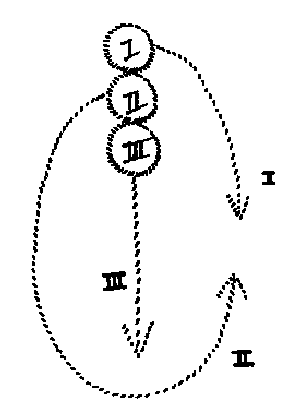
[ 10 ] What does this signify for man? For man it signifies that in the first place all the parts are combined which then form his physical body. At that time, on Saturn, the human being was a veritable automaton. If one had spoken a word into him, he would have spoken it out again. Forms of beings are fashioned. This is called the work of the Third Logos and it continues into the Sun epoch, when man also receives his etheric body and with it life. This is the work of the Second Logos. Now let us continue into the Earth Epoch. There man himself acquires a consciousness, that is to say, the possibility of gathering experiences out of nothingness. This is the work of the First Logos. On Saturn man received from the Third Logos what in him is form. On the Sun he received what in him is life from the Second Logos. On the Earth he received what in him is consciousness, from the First Logos.
[ 11 ] Der Begriff des Bewußtseins muß uns noch ein wenig klarer werden. Wir müssen uns dazu vollständig herausarbeiten den Begriff des Bewußtseins auf einem bestimmten Plan. Der Mensch ist bewußt, aber es handelt sich darum, zu wissen, wo sein Bewußtsein ist. Der Mensch ist jetzt bewußt auf dem physischen Plan, wenn wir von dem Wachbewußtsein sprechen. Aber das Wachbewußtsein könnte ja auch auf dem Astralplan sein. Wenn bei einem Geschöpf das Leben auf dem physischen Plan und das Bewußtsein auf dem Astralplan ist, so ist das ein Tier.
[ 11 ] The concept of consciousness must become a little clearer to us. We must work out fully the concept of consciousness on a particular plane. Man is conscious, but we have to know where his consciousness is. Now he is conscious on the physical plane when we are speaking about waking consciousness. But waking consciousness could also be on the astral plane. When in the case of a creature, life is on the physical plane and consciousness is on the astral plane, then this creature is an animal.
[ 12 ] Beim Menschen ist das Bewußtsein im Kopfe lokalisiert. Beim Tier, zum Beispiel beim Tiger, ist das Bewußtsein auf dem Astralplan. Es schafft sich außerhalb des Kopfes einen gewissen Angriffspunkt, durch den es auf den Tiger wirkt. Wenn der Tiger Schmerz empfindet, dann geht der Schmerz auch über auf den Astralplan. Das Organ dafür ist bei dem Tiger vor dem Kopfe, an der Stelle, wo beim Menschen die Stirne ist. Beim Menschen ist der Punkt bereits in den Kopf eingeschlossen und mit dem Vorderhirn ausgefüllt; es ist das Bewußtsein eingefangen worden durch das Gehirn und den Vorderschädel und ist daher auf dem physischen Plan. Bei dem Tiger und überhaupt bei allen Tieren liegt der Knotenpunkt des Bewußtseins vor dem Kopfe, im Astralen, da geht es in die Astralwelt hinein. Bei der Pflanze ist es wiederum anders. Wenn wir ihr Bewußtsein verfolgen könnten, würden wir, von oben nach unten gehend, immer an der Wurzelspitze herauskommen. Wenn wir dann die Linie des Wachstums verfolgen, so würden wir an den Mittelpunkt der Erde kommen. Da ist der Sammelpunkt aller Empfindungen, der Aufsaugepunkt des Bewußtseins der Pflanzen. Er steht direkt in Verbindung mit der mentalen Welt. Die gesamte Pflanzenwelt hat ihr Bewußtsein im Mentalen.
[ 12 ] In human beings, thinking is localised in the head. With the animal, for instance the tiger, consciousness is on the astral plane. Outside the head what may be called a focal point is formed through which the tiger is affected. When the tiger feels pain this goes over on to the astral plane. With the tiger the organ for this is in front of the head, at the place where the brow is in the case of man. With man this place is already enclosed within the head and it is filled with the frontal brain; consciousness has been imprisoned through the brain and the front part of the skull and is therefore on the physical plane. In the case of the tiger, and indeed of all animals, the focal point of consciousness lies in front of the head, in the astral: from there it goes into the astral world. In the case of the plant things are again different. Could we follow its consciousness, going from above downwards, we would always come out at the tip of the root. If then we were to follow the line of growth, we would come to the centre of the earth. There is the collecting point of all the sensations, the suction point of the consciousness of the plant. It is in direct connection with the mental world. The entire plant world has its consciousness on the mental plane.
[ 13 ] Bei der gesamten mineralischen Welt ist das Bewußtsein auf den höchsten Gebieten der Mentalwelt, auf dem Arupaplan. Die Steine haben ihr Bewußtsein so, daß wenn wir den Punkt suchen wollten, wir ihn wie eine Art Sonnenatmosphäre finden würden. Wenn wir auf der Erde die mineralische Welt bearbeiten, Steine klopfen, steht jede einzelne Tat zu dieser Sonnenatmosphäre in einer gewissen Beziehung. Dort spürt man, was der Mensch hier arbeitet. Da haben wir also eine Reihe von Wesenheiten auf dem physischen Plan, deren Bewußtsein aber auf verschiedenen Planen liegt.
[ 13 ] The consciousness of the entire mineral world is in the highest regions of the Mental World, on the Arupa plane. The consciousness of stones is such that if we wished to seek its focus we should find it as a kind of Sun-atmosphere. When on the Earth we work upon the mineral world, when we break stones, each single action is in a certain relationship to this Sun-atmosphere. There one perceives the work that man does here. Thus we have a range of beings on the physical plane whose consciousness however lies on different planes.
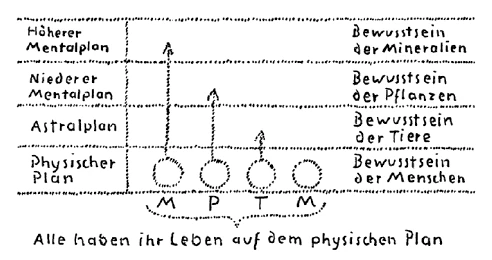
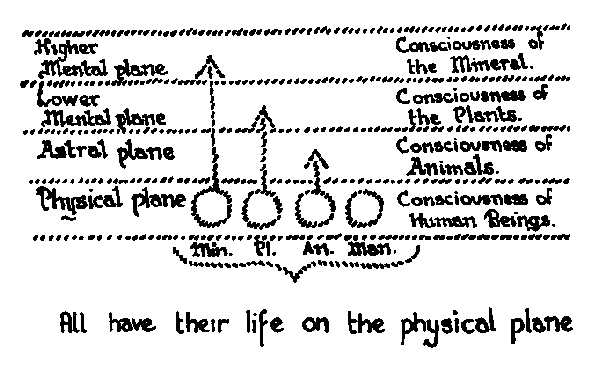
[ 14 ] Menschen und Tiere unterscheiden sich dadurch, daß sie ihr Bewußtsein auf verschiedenen Planen haben. Es gibt nun auch noch andere Wesen als Mineralien, Pflanzen, Tiere und Menschen. Es gibt Wesen, die ihr Bewußtsein im Physischen haben und ihren Körper im Astralen. Ein solches Wesen ist sozusagen das umgekehrte Tier. Solche Wesen gibt es wirklich, es sind die Elementarwesen. Machen wir uns zu ihrem Verständnis klar, was zum physischen Plan gehört.
[ 14 ] Human beings and animals differ from each other through the fact that they have their consciousness on different planes. Now there are also other beings besides minerals, plants, animals and human beings. There are beings who have their consciousness on the physical plane and their body in the astral. Such a being is, as it were, an animal in reverse. Such beings actually exist; they are the elemental beings. In order to make their nature comprehensible let us be clear about what belongs to the physical plane.
[ 15 ] Physisch ist: Erstens die feste Erde, zweitens Wasser, drittens Luft, viertens Äther (Wärmeäther, Lichtäther, chemischer Äther, Lebensäther). Bleiben wir bei den vier unteren Formen unseres physischen Planes, scheiden wir die ätherische Welt davon ab.
[ 15 ] Physical is: Firstly the solid earth, secondly water, thirdly air, fourthly ether (warmth ether, light ether, chemical ether, life ether). Let us keep to the four lower forms of our physical plane and separate the etheric world from them.
[ 16 ] In allen vier Formen des physischen Planes können Bewußtseine liegen, während der Körper eines solchen Wesens im Astralen liegt. Man denke sich das Bewußtsein in der festen Erde, den Körper im Astralen; oder ein Wesen, das im Wasser sein Bewußtsein hat, und dessen Körper im Astralen ist; dann ein solches mit dem Bewußtsein in der Luft und dem Körper im Astralen; und eines mit dem Bewußtsein im Feuer und dem Körper im Astralen. Die heutige Menschheit weiß nicht viel von diesen Wesen, man kennt sie in unserer Zeit nur durch die Poesie. Die Bergleute aber kennen solche Wesen sehr gut. Ein Gnom ist nur wahrnehmbar für den, der auf dem astralen Plan schauen kann, aber Bergleute besitzen manchmal ein solches astrales Schauen, sie wissen, daß Gnomen Wirklichkeiten sind. So sind in unserer Erde eigentlich Bewußtseine vorhanden, und was der Naturforscher heute Naturgesetze nennt, das sind die Gedanken von Wesenheiten, die auf dem physischen Plan denken, aber ihren Körper auf dem Astralplan haben. Wenn in der Physik etwas von einem Naturgesetz steht, so können wir uns sagen: das sind Gedanken eines Wesens, das auf dem Astralplan seinen Körper hat. Die Naturkräfte sind schaffende Wesenheiten und die Naturgesetze sind ihre Gedanken.
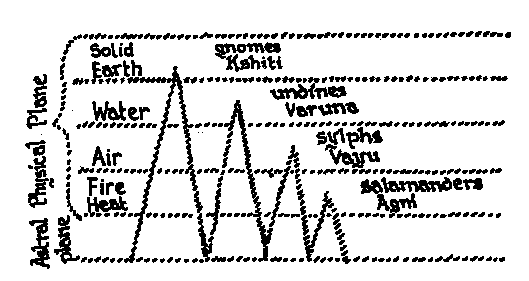
[ 16 ] States of consciousness can lie in all four forms of the physical plane while the body of such a being lies in the astral. We must think of the consciousness in the solid Earth, the body in the astral; or a being that has its consciousness in the water and its body in the astral; then such a being with its consciousness in the air and its body in the astral and one with its consciousness in fire and its body in the astral. Present-day man knows but little of such beings; in our time it is only through poetry that they are known. Miners (of minerals) however know such beings very well. A gnome is only visible to someone who can see on the astral plane, but miners frequently possess such an astral vision; they know that gnomes are realities. Thus, on our Earth there exist various forms of consciousness, and what the natural scientist today calls laws of nature are the thoughts of beings who think on the physical plane but have their bodies on the astral plane. When in physics we have to do with laws of nature we can say: these are the thoughts of a being who has its body on the astral plane. The forces of nature are creative beings and natural laws are their thoughts.
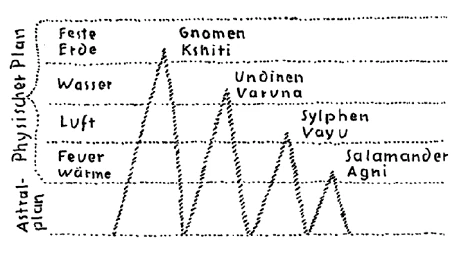
[ 17 ] Im Mittelalter versuchte der Alchimist, sich die Geister dienstbar zu machen. Goethe hat das recht gut gewußt; Faust will Feuerluft haben; da soll der Salamander hervorgehen, der auf dem Astralplan seinen Körper hat. Wir haben also um uns Wesenheiten, die tatsächlich im Feuer ihr Bewußtsein haben, denen wir Schmerz verursachen, wenn wir Feuer anzünden, denn dadurch verursacht man eine gewisse Veränderung des betreffenden Körpers der Wesenheit auf dem Astralplan. Wenn man Licht anzündet, verändert man diese astrale Wesenheit. Ebenso wenn man auf anderen Gebieten der Elemente und der Naturkräfte Veränderungen hervorbringt, verändert man etwas an diesen astralen Wesenheiten. Wir bevölkern den Astralplan fortwährend mit Wesenheiten, indem wir dies oder jenes tun. Denken wir uns diesen Gedanken klar aus, dann haben wir den Sinn der kirchlichen Zeremonie: nämlich nicht beliebige Dinge vorzunehmen auf dem physischen Plan, sondern solche, die sinnvoll sind, wodurch sinnvolle Wesenheiten auf dem Astralplan entstehen. Wenn man zum Beispiel mit Weihrauch räuchert, macht man etwas Planvolles; man verbrennt bestimmte Stoffe und schafft Wesenheiten von einer bestimmten Sorte. Wenn man ein Schwert nach vier Seiten durch die Luft führt, schafft man ein bestimmtes Wesen. Ebenso der Priester, wenn er bestimmte Handbewegungen macht bei bestimmten Lauten, wie zum Beispiel bei 0, i, u, verstärkt durch die Wiederholung: Dominus vobiscum. Der Klang ist regelmäßig angeordnet, die Luft wird in bestimmte Erschütterungen gebracht, die dadurch verstärkt werden, daß man bestimmte Handbewegungen macht, und es wird eine Sylphe hervorgerufen. Auch Zeichen, Griff und Wort der Freimaurer bringen bestimmte Gebilde hervor, die eine Gesetzmäßigkeit in der physischen Welt ausdrücken. Durch planvolles Gebrauchen dieser Worte schafft man ein Band vom einen zum anderen, man hüllt sich ein in eine astrale Materie, die durch Zeichen, Griff und Wort geschaffen worden ist.
[ 17 ] In the Middle Ages the alchemist tried to make use of these spirits. Goethe knew this very well; Faust wished to have fire air; this was to be produced by the salamanders which have their body on the astral plane. Thus we have around us beings who actually have their consciousness in fire, to whom we cause pain when fire is kindled, for by so doing we actually cause a certain alteration in the body of the being in question on the astral plane. When one kindles fire one alters this astral being. In the same way when one brings about alterations in other spheres of the elements and the forces of Nature one alters something in these astral beings. When we do this or that we are continuously peopling the astral plane. If we think these thoughts through clearly, we have the meaning of church ritual: that is, not to make use of any kind of substances on the physical plane, except such as have meaning, whereby meaningful beings arise on the astral plane. When for instance one kindles the smoke of incense one does something which has purpose; one burns a particular substance and creates beings of a particular kind. When one passes a sword through the air in four directions one creates a definite kind of being. It is the same with the priest, when he makes definite movements with his hands, to accompany definite sounds o, i, u, intensified by repetition: Dominus vobiscum. The sound is regular, the air is brought into definite vibrations intensified by definite movements of the hand, and a sylph is called into existence. Sign, grip and word of the freemasons also bring about definite forms which manifest in accordance with definite laws in the physical world. Through a purposeful use of these words a link is formed from one person to another, one is enwrapped in an astral substance which is created through sign, grip and word.
[ 18 ] Der Mensch tut das alles natürlich auch im gewöhnlichen Leben fortwährend, aber da tut er es unsystematisch, er schafft sich widersprechende Wesenheiten. Die Kunst besteht darin, vom physischen Plan auf höhere harmonisch hinaufzuwirken. In den Kultuszeremonien sollen durch bestimmte Handlungen nicht widersprechende, sondern harmonische Wesenheiten erschaffen werden. Der Mensch ist zunächst nicht imstande, diese Dinge in Harmonie zu bringen. Aber für alles, was der Mensch so schafft auf dem Astralplan, gibt es gewisse dirigierende Wesenheiten. So haben wir eine Welt von Elementarwesen um uns mit einem König. Bei den Indern werden genannt der König der Gnomen: Kshiti, der alleroberste Gnom; das oberste Wesen unter den Undinen: Varuna; das oberste Wesen unter den Sylphen: Vayu; und alles, was im Feuer sein Bewußtsein hat, wird dirigiert durch den König des Feuers: Agni. Bei allem Feuer- und Wasserwirken und so weiter haben wir es zu tun mit diesen bestimmten Devawesenheiten. Alles Feuer, das wir hier auf der Erde haben, ist der Stoff, der aus den Wesen, die zu Agni gehören, gewoben ist. Zeremonielle Magie ist die niedrigste Art der Zauberei und besteht darin, daß man sich gewisse Kunstgriffe aneignet auf dem physischen Plane, um bestimmte Gebilde und Wesenheiten auf dem Astralplan zu schaffen. Es gibt Schulen, in denen zeremonielle Magie heute noch getrieben wird. Ein solches Treiben verursacht einen großen Hang zur Astralwelt und bewirkt sehr häufig Selbstmord, weil dann der Mensch fast nur in der astralen Welt tätig ist und sich abgewöhnt hat, die physische Welt um ihrer selbst willen zu nehmen. Er hat den Hang zur anderen Welt ausgebildet und der physische Körper ist ihm dann oft hinderlich.
[ 18 ] Naturally man continually does all this in ordinary life, but he does it in an unsystematic way, creating contradictory beings. Art consists in working harmoniously upwards from the physical to higher planes. In rituals, through definite acts, the aim is to produce not contradictory but harmonious beings. At present man is not in a position to bring these things into harmony. But for everything man creates in this way on the astral plane there are certain directing beings. So we have a world of elemental beings around us with a king. Among the Indians the king of the gnomes is called Kshiti, the highest of the gnomes; the highest being among the undines: Varuna; the highest being among the sylphs: Vayu, and everything having its consciousness in fire is directed by the king of fire: Agni. In all activity connected with fire, water and so on we have to do with these particular Deva-beings. All the fire we have here on Earth is the substance that is woven out of the beings which belong to Agni. Ceremonial magic is the lowest kind of sorcery and consists in making use of certain specially devised tricks on the physical plane in order to create definite forms and beings on the astral plane. Schools exist today in which ceremonial magic is still exercised. Such usages cause great attraction towards the astral world and very frequently result in suicide, because then a person is almost exclusively active in the astral world and has become unaccustomed to using the physical world for its rightful purpose. He has developed a partiality for the other world and the physical body is often a hindrance.
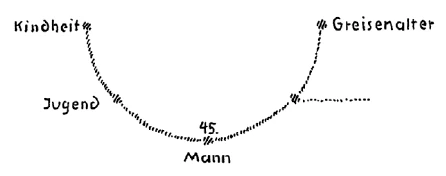
[ 19 ] Nun werden Sie auch den Zusammenhang mit dem Feuerdienst begreifen, der in der Religionsgeschichte hervorgetreten ist. Die Anhänger des Zarathustra versuchten, durch das Feueropfer der Priester gewisse Gebilde auf dem astralen Plane tatsächlich zu schaffen. Auf der Erdkugel geht jetzt alles physisch vor sich. Aber man kann aus dem Gesagten sehen, daß sich fortwährend astrale Wesenheiten bilden unter dem Einflusse unserer Taten. Alle Handlungen sind begleitet von astralen Wesenheiten. Das sind unsere Skandhas, die unser Karma vollziehen. Aber auch alle physischen Tatsachen lassen astrale Wesenheiten im Astralen zurück. So zum Beispiel entspricht auch dem Kölner Dom eine ganz bestimmte Wesenheit auf dem Astralplan. Durch alles, was auf der Erde geschieht, wenn alle physische Materie umgearbeitet ist und die Erde sich auflöst, wird von selbst der nächste astrale Globus gebildet. Er ist einfach da als die astralen Wesenheiten, als die Wirkungen aller früheren physischen Vorgänge. Darum muß der Mensch fortwährend im Karma wirken. Er muß die grotesken astralen Wesenheiten, die er verpfuscht hat, im nächsten Leben wieder zurechtbringen, sonst wären diese als sinnlose Geschöpfe für den nächsten Globus da. Das ist Karma, das der Mensch ausbessern muß. Was da im Großen vorgeht auf der Erde, das geht beim Menschen auch im Kleinen vor. Man denke sich ein Kind. Man erzieht es falsch, man verzieht es durch Leckereien und so weiter. Das zieht nicht nur Vorgänge im physischen Körper nach sich, sondern das teilt sich dem Astralen fortwährend mit, so daß man tatsächlich den Astralkörper mitverändert. Was man dem Säugling beibringt, physisch, das geht in seinen Astralkörper über, das ist da in Form von bestimmten Gebilden vorhanden. Was so hineingearbeitet ist, wird aber stufenweise wieder herausgearbeitet. In der Zeit des höheren Alters rächen sich die Sünden, die an dem Kinde begangen worden sind. Diese Sünden bleiben durch die ganze Lebenszeit hindurch und sind von großer Wichtigkeit gerade für den letzten Lebensabschnitt des Menschen. Nach dem mittleren Zeitpunkt des Lebens geschieht eine Art von Umkehr; das Astrale wirkt dann in den physischen Plan hinein. Der Mensch legt in der Kindheit im Astralen den Grund zu dem, was er im Alter haben wird. Wenn der Mensch einsieht, was an ihm gesündigt worden ist und er daraufhin an sich selbst arbeitet, dann kann er die Schäden im Astralleib wieder ausmerzen, sonst wird er im Alter unter denselben Schwächen seiner Kindheit zusammenbrechen. Auf den Astralkörper wirkt aber nur dasjenige ausgleichend, was man bewußt hineinarbeitet. Wenn man später nicht bewußt die entgegengesetzten Eigenschaften hervorruft, kann man die Fehler nicht ablegen.
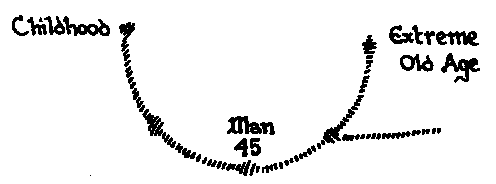
[ 19 ] Now you will also comprehend the connection with fire worship which has appeared in the history of religion. The followers of Zarathustra sought, through the sacrificial fire of the priests, actually to create definite forms on the astral plane. On the Earth today everything takes place physically. But from what has been said, one can see that astral beings are continually created under the influence of our deeds. All deeds are accompanied by astral beings. These are our Skandas which bring about our Karma. But also all physical deeds leave astral beings behind on the astral plane. For instance Cologne cathedral corresponds to a definite being on the astral plane. Through everything that happens on the Earth, when all physical matter is worked over and the Earth has dissolved, through this the next astral Globe will arise of itself. It will simply be there as astral beings, as the effects of all the earlier physical processes. This is why man must continually work with Karma. In his next life he must put right again the grotesque astral beings that he has bungled, otherwise they would produce meaningless creatures for the next Globe. This is Karma that he must rectify. What takes place on a large scale on the Earth, takes place in a small way in man. Let us think of a child. He is wrongly brought up, spoiled with sweets and so on. This not only brings about processes in the physical body but continually imparts them to the astral, so that in fact the astral body also is changed. What one gives physically to the infant goes over into his astral body, it is present in the shape of definite forms. What is thus worked in, is however gradually worked out again. In advanced age the sins against the child take their revenge. These sins remain throughout the whole life and have great importance particularly in the final years. After the middle period a sort of reversal takes place; the astral then works into the physical plane. In childhood the foundation of what man will have in old age is implanted into the astral. When a person perceives how he has been sinned against and works upon himself with this in view, then he can eliminate the damage in the astral body, otherwise he will break down in old age under the weaknesses of his childhood. Only what man works into it consciously has a balancing effect on the astral body. If later in life the opposite qualities are not called up consciously, one cannot rid oneself of the failings.