Basic Elements of Esotericism
GA 93a
5 November 1905, Berlin
Translate the original German text into any language:
Versions Available:
The Foundations of Esotericism, tr. Compton-Burnett
XXXI
Lecture XXXI
[ 1 ] Unserer fünften Wurzelrasse, der jetzigen nachatlantischen Menschheit, ist die atlantische vorangegangen, auf dem jetzt versunkenen Kontinent zwischen Europa und Amerika. Die Atlantier sind in keiner Weise zu vergleichen mit denjenigen Menschen, die heute den Erdball bewohnen. Denn selbst die Überbleibsel jener alten Rasse haben verschiedenes gelernt von den späteren Bewohnern des fünften Kontinents, und wir könnten uns daher den Zustand jener Kultur nicht daraus konstruieren. Im Anfange der atlantischen Kultur gab es keine Werkzeuge. Durch die hellseherischen Kräfte war es dem Atlantier möglich, sich die Erde dienstbar zu gestalten. Die Zubereitung der Metalle findet sich aber erst gegen Ende der atlantischen Zeit.
[ 1 ] Our Fifth Root-Race, the present Post-Atlantean humanity, was preceded by that of Atlantis, on the now submerged continent between Europe and America. The Atlanteans can in no way be compared with the human beings who today inhabit our Earth Globe. For even the remnants of that old race have learnt a variety of things from the later inhabitants of the Fifth Continent and we are therefore unable to reconstruct from them the conditions of that civilisation. At the beginning of the Atlantean civilisation there were no tools. By means of clairvoyant forces it was possible for the Atlantean to make the earth serve his needs. The preparation of metals for such uses only appeared towards the end of the Atlantean Epoch.
[ 2 ] Von der atlantischen Bevölkerung wurde eine kleine Gruppe ausgesondert, so wie sie jetzt wieder in der Theosophischen Gesellschaft ausgesondert werden soll. Ihre Aufgabe war es, eine neue Kultur hinüberzutragen in die fünfte Wurzelrasse. Den Ort, wo jene wohnten, die dazu ausersehen waren, eine kleine Kolonie, abgesondert von der übrigen Kultur, anzulegen, würden Sie im heutigen England und Irland finden. Da wohnten dazumal die Ursemiten. Das waren die ersten Menschen, die imstande waren, verstandesmäßig zu denken. Alles Vorstellen der Atlantier war noch ein bildhaftes. Die Wölbung der Stirne nach vorne, die Bildung des Denkhirns, trat zuerst auf bei der ursemitischen Bevölkerung, die keine Ähnlichkeit hatte mit den jetzigen Semiten. Diese ursemitische Bevölkerung, die sozusagen das Denken erfand, die wanderte durch Europa hindurch nach Asien hinüber und begründete zunächst dort eine Kultur. Die Ursemiten bildeten die fünfte Unterrasse der Atlantier. Die sieben Unterrassen der atlantischen Wurzelrasse waren folgende: Erstens die der Rmoahals, zweitens die der Tlavatlis, drittens die der Urtolteken, viertens die der Urturanier, fünftens die der Ursemiten, sechstens die der Urakkadier, siebentens die der Urmongolen.
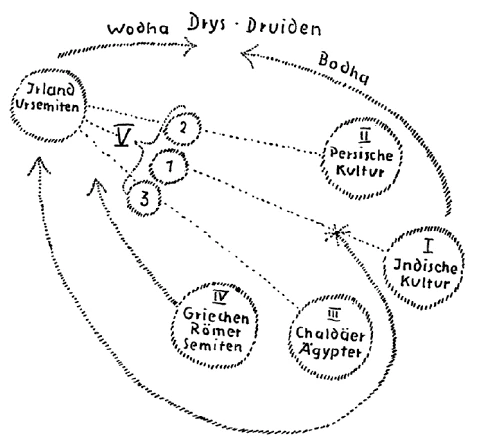
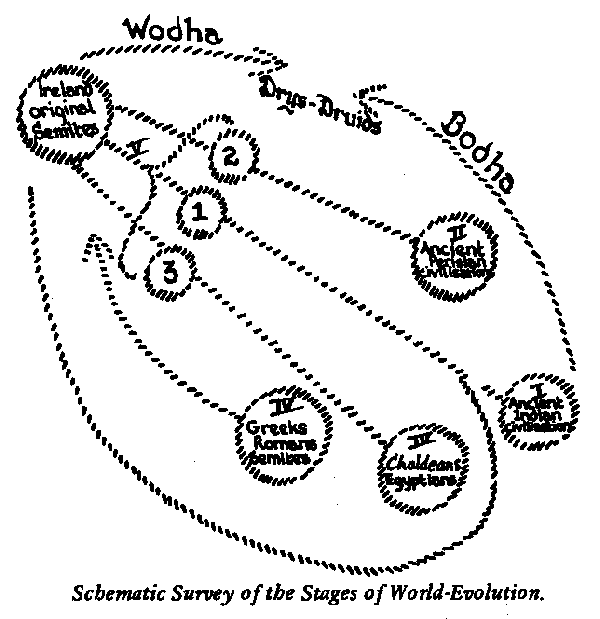
[ 2 ] A small group was separated off from the population of Atlantis, just as now in the Theosophical Society a separation should once again take place. It was their task to carry over a new civilisation into the Fifth Root-Race. You would find the place where those who were chosen lived, a small colony, in present England and Ireland. At that time this was where the original Semites lived. They were the first people who were in a position to think with their intellect. All the ideas of the Atlanteans were still of the nature of pictures. The rounded shape of the front of the brow, the formation of the part of the brain on which thought depends, first appears with the population of the original Semites, who were in no way similar to the present Semitic race. This original Semitic people who, one can say, discovered thinking, journeyed through Europe into Asia and there founded a civilisation. They formed the Fifth Sub-Race of the Atlanteans. The seven Sub-races of the Atlantean RootRace were as follows: Firstly the Rmoahals, secondly the Tlavatlis, thirdly the original Toltecs, fourthly the original Turanians, fifthly the original Semites, sixthly the original Accadians, seventhly the original Mongolians.
[ 3 ] Von der fünften Unterrasse der Atlantier stammt also die fünfte Wurzelrasse ab. Wenn wir einen Blick hinüberwerfen nach Asien, so finden wir da zunächst als erste Unterrasse der fünften Wurzelrasse, der alten indischen Rasse, jenes Volk, welches später mehr nach Süden wanderte und dort die Stammväter bildete der späteren Inder. Die wesentlichste Eigenschaft dieses nach dem nördlichen Indien hin lebenden Stammvolkes war, daß es in bezug auf die materielle Kultur keinen rechten Sinn entwickelte. Es hatte geistige Anschauungen höchster Art mit einem ganz und gar unentwickelten Sinn für die materielle Kultur. Weltabgewandt waren die alten Inder; ihre Seele war der atlantischen noch vollständig ähnlich darin, daß sie in sich eine unendlich herrliche Bilderwelt entwickeln konnte. Durch Jogaübung, aus dem Inneren heraus, entwickelte sich bei ihnen später eine fein ausgebildete, uns heute gelehrt erscheinende Anschauung von der Welt. Davon sind in der äußeren Überlieferung nur noch Bruchstücke vorhanden. Die Veden und die Bhagavad Gita geben von den gewaltigen Anschauungen der Inder kein richtiges Bild mehr, sondern nur noch Nachklänge. Auch in der Vedantaphilosophie ist nur noch ein ganz abstrakter Nachklang der ursprünglich wörtlich gelehrten Anschauung der Inder überliefert.
[ 3 ] The Fifth Root-Race therefore arose from the Fifth Sub-Race of the Atlanteans. When we look towards Asia we find there as, the First Sub-Race of the Fifth Root-Race, the Ancient Indian race, that people who later journeyed in a more Southern direction and there became the ancestors of the later Indians. The most essential characteristic of this ancestral race, who had travelled towards the north of India, was that it developed no real sense for material culture. It possessed spiritual vision of the highest order combined with a completely undeveloped sense for the material. The ancient Indians were turned away from the world; their souls were completely similar to the Atlanteans, in that they were able to develop a superlative, glorious picture world. Through the practise of Yoga, working from within outwards, they later evolved what today seems to us a learned conception of the world. Of this, what has been handed down as external tradition, only fragments remain. The Vedas and the Bhagavad Gita no longer give any real picture of the mighty conceptions of the Indians, but only echoes. In the Vedanta philosophy also there is only an abstract remainder of the original teaching of the Indians, which was handed down by word of mouth.
[ 4 ] Denken Sie sich den Sinn, der dann in der späteren Kabbalistik herausgekommen ist in einer Form, die sich auf andere Dinge, mehr auf knifflige Kleinigkeiten erstreckte, denken Sie sich diesen Sinn angewendet auf hohe Weltgedanken. Wenn später der Jude darüber nachdenken konnte in der Kabbalistik, so rührte das davon her, daß die spätere jüdische Geheimlehre nur noch ein verkommenes Abbild, ein Nachklang ist jenes feinverzweigten Gedankensystems der uralten Inder. Und das, was Brahmanenlehre wurde, das ist durchaus nicht nur Religion in dem Sinne, wie die späteren Systeme, sondern Wissenschaft, Dichtung und Religion in einem einzigen großen Ganzen. Das alles war wie die feinste Auslese, wie der herausgezogene Extrakt dessen, was sich in der alten atlantischen Kultur entwickelt hatte.
[ 4 ] Think of the faculty which appeared in the later Kabbalistic teaching in a form which elaborated matters in minute detail with subtle intricacy, think of this faculty applied to lofty cosmic thoughts. When later the Jew was able to apply thought to such things in the Kabbalistic teachings, it followed that the later Jewish occult teaching was only a decadent reflection, an echo of that finely articulated thought system of the primeval Indians. And what the teaching of the Brahmans became is by no means only religion in the sense of later systems, but knowledge, poetry and religion in a single great whole. All this was, as it were the finest flower, the extracted essence of what had developed in the old Atlantean civilisation.
[ 5 ] Auch die europäischen Völker waren von der Atlantis herübergekommen in den Westen und nach Mitteleuropa. Da entwickelte sich eine ganz andere Lehre. Da waren Völkerschaften übriggeblieben, die noch nicht dazu auserwählt waren, neue Kulturen zu begründen, aber in der Anlage auch das hatten, was in Indien so großartig zum Ausdruck kam, was nur hier auf einer viel, viel älteren Stufe stehengeblieben ist. Was von Europa ausgegangen war, das rückte immer weiter und weiter gegen Asien vor. Eine gemeinschaftliche Lehre bildete die Grundlage und ist hier in Europa in einer gewissen Grobbheit geblieben.
[ 5 ] The Europeans also came over from Atlantis to Western and Central Europe and here there developed a quite different teaching. Groups of people settled who were not yet advanced enough to be chosen to found new civilisations, but yet possessed in germinal form what in India came to expression in so magnificent a way, but which here remained at a much earlier stage. What had its start in Europe moved ever further and further towards Asia. A common teaching formed its foundation, but in Europe this remained at a somewhat primitive level.
[ 6 ] Die indische Lehre kam heraus in den Veden. «Veda» bedeutet dasselbe wie «Edda». Nur ist das in den Veden Enthaltene eine feinere Ausbildung dessen, was in gröberer Weise hier in Europa als Edda zurückgeblieben ist, und erst am Ende des Mittelalters Aufzeichnung gefunden hat. Wir müssen uns vorstellen, daß diese ursprüngliche große geistige Lehre durch die nachrückenden Völkerschaften eine gewisse Veränderung erfahren hat. Ihre ursprüngliche Größe bestand in der Erfassung der gewaltigen, göttlichen Einheit, die durch die indischen Schauer erkannt wurde. Das war nicht mehr der Fall bei der nächsten, der persischen Rasse. Ein anderer Zug dieser uralten indischen Anschauung ist der, daß der Zeitbegriff in ihr fast vollständig fehlt. In der zweiten Unterrasse, der urpersischen, tritt gleich der Zeitbegriff hervor. Die Zeit wird von dem Inder zwar erkannt, aber mehr gleichförmig; der Begriff der Geschichte, des Fortschreitens vom Unvollkommenen zum Vollkommenen aber fehlt. Beherrscht war das Denken von der Anschauung, daß alles aus der göttlichen Vollkommenheit emaniert wird.
[ 6 ] The Indian teaching was expressed in the Vedas. ‘Veda’ means the same as ‘Edda’, only the content of the Vedas is more finely developed than that which remained here in Europe in a more primitive form as the Edda, which was only written down at the end of the Middle Ages. We must realise that this great primal spiritual teaching underwent a certain modification brought about by the migrating peoples. Its original greatness consisted in grasping the mighty divine unity which was recognised by the spiritual vision of the (ancient) Indians. This was no longer so with the next, the (ancient) Persian Race. In the wisdom arising from this primeval Indian vision the concept of time was almost entirely absent. It was with the Second Sub-Race, the ancient Persian, that the concept of time made its appearance. Time, it is true, was recognised by the Indian but was more uniform; the concept of history, the progression from the imperfect to what is more perfected, was lacking. Thinking was governed by the idea that everything has emanated from divine perfection.
[ 7 ] Das persische Denken wird beherrscht vom Gedanken der Zeit. Zervan Akarana ist eine Hauptgottheit bei den Persern, und das ist eigentlich die Zeit. Wie kam man zum Begriff der Zeit? Wer wie der uralte Inder vor allem die ureinheitliche Gottheit sucht, muß sie sich als das absolut Gute vorstellen. Das Böse, das Unvollkommene in der Welt, das war für den alten Inder nichts als Illusion; Illusion war ein sehr wichtiger Begriff. Diese Alten sagten: Es gibt in der Welt überhaupt nichts Unvollkommenes und Böses. Wenn ihr glaubt, daß es etwas Böses gibt, so habt ihr die Welt nicht genug illusionsfrei angesehen. Der Rost zum Beispiel, der das Eisen frißt, ist anderswo ein großes Gutes; ihr müßt nur suchen, wo. Wenn ihr einen Verbrecher durch den Schleier der Illusion betrachtet, wird er euch als solcher erscheinen; seht ihr aber von der Illusion ab, so werdet ihr erkennen, daß es das Böse gar nicht gibt. - Diese Lehre hängt innig zusammen mit einer Weltabgewandtheit.
[ 7 ] Persian thinking was governed by the concept of time. Zervan Akarana is one of the most important Divinities of the Persians and this is in fact Time. How did one arrive at the concept of time? Whoever seeks above all the primal unity of the Godhead, as in the case of the ancient Indians, must conceive it as the absolute Good. Evil, the imperfect in the world, was for the ancient Indian nothing but illusion; ‘illusion’ was a very important concept. These ancient people said: Nothing whatever exists in the world that is imperfect and evil. If you believe that something evil exists, you have not looked at the world in a way sufficiently free from illusion. Rust, for instance, which eats into iron, is elsewhere very beneficial: you must only consider where it is. When you look at a criminal through the veil of illusion, he will appear to you as such; if however you turn away from illusion you will realise that there is no such thing as evil.—This teaching is inwardly connected with a turning away from the world.
[ 8 ] Anders war es in der zweiten Unterrasse. Da, bei den uralten persischen Völkern wurde das Gute in den Weltprozeß gelegt, an das Ziel gestellt. Es wurde gesagt: Das Gute muß erkämpft werden. Die Welt ist gut und böse - Ormuzd und Ahriman -, und was das Böse überwindet, das ist Zervan Akarana, die Zeit. - So kommt Gutes und Böses als Entwickelungsprinzip in die frühpersische Weltanschauung hinein. Die Zarathustra-Lehre fußt auf dieser Stellung des Bösen in der Welt, und auf dem Zeitbegriff: Der Mensch ist in das Leben hineingestellt, um das Böse zu überwinden. — Diese Anschauung hängt damit zusammen, daß die zweite Unterrasse keine weltabgewandte war, sondern eine arbeitende. Tätig, wirksam in verschiedenen Zweigen der menschlichen Betätigung, den Blick auf die äußere Welt gerichtet, darauf bedacht, wie man aus der Welt heraus selbst das Gute schaffen könne, so war die zweite Unterrasse. Daher treten bei den Persern eine Fülle von Gottheiten auf; nicht Eigenschaften des einen Gottes, sondern eine Fülle von Gottheiten, weil die Welt, wenn man sie nicht als Illusion, sondern als Wirklichkeit betrachtet, eine Fülle, eine Mannigfaltigkeit bietet. Es waren mehr oder weniger persönlich-geistige Gottheiten, die man dort verehrte.
[ 8 ] It was otherwise with the Second Sub-Race. There, with the earliest of the Persian peoples, the Good was given a particular place in the World-process, was regarded as the goal. It was said: The Good must be sought for. The world is good and evil, Ormuzd and Ahriman; and what conquers the evil is Zervan Akarana, Time. This is how good and evil came into the early Persian world-conception as the principle of evolution. The Zarathustran teaching rests on the placing of evil in the world, and on the time-concept. Man is placed into life in order to conquer evil. This conception is connected with the fact that the Second Sub-Race was not one that was estranged from the world, but worked within it. Active, productive in various branches of human work, attention directed to the outer world, concerned as to how someone could himself create good out of the world: this was the Second Sub-Race. With the Persians therefore a whole company of Gods makes it appearance; not characteristics of one God, but a plurality of Gods; because the world, if not regarded as illusion, but as reality, presents a plurality, a multiplicity. The Gods which were venerated there were more or less personal-spiritual Divinities.
[ 9 ] Die ursprünglichen Initiatoren, die auch die altindische Lehre begründeten, waren auch die Lehrer der zweiten Unterrasse, der uralten persischen Rasse. Sie paßten hier die ganze Lehre einer arbeitenden Rasse an. Sie schufen diejenige Religion, die durch die verschiedenen Zarathustras ihre Ausbildung erlangte.
[ 9 ] The earliest initiates, who founded the ancient Indian teaching, were also the teachers of the Second Sub-Race, the ancient Persian Race. Here they adapted the whole teaching to a working people. They created that religion which was brought to fruition by the various Zarathustras.82Re the original Zarathustra see note 65. The historical Zarathustra lived in the 6th century BC and according to Alexander Polyhistor and Plutarch, was the teacher of Pythagoras. On the tradition in mystery schools of transmitting the name of the teacher with the teaching, compare Rudolf Steiner on Dionysius the Areopagite in lecture 13.
[ 10 ] Eine weitere Initiation erfolgte noch weiter nach Vorderasien hinein: bis nach Ägypten, bis zu den Babyloniern, Assyrern, Chaldäern, diesen Stammyvätern der Araber. Da wurde dann die dritte Unterrasse ausgebildet. Diese dritte Unterrasse war nun eine solche, welche vorzugsweise die beiden Richtungen — das Innere des Menschen und das Äußere - miteinander in Einklang zu bringen suchte. Ob Sie die Grundanschauung dieser dritten Unterrasse in Chaldäa oder Ägypten suchen, überall finden Sie ein starkes Bewußtsein von dem Zusammenhang der menschlichen Arbeit mit den Naturkräften. Das ist ein wesentlicher Unterschied im Vergleich zu der persischen Rasse. In Persien haben Sie die zwei Mächte, das Gute und das Böse, die den Kampf miteinander bestehen. Jetzt versucht der Mensch, die verschiedenen Naturkräfte oder Wesenheiten in seinen Dienst zu bringen. Was sich als persische Religion herausbildete, war vorzüglich auf die menschliche Tüchtigkeit gebaut. Jetzt, innerhalb der dritten Unterrasse, trat das Bewußtsein auf, daß man nicht nur durch körperliche Kraft und moralisches Verhalten, sondern am besten durch Kenntnisse die Natur bewältigen könne. In solchen Ländern, wo ein kunstvoll gehegter Ackerbau betrieben wurde, wie in Ägypten und Chaldäa, entwickelte sich dieses Zusammenbringen der himmlischgeistigen Mächte mit dem, was der Mensch arbeitet. Kenntnis der meteorologischen Umgebung und der Gestirne entwickelte sich da. Der Mensch suchte Kraft für die Arbeit in der Erkenntnis der Natur. So kam es, daß er den Blick nach den Sternen lenkte und daß Astronomie in Zusammenhang gebracht wurde mit dem Menschen auf der Erde. Des Menschen Ursprung wurde in den Sternen gesucht. So kam es, daß wir es in diesem Sinne zum erstenmal mit Wissenschaft zu tun haben. Jetzt, in der dritten Unterrasse, haben wir statt innerer Anschauung praktisches Wissen. Daher hören wir von großen Eingeweihten, welche die Geometrie, die Kunst des Feldmessens, technische Fähigkeiten lehrten. Die Befruchtung des menschlichen Tuns mit der vom Himmel herabgeholten Weltanschauung tritt in der dritten Unterrasse auf. Damit war etwas gegeben, was die ganze Auffassung des menschlichen Lebens in eine Art Himmelskunde rückte. Bei den verschiedenen Völkern kam dies verschieden zum Ausdruck. Bei den Ägyptern wurden Osiris, Isis und Horus als die Vertreter astronomischer Erscheinungen aufgefaßt.
[ 10 ] A further initiation advanced towards the Near East: to Egypt, to the Babylonians, Assyrians, Chaldeans, these forefathers of the Arabs. There the Third Sub-Race was developed. This Third Sub-Race was such that it now sought to bring both directions—the inner nature of man and the outer world—into harmony with each other. Whether you look for the fundamental conception of this Third Sub-Race in Chaldea or Egypt, everywhere you will find a pronounced awareness of the connection between human work and the forces of Nature. This is an essential difference when compared with the Persian Race. In Persia you have two powers, the good and the evil, which do battle with one another. Now man tries to bring the different nature forces or beings into his service. What developed as Persian religion was mainly built up on human morality and industry. Now in the Third Sub-Race the consciousness developed that one does not master nature only by means of bodily strength and moral behaviour, but best of all through knowledge. In those lands where a skillful agriculture was pursued as in Egypt and Chaldea, there developed a co-ordination of heavenly-spiritual powers with what was carried out by human work. Knowledge of the meteorological environment and the heavenly bodies evolved there. Strength for work was sought for in the knowledge of Nature. So it came about that man directed his gaze to the stars, and astronomy was brought into connection with humanity on the Earth. Man's origin was sought for in the stars. Thus, in this sense we have for the first time to do with science. Now in the Third Sub-Race, instead of inner perception, we have practical knowledge. So we hear of great initiates who taught geometry, the practice of surveying, technical skills. The fructification of human activity with cosmic wisdom brought down from the spiritual world makes its appearance in the Third Sub-Race. With this, something was given which translated the whole conception of human life into a kind of heavenly science. With the different peoples this found expression in various ways. In the case of the Egyptians, Osiris, Isis and Horus were conceived of as representatives of astronomical phenomena.
[ 11 ] Drei verschiedene Unterrassen bildeten sich in Asien aus. Vom atlantischen Ausgangspunkte ging unter Führung von Eingeweihten eine Kolonie nach Asien hinüber. Ein besonderes Ergebnis ist die altindische Kultur, ein zweites die altpersische, das dritte Ergebnis ist die chaldäisch-ägyptische Kultur; sie alle haben einen gemeinschaftlichen Initiationsherd. In Europa aber bleiben immer Reste zurück von dem, was in Asien in den drei großen Kulturen so großartig hervorbricht. Diese einzelnen Kulturen sind durchaus in Europa in der mannigfaltigsten Weise durcheinander geschichtet. Auch in Europa gab es Eingeweihte, die gegen Ende des besprochenen Zeitraumes Mysterienschulen ausbildeten: man nannte sie Druiden; Drys bedeutet Eiche. Die starke Eiche war das Symbol der uralten europäischen Gelehrtenpriester. Denn was im Norden die Völker beherrschte, war der Gedanke, daß diese ihre alte Kultur doch untergehen werde. Die Götterdämmerung wurde gelehrt, und die Zukunft des Christentums kam bei den nordischen Propheten großartig zum Ausdruck in dem, was später die Siegfried-Sage wurde. Vergleichen Sie diese mit der Achilleus-Sage.
[ 11 ] Three different Sub-Races developed in Asia. Taking their start from Atlantis, a colony led by initiates traveled over to Asia. A special result of this was the ancient Indian civilisation, a second, the ancient Persian; the third result was the Egyptian-Chaldean civilisation: they all had a common initiation-source. In Europe however groups always remained behind which fell away from what culminated with such magnificence in the three great civilisations. These separate cultural streams were distributed in Europe in the most varied way. In Europe too there were initiates who formed Mystery Schools towards the end of the period of which we are speaking: they were called Druids: Drys means Oak. The strong oak was the symbol of the early European priest-teachers, for what dominated the peoples in the North was the thought that their old form of culture would necessarily have to decline. There the Twilight of the Gods was taught and the future of Christianity came to magnificent expression through these Northern prophets in what later became the Siegfried Saga.83asee lecture 22.3.1906, Siegfried and the Twilight of the Gods (Typescript). This may be compared with the Achilles Saga.83bInvulnerability denoted initiation. (See lecture 7 in the cycle on The Gospel of St Mark.)
[ 12 ] Achill ist unverwundbar am ganzen Leibe, bis auf die Ferse, Siegfried bis auf die Stelle zwischen den Schultern. Unverwundbarsein in solcher Weise bedeutet Eingeweihtsein. In Achill haben Sie den Eingeweihten der vierten Unterrasse, welche im aufsteigenden Bogen der menschlichen Kulturentwickelung liegt; daher sind alle höchsten Teile des Achill unverwundbar, nur die Ferse, die niedere Natur ist verwundbar, ähnlich wie Hephaistos lahm ist. Der deutsche Siegfried war auch ein Held der vierten Unterrasse, aber verwundbar zwischen den Schulterblättern. Hier ist seine verwundbare Stelle, wo erst derjenige, der das Kreuz trägt, sich unverwundbar macht. In Siegfried geht da das Göttliche zugrunde, die nordischen Götter gingen dem Untergange entgegen (Götterdämmerung). Das gibt der nordischen Sage den tragischen Zug, daß sie nicht nur auf die Vergangenheit hinweist, sondern auf die Götterdämmerung, auf die Zeit, die kommen soll. Die Druiden gaben den Menschen die Lehre von den untergehenden nordischen Göttern. Daher wird noch symbolisch im Kampf des Bonifatius gegen die Eiche der Kampf gegen die alte Priesterschaft, die Druiden, dargestellt.
[ 12 ] Achilles is invulnerable in his whole body with the exception of the heel, Siegfried with the exception of the spot between the shoulders. To be invulnerable in such a way signifies to have been initiated. In Achilles you have the initiate of the Fourth Sub-Race which lies on the ascending curve of man's cultural development: therefore all the upper parts of Achilles are invulnerable; only the heel the lower nature is vulnerable, just as Hephaistos is lame. The German Siegfried was also an initiate of the Fourth Sub-Race, but vulnerable between the shoulder blades. This is his vulnerable spot, first made invulnerable by the One who bore the cross. With Siegfried the Gods reach their downfall, the Northern Gods approach their end (Twilight of the Gods). This gives the Northern saga its tragic note, for it not only points to the past, but to the Twilight of the Gods, to the time which is to come. The Druids gave to man the teaching of the declining Northern Gods. Thus in what was still symbolic form, the battle of St. Boniface84In the 8th century St Boniface (actually Wynfrith) emissary from Rome, known as the apostle of the Germans, spread Christianity in Thuringia, Friesland and Hesse and was murdered in 754 by heathen Friesians. with the Oak represents the battle of the Druids with the old Priesthood.
[ 13 ] Man kann auch überall im Norden die Spuren dessen nachweisen, was drüben in Asien zum Ausdruck gekommen ist. Zum Beispiel sind Muspelheim und Niflheim ein Gegenstück zu Ormuzd und Ahriman. Der Riese Ymir, aus dem die ganze Welt gemacht wird, korrespondiert mit der Zerstückelung des Osiris in Ägypten. Bis ins einzelnste kann man bei den europäischen Völkern im Norden und den anderen Kulturen diesen Zusammenhang verfolgen. Als sich im Süden von Europa die vierte Unterrasse herausentwickelte, da waren auch die nordischen Stämme in die vierte Stufe herübergekommen, so daß Tacitus viel Verwandtes dort bei den Germanen fand. Irmin zum Beispiel ist dieselbe Gestalt wie unten im Süden Herkules. Auch von einer Art Isis-Dienst dort im Norden erzählt uns Tacitus. So leben ältere Stufen der Kultur dem entgegen, was als Christentum heraufkommen wird.
[ 13 ] Everywhere in the North one can point to the traces of what came to expression over in Asia. For instance Muspelheim and Niflheim are a counterpart of Ormuzd and Ahriman. The giant Ymir, out of whom the whole world is made, corresponds to the cutting into pieces of Osiris. In the most detailed way one can follow the connection between the European peoples of the North and the other civilisations. When in the South of Europe the Fourth Sub-Race was developing, the Northern tribes had also made the transition into the Fourth Stage so that in the Germanic peoples Tacitus85... His descriptions are to be found in Germany and its Tribes. found much that was related to the Southern culture. Irmin86divine ancestor of the Germanic tribes. for example is the same figure as Hercules. Tacitus also tells us of a kind of Isis worship there in the North. So the older stages of civilisations progressed towards what was to come as Christianity.
[ 14 ] Denken Sie sich so Europa, Mittelasien, Ägypten übersät mit dem, was sich unter dem Einflusse der Initiationsschulen ausgebildet hatte. Diese Initiationsschulen schickten jetzt aus ihrer Mitte den Begründer der vierten Unterrasse aus, die in ihrem Schoße sich lange vorbereitet hatte. Das ist diejenige Persönlichkeit, welche die Bibel Abraham nennt; sie stammt aus Ur in Chaldäa und ist herausgebildet wie ein Extrakt der drei alten Kulturen. Die Aufgabe, die in Abraham repräsentiert wird, ist, in das Menschliche hereinzutragen alles das, was draußen verehrt wurde; Eingeweihte zu schaffen, die einen großen Wert legen auf das Menschliche, um Persönlichkeitskulte zu begründen. Daher treten persönliche Eigenschaften bei den jüdischen Patriarchen auf. Mit List und Verschlagenheit geht es eigentlich her. Ein Jakob erhält die Superiorität dadurch, daß er mit List und Verschlagenheit das, was er will, seinem Bruder abnimmt. Es ist die Wirklichkeit, aus der sich unsere gegenwärtige Kultur entwickelt; sie ist auf den Verstand und die Habsucht gegründet. In grandioser Weise kommt das wie eine Art von Morgendämmerung in den Erzählungen des Alten Testamentes heraus. Eine gewaltigere Darstellung des Ursprungs kann es gar nicht geben. Esau ist noch behaart, das heißt, er stellt den Menschheitstypus dar, der noch mehr im Physischen befangen ist; Jakob stellt den dar, der sich auf seinen Verstand und seine List verläßt und dadurch das erreicht, was sich tatsächlich in der menschlichen Natur jetzt entwickelt. Eine Überwindung der physischen Kraft durch den Verstand wird hier inauguriert. Die Initiatoren setzen nicht immer etwas Großes, sondern das, was notwendig kommen muß, in die Welt. «Israel» bedeutet: der die Menschen zum unsichtbaren Gott führt, der im Inneren lebt. Isra-el: El = das Ziel; Isra = der unsichtbare Gott. Bisher war er ein Sichtbarer, sei es der Schaubare in den großen Visionen der Inder, sei es der zum Guten und Bösen Drängende wie bei den Persern, sei es der, welcher in den Sternen, im Universum seinen Körper hatte: er wurde empfunden als etwas Sichtbares.
[ 14 ] So think of Europe, Central Asia and Egypt as sown with the seed of what had developed under the influence of the Initiation Schools. These Initiation Schools sent out from their midst the founder of the Fifth [Fourth] Sub-Race, who had long been prepared in the shelter of the Mysteries. This is the personality who in the Bible is called Abraham. He came from Ur in Chaldaea and developed as an extract of the three older civilisations. The task which was represented in Abraham was to carry into the human realm all that had been held in veneration in the outside world; to create initiates who laid great value on what was human, in order to found the cult of the personality. This brought about personal attributes in the Jewish patriarchs. Here we have to do with duplicity and cunning. Jacob gains his inheritance by employing ruse and cunning in order to take what he wants from his brother. This is the reality out of which our present-day civilisation developed: it is founded on intelligence and possessiveness. In the stories of the Old Testament this is magnificently expressed as a kind of dawning of the new. It would be impossible to present this origin in a more powerful way. Esau is still a hairy man, that means he represents the human type which is still more enmeshed in the physical; Jacob represents one who relies on his intelligence and guile and thereby achieves what is now actually developing in human nature. The overcoming of physical force through intelligence is here inaugurated. The initiators do not always introduce something great into the world, but what must of necessity come about. ‘Israel’ means: He who leads man to the invisible God, who dwells within. Isra-el: El means the goal; Isra = the invisible God. Until then God was visible, whether it was the one who gave the urge towards Good and Evil as with the Persians, whether the God who had his body in the stars, in the Universe: This God was experienced as something visible.
[ 15 ] Und nun haben Sie die jüdische Initiation dargestellt in Joseph und den zwölf Brüdern. Es ist eine schöne, gewaltige Allegorie. Das Allegorische kommt jetzt auf; der Verstand wird, da wo er wirken will, Allegoriker.
[ 15 ] And now we have the Jewish initiation portrayed in Joseph and his twelve brethren. It is a beautiful and powerful allegory. The allegorical now makes its appearance: the intellect, when it wishes to be effective, becomes the recounter of allegories.
[ 16 ] Zunächst wird dargestellt, wie Joseph eingeweiht wird: Er wird hinausgehoben aus dem gewöhnlichen Leben, verkauft für zwanzig Silberlinge und in die Zisterne geworfen; da bleibt er drei Tage lang. Das ist der Ausdruck der Initiation. Dann kommt er nach Ägypten und wirkt dort erfrischend. Und nun haben Sie in feiner Art angedeutet den Umschwung, der damals eintrat von der Sternengotteskunde zu der Menschenkunde. Joseph wurde ausgestoßen, weil er Träume hatte. Er hatte den Traum: Vor ihm neigten sich Sonne, Mond und elf Sterne. Die elf Sterne sind die elf Zeichen des Tierkreises. Er empfindet sich als den zwölften. Das Symbol der Sternenreligion wird jetzt in das Menschliche hinübergeführt. In den zwölf Brüdern, dem Ausgangspunkt der zwölf Stämme, wird die Sternengotteskunde heruntergeleitet in das Persönliche. Nun, du wirst doch nicht behaupten wollen - sagt der Vater -, daß vor dir sich neigen werden deine Brüder. - Da haben wir den Umschwung gegeben: Es wird übersetzt die Himmelssternenkunde in eine Kunde, die haftet am Persönlich-Menschlichen. Das findet seine Ausbildung im Mosaismus.
[ 16 ] How Joseph was initiated was first recounted. He was removed from his normal surroundings, sold for twenty pieces of silver and cast into a pit, where he remained for three days. This indicates an initiation. Then he comes to Egypt where his activities bring new life. And now we have finally indicated the transition which began at that time from the knowledge of God in the stars to the knowledge of man. Joseph was rejected because he had dreams. He had the following dream: Sun, Moon and eleven stars bowed down before him. The eleven stars are the eleven signs of the Zodiac. He felt himself to be the twelfth. The symbolism of the Star-Religion was now led over into the human. In the twelve brothers, the starting point of the twelve tribes' the knowledge of God in the stars was led over into the personal. “Now you surely do not wish to assert,” said his father—“that your brothers will bow down to you.” Here the change is given us. The divine knowledge of the stars is replaced by a knowledge attached to the personal human. This finds its form in the Mosaic law.
[ 17 ] Aus den drei alten Kulturen wird durch Initiation der jüdischen Patriarchen diese vierte Kultur, das Urjüdische abgeleitet, von welchem dann tatsächlich alles herstammt, was wir als vierte Unterrasse haben, denn es gehören dazu auch die althellenische und altrömische Kultur. Auch das Griechische und das Römische (römisches Recht) sind groß geworden gerade durch das persönliche Element, bis dann dieser Gedanke inkarniert und in die Höhe gehoben erscheint im Christentum. So kommt gerade in dieser kleineren Abzweigung die eigentliche Strömung der vierten Unterrasse zum Vorschein. Die griechisch-lateinische Strömung ist eine Höherbildung der jüdischen; das Persönliche wird hier gesteigert. Es widerspricht einander nicht dieser Abstieg bis zum tiefsten Punkt und dann der Aufstieg.
[ 17 ] Out of the three Ancient Civilisations, through the initiation of the Jewish Patriarchs, this Fourth Civilisation, the primal Jewish, was derived. This we have as the Fourth Sub-Race, for there belong to it also the civilisations of Ancient Greece and Rome. The civilisations of Greece and Rome (Roman law) both become great just through this personal element, until eventually this thought incarnated, reaching its culmination in Christianity. So it is in this lesser racial branch that the actual stream of the Fourth Sub-Race makes its appearance. The Graeco-Latin stream is a higher form of the Judaic; here the cult of the personal is intensified. There is no contradiction between this descent to the deepest point and then the ascent.

[ 18 ] Überall können wir das beobachten [innerhalb der vierten Unterrasse]. Das Persönliche mußte tatsächlich so zum Ausdruck kommen, wie es in der Esau- und Jakob-Sage geschildert ist, um dann seine Läuterung im schönen Menschentum der Griechen und in der Größe des Römertums zu finden. In Odysseus überwindet noch die Verschlagenheit die alte Priesterkultur. Aus dieser Kultur heraus kann sich erst das Christentum entwickeln, das tatsächlich alle alten Kulturen in sich schließt und sie daher auch aufnehmen kann. Jesus Christus wird seinem Ursprunge nach nach Galiläa verlegt. «Galiläer» bedeutet: der «Fremdling», der eigentlich nicht dazugehört; Galiläa bedeutete eine kleine Enklave, wo jemand erzogen werden konnte, der in seinem Volksmilieu nicht nur das Jüdische, sondern alle alten Kulturen aufzunehmen hatte.
[ 18 ] Everywhere [within the Fourth Sub-Race] we can observe this. The personal had actually to come to expression in the way described in the Esau and Jacob Saga in order to find its purification in the beauty of the human culture of the Greeks and the greatness of the human culture of the Romans. In the Odysseus Saga the ancient civilisation of the priests was conquered by cunning. It was out of the civilisations that arose from this that Christianity could first develop, which in truth contains all the ancient cultures in itself and can therefore also absorb them. In accordance with his parentage Jesus Christ was a native of Galilee ... ‘Galilean’ means: ‘The Stranger’, someone who does not really belong; ‘Galilee’ means a small isolated territory where someone could be brought up who, in his native milieu had to take into himself, not only the Jewish, but also all the ancient forms of culture.
[ 19 ] Aus dem Zusammenstoß zwischen dem Römertum und den nordischen Völkerschaften entwickelte sich nun die fünfte Unterrasse, in der wir selbst leben. Sie hat noch von den alten Initiationsschulen einen Einschlag erhalten im Maurentum, im Arabertum, das von Asien her kam. Es ist immer derselbe Einfluß derselben Initiatorenschule. Wir können verfolgen, wie die Mönche Irlands, wie auch diejenigen, die wissenschaftlich arbeiten, ganz und gar inspiriert sind von der maurisch-arabischen Wissenschaft. Das gibt denselben Grundcharakter in neuer Form, so wie er hier aufgenommen werden konnte. Das Christentum findet erst hier seinen wirklichen Ausdruck. Es ist bloß durchgegangen durch das Altgriechische, solange sich die fünfte Kultur noch vorbereitet hat, und faßt dann hier festen Boden, gliedert sich ein in eine Reihe von Nationen. Alles wurde damals durchströmt und inspiriert vom Christentum. Unsere heutige Zeit mit ihrer materialistischen Kultur ist die letzte radikale Ausprägung dessen, was damals inauguriert wurde. Die Entstehung dieser neuen Kultur ist symbolisch dargestellt in der Lohengrin-Sage. Lohengrin ist der Initiator des Städtetums, und das Städteleben, das sich zu einer neuen Kulturetappe hinaufarbeitet, ist symbolisiert in Elsa von Brabant.
[ 19 ] Out of the impact between the Romans and the Northern peoples there now developed the Fifth Sub-Race in which we ourselves live. It has still kept an impulse from the old Initiation Schools in the Moorish, and Arabian influence which came over from Asia. It is always the same influence, the same Initiation School. We can trace how the Irish monks, as also those who work in scientific fields, are essentially inspired by the Moorish-Arabian science. This gives the same fundamental character in a new-form, in a way in which it could now be received. It is here that Christianity first finds its real expression. It has merely passed through the ancient Greek civilisation for as long as the Fifth Period of Culture was being prepared; and then finds here firm ground, embodying itself in a whole range of nations. Everything at that time was permeated and inspired by Christianity. Our present time with its materialistic culture is the last radical expression of what was then inaugurated. The birth of this new culture is symbolically presented in the Lohengrin Saga. Lohengrin is the initiator of the ‘city-state’, and the city life which leads up to a new cultural stage is symbolised by Elsa of Brabant.
[ 20 ] In alle diese Strömungen schieben sich noch andere hinein, zum Beispiel die Mongolenstämme. Was ursprünglich vom Westen herübergekommen war, war verwandt mit dem, was mit den Hunnen vom Osten her kam. So kam etwas Verwandtes von Osten und Westen hier zusammen: mongolische und germanische Völkerstämme. Die ursprünglich vom Westen kamen, waren auch zurückgebliebene Nachkommen der Atlantier, so wie die vom Osten herkommenden Mongolen. Im Grunde waren beide Strömungen verwandt. Es ist immer eine Strömung, die die andere durchkreuzt. Beide haben aber einen gemeinsamen Mutterboden, da sie beide aus der Atlantis stammen.
[ 20 ] Into all these streams others penetrate, for instance the Mongolian tribes. What originally came over from the West was related to what came with the Huns from the East. So from East and West something came together that was related: the Mongolian and Germanic tribes. Those who originated from the West were left-behind descendants of the Atlanteans, as were also the Mongolians from the East. Fundamentally both streams were related. It is always one stream which crosses another. Both, however, have a common native ground since they both originated from Atlantis.
[ 21 ] Hier im Norden nun bekommt alles, was aus älteren Zeiten geblieben ist, eine festere Bildung. Zu derselben Zeit, in der das jüdische Prophetentum besteht, in den Jahrhunderten vor Christus, finden wir hier den Hinweis auf einen großen uralten atlantischen Initiierten, auf Wod-Wodha-Odin. Das ist ein modernisiertes Atlantiertum in einer neuen Gestalt, ein Atavismus, ein Rückschlag ins Atlantiertum. Und das geschieht überall, drüben in Asien auch. In Asien ist das W ein B, Wodha = Bodha = Buddha. Der Buddhismus ist drüben in Asien dieselbe Erscheinung, die als ein Rückschlag in die atlantische Zeit auftritt. Daher finden wir den Buddhismus am ausgebreitetsten bei den Überresten der Atlantier, bei den mongolischen Völkern. Und wo er am großartigsten, säulenartig auftritt, in Tibet, da haben wir einen modernen, monumentalen Ausdruck alter atlantischer Kultur.
[ 21 ] Now here in the North, everything that has remained from earlier times took on a more established form. At the same time as the epoch of the Jewish Prophets, in the centuries before Christ, we find here indications of a great, primeval, Atlantean initiate. Wod-Wodha-Odin.87Rudolf Steiner has spoken in greater detail of this connection, for instance in Universe, Earth and Man lecture 10 This is a modernised Atlantis, in a new form, an atavism, a throwback into the Atlantean Age. And this happens everywhere, over in Asia also. In Asia W, the sound V, becomes B, Wodha = Bodha = Buddha. Buddhism appears as a throwback into the Atlantean Age. This is why we find Buddhism most widespread with what has remained over from the Atlanteans in the Mongolian peoples. And where the very pillars of its greatness make their appearance in Tibet, there we have a modern, monumental expression of Atlantean culture.
[ 22 ] Solche Völkerzusammenhänge muß man kennen, dann versteht man auch die Geschichte. Als Attila, der Kämpfer für den Monotheismus, in Europa erschien, machte er erst vor dem Christentum halt, weil ihm da etwas Größeres entgegentrat, als die Hunnen es hatten. Der Monotheismus der Hunnen war als Ausfluß einer atlantischen Kultur von einer Großartigkeit, wie sie sie bei keinem der anderen Völker auf ihren Wegen fanden. Nur das Christentum imponierte den Hunnen. Manche Einzelheiten in der geschichtlichen Entwickelung werden verstanden aus diesen großen Betrachtungen heraus.
[ 22 ] One must get to know such relationships between peoples, then one will also understand history. When Attila,88Rudolf Steiner here refers to Attila's penetration into Italy in the year 452 when Aquileia was destroyed and the Roman bishop Leo I went out with his followers against Attila and was able to force him to retreat. the fighter for monotheism, appears in Europe, it was Christianity which first halted him, because there he was confronted with something greater than anything the Huns possessed. The monotheism of the Huns was, as the outcome of an Atlantean civilisation, of a magnitude which they found in no other peoples that they encountered on their way. Christianity alone made a forceful impression on them. Many things in historical development are to be understood in the light of these great considerations.
[ 23 ] Der bekannte Reisende Peters fühlt wohl, daß das alte Bodhatum und das Wotantum zusammenfließen können, aber er weiß nicht, daß wir in Europa nicht bloß Uraltes zu vertreten haben, sondern etwas Neues, einen neuen Wirbel. In den alten Teil des Wirbels schlägt herein das Allerneueste, die in die Zukunft weisende Weisheit. Diese verhält sich zur alten Weisheit wie das helle Tagesbewußtsein zum Trancezustand. Bei vollkommen hellem Tagesbewußtsein werden die künftigen Völker eine spirituelle Kultur entwickeln, die anders sein wird als die alte. Deshalb darf auch Theosophie nicht ein Übertragen von Altem, von Buddhismus und Hinduismus sein; dies würde doch zusammenbrechen. Ein Neues muß aus den Keimen, die im Osten von Europa schlummern, hervorgehen, ein ZusammenschlieBen mit alledem, was hier erarbeitet worden ist.
[ 23 ] The well-known traveler, Peters,89Traveled especially in Africa where he founded the East African German colonies and the German East African Company. Wrote among other things Das Goldene Ophir Salomos (1895) and Im Goldland des Altertums (1902). certainly feels that the old Bodhism and the Wotanism can flow together, but he does not know that we in Europe have not only to be representatives of what comes from the ancient past, but something new, a new spiral. Into the old part of the spiral there strikes the very newest, the wisdom pointing to the future. This is related to the old wisdom as clear day consciousness is related to trance consciousness. With completely clear day consciousness future peoples will develop a spiritual culture which will be different from the old. For this reason Theosophy must not be only what is carried over from the old, from Buddhism and Hinduism; this would certainly collapse. Something new must arise out of the seeds which slumber in the East of Europe, coming together with everything that is being worked out there.
[ 24 ] Die eigentliche [zukünftige Kultur] liegt in den aufkeimenden Völkerelementen Osteuropas. Wir selber in Mitteleuropa sind die Vorposten. Es muß sich im Osten Europas das Stoffliche, das Menschenmaterial finden für das, was hier vorpostlich begründet wird.
[ 24 ] The inherent culture of the future lies in the unfolding of what is now in a seed condition in the Folk-elements of Eastern Europe. We ourselves in Central Europe are the advance post. Eastern Europe must provide the means, the human material for what is here being founded in advance.
[ 25 ] Die Rosenkreuzerschulen lehrten immer, daß Mittel- und Westeuropa bloß Vorposten sind dessen, was sich im europäischen Osten entwickeln wird, was aus der Befruchtung von Volkstum und europäischem Wissen hervorgehen wird. Bei To/stoj ist alles befruchtet durch die westeuropäische Kultur, aber anders als bei anderen Menschen vor ihm. Er spricht in gewaltiger, einfacher Weise aus, was kein Kant und kein Spencer hätten aussprechen können. Was hier überreif erscheint, das erscheint bei ihm allerdings noch unvollkommen. Aber so ist es immer mit dem, was Keim ist. Nicht aus der fein ausgebildeten Pflanze, sondern aus dem Keim wächst die neue, zukünftige Pflanze.
[ 25 ] The Rosicrucian Schools always taught that Central and Western Europe are only advance posts of what will develop in the European East, what will proceed from the fructification of the Folk element and European knowledge. With Tolstoi everything is fructified through the West European culture, but in a way different from that of others before him. With powerful simplicity he utters what no Kant and no Spencer could have expressed. What there appears over-ripe appears in him as something still unfulfilled. But it is always so with what is in a seed condition. Not out of the fine perfected plant, but out of the seedling does the new, future plant grow.
[ 26 ] Was man auch erlebt, man kann mit tiefer Befriedigung auf die Zukunft schauen. Denn so wie der Kristall sich aus der Lauge erst herausentwickelt, nachdem die Lauge stark umgerührt worden ist, so kann sich auch dort erst etwas herausentwickeln dadurch, daß große Umwälzungen kommen.
[ 26 ] Whatever one may experience, one can look with complete trust towards the future. For just as the crystal first develops out of an alkaline solution only after it has been vigorously stirred, so also something new can only develop after great upheavals.