

Anthroposophy, Psychosophy
and Pneumatosophy
GA 115
26 October 1909, Berlin
Translated by Steiner Online Library
Anthroposophy III
[ 1 ] In our considerations, we have ascended to what we have called the linguistic sense, and we now wish to turn our attention first to what we have called the conceptual sense. Of course, you must not take the word here in the sense of a pure concept, but in the sense in which it is used in everyday life; that is, when someone says something to you—any word at all—you can form an idea of what that word means. One might just as well have said “sense of representation.” Now, however, we must first make clear to ourselves how this sense of representation comes about. To do this, we must once again refer back to the two preceding senses—the sense of sound, the sense of hearing, and the sense of language—and ask ourselves the question: What does it actually mean to have a sense of language, to have a sense of sound? How does the perception of sound, as we have characterized it, actually come about? — I will now first have to characterize for you what is specifically happening when a person perceives a sound, an A or an I or some other sound. We must, so to speak, clarify the apparatus of sound perception. However, since I cannot speak on such a subject for a whole hour, I will only be able to provide you with a few points, which you can then verify through this or that, which you yourselves gain through reflection or exploration in life.
[ 2 ] You know that, within music, one can distinguish between the individual note, the melody, and the harmony. And you know that harmony is based on the perception of simultaneous notes, melody on the combination of successive notes, and that the individual note is then considered as such. Now you can only understand the mechanism of sound perception if you consider the relationship of the sounder—that which is in the sound—to the sound itself. Let us take, for example, what harmony is: we have a simultaneous interplay of tones; and let us take what a melody is: we have a sequential interplay of tones. Now imagine that you could make conscious what you do unconsciously in the perception of sound; the following would happen.
[ 3 ] You must be clear that perception involves something unconscious—or at least subconscious. If what is unconscious in sensory perception were made conscious, it would no longer be a sense, no longer sensory perception, but one would have to speak of a judgment, a formation of concepts, and the like. You must therefore imagine how that which takes place in the subconscious during the perception of sound would proceed if you could carry it out consciously. Imagine for a moment that you are perceiving a melody. When you perceive this melody, you perceive the notes one after another. Now imagine that you could easily compress the notes of a melody along the timeline so that you could perceive them simultaneously. To do this, of course, you would need to merge the past and the future. Ideally, you would have to know what comes next while you are in the middle of a melody in order to be able to shift it from the future into the present. What a person cannot consciously accomplish in this way actually happens unconsciously in the realm of sound. Whenever we hear an A or an I or another sound, a melody is momentarily transformed into a harmony through a subconscious process. That is the secret of sound. This wonderful subconscious activity is carried out on a more spiritual level in much the same way as the various refractions of light occur within the eye according to the regular laws of physics, which you only bring to your consciousness afterward. We are now doing the same thing that the physicist does when he demonstrates how the refraction of light occurs in the eye. So a melody is instantly transformed into harmony. But that is not enough. If only that were to happen, the sound would not yet emerge; something else must be added to it.
[ 4 ] You must realize that no musical tone is a simple tone; rather, if a tone is musical, it is so because the overtones are always present, even if only very faintly. This is what distinguishes a musical tone from other sounds, such as a bang or the like: the overtones are always present, even if they are practically inaudible. When you have a melody, you do not just have the individual notes, but with each note you also have the overtones. If you compress a melody into a chord for a moment, you have not only compressed the individual fundamental tones, but also compressed the overtones of each tone into it. But now the subconscious activity must perform one more task: it must divert attention away from the fundamental tones; it must, in a certain sense, ignore them. This is indeed what the soul does when it perceives the sound A or I. Not as if the other tones were not there, but attention is simply diverted from them, and only that harmony of overtones is perceived. That is the sound itself. This creates a sound in which a melody is momentarily transformed into a harmony, then the fundamental tones are disregarded, and only the system of overtones is perceived. What these overtones then produce is the meaning of the sound, A or I. Now you have explained what sound perception actually is in exactly the same way that one explains vision in the eye physically.
[ 5 ] Now, what is—and this is an equally difficult but important question—the perception of an idea? What is the act of perceiving meaning alone, such that you hear the word and, through the word, perceive and grasp its meaning? How does this come about?
[ 6 ] That this is something quite special may simply become clear to you from the trivial observation that you can refer to any given thing in different languages using a wide variety of sounds. You might call a thing “Amor” in one instance and “Liebe” in another. Thus, these two different sound patterns express something that is the same in both cases. This points to the underlying conceptual meaning. So while the sound is heard differently by every people, in every language, one hears the same concept through the sound everywhere—that which actually lies behind it and which, despite all the differences in sound patterns, remains the same. This must also be perceived. And how is this perceived?
[ 7 ] To make this clear to ourselves, let us consider the process of perceptual representation—and I ask you to bear in mind—on the assumption that the representation comes to us through sound. If, in our perception of sound, we have a melody that has been transformed into harmony—setting aside the fundamental tones, which give us the meaning of the sound or the word—then, for the meaning of the concept to emerge, it is necessary that our attention be diverted from the entire system of overtones as well. If you also carry this out in your inner life, then you look back to what has been embodied in the overtones, to that which comes to you as an idea. But this also means that when a person hears the sounds and words of their language, they receive, so to speak, a somewhat nuanced, tempered version of what is universally human: the concept that runs through all sounds and all languages.
[ 8 ] We have said that through language—insofar as language has its sounds—high spiritual beings make themselves known, beings who have a special mission in the context of earthly life: the national spirits, who do not merely work through the mysterious murmurings [of languages], but also in the equally mysterious formation of the human life-sap, in that which vibrates into the human organism within the system of overtones, then we must say that what lies behind the sound of the overtones as the universal human element is the common human spirit that surges across the entire Earth. This human spirit surging across the entire earth can therefore only be recognized when each person, in their own place, listens, so to speak, through the overtones into the inaudible, into the purely imaginative. It is through the fact that human beings have been given the ability, so to speak, to look beyond the nuances, to listen beyond them, and to recognize a commonality that surges across the entire earth—it is through this that they have, in the course of humanity’s historical development, first acquired the capacity to comprehend that which is universally human. For it is only in the life of the imagination that the Christ Spirit can first be grasped in its true form, in what is universally human. Those spiritual beings who proclaim him in the most diverse forms and are sent by him—each to their own place, as you find so beautifully depicted, for example, in Goethe’s poem “The Mysteries”—these spirits, the messengers of Christ who have received their task from him, are the individual national spirits, the spirits of the individual national individualities.
[ 9 ] All of this gives you a glimpse of what the power of imagination actually is. But in doing so, we have traveled a very special path. We have, so to speak, first exhausted that which constitutes meaning for us in ordinary human life. We have exhausted it by looking at that subconscious spiritual capacity in human beings which is capable of pushing back, as it were, the system of overtones. What, then, will be an even higher capacity? What is it that pushes back this system of overtones? What is it in human beings that reaches out like tentacles and pushes back the system of overtones? — That is the human astral body. If the human astral body acquires the ability to push back the overtones—which, expressed in everyday language, means nothing other than turning one’s attention away from them—then this signifies a greater power of the astral body than when it can, so to speak, push them back to a lesser extent. When will this astral body become even stronger? It will be even stronger when it can not only push back the overtones, not only reach the images by pushing back the overtones and thereby reach the boundary of the outer world and observe it at its boundary as an image, but when it makes itself capable, without any resistance being present, of propelling its astral substance outward through its own inner power. To arrive at a mental image, you still need to push back against a resistance: the system of overtones. If you are now able, without any external stimulus, to extend your astral tentacles, then what occurs is what can be called, in the higher sense, spiritual perception. The actual organs of spiritual perception are formed. At the moment when a person acquires the ability not only to push back the system of overtones with their attention, but also to project their astral substance like two tentacles from a certain point in the frontal lobe—between the eyebrows— there he forms at this point what is called the two-petaled lotus flower, the first spiritual organ, which can also be called the imaginative sense. This is now the eleventh of the senses. And to the same extent that a person becomes increasingly capable of extending their astral substance of their own accord, without being compelled by the external world, to that same extent they develop further higher senses. In the region of the larynx, through this work, they develop a very complex sense, the sixteen-petaled lotus flower, the inspiring sense; further on, in the region of the heart, the sense that can also be called the intuitive sense, the twelve-petaled lotus flower; and then even higher senses, which, however, since one is now entering the purely spiritual realm, can no longer be called senses in the ordinary sense. It is sufficient, after all, that we have to add to the physical, actual senses the imaginative sense, the inspiring sense, and the intuitive sense.
[ 10 ] Now let us ask ourselves: Are these three senses active only in the clairvoyant, or is there something in the ordinary person as well that can be understood as an activity of these senses? — Yes, even in the ordinary person there is something that can be understood as an activity of these senses: the imaginative, the inspiring, and the intuitive senses. If you have understood exactly how these senses function in the clairvoyant person, you will say to yourself that they function by extending outward like tentacles. They are also present in the ordinary person, with the difference that they do not extend outward but inward. Exactly at the point where the two-petaled lotus flower arises in the clairvoyant person, there is something in the ordinary person like two such tentacles that extend inward, crossing only in the region of the forebrain. Thus, ordinary consciousness simply turns these tentacles inward, rather than outward as in the clairvoyant person.
[ 11 ] I can only explain what is at issue here by means of a comparison. You would have to meditate deeply if you wanted to move beyond the comparison to the fact itself. For it is a fact. You need only realize that human beings see what is outside themselves, but do not see what is within them. No one has ever seen their own heart or brain. It is the same in the spiritual realm. Not only are the organs not seen, but they are also not conscious, and therefore they cannot be used. But they are active. Just because something is not conscious does not mean it is inactive. Consciousness does not determine reality. Otherwise, everything that surrounds us in this city of Berlin and that you do not see now would not be there. However, this is the logic followed by those who deny the higher worlds because they do not see them. These senses are active, but their activity is directed inward. And it is this inward effect of their activity that human beings now perceive. How do they perceive it?
[ 12 ] As the imaginative sense flows inward, what arises is what we in everyday life call the sensation of a particular thing—the external sensation, the external perception. The fact that you see things outside is due to this sense working inward. What you experience outwardly as sensation or perception, you can only have because that which emerges in the imaginative sense works its way into you. But be sure to distinguish what is called sensation here from what, for example, a sound is. It is something else entirely to hear a sound, to see a color, or to have a sensation in doing so. To see a color and say it is red is something different from having the sensation that it is beautiful or ugly, pleasant or unpleasant in the immediate impression.
[ 13 ] The inspiring sense, too, directs its activity inward, and through this activity arises what is now a more complex sensation: feeling. The entire life of feeling, which is more inward than the mere life of sensation, is an activity of the inspiring organ, which acts only inwardly rather than outwardly. And when the intuitive sense pours inward, what we now actually call thinking—the formation of thoughts—arises. This is the result of the intuitive sense’s inward activity. First, a person has a sensation of the thing; then comes feeling; and finally, they form their thoughts about it.
[ 14 ] You will have seen, then, that we have already moved from the sensory life into the life of the soul. From the outside, from the world of the senses, we have grasped the soul within the human being itself in sensations, in feelings, in thoughts. If we were now to proceed further and consider the higher senses—which we can no longer properly call “senses,” and which correspond to the other lotus flowers—in their inward effect, we would find the entire higher life of the soul. When, for example, the eight-petaled or ten-petaled lotus flower, situated lower down in the organism, pours its activity inward, then an even finer soul activity arises. And at the end of this series we find that very finest soul activity, which we can no longer describe as mere thought, but as pure thought, as purely logical thought. This is what is brought about by the various lotus-flower activities working inward into the human being. When this inward working ceases to be merely inward working and, as I have indicated, begins to work outward—that is, when those tentacles that otherwise extend inward cross everywhere and pour outwards as lotus flowers— then that higher activity comes about through which we ascend from the soul to the spirit, where that which otherwise appears to us merely as inner life in thinking, feeling, and willing now appears in the outer world, carried by spiritual beings.
[ 15 ] In this way, you have, so to speak, come to understand human beings by ascending from the senses through the soul to that which is no longer actually within the human being, but which acts upon them from without as a spiritual force and belongs to human beings just as much as it does to all of nature and the rest of the world outside. We have ascended to the spiritual realm.
[ 16 ] What I have described to you in these remarks given today and in the last two lectures is the true human being; this is the human being, so to speak, as an instrument for perceiving the world, experiencing it through the soul, and grasping it spiritually. That is what a human being is. And what this human being is actually shapes his body. I have not described to you what a human being is when he stands before you fully formed. I have described to you the active interplay taking place within the human being. But that which is this active interplay—all that works together—sensually, soulfully, and spiritually—is what shapes the human being as he stands before us on the earth.
[ 17 ] How does it take shape for human beings? At first, I will only be able to give you hints, so to speak—hints that you will, however, find to be true everywhere if you consider the positive results of external observation. What stands there before us when we look at a human being with our external senses is merely an optical illusion. It does not exist at all. It appears quite differently when viewed in its entirety. Just think about it—to get a picture—that you cannot perceive yourself entirely through your senses. When you let your gaze wander over yourself, you see only a part of yourself, only a part of your surface. You can never perceive your own nape or your back yourself. Yet you know that you have them. You know this through your other senses—through your sense of balance, your sense of movement, and so on. You know, so to speak, through an inner consciousness, that there is something about you that you cannot perceive externally in yourself. Thus, there is much about the human being that he cannot perceive—things that, for example, can only be grasped once the higher organs of perception I have described are fully developed.
[ 18 ] Now let us first consider that part of the human being which he can perceive sensually in himself—let us assume through his eyes. First, define the part that a person can see in himself. What, in fact, is this part that a person perceives in himself? Just consider the words carefully. Through what means is a person supposed to perceive this aspect that they can see in themselves? Everything one perceives is, in essence, perceived through the sensory soul. For if one does not receive some kind of message through the sensory soul about what is happening, one will not arrive at any understanding of anything. If the mere sensory body were to receive such a message, it would not be able to grasp it. It would stand before it without understanding. But the fact that a person can perceive something is due to the soul of sensation, which grasps what is happening there. And what is it that stands opposite this sensory soul? What is the object that stands opposite the sensory soul when the eye perceives it? It is nothing other than the appearance of the sensory body, the outer illusion of the sensory body. However, you must now expand the concept somewhat. You can perceive yourself not only by directing your eye to the surface of your body, but you can also reach out to it with your fingers. There, too, you perceive it through the sensory body. The sensory body extends wherever the human being can be perceived through touch, through sensation. However, what the human being perceives there is not the sensory body. If you were to truly see the sensory body, you would see that where you see your own illusory image—your physical body—an astral form presses forward and is pushed back. When something is pushed back, it accumulates. Thus, at the front, you have an interaction between the sensory body and the sensory soul. From the back comes the current of the soul of sensation, so that it meets your skin on the front of your body, and from the front, what is your body of sensation pushes in. When two currents accumulate, the accumulation becomes apparent. It is just as when two streams collide: then something comes to light. There you see one stream, and you see the other stream. But now imagine that you could not see one stream or the other, but could only see what emerges at this point through the swirling together of the two streams. This is the part of your outer physicality that your eye or any other external sense can perceive in yourself. You can literally trace the boundary on your skin where this meeting of the feeling soul and the feeling body takes place. From this example, you can see how what we have considered spiritually—how these various members of the human being—take shape in the human being themselves. We see how the soul shapes itself in the body. Now let us continue.
[ 19 ] We can say that in human beings there is an interaction between the front and the back, such that the sensory soul and the sensory body come into contact. In the same way, there is a collision of currents coming from the right and from the left. From the left comes the current that belongs to the human being’s physical body; from the right, the one that belongs to his etheric body. The etheric body and the physical body pour into one another, push into one another, and where the two push into one another, where the physical body and the etheric body act together, there is what arises there: the actual, sensibly perceptible human being. A kind of illusion arises before the human being, so to speak. From the left comes the current of the physical body, from the right the current of the etheric body; the two interpenetrate and form in the middle that which appears to us as the physically perceptible human being.
[ 20 ] And further. Just as there are currents from the left and right, from the front and back, so there is a current from above and one from below. For the main current of the astral body flows upward from below, and the main current of the ego flows downward from above. If we previously characterized the sensory body as being bounded at the front, the truth is that the astral body flows upward from below, but this flow is then taken up by a flow that moves from back to front, and is thereby limited in a certain way. But there is not only a current from below to above and from back to front in this astral body, but there is also a real current from front to back, so that the astral body comes into being through these directions of flow: from below to above and from front to back. In the human being, all these currents truly flow into one another: one from top to bottom, one from bottom to top, one from back to front, one from front to back, one from right to left, and another from left to right.
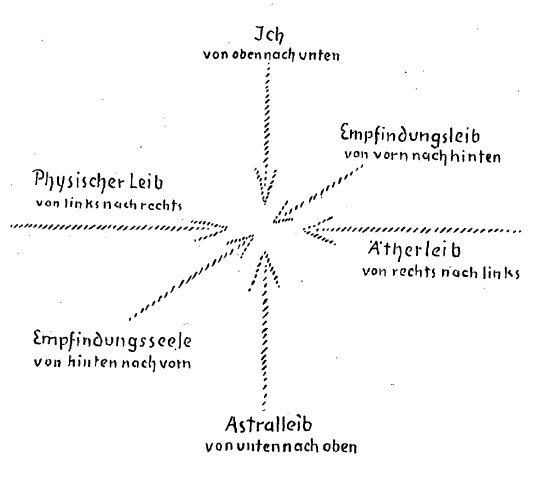
[ 21 ] What happens when the currents flowing upward from below and those pouring downward from above meet? I will explain what happens in the following way. One current flows from top to bottom. It cannot flow unimpeded because it is held back by the other current, which flows from bottom to top. The same is true of the current that flows from right to left, and so on. Each is held back, and this creates the illusion of the physical body in the center.
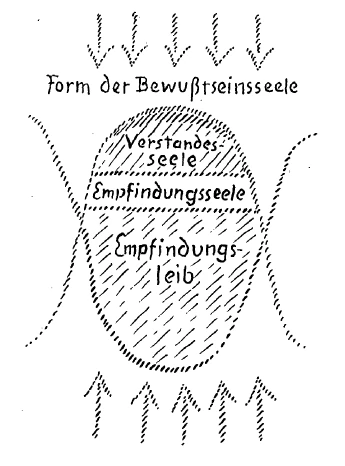
[ 22 ] When we consider the two currents flowing backward and forward, we must be clear that these two currents are intersected by the currents flowing from below and from above. And this intersection does indeed give rise to a threefold division within the human being. Thus, the lower part of one of these currents can be described as the sensory body in the narrower sense. Then, through the accumulation, something arises that corresponds to what can now be described in the strictest sense as the highest development of the sensory body, there where the actual senses develop—what you can no longer see because the eyes themselves are part of it, what you can no longer smell because the olfactory organ itself is part of it. You cannot look into the interior of the eye, but you can only look out from the eye.
[ 23 ] This is the structure of the entire sensory body of the human being. But why did I draw two parts for you at all [see p. 62], if it is all sensory body? The reason is that down below, the effect mainly comes from the outside, and up above is the physical image of what we call the sensory soul. In the face, first of all, you have the expression of the sensory soul. The face is formed by the soul of sensation. And up there, the uppermost part, the least pushed back, that is where the soul of understanding builds its organ. But now you will notice that not only do these currents come from below and above, but that currents also come from the right and the left, so that the whole is again cut through. We have a current there that runs through the longitudinal axis of the body. This current causes a kind of division to arise up there as well. A portion is split off from the form of the intellectual soul; and this split-off portion, right at the top of the boundary, is the form of the conscious soul. This consciousness soul shapes up there into the very innermost part of the human being, and it also shapes the convolutions of the gray matter of the brain. There you have the work of the consciousness soul on the human being. If you know the human being in this way as a spiritual being, then you can readily understand what is form in the human being from this spiritual being. This is how the spirit works on the form of the human body. All the individual organs are, so to speak, sculpted out of the spiritual realm. A person can only understand the structure of the brain once they know how the individual currents swirl through it.
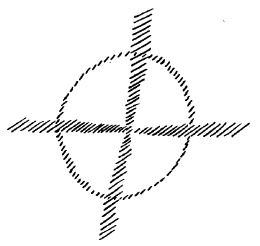
[ 24 ] Now let us consider one detail so that you can see how these things can bear fruit once they become the common heritage of true science, rather than today’s superficial science. We have now seen that up there, through the various currents, the external organs for the conscious soul, the intellectual soul, and the feeling soul, for example, come into being. To show how these organs then continue inwardly would require very lengthy explanations. But let us raise another question. We have said that the ego acts from top to bottom, and that the main mass of the astral body moves from bottom to top, so that the main mass of the astral body and the ego touch one another in a current. This brings about an interaction between the ego and the astral body, so that they interpenetrate one another. Where the ego is to perform a conscious activity, something must be able to come about that arises through the soul of feeling, through the soul of understanding, and through the soul of consciousness. Something that arises, for example, through the intellectual soul is a human judgment. Where, then, must a human judgment be located? Naturally, it must be located in the head, because that is where the relevant living forces and constitutional elements of the human being find their expression. Let us, however, take a specific example: suppose such an organ were to come into being in the human being in which the intellectual soul has no part, in which no judgment is made, but in which only the physical body, the etheric body, the I, and the astral body—as the bearers of pleasure and suffering, joy and pain, and so on—are to have a part. Let us assume that these four members of the human being—the astral body, the ego (without the finer activity of judgment and consciousness), the physical body, and the etheric body—were to interact. What would an organ look like in which these four currents interact? Such an organ would be such that it would not allow for judgment, that it would immediately follow the impression of the astral body with a counteraction. The physical body and the etheric body must interact, for otherwise this organ could not exist. The astral body and the I must interact; otherwise, this organ could not have feelings, nor could it express any sympathy or antipathy in response to an impression. Let us imagine the physical body and the etheric body working together, and let us imagine that it is a physical organ, and that it must naturally have a corresponding etheric body, since every physical organ must be built up by an etheric body. In this case, a current from the right side of the etheric body of this organ would have to interact with a current from the left, that of the physical body of this organ. These would accumulate in the middle, would be unable to overlap, and would therefore cause a thickening. Then there would be the other two currents, that of the astral body from below and that of the ego from above; these would cause a different kind of congestion. Now let us imagine schematically this interaction of the currents within a single organ. I will only sketch the matter schematically; the individual forms of such an organ would follow from entirely different premises. I mean to say: there would be an organ, shaped in some way; there would be one current representing the physical body, and another current representing the etheric body. These cause a thickening in the middle. The other two currents from above and below also accumulate and, for their part, cause a thickening as well. There you have drawn the human heart: right atrium, right ventricle, left atrium, left ventricle. If you carefully consider everything the human heart is capable of, you will have to say to yourself: This is exactly how the human heart must be constructed from the spirit! — This is how the human spirit constructs this heart. It cannot be any other way.
[ 25 ] Let’s take another example. We said something curious yesterday. We said that, fundamentally, there is a subconscious thought process involved in the act of seeing. Thought processes, when they become conscious, occur only in the brain. Now let us consider how the brain is structured so that conscious thought can take place.
[ 26 ] We don’t have time right now to go into the individual structures of the brain in detail. We could demonstrate for each individual organ that it must be exactly as it is. Let us assume the basic structure of the brain, to the extent that we need it, from the outset. Let us say: In the brain we have—leaving everything else aside—the outer membrane, then a kind of vascular membrane; then inside, between the vascular membrane and the reticular membrane, we have something like spinal fluid. 1What was demonstrated on the blackboard in the following is inadequately recorded in the notes. From there it then enters the spinal cord. The interior of the brain is filled with the actual brain matter, with nerve tissue. Nerve tissue is the outer form for mental activity, so that when an impression is transmitted to the nerve tissue through any sense organ, what results is the conscious mental processing of this external impression. All of this is conveyed to the nervous tissue. When the impression arrives, it is first processed intellectually, and after it has been processed intellectually, it is further processed by the nervous system into sensation and so on.
[ 27 ] Now suppose there is to be no conscious mental processing of an external impression. You would have to do this in a similar way at first. So there would have to be, once again, a kind of—let’s say—envelope; there would have to be, on the back wall, what one might call a vascular membrane. For a specific reason—which could also be explained, but that would take us too far afield now—the cerebrospinal fluid would atrophy. In order for subconscious thought activity to become possible, we must push the brain mass back: this creates space in the front, so that a subconscious thought activity, not processed by any nervous system, comes about. Something must happen to what is otherwise immediately received by the nervous tissue. But for this to happen, the nervous tissue must be pushed back. If the nervous tissue were not pushed back, thinking would take place here. If it is pushed back, thinking cannot take place here, nor can sensation. You have an organ intended to serve subconscious thought activity, provided that you push everything that constitutes the nervous system back to the rear wall, and allow the impression—instead of having it processed immediately by a mass of nerves—to be processed by something that is not permeated by any nervous system. — Now look at what we have done: we have turned the brain into an eye.
[ 28 ] What is the eye? The eye is a small brain that has been shaped by our mind in such a way that the actual nervous system has been pushed back to the rear wall, where it has become the retina of the eye. This is how the architects of nature, the creators of forms, work. This is how they shape things. Essentially, there is a blueprint governing all human organs, which is modified only in detail, as needed. If I could speak for weeks on end, I would show you how every sense organ is nothing other than a modified little brain, and the brain, in turn, a sense organ at a higher level. The entire human organism is built from the mind.
[ 29 ] Let us now consider another detail. But first, allow me to make a sort of epistemological preliminary remark, in order to use this remark to clarify the standpoint of anthroposophy.
[ 30 ] We have said that anthropology has its standpoint down below in the details of sensory life, that theosophy has its standpoint up on the mountaintop, and that anthroposophy has its standpoint in the middle. If you now wish to focus on the difference that lies in how human beings relate, on the one hand, to the external sensory world and, on the other hand, to the spiritual world and the facts communicated through spiritual research, then you can say: Anyone who has senses and who applies their intellect—which is bound to the sensory world—can convince themselves of the existence of the sensory world and its laws. That is why people generally find it easier to believe in what is similar to what they perceive in the sensory world than in what is communicated through spiritual research. For they can grasp that more easily. But one could very easily show that there is formally no difference between the belief you place in the facts communicated to you by the spiritual researcher and the belief in the fact that you are told there was a Frederick the Great. To believe that there are spirits of the will and that there was a Frederick the Great—there is formally no difference between the two. The only difference is that what is recounted is based on what is available in the archives: These are the deeds of Frederick the Great that took place in the external world! — And if someone reconstructs the entire course of historical events for you from the external facts all the way back to the time when Frederick the Great lived, you believe them for the simple reason that no being lived back then that looked any different from a human being. For this reason, the person who does not want to believe in spiritual worlds believes it, because what is told to them here is similar to what they themselves have in their surroundings. The spiritual researcher is, after all, not initially in a position to speak from his research about such things that resemble the beings and things that are present in the ordinary person’s surroundings. Since there is nevertheless no difference between the two kinds, and since this is nevertheless absolutely justified, what I have just said must nevertheless be taken into account in a certain way. But now something else comes into play.
[ 31 ] We have described the perspective of someone who, for example, takes the standpoint of anthropology, and the perspective of someone who takes the standpoint of theosophy. It is entirely justified—as Dr. Unger has demonstrated to you—to have confidence and faith, in a well-founded manner, in what is presented by spiritual science. This is indeed a fully justified way of acknowledging the truths of spiritual science. But now the question arises: Is there perhaps a third way? — Are there only these two options: to accept something because it resembles what one is accustomed to seeing in the sensory world, or to accept the spiritual merely because one receives it as a message from the higher worlds? Is there not a third option after all? In other words, can a person reasonably only distinguish between: Here is something perceptible to the senses; I believe it because I see it with my senses. Then there is something perceptible to the spirit; I believe it because the spiritual researcher sees it. — Is there not something else in between?
[ 32 ] Let me use an example to show you that there is, in fact, a third factor. Imagine there is a hammer here. My hand picks it up and sets it upright. Now the hammer has performed a movement. You will attribute this movement to the fact that there was a will that set the hammer upright. There is nothing remarkable about this, for you see the will behind it embodied in a human being. If you see a person pick up a hammer, you would not regard that as anything special. But suppose the same hammer were to stand upright on its own, without any visible being touching it. What would you say to that? Now you will say: I would be very foolish if I believed that what has stood up there is a hammer like any other hammer, which can only be raised by a human being. — What will you have to say to yourself now? You will now say to yourself: It goes without saying that this is no ordinary hammer, but that there is something invisible within this hammer, something that is a will. — When you see the hammer standing upright, you can no longer regard it as an ordinary hammer, but you must regard it as something that is the embodiment of another will, of another spiritual entity. And you will say to yourself: If I see that a thing does something which, according to the properties I know of it as an external thing, it cannot do according to the knowledge of ordinary external sensory observation, then I must say, although I do not see the spirit in the hammer that has raised itself up; but in this case I must not merely believe in the spirit; rather, in this case I would be a great fool if I did not believe in the spirit within the hammer.
[ 33 ] If you lack keen observational skills and were to walk with someone who is clairvoyant, there might be a person lying there, a person who doesn’t move. With your lack of keen observational skills, you wouldn’t be able to tell at all whether that is a real person or a person made of papier-mâché. But the other person tells you: That is a real person; he has an astral body! — Then you have to believe it. But there is also a third possibility, and that would be that the person lying there suddenly gets up. Then you will no longer doubt that the clairvoyant was right all along and that there is a spirit and a soul inside, once the person in question has stood up. That is the third possibility.
[ 34 ] Now I would like to show you a case where you can observe this in life—not in the immediate vicinity, and yet, in a sense, in the immediate vicinity. We have said: In the human being, the current of the physical body flows from left to right, the current of the etheric body from right to left, the current of the sensory body from front to back, and the current of the sensory soul from back to front. The astral body and the ego act in opposition to one another from bottom to top and from top to bottom. These currents thus all flow intermingled. The ego, we said, acts in the human being from top to bottom. How, then, must the external organ be situated so that the human being can have it as an instrument of the ego? The external organ for the ego, as you know, is the circulating blood. The ego could not act from top to bottom if it did not find its organ in the physical body, one that runs through the human body from top to bottom in the vertical direction. Where can there be no ego as humans have it? Where the main blood flow does not run from top to bottom, but where it is horizontal. This is the case in the animal world. The group ego of animals finds no organ because the main blood flow is horizontal. This is the difference: the main blood flow had to rise vertically in humans so that the human ego could enter into this main blood flow. So we have the animals, in whom the ego cannot grasp the blood as its organ because the main bloodline is oriented horizontally, and we have humans, in whom the ego can grasp the blood as its organ because the main bloodline has risen vertically. Let us now consider the view that assumes a kinship between animals and humans based solely on external grounds. You must tell yourself: There are animal forms; they have been preserved from earlier times. But at some point the entire bloodline had to rise from the horizontal to the vertical so that the human being could emerge from it. — Here you have the historical case: you have something that lies horizontally. But this cannot, of course, raise itself up on its own based on the characteristics you can observe in the animal bloodline, any more than a hammer could raise itself up if it were not animated by a spirit. Just as it would be foolish to deny that there is a spirit in that which raises itself up, so too would it be foolish to think that the horizontal bloodline of the animal raises itself up on its own into the vertical bloodline of the human being. Only if there is a spirit within it, if a will flows through it, can it raise itself from the horizontal to the vertical, can the animal group soul pass over into the individual human soul. And whoever does not admit to himself, on the one hand: I would be a fool if I were to believe that the hammer that raised itself up were nothing other than an ordinary hammer—would be just as great a fool if he were to assume: I think that what is in the blood raises itself up vertically on its own.
[ 35 ] Here is the third way in which you can verify all spiritual truths: by realizing that certain things happen in which it would be foolish and absurd to assume that only what is perceived by the external senses is involved. And the deeper one penetrates into things, the more it becomes evident that this middle path of conviction is possible for everything—this middle path, which consists in ordinary thinking being enriched by spiritual science. For you must surely admit that the human heart cannot be described as we have done without prior spiritual research. Research must be inspired by spiritual science. But then, when the results of spiritual science are given, and we then observe the external phenomena, we will see that something is taking place in these external phenomena that could not possibly take place if the things that spiritual science can tell us were not presupposed. Thus there is a method for observing things impartially, for example, when you see how the bloodline is horizontal in animals and vertical in humans, and then ask yourself: What must be present in the blood so that the entire main bloodline can stand upright? and then receive the answer from spiritual research: Spiritual beings reign in the blood! so that you then say to yourself: Does not the blood show me the presence of a spiritual being just as a hammer that were to stand up on its own would show me the presence of a spiritual being? Here you have the middle point of view of anthroposophy, which observes the facts below, observes the facts of the spiritual world, compares the two with one another—and thereby fully explains what is present outwardly in the world.
[ 36 ] We have now shown, using specific examples such as the transformation of the brain into the eye and the internal schematic contraction of the human heart, how the form of every organ can be grasped. In this way, we could construct the individual forms of every organ from the mind. Everywhere you would see how the spirit works in the human being to bring about the organs and the forms of the body. This should only be hinted at in principle. But through such things as have been hinted at today, you should gain a sense that there is indeed much in the world of which scholarly wisdom cannot even dream, because it refuses to engage with these matters. If you take this feeling with you, you will see that there is a possibility for human beings to view the world impartially, where the interweaving of what the spiritual researcher communicates from the spiritual world with earthly things—though not everyone can see it in the same way—leads one to say: It is absurd not to accept, for certain phenomena, the facts that the spiritual researcher describes.
[ 37 ] If this feeling is present, then these anthroposophical lectures have already achieved enough; for we can only ascend slowly and gradually in spiritual research.