

Anthroposophy, Psychosophy
and Pneumatosophy
GA 115
26 October 1909, Berlin
Translate the original German text into any language:
Versions Available:
Anthroposophy Psychosophy Pneumatosophy, tr. SOL
Anthroposophie III
Anthroposophy III
[ 1 ] Wir sind in unseren Betrachtungen aufgestiegen bis zu dem, was wir den Sprachsinn genannt haben, und wollen jetzt ins Auge fassen zunächst dasjenige, was wir genannt haben den Begriffssinn. Selbstverständlich dürfen Sie das Wort hier nicht in dem Sinne des reinen Begriffes nehmen, sondern in dem Sinne, wie man im gewöhnlichen Leben spricht; daß man sich, wenn irgend jemand einem etwas sagt, irgendein Wort sagt, eine Vorstellung davon machen kann, was dieses Wort bedeutet. Ebensogut hätte also Vorstellungssinn gesagt werden können. Nun werden wir uns aber erst begreiflich machen müssen, wie dieser Vorstellungssinn zustande kommt. Dazu müssen wir noch einmal zurückgreifen auf die beiden vorhergehenden Sinne, auf den Tonsinn, den Gehörsinn, und auf den Sprachsinn, und uns die Frage einmal vorlegen: Was heißt denn das überhaupt, Sprachsinn haben, Lautsinn haben? Wie kommt denn die Wahrnehmung des Lautes, wie wir sie charakterisiert haben, eigentlich zustande? — Ich werde Ihnen jetzt also zuerst zu charakterisieren haben, was da Besonderes geschieht, wenn der Mensch einen Laut wahrnimmt, A oder I oder einen andern Laut. Wir müssen uns sozusagen den Apparat des Laut-Wahrnehmens klarmachen. Ich werde Ihnen allerdings, da ich nicht über eine solche Sache eine ganze Stunde sprechen kann, nur einige Angaben machen können, welche Sie dann bewahrheitet finden können durch dieses oder jenes, was Sie selber durch Nachdenken oder Erforschen im Leben gewinnen.
[ 1 ] In our considerations, we have ascended to what we have called the linguistic sense, and we now wish to turn our attention first to what we have called the conceptual sense. Of course, you must not take the word here in the sense of a pure concept, but in the sense in which it is used in everyday life; that is, when someone says something to you—any word at all—you can form an idea of what that word means. One might just as well have said “sense of representation.” Now, however, we must first make clear to ourselves how this sense of representation comes about. To do this, we must once again refer back to the two preceding senses—the sense of sound, the sense of hearing, and the sense of language—and ask ourselves the question: What does it actually mean to have a sense of language, to have a sense of sound? How does the perception of sound, as we have characterized it, actually come about? — I will now first have to characterize for you what is specifically happening when a person perceives a sound, an A or an I or some other sound. We must, so to speak, clarify the apparatus of sound perception. However, since I cannot speak on such a subject for a whole hour, I will only be able to provide you with a few points, which you can then verify through this or that, which you yourselves gain through reflection or exploration in life.
[ 2 ] Sie wissen, daß man innerhalb des Musikalischen unterscheiden kann den einzelnen Ton, die Melodie und die Harmonie. Und Sie wissen, daß Harmonie beruht auf der Wahrnehmung gleichzeitiger Töne, Melodie auf dem Zusammenfassen aufeinanderfolgender Töne, und daß dann der einzelne Ton als solcher in Betracht kommt. Nun können Sie den Mechanismus des Laut-Wahrnehmens nur begreifen, wenn Sie die Beziehung des Tönenden, was im Laute ist, zu diesem Laute selbst ins Auge fassen. Nehmen wir einmal dasjenige, was eine Harmonie ist: wir haben ein gleichzeitiges Zusammenwirken von Tönen; und nehmen wir das, was eine Melodie ist: wir haben ein aufeinanderfolgendes Zusammenwirken von Tönen. Denken Sie sich nun, Sie könnten dasjenige bewußt machen, was Sie unbewußt im Laut-Wahrnehmen tun, so würde folgendes geschehen.
[ 2 ] You know that, within music, one can distinguish between the individual note, the melody, and the harmony. And you know that harmony is based on the perception of simultaneous notes, melody on the combination of successive notes, and that the individual note is then considered as such. Now you can only understand the mechanism of sound perception if you consider the relationship of the sounder—that which is in the sound—to the sound itself. Let us take, for example, what harmony is: we have a simultaneous interplay of tones; and let us take what a melody is: we have a sequential interplay of tones. Now imagine that you could make conscious what you do unconsciously in the perception of sound; the following would happen.
[ 3 ] Sie müssen sich klar sein darüber, daß im Sinn eben etwas Unbewußtes — Unterbewußtes wenigstens — liegt. Würde das, was bei der Sinneswahrnehmung unbewußt vorliegt, bewußt gemacht werden, so würde es kein Sinn mehr sein, keine Sinneswahrnehmung, sondern man müßte sprechen von einem Urteil, einer Begriffsbildung und dergleichen. Sie müssen sich also denken, wie dasjenige vor sich ginge, was da im Unterbewußten sich vollzieht bei der Lautwahrnehmung, wenn Sie es bewußt ausführen könnten. Denken Sie einmal, Sie nehmen eine Melodie wahr. Wenn Sie diese Melodie wahrnehmen, nehmen Sie die Töne hintereinander wahr. Denken Sie nun, Sie könnten ohne weiteres die Töne einer Melodie so in der Zeitlinie zusammenschieben, daß Sie dieselben gleichzeitig wahrnehmen könnten. Dazu hätten Sie freilich nötig, Vergangenheit und Zukunft ineinanderzuschieben. Sie müßten vorzugsweise in der Mitte einer Melodie schon das Folgende wissen, um es aus der Zukunft in die Gegenwart hineinschieben zu können. Was so der Mensch bewußt nicht ausführen kann, das geschieht tatsächlich im Lautsinn unbewußt. Es wird, wenn wir A oder I oder einen andern Laut hören, immer durch eine unterbewußte Tätigkeit eine Melodie momentan in eine Harmonie verwandelt. Das ist das Geheimnis des Lautes. Diese wunderbare unterbewußte Tätigkeit wird etwa so ausgeführt auf einer geistigeren Stufe, wie innen im Auge die verschiedenen Strahlenbrechungen nach den regelrechten physikalischen Gesetzen ausgeführt werden, die Sie sich auch erst hinterher ins Bewußtsein bringen. Wir tun jetzt dasselbe, was der Physiker tut, wenn er zeigt, wie die Strahlenbrechung im Auge zustande kommt. Also eine Melodie wird momentan zur Harmonie gemacht. Das ist aber noch nicht genug. Wenn nur das geschähe, dann käme noch nicht der Laut heraus, sondern dazu muß noch etwas anderes hinzukommen.
[ 3 ] You must be clear that perception involves something unconscious—or at least subconscious. If what is unconscious in sensory perception were made conscious, it would no longer be a sense, no longer sensory perception, but one would have to speak of a judgment, a formation of concepts, and the like. You must therefore imagine how that which takes place in the subconscious during the perception of sound would proceed if you could carry it out consciously. Imagine for a moment that you are perceiving a melody. When you perceive this melody, you perceive the notes one after another. Now imagine that you could easily compress the notes of a melody along the timeline so that you could perceive them simultaneously. To do this, of course, you would need to merge the past and the future. Ideally, you would have to know what comes next while you are in the middle of a melody in order to be able to shift it from the future into the present. What a person cannot consciously accomplish in this way actually happens unconsciously in the realm of sound. Whenever we hear an A or an I or another sound, a melody is momentarily transformed into a harmony through a subconscious process. That is the secret of sound. This wonderful subconscious activity is carried out on a more spiritual level in much the same way as the various refractions of light occur within the eye according to the regular laws of physics, which you only bring to your consciousness afterward. We are now doing the same thing that the physicist does when he demonstrates how the refraction of light occurs in the eye. So a melody is instantly transformed into harmony. But that is not enough. If only that were to happen, the sound would not yet emerge; something else must be added to it.
[ 4 ] Sie müssen sich bewußt werden, daß ein jeder musikalische Ton kein einfacher Ton ist, sondern wenn irgendein Ton ein musikalischer Ton ist, so ist er das dadurch, daß, wenn auch in einer noch so schwachen Weise, immer die Obertöne mitklingen. Das ist das Besondere des musikalischen Tons gegenüber den andern Geräuschen, Knall oder dergleichen, daß immer die Obertöne gehört werden, wenn sie auch praktisch nicht hörbar sind. Wenn Sie eine Melodie haben, haben Sie nicht nur die einzelnen Töne, sondern Sie haben auch bei einem jeden Ton die Obertöne. Wenn Sie eine Melodie momentan in eine Harmonie zusammendrängen, so haben Sie nicht nur zusammengedrängt die einzelnen Grundtöne, sondern auch hineingedrängt von einem jeglichen Ton die Obertöne. Nun muß aber die unterbewußte Tätigkeit noch etwas ausführen: sie muß die Aufmerksamkeit abwenden von den Grundtönen, sie muß sie in gewisser Weise überhören. Das tut tatsächlich die Seele, wenn sie den Laut A oder I wahrnimmt. Nicht als ob die andern Töne nicht da wären, sondern es wird nur die Aufmerksamkeit von ihnen abgelenkt, und es wird nur jene Harmonie von Obertönen aufgefaßt. Das ist erst der Laut. Dadurch entsteht ein Laut, daß eine Melodie momentan in eine Harmonie umgewandelt wird, dann von den Grundtönen abgesehen wird und nur das System der Obertöne aufgefaßt wird. Was diese Obertöne dann geben, das ist der Sinn des Lautes, A oder I. Nun haben Sie dasjenige, was eigentlich Laut-Wahrnehmung ist, geradeso erklärt, wie man das Sehen im Auge physikalisch erklärt.
[ 4 ] You must realize that no musical tone is a simple tone; rather, if a tone is musical, it is so because the overtones are always present, even if only very faintly. This is what distinguishes a musical tone from other sounds, such as a bang or the like: the overtones are always present, even if they are practically inaudible. When you have a melody, you do not just have the individual notes, but with each note you also have the overtones. If you compress a melody into a chord for a moment, you have not only compressed the individual fundamental tones, but also compressed the overtones of each tone into it. But now the subconscious activity must perform one more task: it must divert attention away from the fundamental tones; it must, in a certain sense, ignore them. This is indeed what the soul does when it perceives the sound A or I. Not as if the other tones were not there, but attention is simply diverted from them, and only that harmony of overtones is perceived. That is the sound itself. This creates a sound in which a melody is momentarily transformed into a harmony, then the fundamental tones are disregarded, and only the system of overtones is perceived. What these overtones then produce is the meaning of the sound, A or I. Now you have explained what sound perception actually is in exactly the same way that one explains vision in the eye physically.
[ 5 ] Was ist nun — und das ist eine ebenso schwierige, aber wichtige Frage — die Wahrnehmung der Vorstellung, was ist das Wahrnehmen des Sinnes allein, so daß Sie also das Wort hören und durch das Wort hindurch dessen Sinn vernehmen, begreifen? Wie kommt das zustande?
[ 5 ] Now, what is—and this is an equally difficult but important question—the perception of an idea? What is the act of perceiving meaning alone, such that you hear the word and, through the word, perceive and grasp its meaning? How does this come about?
[ 6 ] Daß das noch etwas ganz Besonderes ist, das mag Ihnen einfach aus der trivialen Erwägung hervorgehen, daß Sie irgendeine Sache in den verschiedenen Sprachen mit den verschiedensten Lauten bezeichnen können. Sie heißen eine Sache das eine Mal «Amor», das andere Mal «Liebe». So ist in diesen beiden verschiedenen Lautbildern etwas ausgedrückt, was in beiden Fällen dasselbe ist. Das weist hin auf den dahinterstehenden Vorstellungssinn. Während man also den Laut bei jedem Volke, in jeder Sprache anders hört, hört man durch den Laut hindurch überall dieselbe Vorstellung, dasjenige, was eigentlich dahintersteckt und was trotz aller Verschiedenheit der Lautbilder das gleiche ist. Das muß auch wahrgenommen werden. Und wie wird das wahrgenommen?
[ 6 ] That this is something quite special may simply become clear to you from the trivial observation that you can refer to any given thing in different languages using a wide variety of sounds. You might call a thing “Amor” in one instance and “Liebe” in another. Thus, these two different sound patterns express something that is the same in both cases. This points to the underlying conceptual meaning. So while the sound is heard differently by every people, in every language, one hears the same concept through the sound everywhere—that which actually lies behind it and which, despite all the differences in sound patterns, remains the same. This must also be perceived. And how is this perceived?
[ 7 ] Wir wollen, um uns das klarzumachen, den Prozeß des Vorstellungswahrnehmens betrachten, und zwar — das bitte ich Sie, ins Auge zu fassen — unter der Voraussetzung, daß die Vorstellung uns auf dem Wege des Lautes zukommt. Wenn wir nun in dem Laut-Wahrnehmen eine Melodie haben, die in eine Harmonie verwandelt ist, wobei abgesehen wird von den Grundtönen — was uns den Lautsinn oder Wortsinn gibt —, so ist es notwendig, damit der Vorstellungssinn herauskommt, daß nun auch von dem ganzen System der Obertöne die Aufmerksamkeit abgelenkt wird. Wenn Sie auch das noch seelisch ausführen, dann blicken Sie zurück zu dem, was sich in den Obertönen verkörpert hat, zu demjenigen, was Ihnen als Vorstellung zukommt. Damit ist aber zu gleicher Zeit nun auch das gegeben, daß der Mensch, wenn er die Laute und Worte seiner Sprache hört, dasjenige sozusagen etwas nuanciert, abgetönt erhält, was allgemein menschlich ist: die Vorstellung, welche durch alle Laute und alle Sprachen hindurchgeht.
[ 7 ] To make this clear to ourselves, let us consider the process of perceptual representation—and I ask you to bear in mind—on the assumption that the representation comes to us through sound. If, in our perception of sound, we have a melody that has been transformed into harmony—setting aside the fundamental tones, which give us the meaning of the sound or the word—then, for the meaning of the concept to emerge, it is necessary that our attention be diverted from the entire system of overtones as well. If you also carry this out in your inner life, then you look back to what has been embodied in the overtones, to that which comes to you as an idea. But this also means that when a person hears the sounds and words of their language, they receive, so to speak, a somewhat nuanced, tempered version of what is universally human: the concept that runs through all sounds and all languages.
[ 8 ] Haben wir gesagt, daß sich durch die Sprache, insofern die Sprache ihre Laute hat, kundgeben hohe geistige Wesenheiten, die ihre besondere Mission haben im Zusammenhange des Erdenlebens, die Volksgeister, welche nicht nur in dem geheimnisvollen Raunen [der Sprachen], sondern in dem ebenso geheimnisvollen Bilden an den Säften des Menschen wirken, in dem, was da im System der Obertöne hineinerzittert in den menschlichen Organismus, so müssen wir sagen, daß dasjenige, was hinter dem Tönen der Obertöne liegt als das allgemein Menschliche, der gemeinsame Menschengeist ist, der über die ganze Erde hinüberwallt. Dieser über die ganze Erde hinüberwallende Menschengeist, er läßt sich daher nur dann erkennen, wenn ein jeder an seinem Orte sozusagen durch die Obertöne hindurch ins Unhörbare, ins bloß Vorstellungsmäßige hineinhorcht. Dadurch, daß die Menschen die Möglichkeit bekommen haben, sozusagen über die Nuancen hinwegzusehen, hinwegzuhören und ein Gemeinsames, das über die ganze Erde wallt, zu erkennen, dadurch haben sie erst die Fähigkeit erlangt im Laufe der geschichtlichen Entwickelung der Menschheit, dasjenige, was allgemein menschlich ist, zu begreifen. Denn nur im Vorstellungsleben läßt sich der Christus-Geist in seiner wahren Gestalt zuerst erfassen, im allgemein Menschlichen. Diejenigen geistigen Wesenheiten, welche ihn in den verschiedensten Formen verkündigen und verkündigen sollen, die von ihm ausgeschickt sind, jeder an seinen Ort, wie Sie das zum Beispiel so schön dargestellt finden in dem Goetheschen Gedicht «Die Geheimnisse», diese Geister, dieSendboten des Christus, die von ihm ihre Aufgabe erhalten haben, das sind die einzelnen Volksgeister, die Geister der einzelnen Völkerindividualitäten.
[ 8 ] We have said that through language—insofar as language has its sounds—high spiritual beings make themselves known, beings who have a special mission in the context of earthly life: the national spirits, who do not merely work through the mysterious murmurings [of languages], but also in the equally mysterious formation of the human life-sap, in that which vibrates into the human organism within the system of overtones, then we must say that what lies behind the sound of the overtones as the universal human element is the common human spirit that surges across the entire Earth. This human spirit surging across the entire earth can therefore only be recognized when each person, in their own place, listens, so to speak, through the overtones into the inaudible, into the purely imaginative. It is through the fact that human beings have been given the ability, so to speak, to look beyond the nuances, to listen beyond them, and to recognize a commonality that surges across the entire earth—it is through this that they have, in the course of humanity’s historical development, first acquired the capacity to comprehend that which is universally human. For it is only in the life of the imagination that the Christ Spirit can first be grasped in its true form, in what is universally human. Those spiritual beings who proclaim him in the most diverse forms and are sent by him—each to their own place, as you find so beautifully depicted, for example, in Goethe’s poem “The Mysteries”—these spirits, the messengers of Christ who have received their task from him, are the individual national spirits, the spirits of the individual national individualities.
[ 9 ] Dies alles gibt Ihnen erst ein Bild von dem, was eigentlich Vorstellungssinn ist. Damit aber haben wir einen ganz besonderen Weg zurückgelegt. Wir haben sozusagen dasjenige, was im gewöhnlichen Menschenleben Sinn an uns ist, zunächst erschöpft. Wir haben es dadurch erschöpft, daß wir hingeschaut haben auf diejenige unterbewußte seelische Fähigkeit im Menschen, die imstande ist, das System der Obertöne gleichsam zurückzuschieben. Was wird nun eine noch höhere Fähigkeit sein? Was schiebt denn dieses System der Obertöne zurück? Was ist es denn im Menschen, was da hinauswirkt wie Fangarme und das System der Obertöne zurückschiebt? — Das ist des Menschen astralischer Leib. Erlangt des Menschen astralischer Leib die Fähigkeit, die Obertöne zurückzuschieben, was in trivialer Sprache ausgedrückt nichts anderes heißt, als die Aufmerksamkeit von ihnen abzuwenden, dann bedeutet das eine höhere Macht des astralischen Leibes, als wenn er sozusagen weniger zurückschieben kann. Wann wird dieser astralische Leib nun noch stärker sein? Er wird noch stärker sein, wenn er nicht nur die Obertöne zurückschieben kann, nicht nur die Vorstellungen dadurch erreicht, daß er die Obertöne zurückschiebt und dadurch an die Grenze der äußeren Welt kommt und sie an ihrer Grenze als Vorstellung beobachten kann, sondern wenn er sich fähig macht, ohne daß erst ein Widerstand da ist, durch eine eigene, innere Kraft seine astralische Substanz herauszustoßen. Um zur Vorstellung zu kommen, haben Sie immer noch nötig, einen Widerstand zurückzuschieben: das System der Obertöne. Wenn Sie nun in der Lage sind, ohne daß eine äußere Veranlassung da ist, Ihre astralischen Fangarme herauszustrecken, so tritt das ein, was man im höheren Sinne das geistige Wahrnehmen nennen kann. Es bilden sich die eigentlichen geistigen Wahrnehmungsorgane. In dem Augenblick, wo der Mensch die Fähigkeit erlangt, nicht nur mit seiner Aufmerksamkeit das System der Obertöne zurückzuschieben, sondern wo er an einer gewissen Stelle des Vorderhirns — zwischen den Augenbrauen seine astralische Substanz herausschieben kann wie zwei Fangarme, da bildet er an dieser Stelle das, was man die zweiblättrige Lotusblume nennt, das erste geistige Organ, was man auch nennen kann den imaginativen Sinn. Das ist nun der elfte der Sinne. Und in demselben Maße, als der Mensch immer fähiger und fähiger wird, so aus sich selbst heraus, ohne daß er durch die Außenwelt gezwungen wird, seine astralische Substanz herauszustrecken, in demselben Maße bildet er weitere höhere Sinne aus. In der Gegend des Kehlkopfes bildet er aus durch diese Arbeit einen sehr komplizierten Sinn, die sechzehnblättrige Lotusblume, den inspirierenden Sinn; weiter in der Herzgegend den Sinn, den man auch den intuitiven Sinn nennen kann, die zwölfblättrige Lotusblume, und dann noch weitere höhere Sinne, die man aber nun, weil man da ins rein Geistige kommt, nicht mehr Sinn nennen kann im gewöhnlichen Sinne. Es genügt ja, daß wir zu den physischen, eigentlichen Sinnen hinzuzufügen haben den imaginativen Sinn, den inspirierenden Sinn und den intuitiven Sinn.
[ 9 ] All of this gives you a glimpse of what the power of imagination actually is. But in doing so, we have traveled a very special path. We have, so to speak, first exhausted that which constitutes meaning for us in ordinary human life. We have exhausted it by looking at that subconscious spiritual capacity in human beings which is capable of pushing back, as it were, the system of overtones. What, then, will be an even higher capacity? What is it that pushes back this system of overtones? What is it in human beings that reaches out like tentacles and pushes back the system of overtones? — That is the human astral body. If the human astral body acquires the ability to push back the overtones—which, expressed in everyday language, means nothing other than turning one’s attention away from them—then this signifies a greater power of the astral body than when it can, so to speak, push them back to a lesser extent. When will this astral body become even stronger? It will be even stronger when it can not only push back the overtones, not only reach the images by pushing back the overtones and thereby reach the boundary of the outer world and observe it at its boundary as an image, but when it makes itself capable, without any resistance being present, of propelling its astral substance outward through its own inner power. To arrive at a mental image, you still need to push back against a resistance: the system of overtones. If you are now able, without any external stimulus, to extend your astral tentacles, then what occurs is what can be called, in the higher sense, spiritual perception. The actual organs of spiritual perception are formed. At the moment when a person acquires the ability not only to push back the system of overtones with their attention, but also to project their astral substance like two tentacles from a certain point in the frontal lobe—between the eyebrows— there he forms at this point what is called the two-petaled lotus flower, the first spiritual organ, which can also be called the imaginative sense. This is now the eleventh of the senses. And to the same extent that a person becomes increasingly capable of extending their astral substance of their own accord, without being compelled by the external world, to that same extent they develop further higher senses. In the region of the larynx, through this work, they develop a very complex sense, the sixteen-petaled lotus flower, the inspiring sense; further on, in the region of the heart, the sense that can also be called the intuitive sense, the twelve-petaled lotus flower; and then even higher senses, which, however, since one is now entering the purely spiritual realm, can no longer be called senses in the ordinary sense. It is sufficient, after all, that we have to add to the physical, actual senses the imaginative sense, the inspiring sense, and the intuitive sense.
[ 10 ] Nun fragen wir uns: Sind nun diese drei Sinne nur tätig im hellsichtigen Menschen oder gibt es auch beim gewöhnlichen Menschen etwas, was er als eine Tätigkeit dieser Sinne auffassen kann? — Ja, auch beim gewöhnlichen Menschen gibt es etwas, was als eine Tätigkeit dieser Sinne aufzufassen ist, des imaginativen, des inspirierenden und des intuitiven Sinnes. Wenn Sie genau aufgefaßt haben, wie diese Sinne beim hellsichtigen Menschen wirken, so werden Sie sich sagen, sie wirken, indem sie sich wie Fangarme nach außen erstrecken. Beim gewöhnlichen Menschen sind sie auch vorhanden, nur mit dem Unterschiede, daß sie sich da nicht nach außen, sondern daß sie sich nach innen strecken. Genau an der Stelle, wo die zweiblättrige Lotusblume beim hellsichtigen Menschen entsteht, da ist beim gewöhnlichen Menschen etwas vorhanden wie zwei solcher Fangarme, die nach innen gehen, die sich nur in der Gegend des Vorderhirns kreuzen. So wendet das gewöhnliche Bewußtsein einfach diese Fangarme, statt wie beim hellsichtigen Menschen nach außen, nach innen.
[ 10 ] Now let us ask ourselves: Are these three senses active only in the clairvoyant, or is there something in the ordinary person as well that can be understood as an activity of these senses? — Yes, even in the ordinary person there is something that can be understood as an activity of these senses: the imaginative, the inspiring, and the intuitive senses. If you have understood exactly how these senses function in the clairvoyant person, you will say to yourself that they function by extending outward like tentacles. They are also present in the ordinary person, with the difference that they do not extend outward but inward. Exactly at the point where the two-petaled lotus flower arises in the clairvoyant person, there is something in the ordinary person like two such tentacles that extend inward, crossing only in the region of the forebrain. Thus, ordinary consciousness simply turns these tentacles inward, rather than outward as in the clairvoyant person.
[ 11 ] Dasjenige, was hier vorliegt, kann ich Ihnen nur durch einen Vergleich klarmachen. Sie müßten viel meditieren, wenn Sie über den Vergleich hinauskommen wollten zur Tatsache. Denn eine Tatsache ist es. Sie brauchen sich nur klarzumachen, daß der Mensch das, was er außer sich hat, sieht, und das, was er in sich hat, nicht sieht. Keiner hat noch sein eigenes Herz oder Gehirn gesehen. So ist es auch im Geistigen. Die Organe werden nicht nur nicht gesehen, sondern sie werden auch nicht bewußt, und sie können daher auch nicht angewendet werden. Aber sie wirken. Dadurch, daß etwas nicht bewußt ist, ist es noch nicht untätig. Das Bewußtsein entscheidet nicht über die Wirklichkeit. Sonst müßte alles dasjenige, was um uns ist in dieser Stadt Berlin und was Sie jetzt nicht sehen, nicht da sein. Allerdings ist das eine Logik, wonach diejenigen gehen, welche die höheren Welten ableugnen, weil sie sie nicht sehen. Tätig sind diese Sinne, aber ihre Tätigkeit richtet sich nach innen. Und diese Wirkung der Tätigkeit nach innen nimmt jetzt der Mensch wahr. Wie nimmt er sie wahr?
[ 11 ] I can only explain what is at issue here by means of a comparison. You would have to meditate deeply if you wanted to move beyond the comparison to the fact itself. For it is a fact. You need only realize that human beings see what is outside themselves, but do not see what is within them. No one has ever seen their own heart or brain. It is the same in the spiritual realm. Not only are the organs not seen, but they are also not conscious, and therefore they cannot be used. But they are active. Just because something is not conscious does not mean it is inactive. Consciousness does not determine reality. Otherwise, everything that surrounds us in this city of Berlin and that you do not see now would not be there. However, this is the logic followed by those who deny the higher worlds because they do not see them. These senses are active, but their activity is directed inward. And it is this inward effect of their activity that human beings now perceive. How do they perceive it?
[ 12 ] Indem sich der imaginative Sinn nach innen ergießt, entsteht das, was man im gewöhnlichen Leben die Empfindung irgendeiner Sache nennt, die äußere Empfindung, die äußere Wahrnehmung. Daß Sie die Dinge draußen sehen, das beruht darauf, daß nach innen hinein dieser Sinn arbeitet. Was Sie nach draußen als Empfindung, als Wahrnehmung haben, das können Sie nur dadurch haben, daß dasjenige in Sie hineinarbeitet, was im imaginativen Sinn zum Vorschein kommt. Unterscheiden Sie aber wohl, was hier Empfindung genannt ist, von dem, was zum Beispiel ein Ton ist. Es ist noch etwas anderes, einen Ton zu hören, eine Farbe zu sehen, oder eine Empfindung dabei zu haben. Eine Farbe zu sehen und zu sagen, sie ist rot, ist etwas anderes, als die Empfindung dabei zu haben: sie ist schön oder häßlich, angenehm oder unangenehm im unmittelbaren Eindruck.
[ 12 ] As the imaginative sense flows inward, what arises is what we in everyday life call the sensation of a particular thing—the external sensation, the external perception. The fact that you see things outside is due to this sense working inward. What you experience outwardly as sensation or perception, you can only have because that which emerges in the imaginative sense works its way into you. But be sure to distinguish what is called sensation here from what, for example, a sound is. It is something else entirely to hear a sound, to see a color, or to have a sensation in doing so. To see a color and say it is red is something different from having the sensation that it is beautiful or ugly, pleasant or unpleasant in the immediate impression.
[ 13 ] Auch der inspirierende Sinn ergießt seine Tätigkeit nach innen, und durch diese Tätigkeit entsteht das, was nun eine kompliziertere Empfindung ist: das Gefühl. Das ganze Gefühlsleben, das mehr Innerlichkeit hat als das bloße Empfindungsleben, ist eine Tätigkeit des inspirierenden Organes, das nur nach innen tätig ist statt nach außen. Und wenn der intuitive Sinn sich nach innen ergießt, dann entsteht das, was wir eigentlich jetzt das Denken nennen, das Gedankenbilden. Das ist der Erfolg der Tätigkeit des intuitiven Sinnes nach innen. Zuerst hat der Mensch eine Empfindung von der Sache, dann kommt das Gefühl, und zuletzt bildet er sich seine Gedanken darüber.
[ 13 ] The inspiring sense, too, directs its activity inward, and through this activity arises what is now a more complex sensation: feeling. The entire life of feeling, which is more inward than the mere life of sensation, is an activity of the inspiring organ, which acts only inwardly rather than outwardly. And when the intuitive sense pours inward, what we now actually call thinking—the formation of thoughts—arises. This is the result of the intuitive sense’s inward activity. First, a person has a sensation of the thing; then comes feeling; and finally, they form their thoughts about it.
[ 14 ] Damit werden Sie gesehen haben,:daß wir aus dem Sinnesleben bereits hineingestiegen sind in das Seelenleben. Wir haben von außen, aus der Sinnenwelt heraus, im Menschen selber die Seele ergriffen in Empfindungen, in Gefühlen, in Gedanken. Wenn wir nun weitergehen würden und die höheren Sinne, die wir nun nicht mehr gut Sinne nennen können, die den andern Lotusblumen entsprechen, in ihrer Wirkung nach innen betrachten, so würden wir das gesamte höhere Seelenleben finden. Wenn zum Beispiel die im Organismus weiter unten gelegene achtblättrige oder die zehnblättrige Lotusblume ihre Tätigkeit nach innen ergießt, dann entsteht eine noch feinere Seelentätigkeit. Und am Ende dieser Reihe finden wir jene allerfeinste Seelentätigkeit, die wir nun nicht mehr mit dem bloßen Gedanken bezeichnen, sondern als den reinen Gedanken, den bloß logischen Gedanken. Das ist das, was hervorgebracht wird durch das Hineinwirken ins Innere des Menschen durch die verschiedenen Lotusblumentätigkeiten. Wenn nun dieses Hineinarbeiten wiederum aufhört, bloßes Hineinarbeiten zu sein und, wie ich angedeutet habe, anfängt hinauszuarbeiten, wenn also jene Fangarme, die sich sonst nach innen erstrecken, sich überall kreuzen und nach außen sich als Lotusblumen ergießen, dann kommt jene höhere Tätigkeit zustande, durch die wir von der Seele aufsteigen zum Geiste, wo dasjenige, was uns sonst bloß als Innenleben erscheint in Denken, Fühlen und Wollen, nunmehr in der Außenwelt auftritt, getragen von geistigen Wesenheiten.
[ 14 ] You will have seen, then, that we have already moved from the sensory life into the life of the soul. From the outside, from the world of the senses, we have grasped the soul within the human being itself in sensations, in feelings, in thoughts. If we were now to proceed further and consider the higher senses—which we can no longer properly call “senses,” and which correspond to the other lotus flowers—in their inward effect, we would find the entire higher life of the soul. When, for example, the eight-petaled or ten-petaled lotus flower, situated lower down in the organism, pours its activity inward, then an even finer soul activity arises. And at the end of this series we find that very finest soul activity, which we can no longer describe as mere thought, but as pure thought, as purely logical thought. This is what is brought about by the various lotus-flower activities working inward into the human being. When this inward working ceases to be merely inward working and, as I have indicated, begins to work outward—that is, when those tentacles that otherwise extend inward cross everywhere and pour outwards as lotus flowers— then that higher activity comes about through which we ascend from the soul to the spirit, where that which otherwise appears to us merely as inner life in thinking, feeling, and willing now appears in the outer world, carried by spiritual beings.
[ 15 ] So haben Sie den Menschen sozusagen begriffen, indem Sie aufgestiegen sind von den Sinnen durch die Seele zu dem, was eigentlich nicht mehr im Menschen ist, sondern was als Geistiges von außen hereinwirkt und dem Menschen ebenso angehört wie der ganzen Natur und der ganzen übrigen Welt draußen. Wir sind aufgestiegen zum Geistigen.
[ 15 ] In this way, you have, so to speak, come to understand human beings by ascending from the senses through the soul to that which is no longer actually within the human being, but which acts upon them from without as a spiritual force and belongs to human beings just as much as it does to all of nature and the rest of the world outside. We have ascended to the spiritual realm.
[ 16 ] Was ich Ihnen jetzt geschildert habe in diesen heute gegebenen Andeutungen und in den beiden letzten Vorträgen, das ist der eigentliche Mensch; das ist der Mensch, sozusagen als ein Werkzeug, die Welt wahrzunehmen, seelisch durchzuerleben und geistig zu erfassen. So ist erst der Mensch. Und das, was dieser Mensch ist, das formt sich eigentlich erst seinen Leib. Ich habe Ihnen nicht das geschildert, was der Mensch ist, wenn er fertig vor Ihnen steht. Ich habe Ihnen geschildert, was da im Menschen drinnen tätiges Spiel ist. Das aber, was da tätiges Spiel ist, was da alles zusammenwirkt — sinnlich, seelisch und wiederum geistig —, das formt sich den Menschen so, wie er vor uns steht auf dem Erdenrund.
[ 16 ] What I have described to you in these remarks given today and in the last two lectures is the true human being; this is the human being, so to speak, as an instrument for perceiving the world, experiencing it through the soul, and grasping it spiritually. That is what a human being is. And what this human being is actually shapes his body. I have not described to you what a human being is when he stands before you fully formed. I have described to you the active interplay taking place within the human being. But that which is this active interplay—all that works together—sensually, soulfully, and spiritually—is what shapes the human being as he stands before us on the earth.
[ 17 ] Wie formt es sich den Menschen? Da werde ich Ihnen zunächst auch nur sozusagen Hinweise geben können, Hinweise, die Sie aber überall, wenn Sie auf die positiven Resultate der äußeren Beobachtung eingehen, werden bewahrheitet finden. Dasjenige, was da draußen vor uns steht, wenn wir mit den äußeren Sinnen den Menschen anschauen, das ist bloß eine optische Täuschung. Das ist gar nicht vorhanden. Das nimmt sich vor einer vollständigen Betrachtung ganz anders aus. Denken Sie doch einmal daran — um sich ein Bild zu machen —, daß Sie sich selbst gar nicht ganz sinnlich wahrnehmen können. Wenn Sie Ihr Auge schweifen lassen über sich selber, so sehen Sie nur einen Teil von sich selber, nur einen Teil Ihrer Oberfläche. Sie können niemals Ihr eigenes Hinterhaupt oder Ihren Rücken selbst wahrnehmen. Dennoch wissen Sie, daß Sie sie haben. Sie wissen es durch die übrigen Sinne, durch den Gleichgewichtssinn, durch den Bewegungssinn und so weiter. Sie wissen sozusagen durch ein inneres Bewußtsein, daß etwas an Ihnen ist, was Sie nicht äußerlich an sich selber wahrnehmen können. So ist sehr viel am Menschen, was er nicht wahrnehmen kann, was zum Beispiel erst erfaßt werden kann, wenn die gesamten von mir charakterisierten höheren Wahrnehmungsorgane entwickelt sind.
[ 17 ] How does it take shape for human beings? At first, I will only be able to give you hints, so to speak—hints that you will, however, find to be true everywhere if you consider the positive results of external observation. What stands there before us when we look at a human being with our external senses is merely an optical illusion. It does not exist at all. It appears quite differently when viewed in its entirety. Just think about it—to get a picture—that you cannot perceive yourself entirely through your senses. When you let your gaze wander over yourself, you see only a part of yourself, only a part of your surface. You can never perceive your own nape or your back yourself. Yet you know that you have them. You know this through your other senses—through your sense of balance, your sense of movement, and so on. You know, so to speak, through an inner consciousness, that there is something about you that you cannot perceive externally in yourself. Thus, there is much about the human being that he cannot perceive—things that, for example, can only be grasped once the higher organs of perception I have described are fully developed.
[ 18 ] Nun wollen wir zunächst einmal ins Auge fassen dasjenige Stück vom Menschen, das er — nehmen wir an durch sein Auge — sinnlich an sich selber wahrnehmen kann. Begrenzen Sie zunächst das Stück, das der Mensch an sich selber sehen kann. Was ist denn eigentlich dieses Stück, das der Mensch da an sich selber wahrnimmt? Fassen Sie nur die Worte genau. Wodurch soll der Mensch denn dieses Stück, das er an sich selber sehen kann, wahrnehmen? Alles was man wahrnimmt, nimmt man wahr im Grunde genommen durch die Empfindungsseele. Denn wenn man nicht durch die Empfindungsseele irgendeine Nachricht bekommt von dem, was vorgeht, so wird man zu keiner Auffassung über etwas kommen. Würde der bloße Empfindungsleib eine solche Nachricht bekommen, so würde er es nicht auffassen können. Er würde davorstehen ohne Verständnis. Daß der Mensch aber etwas wahrnehmen kann, das macht die Empfindungsseele, welche dasjenige, was da vorgeht, auffaßt. Und was ist es, was da gegenübersteht dieser Empfindungsseele? Was ist das Stück, was dann der Empfindungsseele gegenübersteht, wenn das Auge es wahrnimmt? Das ist nichts anderes als der Schein des Empfindungsleibes, die äußere Illusion des Empfindungsleibes. Allerdings müssen Sie nun den Begriff etwas erweitern. Sie können sich nicht nur dadurch wahrnehmen, daß Sie Ihr Auge auf die Oberfläche Ihres Körpers richten, sondern Sie können auch mit Ihren Fingern dahin reichen. Da nehmen Sie es auch durch den Empfindungsleib wahr. Der Empfindungsleib erstreckt sich überall da, wo der. Mensch wahrgenommen werden kann durch Berührung, durch Empfindung. Das ist jedoch nicht der Empfindungsleib, was der Mensch da wahrnimmt. Würden Sie den Empfindungsleib wirklich sehen, dann würden Sie sehen, daß da, wo Sie Ihr eigenes Scheinbild sehen, Ihren physischen Leib, ein Astralisches sich herandrängt und zurückgeschoben wird. Wenn etwas zurückgeschoben wird, dann staut es sich. So haben Sie vorne ein Zusammenwirken von Empfindungsleib und Empfindungsseele. Von hinten her kommt die Strömung der Empfindungsseele, so daß sie sich stößt an Ihrer Haut am Vorderleibe, und von vorne stößt sich das hinein, was Ihr Empfindungsleib ist. Wenn zwei Strömungen sich stauen, dann kommt die Stauung zum Vorschein. Da ist es gerade so, wie wenn zwei Ströme aufeinanderprallen: dann kommt dabei etwas zum Vorschein. Da sehen Sie den einen Strom, und Sie sehen den andern Strom. Jetzt aber denken Sie sich, Sie könnten den einen und den andern Strom nicht sehen, sondern Sie könnten nur dasjenige sehen, was an dieser Stelle durch das Durcheinanderwirbeln der zwei Ströme zum Vorschein kommt. Das ist das Stück an Ihrer äußeren Leiblichkeit, was Ihr Auge oder sonst irgendein äußerer Sinn an Ihnen selber wahrnehmen kann. Sie können geradezu an Ihrer Haut begrenzen, wo dieses Zusammentreffen von Empfindungsseele und Empfindungsleib stattfindet. Hieraus sehen Sie an einem Beispiel, wie dasjenige, was wir geistig betrachtet haben, wie diese verschiedenen Glieder des Menschen an dem Menschen selber formen. Wir sehen, wie die Seele am Leibe selber formt. Nun gehen wir weiter.
[ 18 ] Now let us first consider that part of the human being which he can perceive sensually in himself—let us assume through his eyes. First, define the part that a person can see in himself. What, in fact, is this part that a person perceives in himself? Just consider the words carefully. Through what means is a person supposed to perceive this aspect that they can see in themselves? Everything one perceives is, in essence, perceived through the sensory soul. For if one does not receive some kind of message through the sensory soul about what is happening, one will not arrive at any understanding of anything. If the mere sensory body were to receive such a message, it would not be able to grasp it. It would stand before it without understanding. But the fact that a person can perceive something is due to the soul of sensation, which grasps what is happening there. And what is it that stands opposite this sensory soul? What is the object that stands opposite the sensory soul when the eye perceives it? It is nothing other than the appearance of the sensory body, the outer illusion of the sensory body. However, you must now expand the concept somewhat. You can perceive yourself not only by directing your eye to the surface of your body, but you can also reach out to it with your fingers. There, too, you perceive it through the sensory body. The sensory body extends wherever the human being can be perceived through touch, through sensation. However, what the human being perceives there is not the sensory body. If you were to truly see the sensory body, you would see that where you see your own illusory image—your physical body—an astral form presses forward and is pushed back. When something is pushed back, it accumulates. Thus, at the front, you have an interaction between the sensory body and the sensory soul. From the back comes the current of the soul of sensation, so that it meets your skin on the front of your body, and from the front, what is your body of sensation pushes in. When two currents accumulate, the accumulation becomes apparent. It is just as when two streams collide: then something comes to light. There you see one stream, and you see the other stream. But now imagine that you could not see one stream or the other, but could only see what emerges at this point through the swirling together of the two streams. This is the part of your outer physicality that your eye or any other external sense can perceive in yourself. You can literally trace the boundary on your skin where this meeting of the feeling soul and the feeling body takes place. From this example, you can see how what we have considered spiritually—how these various members of the human being—take shape in the human being themselves. We see how the soul shapes itself in the body. Now let us continue.
[ 19 ] Wir können sagen: An dem Menschen ist ein Zusammenwirken von hinten und vorn, so daß Empfindungsseele und Empfindungsleib zusammenstoßen. Geradeso gibt es ein Zusammenstoßen von Strömungen, die von rechts und von links kommen. Von links her kommt diejenige Strömung an den Menschen heran, welche seinem physischen Leib angehört, von rechts diejenige, welche seinem Ätherleibe angehört. Ätherleib und physischer Leib ergießen sich ineinander, schieben sich ineinander, und wo die beiden sich ineinanderschieben, wo physischer Leib und Ätherleib gemeinschaftlich wirken, da ist dasjenige, was da entsteht, der eigentliche sinnlich wahrnehmbare Mensch. Sozusagen ein Blendwerk entsteht vor dem Menschen. Von links kommt die Strömung des physischen Leibes, von rechts die Strömung des Ätherleibes; die beiden dringen ineinander und bilden in der Mitte das, was uns erscheint als der sinnlich wahrnehmbare physische Mensch.
[ 19 ] We can say that in human beings there is an interaction between the front and the back, such that the sensory soul and the sensory body come into contact. In the same way, there is a collision of currents coming from the right and from the left. From the left comes the current that belongs to the human being’s physical body; from the right, the one that belongs to his etheric body. The etheric body and the physical body pour into one another, push into one another, and where the two push into one another, where the physical body and the etheric body act together, there is what arises there: the actual, sensibly perceptible human being. A kind of illusion arises before the human being, so to speak. From the left comes the current of the physical body, from the right the current of the etheric body; the two interpenetrate and form in the middle that which appears to us as the physically perceptible human being.
[ 20 ] Und weiter. Ebenso wie es Strömungen von links und rechts, von vorn und hinten gibt, so gibt es eine Strömung von oben und eine von unten. Von unten herauf ergießt sich nämlich die Hauptströmung des astralischen Leibes und von oben herunter die Hauptströmung des Ich. Haben wir den Empfindungsleib vorhin so charakterisiert, daß er sich vorne abgrenzt, so ist es in Wahrheit so, daß der astralische Leib in seiner Strömung von unten herauf strömt, daß dann aber diese Strömung ergriffen wird von einer Strömung, die von hinten nach vorne geht, und dadurch in einer gewissen Weise begrenzt wird. Aber es ist nicht allein eine Strömung von unten nach oben und von rückwärts nach vorne in diesem astralischen Leibe, sondern es ist auch eine wirkliche Strömung von vorne nach rückwärts, so daß der astralische Leib durch diese Stromrichtungen zustande kommt: von unten nach oben und von vorne und rückwärts. Im Menschen fließen wirklich alle diese Strömungen ineinander: eine von oben nach unten, eine von unten nach oben, eine von rückwärts nach vorn, eine von vorn nach rückwärts, eine von rechts nach links, eine andere von links nach rechts.
[ 20 ] And further. Just as there are currents from the left and right, from the front and back, so there is a current from above and one from below. For the main current of the astral body flows upward from below, and the main current of the ego flows downward from above. If we previously characterized the sensory body as being bounded at the front, the truth is that the astral body flows upward from below, but this flow is then taken up by a flow that moves from back to front, and is thereby limited in a certain way. But there is not only a current from below to above and from back to front in this astral body, but there is also a real current from front to back, so that the astral body comes into being through these directions of flow: from below to above and from front to back. In the human being, all these currents truly flow into one another: one from top to bottom, one from bottom to top, one from back to front, one from front to back, one from right to left, and another from left to right.
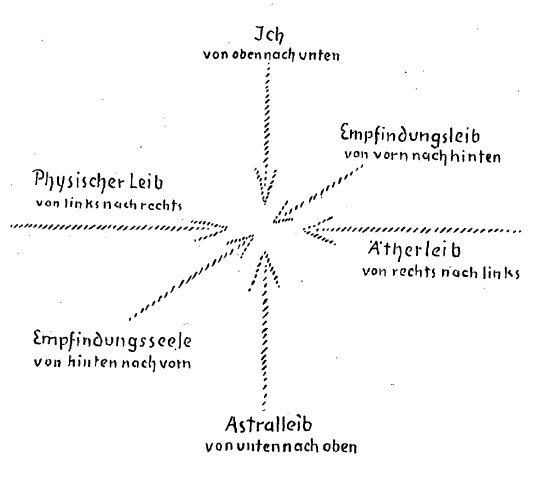
[ 21 ] Was kommt denn zustande durch das Aufeinanderströmen der von unten herauf und der von oben nach unten sich ergießenden Strömungen? Was da zustande kommt, das will ich Ihnen in der folgenden Weise klarmachen. Eine Strömung geht von oben nach unten. Sie kann sich nicht ungehindert ergießen, weil sie aufgehalten wird von der andern Strömung, welche von unten nach oben strömt. Ebenso ist es bei der Strömung, die von rechts nach links geht und so weiter. Jede wird aufgehalten, und das bietet in der Mitte das Scheinbild des physischen Leibes.
[ 21 ] What happens when the currents flowing upward from below and those pouring downward from above meet? I will explain what happens in the following way. One current flows from top to bottom. It cannot flow unimpeded because it is held back by the other current, which flows from bottom to top. The same is true of the current that flows from right to left, and so on. Each is held back, and this creates the illusion of the physical body in the center.
[ 22 ] Wenn wir die beiden Strömungen betrachten von rückwärts nach vorn und von vorn nach rückwärts, so müssen wir uns darüber klar sein, daß diese beiden Strömungen durchschnitten werden von den Strömungen von unten und von oben. Und durch dieses Durchschneiden entsteht in der Tat eine Dreigliederung im Menschen. So daß der untere Teil der einen Strömung zu bezeichnen ist als der Empfindungsleib im engeren Sinne. Dann entsteht durch die Stauung etwas, was demjenigen entspricht, was man nunmehr im engsten Sinne bezeichnen kann als die höchste Ausbildung des Empfindungsleibes, dort, wo sich die eigentlichen Sinne entwickeln, was Sie nicht mehr sehen können, weil die Augen selber dazugehören, was Sie nicht mehr riechen können, weil das Riechorgan selber dazugehört. Sie können nicht hineinsehen in das Innere des Auges, sondern Sie können nur herausschauen aus dem Auge.
[ 22 ] When we consider the two currents flowing backward and forward, we must be clear that these two currents are intersected by the currents flowing from below and from above. And this intersection does indeed give rise to a threefold division within the human being. Thus, the lower part of one of these currents can be described as the sensory body in the narrower sense. Then, through the accumulation, something arises that corresponds to what can now be described in the strictest sense as the highest development of the sensory body, there where the actual senses develop—what you can no longer see because the eyes themselves are part of it, what you can no longer smell because the olfactory organ itself is part of it. You cannot look into the interior of the eye, but you can only look out from the eye.
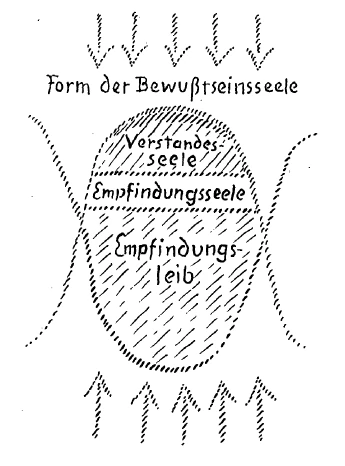
[ 23 ] Das ist die Ausgestaltung des gesamten Empfindungsleibes des Menschen. Warum aber habe ich Ihnen überhaupt zwei Glieder gezeichnet [siehe S. 62], wenn das alles Empfindungsleib ist? Das ist richtig aus dem Grunde, weil da unten hauptsächlich die Wirkung geschieht von außen, und da oben ist wiederum das physische Scheinbild dessen, was wir Empfindungsseele nennen. Im Antlitz zunächst haben Sie den Ausdruck der Empfindungsseele. Das Antlitz wird von der Empfindungsseele gebaut. Und da oben, das oberste Stück, das am wenigsten zurückgeschobene, das ist das, wo die Verstandesseele sich ihr Organ baut. Nun aber merken Sie, daß nicht nur diese Strömungen von unten und oben kommen, sondern daß auch Strömungen von rechts und von links kommen, so daß das Ganze wiederum durchschnitten wird. Wir haben da eine Strömung, die durch die Längsachse des Körpers verläuft. Diese Strömung bewirkt, daß wiederum eine Art von Spaltung da oben entsteht. Es wird ein Stück abgespaltet von der Form der Verstandesseele; und dieses abgespaltene Stück, ganz oben an der Grenze, das ist die Form der Bewußtseinsseele. Diese Bewußtseinsseele formt da oben bis ins Innerste des Menschen hinein, und sie formt da auch die Windungen des grauen Gehirns. Da haben Sie die Arbeit der Bewußtseinsseele an dem Menschen. Wenn Sie den Menschen so als eine geistige Wesenheit kennen, dann können Sie rundweg das, was im Menschen als Form ist, aus dieser geistigen Wesenheit heraus begreifen. So arbeitet der Geist an der Form des menschlichen Leibes. Alle einzelnen Organe werden aus dem Geistigen sozusagen plastisch herausgemeißelt. Der Mensch kann den Bau des Gehirnes erst dann begreifen, wenn er weiß, wie die einzelnen Strömungen im Gehirn durcheinander wirbeln.
[ 23 ] This is the structure of the entire sensory body of the human being. But why did I draw two parts for you at all [see p. 62], if it is all sensory body? The reason is that down below, the effect mainly comes from the outside, and up above is the physical image of what we call the sensory soul. In the face, first of all, you have the expression of the sensory soul. The face is formed by the soul of sensation. And up there, the uppermost part, the least pushed back, that is where the soul of understanding builds its organ. But now you will notice that not only do these currents come from below and above, but that currents also come from the right and the left, so that the whole is again cut through. We have a current there that runs through the longitudinal axis of the body. This current causes a kind of division to arise up there as well. A portion is split off from the form of the intellectual soul; and this split-off portion, right at the top of the boundary, is the form of the conscious soul. This consciousness soul shapes up there into the very innermost part of the human being, and it also shapes the convolutions of the gray matter of the brain. There you have the work of the consciousness soul on the human being. If you know the human being in this way as a spiritual being, then you can readily understand what is form in the human being from this spiritual being. This is how the spirit works on the form of the human body. All the individual organs are, so to speak, sculpted out of the spiritual realm. A person can only understand the structure of the brain once they know how the individual currents swirl through it.
[ 24 ] Nun wollen wir einmal auf eine Einzelheit eingehen, damit Sie sehen, wie diese Dinge einmal fruchtbar wirken können, wenn sie Gemeingut einer wahren Wissenschaft werden, anstelle der heutigen, äußeren Wissenschaft. Wir haben jetzt gesehen: Da oben entstehen durch die verschiedenen Strömungen die äußeren Organe für die Bewußtseinsseele, Verstandesseele, Empfindungsseele zum Beispiel. Zu zeigen, wie dann diese Organe im Innern sich fortsetzen, würde sehr weitläufige Erklärungen erfordern. Wir wollen aber eine andere Frage aufwerfen. Wir haben gesagt, daß das Ich von oben nach unten wirkt, und daß die Hauptmasse des astralischen Leibes von unten nach oben geht, so daß die Hauptmasse des astralischen Leibes und das Ich sich in einer Strömung berühren. Dadurch kommt eine Wechselwirkung zustande zwischen Ich und astralischem Leib, so daß sie sich ineinander stauen. Da, wo das Ich eine bewußte Tätigkeit ausführen soll, da muß etwas zustande kommen können, was durch die Empfindungsseele, was durch die Verstandesseele und was durch die Bewußtseinsseele entsteht. So etwas, was zum Beispiel durch die Verstandesseele zustande kommt, ist ein menschliches Urteil. Wo muß denn also ein menschliches Urteil lokalisiert sein? Natürlich muß es im Kopfe lokalisiert sein, weil dort die betreffenden lebendigen Kräfte und Wesensglieder des Menschen ihren Ausdruck gefunden haben. Nehmen wir jedoch als ein besonderes Beispiel an, es sollte im Menschen ein solches Organ zustande kommen, an dem die Verstandesseele keinen Anteil hat, in dem nicht geurteilt wird, sondern an dem nur Anteil haben sollen der physische Leib, der Ätherleib, das Ich und der astralische Leib als Träger von Lust und Leid, Freude und Schmerz und so weiter. Nehmen wir an, diese vier Glieder der menschlichen Wesenheit, der astralische Leib, das Ich — ohne jene feinere Tätigkeit des Urteilens und des Bewußtseins —, der physische Leib und der Ätherleib sollten zusammenwirken. Wie müßte sich dann ein Organ ausnehmen, worinnen diese vier Strömungen zusammenwirken? Ein solches Organ würde so sein, daß es nicht urteilen ließe, daß es sogleich folgen lassen würde auf den Eindruck des astralischen Leibes die Gegenwirkung. Physischer Leib und Ätherleib müssen zusammenwirken, denn sonst könnte dieses Organ nicht da sein. Astralischer Leib und Ich müssen zusammenwirken, sonst könnte dieses Organ nicht Gefühle haben, und es könnte auch nicht auf einen Eindruck hin irgendeine Sympathie oder Antipathie äußern. Wir wollen uns zusammenwirkend denken physischen Leib und Ätherleib, und wir wollen uns denken, daß es ein physisches Organ ist, und daß es natürlich einen entsprechenden Ätherleib haben muß, weil ja jedes physische Organ von einem Ätherleib aufgebaut werden muß. In diesem Falle müßte zusammenwirken eine Strömung von rechts des Ätherleibes dieses Organs, und eine Strömung von links, diejenige des physischen Leibes dieses Organs. Die würden sich in der Mitte stauen, würden sich nicht übereinanderschieben können und würden daher eine Verdickung hervorrufen. Dann würde es die beiden andern Strömungen geben, die des astralischen Leibes von unten und die des Ich von oben; die würden eine andere Stauung hervorrufen. Nun wollen wir uns einmal schematisch dieses Zusammenwirken der Strömungen in einem einzelnen Organ denken. Ich will nur schematisch die Sache zeichnen; die einzelnen Formen eines solchen Organes würden aus ganz andern Voraussetzungen folgen. Ich will sagen: Es gäbe ein Organ, irgendwie geformt; da gäbe es die eine Strömung, die den physischen Körper repräsentiert, und die andere Strömung, welche den ätherischen Leib repräsentiert. Die rufen in der Mitte eine Verdikkung hervor. Die beiden andern Strömungen von oben und von unten stauen sich ebenfalls und rufen auch ihrerseits eine Verdickung hervor. Da haben Sie das menschliche Herz gezeichnet: rechte Vorkammer, rechte Herzkammer, linke Vorkammer, linke Herzkammer. Wenn Sie sich alles, was das menschliche Herz kann, genau vergegenwärtigen, so werden Sie sich sagen müssen: Gerade so muß das menschliche Herz aus dem Geiste heraus gebaut sein! — So baut sich der menschliche Geist dieses Herz. Es kann gar nicht anders sein.
[ 24 ] Now let us consider one detail so that you can see how these things can bear fruit once they become the common heritage of true science, rather than today’s superficial science. We have now seen that up there, through the various currents, the external organs for the conscious soul, the intellectual soul, and the feeling soul, for example, come into being. To show how these organs then continue inwardly would require very lengthy explanations. But let us raise another question. We have said that the ego acts from top to bottom, and that the main mass of the astral body moves from bottom to top, so that the main mass of the astral body and the ego touch one another in a current. This brings about an interaction between the ego and the astral body, so that they interpenetrate one another. Where the ego is to perform a conscious activity, something must be able to come about that arises through the soul of feeling, through the soul of understanding, and through the soul of consciousness. Something that arises, for example, through the intellectual soul is a human judgment. Where, then, must a human judgment be located? Naturally, it must be located in the head, because that is where the relevant living forces and constitutional elements of the human being find their expression. Let us, however, take a specific example: suppose such an organ were to come into being in the human being in which the intellectual soul has no part, in which no judgment is made, but in which only the physical body, the etheric body, the I, and the astral body—as the bearers of pleasure and suffering, joy and pain, and so on—are to have a part. Let us assume that these four members of the human being—the astral body, the ego (without the finer activity of judgment and consciousness), the physical body, and the etheric body—were to interact. What would an organ look like in which these four currents interact? Such an organ would be such that it would not allow for judgment, that it would immediately follow the impression of the astral body with a counteraction. The physical body and the etheric body must interact, for otherwise this organ could not exist. The astral body and the I must interact; otherwise, this organ could not have feelings, nor could it express any sympathy or antipathy in response to an impression. Let us imagine the physical body and the etheric body working together, and let us imagine that it is a physical organ, and that it must naturally have a corresponding etheric body, since every physical organ must be built up by an etheric body. In this case, a current from the right side of the etheric body of this organ would have to interact with a current from the left, that of the physical body of this organ. These would accumulate in the middle, would be unable to overlap, and would therefore cause a thickening. Then there would be the other two currents, that of the astral body from below and that of the ego from above; these would cause a different kind of congestion. Now let us imagine schematically this interaction of the currents within a single organ. I will only sketch the matter schematically; the individual forms of such an organ would follow from entirely different premises. I mean to say: there would be an organ, shaped in some way; there would be one current representing the physical body, and another current representing the etheric body. These cause a thickening in the middle. The other two currents from above and below also accumulate and, for their part, cause a thickening as well. There you have drawn the human heart: right atrium, right ventricle, left atrium, left ventricle. If you carefully consider everything the human heart is capable of, you will have to say to yourself: This is exactly how the human heart must be constructed from the spirit! — This is how the human spirit constructs this heart. It cannot be any other way.
[ 25 ] Wollen wir ein anderes Beispiel nehmen. Wir haben gestern etwas Merkwürdiges gesagt. Wir haben gesagt, daß bei der Sehtätigkeit im Grunde genommen eine unterbewußte Denktätigkeit vorhanden ist. Denktätigkeit, wenn sie bewußt wird, kommt ja nur im Gehirn zustande. Nun wollen wir uns vergegenwärtigen, wie das Gehirn gebaut ist, damit eine bewußte Denktätigkeit zustande kommt.
[ 25 ] Let’s take another example. We said something curious yesterday. We said that, fundamentally, there is a subconscious thought process involved in the act of seeing. Thought processes, when they become conscious, occur only in the brain. Now let us consider how the brain is structured so that conscious thought can take place.
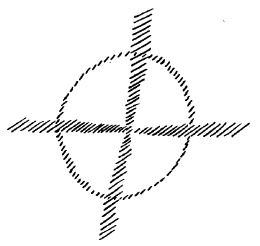
[ 26 ] Wir haben jetzt nicht Zeit dazu, um die einzelnen Formen des Gehirns herauszumeißeln. Wir könnten bei jedem einzelnen Organ zeigen, daß es so sein muß, wie es ist. Wir wollen das Schema des Gehirns, soweit wir es brauchen, von vornherein voraussetzen. Wir wollen sagen: In dem Gehirn haben wir gegeben — um von allem andern abzusehen — die äußere Haut, dann eine Art von Gefäßhaut; dann da drinnen, zwischen der Gefäßhaut und der netzförmigen Haut, haben wir so etwas wie die Rückenmarkstlüssigkeit.1Was im folgenden an der Tafel demonstriert wurde, ist in den Nachschriften nur ungenügend festgehalten. Von dort geht es dann in das Rückenmark hinein. Das Innere des Gehirns ist ausgefüllt mit der eigentlichen Gehirnmasse, mit Nervenmasse. Nervenmasse ist die äußere Form für die Denktätigkeit, so daß also, wenn durch irgendein Sinnesorgan ein Eindruck der Nervenmasse überliefert wird, das zustande kommt, was bewußte denkerische Verarbeitung dieses Eindruckes von außen ist. Das alles ist der Nervenmasse übertragen. Wenn der Eindruck kommt, wird er zuerst denkerisch verarbeitet, und nachdem er denkerisch verarbeitet ist, wird er von einem Nervensystem weiterverarbeitet zur Empfindung und so weiter.
[ 26 ] We don’t have time right now to go into the individual structures of the brain in detail. We could demonstrate for each individual organ that it must be exactly as it is. Let us assume the basic structure of the brain, to the extent that we need it, from the outset. Let us say: In the brain we have—leaving everything else aside—the outer membrane, then a kind of vascular membrane; then inside, between the vascular membrane and the reticular membrane, we have something like spinal fluid. 1What was demonstrated on the blackboard in the following is inadequately recorded in the notes. From there it then enters the spinal cord. The interior of the brain is filled with the actual brain matter, with nerve tissue. Nerve tissue is the outer form for mental activity, so that when an impression is transmitted to the nerve tissue through any sense organ, what results is the conscious mental processing of this external impression. All of this is conveyed to the nervous tissue. When the impression arrives, it is first processed intellectually, and after it has been processed intellectually, it is further processed by the nervous system into sensation and so on.
[ 27 ] Nehmen Sie nun einmal an, es soll keine bewußte denkerische Verarbeitung eines Eindruckes von außen geschehen. Da müßten Sie das zunächst in ähnlicher Weise machen. Es müßte also wiederum eine Art von, sagen wir, Umhüllung da sein; es müßte wiederum da sein an der Rückwand das, was man nennen könnte Gefäßhaut. Aus einem bestimmten Grunde — der auch ausgeführt werden könnte, was aber jetzt zu weit führen würde — würde die Rückenmarksflüssigkeit verkümmern. Damit es nun geschehen kann, daß eine unterbewußte Denktätigkeit möglich wird, müssen wir die Gehirnmasse zurückschieben: dadurch wird vorne Platz, so daß eine unterbewußte, von keinem Nervensystem durchgearbeitete Denktätigkeit zustande kommt. Da muß etwas geschehen mit dem, was sonst gleich von der Nervenmasse in Empfang genommen wird. Dafür aber muß die Nervenmasse zurückgeschoben werden. Würde die Nervenmasse nicht zurückgeschoben werden, so würde hier gedacht werden. Wird sie zurückgeschoben, so kann hier nicht gedacht werden, kann auch nicht empfunden werden. Sie haben ein Organ, das einer unterbewußten Denktätigkeit dienen soll, dann, wenn Sie alles, was Nervensystem ist, zurückschieben bis an die hintere Wand, und den Eindruck, statt ihn gleich von einer Nervenmasse verarbeiten zu lassen, von etwas verarbeiten lassen, was von keinem Nervensystem durchzogen ist. — Nun sehen Sie sich an, was wir gemacht haben: wir haben aus dem Gehirn ein Auge gemacht.
[ 27 ] Now suppose there is to be no conscious mental processing of an external impression. You would have to do this in a similar way at first. So there would have to be, once again, a kind of—let’s say—envelope; there would have to be, on the back wall, what one might call a vascular membrane. For a specific reason—which could also be explained, but that would take us too far afield now—the cerebrospinal fluid would atrophy. In order for subconscious thought activity to become possible, we must push the brain mass back: this creates space in the front, so that a subconscious thought activity, not processed by any nervous system, comes about. Something must happen to what is otherwise immediately received by the nervous tissue. But for this to happen, the nervous tissue must be pushed back. If the nervous tissue were not pushed back, thinking would take place here. If it is pushed back, thinking cannot take place here, nor can sensation. You have an organ intended to serve subconscious thought activity, provided that you push everything that constitutes the nervous system back to the rear wall, and allow the impression—instead of having it processed immediately by a mass of nerves—to be processed by something that is not permeated by any nervous system. — Now look at what we have done: we have turned the brain into an eye.
[ 28 ] Was ist das Auge? Das Auge ist ein kleines Gehirn, das von unserem Geiste so bearbeitet ist, daß der eigentliche Nervenapparat zurückgeschoben ist an die hintere Wand, wo sie zur Netzhaut des Auges geworden ist. So arbeiten die Baumeister der Natur, die Bildner der Formen. So formen sie. Im Grunde genommen herrscht ein Bauplan in allen menschlichen Organen, der nur im einzelnen, je nach Bedarf, abgeändert wird. Wenn ich wochenlang sprechen könnte, würde ich Ihnen zeigen, wie jedes Sinnesorgan nichts anderes ist als ein abgeändertes kleines Gehirn, und das Gehirn wiederum ein Sinnesorgan auf einer höheren Stufe. Aus dem Geiste heraus ist der ganze menschliche Organismus aufgebaut.
[ 28 ] What is the eye? The eye is a small brain that has been shaped by our mind in such a way that the actual nervous system has been pushed back to the rear wall, where it has become the retina of the eye. This is how the architects of nature, the creators of forms, work. This is how they shape things. Essentially, there is a blueprint governing all human organs, which is modified only in detail, as needed. If I could speak for weeks on end, I would show you how every sense organ is nothing other than a modified little brain, and the brain, in turn, a sense organ at a higher level. The entire human organism is built from the mind.
[ 29 ] Betrachten wir nun noch eine andere Einzelheit. Vorerst aber gestatten Sie mir eine Art erkenntnistheoretischer Vorbemerkung, um an dieser Vorbemerkung wiederum den Standpunkt der Anthroposophie klarzumachen.
[ 29 ] Let us now consider another detail. But first, allow me to make a sort of epistemological preliminary remark, in order to use this remark to clarify the standpoint of anthroposophy.
[ 30 ] Wir haben gesagt, daß unten in den Einzelheiten des Sinnenlebens die Anthropologie ihren Standpunkt hat, daß die Theosophie oben auf dem Bergesgipfel und daß die Anthroposophie in der Mitte ihren Standpunkt hat. Wenn Sie sich nun an den Unterschied klammern wollen, der darinnen besteht, wie sich der Mensch einerseits verhält zur äußeren Sinneswelt und andererseits zu der geistigen Welt und den Tatsachen, die aus der Geistesforschung heraus mitgeteilt werden, so können Sie sagen: Von dem Dasein der Sinnenwelt und ihren Gesetzen kann sich jeder überzeugen, der Sinne hat und der seinen Verstand, der an die Sinnenwelt gebunden ist, anwendet. Daher glauben die Menschen auch im allgemeinen leichter an dasjenige, was ähnlich ist dem, was sie in der Sinnenwelt wahrnehmen, als an das, was aus der Geistesforschung heraus mitgeteilt wird. Denn das schauen sie leichter. Man könnte aber sehr leicht zeigen, daß formal kein Unterschied besteht zwischen dem Glauben, den Sie entgegenbringen den Tatsachen, die Ihnen der Geistesforscher mitteilt, und dem Glauben daran, daß man Ihnen sagt, es hat einen Friedrich den Großen gegeben. Zu glauben, daß es Geister des Willens gibt und daß es einen Friedrich den Großen gegeben hat, dazwischen ist formal kein Unterschied. Der Unterschied ist nur der, daß aus dem, was in den Archiven vorhanden ist, erzählt wird: Das sind die Taten Friedrichs des Großen, die äußerlich geschehen sind! — Und wenn Ihnen jemand aus den äußeren Tatsachen heraus den ganzen Gang der geschichtlichen Geschehnisse aufbaut bis rückwärts, wo Friedrich der Große gelebt hat, so glauben Sie ihm aus dem Grunde, weil damals nicht eine Wesenheit gelebt hat, die anders ausgeschaut hat als ein Mensch. Aus dem Grunde glaubt es der Mensch, der nicht an geistige Welten glauben will, weil ihm hier etwas Ähnlicheserzählt wird, wie dasjenige ist, was er selber in seiner Umgebung hat. Der Geistesforscher ist ja zunächst nicht in der Lage, aus seiner Forschung heraus über solche Dinge zu reden, die ähnlich schauen den Wesenheiten und Dingen, die für den gewöhnlichen Menschen in seiner Umgebung sind. Daß trotzdem zwischen den beiden Arten kein Unterschied ist, und trotzdem dies absolut begründet ist, so ist das, was ich Jetzt gesagt habe, dennoch in einer gewissen Weise zu berücksichtigen. Nun kommt aber noch etwas anderes.
[ 30 ] We have said that anthropology has its standpoint down below in the details of sensory life, that theosophy has its standpoint up on the mountaintop, and that anthroposophy has its standpoint in the middle. If you now wish to focus on the difference that lies in how human beings relate, on the one hand, to the external sensory world and, on the other hand, to the spiritual world and the facts communicated through spiritual research, then you can say: Anyone who has senses and who applies their intellect—which is bound to the sensory world—can convince themselves of the existence of the sensory world and its laws. That is why people generally find it easier to believe in what is similar to what they perceive in the sensory world than in what is communicated through spiritual research. For they can grasp that more easily. But one could very easily show that there is formally no difference between the belief you place in the facts communicated to you by the spiritual researcher and the belief in the fact that you are told there was a Frederick the Great. To believe that there are spirits of the will and that there was a Frederick the Great—there is formally no difference between the two. The only difference is that what is recounted is based on what is available in the archives: These are the deeds of Frederick the Great that took place in the external world! — And if someone reconstructs the entire course of historical events for you from the external facts all the way back to the time when Frederick the Great lived, you believe them for the simple reason that no being lived back then that looked any different from a human being. For this reason, the person who does not want to believe in spiritual worlds believes it, because what is told to them here is similar to what they themselves have in their surroundings. The spiritual researcher is, after all, not initially in a position to speak from his research about such things that resemble the beings and things that are present in the ordinary person’s surroundings. Since there is nevertheless no difference between the two kinds, and since this is nevertheless absolutely justified, what I have just said must nevertheless be taken into account in a certain way. But now something else comes into play.
[ 31 ] Wir haben charakterisiert den Gesichtspunkt dessen, der zum Beispiel unten auf dem Standpunkt der Anthropologie steht, und den Gesichtspunkt dessen, der auf dem Standpunkt der Theosophie steht. Es ist vollbegründet — das hat Ihnen ja Dr. Unger bewiesen —, Vertrauen und Glauben in begründeter Weise zu haben zu dem, was aus der Geisteswissenschaft vorgebracht wird. Das ist durchaus eine voll begründete Art der Anerkennung geisteswissenschaftlicher Wahrheiten. Nun fragt es sich aber: Gibt es vielleicht nicht noch ein Drittes? — Gibt es nur diese zwei Dinge: etwas anzuerkennen, weil es ähnlich schaut dem, was man gewohnt ist zu sehen in der Sinnenwelt, oder bloß anzuerkennen das Geistige daraufhin, daß man es als eine Mitteilung empfängt aus den höheren Welten? Gibt es nicht doch noch ein Drittes? Mit andern Worten, kann der Mensch vernünftigerweise nur unterscheiden: Hier gibt es ein sinnlich Wahrnehmbares; ich glaube es, weil ich es sinnlich sehe. Dann gibt es ein geistig Wahrnehmbares; ich glaube es, weil der Geistesforscher es sieht. — Gibt es dazwischen nicht noch etwas?
[ 31 ] We have described the perspective of someone who, for example, takes the standpoint of anthropology, and the perspective of someone who takes the standpoint of theosophy. It is entirely justified—as Dr. Unger has demonstrated to you—to have confidence and faith, in a well-founded manner, in what is presented by spiritual science. This is indeed a fully justified way of acknowledging the truths of spiritual science. But now the question arises: Is there perhaps a third way? — Are there only these two options: to accept something because it resembles what one is accustomed to seeing in the sensory world, or to accept the spiritual merely because one receives it as a message from the higher worlds? Is there not a third option after all? In other words, can a person reasonably only distinguish between: Here is something perceptible to the senses; I believe it because I see it with my senses. Then there is something perceptible to the spirit; I believe it because the spiritual researcher sees it. — Is there not something else in between?
[ 32 ] Ich will Ihnen an einem Beispiel klarmachen, daß es doch noch etwas Drittes gibt. Denken Sie, hier liege ein Hammer. Meine Hand ergreift ihn und stellt ihn vertikal auf. Jetzt hat der Hammer eine Bewegung ausgeführt. Sie werden diese Bewegung darauf zurückführen, daß ein Wille da war, der den Hammer aufgerichtet hat. Das ist weiter nicht wunderbar, denn Sie sehen den dahinterstehenden Willen im Menschen verkörpert. Wenn Sie sehen, daß ein Mensch einen Hammer aufhebt, so werden Sie das nicht als etwas Besonderes betrachten, Aber nehmen Sie an, derselbe Hammer würde, ohne daß ein sichtbares Wesen ihn anrührt, selber sich vertikal aufrichten. Was würden Sie jetzt dazu sagen? Jetzt werden Sie sagen: Ich wäre sehr töricht, wenn ich glauben würde, daß dasjenige, was sich da aufgerichtet hat, ein Hammer wäre wie ein jeder andere Hammer, der nur aufgerichtet werden kann durch einen Menschen. — Was werden Sie jetzt sich sagen müssen? Sie werden sich jetzt sagen: Es ist doch selbstverständlich, daß das kein gewöhnlicher Hammer ist, sondern daß in diesem Hammer etwas unsichtbar darinnen ist, etwas, was ein Wille ist. — Wenn Sie sehen, daß der Hammer sich aufrichtet, können Sie ihn als keinen gewöhnlichen Hammer mehr nehmen, sondern Sie müssen ihn als etwas nehmen, was die Verkörperung eines andern Willens, eines andern Geistigen ist. Und Sie werden sich sagen: Sehe ich, daß ein Ding etwas tut, was es sonst nach den Eigenschaften, wie ich es als äußeres Ding kenne, nicht tun kann nach der Kenntnis der gewöhnlichen äußeren Sinnenbeobachtung, so muß ich sagen, zwar sehe ich nicht den Geist in dem Hammer, der sich aufgerichtet hat; aber in diesem Falle darf ich nicht bloß an den Geist glauben, sondern in diesem Falle wäre ich ein großer Tor, wenn ich nicht an den Geist im Hammer glauben würde.
[ 32 ] Let me use an example to show you that there is, in fact, a third factor. Imagine there is a hammer here. My hand picks it up and sets it upright. Now the hammer has performed a movement. You will attribute this movement to the fact that there was a will that set the hammer upright. There is nothing remarkable about this, for you see the will behind it embodied in a human being. If you see a person pick up a hammer, you would not regard that as anything special. But suppose the same hammer were to stand upright on its own, without any visible being touching it. What would you say to that? Now you will say: I would be very foolish if I believed that what has stood up there is a hammer like any other hammer, which can only be raised by a human being. — What will you have to say to yourself now? You will now say to yourself: It goes without saying that this is no ordinary hammer, but that there is something invisible within this hammer, something that is a will. — When you see the hammer standing upright, you can no longer regard it as an ordinary hammer, but you must regard it as something that is the embodiment of another will, of another spiritual entity. And you will say to yourself: If I see that a thing does something which, according to the properties I know of it as an external thing, it cannot do according to the knowledge of ordinary external sensory observation, then I must say, although I do not see the spirit in the hammer that has raised itself up; but in this case I must not merely believe in the spirit; rather, in this case I would be a great fool if I did not believe in the spirit within the hammer.
[ 33 ] Wenn Sie keine genaue Beobachtungsgabe haben, und Sie würden mit jemandem gehen, der hellsichtig ist, so könnte da jemand liegen, ein Mensch, der sich nicht rührt. Sie mit Ihrer ungenauen Beobachtungsgabe könnten gar nicht unterscheiden, ob das ein wirklicher Mensch ist oder ein Mensch aus Papiermache. Der andere aber sagt Ihnen: Das ist ein wirklicher Mensch; er hat einen astralischen Leib! — Da müssen Sie es glauben. Aber ein Drittes gibt es auch noch, und das wäre, daß derjenige, der da liegt, plötzlich aufstände. Dann werden Sie nicht mehr daran zweifeln, daß der hellsichtige Mensch vorher recht gehabt hat und daß da ein Geist und eine Seele drinnen ist, wenn der Betreffende aufgestanden ist. Das ist das Dritte.
[ 33 ] If you lack keen observational skills and were to walk with someone who is clairvoyant, there might be a person lying there, a person who doesn’t move. With your lack of keen observational skills, you wouldn’t be able to tell at all whether that is a real person or a person made of papier-mâché. But the other person tells you: That is a real person; he has an astral body! — Then you have to believe it. But there is also a third possibility, and that would be that the person lying there suddenly gets up. Then you will no longer doubt that the clairvoyant was right all along and that there is a spirit and a soul inside, once the person in question has stood up. That is the third possibility.
[ 34 ] Nun will ich Ihnen einen Fall zeigen, wo Sie im Leben das beobachten können, allerdings nicht in nächster Nähe, und doch wiederum in nächster Nähe. Wir haben gesagt: Von links nach rechts im Menschen wirkt die Strömung des physischen Leibes, von rechts nach links die Strömung des Ätherleibes, von vorn nach rückwärts die Strömung des Empfindungsleibes, von rückwärts nach vorne die Strömung der Empfindungsseele. Von unten nach oben und von oben nach unten wirken astralischer Leib und Ich einander entgegen. Diese Strömungen fließen also alle durcheinander. Das Ich, sagten wir, wirkt im Menschen von oben nach unten. Wie muß das äußere Organ daher liegen, damit es der Mensch als einen Apparat des Ich haben kann? Das äußere Organ für das Ich, das wissen Sie ja, ist das zirkulierende Blut. Das Ich könnte nicht wirken von oben nach unten, wenn es nicht im physischen Leibe sein Organ fände, das von oben nach unten in der vertikalen Richtung den menschlichen Leib durchzöge. Wo kann kein Ich sein, wie es der Mensch hat? Da, wo die Hauptblutrichtung nicht von oben nach unten geht, sondern wo sie horizontal liegt. Das ist in der Tierwelt der Fall. Das Gruppen-Ich der Tiere findet kein Organ, weil die Hauptblutlinie horizontal ist. Das ist der Unterschied, daß die Hauptblutlinie sich beim Menschen aufrichten mußte, damit in diese Hauptblutlinie das Ich des Menschen hineinkommen konnte. Da haben wir also die Tiere, bei denen das Ich das Blut nicht erfassen kann als sein Organ, weil die Hauptlinie des Blutes horizontal gerichtet ist, und da haben wir die Menschen, bei denen das Ich das Blut erfassen kann als sein Organ, weil die Hauptlinie dieses Blutes sich vertikal aufgerichtet hat. Nehmen wir nun einmal diejenige Anschauung, welche eine Verwandtschaft des Tieres mit dem Menschen aus bloß äußeren Gründen annimmt. Da müssen Sie sich sagen: Da sind tierische Formen; die sind erhalten aus früheren Zeiten. Jetzt aber mußte sich einmal die ganze Blutrichtungslinie aus der Horizontalen in die Vertikale aufrichten, damit der Mensch daraus werden konnte. — Hier haben Sie den geschichtlichen Fall: Sie haben etwas, was horizontal liegt. Das kann sich aber selbstverständlich aus den Eigenschaften, die Sie beobachten können an dem tierischen Blutcharakter, ebensowenig selber aufrichten, wie der Hammer sich selber aufrichten könnte, wenn er nicht von einem Geiste durchseelt wäre. Ebenso wie es töricht wäre zu leugnen, daß in dem, was sich selber aufrichtet, ein Geist ist, ebenso töricht wäre es zu denken, daß sich die horizontale Blutlinie des Tieres von selber aufrichtet zur vertikalen Blutlinie des Menschen. Nur wenn darinnen ein Geist ist, wenn ein Wille sie durchströmt, kann sie sich aufrichten von der Horizontalen in die Vertikale, kann die tierische Gruppenseele übergehen in die individuelle Menschenseele. Und wer sich nicht eingesteht auf der einen Seite: Ich wäre ein Tor, wenn ich glauben wollte, daß der Hammer, der sich selber aufrichtete, nichts anderes wäre wie ein gewöhnlicher Hammer —, der wäre ein ebenso großer Tor, wenn er annehmen wollte: Ich denke, daß das, was im Blute ist, sich von selber vertikal aufstellt.
[ 34 ] Now I would like to show you a case where you can observe this in life—not in the immediate vicinity, and yet, in a sense, in the immediate vicinity. We have said: In the human being, the current of the physical body flows from left to right, the current of the etheric body from right to left, the current of the sensory body from front to back, and the current of the sensory soul from back to front. The astral body and the ego act in opposition to one another from bottom to top and from top to bottom. These currents thus all flow intermingled. The ego, we said, acts in the human being from top to bottom. How, then, must the external organ be situated so that the human being can have it as an instrument of the ego? The external organ for the ego, as you know, is the circulating blood. The ego could not act from top to bottom if it did not find its organ in the physical body, one that runs through the human body from top to bottom in the vertical direction. Where can there be no ego as humans have it? Where the main blood flow does not run from top to bottom, but where it is horizontal. This is the case in the animal world. The group ego of animals finds no organ because the main blood flow is horizontal. This is the difference: the main blood flow had to rise vertically in humans so that the human ego could enter into this main blood flow. So we have the animals, in whom the ego cannot grasp the blood as its organ because the main bloodline is oriented horizontally, and we have humans, in whom the ego can grasp the blood as its organ because the main bloodline has risen vertically. Let us now consider the view that assumes a kinship between animals and humans based solely on external grounds. You must tell yourself: There are animal forms; they have been preserved from earlier times. But at some point the entire bloodline had to rise from the horizontal to the vertical so that the human being could emerge from it. — Here you have the historical case: you have something that lies horizontally. But this cannot, of course, raise itself up on its own based on the characteristics you can observe in the animal bloodline, any more than a hammer could raise itself up if it were not animated by a spirit. Just as it would be foolish to deny that there is a spirit in that which raises itself up, so too would it be foolish to think that the horizontal bloodline of the animal raises itself up on its own into the vertical bloodline of the human being. Only if there is a spirit within it, if a will flows through it, can it raise itself from the horizontal to the vertical, can the animal group soul pass over into the individual human soul. And whoever does not admit to himself, on the one hand: I would be a fool if I were to believe that the hammer that raised itself up were nothing other than an ordinary hammer—would be just as great a fool if he were to assume: I think that what is in the blood raises itself up vertically on its own.
[ 35 ] Hier haben Sie die dritte Art, wie Sie sich alle geisteswissenschaftlichen Wahrheiten bewahrheiten können, indem es Ihnen einleuchtet, daß Dinge geschehen, bei denen anzunehmen, daß nur dasjenige daran beteiligt ist, was man mit äußeren Sinnen sieht, eine Torheit, ein Unding ist. Und je weiter man in die Dinge eindringt, desto mehr zeigt es sich, daß diese mittlere Art der Überzeugung für alles möglich ist, diese mittlere Art, die darin besteht, daß das gewöhnliche Denken befruchtet wird von der Geisteswissenschaft. Denn Sie müssen doch zugeben können, daß ein menschliches Herz nicht so gezeigt werden kann, wie wir es taten, ohne die vorherige geistige Forschung. Angeregt werden muß die Forschung von der Geisteswissenschaft. Dann aber, wenn die Resultate der Geisteswissenschaft gegeben sind, und wir betrachten dann die äußeren Erscheinungen, dann werden wir sehen, daß an diesen äußeren Erscheinungen etwas vorgeht, was unmöglich vorgehen könnte, wenn nicht die Dinge vorausgesetzt würden, die uns von der Geisteswissenschaft gesagt werden können. So gibt es eine Methode, die Dinge unbefangen zu beobachten, wenn Sie zum Beispiel sehen, wie die Blutlinie im Tier horizontal, im Menschen vertikal ist, und sich dann fragen: Was muß im Blute vorhanden sein, damit sich die ganze Hauptblutlinie aufrichten kann? und dann die Antwort aus der Geistesforschung erhalten: Im Blute herrschen geistige Wesenheiten! so daß Sie sich dann sagen: Zeigt mir das Blut nicht ebenso die Anwesenheit einer geistigen Wesenheit, so wie ein Hammer, der sich selber aufstellen würde, mir die Anwesenheit einer geistigen Wesenheit zeigen würde? Hier haben Sie den mittleren Standpunkt der Anthroposophie, der die Tatsachen unten beobachtet, die Tatsachen der geistigen Welt beobachtet, beide miteinander vergleicht — und dadurch dasjenige vollständig erklärt, was äußerlich in der Welt vorhanden ist.
[ 35 ] Here is the third way in which you can verify all spiritual truths: by realizing that certain things happen in which it would be foolish and absurd to assume that only what is perceived by the external senses is involved. And the deeper one penetrates into things, the more it becomes evident that this middle path of conviction is possible for everything—this middle path, which consists in ordinary thinking being enriched by spiritual science. For you must surely admit that the human heart cannot be described as we have done without prior spiritual research. Research must be inspired by spiritual science. But then, when the results of spiritual science are given, and we then observe the external phenomena, we will see that something is taking place in these external phenomena that could not possibly take place if the things that spiritual science can tell us were not presupposed. Thus there is a method for observing things impartially, for example, when you see how the bloodline is horizontal in animals and vertical in humans, and then ask yourself: What must be present in the blood so that the entire main bloodline can stand upright? and then receive the answer from spiritual research: Spiritual beings reign in the blood! so that you then say to yourself: Does not the blood show me the presence of a spiritual being just as a hammer that were to stand up on its own would show me the presence of a spiritual being? Here you have the middle point of view of anthroposophy, which observes the facts below, observes the facts of the spiritual world, compares the two with one another—and thereby fully explains what is present outwardly in the world.
[ 36 ] So haben wir jetzt an einzelnen Beispielen, wie an der Umwandlung des Gehirns in das Auge und an der inneren schematischen Kontraktion des menschlichen Herzens, gezeigt, wie jedes Organ in seinen Formen begriffen werden kann. So könnten wir die einzelnen Formen jedes Organs konstruieren aus dem Geiste heraus. Überall würde sich Ihnen zeigen, wie der Geist am Menschen arbeitet, um die Organe und die Formen des Körpers zustandezubringen. Nur im Prinzip sollte das angedeutet werden. Aber Sie sollten durch solche Dinge, wie sie heute angedeutet sind, ein Gefühl davon erhalten, daß es doch vieles in der Welt gibt, wovon sich Gelehrtenweisheit gar nichts träumen läßt, weil sie nicht eingehen will auf die Sachen. Wenn Sie dieses Gefühl davontragen, so werden Sie sehen, daß es eine Möglichkeit gibt für den Menschen, die Welt unbefangen zu betrachten, wo das Ineinanderweben dessen, was der Geistesforscher aus der geistigen Welt heraus mitteilt, mit den irdischen Dingen, zwar nicht jeder gleich sehen kann, wo man sich aber doch sagt: Es ist ein Unding, für gewisse Erscheinungen nicht jene Tatsachen anzunehmen, welche der Geistesforscher erzählt.
[ 36 ] We have now shown, using specific examples such as the transformation of the brain into the eye and the internal schematic contraction of the human heart, how the form of every organ can be grasped. In this way, we could construct the individual forms of every organ from the mind. Everywhere you would see how the spirit works in the human being to bring about the organs and the forms of the body. This should only be hinted at in principle. But through such things as have been hinted at today, you should gain a sense that there is indeed much in the world of which scholarly wisdom cannot even dream, because it refuses to engage with these matters. If you take this feeling with you, you will see that there is a possibility for human beings to view the world impartially, where the interweaving of what the spiritual researcher communicates from the spiritual world with earthly things—though not everyone can see it in the same way—leads one to say: It is absurd not to accept, for certain phenomena, the facts that the spiritual researcher describes.
[ 37 ] Wenn dieses Gefühl besteht, dann ist schon genügend gewonnen durch diese anthroposophischen Vorträge; denn wir können nur langsam und allmählich aufsteigen in der geistigen Forschung.
[ 37 ] If this feeling is present, then these anthroposophical lectures have already achieved enough; for we can only ascend slowly and gradually in spiritual research.