

Anthroposophy, Psychosophy
and Pneumatosophy
GA 115
16 December 1911, Berlin
Translated by Steiner Online Library
Pneumatosophy IV
[ 1 ] It is understandable that we can only provide a very brief—and in a certain sense even fleeting—sketch of what one might envision as Pneumatosophy, since we have only these four lectures at our disposal during our General Assembly. It is therefore natural that many things can only be touched upon here, indeed can only be touched upon in such a way that one actually expects, at the very least, this or that explanation to provide further justification and detail. In some cases, it may even be difficult to see the connection between what is presented and what is actually referred to here as Pneumatosophy. Yesterday, for example, we showed how one moves from the realm of the purely soul-related—on the one hand from the life of imagination and on the other from the life of emotional movements—into realms that, by their very nature, must be counted among the supersensible worlds. We have recognized that they must be counted among the supersensible worlds from the simple fact that the realm of the soul ceases precisely at a certain boundary in relation to these things, and that even astute researchers of the soul, as they survey and classify the realm of the soul, stop short of these things. For the theosophist, all such things—as they have appeared to us as imagination, intuition, and inspiration—are known from other sources, and one must realize that the validity of this known material, which may stand before us from entirely different perspectives—such as those presented in my book *How to Attain Knowledge of the Higher Worlds?* , can be seen to be justified if one goes further and further in revealing all the threads that lead from the ordinary soul life of everyday existence—the life of imagination, the life of emotion, and judgment—to imagination, intuition, and inspiration.
[ 2 ] It is only natural, of course, that human beings will first turn their attention to the soul—in order to pass from it into the spiritual—that is given to them in their own soul and in their own spirit; in other words, they will first set out to learn to recognize their own spiritual-soul nature. In the course of these lectures, we have been able to point out how, within Western development up through the 19th century, indeed right up to our own time, humanity has had difficulty acknowledging the fact that appears to us as fundamental: that the human spirit passes through repeated earthly lives. And at the end of the second lecture, we cited Frohschammer as a prime example of someone who grappled with such difficulties; out of scientific integrity of the highest order, he states in his work on the philosophy of Thomas Aquinas: How could it be that human beings, with their enduring, spiritual essence, should in fact merely plunge again and again into a physical existence—as into a kind of purgatory, as into a kind of dungeon, into a prison? Should one, says Frohschammer, regard that which pertains to the relationship of love and the sexual dichotomy merely as a means to imprison the human soul for the duration between birth and death? - Now, in the face of such an honest objection to the doctrine of repeated earthly lives, it is necessary to ask oneself whether Frohschammer has not perhaps asserted a point of view here that is merely a point of view, and whether another point of view might not still be possible? What one must concede to Frohschammer is his sincere enthusiasm for all that is beautiful and magnificent in this world, as expressed in his arguments. For it is precisely from Western spiritual life that he derives this enthusiasm for the external world, for all that is beautiful and great in the external world, and it seems to him as if the doctrine of repeated earthly lives were tantamount to saying: There is assumed to be a spiritual-eternal, an eternal aspect of human individuality, of the human spirit, which could have it quite good and quite blissful in the spiritual world, and which is forced, imprisoned into a world that is entirely unsuited to this height, this sublimity of the human spirit. - If this were asserted, then someone who justifiably develops enthusiasm for the beauty and grandeur of divine nature and historical development, and for the uplifting passions and impulses that arise in the human soul, might indeed rebel against what Frohschammer also rebels against: that the human soul proceeds each time only toward a new imprisonment when it is to incarnate again. But is that really the only standpoint that can be conceived? It must be admitted that even today, among the proponents of the doctrine of repeated earthly lives, there are still people who say something like what has just been suggested: that the human spirit descends from a sublime height into a kind of imprisonment within the body. But what is presented here is not what spiritual science can bring to light through spiritual research, but rather such general, vague ideas about repeated earthly lives. We must ask: Could it not perhaps be acknowledged that the very place into which a human being is born, when they come to life between birth and death, is actually something wonderfully beautiful, something truly magnificent? Could it not be acknowledged that the human being, as they appear to us in physical form, is truly, in the biblical sense, a kind of image of the Deity? And then that would be enough to fill us with enthusiasm. Then we would have to admit that when a human being incarnates, they are not actually being sent to a dungeon, but to a beautiful setting, to a beautiful dwelling. Yes, does it really depend on the house and its size and beauty whether one feels at home and truly at ease inside, or does it perhaps depend more on whether one is “imprisoned” within it by one’s own qualities and circumstances? Does what one feels inside depend on the house at all, or does this house perhaps become so prison-like for a person precisely because, despite its beauty and size, they do not know what to do with it and are bound within it? That the house in which we dwell is a beautiful one, and that the worst of it is merely that we are locked within it during our earthly life—this is precisely what a spiritual-scientific perspective can reveal, one that, through imagination, intuition, and inspiration, ascends to a true understanding of that which passes through the human being during its various earthly lives.
[ 3 ] The first thing a person experiences when, in the manner hinted at yesterday, they enter the imaginative world as it were in reverse from their life of imagination is a world of images. People of all kinds have entered this world of images at all times. If one considers this imaginative world—which can be accessed through careful concentration, meditation, and so on, or through special dispositions of the soul— in terms of its mere appearance, it presents itself in such a way that it initially reveals, as it were, the rudiments, the remnants of the still external sensory world, in that the human being then sees all manner of things in this imaginative world—houses, animals, people, this or that event—which actually unfold pictorially, so that one has before one scenes and beings in a very vivid world of images. On the other hand, this imaginative world is already characterized as belonging, in a certain sense, to the supersensible by the fact that the human being does not have the pure freedom to determine the symbols or images, that it is subject to inner laws of nature when he has formed this or that, indeed, that very specific supersensible relationships are expressed in very specific symbols and images. Thus, when it comes to this imaginative world, a person can be fairly certain that, under all circumstances, a certain stage of their soul’s development—a certain ability to live in a specific region of the supersensible world—is characterized in a pictorial-imaginative way by, for example, a chalice being offered to them, or by being led through a river, or by being baptized, and so on. It may also happen that within this imaginative world a person experiences—and these are, of course, the more unpleasant experiences—that their various qualities and impulses confront them symbolically in all manner of creatures, either in large, fearsome animals or in small, crawling, creeping creatures. It is, of course, impossible—since we are dealing here with a world that is far richer than our sensory world—to even begin to describe this first stage of the imaginative world that a person can reach there.
[ 4 ] All in all, it must be said that this world—even when it is quite unpleasant to a person, appears quite hideous to them, and they must tell themselves that this unpleasantness and hideousness are symbols of their own characteristics—is nevertheless something that, in most cases, is quite pleasant to the person who finds themselves in it; for the usual experience is that when people have this experience, they overlook the nature of what they have experienced and are quite happy simply to be in the spiritual world at all. This is entirely understandable. For the spiritual world one enters in this way, even if it is quite hideous, does not weigh heavily upon one; for it is, after all, a world of images. And only if one lacks sufficient strength and this world overwhelms and oppresses a person does it destroy their healthy soul life. But a sense of moral responsibility, or a sense of a certain responsibility toward the great phenomena of the world, does not necessarily follow from such a vision of the imaginative world. The exact opposite may also be the case. For example, it may be that people who possess great perfection precisely in their ability to see through this world actually develop a rather lax moral attitude regarding the sense of truth and untruth. It is indeed a particularly great temptation for the imaginative clairvoyant not to take the truth of the physical world very seriously and thus to no longer develop a particular sense of responsibility toward the truth. In a certain sense, it is a predicament that, in imaginative clairvoyance, something like an inability to distinguish between the objectively true and false can easily arise. Being firmly grounded in this world and the ability to attribute the right meaning to it at all—that is precisely a matter of development. One can actually be quite undeveloped as a human being and still have this imaginative world right before one’s eyes; one can have many, many vision-like imaginations of the higher world and not necessarily be particularly advanced as a human being. As I said, it is a matter of development. Over time, development leads one to learn to distinguish between these imaginative visions just as one, in the physical world, essentially first learns to distinguish between things—only that one goes through this at such an early age that one usually does not take it into account. But in the physical world, too, one does not mistake a tree frog for an elephant; rather, one learns to distinguish between things, to classify and organize them, so that this physical world appears structured to us. At first, a person stands before the imaginative world just as they would stand before the physical world if they were to mistake a tree frog for an elephant; that is, unable to distinguish between them. How uniformly spread out and of equal importance the imaginative world appears at first! That we attach more weight to one thing and less to another is something we must first learn. For this is the peculiarity of this world: that it does not appear great or small to us by its own nature, but by what we are. Let us suppose that someone is a very haughty, arrogant person; then he takes a liking to this arrogant nature in himself. When the imaginative world now opens up to him, his feeling, his fondness for arrogance, is transferred to the size of the beings he then sees, and everything in the imaginative world that manifests as something arrogant, as something haughty, appears to him as enormous, as something of immense significance, whereas perhaps what appears great to the humble person appears to him as small as a tiny tree frog. It depends entirely on people’s characteristics how this world appears to them in perspective. It is a matter of human development that the true proportions and the intensities and qualities of this world are correctly recognized. Things are entirely objective, but a person can distort them completely and see them as caricatures. The essential point is that a person must first, in a certain way, pass through—even in these higher supersensible insights—what they themselves are; that is, they must get to know themselves in an imaginative way. This is, however, a perilous matter because the perspective on what is given in the imaginative world is then most completely determined by the soul’s own qualities—that is, determined in a false or true sense.
[ 5 ] What does it mean that a person must come to know themselves through imaginative insight? It means that, among the imaginations, among the images that confront him in the imaginative world, he must first encounter himself as an objective image. Just as a person in the physical world has, for example, a bell or some other object before him as an objective entity, so must he encounter himself in the imaginative world as what he is, as a reality, just as he is at first. He can achieve this in a regular way only if, through meditation and so on, he actually advances from the perception of the external world to life within his ideas, by imagining, as we have already mentioned, certain specific symbols so that he can detach himself from the external world, and learns to live in the purely inner soul life of ideas until this becomes for him something he experiences as natural: life within his own imaginings. Then the person will truly notice something like a kind of splitting of his being, a kind of splitting of his personality. He will often have to pull himself together during the transitional stages so as not to allow a certain state to develop too strongly. When this peculiar state sets in, what happens is that the person gradually develops a kind of mental image in which they live, in which they are fully immersed, so that they no longer say: “I am what my body is”—but instead have before them an image: “That is you! That is who you are!” — Then what happens is that they sometimes notice how the other part of their being, apart from what has freed itself there, acts like a kind of automaton, that they actually stand above it, but that this part has the urge to automatically speak words, make gestures, and so on. Untrained people will then sometimes find themselves making all sorts of grimaces, because they have drawn something out of themselves through the imagination; and what remains behind does all sorts of automatic things. This is something that should not go further than an attempt; it must always be possible to overcome it. The person must always bring himself to the point where, just as with other objects, he now has his own being outside of himself.
[ 6 ] When it comes to the imagination—which is what we are about to explore—it is of the utmost importance that one has indeed developed certain qualities of the soul beforehand. For in this imaginative self-knowledge, all manner of illusions do indeed arise. Lurking in the background is everything that constitutes human pride and the very capacity for illusion that arises from the most diverse qualities. One can see the most varied things in the imaginative world. Among these varied things, one will naturally regard something as purely emotional for oneself, and it is a quite widespread phenomenon that people in the imaginative world actually regard themselves as the very best at first. When people who see themselves in this way in the imaginative world wish to draw a conclusion about what they must have been in a previous life, in terms of their individuality, in order to have become this quite extraordinary human being that they are now, they sometimes come to the conclusion that they must have been, at least historically, someone of high standing—someone royal or the like. We see it time and time again that budding clairvoyants in particular are convinced that in their previous incarnation they were somehow Charlemagne, Napoleon, Julius Caesar, Marie Antoinette, or this or that high-ranking historical figure, because these people feel that way —not to mention those who consider themselves even higher reincarnations, such as saints and the like—because people must regard their individuality as something so significant, as it now presents itself to them, that in this “prison” in which they now find themselves, they can only assume that they were something extraordinary in their past incarnations. There one could once see sitting together at a table the Marquise de Pompadour, Marie Antoinette, Frederick the Great, the Duke of Reichstadt, and other highly influential figures. Yes, you laugh, but these things are actually very serious, because they are meant to draw attention to how it depends entirely on the human soul itself how one’s own being appears to us in imaginative insight. For we come to know this very essence of our own being when we truly detach ourselves entirely from ourselves, when we work with all our energy to shed all those qualities which, in ordinary life, we can perceive to be dreadful, to be unpleasant to others, and to be something we constantly carry around with us that, when we reflect objectively upon ourselves, we ought not to possess. We must, in fact, take these traits very much to heart; for now it is not a matter of merely saying things that might please everyone, but of saying things that are true, that are meant purely and objectively. One can always be assured that, if we go about our work with sufficient objectivity, we really have an endless amount to do with criticizing ourselves, and that we should actually only resort to what is common practice among humanity—criticizing others, taking offense at others, and so on—in the most extreme necessity, when external circumstances make it necessary. Anyone who spends a great deal of time judging others, who exercises a great deal of criticism toward others, can be certain that they have far too little time left to discover in themselves what they must discover, and to clear away what must be cleared away, so that the imaginative knowledge of our self may stand before us in its truth. And when, after someone has been engaged in spiritual science for a long time, one hears them ask again and again: Why am I not making progress? Why can’t I see anything in the spiritual world?”—then the objection that one might raise against oneself would be all too obvious: that one must take care to completely refrain from all criticism of others, unless it is demanded by the utmost necessity, and that one must above all learn what it means to refrain from all criticism of others. For some people forget, when they get up and begin the next day’s work, what it means to refrain from criticizing others. For that means being able to accept, at times, something from others that may be unpleasant and even disastrous in one’s life. One must be able to accept that. For whoever truly believes in karma knows that what is inflicted upon us by another, we have inflicted upon ourselves. It is, after all, part of karma that this is inflicted upon us.
[ 7 ] It takes an infinite amount to arrive at an imaginative understanding of one’s own self. Then one begins to realize why Frohschamr’s image of imprisonment is incorrect. One then realizes that one is, in fact, so deeply immersed in one’s life that one must say to oneself: The incarnation, the earthly life in which you find yourself, would be lovely, would be quite wonderful and glorious, but you are not so inclined; you cannot undertake everything that you could undertake given the physicality that has placed you in a specific setting. — One then comes to the realization: Here I stand in the world, at a specific moment in time, at a specific point in space; all around me is the beautiful world, all that is great and mighty, and I have physical organs through which all that is great and mighty enters, all that is magnificent and splendid, everything that an unbiased feeling must tell us: We actually live in the world in which we are, continually in a paradise! — This is something we should tell ourselves, even when we are doing extremely poorly. For the issue is not how we are doing, but whether this world is beautiful and magnificent; for whether we are doing poorly may depend on our karma. How the world is depends solely on the world and must not be judged from our personal standpoint. But to fully embrace this world, to attain the goal of highest satisfaction and bliss, we have been given our physicality, we have been given our organs, and great is the gap between what we could draw from this worldly paradise in our existence between birth and death if we were to take everything out of it, and what we actually do take out. And why do we take so little out of it? Yes, because embodied within this physicality is something that is small in relation to the world, something that allows us to extract only a negligible fragment. Compare what your eyes see continuously from morning to evening with what they could actually see, and you will have a ratio between what you are capable of perceiving and what you actually perceive.
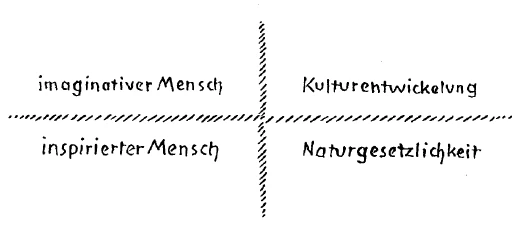
[ 8 ] Through such an insight, we do indeed experience a strange relationship between ourselves and the spirit. When we recognize ourselves in the spirit, we feel that we are by no means as well-suited to this world as we would be if we could make use of our entire being. We then discover that something else in the world must stand in opposition to what we ourselves are prior to our imaginative insight. And here we arrive at an interesting synthesis that we must simply allow to take full effect on our minds if we wish to get to know ourselves, namely that the human being, by recognizing himself in the imaginative world, truly cannot appear great and sublime in relation to the world around him—not as if he were a being from a higher world placed in this earthly dungeon, but rather that he is not suited to this earthly dungeon. Oh, with his body, a human being could do an infinite amount if he could make full use of it. That is the true state of affairs. Therefore, set against what a human being is in the imaginative world stands a world that corrects what he makes of himself by failing to use his physicality at all—it would indeed be fascinating if one could fully elaborate on the correspondence between these two worlds—set against what a human being is in the imaginative world stands the entire cultural development of humanity from the beginning of the Earth to its end. Why does this world of cultural development from the beginning of the Earth to the end of the Earth stand in contrast to what a human being appears to be in an incarnation, in an existence between birth and death, before their own imagination?
[ 9 ] If we wish to answer this question, we realize that what a human being cannot be in a single incarnation, he must become through many incarnations over the course of Earth’s cultural development. He must return again and again. Then, what they are so little in a single incarnation, they can gradually become by constantly longing for new incarnations, so that they may become what they cannot become in a single incarnation. Precisely when a human being gains an insight and a feeling for what they could actually be during an earthly life and what they cannot be because of their own inner nature, then they know what the predominant feeling in their soul must be when they pass through the gate of death. This predominant feeling must be: to come down again, in order to become, in a subsequent and ever subsequent earthly life, what he cannot be in one. This must be the strongest force: the longing for ever subsequent incarnations during the course of earthly civilization.
[ 10 ] This idea can only be touched upon here. If you think it through further, you will see that it provides the strongest confirmation of reincarnation. And the fact that one can say this idea provides the strongest confirmation of reincarnation is also evident from something else. The human being can now continue their efforts to enter the spiritual world. I have said that, from a purely technical standpoint, the human being arrives at an imaginative understanding of themselves by setting aside all external perception and devoting themselves to the life of the imagination in the manner described. Now there is another way to give meditation and inner concentration a certain direction. It consists in attempting, with complete inner fidelity and complete inner conscientiousness, to allow what one might call one’s own memory to unfold. One need only do this for a few hours, but one must do it earnestly. What is one actually in ordinary life? Of course, through reflection, epistemology, and logic, one comes to realize that one is an “I.” But in ordinary life, one is this “I” in a very questionable sense; in ordinary life, it is very questionable what fills this “I.” What someone is at any given moment is what the impressions of ordinary life give him. If someone is playing cards at the moment, he is what the impressions of the card game give. There he is not the “I”; he is it, but not in terms of his consciousness. For what he actually has in his consciousness are the impressions of ordinary life. The “I” is what we can indeed seek to attain, but it is something highly variable and fleeting, flickering. One can only discover what one really is by surrendering to one’s memories and bringing them before oneself in such a way that, while they are otherwise behind one, one brings them before oneself. This is an extraordinarily important process. Fundamentally, a person is always the result of their past experiences, which live on in their memories. You can very well perceive, even in small things, how a person is the result of their memories. Suppose you have experienced nothing but unpleasant things all day. Then compare how you are in the evening, how that makes you in the evening: grumpy, repulsive, turning up your nose, and so on; and contrast that with the supposition that you have experienced nothing but satisfying experiences throughout the day. How are you then? Joyful, smiling, pleasant to those around you—perhaps something truly wonderful. This is how a person truly is—sometimes one way, sometimes another—because, at the core, they are what their past experiences have shaped them to be.
[ 11 ] When he brings to the fore the experiences he has had by going through them in reverse order, he brings them to the fore and is then behind the matter. If he does this earnestly—not schematically or mechanically, but if he truly remains fully alive within those events and has brought his life before him—even if only for a few hours, like memories he has brought to the surface—then something occurs within the soul, provided that soul is capable of paying sufficient attention to itself. It only occurs when one has reached the point of being able to devote sufficient attention to it: namely, a kind of underlying tone in which one perceives oneself. There one can sometimes experience that one perceives oneself in a rather bitter underlying tone, a rather sour-bitter underlying tone. And if one—which again depends on one’s development—proceeds quite carefully with oneself, one will rarely find oneself to be a sweet being through such a process, but one will generally perceive oneself as a rather bitter being, will sense a rather bitter underlying tone. That is certainly the case. For in this way, if one can direct the proper attention to oneself, one does indeed gradually arrive at what one might call an inspired insight into oneself. One passes through the bitterness. But then it actually becomes the case that one feels very much like a detuned instrument. In the world of spherical harmonies, one usually emits only a disharmonious tone at first.
[ 12 ] Thus, through this deeper self-knowledge, one actually comes to realize even more clearly that one does not know what to do with the magnificent divine nature from which one could draw so much, if only one were up to the task. Precisely when one engages in such an exercise often, again and again and again, then—when life’s decline sets in, that is, in the later years of life—once one is past thirty-five, it becomes —it becomes quite clear, through the peculiar way this tone sounds, that one can actually interpret such a fundamental tone only to mean that one has much, much to improve upon in what one has begun in the present life, that one must desire with all one’s might to be enclosed once more in such a physical body in order to correct what one has neglected in this incarnation. One of the most important consequences of our self-knowledge is that we wish to be reincarnated. And those who take offense at the desire to be reincarnated merely reveal the inadequacy of their understanding of the magnificent divine nature into which we are born, in relation to this divine nature.
[ 13 ] The second thing one attains, then, is the inspired human being—the person as whom each individual recognizes themselves, recognizes themselves within the spiritual world of tone, when they arrive there in the manner described. What one experiences there, when one gets to know one’s own tone, so to speak, is how little one is actually suited to what exists in the great world outside. Now one can already, I would say, move from the merely moral to the fateful and also take into account how little one is able in life to attain the inner peace and inner harmony that one does indeed desire. And people who possess the power of self-knowledge—once they hold fast to this self-knowledge—will truly, time and again, be able to say to themselves: How little can you find within yourself that peace and security for which you must surely yearn! — To characterize this, one may recall a beautiful passage in Goethe’s writings, where he speaks of how, sitting on a mountain peak—which expresses the tranquil regularity of earthly nature—he beholds before his eyes what that “eldest son of nature,” granite, presents to him in the mountain peaks. He perceives the inner consistency, the grandeur of the laws of nature, the calm in the face of inner turmoil and the “swinging back and forth between joy and sorrow, between ‘exulting to the heavens’ and ‘grieved to death’”—the fundamental tone of human nature. If one proceeds from such a mood and looks to the laws of nature—to the laws of nature that already existed in the times when humans lived under entirely different cultural conditions in primeval times, and which as laws of nature still traverse space today—then one will come to understand—what might require a more detailed elaboration in ten or twenty lectures—in terms of its theoretical foundation: that just as cultural development is the antithesis of the imaginative image of humanity, the world of actual natural laws is the antithesis of the inspired human being. Through the Maya, the world of the spirit’s deeds reveals itself to us in the laws of nature with that inner peace and consistency which, through our error, has become restlessness and disharmony within us, so that we perceive it as restlessness and disharmony when we recognize the inspired human being within ourselves. And then the thought may arise in our soul: If we recognize these laws of nature in reality and in their essence, we know that while Earth’s evolution metamorphoses from form to form, from configuration to configuration, there is nevertheless something in the laws of nature that gives us the assurance that the human being, even as he passes through his various incarnations, that is, absorbs into the development of earthly culture what he must absorb because the potential for it already lies within an incarnation, he will find at the end of his earthly existence such conditions in the external world—due to the inner fidelity and certainty of the laws of nature—that have, so to speak, a balancing effect on what the human being spoils through what he has not yet developed as an inspired human being.
[ 14 ] Thus we see a profound connection between what is manifested outwardly as the laws of nature—the workings of the spirit in nature—and what appears to us as a kind of mirror image when, through inspiration within ourselves, we discover our deeper self. That is why, in all esotericism and in all mysteries, the inner peace and inner harmony of the laws of nature have always been held up as a model for humanity’s own inner laws. And it was not for nothing that the one who had attained the sixth degree of initiation was called a “Sun Hero,” to indicate that his own inner being had attained such regularity that, through this inner regularity and inner security, he could no more stray from the path laid out for him than the sun can stray from its path in the cosmos; for if it were to stray from its path even for a moment, countless revolutions and destructions would have to occur in the cosmos.
[ 15 ] However, there is still a further stage in human self-knowledge. We could ascend further to the apprehension of the human being through intuitive knowledge, but we would then reach such lofty regions of intuition that it would be difficult to characterize the form that would emerge there, and which—to point outwardly to the world as well—appears as the counter-image of the intuited human being. But the image we must pursue is seen in the diagram [on page 297]: that human beings can look upon all that they are in potential, that is, what they could be in that magnificent external world in which they are “imprisoned”—truly not because this external world is bad, but because they have grown so little in relation to this external world.
[ 16 ] We see from this that what is essential depends on a correct assessment of the entire state of the world, on recognizing what underlies that kind of spiritual insight—even in the realm of the human being—which spiritual science can present to humanity today. Objections raised in this regard are usually based on principles that completely misjudge the conditions of the world.
[ 17 ] But now, as a final point, we ask ourselves: Why must human beings enter into an external physical existence at all? — To illustrate even more clearly, so to speak, what is about to be said in the next few words, I would like to remind you—if you have heard them—of Dr. Unger’s lectures on the insertion of the “I” or “I am” into the whole inner life of the human being. I would also like to remind you of what you can find on this subject in my *Philosophy of Freedom* and in *Truth and Science*. Certainly, a little reflection can already teach a person that there are meaningful entities behind the “I” or “I am.” But what a person first experiences, they experience only in their consciousness, precisely as their I-consciousness or self-consciousness. This is even interrupted every night during sleep. And if a person were to sleep only and never wake, then—even though he might also be an “I”—he would never be able to realize from within himself that he is an “I.” On what, then, does it depend that a person comes to the consciousness of his “I” at all? It depends on the fact that, just as he experiences it in the waking state, he makes use of his physicality, his bodily organs, and confronts the entire external world with his body. A person must experience their “I” through their physicality. For if a person had never descended to Earth to make use of a body, they would, for all eternity, feel themselves to be, for example, a limb of an angel or archangel, just as the hand feels itself to be a limb of our organism. Human beings would never be able to attain consciousness of their independence. That would be entirely out of the question. They could attain all manner of contents of consciousness and all manner of great things in the world, but not self-consciousness, if they did not enter into an earthly body. It is from this earthly body that human beings must derive their self-consciousness. Even when you study the state of sleep and observe what the dream reveals, you see that something is at work there without any connection to the “I.” Self-awareness involves being confined within the body, making use of the sense organs, and also of the brain as an instrument. But if, as we have seen, a human being can make use of only a very small portion of what is given to them in an incarnation, then it should not be surprising, but must appear quite understandable, that clairvoyant consciousness says: Insofar as I truly explore a human ego, insofar as it reveals itself to me in its true form, I find in it, as the predominant force and impulse, first and foremost this: to return again and again to Earth in ever new bodies, in order to develop the ego-consciousness further and further and to make it ever richer and richer. In this respect, the human being, in his own individuality, reproduces something that the theosophists of the 18th century so often spoke of, and which, when processed into spiritual knowledge—into pneumatosophy—can be extraordinarily helpful. The 18th-century theosophists—however imperfect their explanations may seem to us in relation to the spiritual science we have today (Oetinger, Bengel, Völker, among others)—how did they express the meaning of the spiritual activity of the divine spirits, or, as they spoke from a monotheistic standpoint, of the Spirit of God? They had a beautiful formula for expressing, so to speak, a fundamental quality of divine spirituality. They said: Physicality—the physical world is the end of God’s ways! That is a wonderful statement. It means: the Deity, by virtue of the impulses within it, has passed through many spiritual worlds and descended in order to reach a kind of end, an end from which it turns back to ascend again. And this end is the manifestation, as it were, the crystallization of the divine beings in physical, corporeal form. If one were to translate what the 18th-century theosophists said into the realm of the soul, one might use the word: The spiritual reveals itself to us with a fervent longing for embodiment in physicality when we observe it in the higher regions, and only then does it cease to manifest this fervent longing for embodiment when it has reached the end of God’s paths—which consist in corporeality—and is on its way back. — That was a beautiful phrase spoken by these 18th-century theosophists, and indeed a phrase that sheds more light on, and penetrates more deeply into, what can enlighten—thus illuminating and elucidating the events within the human being—than much of what has come to light in 19th-century philosophy. While theosophical activity and theosophical work are virtually nonexistent, especially in the first half or the second third of the 19th century, we do indeed find theosophers of the older kind in the first half of the 18th century. And what they lacked was something they lacked precisely because Christian development had held it back in the West: the knowledge of the law of repeated earthly lives. Regarding the Deity, these 18th-century theosophers knew that physicality is the end of the Deity’s spiritual paths; regarding humanity, they did not recognize this. For in the case of human beings, they should have realized that with every incarnation, due to the very nature of the human being, a longing must arise for further incarnations until everything that matures the human being has been drawn out of the incarnations, so that they may then ascend to other forms of existence.
[ 18 ] Now more than ever, as these Pneumatosophical Lectures draw to a close, I feel how much everything had to remain in the form of sketches and hints during these four hours. And what applies to the first two lecture series of these comprehensive lectures—on anthroposophy and psychosophy—also applies to the pneumatosophical lectures: The intention was simply to offer a few suggestions once again. If you follow them, you will find a wealth of material that you can work with in the most diverse ways. To do so, you will need to draw upon many sources, to look around in the world to see how this or that can confirm what could only be presented here in very brief, fleeting strokes—like a charcoal sketch—whereas it would take a long time to provide a complete picture. But this is simply the nature of spiritual science, because it is so comprehensive: if we wanted to proceed systematically and truly proceed as is often done today in other sciences, then we would not now, after ten years of work in our Section, be at the point where we stand today, but perhaps at the point where we stood after the first quarter. And it is truly the case—let me say this now at the end of this cycle—that in our community we count on souls who carry within them the will and the impulse toward independence, who truly have the serious will to independently further develop what is given in outline form. Much will also emerge in this independent work from those regions that could not even be hinted at, and everyone will be able to find points of connection to the work in their own way. Everyone will be able to convince themselves of this, if they truly proceed in an independent manner within their soul, that our community will prove itself best when this feeling of inner independence grows ever greater, the feeling that one receives something in order to be inspired in such a way that one’s own inner being increasingly comes to experience the worlds that are to be opened up to humanity precisely through that important spiritual current which we have hitherto been accustomed to call the “theosophical.”