

Anthroposophy, Psychosophy
and Pneumatosophy
GA 115
15 December 1911, Berlin
Translated by Steiner Online Library
Pneumatosophy III
[ 1 ] Yesterday we saw how, in a certain sense, even for ordinary consciousness—provided it understands itself correctly—there is something akin to proof of the existence of the spirit, and we were able to say that, for this ordinary consciousness, error and the possibility of overcoming error are, in the first instance, evidence of the existence of the spirit. To understand this, we have drawn upon a property of the spirit that seems self-evident to us, namely the property known as supersensibility; for we have, after all, argued that error must have its roots in the supersensible. I have said that it is, of course, not possible to bring forth all the details to substantiate such a matter in full. But that could be done. It might even be of great interest to show how, so to speak, the possibility of error arises only in that realm to which the human being ascends by freeing themselves from the constraints of the external physical world—that is, by freeing themselves from everything that they can, after all, only perceive through sensation. It suffices for now to point out a single fact to indicate, so to speak, the method by which one could show how, fundamentally, only human beings can be exposed to the temptation to fall into error through a relationship with the external world—mind you: exposed through their own inner nature and being. On other occasions, attention has already been drawn to how, in essence, modern science itself provides, from all sides, what one might call evidence for the findings of spiritual science. It is just that these findings of external science are not interpreted today by its adherents with sufficient freedom from prejudice.
[ 2 ] Let us consider a fact such as that observed by the naturalist Huber when he studied a caterpillar spinning a cocoon. There are caterpillars that spin such a cocoon in successive stages, in successive phases, so that one can say the caterpillar spins in the first, second, third, fourth, fifth, and sixth stages. Now Huber took such a caterpillar, which had completed its cocoon up to the third stage, and placed it inside another caterpillar’s cocoon that was already finished up to the sixth stage. Then something strange happened. This caterpillar, which had completed its web up to the third stage and had now been placed in another web that had already been completed by another caterpillar up to the sixth stage, calmly continued, of its own accord—albeit with some difficulty—not to spin the seventh and eighth stages, but rather the fourth and fifth. So it calmly continued spinning, as its instinct dictated, from the stage it had reached; that is, it followed an inner life that was unwavering, that can follow only itself. If one then took such a caterpillar from its own cocoon, which it had spun up to the third stage, and placed it in another cocoon that was also complete up to the third stage, it would calmly continue and complete this cocoon in a regular manner, because even there it did not follow an external impression, but its inner instinct to spin the fourth stage after the third. But it does the same even when there is an external impression from a web that has already developed up to the sixth stage.
[ 3 ] This is an extraordinarily interesting fact, because it shows us that in the beings of the animal kingdom, external impressions cannot bring about anything that falls under the categories we apply to human beings as right or wrong, or as falling within the realm of possible error. Only human beings can be led astray by something external because they are organized in such a way that they do not merely follow their inner instinctual life and inner impulses, but must also, in what they do, follow the impulses that penetrate them from the outside. In this sense, we actually see only human beings facing an external world. But this, in essence, gives rise to all those misconceptions one can harbor regarding the concept of the spirit. It is closely connected to this. |
[ 4 ] Today, in order to find the right point of connection to our spiritual science of the soul from a scientific perspective, let us once again consider what a perceptive contemporary researcher of the soul has put forward to characterize the soul and its faculties as such. Brentano—and I would like to sketch on the board what this entails, so that we may make a fitting transition into the realm of the spiritual—has classified the faculties of the soul, as I mentioned in the first lecture, into that which is within us as imagination, that which is within us as judgment, and into what we might call the emotions, the phenomena of love and hate.
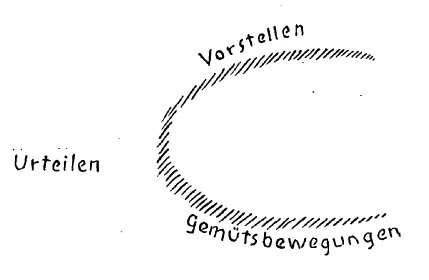
[ 5 ] If we were to conceive of the entire scope of the life of the soul as being organized in this way, we would have to conclude that, upon truly close examination, imagination and emotional stirrings stand in a different relationship to the soul—and to what a person might otherwise include in their considerations—than judgment does. This is precisely what this teacher of the soul, the psychologist Brentano, claims as his own special contribution: to point out that he distinguishes judgment from representation in such a way that he sees in a judgment something other than a mere combination of representations. I already pointed out in the first lecture that it is commonly said that a judgment is formed by combining representations. “Tree” is a concept, “green” is also a concept; “The tree is green” results in a combination of concepts: this would constitute a judgment. Our psychologist does not at all regard this as the essence of judgment, which is supposed to involve a determination, for he says—and there is good reason for everything that is put forward here—that when we connect ideas, it may also be a matter of establishing the impossibility of connecting these ideas. It could, for example, also involve connecting the concepts “tree” and “golden”; then, if we had to form not the concepts “tree” and “green” but “tree” and “golden” for a propositional statement, we would be compelled to say: “No tree is golden” or something of the sort. What, then, is actually the prerequisite for a judgment in this sense? It is that we can, so to speak, form an existential proposition from every such judgment, and that this existential proposition is valid. From the combination of the concepts “A tree is green,” I can form the existential proposition: “A green tree is”; only then have I made a judgment. And when I try to form the existential proposition, I realize for the first time that something can be established through a combination of concepts. “A golden tree is”—that doesn’t work. So the question would be whether a judgment can emerge from a combination of concepts, whether an existential proposition can be formed.
[ 6 ] But now I ask you: if you were to survey the entire scope of your inner life, searching every corner of your soul, would you find any way to form an existential proposition so readily from a combination of ideas? What could possibly prompt you to form the existential proposition “A green tree is” from the combination of ideas “A tree is green”? Nothing, really, that is not already present in your soul; for you can find nothing within the vast expanse of your soul. And if you wish to find the transition from a combination of ideas to an existential proposition, to a proposition that decides something, through which a determination takes place, then you have no choice but to go beyond your inner life to that place where you still feel inwardly in your soul that this soul enters into a relationship with something other than itself. That is to say: There is no other way to find the transition from a conceptual arrangement to a judgment than first through perception [the word “perception” is inserted into the diagram on the board].
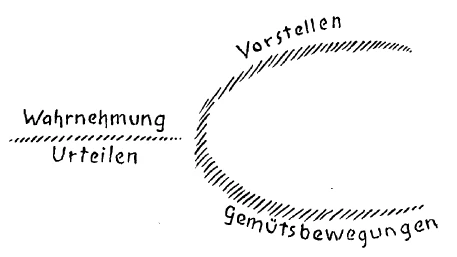
[ 7 ] If what we might call perception is added to a set of representations, then we are first given the possibility of saying that we can form a judgment in the sense of this arrangement. But in doing so, we have shown that, regarding everything we imagine, we can initially say nothing other than that it lives within our soul, and that we need something other than what is in our soul if we wish to move from imagination to judgment.
[ 8 ] When it comes to emotions, it is probably even easier for everyone to be convinced—more so than with ideas—that they exist only in the soul; for otherwise, emotions could not possess such an individual character in different people as they do if these emotions were to exist in something other than the soul. We therefore need not say much about the fact that emotions exist primarily in the soul.
[ 9 ] But let us now ask ourselves: Is there any way at all to attribute a mere existence in the soul to ideas and emotions, even though we know that we cannot initially form any judgment based on them, since they are internal processes of the soul? If there is no contact with the external world through perception, if we cannot justifiably speak of perceptions, then we must ask: Are we in any way justified in speaking of our ideas and emotions as if they existed solely within the soul? With regard to the life of the imagination, we could first point out that when a person lives in their ideas, they by no means feel as though they are entirely in control of these ideas within their soul, as though nothing compelling or the like were present in these ideas. If we hold fast to what we recognized the day before yesterday in the second lecture: that error is a spiritual, a supersensible entity that can enter the realm of our ideas, and that our ideas in turn can overcome error—for otherwise it would never be possible to move beyond error—then we must, so to speak, acknowledge that within our soul there is a kind of arena for a struggle between error and something else. But error is a spiritual entity. We must therefore have something opposed to error that can stand up to it; otherwise, we would never be able to move beyond any error. And there is a way to overcome error. Everyone knows that within the life of the imagination there is the possibility of overcoming error. Since error is a spiritual phenomenon, we cannot overcome it through mere perceptions from the sensory world. I have already pointed out on the occasion of the lectures on anthroposophy that the senses, strictly speaking, do not err. Goethe once emphasized this very strongly. The senses cannot deceive. Only what takes place in the soul can err. Therefore, however—as a little reflection shows—error can also be overcome only within the soul, and initially through imagination. We thus transcend error through imagination. But yesterday we saw that error is, in a certain sense, a kind of degenerate form of something else—namely, that which we have just described as the element within us that lifts us up into higher regions of our soul life. The essence of error is, after all, its lack of correspondence with the world of perception. And we have said to ourselves: On the path we must take up into the spiritual world, we must indeed—in our meditations, concentrations, and so on—surrender to images that do not correspond with external perception. The Rosicrucian symbol itself—we have cited it as an example of an idea that does not correspond to external perception, which thus shares a similarity with error in that it does not correspond to external perception.
[ 10 ] How, then, do we arrive at such ideas, which, while sharing the error of not corresponding to the external world of perception, nevertheless awaken higher spiritual powers within us in a healthy and proper way? In other words, how do we move from a mere false idea to a symbolic idea, as we have often described it, and as we find it in the Rosicrucian tradition as one of the most outstanding? We arrive at this when, in compiling such ideas, we do not allow ourselves to be guided by the external sensory world or by the world of perception, nor do we allow ourselves to be guided by those forces that lead us into error. We must refrain from both: from the guidance of the external sensory world of perception and from that world which leads us into error. We must appeal to forces within our soul that we must first awaken. The day before yesterday, they were characterized as inner impulses arising solely from the realm of the moral and the beautiful. We must, in a certain sense, break with our instincts and passions, as they have been imprinted upon us by a world that we can only describe as external. We must work on ourselves to summon from our soul, as it were on a trial basis, such forces that we do not initially possess at all. And when we awaken from our soul such forces that we do not initially possess, then we succeed in forming symbolic representations that, in a certain sense, possess an objective validity, even if not one related to the world of perception. There we first form, as has often been discussed, the image of the human being as he stands before us now in the present, as he stands as a being to whom he, in a certain sense, cannot say yes at all, with whom he himself cannot agree, of whom he himself must say: This human being must be overcome, just as he is! - And then we set alongside this the other conception, which cannot enter into perception for the very reason that it does not refer to the present or the past, but to the future of the human being—that other conception which tells us: Human beings feel within themselves that they must strive for a higher self-nature, a nature that makes them completely and utterly masters of all that which they do not recognize in their present form. And then, from such inner impulses, we bring together ideas that would otherwise not coincide under the guidance of the world of perception; we bring together the symbol of that which must be brought to an end, the black cross, and the symbol of the life that must spring from it, the red roses, and in inner meditation we envision the Rose Cross as an idea that we can only describe as unreal, yet one that we have not been able to assemble in the same way that a simple error comes about, but rather one that we have brought forth from the noblest stirrings of our soul.
[ 11 ] We have thus, from the noblest impulses of our soul, given birth to an idea that corresponds to no external perception. And when we now apply this idea—that is, when we devote ourselves to such an idea in deep inner contemplation, allowing it to work within our soul—it becomes evident that our soul is developing in a healthy way, that it is reaching higher heights than it previously possessed. We then experience that this soul is capable of development. Thus, with an idea that at first truly coincides with error in relation to the external world of perception—insofar as it does not reflect anything from this external world of perception—we have accomplished something that leads to the truth, to that which reveals itself as true. |
[ 12 ] Now let us ask ourselves: Can we grant power to all that which initially enters us from the outside, from external perception, over such a conception that has nothing in common with this external perception; can we grant it the power to exert some force, a force that transforms it into something entirely different in our soul than what would result from the error? Here we must say: That which within us has made something entirely different out of this symbolic image than what might otherwise arise from the error—that is precisely the opposite of what is at work in the error, of what operates within the error. And if we were able to say the day before yesterday: In the error we perceive the Luciferic forces—so we can now say: In the transformation of the symbolic image that takes place within our own soul, in the healthy guidance of the symbolic image toward a higher vision of the soul, it becomes clear to us that in what we feel there as noble impulses within us, we have the opposite of the Luciferic, that is, the spiritual-divine. —- And the deeper you delve into this connection, the more it will become clear to you that through this inner experience of the transformation of a symbolic image, the inner working of the supersensible is directly perceived and felt. But when it becomes evident that the supersensible is doing something within us, accomplishing something, exerting a force, then what was previously merely an idea in the soul—what lived within the soul—becomes something entirely different, something we must now describe as a realization, as something that cannot be brought forth by the soul itself, as it is at first. Just as a conclusion can be brought about in judgment through perception, so too can the inner idea, through the entire process now described, accomplish by itself what has been described here. Just as the idea, when it comes into contact with the ordinary external world through perception, leads to judgment, so the inner life of the idea, which is not directionless but allows itself to be guided in the manner described, leads even beyond this mere idea to the idea becoming something else—if not yet a judgment, then at least something that makes this idea a meaningful one pointing outward from the soul. This is what we can then, in the true sense of the word, call imagination [“Imagination” is written here].
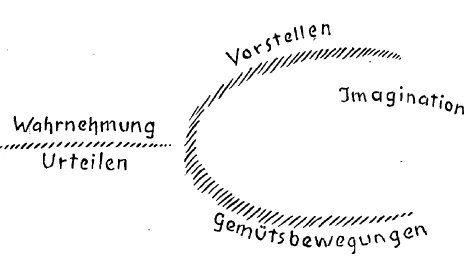
[ 13 ] Thus we can say: On the one hand, by coming into contact with the external world, the concept points toward judgment; and on the other hand, by undergoing the process described, it points toward what we now call, in the true sense of the word, imagination. Just as perception is not merely a representation, so too is imagination not merely a representation. Through perception, the life of representation comes into contact with an external world that is initially still indeterminate to it; through the process described, the act of representing immerses itself in what we might call the imaginative world. And just as there is indeed a transition from the mere composition of ideas “A tree is green” to the judgment “A green tree is,” so too does such a transition exist from the mere life of ideas to what lies in imagination in the fulfilled idea—and indeed, not one fulfilled by any external, spatially external world. Thus we have before us the process that fills our concepts in the life of the imagination.
[ 14 ] There is, however, something that lies between imagination and conception. Imagination is such that, the moment it occurs, it already announces itself quite tangibly. When our soul truly engages in its imaginings, it feels something in its life of conception quite similar to what it feels in its life of perception. In the latter, it feels its immediate contact with an external world of physicality; in imagination, it feels its immediate contact with a world that is at first also external to it, but an external world of the spirit. This spirit, as it enters into the concepts when they truly reach the realm of imagination, is just as compelling as the external physical world is compelling. Just as, when we come into contact with the external world, we cannot imagine a tree as golden, but rather the external world compels us to imagine in a certain way, and we have nothing for this compulsion other than contact with the external world—so too do we feel that compulsion emanating from the spirit when representation rises to imagination. But when representations rise to the level of imagination, we know at the same time that this life of representation unfolds independently of all those pathways through which representations are otherwise filled with content. In ordinary life, representations are filled with content because our eyes, ears, and so on have perceptions, and the life of representation is nourished by these perceptions, so that the life of representation is filled with the content of our perceptions. In imagining, we allow our ideas to be filled from the side of the spirit. Nothing may contribute here that could form the content of our soul through the physical organs; nothing may contribute—and indeed nothing does—that enters us through the eyes or ears. Here we have a direct awareness that we are free from everything that belongs to our own physicality, to our own corporeality. We are directly free from all of this, as free as we can only say—when we observe things impartially—that we are free from all the processes of the external body during sleep. Therefore, in the person who imagines, everything regarding their entire organism is as it is in sleep, except that the unconsciousness of sleep is replaced by imaginative consciousness, so that what otherwise proves to be completely empty—that is, what has separated from the body—is filled with what we might call imaginative images. There is, therefore, no other difference between a sleeping person and one who is imagining than that what is outside the physical body during sleep is, in a certain sense, devoid of imagery in the ordinary sleeping person, whereas during imagination it is filled with imaginative images.
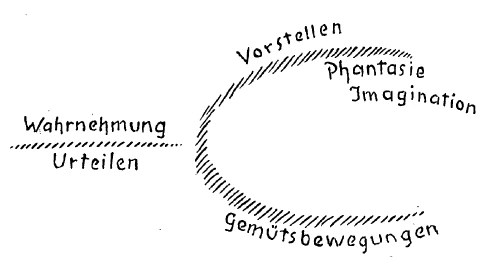
[ 15 ] However, an intermediate state can also occur. This would happen if a person were filled with imaginative visions while asleep but lacked the strength to bring these visions into consciousness. That could also happen; for it is a possible state. You can already see from everyday life that it is possible. I simply want to draw your attention to the fact that in everyday life you perceive a great many things that you do not bring to consciousness, for example when you are walking down the street: you perceive a whole world, but you do not bring everything to consciousness. You can often convince yourself that you have already perceived things but have not brought them to consciousness when, for example, you dream of strange things. There are dreams that are quite strange in this regard. Suppose, for example, you dream that a man is standing next to a woman and saying this or that to her. Well, the dream remains in your consciousness; you remember the dream, but you must admit to yourself, when you reflect on the dream, that the situation was actually there, yet you would not have known anything about it had you not dreamed it. The same lady, the same man, stood before you, only you did not notice it; only when you were free from all other impressions and were dreaming did this otherwise completely unnoticed image come to consciousness. Such things happen often. Thus, perceptions that have certainly been made can leave consciousness untouched. But imaginations that live in the soul can also leave consciousness untouched; they cannot appear directly in the soul as imaginations. Then they enter consciousness in a manner similar to the perceptions I have just spoken of. Namely, such perceptions that have been made and have passed into consciousness unnoticed sometimes approach the human being in that state of semi-consciousness which is dream consciousness. And in the same way, such imaginations, for which the human being does not yet have the strength to bring them into consciousness, can shine into waking daily life and there take effect in a similarly transformed way as in a dream, fluctuating and flowing into such perceptions that otherwise stand clearly before the human being. And what happens is that such imaginations truly enter into the consciousness of ordinary daily life, but undergo a transformation when that which is called imagination—rooted in the reality of the world—is fully expressed in human consciousness; this is the true foundation of all artistic creation, of all creation connected in any way with human productivity [the word “imagination” is written here].
[ 16 ] That is why, for example, Goethe—who was well acquainted with the artistic process—so often emphasized that the imagination is by no means something that assembles the phenomena of the world in any arbitrary way, but rather that it is subject to the laws of truth. But the laws of truth are such that they operate entirely from within the world of the imagination. Only because they influence everyday life do they change and interweave with what everyday life holds in consciousness, structuring the ordinary world of perception in a free manner, so that in true imagination we truly have something that lies right in the middle between mere conception and imagination. If fantasy is not understood in such a way that it is regarded by people merely as what is often said—that fantasy is something that is not true—but if it is truly understood, then it contains an immediate witness to a further development of ideas in the direction where ideas can flow into the realm of the supersensible, the imaginative world. Here we have one of those points where we are able to perceive the direct influx of the spiritual world into our ordinary world.
[ 17 ] But let us now consider the other side of the matter, the side of emotional responses. It has already been said that the psychologist under consideration here remains within the soul and therefore, with regard to all that are impulses of the will, pursues the matter only to the extent that, remaining within the soul, he stops at the emotions. When a human being carries out any action, such an action is of course based on a desire, an emotion, or an impulse—that is, on what, when viewed within the soul, must be regarded as an emotional state. But a mere emotional state does not, of course, bring about anything. As long as we remain within the soul, nothing needs to happen. We may experience any emotional movement with tremendous intensity: yet this does not achieve what the will is meant to achieve, namely that something happens that is now independent of the soul. For everything that remains within the soul is not a true expression of the will. If the soul were never to transcend itself, if it were to experience only this or that emotional impulse within itself—ranging from disgust on the one hand to the highest reverence on the other—nothing would thereby come to pass that is independent of the soul. We must therefore say: Since we must acknowledge the will in its true form as a fact, the entire realm of emotional states also points us beyond the soul. But in a very peculiar way, this sphere of emotions points us beyond the soul. Where does it point us first? When the simplest expression of a will occurs—when, for example, we raise a hand, or walk, or strike the table with some instrument— that is, when we perform an action that has something to do with the will, we can see that in reality something takes place that we can call a transition of our emotional states—that is, of the inner impulse toward the action—to something that is truly no longer within our soul, yet in a certain way still within us. For that which occurs through a real impulse of the will, whereby we set our own body into motion, and through which the external action then takes place, so to speak, as a continuation of this setting into motion—that is by no means confined to what is exhausted within the soul; for it is impossible for a person to follow all the actions that must take place from the decision to raise a hand to the actual raising of the hand. On the other hand, a person is led by their emotional stirrings into an external realm, but into an external realm that is now external in a completely different way, namely the external realm within ourselves: our physicality, our own corporeality. We descend from the soul into our own physicality, into our own corporeality; but at first we do not know how to do this in external life. Just think of the effort you would have to make if, instead of moving your hand, you had to construct a device which, by moving it from the outside with springs and so on, would produce the same effect as if you were to say: I want to pick up the chalk—that is, if you simply said: I want to pick up the chalk—and then raised your hand to do so. Just think of everything you would have to accomplish between the thought: I want to pick up the chalk—and the actual picking up of the chalk, in order to bring it about in reality through a tool! Just think of all the preparations you would have to make! You cannot conceive of this, for the simple reason that you are not capable of it at all. Nor is such a mechanism actually there. Yet it exists within the human being. Something is happening in the world that is quite clearly not in our consciousness; for if it were in our everyday consciousness, we would be able to construct the mechanism with ease. If one knew everything that takes place between the thought: “I want to pick up the chalk”—and the act of picking up the chalk itself, one would be able to construct the corresponding apparatus. So there is something flowing there that we must count as part of our physicality, but which is completely unknown to human beings.
[ 18 ] We must therefore ask: What would have to happen if consciousness were to penetrate into what is being carried out in the movement of the hand or in any other bodily movement that follows the will? Then such a reality, which lies outside of us, would not stop at the threshold of our consciousness, but would have to rise up into our consciousness. We would have to have before us just such an event, just such a process, as it takes place in our own physicality and does not intrude into our consciousness, in such a way that it would be just as external to us, yet just as intensely connected to us as our hand movement is to our consciousness. We would need to have something that belonged to us so intensely and yet fell into us as if from the outside—that is, something we would experience in our soul and yet experience within our soul as something external. Thus, we would need to have something as ingenious as a device for lifting the chalk, and we would need to have this ingenuity within our consciousness just as we have something grounded in fixed external laws. Something would have to enter our consciousness that acts within this consciousness in a lawful manner, so that we would not now think as we do in any other act of will, telling ourselves: On the one hand, the thought lives within us: I want to pick up the chalk—and then, strictly separated from it, something of which I know nothing at all, namely the process that I can at most then regard as an external perception—but rather the two things would have to coincide, would have to be one and the same. The event must be directly connected with mental consciousness, so that it falls into it, as if all the details of the hand movement were taking place not outside but within consciousness. But this is the process that takes place in intuition [“intuition” is written here].
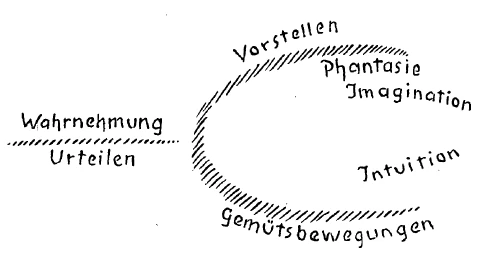
[ 19 ] Therefore, we can say: If we—with our own consciousness—can grasp something that unfolds entirely within it, not as mere knowledge but as an event, as a world event, then we are dealing with intuition, specifically with that intuition in the higher sense, as is also meant in the book *How to Attain Knowledge of the Higher Worlds*, so that within intuition we are dealing with the ruling will. While Brentano, that astute psychologist, finds only emotional movements in the ordinary phenomena of the soul and does not find the will at all, because it is not present there—for the will falls outside the scope of ordinary consciousness—it is only the consciousness ascending into the higher regions that finds within itself something that is at the same time an event. This is where the world plays into consciousness. This is intuition.
[ 20 ] Here, too, there is a kind of transition, though it is not as easy to discern as the transition from mental imagery to imagination. This transition occurs when a person learns to pay such attention to themselves that they are not merely able to will something and then follow through with the action—leaving thought and action, so to speak, gaping side by side—but when they begin to extend their emotional responses to the very nature of their actions. This is something that is, in many cases, quite troublesome; yet it does happen in life that, while acting, one can experience a kind of pleasure or disgust at one’s own actions. I do not believe that an impartial observer of life can deny that one can extend one’s emotional states to the point of allowing the characteristics of one’s own states to flow into one’s actions, so that within these emotional states one also possesses what one might call sympathy or antipathy toward an action. But this sharing in one’s own actions can also intensify within the emotions. And when it intensifies, when it appears as what it is actually meant to appear as, then we have, at the transition between the emotions and intuition, that which we can call the human conscience, that is, the stirrings of conscience [it is written as “stirring of conscience”]. Conscience is something that resides in this transition, if we look for it in its proper place. Therefore, we can say: Actually, our soul is open on two sides, toward the side of imagination and toward the side of intuition, and the soul is closed toward the side where we, as it were, are thrust through perception into external physicality. It finds fulfillment when it enters the realm of the imagination, and it also finds fulfillment—indeed, through an event—when it enters the realm of intuition.
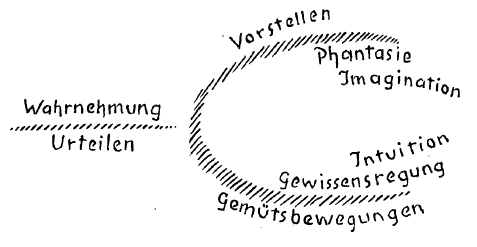
[ 21 ] Now, since intuition and imagination must coexist within a single soul, how can a kind of mediation, a kind of connection, arise between imagination and intuition within this one soul? In imagination, we first have an image, a complete image of the spiritual world. In intuition, we have an event that falls into us from the spiritual world. An event, when it confronts us in the ordinary physical world, is something that, so to speak, does not leave us in peace. When it confronts us, we seek to get to the bottom of it; then we seek that which lies behind this event as an entity. So it is also with that event which lies in the spiritual world and is meant to penetrate into our consciousness. Let us consider the matter once more more closely, as it actually is. How does intuition first enter our consciousness? We had to look for it initially on the side of emotional stirrings. There it does indeed enter our consciousness, our soul, but on the side of emotional stirrings, not on the side of imagination. This is how it is with intuition at first. For this intuition can indeed penetrate into our consciousness, into our soul, without our having the possibility of conceiving it. We have also said of imagination that a person can have it without being conscious of it; it then enters into the imagination because it acts directly within the process of conceptualization. But we had to place intuition on the other side, on the side of emotional movements. In the whole of human life, intuition generally stands on the side of emotional movements. I would like to cite once again the example I mentioned recently, which is a well-known dream.
[ 22 ] A couple had a son. He suddenly fell ill one day, and even though they tried every possible remedy, he died within a few days. The parents were deeply moved by their son’s passing, and their thoughts were entirely occupied with him—that is to say, in this case, their memories were occupied with him. They thought about him a great deal. One day, however, it turned out that during the night, both parents, father and mother, had had the same dream. They recounted it to one another. You can find this example cited by a more or less materialistically minded dream researcher who, in explaining this dream, performs the most grotesque somersaults but cannot deny the fact. For their son appeared to the parents in a dream and urged them to have the grave checked, because he had been buried alive. The parents went to every conceivable length to have an investigation conducted to determine whether their son had been buried alive, but they did not live in a country where the authorities would have permitted an investigation of a grave after such a long time.
[ 23 ] How, then—and I mention this merely to establish a basis for deriving the relationship between intuition and emotional responses—can we, so to speak, formulate some sort of explanation for the phenomenon presented by this dream? Well, you can probably assume this from the outset: Because the parents were constantly preoccupied in their memories with their son, who, after passing through the gate of death, existed in the spiritual world as a spiritual being, a kind of bridge was thereby created with the son. By directing their thoughts toward him, a connecting bridge exists with the son’s enduring individuality. But you cannot possibly assume that, once one has penetrated all the veils that lie between the living and the dead, there was only something subjective in the revelations from the dead—as there must have been, since the two people had the same dream. Or it must be a so-called coincidence—but in this way one could explain all sorts of things—if it is the case that the two had the same dream, as I have described. In reality, however, there was a connection that night between the parents and the son. He had also said something to them, or rather, he had instilled something into their minds. But since the parents had no way whatsoever of bringing into consciousness what the son had instilled in them, only the dream image—containing ideas they were accustomed to—preceded the actual event. So it was something entirely different that the son actually wanted to reveal; but the parents had to form an idea that they could draw only from the material of their own imagination. This stood before the event as a dream.
[ 24 ] Or another dream: A farmer’s wife dreams that she is going to church in town. She dreams every single stage of the journey: how she enters the church, how the preacher stands there with his hands raised to heaven and preaches with extraordinary fervor; she dreams how this fills her with enthusiasm. But then a strange change takes place: The preacher changes his form; he grows wings and feathers, and finally his voice changes; it becomes more and more like a crowing, and at last his entire form transforms into a rooster that crows. The woman wakes up—and outside, the rooster is really crowing! —This crowing, as you can imagine, brought about the entire dream. But you must also admit that this crowing could have triggered other dreams in the most varied ways. A rascal, for example, might have dreamed that he was startled by the rooster’s crow and might then have dreamed that he spent a very long time thinking about how he could open something, for example, a lock. Then another rogue, who was smarter than he, would have given him instructions, which would then have turned into a rooster’s crow. — From this you can see how what appears as a mental image before the actual experience need not have anything to do with what the soul actually experiences. What, for example, did the aforementioned couple experience? A connection, a revelation from their son, which flowed directly into their hearts. And in the other case: The farmer’s wife was a very devout woman who was completely immersed in an atmosphere permeated by piety. That is what she truly went through. And when she is then torn from her sleep, she still has the feeling that she is emerging from something; but her entire consciousness is taken up by the crowing of the rooster, which superimposes itself on her experience by imagining itself as the preacher in the church. Thus the soul experience becomes what has been dreamed.
[ 25 ] When someone acquires a certain practice of moving from dreams to the corresponding realities, it also becomes apparent that, before reaching the inner reality, they must pass through a state of mind characterized by elation or sorrow—in short, some form of emotional tension or release. The ideas regarding what is experienced in the spiritual world usually dissolve into a kind of nothingness; one must form entirely different ideas of what is actually happening. Or, in other words: Spiritual events are closer to emotional stirrings than to the imagination, for ideas are not decisive for soul-spiritual events. There, in the spiritual world, are the events that extend into the emotional stirrings throughout the entire night; but through his imagination, man cannot reach these events to characterize this experience.
[ 26 ] This allows us to point out that intuition, too, is connected in a certain way to emotional responses. This is also why mystics, before they arrive at any clearly defined conceptions of the higher worlds, experience a kind of general, vague emotional sensation of these higher worlds, and many are satisfied with this, many even with even less. But those who truly immerse themselves in the higher worlds with their minds all describe in the same way the states of spiritual devotion they undergo there—in short, a series of emotional states arising from what can be called the direct experience of the spiritual world.
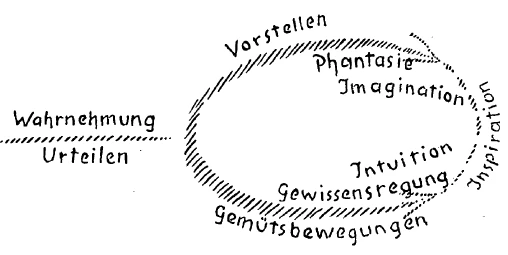
[ 27 ] If we were to proceed based on this intuition that arises within the mind, we would not make much progress; rather, we must actually start from the other side. In order not to indulge so generally in the stirrings of the soul, but to arrive at a concrete perception of the spiritual world, we must already try to develop imaginations and then turn our attention to them in relation to the spiritual world. Then a connection gradually arises in our lives between the intuition—which is still not understood, but rather felt—and the imagination, which still hovers more or less in unreality and consists only of images. And what this connection is, is ultimately revealed to us as we approach the thought: We have now come to the beings who carry out the spiritual events. We call this approach to the beings “inspiration” [the word “inspiration” is written here]. So here we have, in a sense, the reverse of the processes we experience in relation to the outer physical world. In the latter, we have, so to speak, the thoughts we form about things. There, the things are already given to us, and we form thoughts about them. Here, however, the event—the thing that first appears in intuition as a stirring of the soul—is entirely indeterminate, and imagination as such would be something hanging in the air. Only when the two come together, when imagination works its way into intuition through inspiration, when, in other words, our imagination leads us up to imagination, and when we feel imagination as coming from beings, then does the essence of these beings also flow into us as an event. Something is brought in through imagination that flows in from intuition, and with this event we perceive a content that can be compared to the content of our imagination. We then perceive these thoughts, for the perception of which we have prepared ourselves, through imagination within the event that is given to us in intuition.
[ 28 ] Today I have described to you how human beings, as it were, grow upward into the spiritual world on the other side of their soul life. I have, however, anticipated some of what only spiritual science itself can provide through spiritual research; but I had to do so in order that we may more easily understand one another in tomorrow’s lecture regarding what will now be our main focus: a description of the nature and characteristics of the spiritual world itself.