

Wonders of the World,
Trials of the Soul,
and Revelations of the Spirit
GA 129
19 August 1909, Munich
Translated by Steiner Online Library
Second Lecture
[ 1 ] Yesterday I attempted to give an idea of how people in ancient Greece thought about the connection between the human soul and the development of our Earth, and two points of view were particularly emphasized. It was emphasized that in the Greek consciousness there was a sense that in ancient times the human soul was endowed with clairvoyant abilities. As I said, Persephone, the daughter of Demeter, was regarded as the ruler of those forces that flowed from the cosmos into the human soul; in contrast, everything that can be called the intellectual culture of humanity found expression in that current associated with the names of Odysseus, Menelaus, and Agamemnon. The feeling was aroused that for this culture, a continual sacrifice is necessary, so that the finest feelings, the finest sensibilities that the human soul can develop when influenced by intellectual culture, are, so to speak, sacrificed to a certain religious priesthood. This idea is represented to us in the sacrifice of Iphigenia. From such a perspective, we can gain a sense of how, in ancient Greece, the tradition was still very much alive and, in part, the direct knowledge of what we are now striving for through our spiritual science. We point out that in ancient times the human soul possessed clairvoyant powers. In *The Secret Science*, you can read how, in ancient Atlantis, human souls looked into the spiritual world and the world forces truly appeared to them in the form of beings, so that in those days one spoke not merely of abstract forces, but of substantial beings. And a consciousness of such substantiality has indeed been preserved in a figure such as Persephone. Slowly, through spiritual science, we are once again striving to recognize, from our modern perspectives, the same living essence in the spiritual world that was well known to people in ancient times and that was enshrined in ancient Greek mythology and in the depiction of divine beings. And the deeper one engages with something such as, for example, the Greek pantheon, the greater the reverence and admiration one feels for the profound wisdom of the world hidden within this pantheon. To give you, so to speak, an idea of how profoundly wise this entire Greek pantheon can appear to us in its context, I would like to draw your attention to just one thing. I mentioned yesterday that Greek mythology points to two currents: the current that, as intellectual culture, connects to Menelaus, Agamemnon, and Odysseus, and which is so beautifully represented in the sacrifice of Iphigenia; and I have shown how the other current is linked to the names of Persephone and Demeter, the mother of Persephone. Now, anyone who reflects on the world must of course say to themselves: Such currents do not run independently of one another; although they appear to us as separate currents, they must have an inner connection; they must touch one another somewhere. — How does Greek mythology express this profound wisdom regarding the intersection of the Demeter current and the Agamemnon current?
[ 2 ] Well, in light of modern science, we can say little more about such a connection today than we can about any abstract ideas. Greek mythology, however, expresses it this way: it traces the lineage of Agamemnon back to a representative of human spiritual powers, whom we might call Tantalus. We know that, according to Greek legend, this Tantalus wickedly offered his own son as food to the gods. We know that the gods recognized this as well, that only one of the goddesses partook of a shoulder blade, and that goddess was Demeter. Thus, through this remarkable symbolic act of Demeter’s partaking of the shoulder blade of Tantalus’s son, these two currents are indicated. These two currents are related to one another. And Demeteric forces flow into the whole of modern culture, which ties in with the names Agamemnon, Menelaus, and Odysseus. Thus, for every motif in Greek mythology there is an equivalent in what we are rediscovering as modern spiritual wisdom, and it is not unnecessary to point out such profound and significant motifs from time to time, for in them one recognizes how the way in which human beings view the wonders of nature changes over the course of time.
[ 3 ] Our natural sciences take pride in their interpretation of nature. Oh, how little reason it has to be proud, considering that while the Greeks expressed the profound power of nature as the ruler of natural wonders in the forms of their gods, they revealed in these forms a much deeper wisdom of nature than any science today even suspects, and which will only be sensed again when spiritual science is allowed to penetrate our culture. Thus, there are also significant insights for our own knowledge—as we have acquired it over the years—when we, so to speak, compare it with the profound Greek theology of the gods.
[ 4 ] One aspect of the Eleusinian Mysteries points to a significant natural wonder. What, then, is the fundamental event at the heart of the Eleusinian Mysteries? Persephone, the embodiment of the ancient clairvoyant powers of the human soul, is abducted by Pluto, the god of the underworld. And the entire marvelous drama, as it stands before us in the Pluto scene of the new production of the Eleusinian Mysteries, will surely still be vivid in your minds, especially because our dear Mr. Jürgas, who has devoted himself to our enterprise for several years now, has portrayed this Pluto for you in such an excellent manner. What does it mean, then, when we apply what Greek mythology and the Eleusinian Mystery express to the nature of the human being itself? What, then, has happened—in the sense of our spiritual science—to the ancient clairvoyant capacity of the human soul? Yes, we can say that this abduction of Persephone has been taking place from the earliest times right up to our own; the ancient clairvoyant culture has disappeared. But in truth, nothing in the world disappears; in truth, things merely transform.
[ 5 ] Where, then, has Persephone gone? What does she do today in human nature as the ruler of the ancient clairvoyant powers? You will be able to gather from the opening remarks of a book that will be available here in a few days—and which essentially reproduces my recent lectures in Copenhagen—that the entire scope of the human soul is far greater than what the human soul knows through its intellect, through its reason. There is something that could be called a further, more extensive soul life, a subconscious soul life that works within us, but which, for the majority of people today, simply does not rise into consciousness. It is better to call it a subconscious rather than an unconscious soul life. In this subconscious soul life—in that which works within the human being today without their conscious mind providing a rational, intellectual account of it—there is Persephone; there the ancient clairvoyant powers have descended. Whereas in ancient times they worked in the human soul in such a way that this soul could look into spiritual worlds clairvoyantly, today these forces work in the depths of the human soul, in the depths of the soul; they contribute to the development and formation of our ego, making this ego ever stronger and stronger. So while in ancient times they devoted themselves to the task of giving human beings clairvoyant powers, today they devote themselves to the strengthening, the consolidation of our ego; these Persephone forces have thus truly descended into a human soul underworld; they are entwined with what lies in the depths of the human soul; in a certain sense, they have been stolen from the depths of the human soul. And so, in the course of humanity’s historical development, this abduction of Persephone has taken place through those forces of the human soul that lie deep in its underworld and are represented externally in nature by Pluto. In the Greek pantheon, this Pluto rules the underworld of the Earth. But the Greeks were aware that the same forces that work in the depths of the Earth also work in the depths of the human soul. Just as Persephone is abducted by Pluto, so, in the course of human evolution, the ancient clairvoyant faculty was abducted by the Pluto within our own souls. Now Persephone is the daughter of Demeter, and this leads us to the insight that in Demeter we must see an even older ruler of both the outer forces of nature and the forces of the human soul. I already pointed out yesterday that Demeter is a figure in Greek mythology who points us toward that clairvoyant vision of ancient Atlantis—for that is where she is truly to be found—which belongs to the oldest treasure of wisdom of Atlantean humanity. When the Atlantean looked into the spiritual world, he saw this Demeter; she truly appeared to him. And what did the Atlantean say to himself when, out of the swirling, taking shape, forming spiritual world, this primal mother of the human soul and the fruitful forces of nature appeared to him? Not with consciousness, but as it were in the unconscious, he said to himself: I have done nothing to achieve this, nor have I undergone any inner development—as later times will do—in order to look into the spiritual world. The same natural forces that give me my eyes, my brain, my organism, and that work within me, also give me the power of clairvoyance. Just as I breathe, so do I possess clairvoyance. — And just as human beings do not develop their breathing through special training, so too did they not develop their clairvoyant powers back then; rather, they were given to them by the forces of nature, by divine beings. Human beings were aware, when they let their eyes roam out into the world, into the sphere of existence, and saw the spiritual alongside the physical: I take into myself the substances of the environment from the plant kingdom, which was different back then; I take in everything that grows out there; but in doing so, I also take in the forces that are at work out there. Oh, the human being of that time was not so limited as to believe that what he took in as his nourishment, so to speak, were merely external substances, merely things to be examined by chemistry; rather, he knew that he was taking in the inner configuration of the forces at work in all those substances, and that within these forces lay what constituted him, what in turn built up his body. So such a person would say to themselves: Out there in nature, forces are at work; they enter into me through food, through breathing. What they are out there is governed by the great Demeter. — But the great Demeter sends the forces into the human soul. There they are processed—to put it crudely—through a spiritual digestion, and are transformed into the clairvoyant faculty. In the human being, in the human organism, the clairvoyant faculty—represented by Persephone—is born through the forces that Demeter, as the goddess of fruitfulness, works in the entire environment. Thus did the human being feel placed within the wonders of nature; he felt the clairvoyant faculty being born within him as the birth of Persephone, and felt that he owed this birth to Demeter, who develops the very same forces out there in the vast cosmos that then unfold within the human being as the clairvoyant power.
[ 6 ] Thus the ancient human looked up to the great Demeter, and thus in ancient Greece there was still an awareness of looking up to this great Demeter. But you have already seen from this that the human organism, the entire physical constitution, has changed since those ancient times. Our present-day body, as it is organized in its muscles and bones, is essentially denser, more consolidated within itself, than was the body of those people who could still give birth to Persephone within themselves, who still possessed the ancient clairvoyant powers. And because this body, because our constitution has become denser, it can also, so to speak, hold fast to the clairvoyant powers in the subterranean depths of the soul. The imprisonment of the clairvoyant powers within human nature stems from the densification of the human body. And as one still senses in ancient Greece that the old, let us say symbolically, soft human body is becoming denser within itself, it absorbs the forces active within the Earth, whereas earlier it was more dominated by the forces that occupied the air sphere and thereby made it softer. And what acts in the underworld of the Earth, what is ruled by Pluto, becomes ever more and more effective upon the human body, so that we can say: Within the human being, Pluto became ever more effective, densified the human body, and thereby stole Persephone. — This densification of the human constitution extended into the physical body, for even in the earliest post-Atlantean times, the human constitution looked quite different from what it does today. Only a short-sighted view can believe that human beings have always been constituted as they are today. I have mentioned this on several occasions.
[ 7 ] Thus, among the wonders of nature, we truly see the abduction of Persephone and the relationship between humanity and Demeter expressed. Here, too, we see the prevailing awareness in Greek mythology that humanity is a microcosm, an expression of the macrocosm, the greater world. Just as Demeter works outwardly through the mighty forces of all that bears fruit from the earth, so does that which comes from Demeter work inwardly. Just as the forces that the Greeks had Pluto represent are at work within the earth and not on the surface, so does Pluto work within the human organism itself. One must be able to turn one’s gaze away quite significantly from what is customary today, from what is part of our present-day habits and customs, if one wishes to understand the very different way of thinking even of the ancient Greeks. You see, modern man—this is, of course, not a criticism of present-day customs, but an indication of how things simply are —looks, when he wants laws, to his governments, to his parliaments. That is where his laws come from, and he would probably consider himself a fool today if he were to develop the view that cosmic forces pass through the minds of those people who work in parliaments, that divine forces are also at work there. We do not wish to dwell further on this question; it would sound grotesque to people today. It was not so in those times that preceded the historical, that is, the times described by history, nor even in ancient Greece. In those primeval times there was a conception—so wondrous, so grandiose at the same time, that people today can hardly regard it as true anymore.
[ 8 ] Take everything I have told you about the development of the Greek gods; there we find an indication of how Demeter worked in ancient times, how she sent her powers—which were active in the plants—into human nature and caused her child to be born within human nature. That is what she did in ancient times. In a similar way, other gods worked in ancient times. They worked in conjunction with the forces of nature and natural wonders. How did they work? Well, the human being ate, breathed, and knew: It is the great Demeter who gives the forces into the air and into the plants, which he takes in. It is Demeter who gives him his clairvoyant consciousness, but who also gives him the insight through which he knows how to conduct himself in the world. There were no laws in the later sense back then; there were no externally expressed commandments, but because human beings were clairvoyant, it also dawned on them clairvoyantly what they had to do, what is right, what is good. Thus, in the most ancient times, he saw in Demeter, who provided him with his food, also the power of the world, the power of nature, which, as the food entered him, transformed his forces in such a way that it gave him his customs, his rules of conduct. And the ancient human being said to himself: I look up to the great Demeter. When I accomplish this or that in the world, I accomplish it because the forces that exist out there in the plant world are sent into my brain. - She was a self-evident lawgiver, not one who shone into consciousness but who drove the soul—the Demeter of ancient times. And so it was with other gods as well. By nourishing humanity, allowing it to breathe, and stimulating the impulses to walk and stand, they simultaneously gave humanity the impulses for morality and all outward behavior. By assuming those forms of which we have spoken in connection with later times—that is, by seeing the loss of her child Persephone in human nature, the abduction by denser physicality, so that now these clairvoyant powers are used only for the coarse nourishment of the physical body—by withdrawing, so to speak, from that direct moral law-giving of ancient times, what did Demeter do? She instituted a mystery and, from there, provided in the new legislation a substitute for the old legislation that operated through the forces of nature. Thus the gods withdrew from the forces of nature and entered into the mysteries, and gave moral instructions to human beings who no longer possessed morality through a nature working within them.
[ 9 ] This was the thinking of ancient Greece: In ancient times, the gods bestowed morality upon humanity alongside the forces of nature. Later, the forces of nature receded somewhat. In their place, the gods later imparted moral laws in a more abstract form through their messengers in the mysteries. - As humans became estranged from nature, they needed a more abstract, intellectual morality; therefore, the ancient Greeks looked to their mysteries, from which they received instructions for their moral lives, and they saw in these mysteries the active presence of the gods in their moral instructions, just as they had previously seen it in the forces of nature. That is why the earliest periods of Greek civilization attributed the moral laws to the very same gods who had also been the foundation of the forces of nature in the earliest times. And when the Greeks wished to point to the origin of their oldest laws, they did not point to a parliament, but to the gods who had descended to humanity and, in the mysteries, had given humanity the laws that live on in human morality.
[ 10 ] But what happened to that original Demeter force itself when the human body became denser and changed? Well, if I may use a rough comparison: You all know that you cannot do the same thing with ice as you can with water, because ice is a different form of water. In the same way, you cannot do the same thing with the denser human body that you were once able to do with the finer body through the forces of nature. Through this, Demeter was able to instill in the human body the spiritual powers that lay within the natural elements, thereby developing clairvoyant powers. What happened to the Demeter forces as a result of the human body becoming denser—or, to speak in the mythological sense of the Greeks, as a result of Persephone being abducted by Pluto? These Demeter forces also had to withdraw from the human bodily organization, had to become less effective; humanity had to be removed, so to speak, from the direct influence of Demeter; it was subjected to other forces, forces to which I also referred yesterday. What makes the denser human body, so to speak, fresh and healthy? Just as Demeter made the ancient human body fresh and healthy in primeval times, so Eros makes the new body fresh and healthy—that is, that which is represented by Eros in the forces of nature. And if Eros had not acted upon it, but if Demeter had continued to act, this human body would be withered and wrinkled throughout its entire life. The forces of Demeter do not reside in the fresh, chubby-cheeked, and rosy-cheeked human bodies of today, but rather reside in the human body when it expels the forces of Eros from within itself. It does this as it grows older, as it becomes withered and wrinkled. Consider that this profound aspect is present in the Eleusinian Mystery. After the abduction of Persephone, Demeter appears to you stripped of her original powers; she is transformed by Hecate, transformed in such a way that she now bears the forces that cause withering. And with the abduction of Persephone, we indeed see the withdrawal of Demeter from the immediate human physical constitution unfolding even in the historical development of humanity. Oh, these ancient wonders of nature—they express themselves in the ancient divine figures in a magnificent way. When, with the aging of the human being, Eros withdraws from him, then the influence of Demeter upon the human physical constitution begins anew. Then Demeter can, in a certain sense, enter once more into the human physical constitution; then that which represents fruitful chastity comes to the fore in contrast to the Eros constitution. And we are pointed toward a profound mystery, a truly immense mystery in the development of the human being, when we trace human aging—the transformation of the Eros forces into the Demeter forces—in this sense. Such profound things were enshrined in the Eleusinian drama. So profound is this Eleusinian drama that someone with today’s ordinary, superficial education would certainly regard everything I have just said as fantasy. But it is not what has just been said that is fantasy, but rather what materialistic culture says about these things: that is the true fantasy, the true superstition.
[ 11 ] What, then, has actually changed in human nature over the course of time, from ancient Atlantis down to the present day? That which envelops the actual essence of the human being has changed. It is enveloped in the three physical bodies—the physical body, the etheric body, and the astral body—so that our innermost I-essence is contained within these three physical bodies. These three physical bodies have all changed in the course of development from the ancient Atlantean era to the present day. And we now ask: What, then, is the driving factor that has been at work here, that has transformed these physical bodies? — We must seek this driving, this impelling factor—that which has caused the bodies to change—primarily in the human etheric body. The human etheric body is the active, the truly effective force. It has made the physical body denser and has also transformed the astral body. For these three bodies do not lie side by side externally like, say, fruit peels or onion skins, but their forces interpenetrate one another and are in living interaction. And the most important active sheath in this transformation, in this historical development of the human being, is the etheric body. Let us once symbolically, schematically, depict the three bodies of the human being. I will simply draw the physical, the etheric, and the astral bodies as three layers lying one beneath the other.
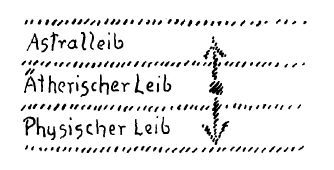
[ 12 ] We must now look for the actual forces at work here—above all, the forces of Eros and Demeter—in the etheric body. They are sent upward from the etheric body into the astral body and downward into the physical body, so that the etheric body influences both the astral body and the physical body. At this time, the etheric body primarily makes the physical body denser and more consolidated within itself; it reshapes the astral body so that it no longer develops clairvoyant powers, but only the intellectual powers of human nature. Because the human being was transformed in this way—receiving a transformation of all three bodies from his etheric body—the most important and essential aspects of these three bodies were altered over the course of time. These three bodies were completely transformed. An Atlantean body—and even a post-Atlantean body from the earliest periods—was different from a body today. All circumstances and living conditions were different. All of that has been transformed.
[ 13 ] If we first consider the physical body in its living development from the earliest times to the present day, we must say: Because the physical body has become denser, it has become more subject to the external influences of the physical environment. While the old, soft physical body was more subject to the spiritual conditions of existence in ancient times, in more recent times it has, due to its density, become subject to the external physical conditions of the physical plane. As a result, certain characteristics of this physical body—which did not exist in this form at all in the past—have been heightened; specifically, what are called the conditions of illness have changed in the physical body. What is called illness and what is called health in the human physical body was subject to entirely different causes in ancient times. Back then, everything that constitutes human health was in direct connection with the spiritual conditions of the spiritual world. Today, the human physical body is connected to external physical conditions and circumstances and is therefore dependent on them. And today we must look for the conditions of health more in the external physical conditions. Thus, through the fact that Pluto—speaking in the sense of Greek mythology—abducted Persephone and brought her down into the underworld of human nature, human beings have been subjected to external conditions regarding matters of illness and health. This is one aspect of what has transpired within the organization of humanity.
[ 14 ] The second refers to the human etheric body itself. Although the forces of transformation lie within it, it has also undergone a transformation itself. In ancient times, this etheric body was organized in such a way that human beings did not perceive the world in the same way they do today; rather, when they looked into the spiritual world through the ancient Persephone clairvoyance, they saw images of the spiritual beings themselves in that spiritual world. Human beings saw a world of images around them. Although these images are brought about by the forces of the astral body, the astral body could not see them if it were left to its own devices. The astral body does not perceive images when it is left to its own devices. Just as a person does not see himself when he walks forward unimpeded by a mirror, so too would the astral body not perceive the images it generates unless the activity of the astral body in human nature were, as it were, reflected back by the etheric body. Thus the etheric body brings the images evoked by the astral body into view, into perception. What a person perceives of what is taking place in their own astral body is what their etheric body reflects back to them. If we did not have this reflection of all our inner astral processes through the etheric body, then everything that the astral body brings about would indeed be within us, but the person would not be able to see it or perceive it. Therefore, the entire worldview that a person can form, the entire content of their consciousness, is a reflection from the etheric body. And it depends on the etheric body whether a person knows anything at all about the world. This depended on the etheric body in the ancient clairvoyant era, and even today all knowledge of the world depends on the reflection of astral activity in the human etheric body.
[ 15 ] What, then, lies in the powers of this etheric body? In the powers of this etheric body lies the fact that through them we possess the key to understanding the world. Otherwise, everything that the world brings about in our astral body would not open the door to understanding the world. The key to understanding the world lies in the etheric body. And everything of which we can speak in the manner described in certain key passages of the two Rosicrucian dramas also lies within our etheric body. There is spoken of the labyrinths of thought, of the threads that our understanding of the world must weave. After all, we do not come to know the world by simply looking at it, but either by moving from image to image, as in the old clairvoyance, or by moving from thought to thought in the newer intellectual culture, just as through the labyrinth of thoughts. This connection, too, is brought about by the forces of the etheric body. Thus, what we might call the key and the threads that spread out between the individual structures of our consciousness as we attain knowledge of the world has changed. In this way, we see what builds upon the forces of the etheric body and what must change in these forces of the etheric body.
[ 16 ] Let us consider the third, the astral body itself. The astral body is, as I said, the element within us into which the world acts and in which the forces and abilities are formed that are then reflected through the etheric body. In the astral body, insight is kindled; it is brought to consciousness through the etheric body. A thought or an image is kindled in the astral body; they are within us because we have an astral body. We become aware of this image, this thought, because we have an etheric body. They would be within us even if we had no etheric body, but we would know nothing of them. The torch of knowledge is kindled in the astral body; reflected as the human being’s conscious knowledge, this torch of knowledge becomes the human etheric body. Thus we can say: In the human astral body the torch of knowledge is kindled, and this torch of knowledge in turn changes in the course of humanity’s historical development, so that in ancient times human beings had clairvoyant, pictorial knowledge, and today they have intellectual, rational knowledge. Thus the powers of the astral body have changed.
[ 17 ] So as humanity underwent this historical development, forces within human nature were at work that altered the entire relationship between Demeter and humankind. Demeter was, so to speak, driven out of the old, frail human body and out of the old astral body, which had been developing clairvoyant abilities. Eros came into play. In its place, the forces of human nature that are—as I have shown you today—of a different kind and free from Eros became more subject to Demeter. Thus, a force of becoming acted upon human nature in three ways during this period from the ancient Atlantean era to the present day; a threefold nature of becoming, of transformation, of reshaping, a threefold kind of metamorphosis, proceeding from the etheric body to the physical body, to the etheric body itself, and to the astral body. This force of becoming and transformation was present in human nature and is within us. It transforms us from youth to old age by converting the forces of Eros into the forces of Demeter. It is this threefold becoming within our constitution that brings about the different conditions of illness and health in the physical body, that gives rise to the different reflection of knowledge in the etheric body, and that transforms the torch of knowledge in the astral body.
[ 18 ] How wonderful it is that the ancient Greek pantheon shines upon us with the representative of these formative forces of human nature, which are at work within us all, which transform our astral body, and which therefore also transform the nature of Demeter—those forces that are within the human etheric body and act upon the physical body, upon themselves, and upon the astral body. They are represented in the triple Hecate. So what we express today by saying that transforming forces of a threefold nature emanate from the etheric body, the Greeks expressed by speaking of the triple Hecate. A natural wonder of the human organism in its becoming is expressed in this triple Hecate. We gaze into it with immense wisdom. And you can still see this image of the triple Hecate in Rome today. This threefold Hecate is depicted as follows: one aspect of Hecate, which relates to conditions of illness and health, is represented by the symbols of the dagger and the snake—the latter of which is also associated with Aesculapius as the representative of the science of health. The dagger represents the external influences, the external destructive influences on the human organism. By assigning the dagger and the snake to the triple Hecate in one of her forms, it was indicated that one was referring to those forces that influenced the physical body in relation to its becoming. The second image of Hecate was then meant to indicate that the key to knowledge of the world has changed within the etheric body. And what symbol does the second image of the triple Hecate bear? The key and a bundle of ropes as a symbol of the labyrinth of thought. And the third Hecate holds the torch as the torch of knowledge, as it forms within the astral body. And now we sense the immense form of materialistic superstition with which we stand today, in our materialistic age, before this profound figure of ancient times, and how these things will come to life when humanity once again knows what is actually meant by such magnificent, profound symbolism as that of the triple Hecate. Ancient Greece will rise anew in its thoughts when the human soul, imbued with spiritual science, stands before such a work of art, and all the knowledge of the spiritual nature of the human being—which is enshrined in such a figure—will well up within that human soul. These things need not be taken in an abstract sense. Of course, we can only express them by, so to speak, clothing them in abstract thoughts. But all of this can become a living sensation and a living feeling for us if we imbue ourselves with the awareness that Hecate, too, has merely changed the manner of her activity, but that she is also within us today and works in each and every one of us.
[ 19 ] The ancient Greeks said: Not only all of humanity in its development, but also the individual human being is subject to the forces of Hecate as his physical form is transformed, as he is reshaped in his physical, etheric, and astral bodies. Hecate works within him in threefold ways. — But what was once conveyed to the human soul through the image of Hecate can also be conveyed again today. How does the modern adherent of spiritual science, who no longer speaks in such pictorial terms, express himself? He says: In the course of the individual human development from birth to maturity, the three members of the human physical body are transformed: the physical body in the first seven years, the etheric body in the second seven years, and the astral body in the third seven years. - The forces you will find described—without the need for this image—in my short treatise on “The Education of the Child,” the forces that act in the human organism in threefold ways, are the Hecate forces. And when spiritual science describes to you today that, up until the change of teeth, the human being primarily develops his physical body, it points out that one form of Hecate is at work within him. There, in a modern form, is stated what the Greek meant when he depicted one part of Hecate with a dagger and a snake. And with a key and a bundle of ropes, the second part of the transformation is depicted, where the etheric body acts from within itself during the second seven years. And the third seven years are depicted as taking place entirely within the astral body itself, with the symbol of the torch. So, in essence, I have long since told you in a modern form what the Hecate wisdom of the ancient Greeks was, what was expressed in the image of Hecate in the ancient mysteries of the Greeks.
[ 20 ] But this is also the meaning of the development of European culture. If we look back to the ancient times of Greek civilization, we encounter in the traditions of Greek mysticism and Greek mythology the powerful images that were presented to students in order to awaken in the soul the insight that was necessary for people at that time. The image of the threefold Hecate awakened—not in its present form—the knowledge we take in when we consider the teaching of the threefold transformation from birth to about the age of twenty. And when we consider such teachings, we faithfully follow the course that human culture must take. The old clairvoyant form had to sink into the realm of Pluto within the human soul, and for a time, from the old Socratic era right up to the present day, an epoch of ignorance had to prevail, so to speak, with regard to all these conditions. Human beings had to consolidate their “I,” to develop their ego. There, beneath the surface of the human soul, remained the ancient knowledge of the Greeks, inspired by those magnificent images. There it lay, as it were, buried beneath the rubble of intellectual culture. Now it is emerging once more from a dark depth of the spirit. In spiritual science, that which had sunk into the deeper recesses of the human soul is rising again from modern life. Today we are once again beginning to recognize the triple Hecate in a more abstract form, in the manner I described in *The Education of the Child*. Through this, however, the human soul is once again being prepared for a future clairvoyance that lies in prospect for us, despite intellectualism. And the preparation for this future clairvoyance of humanity—that is our spiritual science. Oh, that triple Hecate of whom the Greeks spoke, that Demeter and Persephone and all the other figures, who were not, back then, mere abstractions as the superstitious scholars of today imagine, but living figures of Greek seership, all these figures will appear again before the clairvoyant gaze that will descend more and more from the spiritual worlds for humanity in the future. And the power that penetrates human souls to lead them upward again—or I might also say, to bring down to them the clairvoyant powers—is the one that was first prepared for human knowledge as a conscious thought in the ancient Yahweh culture and then attained its full form through the appearance of the Christ Being, who will be recognized by humanity more and more. And while it is said within our true spiritual science that already in this 20th century that clairvoyant looking upward of human beings toward the Christ—who has been united with the Earth since the Mystery of Golgotha—begins, it is said at the same time that this event of the returning Christ will, of course, not occur in a physical body, but for the etheric beholding, as with Paul on the road to Damascus. In this Christ-force are contained all the impulses of human nature, to lift it up once more and at the same time allow it to behold all that has, for example, also descended from Greek deities into the subconscious depths of the soul.
[ 21 ] This will be the greatest event in the future development of the human soul—the event for which spiritual science must prepare, so that human souls may become capable of attaining that etheric vision. And over the next three thousand years, this will increasingly take hold of human souls, and the next three thousand years will essentially be devoted to the awakening of the powers of the human soul, which will be able to perceive the etheric wonders of nature all around it. In our century, it will begin that individuals will behold the returning Christ from within their etheric soul, and there will be more and more people doing so over the next three millennia. And then what the true Eastern tradition holds—which is in harmony with all true occultism—will be fulfilled: that at the end of these three thousand years, the Maitreya Buddha, descending to humanity, will speak to the human soul in a form equally comprehensible to it, and will then impart this Christ-nature to humankind. This is what Eastern mysticism preserves: that some three thousand years after our time, the Maitreya Buddha will appear. What Western culture has to contribute is that this World Individuality—as you find it emphasized once again in the Mystery Play “The Trial of the Soul”—has appeared only once in a physical body, and that it will become ever more visible to the etheric gaze of human beings. Through this, it will become something familiar to the human soul. And with words as captivating as those spoken by the Buddha two millennia ago about what was then natural to the finest human souls of his time, the Maitreya Buddha will be able to proclaim everywhere what is not yet possible to speak of publicly today, but which will take place in the etheric vision of the Christ. This is the greatest event of the 20th century: this ascent of human nature to what we might call the re-enactment of the Paul event. Back then, it came only through the individual, through Paul, in the vision on the road to Damascus. In the future, it will come gradually to all of humanity, beginning in our century.
[ 22 ] Anyone who believes in the progress of human nature, who believes that the human soul will develop ever higher and higher powers, knows that it was necessary for the human soul—which had descended into the deepest depths of the physical plane—that Christ should also appear once in a physical body. This was necessary because, at that time, the human soul could only perceive the Godhead in a body that was visible to physical eyes and physical organs. But because this event occurred—because the ancient ‘Yahweh culture’ prepared the way for it and it then took place— the human soul is led to ever higher capacities, and the elevation of these capacities is expressed in the fact that people will now learn to behold the Christ even when he no longer walks among them in a physical body, but when he reveals himself as he has been among us since the Mystery of Golgotha—though visible only to clairvoyant eyes. Christ is here, united with the etheric body of the Earth. What matters is that the human soul develops itself to the point of being able to see him. In this lies the great progress of the development of the human soul, and whoever believes in the progress of the human soul, whoever believes that spiritual science has a purpose and a mission regarding the progress of the human soul, will understand that the powers of the human soul must become ever higher, and that it would mean stagnation if the human soul in our time were to see the Christ in the same physical form in which it once saw him. Whoever, therefore, believes in progress and in the purpose and mission of spiritual science knows this: there lies a profound significance in this ancient Rosicrucian formula concerning the Being of the Son of God, who incarnated in a physical body only once, and who—beginning with our own century, according to the prophecies and our insights—will once again become increasingly visible to human souls as an ethereal being. Whoever believes in the progress of human development believes in this return of the Christ, who will then become visible to the etheric faculties of human beings. Whoever does not wish to believe in this progress may believe that the powers of the human soul remain static and still require, even in our time, to see Christ in the same form as when humanity had descended into the deepest depths of matter; let such a person believe in the return of a Christ in a physical body.